Characteristics of a Fuzzy Project Network using
Statistical Data
B. Pardha Saradhi
Dr. L.B .college, Visakhapatnam, India
N. Ravi Shankar
GITAM University, Visakhapatnam, India
ABSTRACT
In the present paper, Characteristics of fuzzy project network using statistical data are discussed in detail in order to calculate the fuzzy critical path, fuzzy earliest times, fuzzy latest times and fuzzy total float. Fuzzy number as fuzzy activity time is constructed using interval estimate by calculating mean, variance and standard error. A new ranking function is used to discriminate the fuzzy numbers used as activity times in the fuzzy project network and used it in distance measure. The appropriateness and contribution of characteristics of fuzzy project network to ship building is discussed and calculated as an application to real life problem using statistical parameters.
Keywords
Critical path, project network, fuzzy numbers, metric distance
1.
INTRODUCTION
A project can be exemplified by a directed acyclic graph (project network) where the nodes stand for activities and the arcs for precedence relations when resource limitations are taken into consideration. Critical Path Method (CPM) provides the characteristics of project network, marginal project duration and identifies the critical path(s) when the activity times in a project are deterministic. Moreover, there are number of cases where the activities are not deterministic, but random assessments, Program Evaluation and Review Technique (PERT) that is built on the theory of probability can be used. Nonetheless, in real world applications, some activity times ought to be predicted subjectively such as utilizing human judgement, the wisdom of the decision maker, professional knowledge, experience, that should be replacing stochastic assumptions to determine activity times. A substitute method to deal with vague data is to put into use the concept of fuzziness, whereby the inexact activity times can be signified by fuzzy sets.
A fuzzy project network (FPN) was developed by [1] to forecast the activity durations and applied fuzzy algebraic operations in order to calculate the characteristics and critical path with project completion time. In [2], the composite and comparison methods of analyzing fuzzy numbers in
a proficient scheme for solving problems pertaining to project scheduling in a FPN are discussed. The fuzzy Delphi method [3] is used to establish the fuzzy activity time estimates in an FPN.In an FPN, [4] expounded a fuzzy project scheduling decision support system and it is used to earmark resources amid dependent activities in a software project scheduling environment. In [5] , a resource-held back project scheduling method that deals with three performance objectives; (1) expected project completion time; (2) utilization of resources; and (3) interruption of resources is introduced. Chen et al. [6] assimilated time-window constraint and time schedule constraint into the traditional activity FPN and also worked
out a linear time algorithm for finding the critical path in an activity network with the time-constraints. In [7] proposed a procedure for ranking fuzzy numbers without the prerequisite for any postulations and used positive as well as negative values to define ordering which, then is applied, to fuzzy critical path method. They then did away with the fuzziness by putting into use the signed distance ranking for those fuzzy numbers to co-construct the activity network in the fuzzy sense, after which the fuzzy critical path can be acquired without difficulty. In [8] , the notion of criticality in the network with fuzzy activity times is introduced and two procedures of calculation of the path degree criticality are discussed. In [9] depicted a new line of method to a fuzzy critical path method for activity network created on statistical buoyancy interval estimates and a ranking method for level (1-α) fuzzy numbers. His focus was to introduce an approach that combined fuzzy set theory with statistics that incorporates the signed distance ranking of level (1-α) fuzzy numbers derived from (1-α)*100%. In [10], brought forward a new methodology to fuzzy critical path method that is based on statistical confidence interval estimates. An effort to combine statistics and fuzzy mathematics incorporating the signed distance ranking level (1-α) of fuzzy numbers was also focused. In [11] initiated a fuzzy critical path method constructed on statistical confidence-interval estimates and a signed distance ranking for (1-α)fuzzy number levels. In [12] encompassed some results for interval numbers to the fuzzy case for determining the possibility distributions depicting state of the art starting times for activities. In [13] expounded a way of modeling the well-defined collaboration process built on workflow technology, probability theory and
fuzzy set theory. In [14] handed out an uncomplicated
approach to solve the critical path method problem with fuzzy activity times which are fuzzy numbers on the foundation of
the linear programming formulation and the fuzzy number
ranking method that are more pragmatic than crisp ones. In [15], the algorithms for calculating the interval value of the state-of-the-art starting times and maximal floats of activities in the network with interval activity and time lag durations are familiarized. In [16], a fuzzy approach constructed on statistical confidence interval estimates and a distance ranking method for (1-α) fuzzy number levels is discussed.
In Section 2, of the paper some definitions on fuzziness, arithmetic operations between the fuzzy numbers are dealt with the definition of metric distance and signed distance
ranking system for fuzzy numbers are reviewed. Existing
Methods for characteristics of fuzzy project network(FPN) using distance measure of fuzzy activity time as fuzzy number
likecharacteristics of FPN using metric distance and FCPM
evolution of t*are focused. Finally, the characteristics of FPN are discussed in detail. In section 5, an application to real life problem using statistical parameters ship building FPN for five projects is considered and characteristics of FPN are calculated in detail.
2.
BACKGROUND INFORMATION
In this section, fuzzy preliminaries, metric distance ranking of fuzzy numbers and sign distance ranking of fuzzy numbers are reviewed.
2.1
Fuzzy Preliminaries
For a fuzzy critical path method, all relevant definition of fuzzy sets are given below
2.1.1
Fuzzy Point:
Let Abe a fuzzy set[17] on R=
,
.It is called a fuzzy membership function is given below
1, 0, A x a x a 2.1.2
Level
Fuzzy Interval:
Let
p,q
be a fuzzy set on R=
,
.It is called alevel fuzzy interval,0 1,if its member ship function
is
,
,0, otherwise
p q
p x q
x
Let the family of all level
fuzzy numbers be denoted byFN
p q r, , ;
/ p q r p q r, , , R
2.1.3
Arithmetic Operations of Trapezoidal Fuzzy
Numbers:
Let A and B be two trapezoidal fuzzy numbers where
1, ,1 1,1
A p q q r andB(p2,q2,q2,r2) Fuzzy numbers addition:
AB
p1p2,q1q2,q1q2,r1r2
Fuzzy numbers subtraction :A Ө B= (p1r q2, 1q2 ,q1q2,r1p2)
2.2
Metric Distance Ranking of Fuzzy
Numbers
Chen and Cheng [18] introduced a metric distance method to rank fuzzy numbers. Let A and B be two fuzzy numbers defined as follows :
~ ~ ~ ~ ~ ( ) , ( ) ( ) , L A A R A A A x x x x x
~ ~ ~ ~ ~ ( ) , ( ) ( ) , L R x x x x x
B B B B BWhere ~
A
and ~
B
are the mean of A and B.
The metric distance between A and B can be calculated as
( , )
1
1 2 1 2 2
( ) ( ) ( ) ( )
0 0
L L R R
B A B
A MDist A B
y y dy y y dy
where L
A
, RA, L B
and R B
are the inverse functions of
L
A
, RA, L B
and R B
, respectively. In order to rank fuzzy
numbers, in [18] introduces the fuzzy number B 0 (where
0= (0,0,0) for triangular and 0= (0,0,0,0) for trapezoidal) then the metric distance between A and 0 is calculated as follows :
11 2 1 2 2
( , 0) ( ) ( )
0 0
L R
A A
MDist A
y dy y dy
The larger the value of
~ ~ ( , 0)
MDist A the better the ranking of
A.
According to Chen and Cheng [18], a trapezoidal fuzzy number A(a a1, 2,a a3, 4) can be approximated as a symmetry fuzzy number S[,], denotes the mean of A ,
denotes the standard deviation of A, and the membership
function of A is defined as follows :
( ) , ( ) ( ) , A x if x x x if x
Where and are calculated as follows:
2( 4 1) 3 2
4
a a a a
, 1 2 3 4
4
a a a a
.
If a2 a3 , then A becomes a triangular fuzzy number, where A= (a a1, 2,a4) and and can be calculated as follows :
4 1
2
,
a a
1 2 2 4
4
a a a
The inverse functions LA and
R
A
of
L
A
andR
A
respectively, are shown as follows
, R( )
A y y
As per our trapezoidal fuzzy number, and can be written
as
1 2 3 2 4
4
a a a a
,
2( 2 3) ( 1 4)
4
. a a a a
2.3
Sign Distance Ranking of Fuzzy
Number
The signed –distance from a to the origin 0 is defined by
*
,
gnd a a
s
a is a real number. Let A
a b c, ,
FN.Then
s
gnd*
A , 01
is the sign distance ofA, which is measured from 01=(0,0,0)(y-axis) as defined by
1 1
1 *
, 0 , , 0
0
1 2 4
L R
sgnd A sgnd A A
a b c
(1)
Let A
a b c d, , ,
be a trapezoidal fuzzy number then
* 1
, 0
gnd A
s
is the sign distance ofA,which is measuredfrom 01=(0,0,0,0) (y-axis) as defined by
*
1
1
, 0 , , 0
1 0
1
4
L R
sgnd A d A A
a b c d
(2)
The Ranking for A B , FN is defined as
* *
1 1
, 0 , 0
AB sgnd A sgnd B
* *
1 1
, 0 , 0
AB sgnd A sgnd B
(3)
Property:
sgnd*
AB, 0
sgnd*
A , 0 sgnd*
B, 01(4)
* * *
1
, 0 , 0 , 0
sgnd A B sgnd A sgnd B
(5)
3.
EXISTING METHODS FOR
CHARACTERISTICS OF FUZZY
PROJECT NETWORK (FPN) USING
DISTANCE MEASURE OF FUZZY
ACTIVITY TIME AS FUZZY
NUMBER
Two methods [19,20]for characteristics of fuzzy project
network using distance measure of fuzzy activity time as
fuzzy number are discussed.
3.1
Characteristics of FPN using Metric
Distance
The operation time for each activity in the FPN is
characterized as a positive fuzzy number. In accordance with CPM, the forward pass yields the fuzzy earliest-start and earliest-finish times:
max
s s
i j j
E E t
j P i
Eif Ejs ti
Where
s i
E is the fuzzy earliest –start time with
0, 0, 0
s A
E at the initial nodeiA ,
f i
E is the fuzzy earliest finish time withEzf equal to the completion time T at the ending nodeiZ,P i
is the set of predecessors for activity i and tiis the operation time foractivity i. The backward pass is performed to calculate the
fuzzy latest-start and latest finish times:
min
f f
i j j
j S i
L L t
Lis Lif ti
where
f i
L is the fuzzy latest-finish time with
f
z
L Tat the end nodeiZis the fuzzy latest start time and S(i) is the set
of successors for activity i . Here, Maximum and Minim mum
of fuzzy numbers are identified by metric distance ranking using section 2.2.
The fuzzy total float is either
F s s
Ti Li Ei Or
f f F
Ti Li Ei .All the possible paths are found the total slack fuzzy time of each path is calculated and ranked using metric distance ranking in section 2.2.
3.2
FCPM using Sign Distance
An activity on node networkN
V A T, ,
, where
1, 2, ..., n
V v v v . Let
i j
v v
t
be the activity time for eachactivity
v vi, j . LetDj
vi/viVand
v vi, j A
bethe set of events obtained from eventvjV such that
v vi, j Aandvi vj.The earliest event time for eventvias
Ev max Ev v v
j v D j i j i j
t t t
And Ev Lv 0
j j
t t similarly,
/ and ,
i j j i j
H v v V v v A be the set of events
latest event time for eventvjas Lv min Lv v v
j j i j
i i
t t t
v H
and Lv Ev
j j
t
tThis crisp assumption may cause several difficulties in practice. Therefore, we consider v v,
i j
t is the only an estimate
and is imprecise. Thus v v,
i j
t is made fuzzy by using the
following triangular fuzzy number (Fig.1).
1 2
1 2
, , ,
0 , 0 .
v vi j v vi j v v v vi j v vi j v v
ij ij
v vi j
v vi j v vi j
t t t t
t * , v vi j
t to be the estimate of the activity time for activity
v vi, j in the Fuzzy sense i.e.,
* 1 2 1 * , 0 1 4v vi j v vi j
v vi j v v v v i j i j
t sgnd t
t
Similarly to the above v v
i j
t which corresponds to the interval
1, 2
Evi Ev Evi Ev
i i
t t
the fuzzy number of the earliesttime and latest times are
Evi
t as
1 2
, , ,
Evi Evi Evi Evi Evi Evi
t t t t
1 2
where 0 , 0
Ev j
Evi Evi
t
are defined *
Ev j
t to be an
estimate of the earliest event time for event viin the fuzzy sense i.e.,
* *
1 2 1
1 , 0
4
Evi Evi Evi Ev Ev
i i
t sgnd t t
Afterwards the following equation * * *
Evj Evi v vi j
t t t is obtained.
Similarly, the fuzzy umber of
Lvi
t is defined as
1 2
1 2
, , ,
where 0 , 0 .
Lvj Lvj Lv Lvj Lvj Lv
j j
Lv j
Lvj Lvj
t t t t
t * Lv j
t is defined as an estimate of the earliest event time for
eventvjin the fuzzy sense, i.e.,
* * 2 1 1 , 01 4Lvj Lvj Lvj Lv Lv
j j
t sgnd t t
* * *
Lvj Lvi v vi j
t t t
The Fuzzy number of the total available time i j
v v
t
is definedby
1 2
, , ,
0 , 0
v vi j v vi j v v v vi j v vi j v v
i j i j
v vi j
v vi j v vi j
T T T T
T
* *1 2 1
1 , 0
4
v vi j v vi j v vi j v v v v i j i j
T sgnd T T
* * *
v vi j Lvj Evi T t t
1
X
O
v v v v 1
i j i j
t
v v
i j
t
v v v v 2
i j i j
t
Fig.1 A Triangular fuzzy number v v i j
t
4.
CHARACTERISTICS OF FPN USING
STATISTICAL INFERENCE
The notations that are used throughout fuzzy critical path analysis and construction of fuzzy number by confidence interval are discussed in this section. This confidence interval built by using statistical data , a new ranking method and characteristics in a FPN are discussed to find the critical path of a project network under the fuzzy environment.
4.1
Construction of Fuzzy Number using
Statistical Data
A statistical point estimate can be used in an unknown situation, there in inaccuracy problems involving the possibility of obtaining a greater deviation from the true value. Therefore, the confidence interval estimate with statistical view point is used.
4.1.1
Mean and Variance of the Sampling
Distribution
Population refers to the overall fuzzy project networks related to a field. Let tij be the required time for a population and tijq
be the required time for the past nij, where nij is the Statistical data of FPNs, q1, 2, ...,nij for each activityaij
.The Point estimate for the time required for a population is
ij t . 1 1 nij ij ijq q ij t t n
(6)
The variance of the sampling distribution beyond nij
2 2
1
1
s =
1
n ij ijk ij
i ij
t t
n (7)
4.1.2
Confidence Interval and Fuzzy Number
Let the samples be contemplated where an evaluated range of values can be calculated from the set of sample space, that is prone to incorporate an obscure population parameter. Let0ijp 1 , p1, 2,ij1ij2 , 0
1be thelevel of significance for each activity aijin FPN. The
1
100% confidence interval time required for thepopulationtijis
1 1 , 1 2
ij ij
ij ij nij ij ij nij ij
nij ij
s s
I t t t t
n
(8)
The
1
level Fuzzy number for the time required to eachactivity tijis denoted by tij
1 1 , , 1 2
ij ij
ij ij nij ij ij ij nij ij
ij ij
s s
t t t t t t
n n
(9)
4.2
A New Ranking Function for
Constructed Fuzzy Numbers using
Centroid of Centroids
In this section, a new ranking function using centroid of centroid is introduced and this ranking function is applied to the constructed fuzzy number using statistical data. The
distanceD t
ij from origin to the centroid is calculated and it is denoted bytij*.4.2.1
A New Ranking Function for Generalized
Fuzzy Number
Consider a generalized trapezoidal fuzzy number
( , , , ; )
A a b c d w (Fig.2). The Centroids of the three triangles in Fig.2 are
1 ,
3 3
a b c w
G
, 22 2
,
3 3
c b w
G
and3
2 ,
3 3
c d w
G
. Equation of the line G G1 3
is 3
w y
and G2 does not lie on the line G G1 3
. Therefore, G1,G2
and G3 are non-collinear and they form a triangle. The
centroid GA
x0,y0
of the triangle with verticesG1,G2and G3 of the generalized trapezoidal fuzzy number
( , , , ; )
A a b c d w as
0, 0
2 5 ,49 9
A
a b c d w
G x y
As a special case, for triangular fuzzy number
( , , , ; )
A a b c d w i.e.,
c
b
the centroid of Centroids is given by
0 0
7 4
, ,
9 9
A
a b d w
G x y
Rank of A = R A( ) x02y02
1 ( 7 )2 16 2
9
a b c w
Fig.2 A Trapezoidal Fuzzy Number
4.2.2
A Ranking Function for Constructed Fuzzy
Number
The centroid of the centroid of a trapezoidal fuzzy number (Fig.2) becomes
1 9 1
2 1
49
ij
tij ij nij ij ij ij
s
G x, y = t t ,
n
(10)
The ranking function is the distanceD t
ij from origin (0,0,0) to the centroidGtij
x, y .This D t
ij can berepresented as
t
ij*.
*
1 2 1
2 1
16
ij
ij ij ij nij ij ij ij
s
t D t 9t t
9 n
(11)
The Eq. 6 becomes
*
2 1
2 1
16
ij ij ij ij ij ij ij
t D t 9t z z
9
Where ij
ij1 n 1 ij ij1ij ij
s
z t
n
and
2 1 2 ij ij ij nij ijij
s
z t
n
4.3
Characteristics of a Crisp and FPN
The method of finding characteristics of an FPN is explained using statistical data.
4.3.1
Comparison of Average and Ranking
Function Fuzzy Times with Statistical Data
In this section some of the observations and comparison are discussed. First it is observed observe that the method todetermine the values ofzij
ij1 andzij
ij2 by using the standard deviationsij12,sij22which can be obtained by separating the two sets. Next Comparison of C t
ij (centroid of tij), ranking functiontij*,average statistical datatijand middle of the interval M Finally it is observed that the tij* as an estimate of tijin the fuzzy sense. The values of zij
ij1and zij
ij2 are determined by using statistical data tijq1, 2, ..., ij
q n for each activityaij. Suppose that the set
/ forall
ij ijk ij ijk
A t t t and Bij
tijp/ forall tij tijp
thenumber of elements in Aij
,
Bijare mijandrij respectively.Let 12
2 1
=
1 1
ij ijk ij
ij
n
s t t
i m
and
2 2
2 1
=
1 1
ij ijp ij
ij
n
s t t
i r
The determination of the values for zij
ij1 andzij
ij2should include the following cases.
Case-1 sij12sij22
If sij12sij22 thentij misrepresents the left side of the interval, The distance between tij and the left end point of the interval are less than that of tij,and the right end of the interval. Noticeably, the decision-maker should choose the
appropriate value for ij1andij2 to satisfy
2 1
0
ij
ij
1
,tijzij
ij1 0and ij1
ij2
for securing the
1
100% confidence interval
1 ,
2 ij ij ij ij ij ijt z t z
.Hence zij
ij1 zij ij2Case-2 sij12sij22
If sij12sij22 then
t
ij distort to the left side of the interval. The distance between the tij and the left endpoint of the interval are greater than that of tij, and the right end of the interval. Evidently, the decision-maker should opt for the pertinents value for ij1andij2 to satisfy0 ij1 ij2 1 ,tij zij
ij1 0and ij1 ij2 for obtaining the
1
100% confidence interval
1 ,
2 ij ij ij ij ij ijt z t z
.Hence zij
ij1 zij ij2Case-3 sij12sij22
The decision maker should choose the appropriate value for
1 ij
andij2, to satisfy
1 2
0 ij ij 1,tijzij
ij1 0and 1= 2 2ij ij
,for obtaining
1 2ij ij ij ij
z z
Obviouslytij is the middle of the interval.
Comparison of
C t
ij(Centroid of
t
ij),
t
ij*,
t
ijand Middle of the Interval
M
:
The centroid of the level
1
fuzzy number is
2 1
3
3
ij ij ij ij ij ij
t z z
C t
The mean of the two end points
1
100% confidence interval
1 ,
2ij ij ij ij ij ij
t z t z
is
1 22
2
ij ij ij ij
t z zij
M
.
The comparison ofC t
ij ,t*ij,tijand M should include the following cases.
*
1 1
ij ij ij ij ij ij ij ij ij
t z t t C t Mt z The
statistical data is skewed to the area greater thantij. Therefore
*
1 2 1
2 1
16
ij
ij ij nij ij ij ij
ij s
t 9t t t
9 n
Case 2: sij12sij22
*
1 1
ij ij ij ij ij ij ij ij ij
t z M C t t t t z The
statistical data is skewed to the area less thantijTherefore
*
1 2 1
2 1
16
ij
ij ij nij ij ij ij
ij
s
t 9t t t
9 n
Case 3:
s
ij12
s
ij22
*
1 1
ij ij ij ij ij ij ij ij ij
t z M C t t t t z tij is
the middle of the interval. Hence tij
t*ij.Finally tij*is better thantij.4.3.2
Calculation of Fuzzy Earliest Times
The time variables are vague and should be regarded as fuzzy number. So the range of an estimate the interval
1, 2
Ei Ei Ei Ei
,0 E1 ii E
and0 2
Ei
,where Ei
is known. This interval will be changed in to fuzzy number with respect to the level
1
fuzzy number is defined asi
i E1, i, i E2;1
i i
E E E E ,0 E1 i
i E
and0 2
Ei
(13)
The estimate of Eiin the fuzzy sense as
*
2 1
2 1
16 0
i i i Ei Ei
E D E 9E
9
(14)
The centroid of the fuzzy number is
2 1
3
3
i Ei Ei i
E C E
iC E also irrelevant to
1
,because the middle of theinterval i E1, i E2
i i
E E
is
2 1
2
2
i Ei Ei Ei
E M
Thus Ei* is closer to Ei than C E
i and C E
i is closer toEi M thanEi*
From Eq.1, Eq.2 and Eq.3, it can be written
D E
i D t
ij D EjWhere at least one equal sign holds.From (12) and (14) to get
Ei*t*ij E*j
Where at least one equal sign holds. Thus
*j max
i* *ij
j
E E t
i D
(15)
4.3.3
Calculation of Latest Times
Consider the second variableLj, the time variables are vague
and should be regarded as fuzzy number. So the range of an
estimate for is the interval j L 1, j L 2
j j
L L
,1
0 L j
j L
and0 2
L j
. This interval will be changed in
to fuzzy number with respect to the level
1
fuzzynumber is defined as
j
j L1, j, j L 2;1
,j j
L L L L
1
0 L j
j L
and0 2
L j
(16)
The estimate of Ljin the fuzzy sense as
*
2 1
2 1
16 0
j j j Li Li
L D L 9L
9
(17)
The centroid of the fuzzy number is
2 1
3
3
j Li Li j
L C L
jC L also irrelevant to
1
,because the middle of the interval1, 2
j Lj j Lj
L L
2 1
2
2
j Li Li L j
L M
Thus L*j is closer to Lj then C L
j and C L
j is closer toL j
M thanL*j from section 3.1
Li Ljtij
Li Ljtij
In addition that the following equation holds
*i min
*j ij*
i
L L t
j H
(18)
4.3.4
4.3.4 Proof of
* *
n n
E
L
Consider the equation in section 3.1,E1 0 L1 after
fuzzifying the equation will be E1 0 L1and
i
ij
0D E D t D .ThusE1*0andL*10 and the
additional conditions are E1 E2 L1 L2 0
i i i i
Also consider the equationEn Lnin in section 3.1,after fuzzifying this equation to get the following equation
1 2
1 2
, , ;1
, , ;1
n n En n n En
n Ln n n Ln
n
E E E E
L L L
L
Apply Eq.11
2 1
2 1
2 1
16
2 1
16
n En En
n Ln Ln 9E
9 9L 9
Whenever E 2 E1 L 2 L1
n n n n
thus
E*n L*n
4.3.5
Calculation of Total float
*
ij
T
Consider the final variableTij, the time variables are vague and should be regarded as fuzzy number. So the range of an
estimate for is the interval
Tij ij1,Tij ij2
,0ij1Tijand0ij2. This interval will be change in to fuzzy number with respect to the level
1
fuzzy number is defined as Tij
Tij ij1,T Tij, ijij2;1
,1
0ij Tij and0ij2
The estimate of Tijin the fuzzy sense as
*
2 1
2 1
16 0
ij ij ij ij ij
T D T 9T
9
The centroid of the fuzzy number is
3 2 13
ij ij ij ij
T C T
ijC T also irrelevant to
1
,because the middle of the interval
Tijij1,Tij ij2
is
2 1
2
2
ij ij ij Tij
T M
Thus Tij* is closer to Tij than C T
ij and C T
ij is closer toTij
M then
* ij
T . From the section 3.2,
Tij LjEi
It is clear that at least one equal sign holds. The same method is used to fuzzily both sides of the equation, thus obtaining fuzzy inequality
D T
ij D Lj D E
iIn addition that the following equation holds
Tij*L*jEi* (19)
Determination time of activity (i,j):
* *i ij
Es = E
,
* * ij*ij ij
Ef = ES t
,
* = *j ijLf L
,
* * *=
ij ij ij
Ls Lf t
,
*
* *ij ij ij
TF Ls Es
.
5.
NUMERICAL EXAMPLE
Project networks of 5 ship bulding organizations in India are collected and the activity involved in the projectes are presented in the Table I. A network diagram related to Table I is constructed and represented in Fig.3. Activity times for FPN are presented in Table II.
The five ship building companies in India are
Hindustan Shipyard Limited (HSL) (Andhra Pradesh)
Garden Research Work shop(GRW)(Kolkata)
Mazogon Docks(MD) ( Mumbai)
Cochin shipyard (CS) (Cochin)
Table I : Activities involved in Ship building process
Activity Description Immediate Predecessor(s)
1 Bill of materials(drawing office) ---
2 Purchasing 1
3 Storing of materials 2
4 Hull shop 3
5 Contractors to do some panels 3
6 Prefabrication 4
7 Welding 6
8 Erection 3,5,7
9 Assembling 8
[image:9.595.69.529.84.489.2]Fig .3 FPN for Ship Building
Table II : Activity times in Ship Building Process for various organizations
Activity
i j, HSL(weeks)
GRW
(weeks)
MD
(weeks)
CS
(weeks)
ABN
(weeks)
1, 2 2 2 4 3 2
2, 3 16 14 12 18 16
3, 4 12 14 16 15 14
3, 5 24 20 26 24 23
3, 8 24 20 21 22 28
4, 6 4 6 2 4 3
5, 8 8 7 6 9 101
2
3
4
6
5
7
[image:9.595.178.420.493.761.2]
6, 7 8 9 11 10 7
7, 8 12 10 13 12 10
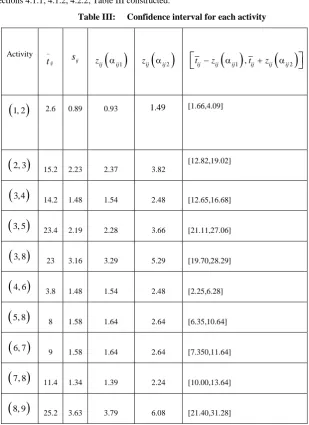
8, 9 24 22 30 28 22Using Table II and the sections 4.1.1, 4.1.2, 4.2.2, Table III constructed.
Table III: Confidence interval for each activity
Activity
ij
t
ij
s
1 ij ij
z zij
ij2
tijzij
ij1 ,tijzij
ij2
1, 2 2.6 0.89 0.93 1.49 [1.66,4.09]
2, 3 15.2 2.23 2.37 3.82 [12.82,19.02]
3,4 14.2 1.48 1.54 2.48 [12.65,16.68]
3, 5 23.4 2.19 2.28 3.66 [21.11,27.06]
3, 8 23 3.16 3.29 5.29 [19.70,28.29]
4, 6 3.8 1.48 1.54 2.48 [2.25,6.28]
5, 8 8 1.58 1.64 2.64 [6.35,10.64]
6, 7 9 1.58 1.64 2.64 [7.350,11.64]
7, 8 11.4 1.34 1.39 2.24 [10.00,13.64]
8, 9 25.2 3.63 3.79 6.08 [21.40,31.28] [image:10.595.177.419.71.166.2]Using Table III and the sections 4.1.2, 4.2.2, 4.3.5, Table IV constructed
Table IV :Triangular fuzzy number and time characteristics
Activity
ij
t *
, 0
ij ij
t d
t
*ij
ES EFij* LSij* LFij* TFij*
1, 2
1.66, 2.6, 4.09
2.69 0 2.69 0 2.69 0
2, 3
12.82,15.2,19.02
[image:10.595.143.453.175.601.2]
3, 4
12.65,14.2,16.68
14.31 18.06 32.37 18.06 32.37 0
3, 5
21.11, 23.4, 27.06
23.55 18.06 41.62 25.25 48.80 7.19
3, 8
19.70, 23, 28.29
23.22 18.06 41.29 33.70 56.93 15.63
4, 6
2.25, 3.8, 6.28
3.92 32.37 36.30 32.37 36.30 0
5, 8
6.35, 8,10.64
8.12 41.62 49.74 48.80 56.93 7.18
6, 7
7.35, 9,11.64
9.12 36.30 45.42 36.30 45.42 0
7, 8
10.0,11.4,13.64
11.50 45.42 56.93 45.42 56.93 0
8, 9
21.41, 25.2, 31.28
25.45 56.93 82.39 56.93 82.39 0Critical path:
From the Table IV,the critical path of the FPN is 1-2-3-4-6-7-8-9
6.
ADVANTAGES USING
STATISTICAL DATA
The focus of this study was to introduce an approach that combined fuzzy set theory with statistics that includes a new fuzzy number. We would like to point out the following significant results obtained in this paper for characteristics of fuzzy project network.
(i) The activity fuzzy project network is same as
the fuzzy project network based on confidence interval estimate.
(ii) It was shown that some relations exist between
the notion of fuzzy criticality and the notion of criticality in the fuzzy project network with newly constructed fuzzy numbers.
(iii) It can be noted that this approach is used to
solve practical problems in unknown or vague situations, without any assumptions, using fuzzy numbers.
(iv) Calculating the past statistical data average,
we observed that there is inaccuracy for the possibility of obtaining a greater deviation from the true value.
7.
CONCLUSIONS
This paper has presented characteristics of fuzzy project network using statistical information related to the project by calculating mean and variance. Fuzzy number has been constructed using interval estimate. A new ranking function has been developed to discriminate various fuzzy numbers. The fuzzy number combined with ranking function, a new formula for calculating characteristics of fuzzy network using
t distribution has been developed.
This method has been applied on five ship building projects collected from various places in India. Throughout the paper, it has been observed that: (i) A new fuzzy number is constructed to calculate characteristics of a fuzzy project network using statistical data.
(ii) A new ranking function is developed on the newly constructed fuzzy number which gives more accurate results in discriminating fuzzy numbers.
(iii) The appropriateness and contribution of characteristics of fuzzy project network to ship building is discussed using statistical parameters.
This method gives fuzzy project network researchers new tools and ideas on how to approach fuzzy project network problems using statistical data.
8.
REFERENCES
[1] Gazdik, I. (1983). Fuzzy network planning – FNET.
IEEE Transactions on Reliability, 32, 304–313. doi:10.1109/TR.1983.5221657.
[2] Chang, D. H., Son, J. H., & Kim, M. H. (2002). Critical
path identification in the context of a workflow. Information and Software Technology, 44, 405–417. doi:10.1016/S0950-5849(02)00025-3.
[3] Chang, I. S., Tsujimura, Y., Gen, M., & Tozawa, T. (1995). An efficient approach for large scale project Planning based on fuzzy delphi method. Fuzzy Sets and
Systems, 76, 277–288.
doi:10.1016/0165-0114(94)00385- 4.
[4] Hapke, M., Jaszkiewicz, A., & Slowinski, R. (1994). Fuzzy project scheduling system for software de-velopment. Fuzzy Sets and Systems, 67, 101–117. doi:10.1016/0165-0114(94)90211-9.
[5] Lorterapong, P. (1994). A fuzzy heuristic method for
resource constrained project scheduling. Project
Management Journal, 25, 12–18.
Journal of Operational Research, 100, 122–133. doi:10.1016/S0377-2217(96)00140-3.
[7] Yao, J. S., & Lin, F. T. (2000). Fuzzy critical path method based on signed distance ranking of fuzzy numbers. IEEE Transactions on Systems, Man, and Cybernetics. Part A, Systems and Humans, 30, 76– 82. Doi:10.1109/TSMCA.2000.833106.
[8] Chen, L. H., & Lu, H. W. (2001). An approximate
approach for ranking fuzzy numbers based on left and right dominance. Computers & Mathematics with Applications (Oxford, England),41,1589–1602. doi:10.1016/S0898- 1221(01)00124-9.
[9] Lin, F. T. (2001). Critical path method in activity
networks with fuzzy activities duration times. Pro-ceedings IEEE Conference on Systems, Man and Cybernetics, 2, 1155- 1160.
[10]Lin, F. T. (2002). Fuzzy critical path method based on
statistical data. Proceedings IEEE International
Conference on Fuzzy Systems, 2, 1245-1250.
[11]Lin, F. T., & Yao, J. S. (2003). Fuzzy critical path method based on signed distance ranking and statistical
confidence interval estimates. The Journal of
Supercomputing, 24, 305–325.
doi:10.1023/A:1022036931014.
[12]Zielinski, P. (2005). On computing the latest starting times and floats of activities in a network with imprecise durations. Fuzzy Sets and Systems, 150, 53–76. doi:10.1016/j.fss.2004.08.007.
[13]Tian, F., & Li, R. (2006). A fuzzy critical path method based scheduling approach for collaboration process. In
Proceedings 10th International Conference on Computer Supported Cooperative Work in Design (pp. 1-6).
[14]Chen, S. P., & Hsueh, Y. J. (2008). A simple approach to fuzzy critical path analysis in project networks. Applied
Mathematical Modelling, 32, 1289–1297.
doi:10.1016/j.apm.2007.04.009.
[15]Yakhchali, S. H., Ghodsypour, S. H., & Fatemi Ghomi, S. (2008). An incremental approach for temporal analysis in networks with imprecise activity and time lag durations. In Proceedings IEEE International Conference on Industrial Engineering and Engineering Management (pp. 1774-1778).
[16]Lin, F. T. (2008). Time-cost trade off in fuzzy critical path analysis based on (1-α) × 100% confidence-interval estimates. In Proceedings IEEE International Conference on Systems, Man and Cybernetics (pp. 601-606).
[17]Zadeh, L. A. (1965). Fuzzy sets. Information and
Control, 8(3), 338–353. doi:10.1016/S0019-
9958(65)90241-X.
[18]Chen LS, Cheng CH (2005) Selecting IS personnel using
ranking fuzzy number by metric distance method. European Journal of Operational research 160 (3) : 803- 820.
[19]N. Ravi Shankar, V. Sireesha, K. Srinivasa Rao and N.
Vani.Fuzzy Critical Path Method Based on
MetricDistanceRanking of Fuzzy Numbers Int. Journal of Math. Analysis, Vol. 4, 2010, no. 20, 995 – 1006.
[20]Jin-Shing Yao and Feng –Tse Lin. IEEE transactions