Munich Personal RePEc Archive
Effectiveness of poverty reduction in the
EU: A descriptive analysis
Caminada, Koen and Goudswaard, Kees
Department of Economics, Leiden University
2008
Online at
https://mpra.ub.uni-muenchen.de/20167/
Leiden Law School
Department of Economics Research Memorandum 2008.06
Effectiveness of poverty reduction in the EU: A descriptive
analysis
Koen Caminada and Kees Goudswaard
Correspondence to
Leiden Law School
Department of Economics
P.O. Box 9520
2300 RA Leiden
The Netherlands
Phone ++31 71 527 7756 (7855)
Email:
[email protected]
Website:
www.economie.leidenuniv.nl
Editors
Effect ive ness of Pover t y Re duct ion in t he EU:
A D e scr ipt ive An a lysis.
∗
Pr of. dr . C.L.J. Ca m in a da ( Koe n )
Leiden Law School
Economics Department, Leiden University P.O. Box 9520, 2300 RA, The Netherlands Phone: ++31 71 527 7756
URL: www.hsz.leidenuniv.nl
E-mail: [email protected]
Professor of Empirical analysis of tax and social policy
Pr of. dr . K.P. Gou dsw a a r d ( Ke e s)
Leiden Law School
Economics Department, Leiden University P.O. Box 9520, 2300 RA, The Netherlands Phone: ++31 71 527 7756
URL: www.hsz.leidenuniv.nl
E-mail: [email protected]
Professor of Economics and social security
Abst r a ct
The European Union coordinates and encourages Member State actions to combat poverty, and to reform their social protection systems on the basis of policy exchanges and mutual learning (‘best practices’). Some EU countries are more effective in poverty reduction than others. What can explain these variations in effectiveness? This paper analyses the effectiveness of welfare state policies and especially social transfers in EU-countries in alleviating poverty. To indicate whether European economic integration may have had any impact on poverty reduction, we also include several non-EU15 countries as a benchmark into our analysis. We analyze on a cross-country basis the relationship between poverty rates and social effort, as measured by social expenditure ratios. We also correct these expenditure ratios for the impact of the tax system and for private social arrangements, using OECD methodology. Next, we compare poverty rates at the levels of market and disposable incomes, that is before and after transfers, in order to analyze the effect of tax and transfer policies in reducing poverty, i.e. to determine the target efficiency of social transfers. We perform several tests with the most recent data (LIS, OECD SOCX, and Eurostat: ECHP/EU-SILC).
Our results are less clear cut than earlier findings. We still find a quite strong negative relationship between the level of social expenditure and poverty among OECD countries. However, for EU-countries this relationship is weaker and there are substantial differences within the EU15. After correcting for the impact of taxes and for private social arrangements, the linkage between social effort and poverty levels becomes even weaker. Also, we do not find a strong relationship between levels of social spending and antipoverty effects of social transfers and taxes. At the program level, family programs and child support alleviate poverty to a large extent.
JEL-codes: H53, H55
Keywords: poverty, welfare states, Lisbon objectives, social indicators
Focus: Macro (primarily)
Draft: 21/11/08
- 1 -
1 . I n t r odu ct ion
Poverty alleviation has been a European objective already since the Treaty of Rome in 1957. In 2000 the European Council adopted the goal that besides economic growth also social cohesion should be strengthened in the EU (the Lisbon Agenda). The open method of coordination was introduced as the means of spreading best practices and achieving greater convergence towards the main EU-goals. Social indicators were developed to monitor the improvements with respect to social cohesion.
The Lisbon Agenda has renewed the interest in poverty alleviation across member states. However, still a sizable proportion of the EU15 population lives in poverty (16 percent), although both poverty structure and poverty rates vary across countries (from 10 percent in the Netherlands to about 20 percent in Greece, Spain and Portugal). Moreover, the average at-risk-of-poverty rates – an official EU social cohesion indicator – even have risen since the adoption of the Lisbon Agenda. Some EU-countries are more effective in poverty reduction than others. What can explain these variations in effectiveness? Obviously, a range of policy strategies may be chosen to tackle poverty, including improving educational outcomes, improving job opportunities and stimulating labor force participation and reducing inequalities in health outcomes. This paper analyses the effectiveness of income transfer policies in EU-countries in alleviating poverty. To indicate whether European economic integration may have had any impact on poverty reduction, we also include several non-EU15 countries as a benchmark into our analysis. We analyze on a cross-country basis the relationship between poverty rates and social effort, as measured by social expenditure ratios. We also correct these expenditure ratios for the impact of the tax system and for private social arrangements, using OECD methodology (Caminada and Goudswaard, 2005). Next, we compare poverty rates at the levels of market and disposable incomes, that is before and after taxes and social transfers, in order to analyze the effect of tax and transfer policies in reducing poverty, i.e. to determine the target efficiency of social transfers. We will perform several tests with data from LIS, OECD SOCX, and Eurostat (ECHP/EU-SILC) and confront our results with earlier findings on country poverty research. This kind of country comparisons may guide us to cross-country differences on poverty alleviation in the EU15.
Finally, we will perform several partial analyses by disaggregating poverty rates to socioeconomic and demographic conditions (using recent data from the European Commission, 2007) in order to investigate to what extent variations at the social program level (such as old age pensions, child benefits) affect the measured effectiveness of the welfare state in alleviating poverty.
The paper is organized as follows. In section 2 we discuss the Europeanization of social policies on poverty alleviation. In section 3 we present the research design. After a descriptive overview of poverty rates in highly-developed welfare states in section 4, the paper investigates the relationship between welfare state effort and poverty rates across countries in several steps. First we address in section 5 the question whether there is a correlation between the size of the welfare state as measured by social expenditure ratios and the incidence of poverty. We also correct these expenditure ratios for the impact of the tax system and for private social arrangements. Are high social expenditure rates associated with low poverty rates? Next (section 6) we turn to the reduction of poverty rates through taxes and transfers and its relationship to welfare state effort. Finally (section 7) we look at two vulnerable age groups: children and the elderly. We present linkages across countries of their poverty rates with expenditures for several social programs as family and child benefits, and public old age pensions and survivor schemes. Section 8 concludes the paper.
2 . Policy on pove r t y a lle via t ion
2.1 Europeanizat ion of social policies
- 2 -
European Council in 1992. The first recommendation, of June 1992, dealt with common criteria concerning sufficient resources and social assistance in social protection systems (92/441/EEC). The second recommendation, of July 1992, addressed the “convergence of social protection objectives and policies” (92/442/EEC). The motivation was that convergence seeks to guarantee the continuation and stimulate the development of social protection within the context of the completion of the internal market. And also that member states face common problems, such as ageing of the population, unemployment, changing family structures and poverty; common objectives must act as pointers to the way social protection systems are modified to take account of these problems.
A new and important step was taken at the European Council in Lisbon 2000. For the EU the strategic goal was set for the decade ending in 2010 to become the most competitive and dynamic knowledge-based economy with sustainable economic growth and greater social cohesion. The economic and social agendas were thus explicitly coupled. To achieve these aims, the social model needs to be modernized. To ensure long-term sustainability of the social security systems in the light of the ageing process, participation rates should be increased.
The Treaty of Nice of 2001 took the social agenda forward. It was agreed to advance social policy on the basis of the open method of coordination, first employed with respect to employment policies. The method recognizes that social policy remains the responsibility of member states, under the principle of subsidiarity. It implies that member states define and evaluate common objectives and learn from each other how to reach these objectives. Best practices are disseminated and benchmarking is used. Coordination is based on evaluation and peer pressure, but does not offer the option of sanctions. In Nice it was decided that member states should implement action plans for combating poverty and social exclusion and to define common objectives on social indicators. The indicators encompass financial poverty, income inequality, long-term unemployment, regional variation in employment rates, life expectancy and poor health. Some consider these common indicators and the national action plans for social inclusion as significant progress towards integration along the social dimension (Atkinson, 2002). Others question this form of coordination (Leibfried, 2002). At least, this new mode of governance and the Lisbon agenda in general, have renewed the debate on poverty reduction in EU member states.
2.2 Com bat ing povert y
In September/October 2006, member states adopted renewed National Action Plans for Social Inclusion under the new streamlined open method of coordination (OMC) as one chapter of the National Report on Strategies for Social Protection and Social Inclusion. They presented the key priorities in member states efforts to promote greater social inclusion and make a decisive impact on the eradication of poverty and social exclusion (European Commission, 2007). A year later, the Commission gave special attention to the poverty among vulnerable groups, especially children, in
their most recent Joint Report on Social Prot ect ion and Social I nclusion 2008 (European
Commission, 2008). In most member states children are at greater risk of poverty than the overall
population. In some countries more than 25 percent of the children is at risk of poverty. Child poverty may have a strong damaging effect on future life opportunities and also on the future capacity of these children to contribute to society (European Commission 2008, p.6). In general, the Report indicates that social inclusion and social protection remains high on the political agenda for most member states. Some member states have reinforced their commitments by setting quantitative targets to reduce poverty (p.101).
Progress of social inclusion and poverty reduction is monitored considering the performance in each member state on the basis of national indicators, based on the Social Indictors report of Atkinson et al (2002). In the European Union people are said to be in income poverty if their incomes are below 60 per cent of the median disposable income of households in their country, after adjusting
for household size (equivalence scales).1 Based on this criterion, the proportion of the
- 3 -
population who were at risk of poverty in 2005 is 16 percent. This means that around 72 million citizens are considered as at risk of poverty in the EU25 (Guio, 2005).
The poverty problem is also striking in other highly-developed welfare states. Industrialized countries spend a large share of their income on social security, but poverty and social exclusion have not been eradicated. A sizeable proportion of the population lives in economic poverty in all industrial welfare states. According to the most common standards used in international poverty analyses, on average roughly one in ten households live in relative poverty in OECD countries (cf. Atkinson et al. 1995; Behrendt 2002; Smeeding, 2005).
The persistence of poverty in industrial welfare states calls for an explanation. If these welfare states offer elaborate systems of income maintenance, why is there still a considerable amount of poverty? Why are some countries more effective than others in this respect? What can explain these variations in effectiveness?
3 . Re se a r ch de sign
This paper will assess the relationship between welfare state effort and poverty alleviation in two steps. First we have to address the question whether there is a correlation between the size of the welfare state and the incidence of poverty. Are high social expenditure rates associated with low poverty rates? Next we turn to the reduction of poverty rates through taxes and transfers and its relationship to welfare state effort. Our research design starts with the data to be used, because poverty rates and social expenditure rates can be collected from several sources. Next we discuss how to measure of social effort and the effect of social transfers on poverty.
3.1 Measuring povert y incidence
For various reasons we use poverty rates from different databases. The official EU-indicator for social cohesion is the at-risk-of-poverty rate after social transfers. This rate is defined as the share of persons with an equivalized disposable income below the risk-of-poverty threshold, which is set at 60 percent of the national median equivalized disposable income. For this indicator Eurostat data (ECHP/EU-SILC)are available for the period 1995-2005, but not for all member states.
For a further comparison, we will also use OECD poverty indicators: the poverty rate and the poverty gap. The OECD poverty rate is defined as the proportion of individuals with equivalized disposable income less than 50 percent of the median income. The poverty gap is the percentage difference between the average income of the poor and the 50 percent of median income poverty threshold. In this paper we will use OECD poverty data from the mid-1980’s until the year 2000
(based on Förster and D’Ercole, 2005).2
Finally, we use also data from the Luxembourg Income Study (LIS). The LIS database contains income data files for 32 nations covering the period 1967 to 2005. We can analyze both the level and trend in poverty for a considerable period across a wide range of nations.
Following international standards, we use the relative rather than the absolute approach in measuring income poverty. This means that we define as poor those households that have an equivalent disposable income below a certain threshold representing the level of well-being of the population in a specific country. In our empirical analysis we use several thresholds for a poverty line (40 percent, 50 percent, and 60 percent), because the absolute number and also the structure
of poverty differ dramatically depending on the threshold chosen.3 In most comparative studies the
poverty threshold has been set at 50 percent of median equivalent disposable income, but we focus especially on the EU’s definition of the poverty line. For comparison, the official United States
2 Recently OECD (2008) published their study ‘Growing unequal? Income distribution and poverty in OECD countries’ with even more recent data on poverty rates across countries up till the mid-2000s. In future research we will incorporate these data as well in our analyses.
- 4 -
poverty line was just about 27 percent of median United States family pre-tax cash income, and about 32 percent of median United States disposable post-tax household income (Smeeding, 2005). It should be noted that there have been controversial arguments on the issues in the measurement of poverty. These arguments have their own merits and shortcomings, and there has been little professional consensus on the theoretical superiority of a particular way of poverty measure. Moreover, the availability of reliable data restricts what is possible to do, which is especially critical
in cross-national studies. The aim of this paper is not to review definitional issues that arise in
assessing the extent of, and change in, poverty in western industrialized countries. We refer simply to a vast amount of literature on the sensitivity of measured results to the choice of income definitions, poverty lines, appropriate equivalence scales, and other elements that may affect
results in comparative poverty research.4
3.2 Measuring social effort
The overall result of quantitative studies seems to be that there is strong negative correlation between poverty and social expenditures across European countries over the last 25 years (Behrendt, 2002). We use social expenditure data from the most recent OECD Social Expenditure Database (2007). This database contains aggregate and disaggregated data on social expenditures. The main social policy areas included are old age, survivors, family and other social programs. Both cash benefits and benefits in kind are included. In this study we will perform several tests both at the aggregate level and at the program level. It should be noted that social expenditure indicators at the aggregate level have its limitations (Kühner, 2007): changes in expenditure ratio’s may not be caused by policy changes, but simply by the number of beneficiaries as a result of an ageing population or changes in unemployment levels due to cyclical factors (see also section 3.4).
To indicate whether it is Europeanization rather than globalization that has had any impact on poverty (and/or social expenditures), we include not only EU member states, but also other
OECD-countries. These non-EU15 countries control for the effects of globalization.5
Other problems with social expenditure as an indicator for differences in social protection across countries are related to differences in the public/private mix in the provision of social protection and differences in tax features. Adema (2001) has developed indicators that aim to measure what part of an economy’s domestic production recipients of social benefits really draw on, net total social expenditure. This requires capturing private social benefits and the impact of tax systems on social effort. For private programs to be considered ‘social’, they need to have a social purpose and
contain an element of interpersonal redistribution and/or compulsory participation.6 The distinction
between public and private social protection is made on the basis of whoever controls the relevant financial flows. Private social benefits may be important for our analysis. In so far they contain an element of redistribution they may also have an impact on poverty levels. For example, private but mandatory pensions (in the second pillar) may have effect on poverty incidence among the elderly. However, the impact of private social benefits is likely to be smaller than the impact of public social transfers.
The impact of the tax system on the social effort is threefold. In some countries cash benefits are taxable as a rule, in other countries they are not. In the former countries net social effort is less than suggested by gross spending indicators. Indirect taxation of consumption by benefit recipients
4 Among others, see Atkinson (1987 and 2003), Hagenaars and De Vos (1987), Förster (1993), Atkinson et al (1995), Behrendt (2000), Gottschalk and Smeeding (1997 and 2000), Smeeding et al (2000), Marcus and Danziger (2000), Atkinson and Brandolini (2001), Caminada and Goudswaard (2001), Förster and Pearson (2002), Smeeding (2005), Guio (2005), Förster and d’Ercole (2005), and (other) papers listed in our reference section using data from the Luxembourg Income Study. See Bourguignon et al (2002) for a more elaborated paper on the evaluation of poverty impact of economic policies.
5 It should be mentioned that European non-EU27 countries as Switzerland or Norway may also be influenced by European integration, for example via policy competition.
- 5 -
is another factor that may blur the picture. When indirect taxes are higher, benefit recipients have less effective purchasing power. And thirdly, the tax system can be used for social purposes. Tax deductions (e.g. family tax allowances) replace direct expenditures in some cases. The Earned Income Tax Credit in the United States is a good example of a tax break, which has the features of a social protection program. To control for the impact of tax systems on social spending, we will use the OECD data on net social expenditure. Unfortunately, these data only cover a relatively short time period (1993-2003) and are not available for all EU member states.
The most recent figures for the net social expenditure as percentage of GDP, based on the 2007 edition of the Net Social Expenditure data, indicate that accounting for the impact of taxes and of private social expenditure has an equalizing effect on levels of social effort across countries; see Caminada and Goudswaard (2005) for details.
3.3 Measuring t he effect s of t axes and t ransfers
Usually the impact of social policy on income poverty is calculated in line with the work of Musgrave, Case and Leonard (1974), i.e. statutory or budget incidence analysis. Important issues
of tax/transfer shifting and behavioral responses are ignored.7 A standard analysis of the
anti-poverty effect of taxes and income transfers is to compare pre-tax-transfer anti-poverty and post-tax-transfer poverty. To compare the antipoverty effectiveness of taxes and income post-tax-transfers among western welfare states, poverty rates will be decomposed into the level of market-generated poverty, the overall level of welfare efforts, and the poverty reduction efficiency of taxes and transfers (cf. Kim, 2000a).
A comparison between the standard at-risk-of-poverty rate and the hypothetical situation where social transfers are absent, other things being equal, shows that such transfers have an important
redistributive effect that helps to reduce the number of people who are at risk of poverty.8 In the
absence of all social transfers, the average poverty risk for EU member states would be considerably higher than it is in reality. It should however be noted that the indicator of poverty risk before social transfers must be interpreted with caution (Kim, 2000b; Nell; 2005). First, no account is taken of measures that, like social cash transfers, can have the effect of raising the disposable incomes of households and individuals, namely transfers in kind, tax credits and tax allowances. Second, the pre-transfer poverty risk is compared to the post-transfer risk keeping all other things equal – namely, assuming unchanged household and labor market structures, thus disregarding any possible behavioral changes that the situation of absence of social transfers would involve. Kim (2000b) showed that both the generosity and efficiency of the tax/transfer system may influence the level of pre-tax-transfer poverty. So this standard approach overestimates the antipoverty effectiveness of generous and/or targeted welfare systems.
3.4 Test s on t he linkages bet ween social prot ect ion and povert y
National preferences for social protection differ substantially across countries. Especially Anglo-Saxon countries do not seem to be prepared to sustain the high protection levels prevailing in other countries with the same level of income. This may be an expression of cultural differences within the group of OECD countries. These differences could point to variance in the antipoverty nature of social systems as well. Anglo-Saxon welfare states (especially the United States) rely more heavily on social arrangements as far as pensions, health care and other programs are concerned. However, private social programs may generate a more limited redistribution of resources than public ones, and tax advantages towards private pension and health plans are more likely to benefit the rich. Private employment-related social benefits mostly re-allocate income between the (formerly) employed population. The same holds for fiscal advantages related to, for example, supplementary private pension plans. In general, we do expect that private schemes will generate less antipoverty effects than public programs.
We perform a cross-county analysis of the relationship between (public and private) social expenditures and poverty rates at one moment in time. The material presented is only descriptive
7 See for a critical survey of efforts to measure budget incidence by Smolensky et al (1987).
- 6 -
and does not explain poverty levels and poverty structure. Such an analysis should ideally be
based on a theory, which would have to address at least the following cross-national differences (cf. Gottschalk and Smeeding, 2000, p.263): differences in labor markets that affect earnings of individual household members; demographic differences, such as the ageing of the population and growth of single parent households, which affect both family needs and labor market decisions; and differences across countries in tax and transfers policies that not only affect family income directly, but also may affect work and investment decisions. Two recent seminal books edited by Kakwani and Silber (2007 and 2008) present the panorama of the many dimensions of poverty from various disciplines. A fully-fledged model should be developed to assess the relative performance of social factors and the economic development. Such a comprehensive approach is far beyond the scope of this paper. We simply employ bi-variate regressions on the relationship between social expenditures and poverty rates, so one could argue that omitted (macroeconomic) variables cause bias. Differences in social effort across countries at one point in time can be the result of cyclical factors.
Another important point to keep in mind is that we only analyze the impact of transfers on poverty, while, as we mentioned before, several other strategies can be chosen to alleviate poverty. In fact, several EU member states are increasingly emphasizing strategies to facilitate labor force participation of lower income groups (European Commission, 2008, p.101). This may also be an effective strategy to tackle poverty.
4 . Pove r t y r a t e s: som e de scr ipt ive st a t ist ics
4.1 Povert y level
- 7 -
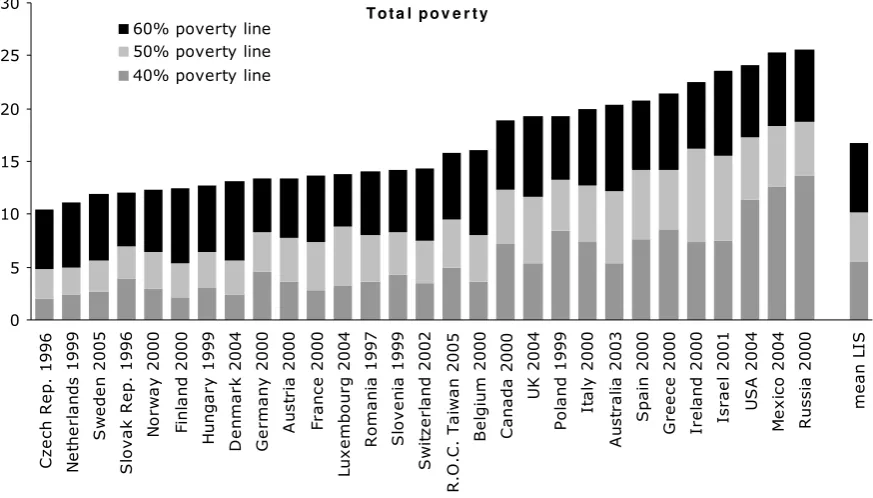
Figure 1: Percent poverty for total population in 30 countries, around 2001
T o t a l p o v e r t y
0 5 10 15 20 25 30 C z e c h R e p . 19 96 N e th e rla nds 199 9 S w e d e n 200 5 S lo v a k R e p . 199 6 N o rw a y 200 0 F inl a n d 200 0 H unga ry 199 9 D e nm a rk 200 4 G e rm a n y 200 0 A u s tr ia 200 0 F ra n c e 200 0 L u x e m b o u rg 200 4 R o m a nia 199 7 S lo v e n ia 199 9 S w it z e rl a n d 200 2 R .O .C . T a iwa n 20 05 B e lg ium 200 0 C a n a d a 20 00 UK 200 4 P o la nd 199 9 It a ly 200 0 A u s tr a li a 200 3 S p a in 200 0 G re e c e 200 0 Ir e la n d 200 0 Is ra e l 200 1 U S A 200 4 M e x ic o 200 4 R u s s ia 200 0 me a n L IS
60% poverty line 50% poverty line 40% poverty line
Not e: Poverty rates are measured as the proportion of individuals with equivalized disposable income less than 40, 50, and 60 percent of the median income of the entire population.
Source: own calculations based on LIS Key figures (www.lisproject.org)
Note that a considerable share of the population lives in relative income poverty in all industrialized welfare states, yet with a large variation of poverty rates and structure across countries. All industrialized countries in this sample display poverty rates between a range of 10.5 to 25.6 percent of the household population if the poverty line is set at 60 percent of median equivalent household income. The lowest poverty rate is found in the Czech Republic, followed by the Netherlands, Sweden, Slovak Republic, Norway, and Finland. At the very bottom of this ranking, we find the United States, Mexico and Russia with a poverty rate of almost a quarter of the household population.
When large proportions of the population are clustered just around the threshold of 60 percent, small changes in their income can lead to large changes in poverty. To examine the sensitivity of results to alternative choices of the poverty line, Figure 1 also shows poverty rates measured with lower thresholds. It turns out that, in all OECD countries reviewed, a significant share of the population is clustered between the 50 and 60 percent thresholds. This explains also why poverty statistics from the OECD (with a threshold of 50 percent) are much lower compared to the official EU-indicator (with a threshold of 60 percent of median equivalized income).
Other poverty indices would alter the country-ranking to some extent. However, the relative poverty patterns found here correspond roughly to the results found in other cross-national comparisons of poverty using income data from the LIS database and/or OECD (see Kim, 2000a). In spite of differences in the measurement of poverty and the databases used, these studies have consistently found that there is a large difference in the extent of poverty among welfare states. In general, Scandinavian and Benelux countries have the lowest poverty rates, followed by continental European countries. Anglo Saxon welfare states have relatively higher poverty rates. Among them, the extent of poverty is highest in the United States.
4.2 Povert y over t im e
- 8 -
poverty barely declined on average between 2000 and 2005. Poverty rates after social transfers
even rose in Denmark, Ireland, Luxembourg, and Spain during this period.9
Table 1: EU at-risk-of-poverty rates
1995 2000 2003 2005
Austria 13 12 13 12
Belgium 16 13 15 15
Denmark 10 : 12 12
Finland : 11 11 12
France 15 16 12 13
Germany 15 10 15 13
Greece 22 20 21 20
Ireland 19 20 20 20
Italy 20 18 : 19
Luxembourg 12 12 10 13
Netherlands 11 11 12 11
Portugal 23 21 19 20
Spain 19 18 19 20
Sweden : : : 9
United Kingdom 20 19 18 19
Mean EU15 Members (14) 16.5 15.5 15.2 15.6
St andard deviat ion 4.11 3.90 3.66 3.85
Coefficient of variat ion 0.248 0.252 0.241 0.230
Not e: EU15 (14) are all EU15 countries excluding Sweden
Source: Structural Indicators EU - Social Cohesion (Eurostat: ECHP/EU-SILC); and own calculations
Using the OECD definition, poverty rates in the EU even show a rather substantial increase from the mid-1980s until 2000 (Table 2). Poverty rates rose in 75 percent of EU-countries: Austria, Finland, Germany, Greece, Ireland, Italy, Luxembourg, Netherlands, and the United Kingdom. Our trend findings on relative poverty use half of median income as the definition of poverty, and our findings are similar to those in other recent LIS papers with different percentage of median poverty rates and a (less) wider ranges of countries. In general, relative poverty is higher in most nations at the end of the period compared to the beginning. Several member states (Austria, Germany, Ireland, Italy, Netherlands, and the United Kingdom) experienced a rapid increase in relative poverty over this period.
- 9 -
Table 2: OECD poverty rates
Mid-1980s Mid-1990s 2000
Change 2000-mid-1980s
Change 2000- mid-1990s
Australia 12.2 9.3 11.2 -1.0 1.9
Austria 6.1 7.4 9.3 3.2 1.9
Canada 11.6 9.5 10.3 -1.3 0.8
Denmark 5.3 3.8 4.3 -1.0 0.6
Finland 5.1 4.9 6.4 1.3 1.5
France 8.0 7.5 7.0 -0.9 -0.4
Germany 6.4 9.1 9.8 3.4 0.6
Greece 13.4 13.9 13.5 0.1 -0.3
Ireland 10.6 11.0 15.4 4.8 4.4
Italy 10.3 14.2 12.9 2.6 -1.3
Japan 11.9 13.7 15.3 3.3 1.6
Luxembourg 5.4 5.5 5.5 0.1 -0.1
Mexico 20.7 21.7 20.3 -0.4 -1.5
Netherlands 3.1 6.3 6.0 2.9 -0.3
New Zealand 5.8 7.8 10.4 4.6 2.6
Norway 6.9 8.0 6.3 -0.6 -1.7
Sweden 6.0 3.7 5.3 -0.7 1.6
Turkey 16.4 16.2 15.9 -0.5 -0.3
United Kingdom 6.9 10.9 11.4 4.5 0.5
United States 17.9 16.7 17.1 -0.9 0.4
Mean OECD-20 9.5 10.1 10.7 1.2 0.6
St andard deviat ion 4.7 4.6 4.4 -0.3 -0.2 Coefficient of variat ion 0.492 0.461 0.414 -0.077 -0.048
Mean EU15 Members (12) 7.2 8.2 8.9 1.7 0.7
St andard deviat ion 2.8 3.5 3.6 0.8 0.0
Coefficient of variat ion 0.384 0.428 0.399 0.015 -0.029
Not es:
- Poverty rates are measured as the proportion of individuals with equivalized disposable income less than 50 percent of the median income of the entire population.
- “2000” data refer to the year 2000 in all countries except 1999 for Australia, Austria and Greece; 2001 for Germany, Luxembourg, and New Zealand; and 2002 for Mexico and Turkey; "Mid-1990s" data refer to the year 1995 in all countries except 1993 for Austria; 1994 for Australia, Denmark, France, Germany, Greece, Ireland, Japan, Mexico and Turkey; and 1996 for New Zealand; "Mid-1980s" data refer to the year 1983 for Austria, Denmark and Sweden; 1984 for Australia, France, Italy and Mexico; 1985 for Canada, Japan, the Netherlands, Spain and the United Kingdom; 1986 data for Finland, Luxembourg, New Zealand and Norway; 1987 for Ireland and Turkey; 1988 for Greece; and 1989 for the United States.
Source: OECD Poverty Indicator Data based on Förster and D'Ercole (2005); and own calculations
- 10 -
Table 3: OECD poverty gap
Mid-1980s Mid-1990s 2000
Change 2000 - mid-1980s
Change 2000 - mid-1990s
Australia 24.2 31.5 26.7 2.5 -4.8
Austria 27.6 20.7 30.0 2.3 9.3
Canada 19.8 29.9 32.0 12.2 2.0
Denmark 22.1 25.6 24.1 2.0 -1.5
Finland 25.9 21.8 20.7 -5.2 -1.0
France 32.9 23.4 25.8 -7.1 2.4
Germany 22.9 23.6 31.7 8.8 8.0
Greece 32.8 29.9 29.7 -3.0 -0.2
Ireland 23.0 12.0 24.0 1.0 12.0
Italy 29.9 37.2 36.5 6.6 -0.7
Japan 0.0 35.0 36.1 36.1 1.0
Luxembourg 18.1 17.7 17.3 -0.7 -0.4
Mexico 36.4 37.1 36.0 -0.4 -1.1
Netherlands 32.4 27.3 29.4 -3.0 2.1
New Zealand 34.2 29.1 23.3 -10.9 -5.8
Norway 22.5 28.1 28.2 5.7 0.1
Sweden 40.2 30.7 26.1 -14.2 -4.6
Turkey 29.2 28.6 27.8 -1.4 -0.8
United Kingdom 16.0 19.6 22.9 6.9 3.3
United States 33.6 34.1 34.7 1.1 0.6
Mean OECD-20 26.2 27.5 28.1 2.0 1.0
St andard deviat ion 8.7 6.5 5.2 -3.5 -1.3 Coefficient of variat ion 0.333 0.239 0.185 -0.149 -0.054
Mean EU15 Members (12) 27.0 24.1 26.5 -0.5 2.4
St andard deviat ion 6.7 6.4 5.0 -1.7 -1.4
Coefficient of variat ion 0.249 0.264 0.189 -0.060 -0.075
Not es:
- Poverty gaps are measured as the percentage difference between the average income of the poor and the 50 percent of median income poverty threshold.
- “2000” data refer to the year 2000 in all countries except 1999 for Australia, Austria and Greece; 2001 for Germany, Luxembourg, and New Zealand; and 2002 for Mexico and Turkey; "Mid-1990s" data refer to the year 1995 in all countries except 1993 for Austria; 1994 for Australia, Denmark, France, Germany, Greece, Ireland, Japan, Mexico and Turkey; and 1996 for New Zealand; "Mid-1980s" data refer to the year 1983 for Austria, Denmark and Sweden; 1984 for Australia, France, Italy and Mexico; 1985 for Canada, Japan, the Netherlands, Spain and the United Kingdom; 1986 data for Finland, Luxembourg, New Zealand and Norway; 1987 for Ireland and Turkey; 1988 for Greece; and 1989 for the United States.
Source: OECD Poverty Indicator Data based on Förster and D'Ercole (2005); and own calculations
- 11 -
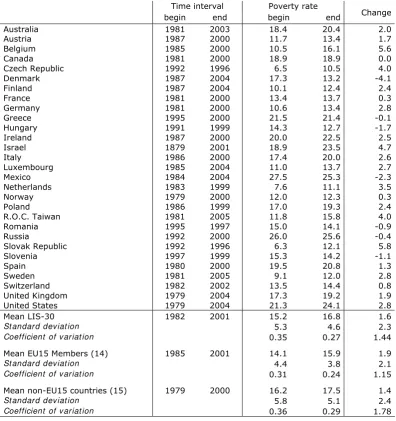
Table 4: Poverty for total population in 30 countries, 1979-2005 (poverty line 60% median income)
Time interval Poverty rate
begin end begin end Change
Australia 1981 2003 18.4 20.4 2.0
Austria 1987 2000 11.7 13.4 1.7
Belgium 1985 2000 10.5 16.1 5.6
Canada 1981 2000 18.9 18.9 0.0
Czech Republic 1992 1996 6.5 10.5 4.0
Denmark 1987 2004 17.3 13.2 -4.1
Finland 1987 2004 10.1 12.4 2.4
France 1981 2000 13.4 13.7 0.3
Germany 1981 2000 10.6 13.4 2.8
Greece 1995 2000 21.5 21.4 -0.1
Hungary 1991 1999 14.3 12.7 -1.7
Ireland 1987 2000 20.0 22.5 2.5
Israel 1879 2001 18.9 23.5 4.7
Italy 1986 2000 17.4 20.0 2.6
Luxembourg 1985 2004 11.0 13.7 2.7
Mexico 1984 2004 27.5 25.3 -2.3
Netherlands 1983 1999 7.6 11.1 3.5
Norway 1979 2000 12.0 12.3 0.3
Poland 1986 1999 17.0 19.3 2.4
R.O.C. Taiwan 1981 2005 11.8 15.8 4.0
Romania 1995 1997 15.0 14.1 -0.9
Russia 1992 2000 26.0 25.6 -0.4
Slovak Republic 1992 1996 6.3 12.1 5.8
Slovenia 1997 1999 15.3 14.2 -1.1
Spain 1980 2000 19.5 20.8 1.3
Sweden 1981 2005 9.1 12.0 2.8
Switzerland 1982 2002 13.5 14.4 0.8
United Kingdom 1979 2004 17.3 19.2 1.9
United States 1979 2004 21.3 24.1 2.8
Mean LIS-30 1982 2001 15.2 16.8 1.6
St andard deviat ion 5.3 4.6 2.3
Coefficient of variat ion 0.35 0.27 1.44
Mean EU15 Members (14) 1985 2001 14.1 15.9 1.9
St andard deviat ion 4.4 3.8 2.1
Coefficient of variat ion 0.31 0.24 1.15
Mean non-EU15 countries (15) 1979 2000 16.2 17.5 1.4
St andard deviat ion 5.8 5.1 2.4
Coefficient of variat ion 0.36 0.29 1.78 Source: own calculations based on LIS Key figures (www.lisproject.org)
Poverty rates across the 30 selected LIS-countries (applying a 60 percent threshold to calculate poverty rates) increased on average with 1.6 percentage points during this period. Over time cross-country differences did not alter much on average. However, in some countries poverty rose at a remarkably high speed (over 3 percentage points): the Netherlands, Czech Republic, Taiwan, Israel, Belgium, and Slovak Republic.
Country clustering based on poverty rates is quite different from that of welfare state regimes. Among the countries with low poverty rates we find representatives of the social democratic regime and the corporatist regime. Likewise the nations with higher rates of poverty represent several regime types and both members of the EU15 and the new member states.
4.3 Vulnerable groups: Decom posit ion of povert y by age groups
Now we turn to groups typically over-represented among the poor - the vulnerable for whom social programs are supposed to guarantee a minimum income. We are particularly interested in how the social transfers affect their poverty status. For each of the vulnerable groups, we report their poverty rates and then assess the impact of transfers on their poverty rates.
- 12 -
median income). Countries are ranked according to their poverty rate at the 60 percent level; the shading of the bars show different intensities of poverty or low income.
[image:17.595.75.500.234.611.2]On average, across all countries, around 18.4 percent of all children fell below the 60 percent poverty threshold around 2001. Child poverty rates are especially low in the Nordic countries, where fewer than 10 percent of all children are poor. Child poverty is high in Mexico, the United States, and Russia (around 30 percent), but also in Italy, Ireland, Spain, and the United Kingdom, where it is above 20 percent. In most countries, relative poverty rates among children are also higher than for the entire population (compare Figure 1 with Figure 2), but with much variation across countries. These differences suggest that specific factors increase risks of poverty for children in some OECD countries (cf. Förster and D'Ercole, 2005).
Figure 2: Poverty rates children and elderly in 30 countries, around 2001
Ch ild pove r t y
0 5 10 15 20 25 30 35 N o rw ay 20 0 0 F inl a nd 20 00 D e n m ar k 20 04 Sw ede n 20 05 C z e c h R ep. 19 96 N e th erl a nds 19 99 Sl ov en ia 19 99 B e lg iu m 2 000 G e rma n y 20 00 R .O .C . Tai w an 20 05 H ung ary 199 9 A u s tri a 20 00 F ra nc e 20 00 S lov ak R e p. 1 996 R o ma ni a 1 997 S w it z e rl an d 200 2 Gre e c e 20 00 Lu x e mbo u rg 20 04 S pa in 20 00 Ir el a nd 20 00 A u s tral ia 20 03 C ana da 20 00 U K 20 04 It al y 2 000 P ol a nd 19 99 Is ra el 20 01 R u s s ia 20 00 U S A 20 04 M e xi co 2 0 0 4 mea n LI S
60% poverty line
50% poverty line
40% poverty line
Pov e r t y e lde r ly
0 10 20 30 40 50 60 Lu xem b ou rg 20 04 Po lan d 19 99 H u ng ary 19 99 N e th erl a nd s 1 9 9 9 C ana da 2 0 0 0 F ran ce 20 00 G e rm any 2 000 R o ma ni a 199 7 S w ed en 2 005 Au str ia 20 00 Cze c h Re p. 19 96 It a ly 20 00 Russia 20 00 F in lan d 20 00 U K 20 04 Sl o v en ia 19 99 N o rw ay 20 00 S w it z e rl an d 20 02 Isr a e l 20 01 D enm ark 20 04 Spa in 20 00 U SA 20 04 Mex ic o 20 04 B e lg iu m 200 0 G ree ce 20 00 R.O .C. Ta iw a n 20 05 Au str a lia 20 03 Ir elan d 20 00 S lo v ak R e p. 199 6 mea n LI S
60% poverty line
50% poverty line
40% poverty line
Not e: Poverty rates are measured as the proportion of individuals with equivalized disposable income less than 40, 50, and 60 percent of the median income of the entire population.
Source: own calculations based on LIS Key figures (www.lisproject.org)
- 13 -
To sum up, our analysis of poverty of vulnerable groups identifies serious holes in the safety net of several countries. In several member states the safety net offers little assistance to vulnerable groups (cf. Sainsbury and Morissens, 2002). On average, child poverty is a lesser problem than is the poverty of elderly in these nations. But single parents and their children generally have the highest poverty rates, while those in two-parent units, mixed units, and the childless experience the least poverty.
5 . W e lfa r e st a t e e ffor t a n d t h e a lle v ia t ion of pove r t y: a n e m pir ica l a n a lysis
5.1 Linkages bet ween povert y rat es and gross social spending
Traditionally, welfare state typologies have been largely based on the overall level of social expenditure. Quantitative studies have found a strong negative relationship between poverty rates and the level of social expenditure over the last 25 years; this finding has now been well
established in empirical studies.10 In other words, countries with a higher level of welfare
expenditure are likely to have lower poverty rates.
Figure 4 illustrates that there is indeed a strong significant correlation between the level of gross
public social expenditure as a percentage of GDP in 2003 and poverty rates across countries
around the year 2000 (ρ<0.01). Countries with higher gross public social expenditure ratios in
2003 tend to have lower poverty rates than countries with lower expenditure ratios. So, our simple linkage exercise does confirm the general finding that more social spending generates less poverty across countries. However, our results are less clear cut than earlier findings. We find an effect which is less strong in EU-countries compared to non-EU15 countries, possibly under the influence of welfare state reforms (cf. Adelantado and Caldéron Cuevas, 2006). This result does not depend on the poverty line applied (40, 50 or 60-percent-of-median-income poverty threshold); see Figure 3. Moreover, we did a sensitivity analysis with the OECD poverty data and found the same result:
higher gross public social expenditure ratios generates less poverty across countries, although this
effect is less strong in EU-countries compared to non-EU15 countries.
- 14 -
Figure 3: Linkage between gross public social expenditure and LIS poverty rates across 19 countries, around 2000-2003
Non- EU15 count ries EU15 count ries
40% poverty line 40% poverty line
y = -1.119x + 24.7 R2 = 0.692
0 10 20 30 40
0 5 10 15 20
Po v e r t y r a t e
S o c ia l e x p e n d it u re
y = -1.206x + 29.5 R2 = 0.334
0 10 20 30 40
0 5 10 15 20
Po v e r t y r a t e
S o c ia l e x p e n d it u re
50% poverty line 50% poverty line
y = -0.831x + 26.7 R2 = 0.639
0 10 20 30 40
0 5 10 15 20 25
Po v e r t y r a t e
S o c ia l e x p e n d it u re
y = -0.745x + 31.0 R2 = 0.413
0 10 20 30 40
0 5 10 15 20 25
Po v e r t y r a t e
S o c ia l e x p e n d it u re
60% poverty line 60% poverty line
y = -0.701x + 29.8 R2 = 0.583
0 10 20 30 40
0 5 10 15 20 25
Po v e r t y r a t e
S o c ia l e x p e n d it u re
y = -0.708x + 35.4 R2 = 0.404
0 10 20 30 40
0 5 10 15 20 25
Po v e r t y r a t e
S o c ia l e x p e n d it u re
Non-EU15 countries: Australia, Canada, Czech Republic, Mexico, Norway, Slovak Republic, and the United States
EU15 countries: Austria, Belgium, Denmark, Finland, France, Germany, Ireland, Italy, Netherlands, Spain, Sweden, and the United Kingdom
Source: Net Social Expenditure, 2007 edition from http://www.oecd.org/dataoecd/14/23/38143827.xls; LIS Key figures from http://www.lisproject.org; and own calculations
5.2 The im pact of t he t ax syst em
Up till now, our results support the conventional view that extensive social-welfare programs reduce poverty. However, these findings may be influenced by ignoring the impact of the tax system. In Figure 4 we have corrected the expenditure ratios for the impact of the tax system, using the OECD data mentioned earlier. We have linked the poverty rates across countries around
the year 2000 to net social expenditures of 2003. We again apply the 40-, 50-, and 60-percent-of
- 15 -
Figure 4: Linkage between net public social expenditure and LIS poverty rates across 19 countries, around 2000-2003
Non- EU15 count ries EU15 count ries
40% poverty line 40% poverty line
y = -0.749x + 21.3 R2 = 0.550
0 10 20 30 40
0 5 10 15 20
Po v e r t y r a t e
S o c ia l e x p e n d it u re
y = -0.683x + 23.5 R2 = 0.160
0 10 20 30 40
0 5 10 15 20
Po v e r t y r a t e
S o c ia l e x p e n d it u re
50% poverty line 50% poverty line
y = -0.541x + 22.5 R2 = 0.482
0 10 20 30 40
0 5 10 15 20 25
Po v e r t y r a t e
S o c ia l e x p e n d it u re
y = -0.445x + 24.5 R2 = 0.222
0 10 20 30 40
0 5 10 15 20 25
Po v e r t y r a t e
S o c ia l e x p e n d it u re
60% poverty line 60% poverty line
y = -0.451x + 24.4 R2 = 0.429
0 10 20 30 40
0 5 10 15 20 25
Po v e r t y r a t e
S o c ia l e x p e n d it u
re y = -0.451x + 27.6
R2 = 0.246
0 10 20 30 40
0 5 10 15 20 25
Po v e r t y r a t e
S o c ia l e x p e n d it u re
Non-EU15 countries: Australia, Canada, Czech Republic, Mexico, Norway, Slovak Republic, and the United States
EU15 countries: Austria, Belgium, Denmark, Finland, France, Germany, Ireland, Italy, Netherlands, Spain, Sweden, and the United Kingdom
Source: Net Social Expenditure, 2007 edition from http://www.oecd.org/dataoecd/14/23/38143827.xls; LIS Key figures from http://www.lisproject.org; and own calculations
At one moment in time, the linkage effect of net public social expenditure ratios and poverty rates
across countries turns out to be less strong compared to the effect of gross public spending (lower
correlation coefficients R2 in all cases). Moreover, in case social expenditures are corrected for the
impact of tax systems, we do not find a significant (negative) correlation for both the EU15 countries and the non-EU15 countries separately. Only for all countries together we still find a fit (ρ<0.01).
We conclude that the conventional view that welfare spending goes along with less poverty must at least be mitigated. The linkage between the two variables becomes substantially weaker if the expenditure data are corrected for relevant tax features, which gives a more realistic picture.
5.3 The im pact of privat e social expendit ure
- 16 -
Figure 5 we have included private social arrangements in our social expenditure indicator for 2003, using the OECD data as developed by Adema (2001). We have linked the poverty rates across
countries around 2000 to net t ot al social expenditures of 2003. For this plot, we apply the
60-percent-of median income poverty threshold, and we use LIS-data on poverty.
Figure 5: Linkage between net total social expenditure and LIS poverty rates across 19 countries, around 2000-2003
Non- EU15 count ries EU15 count ries
60% poverty line 60% poverty line
y = -0.226x + 23.0 R2 = 0.059
0 10 20 30 40
0 5 10 15 20 25
Po v e r t y r a t e
S
o
c
ia
l
e
x
p
e
n
d
it
u
re y = -0.598x + 32.2
R2 = 0.338
0 10 20 30 40
0 5 10 15 20 25
Po v e r t y r a t e
S
o
c
ia
l
e
x
p
e
n
d
it
u
re
Non-EU15 countries: Australia, Canada, Czech Republic, Mexico, Norway, Slovak Republic, and the United States
EU15 countries: Austria, Belgium, Denmark, Finland, France, Germany, Ireland, Italy, Netherlands, Spain, Sweden, and the United Kingdom
Source: Net Social Expenditure, 2007 edition from http://www.oecd.org/dataoecd/14/23/38143827.xls; LIS Key figures from http://www.lisproject.org; and own calculations
The results alter considerably in case private social expenditure are included as well. For non-EU15 countries in our sample we do not find any evidence for a negative correlation between the level of
net total social spending and the incidence of poverty (R2=0.059). Since there is no clear and
strong negative link, more social spending does not offer an easy route to less poverty within these
countries. In contrast, for the group of EU15 countries we find a significant fit (R2=0.338; ρ<0.05).
Private social expenditure does seem to matter as far as poverty alleviation in the EU is
concerned.11 Apparently, private social arrangements have more redistributive impact in the EU
than in other OECD countries.
Table 5 summarizes our results. It shows the correlation coefficients and significance of all linkages between social expenditure and poverty rates across countries in case different poverty lines and /or data sets are employed. This sensitivity analysis shows more or less the same results in case other poverty lines and/or other databases for poverty are applied (LIS or OECD). However, the results are sensitive for the social indicator used.
Note that we find pretty good fits for gross social expenditures, both for non-EU15 and EU15 countries. However, the impact of the tax systems alters the picture. Still we find a significant negative relationship between net public spending and poverty rates for all countries, but not for EU15 countries or non-EU15 countries separately. For the EU15 we do find a fit again if we include private social expenditure. For the EU15, private social benefits do seem to help to reduce poverty levels. However, the linkage between net total social expenditure and poverty levels is still much weaker than in the case the traditional indicator gross public social spending is used.
[image:21.595.289.510.166.302.2]
- 17 -
Table 5: Correlation coefficient and significance of linkages between social expenditure and poverty rates across countries around 2000-2003
Non-EU15 countries EU15 countries All countries
Gross public social expendit ur e
- Poverty line 40, LIS data 0.692 * 0.334 * 0.549 **
- Poverty line 50, LIS data 0.639 * 0.413 * 0.506 **
- Poverty line 50, OECD data 0.772 ** 0.362 * 0.616 **
- Poverty line 60, LIS data 0.538 * 0.403 * 0.454 **
Net public social expendit ur e
- Poverty line 40, LIS data 0.550 -- 0.160 -- 0.405 **
- Poverty line 50, LIS data 0.482 -- 0.222 -- 0.370 **
- Poverty line 50, OECD data 0.527 -- 0.125 -- 0.396 **
- Poverty line 60, LIS data 0.429 -- 0.246 -- 0.345 **
Net t ot al social expendit ure
- Poverty line 40, LIS data 0.121 -- 0.279 -- 0.243 *
- Poverty line 50, LIS data 0.079 -- 0.346 -- 0.231 *
- Poverty line 50, OECD data 0.193 -- 0.205 -- 0.293 *
- Poverty line 60, LIS data 0.059 -- 0.338 * 0.193 --
Note:
- OLS-regression; ** Social expenditure variable significant at the 0.01 level; * Social expenditure variable significant at 0.05 level, -- Social expenditure variable insignificant at 0.05 level.
Source: see Appendix
6 . An t ipove r t y e ffe ct of socia l t r a n sfe r s a n d t a x e s
6.1 I nt roduct ion
- 18 -
Table 6: EU at-risk-of-poverty rate before and after social transfers and taxes, 1995-2005
Before social transfers and taxes After social transfers and taxes
1995 2000 2005 1995 2000 2005
Austria 24 22 24 13 12 12
Belgium 27 23 28 16 13 15
Denmark : : 31 10 : 12
Finland : 19 28 : 11 12
France 26 24 26 15 16 13
Germany 22 20 24 15 10 13
Greece 23 22 23 22 20 20
Ireland 34 31 32 19 20 20
Italy 23 21 24 20 18 19
Luxembourg 25 23 23 12 12 13
Netherlands 24 22 22 11 11 11
Portugal 27 27 26 23 21 20
Spain 27 22 24 19 18 20
Sweden : : 29 : : 9
United Kingdom 32 29 : 20 19 19
Mean 26.0 23.0 26.0 17.0 15.0 16.0
St andard deviat ion 3.48 3.37 3.02 4.11 3.90 3.85
Coefficient of variat ion 0.133 0.143 0.116 0.248 0.252 0.253
Not es:
- At-risk-of-poverty rate before social transfers: the share of persons with an equivalized disposable income, before social transfers, below the risk-of-poverty threshold, which is set at 60 percent of the national median equivalized disposable income (after social transfers). In the EU data retirement and survivor's pensions are counted as income before transfers and not as social transfers, because the prime role of old age (and survivors’) pensions is not to re-distribute income across individuals but rather over the life-cycle of individuals.
- At-risk-of-poverty rate after social transfers: the share of persons with an equivalized disposable income below the risk-of-poverty threshold, which is set at 60 percent of the national median equivalized disposable income
Source: Structural Indicators EU - Social Cohesion (Eurostat: ECHP/EU-SILC); own calculations
We calculate both the absolute and the relative measures of poverty reduction. The absolute antipoverty effect is the percentage point difference between the poverty rate before and after taxes and transfers. The relative effectiveness is measured as: (pre-tax-transfers poverty rate – post-tax-transfers poverty rate) / pre-tax-transfers poverty rate * 100.
Table 6 shows pronounced differences in the performance of the social protection systems of the EU15 countries in reducing poverty. In the absence of all social transfers, the poverty risk for the EU15 population as a whole would be considerably higher than it is in reality (26 percent instead of 16 percent). Moreover, the antipoverty effect amounts 15 to 20 percent points for Nordic countries in 2005; rather poor antipoverty effects are found for Greece, Italy and Spain.
- 19 -
Figure 6: Absolute and relative poverty reduction, 2005
T o t a l p o p u la t io n
0 2 4 6 8 10 12 14 16 18 Gr ee c e It a ly Sp ai n La tv ia L it h ua ni a Cy p ru s Es to ni a Po rt u g al Pol a n d Ma lt a UK Sl o v a k ia Lu x e m b o u rg B e lg ium Ir e lan d Hu n g a ry Au s tr ia Fr a n c e Ge rm a n y Sl o v e n ia Ne th e rl a n d s Cz e c h Fi n la n d De n m a rk S w ed en me a n E U -1 5 me a n E U -2 5 0% 10% 20% 30% 40% 50% 60% 70%
relative (right scale) absolute (left scale)
Not e: In all cases the risk-of-poverty threshold (before and after social transfers and taxes) is set at 60 percent of the national median equivalized disposable income. Retirement and survivor's pensions are counted as income before transfers.
Source: Structural Indicators EU - Social Cohesion (Eurostat: EU-SILC); own calculations
Next, we also include five non-EU15 countries as a benchmark into our analysis. We calculated the antipoverty effect of social transfers and taxes, based on up-dated figures from the LIS Fiscal redistribution dataset (see Mahler and Jesuit, 2006). This dataset measures pre- and post-government poverty levels, using a composite measure that reflects both the headcount of those in poverty (the percentage of all persons whose equivalized household income falls below 50 percent of their country’s median) and the depth of their poverty (the difference between the median income of the entire population and the mean income of the poor). Countries are listed in descending order of the magnitude of their (absolute) antipoverty effect; see Table 7.
Remarkably enough, the United States relative poverty rate before taxes and social transfers is
actually below average for the selected countries, even though the United States ranks the highest
of all the countries in this comparison group in relative poverty rates aft er taxes and transfers.
- 20 -
Table 7: Poverty scores of private sector income and disposable income
Private sector income Disposable income Poverty reduction
Country Year HC GAP HC*GAP HC GAP HC*GAP Absolute Percent
Belgium 1997 32.0 0.91 29.0 8.0 0.63 5.0 24.0 83
Finland 2004 30.3 0.87 26.2 6.5 0.60 3.9 22.3 85
Germany 2000 30.9 0.87 26.8 8.4 0.63 5.3 21.5 80
Sweden 2000 29.8 0.84 24.9 6.5 0.66 4.3 20.6 83
Denmark 2004 28.0 0.86 24.0 5.6 0.62 3.5 20.5 85
France 1994 29.5 0.86 25.3 8.0 0.61 4.9 20.4 81
UK 1999 31.9 0.86 27.5 12.5 0.63 7.9 19.6 71
Ireland 1987 30.4 0.87 26.6 11.1 0.64 7.1 19.5 73
Australia 2003 28.6 0.85 24.4 12.2 0.64 7.8 16.6 68
Norway 2000 24.9 0.82 20.3 6.4 0.64 4.1 16.2 80
Netherlands 1999 21.4 0.82 17.6 4.9 0.64 3.1 14.5 82
Switzerland 2002 20.7 0.85 17.5 7.6 0.63 4.8 12.7 73
Canada 2000 25.2 0.79 20.0 12.4 0.65 8.1 11.9 60
USA 2004 26.6 0.80 21.2 17.3 0.68 11.8 9.4 44
Mean 27.9 0.85 23.7 9.1 0.64 5.8 17.8 75
St andard deviat ion 3.6 2.3 4.2 11.1 Coefficient of variat ion 0.15 0.40 0.235 0.15
Mean EU15 (9) 29.4 0.86 25.3 7.9 0.63 5.0 20.3 80
St andard deviat ion 3.1 1.5 2.5 4.7
Coefficient of variat ion 0.12 0.30 0.121 0.06
Mean other OECD (5) 25.2 0.82 20.7 11.2 0.65 7.3 13.4 65
St andard deviat ion 2.2 2.7 2.7 12.2
Coefficient of variat ion 0.11 0.37 0.203 0.19
Source: LIS Fiscal redistribution dataset based on Mahler and Jesuit (2006); updated figures from
http://www.lisproject.org/publications/fiscalredistdata/fiscred.htm; and own calculations
6.2 The im pact of welfare st at e effort
Next we turn to the reduction of poverty rates through taxes and transfers and its relationship to welfare state effort. Table 8 presents the linkage between poverty reduction and social expenditure ratios for 16 European countries where all relevant data items are available. This gives a picture of the targeting of social protection efforts across European countries at one moment in time (around 2003-2005). Table 8 ranks countries according to their ‘effectiveness’ of combating poverty. Absolute antipoverty effects are divided by social spending ratios to see which country targets best per one point of GDP spent on net social expenditure. Our analysis highlights some cross-country differences of poverty alleviation in the EU15, although the ranking must be interpreted with caution due to cyclical factors. For example, each percentage point of net total public social expenditure alleviates poverty in Ireland and the Scandinavian countries by 0.65-1.05 percentage points, while the lowest scores can be found in Italy, Spain and Portugal (0.18-0.32). Especially the ‘top’ position of Ireland seems to be influenced by the recent economic performance in this particular country (high economic growth, low unemployment rates, and (therefore) the lowest level of social expenditures).
- 21 -
Table 8: Targeting effect of social expenditures on poverty reduction in the EU, around 2003-2005
Pover t y r at e t ot al populat ion, 2005 ( povert y line at 60% of m edian incom e)
Social expendit ures, % GDP, 2003
Target ing effect
Before social transfers and taxes
(1)
After social transfers and taxes
(2)
Absolute effect
(3)
Relative effect
(4)
Gross public
(5)
Net total
(6)
Absolute
(3):(5)
Absolute
(3):(6)
Ireland 33 18 15 45% 15.9 14.3 0.94 1.05
Finland 29 13 16 55% 22.5 20.6 0.71 0.78
Denmark 28 12 16 57% 27.6 21.6 0.58 0.74
Sweden 29 12 17 59% 31.3 26.1 0.54 0.65
Czech Republic 22 10 12 55% 21.1 19.8 0.57 0.61
Austria 25 13 12 48% 26.1 22.2 0.46 0.54
Netherlands 21 10 11 52% 20.7 23.1 0.53 0.48
Germany 26 13 13 50% 27.3 27.6 0.48 0.47
Slovakia 20 12 8 40% 17.3 17.0 0.46 0.47
Belgium 27 15 12 44% 26.5 26.0 0.45 0.46
United Kingdom 30 19 11 37% 20.6 24.6 0.53 0.45
Luxembourg 24 14 10 42% 22.2 n.a. 0.45 n.a.
France 25 13 12 48% 28.7 28.0 0.42 0.43
Portugal 25 18 7 28% 23.5 22.1 0.30 0.32
Spain 24 20 4 17% 20.3 17.7 0.20 0.23
Italy 24 20 4 17% 24.2 22.3 0.17 0.18
Mean 25.8 14.5 11.3 44% 23.5 22.2 0.48 0.51
Source: Structural Indicators EU - Social Cohesion (Eurostat: EU-SILC); Net Social Expenditure 2007; and own calculations
- 22 -
Figure 7: Linkage between social expenditure and relative poverty rate reduction among EU-countries, around 2003-2005
Gross public social expendit ur e Net t ot al social expendit ure
y = 10.368x + 19.0
R2 = 0.105
0 5 10 15 20 25 30 35
0% 10% 20% 30% 40% 50% 60% Po v e r t y r a t e r e d u ct io n
S
o
c
ia
l
e
x
p
e
n
d
it
u
re
y = 7.073x + 19.1
R2 = 0.059
0 5 10 15 20 25 30
0% 10% 20% 30% 40% 50% 60% Po v e r t y r a t e r e d u ct io n
S
o
c
ia
l
e
x
p
e
n
d
it
u
re
Selected countries: Austria, Belgium, Czech Republic, Denmark, Finland, France, Germany, Ireland, Italy, Luxembourg, Netherlands, Portugal, Slovakia, Spain, Sweden, and the United Kingdom
Source: Structural Indicators EU - Social Cohesion (Eurostat: EU-SILC); Net Social Expenditure 2007; and own calculations
As a benchmark we also include four non-EU15 countries into our analysis. The picture on the targeting of social transfers and taxes on poverty reduction is based upon up-dated figures from the LIS Fiscal redistribution dataset. Each percentage point of net total public social expenditure alleviates poverty in Australia and Norway by 0.75-0.92 percentage points, while the lowest scores can be found in Canada and the United States (0.37-0.56). Especially the targeting effectiveness of the United States is remarkably low, and lies below halve of the average of all countries presented in Table 9. It should, however, be noted that these results could be sensitive to the data year chosen (around 2003-2005).
Table 9: Targetting effect of social exependitures on poverty reduction, around 2000-2003
Povert y rat e t ot al populat ion ( povert y line at 50% m edian incom e)
Social expendit ures % GDP, 2003
Target ing effect
Year Private sector income HC*GAP
(1)
Disposable income HC*GAP
(2)
Absolute effect
(3)
Relative effect
(4)
Gross public
(5)
Net total
(6)
Absolute
(3):(5)
Absolute
(3):(6)
Ireland 1987 26.6 7.1 19.5 73% 15.9 14.3 1.22 1.37
Finland 2004 26.2 3.9 22.3 85% 22.5 20.6 0.99 1.08
Denmark 2004 24.0 3.5 20.5 85% 27.6 21.6 0.74 0.95
Belgium 1997 29.0 5.0 24.0 83% 26.5 26.0 0.91 0.92
Australia 2003 24.4 7.8 16.6 68% 17.9 20.6 0.93 0.81
UK 1999 27.5 7.9 19.6 71% 20.6 24.6 0.95 0.80
Sweden 2000 24.9 4.3 20.6 83% 31.3 26.1 0.66 0.79
Germany 2000 26.8 5.3 21.5 80% 27.3 27.6 0.79 0.78
Norway 2000 20.3 4.1 16.2 80% 25.1 21.7 0.65 0.75
France 1994 25.3 4.9 20.4 81% 28.7 28.0 0.71 0.73
Netherlands 1999 17.6 3.1 14.5 82% 20.7 23.1 0.70 0.63
Canada 2000 20.0 8.1 11.9 60% 17.3 21.2 0.69 0.56
United States 2004 21.2 11.8 9.4 44% 16.2 25.2 0.58 0.37
Mean 24.1 5.9 18.2 76% 22.9 23.1 0.80 0.79
[image:27.595.73.547.477.725.2]- 23 -
Overall, the trends of the components of post-tax-transfer poverty can be summarized as follows. In most of welfare states, pre-tax-transfer poverty has increased during the 1980s and early 1990s. Most countries have increased the size of the welfare state during the same period. However, in many cases, the increase in the size of the welfare state is not large enough to offset the increase in pre-tax-transfer poverty. As a result, post-tax-transfer poverty has also - more or less - increased in these countries (cf. Sainsbury and Morissens, 2002; Kim, 2000a; Smeeding, 2005).
7 . Socia l policy a r e a s
An important critic on aggregated social expenditure data is that it is not possible to see which individual program is responsible for a specific dynamic. Therefore we show social expenditures for various programs. We look at two vulnerable age groups: children and the elderly. We present linkages of their poverty rates with social expenditures for social programs as family and child benefits, and the public old age pensions and survivor schemes.
7.1 Children
In most EU-countries, relative poverty rates among children are higher than for the entire population, but with much variation across countries. In Finland and Denmark child poverty rates are 10 percent, while a quarter of all children lives in poverty in Hungary, Italy, Latvia, Poland, Spain, and in the United Kingdom. These differences suggest that specific factors increase risks of poverty for children in some EU-countries.
[image:28.595.77.399.457.644.2]We calculated both the absolute and the relative measures of poverty reduction through social transfers and taxes; see Figure 8. Greece, Spain, and Latvia produce rather poor antipoverty effects among children with their tax/transfer system (below 20 percent). The best-practices in 2005 can be found in Finland, Germany, Austria, Denmark, Sweden, France, and Slovenia with antipoverty effects over 50 percent.
Figure 8: Absolute and relative poverty 0-17 years, 2005
Ch i l d r e n ( 0 - 1 7 y e a r s)
0 5 10 15 20 25 Gr e e c e Sp ain La tv ia It a ly Li thua ni a Por tu g al Pola n d Es to ni a Ma lt a Sl o v aki a Lux e m b o u rg UK Hu n g a ry Cy p ru s Ire lan d Ne th e rl a n d s B e lg iu m Cz e c h Sl o v e n ia Fr a n c e De n m ar k Sw ed en Au s tr ia Ge rm a n y Fi n la n d me a n EU -1 5 me a n EU -2 5 0% 10% 20% 30% 40% 50% 60% 70%
relative (right scale) absolute (left scale)
Not e: In all cases the risk-of-poverty threshold (before and after social transfers and taxes) is set at 60 percent of the national median equivalized disposable income.
Source: Structural Indicators EU - Social Cohesion (Eurostat: EU-SILC); own calculations