Comparative Analysis of Air Conditioning System Using
PID and Neural Network Controller
Puneet Kumar
*, Asso.Prof. K.P.Singh
** *Electrical Engineering Department, MMMEC Gorakhpur, India
**
Electrical Engineering Department, MMMEC Gorakhpur, India
Abstract- Now a days air conditioning system is the necessity part of human life. The different controllers used for controlling air conditioning system like on-off controllers or PID controllers. But these controllers cannot give the sufficient response and consume high power. This paper aims to control the air conditioning system such that the output temperature of air conditioning systems are getting as required by the operator with fast response and low consuming power. For this purpose neural network controllers are designed which is feedback to the air conditioning system. We designed such neural network control system that speculates its own control law. The advantage of using neural networks are this controller is self-learning system and give the faster and better response with comparison to another controllers and give the zero overshoot output.
Index Terms- air conditioning system; neural network controller; Simulink model
I. INTRODUCTION
rom last few decades traditional ON-OFF controllers and conventional PID controllers were used for controlling the Air Conditioning system. But these controllers don’t always produce desired and fast response. And tuning of conventional PID controllers was difficult. So in recent years intelligent control system are designed for controlling the air conditioning (AC) system. Neural network controllers are best option for controlling the system. By choosing suitable neural networks, learning method and input-output data the neural network can be learn the system states, to predict the future behavior of the system. Neural network controllers give the fast response and these controllers are reliable and robustness. The system which are linear or non-linear can be controlled by neural network because of neural networks have the ability to approximate arbitrator value through self-learning property. Due to this property of neural network the designed controllers make up the system uncertainties and system nonlinearities and make system response stable.
A numerous number of applications based on neural network controller are developed for temperature control. Generally temperature control systems are control by PID controllers. But decoupled temperature system can’t be controlled by conventional PID because of these system have large time constant with long delay time characteristics. Similar to this system, neural network with PID controllers are designed to control the system [1].
Controllers like on-off or PID controller were designed for ordinary AC system. With increasing uses of AC, the centralized heating ventilating and air conditioning (HVAC) system and air handling units (AHUs) are developed. For controlling these systems, neural networks based control systems are used. While by simple PID control system controlling of this system are difficult [2].
Application of neural network increases with time. The system which is uncertain and non-linear is control by adaptive neural network control to approximate and determine the characteristics of the uncertain nonlinear system with predictive compensation [3]. Some uncertain system has specified nonlinearities like non smooth nonlinearities. By taking certain well defined sign function and suitable neural network approximation to control the uncertain system with non-smooth nonlinearities. Different temperature control system like MRC and NRMA controllers used in industry for thermal treatment process. For better response nonlinear neural network controller were introduced in [4]. Some system has large inertia and pure lag compensation characteristics. This system can’t be controllable by simple PID controller. Similar to this system is variable frequency air conditioning system which has large inertia and lag compensation characteristics. Neural network PID controllers are introduced for controlling to this system [5].
Although PID controllers are simple in structure intelligent control strategies have more advantages over different ordinary controllers. Control system has suffering with problem of undesired response, overshoot, vibration and large settling time, if the system going from one state to another state. Optimal fuzzy logic controller using genetic algorithm remove the problem of overshoot, vibration and large settling time and give the desired response while system specification change [6].
For designing of controller for air conditioning system studied, modeling and simulink of DC motor with compressor [9] is necessary. Air conditioner comfort the human life but there is problem in using of air conditioning system one is performance and life of air conditioning system and second is power consumption. This paper aims to design a controller using neural network for controlling Air Conditioning system and compare the result neural network controller with traditional PID controllers.
II. EASE NEURAL NETWORK CONTROLLERS
Here we are using neural network for controlling air conditioner. ON-OFF controller and conventional PID controller is already design for this purpose. But due to change in temperature, external environmental conditional ON-OFF controller failed for controlling the system and the tuning of PID controllers are difficult for states change of system. So for the complex system we are using neural network structure for controlling air conditioning system. Controlling of temperature of system in industry, which have long delay time and large constant is controlled by [1]. A PID controller can be used for variable frequency air conditioning system but the richness of PID is weak whenever the parameters of model are changes. The proposed control scheme for controlling air conditioning system gives the improve result. Result of proposed controller is compare with result of conventional PID controller.
As we know that artificial neural network is an information processing system and it has some characteristics same as biological neural network. Intelligent control strategies can design a method that can estimate any signal for getting desired response without assuming signal behavior. A neural network control strategy is one of the intelligent control strategies.
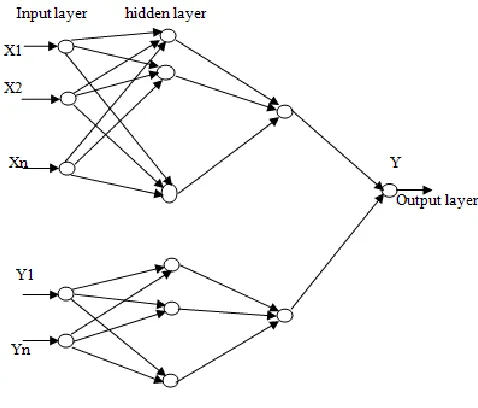
Any neural network can be characterized by its three parts. Fist part is the architecture of neural network means the method for connection of neurons. Second part is the training, or learning or algorithm for determining the weights and last part is the activation function. The neural network architecture can be described in three parts:
Input Layer – The input layer has input neurons which are the state of the system. The output of the system (air conditioner) at different time which is desired at that time is input to the neural network controllers.
Hidden layer – The neuron in this layer is known as hidden neuron which performs different activation function. The activation function of hidden layer’s neuron of proposed controller is tan sigmoid (tansig) function.
[image:2.612.327.566.67.271.2] Output layer – The output layer contains two output neurons. The activation function of the output layer’s neurons is the hyperbolic tangent sigmoid function. A simple structure showing the different layers of neural network in Fig. 1. Equations of input and output for different layer are described below.
Figure 1.Structure of neural network.
In Fig. 1 output from the input neuron of input layer can be expressed by following equation (1).
(1)
Where Ij1 and Ik1 is the output of the jth and kth input neuron of the input layer. The number of input layer’s neurons are j and k. these neurons lies on the complex degree of controller used for air conditioning system.
The input apply to the hidden neurons of the hidden layer can be expressed by following equations (2).
(2)
Here and are the input to the hidden layer’s
neurons. Input for lth neuron of hidden layer is while for
mth neuron of hidden layer’s input is . and are
the weights of hidden layer.
The following equation (3) can be expressed as the output of the hidden layer’s neuron.
(3)
function in hidden layer. Here f1[..] activation function means f1[..] = tansig(x) while f2[..] = tansig(y).
The input equation (4) applies to the output neurons of the output layer.
(4)
The equation (5) for output of the output layer’s neuron can be given.
(5)
Here g1and g2both are tan sigmoid activation function of output layer’s neuron. Wnp(3) and Woq(3) are weights for output neurons. Here used neural network are self-learning system so these weights are adjusted by themselves as required response.
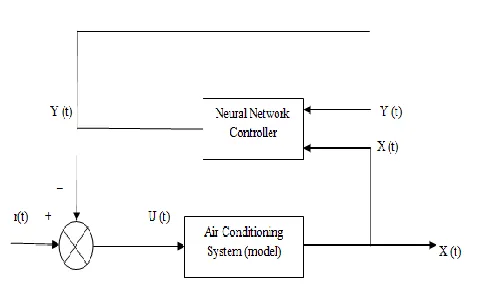
[image:3.612.42.284.442.588.2]A simple block diagram of neural network controller with air conditioning system is shown in Fig. (2). Neural network is directly used here to controlling the air conditioning system. The neural network controller has two inputs, first input is measured compressor’s temperature and second input is the output of controller which feedback to
Figure 2. Block diagram of proposed controller
Control system. The control signal apply to the air conditioning system is optimized signal of controlled signal by neural network controller and desired reference temperature by operator.
.
The mathematical equation for the neural network model is given by equation (1). The output of neural network model can be defined as
(6)
The output value of neural network model Y(t) is feedback to neural network model and output of the air conditioning system x(t) inputs apply to the neural network model.
The output of neural network Y(t) compare with the reference input given by the operator and optimizing the control input. This control input signal applies to the air conditioning model.
III. MODELING OF AIR CONDITIONER
Cooling of a room, whole house, or entire business room is done by Air-Conditioner. Air Conditioner uses chemicals like Freon, or R-410A. These chemicals can be converting easily from a gas to liquid and vice versa. Transformation of heat from the air inside of home to the outside air is done by these chemicals.
Air Conditioner has three main parts first is compressor, second is condenser, third and last is evaporator. Compressor and condenser are placed outside to the air portion of the air conditioner. The evaporator is placed inner side of the house. Compressor is used for compressing the cool and low pressure gas. Condenser is used for cooling the hot gas from compressor and converts high pressure gas into liquid under high pressure. Evaporator evaporates and liquid change into gas.
Controller of air conditioner means controlling of speed of DC motor used for compressor. Temperature of air conditioning system depends upon the speed of compressor. So by controlling the speed of air conditioning system we can control temperature and can get desired temperature set by operator.
Generally brushless DC motor drive is used for Air Conditioning compressor. Electrical equivalent circuit of DC motor is shown
[image:3.612.331.569.568.667.2]in figure (3).
Figure 3. Equivalent circuit of DC motor.
(7)
Torque of the motor can be written as
(8)
Where K is torque constant.
The generated voltage
(9)
By using equation (7) and (9)
(10)
(11)
[image:4.612.322.549.56.384.2]Using these equation block diagram of DC motor is shown in Fig. 4. Here we used direct neural network controllers. Whenever compressor temperature increase or decrease then neural network set the value of temperature to a limit such that the output of air conditioning system means output temperature of compressor will be same as the desired or reference temperature given by the operator.
Figure 4. Block diagram of DC motor
IV. SIMULINK MODEL OF CONTROLLER
Assigned values for our desired air conditioning DC motor model are following
J = 0.25; b = 1.1;
K1 = 0.23; K2 = 0.5;
K = 1;
L = 0.01; R=1;
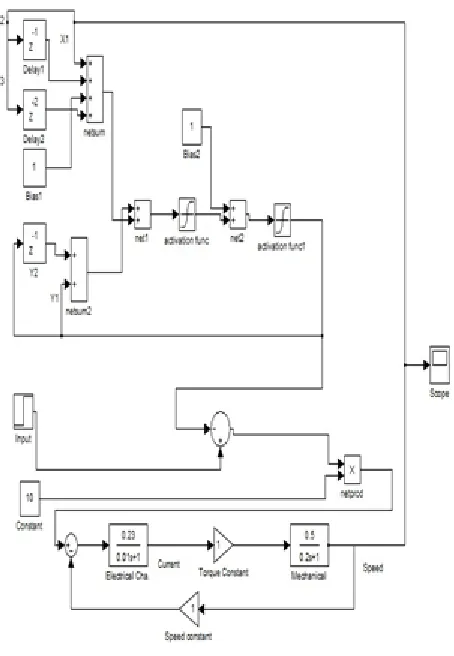
Figure 5. Simulink model of NN controller
A. Simulink of NN controller
Fig. 5 shows the simulink model of controller with air conditioning system. Here neural network is self-learning system. There is no need in modification or changing in neural block or activation function if there is change in reference speed (denote the temperature of air conditioning system) by the operators. The neural network controller receives data from output of air conditioning system and output of self-block as input to controller. The output of controller is such that the output of air conditioning system is very close to desired response.
In any case if the output of the air conditioning system is not close to desired response by operator, then output of self-learning neural network controller adjust themselves in such a way that the output response of the air conditioning system becomes very close to the desired output response set by the operator. Here the activation function of both layer hidden layer and output layer is tan sigmoid function. General form of tan sigmoid function is defined as
[image:4.612.36.289.59.268.2]B. Simulink of PID controller
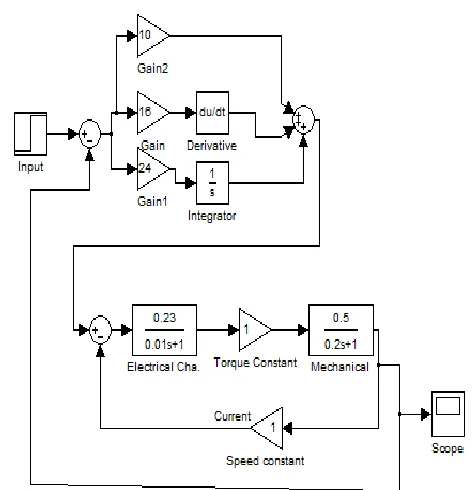
PID model for air conditioning system is shown in Fig. 6.
[image:5.612.330.558.58.251.2] [image:5.612.46.283.166.411.2]Here proportional gain KP = 10; derivative gain KD = 16; and integrated gain KI = 24; are chosen for speed control of DC motor model. Input speed 27.64 is applied to PID controller specified by operator’s speed. The output of this controller is compared with result of proposed Neural Network Controller.
Figure 6. Simulink model of PID controller
V. RESULT AND DISCUSSION
The output response of both PID and Neural Network controller is shown in Fig. 6. Transient response of Neural Network controller and conventional PID controllers are compared with each other as shown in table (1). Neural Network controller gives the better performance for controlling the speed of compressor compared to conventional PID controller. Fig. 6 and table (1) shows the response of Neural Network controller is fast and smooth with compared to conventional PID controller. Overshoot of NN controller is zero. Hence energy consumption is less and compressor’s life increase.
[image:5.612.336.552.278.388.2]Figure 6. Simulation result of NN and PID controller
TABLE I. TRANSIENT RESPONSE OF NN AND PID CONTROLLER
Type of controller Rise
time
Oversh oot Conventional PID
controller 1.18 5.59
NN controller 0.38 0
VI. CONCLUSION
ON-OFF controller or PID controllers have simple structure but for large operating range tuning of PID controllers are difficult and can’t give desired response. To remove these difficulties neural network controller is designed which is gives the fast and desired response.
In this paper neural network control strategy for air conditioning system is introduced. The neural network structure is simple and self-learning system. The temperature control response of air conditioning system is getting better and improved as compared with conventional PID control system. We gets fast and desired response of air conditioning system as set by operator.
REFERENCES
[1] H. Shu, and Y. Pi, “Decoupled Temperature Control System base on PID Neural Network”, ACSE 05 conference, CICC, Cairo, Egypt, pp. 107-111, December, 2005.
[2] C. Guo, and Q. Song, “A Neural Network Assisted Cascade Control System for Air Handling Unit” IEEE Transactions on Industrial Electronics.Vo.54,no.1, pp. 620-628, February 2007.
[3] L. Niu, “Adaptive Neural Network Control with Predictive Compensation for Uncertain Nonlinear System”, IEEE fifth International Conference on Advance Computational Intelligence (ICACI), Nanjing, Jiangsu, China, pp. 535-538, October 2012.
[4] Y. Kaufman, A. Ellenbogen, and A. Meir, “Nonlinear Neural Network Controller for Thermal Treatment Furnaces” IEEE 27th Convention of
Electrical and Electronics Engineers in Israel, pp. 1-4, 2012.
on Control and Automation (ICCA), Guangzhou, China, pp. 317-322, June 2007.
[6] S. Khan, S. F. Abdulazeez, L. W. Adetunji and AHM Z. Alam, “Design and Implementation of an Optimal Fuzzy Logic Controller Using Genetic Algorithm”, Journal of Computer Science, Vol.4, no.10, pp. 799-806, 2008. [7] W. Zheng, H. Ning, and W. Yong, “Studies on Neural Network modeling
for Air Conditioning System by Using Data Mining with Association Analysis” IEEE International Conference on Internet Computing and Information Service, pp. 423-442, 2011.
[8] S. F. Rezeka, N. M. Elsodany and N. A. Maharem, “Fuzzy Gain Scheduling Control of Stepper Motor Driving a Flexible Rotor”, European Journal of Scientific Research, Vol.39, No.1, pp. 50-63, January 2010.
[9] W. P. Aung, “Analysis on Modeling and Simulink of DC Motor and its Driving System used for Wheeled Mobile Robot” World Academy of Science, Engineering and Technology, vol.32, pp. 299-306, 2007.
[10] J. Zhou, M. J. Er, and J. M. Zurada, “Adaptive Neural Network Control of Uncertain Nonlinear System with Non-smooth Actuator Nonlinearities”, ELSEVIER Neuro-computing, Vol. 70, Issues 4-6, pp. 1062-1070, 2007.
[11] V. kinhal, P. Agarwal, and H. Gupta, “Performance Investigation of Neural-Network-based Unified Power-Quality Conditioner” IEEE Transactions on Power Delivery, Vol.26, pp. 431-437, January 2011.
[12] A. Al-Ghasem, and N. Ussaleh, “Air Conditioner Control Using Neural Network and PID Controller” IEEE 8th International Symposium on
Mechatronics and its Applications (ISMA), pp. 1-5, 2012.
AUTHORS
First Author – Puneet Kumar , Electrical Engineering
Department, MMMEC Gorakhpur, India, [email protected]
Second Author – Asso.Prof. K.P.Singh, Electrical Engineering