Design of Transmultiplexer via Spline Function and New
Cosh Window
Jyotsna Ogale
*, Alok Jain
***
Department of Electronics and Communication Engineering, Samrat Ashok Technological Institute, Vidisha (M.P.), India.
**
Department of Electronics Instrumentation Engineering, Samrat Ashok Technological Institute, Vidisha (M.P.), India.
Abstract- In this paper, nearly perfect reconstruction (NPR) critically sampled cosine modulated M-channel filterbank (CMFB) and transmultiplexer systems are proposed. An improved design approach for a FIR low pass prototype filter that expoits spline function in the transition band of the ideal filter and takes the magnitude squared error function into account is considered. Prototype filter is designed by new Cosh window, which is derived in the same way as Kaiser window but having no power series expansion in its time domain representation and performs better side lobe falloff ratio than the Kaiser window. The procedure involves the univariate unconstrained optimization of an error function. A performance evaluation reveals that redefined error function based design significantly lower distortion and interference parameters. The optimized design approach formulated for the filterbank carries over to the transmultiplexer system.
Index Terms- Cosine modulation, filterbank, transmultiplexer, near perfect reconstruction, optimization
I. INTRODUCTION
ultirate digital filterbanks have been used in the realization of transmultiplexer (TMUX) systems [1-3]. In fact, the two can be viewed as complements of one another. For an arbitrary number of channels, three approaches are used to specify the filterbanks. One method is based on matrix formalism [2,3]. Another employs lossless structures [4]. A third approach based on modulated filterbanks [5-8] use frequency shifted version of a prototype filter. The system as shown in Fig. 1, finds application in speech, image, video signal processing, analog-to-digital converters, signal compression systems and design of wavelet bases [9-13 ].
The analysis filters shift the input signal spectrum into a set of frequency bands. The resultant filtered signals are then decimated and hence, contain aliased components of the input signal. The interpolation step followed by the parallel action of the synthesis filters serves to cancel the aliased components thereby restoring the original signal. Complement of filterbank system is TMUX system, is well suited for simultaneous transmission of many data signals across a single channel. At the transmitter, the outputs are multiplexed into one composite signal. At the receiver, the composite signal is passed through a parallel structure of separation filters whose outputs are decimated to recover the original inputs as shown in Fig. 2. Transmultiplexers based on DFT filterbanks [9] are traditionally used for interconversion between the time division
multiplexing format (TDM) and the frequency division multiplexing (FDM) format, and have been successfully utilized to describe several popular communication applications , such as code division multiple access (CDMA), discrete multi-tone (DMT) or orthogonal frequency division multiplexing (OFDM) [14-15]. However, the selectivity of these filterbanks is limited and therefore it can be replaced by CMFB, because they provide better stopband attenuation and lower side lobes. Since TMUX and FB are complementary, both will have identical filterbanks. In FB and TMUX system based on cosine modulation, only the prototype filter needs to be designed, and all the analysis and synthesis filters are generated from this filter with the aid of cosine modulation. These systems are superior than the tree structured and modified discrete fourier transform based systems: Because in CMFB system, all the filters in analysis/synthesis section are obtained by one prototype filter only , thus reducing the cost of designing.
Due to polyphase structure, implementation of these systems is efficient.
Number of parameters needed to be optimized is very less.
This work focuses on describing an efficient technique for designing linear-phase FIR prototype filters for nearly perfect reconstruction systems. NPR systems are chosen due to the fact that in most applications, the transmission channel itself introduces a considerable distortion, while NPR systems relax the PR condition by allowing small amount of distortion and interference. Allowing small distortions and interferences is beneficial since it enables us to achieve better stop band attenuation compared with PR systems. A new window based on cosine hyperbolic function has been used. The synthesis scheme proposed in [16] is enhanced and two efficient objective functions in modified form are used for the purpose of even more improving the performance and the properties of the resulting NPR MFB system. The main contribution of this paper is summarized below:
1) New window based on cosine hyperbolic function [17] has been used to design low pass linear phase prototype filter. Window has computational cost advantage due to having no power series expansion in its time domain representation.
univariate unconstrained optimization , which is of linear nature is used to generate high quality prototype filter.
3) Using cosine modulation technique FBs and TMUXs are designed. Comparisons have been made with earlier reported work in terms of peak to peak amplitude distortion, aliasing distortion, ICI and ISI parameters.
4) Application of Cosh window has been considered in the field of ECG and speech signal for subband coding and different fidelity assessment parameters have been taken into account.
The remaining of the paper is organized as follows:
In section 2, prototype filter design technique and Cosh window parameters have been discussed. Section 3 states the optimization problem with two modified objective functions proposed by [16]. Section 4 briefly reviews the cosine modulation technique to generate CMFB and CMTS. Performance evaluation parameters of FB and TMUX are given in section 5. Design examples and simulation results are considered in Section 6, that show that the proposed approach results in FBs and CMTs with good overall performance. Finally, the concluding remarks are drawn in section 7.
II. PROTOTYPE FILTER DESIGN
A unique prototype filter
p
[
n
]
is required to design nearly perfect filterbanks and transmultiplexers with a narrow transition bandwidth and high stop band attenuation. In this way crosstalk present in the output signals can be minimized.We propose a modified window based prototype filter design technique that exploits the spline function in the transition band to shape it and and allows an explicit control on transition bandwidth. In addition, it also eliminates the Gibb’s phenomenon even more.
To design prototype filter with window function along with spline function in transition region as given in [9,16] the ideal filter response Eqn.(1) is modified by the spline function to Eqn.(2).
(1)
n Nn N n n
hid p s
2 / 2 / 2 / sin (2) where,
2 / 2 / 2 / 2 / sin p s p s N n N n n (3)Here, ωp is the pass band edge frequency, and ωs is the stop
band edge frequency.
ξ(n) is the μth –order spline function. For calculating order of the spline function, analytical formula as given in [9] is used. Hence,
the filter design using window function with spline function in transition region is specified by four parameters: cutoff frequency, window shape parameter, order of the filter and spline function order. The prescribed channel overlapping is achieved through the roll-off factor (RF), whose value lies between 1 to 2. The roll-off factor decides the pass band frequency (ωp), and stop
band edge frequency [20]:
M p
2 1
(4)
M
s
2
1
(5)
The closed form expression for Cosh window in time domain [17] is defined as:
22 cosh( 1 )
1 1
( )
cosh( ) 2
0 otherwise
c c c n N N
w n n
(6)Eqn. (6), representing the Cosh window, becomes the rectangular window forc= 0, where,c is the window shape
parameter. By using the curve fitting method, an approximate expression as a first filter design equation, which shows the relationship between the window adjustable parameter (c) and
the minimum stop band attenuation (As) is defined as [17]:
s 0.4 s s -5 2 s
0, A <20.8 0.2445(A -20.8)
0.1169( 20.8), 20.8 A <50 -8.722 10
0.1335 1.929, 50 A 120
c s s s A A A
(7) The relationship between the normalized width of main lobeand stop band attenuation is required to find the minimum length of the filter which satisfies the given filter specifications. An approximate expression for the normalized transition width can be given as:
s -4 2
s -6 2
s 0, A <20.8
3.03 10
0.05246 0.2397 , 20.8 A <50 -7.771 10
0.07432 0.5402, 50 A 120
s s s s A A A A
(8)
The minimum filter length is calculated by:
1
f s
D
N
f
(9)
where
f
s is sampling frequency and
(
s
p) / 2
is transition width. Using the filter design equations given by Eqns. (7), (8) and (9) a Cosh window (6) can be designed to satisfy the prescribed filter characteristic given in terms of minimum stop band attenuation and transition bandwidth.
III. OBJECTIVE FUNCTIONS AND OPTIMIZATION The objective functions given in Eqn. (12) and Eqn. (13) have been used to minimize the amplitude distortion to approximate perfect reconstruction with univariate unconstrained optimization. The objective function in both the cases is unimodal, but is not smooth in the vicinity of the minimum point of ωp The method of [18] relies on the fact that the frequency
response of the prototype filter satisfies the following two condition:
2 ( / )2
( j ) ( j M 1, 0 /
H e H e for M
(10) ( j ) 0, /
H e for M
(11) Meeting exactly above two conditions together with the
modulation schemes[18] , guarantees that the resulting MFBs satisfy the PR condition. However above two criteria are, too strict to be met by a finite duration prototype filter. . By
decreasing the value of ωp or increasing this value, the resulting
absolute values have different slopes. This problem can be easily solved by redefining the original objective functions given in [16,18,19].
Redefined objective functions are the squared counterparts of the original objective functions and are given by:
2
[0, / ]
2
2 ( / , )
( ) ( 1
( ) max , p
p
CMA p M
j M j
H e H e
(12)
2
1 [ /(2 )]
( ) max [ (2 ),
KWA p p
r N M g N r M
(13) For given filter length N the cutoff frequency (ωc) is optimized
instead of passband frequency (ωp) since Cosh window function
has been employed, to minimize the objective functions defined by Eqn. (12) and Eqn. (13). In the optimization algorithm cutoff frequency (ωc) is varied to obtain the smallest value of distortion
and interference parameters. The algorithm adjusts the cutoff frequency (ωc) of prototype filter by step size in each iteration,
calculates the new filter coefficients, computes the amplitude distortion, compare it with previous value, accordingly step size and search direction has been changed. The iterations are halted when the error of present iteration is within the specified tolerance initialized previously or no improvement has been
made from the previous value. The algorithm of the optimization technique is given in appendix as Fig. 3 and is implemented on MATLAB 7.0 on Pentium IV processor.
IV. SCHEME OF COSINE MODULATION
The most efficient way for designing and implementing these systems is to first start with a linear phase finite impulse response (FIR) prototype filter.
The impulse response coefficients
p n
[ ]
are real-valued and satisfyp n
[
N
]
p n
[ ]
forn
0,1, 2....,
N
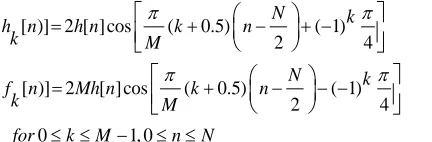
, thereby making the prototype filters linear-phase filters. The impulse response coefficients of the synthesis and analysis filters, respectively, are obtained by applying a cosine modulation in the following manner [16]:[ )] 2 [ ]cos ( 0.5) ( 1)
2 4
[ )] 2 [ ]cos ( 0.5) ( 1)
2 4
0 1, 0
N k
h n h n k n
k M
N k
f n Mh n k n
k M
for k M n N
(14) with N being the order of the prototype filter. When
comparing (14) with the conventional definition of
f n
k[ ]
(see,e.g., [9]), additional constant M is included in (14) due to the following reasons:
To guarantee the maximum magnitude value in the pass band of the up-sampler and each synthesis filter approximately equal to unity.
For compensating the loss of energy that occurs due to interpolation by the same factor M before the kth synthesis filter, there is a need to include the constant of value M.
The constant of the value 1/M appearing in the input output transfer functions of the systems of Fig.1 and Fig. 2 can be omitted, as will be done throughout this paper.
Transmultiplexer and filterbank will be free from phase distortion if analysis filters are chosen according to
[ ]
p n hk
n= fk
N1n
1 0
1 0
M k
N n
(15)
Angles k must be chosen as
2 1
k k
2
0kM (16)
[image:3.612.314.530.260.331.2]
4 .1
k k
0kM1 (17)
V. FILTER BANK AND TRANSMULTIPLEXER QUALITY EVALUATION
Once the nearly perfect filter bank and transmultiplexer is designed, the system’s quality can be evaluated measuring the degree of closeness to perfect reconstruction. We use several quantities to measure distortion and interference parameters. When omitting the effect of the processing unit between the analysis and synthesis banks in Fig.2, the relation between the z- transform of the lth output signal is expressible in terms of the z-transforms of the input signals, denoted by Xk(z) for the kth input
signal , as [16]:
1
0
ˆ ( ) ( ) ( ),
M
l lk k
k
X z T z X z
(18) where
1
1/ 1/
0
( ) ( ) ( )
M
M m M m
lk l k
m
T z H z W F z W
(19)
with Wej2 /M for k0,1, 2...M1.Tlk( )z is the transfer
function between the lth output and the kth input in Fig.2, where the channel filter is assumed to be ideal, that is ( ) 1C z .
For the FB system of Fig.1, the relation between output signal
( )
y n
and input signalx n
( )
is expressible in the z-domain as[16]:
(20) where
1
0 0
( ) ( ) ( )
M
k k
k
T z H z F z
(21)
Is called the distortion transfer function and determines the distortion caused by the overall system for the unaliased component X(z) of the input signal and peak to peak amplitude distortion is given by:
(22)
and total aliasing distortion is given by [20] as:
[0, ]
max ( j ) ,
a l
E T e
(23) where
1
0
( ) ( ) ( )
M
j l
l k k
k
T e F z H zW
(24)
for
l
0,1, 2...
M
1
are called the alias transfer functions .For the NPR system, the kth input signals for
k
l
has effects on the lth output. This is called interchannel interference (ICI) and can be measured by the quantity:
1 2
0 1 [0, ]
0,
max max ( )
M
j
ici lk
l M
k k l
E T e
(25)The delay for data samples passing through the single channel is not exactly K, resulting in the fact that the transmitted sample does not occur at the output at the right time instant. In addition other transmitted samples have an effect on the output sample at this time instant. This error is called intersymbol interference (ISI) and can be measured conveniently in the time domain by the quantity:
20max1 [ ] [ ]
isi ll
l M n
E t n n K
(26)Here, t nll[ ] is the impulse response between the lth output
and input sequences, K is delay and
[ ]
n
is the unit sample.VI. DESIGN EXAMPLES AND DISCUSSION
In this example, an eight- channel CMFB and TMUX have been designed using new Cosh window. Stop band attenuation is
kept at -100 dB. Stop band frequency is
M s
2 1
and
pass band frequency is
M p
2 1
. Overlap of the subbands is influenced by the roll-off factor ρ. With above specifications prototype filters are designed result in filter length 65, 97 and 129 respectively for roll-off factor 1.75, 1.15 and 0.86. Different performance parameters at two different spline function order μ=1 and μ=27 with modified objective functions as given in Eq. (12) and Eq. (13) are listed in Table 1 and Table 2.
As seen from Table 1, the modified creusere- mitra objective function φCMA as given by Eq. (12) provides best behavior at μ=1
in terms of aliasing distortion and at μ=27 in terms of amplitude distortion parameter and ICI parameters for different values of N. Minimum values of amplitude distortion parameter equal to 2.90x10⁻³ is obtained at spline function order μ=1 & N=96 and minimum value of aliasing ,ICI and ISI parameter is obtained at μ=27 with N=128. It may be concluded that with higher order spline function, Cosh windowed design provides better performance by lowering amplitude distortion while lower order spline function improves the performance in terms of ICI, ISI and aliasing. Same is true for systems designed by Cosh window function and another objective function φKWA. In this approach
minimum value of amplitude distortion parameter is 3.2x10⁻³ at μ=27, N=128, minimum value of aliasing distortion is -103.95dB at μ=1 and N=128 is obtained. Minimum ICI is at μ=1, N=96 and
1
0 1
ˆ ( ) ( ) ( ) ( ),
M
l l
l
X z T z T z X zW
0
0
[0, ] [0, ]
max ( j ) min ( j )
amp
E T e T e
ISI parameter is minimum and equal to -74.25dB is for μ=1 and N=128.
Among all the designs, best behavior is obtained at μ=1 with aliasing distortion parameter equal to -117.07 dB, for N=128 and amplitude distortion parameter 3.0x10⁻³ for N=96 at μ=27.Minimum ICI and ISI are obtained for μ=1 at N=128 shows the best behavior. Compared to previously reported design, proposed design leads in terms of aliasing distortion, ICI and ISI parameters in most of the cases, while amplitude distortion is comparable. Fig.4 (a-h) show the plots of magnitude response of optimized prototype filters, eight-analysis filters, amplitude and aliasing distortion parameters.
Application to subband coding-Initially, the concept of subband coding was used in speech processing to reduce the effect of quantization noise in speech [9]; now, it is being used in several other fields. Among all the, FBs, the CMFB is one of the most frequently used FB in audio coding [21-23] and ECG signal processing [24-27]. In these applications, CMFBs are used to decompose the input signal in uniform bands. For these FBs with high stop band attenuation and efficient switching resolution are required. Here the proposed window based method has been used for subband coding of ECG and speech signals. The performance is evaluated in terms of fidelity assessment parameters as given below [28]:
Percent root mean square difference (PRD):
PRD
2
2
100%
n n
x n
y n
y n
Mean square error (MSE):
MSE
2
1
( )
( )
2
Nx n
y n
Maximum error (ME):
ME
max ( )
( )
n
x n
y n
Signal-to- noise ratio (SNR): SNR
energy if input signal
10 log10
energy of the reconstructed error
2
2
( )
10 log10
( )
( )
x n
x n
y n
ECG record has been obtained from the MIT-BIH database. Assumed data sample rate is 250 Hz, and the waveform period is about 130 samples. Before processing the ECG signal base line
drift has been subtracted. Speech signal is obtained from Signal processing Toolbox of MATLAB. It contains signal of duration 4001 samples with sampling rate = 7418 Hz.
An eight- channel CMFB is designed using proposed Cosh window with As = -85dB, ρ = 1.2, spline function order μ = 1 and
27 and with objective functions given by Eq.(12) and Eq.(13). The results are listed in Table 3. Fig.5 (a-h) shows the plot of the original ECG, original speech signal and reconstructed ECG at μ = 1 by φCMA and φKWA approach and reconstructed speech signal
at μ = 1 by φCMA and φKWA approach. An ECG and speech signal
is passed through the filterbank that decomposes the signal into eight- uniform subbands. At the transmitting end all the subband signals are decimated at critical sampling rate. At the receiving end all decimated signals are first up sampled by the same factor and then applied to synthesis filterbank. Outputs of all the synthesis filters are then added to produce the final output i.e. reconstructed signal. Quality of reconstructed signal is evaluated in terms of different fidelity assessment parameters like PRD, MSE, ME, and SNR as listed in Table.3.
It is evident that small fluctuations (of the same order of magnitude) were observed for the measures. Obtained average values for the PRD, MSE, ME and SNR are 1.232x10⁻¹, 9.054x10⁻⁴, and 1.370x10⁻⁸and 63.3125 respectively for ECG signal and 1.2895x10⁻¹, 1.93275x10-4,5.3855x10-7 and 65.585 for speech signal.
VII. CONCLUSION
A simple and efficient method of prototype filter design has been proposed that exploits spline function in the transition band of ideal filter. Prototype filter is designed by new Cosh window and modified objective functions, application is being extended to CMFB and TMUX designs. With univariat unconstrained optimization different designs have been obtained and performance parameters are evaluated for two different spline function order. Simulation results show that proposed window based design are superior at spline function order = 1 in terms of aliasing distortion, ICI and ISI parameters. Amplitude distortion is comparable. It gives good fidelity assessment parameters when used for subband processing of the ECG and speech signal. Therefore it can be very effectively used in designing CMFBs and TMUXs.
REFERENCES
[1] Crochiere R.E and Rabiner L.R.: Multirate Digital Signal Processing, Englewood cliffs, NJ: Prentice – Hall, 1983.
[2] Vetterli M.: “Filter banks allowing perfect reconstruction”, Signal Processing, Vol. 10, pp. 219-244, April 1986.
[3] Vetterli M.:“A theory of multirate filter banks”, IEEE Trans. Acoust., Speech, Signal Processing, Vol. ASSP 35, pp. 356-372, March 1987. [4] Vaidynathan P.P.:“Theory and design of M channel maximally decimated
quadrature mirror filters with arbitrary M, having the perfect reconstruction property”, IEEE Trans. Acoust., Speech, Signal Processing, Vol. ASSP 35, pp. 476-492, April 1987.
[5] Chu P.L.:“Quadrature mirror filterbank design for an arbitrary number of equal bandwidth channels”, IEEE Trans. Acoust., Speech, Signal Processing, Vol. ASSP 33, pp. 203-218, Feb. 1985.
[7] Routhweiler J.:“Polyphase quadrature filters- a new subband coding technique”, in Proc. IEEE Int. Conf. Acoust., Speech, Signal Processing (Bostan, MA), pp. 1280-1283, April 1983.
[8] Masson J. and Picel Z.:“Flexible design of computationally efficient nearly perfect QMF banks”, in Proc. IEEE Int. Conf. Acoust., Speech, Signal Processing (Tampa, FL), pp. 14.7.1-14.7.4, Mar. 1985
[9] P.P.Vaidyanathan, Multirate Systems and Filterbanks, Prentice-Hall, Englewood Cliffs, NJ, 1993.
[10] Basu S.: “Multi-dimentional filter banks and wavelets- a system theoretic perspective, journal of Franklin Institute, Vol.335B (8), pp. 1367-1409, 1998.
[11] Tkacenko A.and Vaidynathan P.P.: “The role of filter banks in sinusoidal frequency estimation,” journal of Franklin Institute, Vol.343 (6), pp. 699-704, 2006.
[12] Zhange L. and Makur A.: “Comments on multi-dimentional filter banks and wavelets- a system theoretic perspective,” journal of Franklin Institute, Vol.338, pp. 517-547, 2001.
[13] Kuo S.M. and Kunduru J.:“Multiple reference subband adaptive noise canceller for hand free cellular phone applications,” journal of Franklin Institute, Vol.338(5), pp. 669-689, 1996.
[14] Maxwell K.:“A symmetric digital subscriber line: Interim technology for the next fourty years,” IEEE Trans. Signal Processing , Vol.34, no.10, pp. 100-106, October 1996.
[15] Yunho J., Jiho K., Seongjoo L., Hongil Y. and Jaeseok K.:“Design and implementation of MIMO-OFDM baseband processor for high speed wireless LANs,” IEEE Trans. Circuit System-II , Vol.54, no.7, pp. 631-635, Jul. 2007
[16] Cruz-Roldan F., Martin P.M., Landete J.S., Velasco M.B and Saramaki T.:,“A fast windowing based technique exploiting spline functions for designing modulated filter banks,”IEEE Transaction on circuits and system-I, regular paper, Vol.56, No.1, pp. 168-176, January 2009.
[17] Avci K., Nacoroglu A.:“Cosh window familty and its application to FIR filter design”, International Journal of Electronics and Communications, Vol. 63, pp. 907-916, 2009
[18] Cresure C.D. and Mitra S.K.:, “A simple method for designing high quality prototype filters for M band pseudo QMF banks”, IEEE Trans. Signal Process,Vol. 43, No.4, pp. 1005-1007,1995,.
[19] Lin Y.P, Vaidyanathan P.P.:, “A Kaiser window approach for the design of prototype filters of cosine-modulated filterbanks”, IEEE Signal Processing Letter, vol.5, no.6, pp. 132-134, 1998.
[20] Martin P., Roldan F.C., and Saramaki T.:, “ windowing approach for the designing critically sampled Nearly Perfect Reconstruction Cosine-Modulated Transmultiplexers and Filter Bank”, Proceeding of 3rd International symposium on Image and signal processing and Analysis, Rome, Italy,pp.755-760, 2003.
[21] Marshall A., Boussakta S.: “Signal analysis of medical acoustic sounds with applications to chest medicine”, Journal of Franklin Institute , vol.344(3), pp. 230-242, 2007.
[22] Roldan F.C.,Bravo Santos A.M., Martin P.M., Jimenez-Martinez R.:, “Design of multi-channel near perfect reconstruction transmultiplexers using cosine modulated filter banks, ” Signal Processing , vol. 83, pp. 1079-1091, 2003.
[23] Mayyas K. and Aboulnasr T.:“A fast exact weighed subband adaptive algorithm and its application to mono and stereo acoustic echo cancellation,” journal of Franklin Institute, Vol.342(3), pp. 235-253, 2005. [24] Afonso V.X., Tompkins W.J., Nguyen T.Q.and Luo S.:“ECG beat detection
using filterbanks,” IEEE Transaction on Biomedical Engineering , Vol.46(2), pp. 192-202, 1996.
[25] Afonso V.X., Tompkins W.J., Nguyen T.Q., Michler K.and Luo S.:“ Comparing stess ECG enhancement algorithms with an introduction to a filter bank based approach,”IEEE Engineering in Medicine and Biology Magazine , Vol.15(3), pp. 37-44, 1996.
[26] Sun M.,Scheuer M.L., Sclabassi R.J.:“Decomposition of biomedical signals for enhancement of their time frequency distribution,” journal of Franklin Institute, Vol.337(4), pp. 453-467, 2000.
[27] Cervigon R., Sanchez C., Castells F., Blas J.M.and Millet J.:“Wavelet analysis of electrocardiograms to characterize recurrent atrial fibrillation,” journal of Franklin Institute, Vol.344(3), pp. 196-211, 2007.
[28] Jalaleddine S.M.S.,Hutchens C.G.,Strattan R. D., Coberly W.A.:“ECG data compression techniques a unified approach”, IEEE Transaction on Biomedical Engineering Vol.37(4), pp. 329-343, 1990.
[29] Berger, S.,W.,A., Antoniou.A.: “An efficient closed form design method for cosine modulated filter banks using window function”, Signal Processing, Vol. 87, pp. 811-823, 2007.
[30] Berger, S., A., W.: “A design for cosine modulated filter banks using weighted constrained least squares filters”, Digital Signal Processing, Vol. 18, pp. 282-290, 2008.
AUTHORS
First Author – Jyotsna ogale, Master of engineering
(Communication system), Samrat Ashok Technological institute, Vidisha (M.P) and email [email protected]
Second Author – Dr. Alok jain, Ph.D, Samrat Ashok
Technological Institute, Vidisha (M.P) and email [email protected].
Correspondence Author – Jyotsna ogale, Master of engineering