ISSN 2250-3153
Effects Of Training As An Aspect Of Preparedness Of
First Responders On Efficacious Response To Terrorist
Attacks
1Katamu, C. H., 1Dr. Nabiswa, F. & 1Rev. Dr. Odhiambo, E .O. S Masinde Muliro University of Science and Technology
Department of Emergency Management Studies
DOI: 10.29322/IJSRP.9.12.2019.p9690
http://dx.doi.org/10.29322/IJSRP.9.12.2019.p9690
Abstract: Inefficacious response to terrorist attacks in Nairobi County is regularly evident in accounts of inadequate preparedness of response organization. Infighting, incompetence and long duration taken for response to attacks is recurring and costs for not addressing their preparedness level is high. This article endeavored to assess effects of training as an aspect of preparedness of First Responders on efficacious response to terrorist attacks. Findings revealed that level and type of training had effect on the preparedness of First Responders during terrorist attacks. There is no standard and coordinated training between Response organizations since they are trained to perform different roles.
Keywords: Efficacious response, preparedness capacity, terrorism
Introduction
Although multilateral instruments against terrorism have existed since 1960’s, the unprecedented reach and potential terrorists network such as Al-Qaeda, ISIS and its affiliates constitute a new danger that challenges standing tools and institutions (Jaffin & Bob, 2008). Yet pursuing a regional approach involving all stake holders in security matters is fraught with challenges. This calls for new and innovative preparedness strategies for effective response to terrorist attacks, and hence the need for this article. According to Cooper (2011), the international counter-terrorism regime continues to suffer from weaknesses such as inadequate compliance and enforcement of existing instruments and limited resources and expertise. For instance, the November 2015 Paris in France where a series of coordinated terrorist attacks occurred, in the city's northern suburb, Saint-Denis. Beginning at 21:16 pm, three suicide bombers struck outside the Stade de France in Saint-Denis, during a football match. This was followed by several mass shootings and a suicide bombing, at cafés and restaurants. Gunmen carried out another mass shooting and took hostages at an Eagles of Death Metal concert in the Bataclan theatre, leading to a stand-off with police. Attackers blew themselves up when police raided the theatre killing 130 people and injuring 100. The attacks were the deadliest on France and the European Union since the Madrid train bombings in 2004 (Faiola & Mekhennet, 2016). Shortly after the attacks, intelligence staff in multiple countries began to review electronic surveillance recorded before the attacks.It was confirmed that the French National Police met with German police and intelligence services a month before the attack to discuss suspicions that terrorists were staking out possible targets in France (Dickson, 2016).
In Africa, emerging security threats of nation states have become a source of challenge for most governments. Further complicating the security landscape is the increase in the outbreak of transnational terrorism that feeds into terrorism loop in Africa (Fisher & Richard, 2006). The growing threat of Al-Shabaab in Somalia and Boko Haram in Nigeria made Africa a region of growing terror concerns (Mona, 2015). On 14 October 2017, a massive blast caused by a truck bombing in Mogadishu, the capital of Somalia, killed at least 587 people and injured 316. The truck was detonated after it was stopped; the actual target of the attack is believed to have been a secure compound housing international agencies and troops. Though no organization claimed responsibility, officials stated that a key member of the cell that carried it out told them Al-Shabaab was responsible (Higgin & Starkey, 2015).
ISSN 2250-3153
of Baga and Doron-Baga (Bassey & Nnimmo, 2006). For instance, various responses has been adopted to combart transnational terrorism when military operations are deployed in Somalia and Nigeria but still terrorism pervades Africa, thus need for new approach in understanding the preparedness capacity of First Responders on efficacious response to terror incidents (Nossiter, 2011).
Kenya has not been exempted in the terrorist attack trends since its deployment of troops to Somalia in pursuit of Shabaab, the al-Qaida-linked Somali militant group that has abducted foreign aid workers and tourists in Kenya On October 14, 2011. Since its October intervention in Somalia, militants have executed a number of terrorist attacks in Kenyan territory. Although authorities blame Al-Shabaab for much of the violence, it has also become clear that Kenya has a domestic radicalization problem of its own. Kenyan nationals have conducted a number of recent terrorist attacks in Kenya, with many of them receiving military training from Al-Shabaab in neighboring Somalia (Mogire & Agade, 2011).
In late 2014, two attacks believed to have been carried out by Al Shabaab killed 64 persons in Mandera County. On 22 November 2014, gunmen attacked a bus traveling from Mandera to Nairobi, killing 28 persons, mostly teachers and government workers heading to Nairobi for the December holidays. On 2 December 2014, Al-Shabaab militants attacked and killed a further 36 quarry workers, many of whom were non-Muslims, near Mandera town (Macharia & Miriri, 2013). Following Al-Shabaab's latest attack in Mandera County, experts and ordinary civilians stressed that a revamp of the entire security architecture and roles of First Responders was urgent to defeat terrorism.
In April 2015, gangsters stormed the Garissa University College, killing 147 people and wounding several others. The attackers claimed to be from the Al-Shabaab militant group, and indicated that they were retaliating over non-Muslims occupying Muslim territory. The militants took several students hostage, freeing Muslims but withholding Christians. Over 500 students were in distress in the siege that took fifteen hours (Mutambo & Hajir, 2015). Akin to Westgate attack, reports suggest that members of Kenya’s security apparatus were provided forewarning of an imminent al-Shabaab attack. In addition to a number of foreign government agencies either issuing specific warnings or changing their travel advisories for the country, a number of Kenyan universities advised students and staff to be extra vigilant due to an unspecified threat. Such advisories were even issued in Garissa, where the Garissa Teachers Training College was closed amid concerns about security prior to the attack on the adjacent university campus. Yet despite these warnings, little was done to increase security provisions in a region (Zirulnick, 2015). Security forces were berated for their slow response, it took the country’s elite paramilitary unit (General Service Unit) seven hours to deploy to Garissa from their base in Nairobi. By the time they arrived, the majority of the deaths had already occurred (Torchia & Christopher, 2013).
Nairobi County has not been exempted in terrorist attack trends. A bomb flattened the Norfolk Hotel in Nairobi on New Year's Eve, killing 20 people and injuring 80 in the year 1980. An Arab group claimed responsibility, saying it was in retaliation for Kenya allowing Israeli troops to refuel in the capital en route to rescue 100 hostages being held by pro-Palestinian hijackers at Entebbe Airport in Uganda (Aronson & Samuel, 2013). After the attack, Elite Security Consultants (ESC) Officer-in-Charge Worley Reed led the search and rescue efforts for two days along with the ESC staff, other remaining employees and the med unit until professionals from Israel arrived to take over since it was unmanageable by Kenya first responders. Over the weekend, more U.S. government personnel and others, such as the Israelis, deployed to help. The Federal Bureau of Investigation (FBI) arrived to investigate and finds that there was no recordings during the occurrence of the terror act (Nossiter, 2011).
On Saturday 21 September 2013, Al-Shabaab militants stormed Westgate shopping mall, an upscale mall in Nairobi, throwing grenades and firing indiscriminately at shoppers. The subsequent siege lasted 80 hours and resulted in at least 67 deaths and more than 175 people were reportedly wounded in the mass shooting (McConnell & Tristan, 2015). Two weeks on, a detailed investigation based on interviews with survivors, their relatives, security forces and officers involved in the operation reveals how infighting, incompetence and a fatal friendly fire incident undermined the response and left the attackers free to prolong their slaughter (Sageman, 2004). Further political post-mortem, evidence surfaced of how both local and foreign intelligence had provided Kenyan officials with forewarning of a potential al-Shabaab attack in the capital yet little was done to increase security provisions in the city (Hoffman, 2006).
ISSN 2250-3153
preparedness of First Responders on efficient response to terrorists attack. Although several measures have emerged to promote security and deter terrorism, there seems to be a discernable gap in how often agencies responsible for first response, prepare its personnel during terrorist attacks (John, 2010). Of much weight is the fact that First Responders to emergencies vary a continuum in terms of organizational strength, their level of dysfunction can represent variable mixture of inadequate preparedness capacity for efficacious response to terrorist attacks.
Training as an aspect of preparedness
Training include tests of the proposed response operations (Alan, 2002). Emergency drills and exercises provide a setting in which operational procedures can be tested. They also facilitate inter organizational contact, thus allowing individual members to better understand each other’s professional capabilities and personal characteristics. Furthermore, multifunctional exercises constitute a simultaneous and comprehensive test of emergency plans and procedures, staffing levels, personnel training, facilities, equipment, and materials.
The study of human dealing with training confirms that to have an action to be second or done without thinking, you must do that action thousands of times. Police are trained in drawing and firing their weapons over and over so that when they are in fight a flight mode, they draw the weapon come directly in target, and fire until the thread is neutralized. The training is refreshed each time an officer goes for fire aims recertification. In Kenya, we give the emergency security personnel basic training and not basically refreshing them on evolving security threats like terrorism response in relation to changing trends. They are not experienced in doing anything other than traditional firefighting duties (Fisher & Richard, 2016). Enhancing coordination with the private sector is critical for ensuring the preparedness of the Nairobi County for protecting vital infrastructures (utilities and transportation). The 2013 West Gate attack in Nairobi survey provides indication of how much coordination is occurring between emergency responders and the private sector. This limited interaction with the private sector, either in sharing threat information or in participation in joint preparedness activities that is: planning and training contributes to confusion during response to terrorism since every organization operates differently thus contributing to inadequate response due to lack of preparedness (Deflem, 2006).
Organizational culture
An organizational culture determines how individual within the organization behave and how they expect others to behave. More importantly, it drives the way the organization conduct business and interacts with the wider community (Pape & Robert, 2003). Consequently, Alan (2002) argues that organizational culture can hamper effective cooperation between agencies. With time, an organizational culture can create an even more complex set of rules and encompass a wider set of beliefs that discourage agencies within First Responders community from even seeking to share training (Alan, 2002).
Absence of central body to coordinating response
Different security departments in disaster management have tended to react to disaster situations in their own departmental way in disregard to the benefits of a systematically coordinated approach. Within the various actors, each has its own strengths and weaknesses that determine the success or failure of the techniques they employ in disaster management and risk reduction (Decker & Russell, 2011), have argued, institutional complexities complicate complex emergencies still further while in some cases, aid has fuelled conflict due to poor coordination for efficacious response to terrorists attack. That disaster management agencies in the country doesn’t deliver their services in a systematic manner to avoid confusion at a time when coordination is most crucial for success in Nairobi County, since individual response agencies developed their protocols separately, and subsequently developed their terminology separately. This can lead to confusion as a word may have a different meaning for each organization (Decker & Russell, 2011)
It was the beginning of a chaotic and what many Kenyans now call a bungled reaction by the national security services to one of the most chilling terrorist attacks this country has ever suffered, in which more than 60 men, women and children were killed. Police officers and soldiers could not communicate with each other their radios were on different frequencies. Rescuers did not have blueprints for several hours, relying instead on printouts of rough floor plans from the Westgate Web site that is, when it had not crashed as people around the world overloaded the site thus giving the assailant’s time on their hands to kill civilians (Kangethe, 2013).
Systems model
ISSN 2250-3153
mechanism and emergent properties (Baird, 2010). Terrorism occurrence can highlight the efficiency of the governmental system because the authority in charge, are facing the short time and the limited sources while they are being forced to continue to help the victims. Because terrorism reveal not only the structural strengths and limitations of the physical environment of a community but also how local, state and national response organizations function effectively and ineffectively. Therefore, the countries which have not structured comprehensive and strategic plan would be confronting more problems than other countries.
In spite of terrorism unpredictability, the governments can be prepared beforehand in order to cope with incidents. Recent terrorism had significant impacts on people’s health and the loss of people's lives which could be controlled by appropriate management techniques. Intervention by the absence of comprehensive and fundamental planning will have unpredictable, unexpected and subsequently unaccepted consequences (Sublette & Carey, 2014). Services are found disrupted right at the time they are most needed, so strategic planning has to include some solutions in order to minimize these types of operation disruptions in times of crisis and disasters. Strategic planning provides the appropriate infrastructure for integrated, coordinated decision making following disasters such as terrorism. Hence, applying Strategic planning to disaster management can reduce the impact of terrorism on the community which results in reducing the number of casualties and disabilities. As emergency and crisis management imply, an effective emergency response and recovery operation in terrorism requires establishing vital collaborations and communications within the system and between the system and its environment. A major contribution of the strategic planning process to emergency and disaster management is the necessity of monitoring the nature and changing character of external forces and their impacts on the operations of an organization. Emergency planning is most likely to be successful when it is viewed, either explicitly or implicitly, from a systems perspective (Luhmann & Nikla, 2004).
Methods and material
Study area
The study was conducted in Nairobi County which is the capital city of Kenya. The city is situated at 1°09′S 36°39′E and 1°27′S 37°06′E and occupies 696 square kilometres (270 sq mi). Is situated between the cities of Kampala and Mombasa, and adjacent to the Eastern edge of the Rift Valley. It has the population of 4,000,000 people (Nairobi City, 2010). Nairobi is divided into a series of constituencies which are: Makadara, Kamukunji, Starehe, Langata, Dagoretti, Westlands, Kasarani, and Embakasi. The main administrative divisions of Nairobi are Central, Dagoretti, Embakasi, Kasarani, Kibera, Makadara, Pumwani, and Westlands (Nairobi City data, 2010).
The city is the regional headquarters of several international companies and organizations. In 2007, General Electric, Young & Rubicam, Google, Coca-Cola, IBM Services, Airtel, and Cisco Systems relocated their African headquarters to the city. The United Nations Office at Nairobi hosts UN Environment and UN-Habitat headquarters. Several of Africa's largest companies are headquartered in Nairobi. Ken Gen, which is the largest African stock outside South Africa, is based in the city. Kenya Airways, Africa's fourth largest airline, uses Nairobi's Jomo Kenyatta International Airport as a (Ranter, 2017). Presence of these amenities predisposes the city to terrorist attacks because of western interest.
Research Design
Researcher used descriptive survey research design in making a detailed examination since the study population was homogeneous in nature where by both qualitative and quantitative research techniques were applied. This design was bend in the study to obtain information concerning the current status of the phenomenon to describe what exists; with respect to specific variables or conditions in the situation. Kombo & Tromp, (2006) describes descriptive research design as a systematic empirical inquiry into which the researcher does not have direct control of independent variables as their manifestation has already occurred or because they inherently cannot be manipulated.
Sample size
Sample size was purposively sampled from various key informants from various institutions including:Kenya Police (General Service Unit and Anti-Terror Police Unit), National Intelligence Service, hospitals, St John’s Ambulance and fire brigades. The sample size for the study included; 22 Nairobi county fire brigade, 50 emergency medical technicians from both private and public hospitals and 76 Kenya Police (GSU and ATPU) from state actors. 22 from St. John’s Ambulance and 33 National Intelligence service was selected as non- state actors. The total sample size for the study was 203.
ISSN 2250-3153
Qualitative and qualitative data was collected through a household survey questionnaire, key informant interviews and focus group discussion were administered personally by the researcher. Observation was used to corroborate information collected using the three data instruments. Data collection instruments were developed after analysis of similar studies through literature review, deliberations with practitioners in this field.
Data analysis
Both quantitative and qualitative methods were used for data analysis. Quantitative data from the questionnaire were coded and entered into the computer for computation of descriptive and inferential statistics. Statistical Package for Social Sciences (SPSS) was used to analyze collected data.
RESULTS AND DISCUSSION
Deficiency of First Responders training in relation to response to terrorist attacks
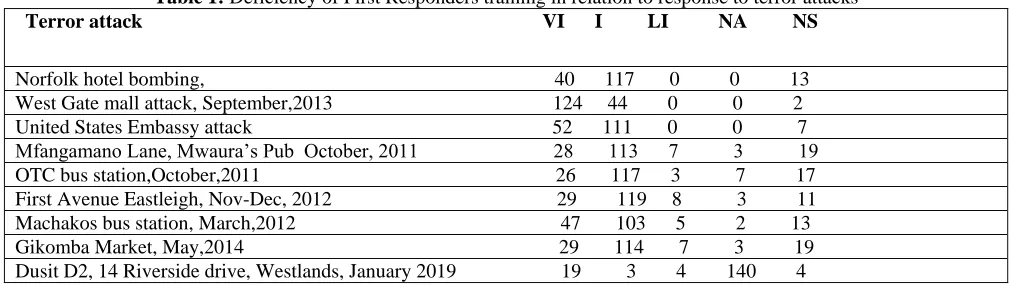
On aspect of training, responders were asked to rank their training level in relation to response to previous terrorist attacks in Nairobi County. Table 1 shows their response.
[image:5.612.53.558.279.422.2]The responses were on a likert scale where VI = means very important, I= important, LI=less important, NA=no association and NS= not sure.
Table 1: Deficiency of First Responders training in relation to response to terror attacks Terror attack VI I LI NA NS
Norfolk hotel bombing, 40 117 0 0 13
West Gate mall attack, September,2013 124 44 0 0 2
United States Embassy attack 52 111 0 0 7
Mfangamano Lane, Mwaura’s Pub October, 2011 28 113 7 3 19
OTC bus station,October,2011 26 117 3 7 17
First Avenue Eastleigh, Nov-Dec, 2012 29 119 8 3 11
Machakos bus station, March,2012 47 103 5 2 13
Gikomba Market, May,2014 29 114 7 3 19
Dusit D2, 14 Riverside drive, Westlands, January 2019 19 3 4 140 4 Source: Field data (2019)
It is noted that training include tests of the proposed response operations. As noted above, emergency drills and exercises provide a setting in which operational procedures can be tested. They also facilitate inter organizational contact, thus allowing individual members to better understand each other’s professional capabilities and personal characteristics. Furthermore, multifunctional exercises constitute a simultaneous and comprehensive test of emergency plans and procedures, staffing levels, personnel training, facilities, equipment, and materials (Ketcham & McGeorge, 2012).
The response on this aspect was based on the level of response of First Responders to terror attacks that had occurred in Nairobi County. Findings from this study showed that response to Norfolk hotel bombing was affected by deficiency with First Responders training. This was represented by a high response rate of 117 respondents (69%) who supported that training was important. A closer number of respondents (40) 24% agreed that training was very important for effective response to terror attacks by First Responders which due to poor training led to inadequate response. (13) of the respondents represented by (8%) indicated that they were not sure on this aspect. According to Nossiter (2011), that after Norfolk hotel bombing, Elite Security Consultants (ESC) Officer-in-Charge Worley Reed led the search and rescue efforts for two days along with the ESC staff, other remaining employees and the med unit until professionals from Israel arrived to take over since it was unmanageable by Kenya first responders. Over the weekend, more U.S. government personnel and others, such as the Israelis, deployed to help. That there was deficiency with First Responders training.
ISSN 2250-3153
In response to United States Embassy attack, approximately 212 people were killed, and an estimated 4,000 wounded (Bennett & Brian, 2011). The attack showed the link between training and efficacious response to terror attacks by First Responders.
Study findings indicated that 31% (52) of the respondents agreed that training was very important basing on the fact that response to U.S Embassy attack was poor due to deficiencies with First Responders training. Majority of respondents 65% (111) agreed that training was important since lack of training affected First Responders response to U.S Embassy. Majority of respondents argued that in 1998, terrorism issues was now being captured in Kenyan imaginations thus First Responders were not well aware of it. 4% (7) of the respondents indicated that they were not sure whether the attack was due to deficiency with First Responders training. Findings were supported by Dunstan & Simon (2011), that the rescue efforts were conducted by Israel Rescue team due to their specialized equipment and saved a mother and a son trapped on the 22nd floor of the Co-operative House for more than 36 hours .The response
level can measure the preparedness level between Kenya First Responders and those from other countries.
The respondents to terror attack on Mfangano Lane, Mwauras Pub indicated that training is only the first step in making all situational awareness at all time and at all incidents. This was represented by 28 (16%) of the respondents who asserted that training was very important and that lack of training is the cause of deficiencies in response to the occurring terror attacks.113 (66%) of the respondents agreed that training was important, and that Mfangano lane terror attack could be detected before the attack by Intelligence Service if were all well trained in intelligence (Respondent from field, 2019). 7 (4%) of the respondents agreed that it was less important.3 (2%) of the respondents said that training had no association with response to Mfangano lane terror attack while 17 (10%) were not sure if training had any relationship with the response to Mwauras Mfangano lane terror attack.
On OTC bus station terror attack, 26 (15%) of the respondents agreed that there is relationship between training of First Responders and response to OTC bus station terror attack, they strongly agreed that it was very important and due to deficiency in training led to occurrence of the attack. 117 (69%) of respondents admitted that deficiencies with First Responders training had a great impact in response OTC bus station attack, that lack of training affects preparedness to response to terror attacks and that is why we had the attack.3 (2%) of the respondents indicated that training in relation to OTC bus attack response was of less important, while 7 (4%) of the respondents indicated that there was no association. 17(10%) of the respondents were not sure if there is relationship between deficiencies with First Responders training and response to OTC bus station terror attack.
The respondents to terror attack on First Avenue Eastleigh indicated there was deficiencies in training in relation to response to the attack. This was represented by 29 (17%) of the respondents who asserted that training was very important and that lack of training is the cause of deficiencies in response to the First Avenue Eastleigh.119 (70%) of the respondents agreed that training was important, and that First Avenue Eastleigh terror attack could be detected before the attack by Intelligence Service if were well trained in intelligence. 8 (5%) of the respondents agreed that it was less important.3 (2%) of the respondents said that training had no association with response First Avenue Eastleigh terror attack while 11 (6%) were not sure if training had any relationship with the response to First Avenue Eastleigh terror attack.
On Machakos bus station terror attack, 47 (27%) of the respondents agreed that there is relationship between training of First Responders and response to Machakos bus station terror attack, they strongly agreed that it was very important and due to deficiency in training led to occurrence of the attack. 103 (61%) of respondents admitted that deficiencies with First Responders training had a great impact in response Machakos bus station attack, lack of training affects preparedness to response to terror attacks and that is why we had the attack.5 (3%) of the respondents indicated that training in relation to Machakos bus attack response was of less important, while 2 (1%) of the respondents indicated that there was no association. 19 (11%) of the respondents were not sure if there is relationship between deficiencies with First Responders training and response to Machakos bus station terror attack.
Out of the total number of respondents, 29 (17%) indicated that training was very important in response to Gikomba market terror attack. That lack of training affects preparedness to response to terror attacks, and that is why we had the attack. This was supported by 114 (67%) of the respondents indicating that training was important in response to Gikomba market terror attack. 7 (4%) of the respondents to terror attack on Gikomba market terror attack indicated that training was less important and that there was deficiencies in training in relation to response to the attack. 3 (2%) of the respondents argued that training deficiency was not experienced in response to Gikomba market attack by First Responders. This was indicated under no association response. 19 (11%) of the respondents were not sure if training had any relationship with the response to Gikomba market terror attack.
ISSN 2250-3153
That emergency drills and exercises provide a setting in which operational procedures can be tested. They also facilitate inter organizational contact, thus allowing individual members to better understand each other’s professional capabilities and personal characteristics and this contributes to effective response to emergencies (Ketcham & McGeorge, 2012). That, apart from security agencies failing to heed warnings of an impending attack in the weeks before the Dusit D2 complex was hit, First Responders launched a reactionary response in which through their coordination controlled the situation (Musambi & Everlyne, 2019). 140 (82%) of the respondents argued that training deficiency had no association in response to Dusit 2 complex attack, the fact that response was well coordinated by First Responders shows the effectiveness of training in response to terror attacks. 4 (2%) of the respondents were not sure if training had any relationship with the response to Dusit 2 complex terror attack.
Effect of level and type of trainingon preparedness of First Responders during terrorist attacks
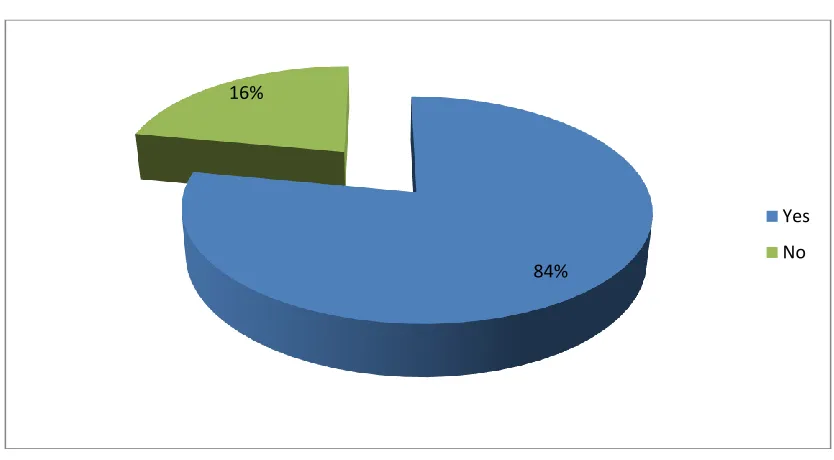
[image:7.612.97.514.194.424.2]Figure 1: shows the effect of level and type of training on preparedness of First Responders during terrorist attacks.
Figure 1: Effect of level and type of training on preparedness of First Responders during terrorist attacks Source: Author (2019)
Based on findings, 143 (84%) of the total respondents indicated that level and type of training had an effect on the preparedness of First Responders during terrorist attacks. While 27 (16%) of the total respondents stated that level and type training had no effect on the preparedness of First Responders during terrorist attacks.
Jacoby (2004), noted that training is an integral part of human resource development programme in almost all organizations. Is the cornerstone of effective management because it makes employees more efficient and productive. Untrained personnel are bound to commit errors while handling equipment resulting in incidents and improper response during terror attacks. Proper training and development programs ensure safety in handling the organization’s resources which results in reduction in the accident rates thus ensuring accomplishment of the target missions.
The need for safety managers to gather information on responders’ capabilities and training is created by the significant differences that exist among responding organizations. If safety managers could assume a common, base level of training for all responders involved at an incident, the need to gather such information would be significantly reduced. In addition to contributing directly to better safety management, not having to devote effort to gathering information on responder capabilities would allow safety managers to give more attention to other concerns (Lawrence & Lorsch, 2001).
Study on developing minimum standards for safety and health training for all Responders involved in disaster response operations especially terrorism indicated that the training curriculum should include a basic familiarity with the following: the Incident Command System approach to disaster response, common terminology for safety and health issues, an “all-hazards” perspective on the range of hazards that could be encountered during disaster response activities, relevant protective equipment, and when and how to use it, decontamination and rehabilitation processes and an overview of the diverse organizations that are likely to become involved in major disaster response. This is further supported by Curtis (2008) on counterterrorism training for transit agencies that effective integrated command systems training is function-specific training reinforcing awareness of the responsibilities and
84% 16%
Yes
ISSN 2250-3153
communication protocols to be used duringresponse to an emergency thereby improving coordination and response from external agencies.
According to Riedel (2008), Personal Protective Equipment Training as specific training should be standardized across responder organizations as much as possible to ensure that everyone has a common knowledge base. In the case of private firms, this could involve formal precertification similar to fulfilling the requirements for working on other hazardous-materials sites. Thatthere is need for pre-disaster extensive training particularly among response organizations. There is need of embracing inclusiveness in pre-disaster training and exercises since every type of responder is on the “front lines” and facing similar threats.
The ability to sustain a long response to a large-scale incident depends on the logistical capabilities that can be put in place. Including the people and organizations responsible for developing and operating logistics systems in the planning discussions can provide them with a better understanding of the needs of responders. Conversely, incident commanders can gain more accurate knowledge and expectations of which logistics capabilities are and, importantly, are not likely to be available (Kim & Yukl, 2001).
During the data collection,participants consistently made it clear that management practices at incident sites are intimately tied to protecting the health and safety of emergency responders. That their fatalities and death to their bosses was just a number which could be replaced during recruitment thus not embracing on the life and safety of their personnel. Respondents claimed that there is need for quick and effective establishment of an effective command authority over an incident site. Until such authority is established, it is difficult to address any of the other concerns about responder protection. They made clear that the plans made for establishing command over a disaster site must be sufficiently resilient and robust to handle situations that can disrupt them and also backup supervisors should be trained to take over in case of the loss of senior personnel. The West Gate mall attack response was particularly hampered by the loss of much of the key leadership and the confusion of the city’s disaster coordination centers leading to infighting between responders (Aronson & Samuel, 2013).
Curtis (2008) article on “After Mumbai: Time to Strengthen U.S. and India Counterterrorism Cooperation,” acknowledges that training should reinforce a command, control, and intelligence architecture that sustains crisis decision making and field management efforts.
Research findings corroborates Curtis (2008) that individuals trained and experienced can play the coordinating and “bridging” role among different agencies and organizations with safety responsibilities and capabilities in incident management. That playing this role successfully requires knowledge and expertise that most members of the response community are unlikely to get in the standard training available to them and their day to day operations; this suggests the need to develop specialized training and preparation efforts.
Influence of different types of training on preparedness of First Responders during terrorist attacks
During the process of data collection under training, Researcher sought to verify on the following courses if they had any influence in preparedness of First Responders during terrorists attack; refresher courses and team building, basic first aid courses, fire emergency training, medical training course, search, rescue and surveillance, incident command course and disaster management course. Figure 2 shows their response.
0% 5% 10% 15% 20% 25% 30% 35% 40% 45%
refresher courses on team building
basic first aid courses
fire emergency training
medical training courses
search,rescue and surveillance
ISSN 2250-3153
Figure 2: Influence of different types of training in preparedness of First Responders during terrorists attack Source: Field Data Analysis (2019)
Basing on the analysis, 3 (2%) of the total respondents ranked incident command as the least in relation to influence of different types of training in preparedness of First Responders during terror attacks. Followed by refresher courses on team building with 5 (3%). 9 (5%) ranked basic first aid courses and fire emergency training matching the same number of respondents as third least types of training. Medical training courses was ranked as the fourth type of training, represented by 17 (10%) of the respondents. 26 (15%) of the respondents claimed that search, rescue and surveillance was the third important aspect in regard to influence of different types of training in preparedness of First Responders during terror attacks. Disaster management course was ranked second by 34 (20%) respondents. Majority of the respondents indicated that security and intelligence courses are most important in regard to preparedness of First Responders during terror attacks with the response rate of 72 (45%). From this findings, conclusion can be drawn that security and intelligence courses is of great importance and thus affects the preparedness of First Responders and its influence to efficacious response to terror attacks. Intelligence is a key factor in countering terrorism as it can provide the means to anticipate, pre-empt and respond to this threats (Mehta, 2013).
Training personnel adequately is necessary to ensure that the organization will function satisfactorily. Research findings contradict Buchanan & Freeman (2000) on results obtained from the respondents. Respondents claimed that incident command system training was the least training to be undertaken in response to preparedness in effective response to terrorists attack. According to Buchanan & Freeman (2000), incident command system training is an important aspect of attaining effective response to disasters. That area command should include representatives from all affected agencies, such as law enforcement, public health, fire, emergency medical services, public works, and mass transit and transportation. As the response grows and becomes more complex, one of the area commands should evolve into a unified command. A unified command helps to determine each jurisdiction’s complex needs, including the need for health care, mass evacuation, and medical equipment.
Buchanan & Freeman (2000) argument became logic basing on the influence of these training on preparedness of response organizations to terrorists attack. That incident command structure addresses organizational components preparedness in counter disaster scenarios:
Direction / Control / Coordination Structure - an operational chain or basic network through which authority can be delegated and decisions implemented.
Facilities - for operations rooms, communications centers, equipment stores and personnel facilities.
Communications - the direction, control and coordination structure ensuring effective communications network (for instance, a police network) and supporting this with other networks for backup or standby emergency purposes. Existing regular broadcasting systems are, of course, invaluable for disseminating information to the public and for transmitting messages in circumstance where this is necessary.
According to Drabek (1986), the command and control framework using the Incident Command System and the National Incident Management System is sufficiently flexible to apply to the enormous challenges of an improvised nuclear device attack. The establishment of command and control starts with developing specific plans and policies ahead of time, ensuring clarity in roles and responsibilities, and planning for complex commands throughout the affected region. Command and control systems are uniquely compromised in terrorists attack incidents relative to other disasters because of the massive disruption of communications, transportation, and financial systems, the scarcity of resources, the inability to deploy first responders into the severe damage zone, and ethical dilemmas for triaging patients (Drabek, 1986).
The flexibility of an ICS enables it to be adapted to all types of emergencies including fire, Rescue and law enforcement. It can be expanded or compressed depending on the complexity of the incident. Its purpose is to prevent independent actions and chaos at the scene of the incident. If an ICS is not established immediately, other rescuers may take independent actions, which will often be in conflict. "Without organization and accountability, chaos will occur and too many people will attempt to command the incident. If you do not control the situation, the situation will control you (Bowers,1960).
Summary
ISSN 2250-3153
Responders during terrorist attacks. Some of managers who formed part of (FGD) attest that training was the cornerstone of effective management because it makes employees more efficient and productive.
Lastly, on influence of different types of training on preparedness of First Responders, majority of the respondents 72 (45%) indicated thatsecurity and intelligence courses were the most important type of courses to be undertaken by First Responders so as to prepare and plan before the attacks.
Conclusion
There is no standard and coordinated training between First Responders organizations since they are trained to perform different roles. From the findings we can conclude that security and intelligence courses are the most important type of courses to be undertaken by First Responders to effectively respond to terrorism issues since it contributes to preemptive response and this helps in thwarting terrorist activities.
Acknowledgement
The author would like to acknowledge the assistance of the representatives from the security departments both State actors and Non- state actors for their invaluable contribution through participation as key informant interviewees during the study.
References
Alan, M. (2002). Why Terrorism Works: Understanding the Threat, Responding to the Challenge (New Haven: Yale
University Press, 2002), pg.6.
Aronson, N. & Samuel, S. (2013). "Kenya and the Global War on Terror". African Journal of Criminology and Justice Studies.
Baird, M. E. (2010). "The Phases of Emergency Management". Vanderbilt Center for Transportation Research.
Bassey, S. & Nnimmo, M. (2006)."Trade and Human Rights in the Niger Delta of Nigeria". Pambazuka News. Fahamu.
Bowers, W. (1960). Surgical Philosophy in Mass Casualty Management, Springfield.
Buchanan, D. & Freeman, C. (2000). Statewide Disaster Medical Standards Development Project (Final Report), www.mvemsa.com. 2000.
Cooper, H. A. (2011). “Terrorism: The problem of the problem” Chitty‟s Law Journal 26:105- 108.
David, L. G. & Royden, J. D. (2010). The Hidden Weapon: The Story of Economic Warfare (Harper).
Decker, B. & Russell,W. (2011)."Acceptance and utilisation of the Incident Command System in first response and allied disciplines: An Ohio study". Journal of Business Continuity &Emergency Planning.
Deflem, M. (2006). Europol and the policing of international terrorism: Counter-terrorism in a global perspective.
Justice Quarterly, 23(3), 336–59.
Dickson, C. (2016). "Report: ISIS had bigger plans for Paris attacks". Yahoo! News.
Drabek, T. (1986). Human system responses to disaster: and inventory of sociological findings. Springer-Verlag.
Faiola, A. & Mekhennet, S. (2016). "Tracing the path of four terrorists sent to Europe by the Islamic State". The Washington Post.
Felter,B. & Joseph, S. (2011). Harmony and Disharmony: Exploiting Al-Qa'ida's Organizational “Evolving Terrorist Threat: Long-term Trends and Drivers and Their implication management.
Fisher, J. & Richard, D. (2016). "Kenya receives 30 Norinco VN4 armoured vehicles". Jane's Information Group. Fisher, R. A. (2005). The Genetical Theory of Natural Selection. Oxford University Press.
ISSN 2250-3153
energy consumption research produce reliable knowledge? Journal of Building Engineering, 1:2–12.
Grove, S.J. & Fisk, R.P.(2005). "Observational data collection methods for services marketing: an overview,"Journal of the Academy of Marketing Science, Vol. 20, No. 3, , p. 219.
Guest, G., Bunce, A., & Johnson, L. (2006). How many interviews are enough?: An experiment with data saturation and
variability. Field Methods, 18, 59–82.
Higgins, A. & Starkey,R. (2015). Kenya bombs Somalia to avenge campus massacre. The Times.
Hoffman, B. (2006). Role of intelligence in counter terrorism. NY: Columbia University Press. Jacoby, J. (2004). "Making the case for parochial schools". The Boston Globe.
Jaffin, B. & Bob, J. (2008). "Emergency Management Training: How to Find the Right Program". Emergency Management Magazine.
John, P. (2010)."Operation CHASE (for "Cut Holes and Sink 'Em")". Globalsecurity.org.
Kangethe, K. (2013)."Police ignored me as I exposed Westgate terrorist". Capitalfm.co.ke.
Ketcham, C & McGeorge, H. (2012). “Terrorist Violence: Its Mechanics and Countermeasures”. Lexington, MA: Heath
Kim, H. & Yukl, G. (2001). "Relationships of managerial effectiveness and advancement to self- reported and subordinate-reported leadership behaviors from the multiple-linkage model",Leadership Quarterly, vol. 6 (1995).
Kombo, S. & Tromp, P.(2006). Research Proposal Writing. Nairobi: Paulines.
Kothari, C. R. (2004). Research methodology: Methods and techniques. (2nd ed.). New Delhi: New Age international
ltd.
Lawrence, P.R. & Lorsch, J.W. (2001). Organization and Environment: Managing Differentiation and Integration. Boston,
Massachusetts: Harvard University.
Luhmann, B. & Nikla, S. (2004). Soziale Systeme: Grundrißeiner allgemeinen Theorie.
Macharia, S. & James, K. (2014)."Bombings threaten Kenya growth goals, open new strains with wary West". Reuters.
McConnell,M. & Tristan,S. (2015). "'Close Your Eyes and Pretend to Be Dead' What really happened two years ago in the bloody attack on Nairobi's Westgate Mall".
Mehta, D. (2013). "Canada offers support to Kenya after mall attack, Canadians among victims". The Canadian Press.
Mogire, E. & Agade, K. M. (2011). Counter-terrorism in Kenya. Journal of Contemporary African Studies, 29 (4), 473-491. Mona, B.( 2015)."Al Mourabitoun Claims Responsibility for Mali Siege, Al Jazeera". The New York Times.
Mutambo, A & Hajir, A. (2015)."147 killed as Garissa University College attacked by gunmen". The EastAfrican.
Nairobi City data (2010)."The Beautification of Nairobi City Project". nairobicity.org. Archived from the original on 27 January.
Nossiter, A. (2011). "Islamic Group Says It Was Behind Fatal Nigeria Attack". NYTimes.
Ombok, K. & Eric, R. (2013)."Kenya Forces Deployed at Nairobi Shopping Mall After Gunfire". Bloomberg L.P.
Otiso, K. (2009). Kenya in the Crosshairs of Global Terrorism: Fighting Terrorism at the Periphery. Kenya Studies Review:
Vol 1, Number1, Dec 2009.
Paul, M. M. & Hank, T. C. (2002). Understanding Terrorism and Managing the Consequences (Upper Saddle River, N.J.: Prentice Hall, 2002), p. 228.
ISSN 2250-3153
Perla, P. P. (1990). The Art of Wargaming: A Guide for Professionals and Hobbyists. Annapolis, Md.: Naval Institute Press.
pp. 114–118. ISBN0870210505. Retrieved 16 January 2015.
Raugh, B & David, N. (2016). "Is the Hybrid Threat a True Threat?". Journal of Strategic Security. 9 (2): 1–13.
Ranter, H. (2017)."ASN Aircraft accident Fokker 50 5Y-CET Nairobi Jomo Kenyatta International Airport (NBO)". aviation-safety.net.
Riedel, B.(2008)."Modeled on Mumbai? Why the 2008 India attack is the best way tounderstand Paris". Brookings.
Curtis, M.(2008). Emergency department disaster preparedness: Identifying the barriers.Annals of Emergency Medicine 44(4).
Sageman, M. (2004). Understanding Terror Networks. Philadelphia: University of Pennsylvania. Press. Ch. 5 pp. 158-161.
Sublette, P. & Carey, E. (2014). "Nuclear Weapons Frequently Asked Questions (Section 1)"
Szoldra, P. (2002)."These 17 Agencies Make Up The Most Sophisticated Spy Network In The World". Business Insider.
Talan, D.& Moran, G. (1998). Emergency ID NET: An emergency department-based emerging infections sentinel network.
Annals of Emergency Medicine 32(6):703–711.
Torchia,K. & Christopher, F. (2013)."Kenya mall attack echoes 1980 hotel bombing". Associated Press.
Wenger, D. & Drabek, E. (1987). “Emergency Preparedness and Response Planning: An Overview of Seismic Policy Issues.” Preliminary Paper No. 121. Newark, Del.: University of Delaware: Disaster Research Center.
Wright, L. (2006). Looming Tower: Al Qaeda and the Road to 9/11. New York: Knopf. p. 272.
Yossi, M. (2011)."Setting the record straight: Entebbe was not Auschwitz". Haaretz. Archived from the original on 27 December 2012.