http://www.scirp.org/journal/jamp ISSN Online: 2327-4379
ISSN Print: 2327-4352
An Alternating Direction Nonmonotone
Approximate Newton Algorithm for Inverse
Problems
Zhuhan Zhang, Zhensheng Yu, Xinyue Gan
University of Shanghai for Science and Technology, Shanghai, China
Abstract
In this paper, an alternating direction nonmonotone approximate Newton algorithm (ADNAN) based on nonmonotone line search is developed for solving inverse prob-lems. It is shown that ADNAN converges to a solution of the inverse problems and numerical results provide the effectiveness of the proposed algorithm.
Keywords
Nonmonotone Line Search, Alternating Direction Method, Bound-Constraints, Newton Method
1. Introduction
We consider inverse problems that can be expressed in the form
( )
21 min
2 Ax b− +φ Bx , (1)
where A∈Rm n× ,B∈Rm n× , :φ Rm→ −∞ ∞
(
,)
is convex, and mb∈R . The emphasis of
our work is on problems where A and B have a specific structure. It can be applied to many applications, especially in machine learning [1][2], image reconstruction [3][4] or model reduction [5]. We assume that the functions in (1) are strictly convex, so both problems has an unique solution *
x .
In Hong-Chao Zhang’s paper [6], he uses the Alternating Direction Approximate Newton method (ADAN) based on Alternating Direction Method (ADMM) which ori-ginaly in [7] to solve (1). He employs the BB approximation to increase the iterations. In many applications, the optimization problems in ADMM are either easily resolvable, since ADMM iterations can be performed at a low computational cost. Besides,
com-How to cite this paper: Zhang, Z.H., Yu, Z.S. and Gan, X.Y. (2016) An Alternating Direction Nonmonotone Approximate New-ton Algorithm for Inverse Problems. Journal of Applied Mathematics and Physics, 4, 2069- 2078.
http://dx.doi.org/10.4236/jamp.2016.411206
Received: October 28, 2016 Accepted: November 27, 2016 Published: November 30, 2016
Copyright © 2016 by authors and Scientific Research Publishing Inc. This work is licensed under the Creative Commons Attribution International License (CC BY 4.0).
http://creativecommons.org/licenses/by/4.0/
bine different Newton-based methods with ADMM have become a trend, see [6][8][9], since those methods may achieve the high convergent speed.
In alternating direction nonmonotone approximate Newton (ADNAN) algorithm developed in this paper, we adopt the nonmonotone line search to replace the tradi-tional Armijo line search in ADAN, because the nonmonotone schemes can improve the likelihood of finding a global optimum and improve convergence speed in cases where a monotone scheme is forced to creep along the bottom of a narrow curved val-ley in [10].
In the latter context, the first subproblem is to solve the unconstrained minimization problems with Alternating Direction Nonmonotone Approximate Newton algorithm. The purpose is to accelerate the speed of convergence, and then to project or the scale the unconstrained minimizer into the box
{
w∈Rm:l≤ ≤w u}
, The secondsubprob-lem is a bound-constrained optimization probsubprob-lem.
The rest of the paper is organized as follows. In Section 2, we give a review of the al-ternating direction approximate Newton method. In Section 3, we introduce the new algorithm ADNAN. In Section 4, we introduce the gradient-based algorithm of the second subproblem. A preliminary convergence analysis for ADNAN and gradient- based algorithm (GRAD) is given in Section 5. Numerical results presented in Section 6 explain the effectiveness of ADNAN and GRAD.
2. Review of Alternating Direction Approximate Newton
Algorithm
In this section, we briefly review the well-known Alternating Direction Approximate Newton (ADAN) method which has been studied in the areas of convex programming and image reconstruction see [4][6] and references therein.
We introduce a new variable w to obtain the split formulation of (1):
( )
2 ,1
min s.t. , ,
2
n m
x w Ax b− +φ w w=Bx x∈R w∈R (2)
The augmented Lagrangian function associated with (2) is
(
)
1 2( ) (
)
2, ,
2 2
L x wλ = Ax b− +φ w +λ Bx−w +β Bx−w (3)
where β>0 is the penalty parameter, b∈Rm is a Lagrangian multiplier associated
with the constraint w=Bx. In ADMM, each iteration minimizes over x holding w
fixed, minimizes over w holding x fixed, and updates an estimate for the multiplier b. More specifically, if λk is the current approximation to the multiplier, then ADMM
[10][11] applied to the split formulation (3) is given by the iteration:
(
)
1
arg min , ,
k k k
x
x + = L x w λ (4)
(
)
1 arg min 1, ,
k k k
w
w+ = L x + wλ (5)
(
)
1
k k k k
w Bx
λ + =λ +β − (6)
( )
1
arg min
k
x
x+ = f x
( )
2 21
1
2 2
k k
f x = Ax b− +β Bx−w +β λ− (7)
For any Hermitian matrix N N
Q∈R × , we define xQ2 = x Qx, , if Q is a positive
de-finite matrix, then •Q is a norm. The proximal version of (4) is
( )
1
arg min
k
x
x+ = f x
( )
2 21
1
2 2
k k k
Q
f x = Ax−b +β Bx−w +β λ− + −x x (8)
In ADAN, the choice Q=δI−A AT will cancel the Ax2 term in this iteration
while 2
Bx is retained. We replace δ by δk, where δkI is a Barzilai-Borwein (BB)
[8][12] approximation to T
A A. We can observe the fast convergence of BB
approxi-mation in the experiments of Raydan and Svaiter [13]. Moreover, δk is strictly smaller
than the largest eigenvalue of T
A A, and Q=δkI−A AT is indefinite, so the new
convergence analysis is needed. As a result, the updated version for x given in (4) can be expressed as follows:
( )
(
)
11 T T
arg min
k k
k x
x + = f x =x − A A+βB B − ∇f (9)
(
)
(
)
T T 1
: k k k k
k
f A Ax b βB Bx w β λ−
∇ = − + − + (10)
Here,
( )
1. − is the generalized inverse, T T
A A+βB B is the Hessian of the objective
f , and ∇f is the gradient of f at xk, gk = ∇f . The formula for
1
k
x + in (2) is
exactly the same formula that we would have gotten if we performed a single iteration of Newton’s method on the equation ∇f x
( )
=0 with starting guess xk. We employthe BB approximation T
k
A A≈δ I, [14] where
(
) (
)
{
}
(
)
2 1 1 min 2 1 min 2 1arg min :
max ,
k k k k
k
k k
k k
A x x x x
A x x
x x
δ δ δ δ
δ − − − − = − − − ≥ − = −
and δmin>0 is a positive lower bound for δk. Hence, the Hessian is approximated by
T kI B B
δ +β . Since a Fourier transform can be inverted in O N
(
logN)
flops. Thein-version of T
kI B B
δ + can be accomplished relatively quickly. After replacing T
A A
by δkI, the iteration becomes
1
k k
k
x + =x +d where dk = −
(
δkI+βB BT)
−1∇fkNote that by substituting T
k
Q=δ I−A A in (2) and solving for the minimizer, we
would get exactly the same formula for the minimizer as that given in (5). When the search direction is determined suitable step size αk along this direction should be found to determine the next iterative point such as k 1 k
k k
x+ =x +α d .
The inner product between dk and the objective gradient at xk is
(
2 2)
,
k k k k k
f d δ d β Bd
It follows that dk is a descent direction. Since f is a quadratic, the Taylor expan-sion of
( )
k 1f x+ around k
x is as follows:
( ) ( )
21 1 1 1
,
2
k k k k k k
k H
f x+ = f x + ∇f x + −x + x+ −x
where H =A AT +βB BT
Algorithm 1. Nonmonotone Line search
In this section, we adopt a nonmonotone line search method [9]. The step size αk is chosen in an ordinary Armijo line search which could not admit the more faster speed in unconstrained problems [12]. In contrast, nonmonotone schemes can not only im-prove the likelihood of finding a global optimum but also imim-prove convergence speed.
Initialization: Choose starting guess x0 , and parameters 0≤ηmin≤ηmax ≤1, 0<m<σ< <1 ρ, and u>0. Set C0 = f x
( )
0 , Q0 =1, and k=0.Convergence test: If f x
( )
k sufficiently small, then stop.line search update: set xk+1=xk+αkd dk, k =0,where αk satisfies either the (non- monotone) Wolfe conditions:
(
k k k)
k k( )
k k,f x +α d ≤C +mα∇f x d (11)
(
k k k)
k( )
k kf x α d d σ f x d
∇ + ≥ ∇ (12)
or the (nonmonotone) Armijo conditions: hk
k
α =αρ , where α >k 0 is the trial step, and hk is the largest integer such that (11) holds and αk ≤µ.
Cost update: Choose ηk∈
[
ηmin,ηmax]
, and update( )
(
)
1 1, 1 1 1
k k k k k k k k k
Q+ =η Q + C+ = η Q C + f x+ Q+ (13)
Observe that Ck+1 is a convex combination of Ck and f x
(
k+1)
. Since C0 = f x( )
0it follows that Ck is a convex combination of the function values f x
( )
0 ,,f x( )
k . Thechoice of ηk controls the degree of nonmonotonicity. If η =k 0 for each k, then the line search is the usual monotone Wolfe or Armijo line search. If η =k 1 for each k,
then Ck =Ak where
( )
0 1
, 1
k
k i i i
i
A f f f x
k =
= =
+
∑
, is the average function value. Thescheme with Ck = Ak was proposed by Yu-Hong Dai [15]. As ηk approaches 0, the line search closely approximates the usual monotone line search, and as ηk ap-proaches 1, the scheme becomes more nonmonotone, treating all the previous function values with equal weight when we compute the average cost value Ck.
Lemma 2.1 If f x
( )
k dk ≤0 for each k, then for the iterates generated by thenonmonotone line search algorithm, we have fk ≤Ck≤Ak for each k. Moreover, if
( )
k k 0 f x d < and f x
( )
is bounded from below, then there exists αk satisfyingeither the Wolfe or Armijo conditions of the line search update.
3. Alternating Direction Nonmonotone Approximate Newton
Algorithm
is an unconstrained minimization problem with ADNAN, then to project or the scale the unconstrained minimizer into the box
( )
2 1 min , 2 nl w u≤ ≤ Ax−b +φ Bx x∈R (14)
the iteration is as follows:
(
)
1
arg min , ,
k k k
x
x + = L x w λ (15)
(
)
1 arg min 1, ,
k k k
l w u
w+ L x+ wλ
≤ ≤
= (16)
(
)
1
k k wk Bxk
λ + =λ +β −
(17) Later we give the existence and uniqueness result for (1).
The solution k
w to (5) has the closed-form means
(
)
arg min , ,
k
k k k k
l w u
w L x w b P Bx λ
β
≤ ≤
= = −
with P being the projection map onto the box
[ ]
l u, .Algorithm 2. Alternating Direction Nonmonotone Approximate Newton algo-rithm.
Parameter: 0.5< < <γ 1 τ ρ, >0, 0<δmin<δ0, Initialize k=1.
Step 1: If f x
( )
k sufficiently small, then set1
1 , 0,
k k k
k k
x+ =x d = δ =δ − , and
branch to Step 4.
(
)
21 min 2 1 max , k k k k k
A x x
x x δ δ − − − = −
,
(
T)
1.
k k k
d = − δ I+βB B − ∇f
Step 2: If δ αk k >δ α δk−1 k, k >max
{
δmin,δk−1}
then δmin=τδmin.Step 3: If αk accomplish the Wolfe conditions, then αk:=ταmax.
Step 4: Update x which generated from Algorithm 1.
Step 5: 1
. k
k k
w P Bx λ
β
+ = −
Step 6: 1
(
1 1)
.
k k k k
b + =b +β Bx + −w+
Step 7: If a stopping criterion is satisfied, terminate the algorithm, Otherwise k = k + 1 and go to Step 1.
Lemma 3.1: we show some criteria that are only satisfied a finite number of times, so
min
δ converge to positive limits. An upper bound for δmin is the following:
Uniformly in k, we have δmin,k ≤δk ≤max
{
δ τ, A}
where δmin,k is the value ofmin
δ at the start of iteration k and δ δ= min,1 is the starting δmin in ADAN.
Lemma 3.2: If Adk =Bdk =0, then k
x minimizes f x
( )
k .4. Algorithm 3: Gradient-Based Algorithm (GRAD)
( )
2 1 min , 2 nl x u≤ ≤ Ax b− +φ Bx w∈R (18)
And the iteration is similar with (4) (5) (6) as follows:
(
)
1
arg min , ,
k k k
l x u
x + L x w λ
≤ ≤
= (19)
(
)
1 1
arg min , ,
k k k
w
w + = L x + wλ (20)
(
)
1
k k k k
w Bx
λ + =λ +β − (21)
Compute the solution k
x from (19), k 1
(
k 1 k)
x =B− λ +P w−
Compute the solution k
w from (20),
(
A AT +B B wT)
k =A bT +βwk−1+λkSet k 1 k
(
k k)
w Bx
λ + =λ +β −
5. Convergence Analysis
In this section, we show the convergence of proposed algorithms. Obviously, the proofs of the two algorithms are almost the same, and we only prove the convergence of algo-rithm 2.
Lemma 3.1: Let L be the function in (3). The vector
(
* *)
[ ]
, n ,
x w ∈R × l u solves (2)
if and only if there exists * n
R
λ ∈ such that
(
* * *)
, ,
x w λ solves
(
* *) (
* * *) (
*)
(
)
[ ]
, , , , , , , , , n , n.
L x w λ ≤L x w λ ≤L x wλ ∀ x wλ ∈R × l u ×R
Lemma 3.2: Let L be the function in (3),
(
* * *)
, ,
x w λ be a saddle-point of L, Then
the sequence
(
k, k)
x w satisfies
(
) (
* *)
lim k, k ,
k→∞ x w = x w .
Theorem 3.1: Let
(
x wk, k)
be the sequence of iterates produced by the algorithm 2.then *
lim k k→∞x =x ,
*
lim k
k→∞w =w and
(
)
* *
,
x w is the optimal point for problem (14)
Proof From Lemma 3.1, 3.2, we obtain that
1
0, l
lim wk+ −wk = im wk−xk =0 (22)
Since we have a unique minimizer in
[ ]
l u, , so we have lim *k k
x x
→∞ = , Then, (22)
gives *
lim k
k→∞w =w which completes the proof.
6. Numerical Experiments
6.1. Parameter Settings
In Algorithm 2, the parameters β, the penalty in the augmented Lagrangian (3), are
common to these two algorithms, ADAN and ADNAN. Besides β has a vital impact
on convergence speed. We choose 4
10
β = − based on the results from W. Hager [6].
The choice τ =1.2 is a compromise between speed and stability, δmin =0.001 is large
enough to ensure invertibility.
objec-tive in (1), we ran them for 100,000 iterations. The optimal objecobjec-tive values for the three data sets were
0.1275 0.2456 0.9627
Ψ = Ψ = Ψ =
In addition, we timed how long it took ADNAN to reduce the objective error to within 1% of the optimal objective value. The algorithms are coded in MATLAB, ver-sion 2011b, and run on a Dell verver-sion 4510U with a 2.8 GHz Intel i7 processor.
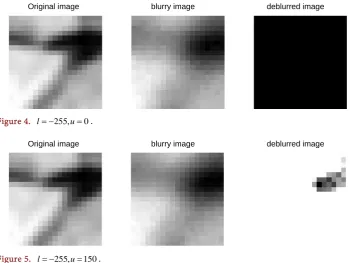
In Algorithm 3, a 256-by-256 gray-scale image was considered, which is compared to the experiment by J. Zhang [8]. The dimensions of the inverse problems are m = n = 65536 and the constraints are l= −∞ and u=
(
255,, 255)
T. The experiments onimage deblurring problems show that GRAD algorithm is also effective in terms of quality of the image resolution.
6.2. Experiments Results
This section compares the performance of the ADNAN to ADAN. The main difference
between the ADNAN algorithm and the ADAN algorithm is the computation of k 1
x + .
In ADAN k 1 k
k k
x+ =x +α d where αk is the step size. In ADNAN, x generated from
Algorithm 1, if the convergence condition in ADAN is satisfied, then the update
1
k k
k k
x + =x +α d could be performed. Here δk is the same choice for them. Hence,
there seems to be a significant benefit from using a value for δk smaller than the larg-est eigenvalue of T
A A.
The initial guess for 1
x , w1 and λ1 was zero for two algorithms. Figures 1-3
[image:7.595.195.553.539.689.2]show the objective values and objective error as a function of CPU time. Moreover, we give the comparison of objective values and objective error versus CPU time/s for dif-ferent
Ψ
conditions. It is observed that ADNAN is slightly stable than ADAN al-though ADNAN and ADAN are competitive. The ADNAN not only could get more smaller objective error but also get more fast convergence speed (see Figure 3). In ad-dition, ADNAN objective value could get more smaller after a few iterations than ADAN. As a whole, the effect of ADNAN is superior to ADAN.
Figure 2. Ψ =0.2456.
[image:8.595.192.552.63.397.2]
Figure 3. Ψ =0.9627.
On the other hand, the experiment results about Algorithm 3 are as follows:
Original image blurry image deblurred image
Figure 4. l= −255,u=0.
[image:8.595.196.547.440.703.2]Original image blurry image deblurred image
Original image blurry image deblurred image
Figure 6. l= −255,u=200.
[image:9.595.191.556.69.352.2]Original image blurry image deblurred image
Figure 7. l= −255,u=255.
7. Conclusions
According to the Figures 1-3, we can conclude that the nonmonotone line search could accelerate the convergence speed, furthermore ADNAN could get the objective values more stable and fast during the iterations when compared to ADAN.
On the other hand, the validness of GRAD is verified. Experiments results on image deblurring problems in Figures 4-7 show that difference constraints on x can also get effective deblurred images.
Acknowledgements
This work is supported by Innovation Program of Shanghai Municipal Education Commission (No. 14YZ094).
References
[1] Amit, Y. (2007) Uncovering Shared Structures in Multiclass Classification. Machine
Learn-ing, Twenty-fourth International Conference, 227, 17-24.
https://doi.org/10.1145/1273496.1273499
[2] Argyriou, A., Evgeniou, T. and Pontil, M. (2007) Multi-Task Feature Learning. Advances in
Neural Information Processing Systems, 19, 41-48.
[3] Chambolle, A. (2004) An Algorithm for Total Variation Minimization and Applications.
Journal of Mathematical Imaging and Vision, 20, 89-97.
[4] Chambolle, A. (2011) A First-Order Primal-Dual Algorithm for Convex Problems with Ap-plications to Imaging. Journal of Mathematical Imaging and Vision, 40, 120-145.
Ap-proximation with Application to System Identification. SIAM Journal on Matrix Analysis
and Applications, 31, 1235-1256.
[6] Hager, W. and Zhang, H.-C. (2015) An Alternating Direction Approximate Newton Algo-rithm for Ill-Conditioned Inverse Problems with Application to Parallel MRI. Journal of the
Operational Research Society of China, 3, 139-162.
[7] Gabay, D. and Mercier, B. (1976) A Dual Algorithm for the Solution of Nonlinear Varia-tional Problems via Finite Element Approximations. Computers & mathematics with
ap-plications, 2, 17-40.
[8] Zhang, J.J. (2013) Solving Regularized Linear Least-Squares Problems by the Alternating Direction Method with Applications to Image Restoration. Electronic Transactions on
Numerical Analysis, 40, 356-372.
[9] Zhang, H.C. and Hager, W. (2004) A Nonmonotone Line Search Technique and Its Appli-cation to Unconstrained Optimization. Society for Industrial and Applied Mathematics, 14, 1043-1056.
[10] Grippo, L., Lampariello, F. and Lucidi, S. (1986) A Nonmonotone Line Search Technique for Newton’s Method. SIAM Journal on Mathematical Analysis, 23, 717-716.
[11] Eckstein, J. and Bertsekas, D. (1992) On the Douglas-Rachford Splitting Method and the Proximal Point Algorithm for Maximal Monotone Operators. Mathematical Programming, 55, 293-318. https://doi.org/10.1007/BF01581204
[12] Barzilai, J. and Borwein, J. (1988) Two Point Step Size Gradient Methods. IMA Journal of
Numerical Analysis, 8, 141-148. https://doi.org/10.1093/imanum/8.1.141
[13] Raydan, M. and Svaiter, B.F. (2002) Relaxed Steepest Descent and Cauchy-Barzilai-Borwein Method. Computational Optimization and Applications, 21, 155-167.
https://doi.org/10.1023/A:1013708715892
[14] Block, K.T., Uecker, M. and Frahm J. (2007) Undersampled Radial MRI with Multiple Coils: Iterative Image Reconstruction Using a Total Variation Constraint. Magnetic
Re-sonance in Medicine, 57, 1086-1098. https://doi.org/10.1002/mrm.21236
[15] Dai, Y.H. (2002) On the Nonmonotone Line Search. Journal of Control Theory and
Appli-cation, 112, 315-330.
[16] Grippo, L., Lampariello, F. and Lucidi, S. (1989) A Truncated Newton Method with Non-monotone Line Search for Unconstrained Optimization. Journal of Optimization Theory
Submit or recommend next manuscript to SCIRP and we will provide best service for you:
Accepting pre-submission inquiries through Email, Facebook, LinkedIn, Twitter, etc. A wide selection of journals (inclusive of 9 subjects, more than 200 journals)
Providing 24-hour high-quality service User-friendly online submission system Fair and swift peer-review system
Efficient typesetting and proofreading procedure
Display of the result of downloads and visits, as well as the number of cited articles Maximum dissemination of your research work