TfflÜÜ
K35¡j
«I
* ij ι ¡M!EUROPEAN ATOMIC ENERGY COMMUNITY - EURATOM
«¡o; il # ¡ " ι
Ë
[BM
ΕΚ
l U t ' f i..'.«ui" w M * · ta ■
' n i1
Srtí
1800 UTILITY PROGRAMS FOR MAGNETIC
TAPES AND TELE-PROCESSING INPUT/OUTPU'
™
by
mm
m\
H.
' n m ΒΒ1Μμ>
SCHMID (Euratom)
and
CLAESSENS (IBM Belgium)
Ì
m
,M
Κν./Π*
1ÍÍ 4.ÜÍ Hi
IHIJPHSm
m
;
5ËI
1969
ÎK'il<et
pi
iiii
JtMl »δι!!ÌÌ|||
«Sii
ii»
liliP
lil
> ' ím
Joint Nuclear Research Center
Geel Establishment - Belgium
Central Bureau for Nuclear Measurements - CBNM
i»
Μ ι ™ rf ¡ . 1 1 1 'Mm
¡timé
SfÄfc
■œJWmwti^&w
« Mlíiii2^aiSS^k
Ιβ
ββ
:
Affli
ίΑΕίίίβ
LEGAL NOTICE
This document was prepared under the sponsorship of the Commission
of the European Communities.
Neither the Commission of the European Communities, its contractors
nor any person acting on their behalf :
ι
m
ÉÉÜSií
tained in this document, or that the use of any information, apparatus,
method, or process disclosed in this document may not infrige
privately owned rights; or
Make any warranty or representation, express or implied, with respect
to the accuracy, completeness, or usefulness of the information
con-mm
8
Assume any Hability with respect to the use of, or for damages resulting
from the use of any information, apparatus, method or process
disclosed in this document
aim
Ms&M
II
m
m?>$m
tf?
ùm
!f If
Wim M$MÁ$wÈÈ& '
:!»3.i;-fJ«g;
3fi mW
mk
»filial!
ddresse
i Miti '
This report is on sale at the addresses listed on cover page 4
1
at the price of F F 18.50
FB 185.
DM 14.80
Lit. 2 310
Fl. 13.45
{
Α|ί tlBi
:lK *
¡Μι!
When ordering, please quote the EUR n u m b e r and the title,
which are indicated on the cover of each report.
I
i:
;
®
Wnujyirit
iii IliÄfli
Printed by Guyot, s.a.
Mil;;,
Brussels, June 1969
This document was reproduced on the basis of the best available copy.
EUR 4263 e
IBM 1800 UTILITY PROGRAMS FOR MAGNETIC TAPES AND TELH PROCESSING INPUT/OUTPUT
by H. SCHMID (Euratom) and H. CLAESSENS (IBM Belgium)
European Atomic Energy Community - EURATOM
Joint Nuclear Research Center - Geel Establishment (Belgium) Central Bureau for Nuclear Measurements - CBNM
Luxembourg, June 1969 - 146 Pages - 6 Figures - FB 185
This report describes the following utility programs for the IBM 1800 computer :
1. Magnetic tape utility programs to execute a tape dump, tape map and tape duplication for 7 and 9-track tapes.
E U R 4 2 6 1
e
EUROPEAN ATOMIC ENERGY COMMUNITY - EURATOM
IBM 1800 UTILITY PROGRAMS FOR MAGNETIC
TAPES AND TELE-PROCESSING INPUT/OUTPUT
by
H. SCHMID (Euratom)
and
H. CLAESSENS (IBM Belgium)
1969
Joint Nuclear Research Center
Geel Establishment - Belgium
A B S T R A C T
This report describes the following utility programs for the IBM 1800 computer :
1. Magnetic tape utility programs to execute a tape dump, tape map and tape duplication for 7 and 9-track tapes.
2. Programs for a tele-processing system with magnetic tape terminals (IBM 7702) connecting the IBM 1800 system with the computers IBM 7090 and 360 (card input and output, list output and Calcomp plotter output). All programs are written in IBM 1800 ASSEMBLER language for the Time Sharing Executive System (TSX).
KEYWORDS
C O N T E N T S
1. Introduction
2. Utility Subroutines
3. Tape Utility P r o g r a m s
4. P r o g r a m s for a T e l e - P r o c e s s i n g System Connecting an
IBM 1800 System with the Computers IBM 7090 and 360
5. R e f e r e n c e s
F i g u r e s
4
-1. Introduction
/#\
This r e p o r t d e s c r i b e s some IBM 1800 utility p r o g r a m s for magnetic
tapes and t e l e - p r o c e s s i n g input/output to be used with the IBM 18 00
s y s t e m at the Central Bureau for Nuclear M e a s u r e m e n t s (CBNM) at
Geel in Belgium. The CBNM is linked via a t e l e - p r o c e s s i n g s y s t e m
to CETIS ("Centre de T r a i t e m e n t des Informations Scientifiques")',
the computer centre of E u r a t o m in Italy. This s y s t e m is based on
two magnetic tape t e r m i n a l s (IBM 77 02 with 7-track tapes) and a
leased telephone line.
The first p a r t of this r e p o r t contains the d e s c r i p t i o n of subroutines
used in the p r o g r a m s to be d e s c r i b e d . Some of these subroutines m a y
be of general i n t e r e s t for other u s e r s , for instance s e v e r a l
conver-sion routines and subroutines facilitating the use of magnetic t a p e s .
The second p a r t gives the d e s c r i p t i o n of tape dump, tape m a p and
tape duplication p r o g r a m s for 7 and 9 - t r a c k t a p e s . Because the IBM
1800 is a disk oriented computer IBM does not supply.magnetic tape
utility p r o g r a m s .
The last section of this r e p o r t d e s c r i b e s the n e c e s s a r y p r o g r a m s to
handle the input and output tapes for the IBM 77 02 t e l e - p r o c e s s i n g
system. At the side of CETIS s e v e r a l tape t r a n s l a t i o n p r o g r a m s a r e
used to operate the t e l e - p r o c e s s i n g input/output. These p r o g r a m s
a r e not d e s c r i b e d h e r e .
The following p r o g r a m s have been written:
1. P r o g r a m s performing the m o n i t o r input for the IBM 7090 under
IBSYS and for the IBM 3 60. F o r 7090 input the following options
m a y be chosen by the u s e r : Either the tape is unblocked and the
p a r i t y depends on the type of c a r d (BCD or binary) or the tapes
a r e blocked and the p a r i t y is odd. The p r o g r a m includes the
s o - c a l l e d l o o k - a h e a d - b i t s ( p r o g r a m P E P 8 ) .
Cards for the IBM 360 a r e loaded on tape with p r o g r a m P E P 7
in which each c a r d is r e g a r d e d a s a binary c a r d and no
look-a h e look-a d - b i t s look-a r e n e c e s s look-a r y .
2. Binary or BCD c a r d s loaded on tape and t r a n s m i t t e d by the
t e l e - p r o c e s s i n g s y s t e m can be punched by p r o g r a m P E P 9 or
P E P 10, depending on whether the c a r d s have been loaded by
P Ë P 8 or P E P 7 . These p r o g r a m s a r e used to t r a n s m i t object
decks or punched c a r d output from CETIS to the CBNM.
3. P r o g r a m P E P 2 p e r f o r m s the list output of the CE TIS.computers.
The t r a n s m i t t e d tape is written in BCD code (even parity) and
m a y be blocked or not. The first c h a r a c t e r of each line m a y be
used optionally as c a r r i a g e control.
4. If BCD c a r d s have been loaded on tape so that each c a r d c o r
-responds to 80 BCD c h a r a c t e r s on tape (the r e c o r d s m a y be
blocked or not) p r o g r a m P E P 1 1 p e r f o r m s the following
func-tions: it r e a d s the tape and punches c a r d s a n d / o r p r i n t s a
5
-list a n d / o r t r a n s f o r m s the contents of the input tape to EBCDIC
format and w r i t e s it on magnetic tape which is compatible with
IBM 1800 FORTRAN. This p r o g r a m s e r v e s mainly to p r o c e s s
tapes from other computer c e n t e r s .
5. Some of the CBNM p r o g r a m s sent to CETIS utilize the Calcomp
subroutines of CETIS (l). These subroutines produce an output
tape, the format of which i s d e s c r i b e d in (2). In o r d e r to plot
these tapes with the IBM 1800 computer t h r e e different p r o g r a m s
can be used depending on the plotter operation mode:
a) Off-line u s e of the Calcomp digital i n c r e m e n t a l plotter with a
Calcomp magnetic tape unit 570. P r o g r a m TRAN t r a n s l a t e s
the plotter tapes of CETIS into original Calcomp code.
b) On-line operation of the Calcomp plotter a s a slow input/output
device. P r o g r a m P7090 r e a d s the magnetic tape and o p e r a t e s
the plotter on-line.
c) On-line operation of the Calcomp plotter in t i m e - s h a r i n g mode.
P r o g r a m T7090 t r a n s l a t e s the plotter tapes of CETIS to a
magnetic tape format, which i s compatible with the on-line
plotting s y s t e m of the CBNM Geel (3).
All p r o g r a m s a r e written in ASSEMBLER language and r e q u i r e the
following machine configuration:
- IBM 1800, 16 K with TSX s y s t e m
- 1443 p r i n t e r
- 1816 or 1053 t y p e w r i t e r
- 1442 c a r d r e a d / p u n c h
- 2402 magnetic tape units with 7 or 9 t r a c k s (up to 4 units can be
handled)
Calcomp plotter
6
-2. Utility Subroutines
All subroutines save the t h r e e index r e g i s t e r s , but do not save
a c c u m u l a t o r , Q - r e g i s t e r and status i n d i c a t o r s . In all c a s e s the
calling sequences differ from the standard method of IBM 1800
FORTRAN. Therefore the subroutines a r e only to be used by
ASSEMBLER written m a i n p r o g r a m s .
2. 01 MOVE
E n t r y points with calling sequences:
CALL
DC
DC
DC
MOVE
ORG
DEST
n (word count)
CALL
D C
D C
D C
MOVEI
ORG1
DEST
n (word count)
Subroutines called by MOVE:
none
Core locations used:
46 (2E hexadec. )
Description:
MOVE A n u m b e r of n w o r d s , starting at location ORG a r e moved
to an a r e a starting at location DEST. DEST m u s t be g r e a t e r
than or equal to ORG.
7
-2. 02 CHIF
Entry points with calling sequences:
LD
CALL
DC
A
CHIF
DEST
LD
CALL
D C
A
CHIF1
DEST
Subroutines called by CHIF: HOLPR χ . - „ . . . ,
BINDC
) I B M 1 8° °
l l b r a ry
MOVE
Core locations used: 8 0 (50 hexadec. )
Description:
CHEF The positive number in the accumulator is converted to
p r i n t e r code and moved to DEST and DEST+1 with t h r e e
digits right-hand side adjusted. Leading z e r o e s and the
sign a r e suppressed.
8
-2. 03 PAGE
E n t r y points with calling sequences:
LIBF PAGE LIBF
DC AREA DC
DC n (word count) DC
BLANK
AREA
n (word count)
Subroutines called by PAGE:
PRNTN
CHIF
IBM 1800 l i b r a r y
Core locations used:
76 (4C hexadec. )
Description:
PAGE The n words from AREA to AREA+n-1 a r e set to z e r o .
AREA-1 m u s t contain the word count of the p r i n t e r
out-put a r e a . Subroutine PAGE p r i n t s on the 1443 p r i n t e r
"PAGE N", w h e r e N s t a r t s with 1 and i s i n c r e m e n t e d
by 1 each t i m e it i s called. "PAGE N" is set starting
with position AREA+n-5.
- 9
2. 04 SCAL
Entry points with calling sequence:
LIBF SCAL
DC AREA+n
DC AREA
DC n (word count)
Subroutines called by SCAL: PRNTN IBM 1800 l i b r a r y
MOVE
Core locations used: 46 (2E hexadec. )
Description:
SCAL Subroutine SCAL m o v e s a scale 123456789012. . . to the
a r e a s t a r t i n g at AREA+n . The length of the scale is n
w o r d s , i. e. 2n c h a r a c t e r s . The word count n should be
a multiple of 5, otherwise n is rounded to a multiple of
5. Location AREA-1 i s supposed to contain a word count
for the output a r e a AREA through A R E A + n . + n - l . Using
this word count the subroutine p r i n t s the scale in the
10
-2. 05 BCD
E n t r y point with calling sequence:
CALL BCD
Subroutine called by BCD: none
Core locations used: 64 (40 hexadec. )
Description:
BCD Subroutine BCD contains the table for the conversion
from BCD to c a r d code. Subroutine BCD i s called by
subroutine PRHOL.
2. 06 PRHOL
Entry point with calling sequence:
LIBF PRHOL
DC ORG
DC DEST
DC n (char, count)
Subroutine called by PRHOL: BCD
Core locations used: 44 (2 C hexadec. )
Description:
PRHOL Subroutine PRHOL converts the n BCD c h a r a c t e r s (packed
format) in a r e a ORG through ORG+n/2 - 1 to c a r d
11
2. 07 CDB CD
E n t r y point with calling sequence:
CALL CDBCD
DC AREA
DC DEST
DC n (char, count)
Subroutines called by CDBCD: none
Core locations used: 104 (68 hexadec. )
Description:
CDBCD This subroutine converts IBM c a r d code subset to
BCD code.
Input i s IBM c a r d code c h a r a c t e r s starting in location
AREA. The c h a r a c t e r s a r e not packed.
Output i s the 6-bit BCD code starting at location DEST.
BCD code is packed two c h a r a c t e r s per binary word in
bit 2-7 and 10-15, bits 0, 1, 8 and 9 a r e z e r o .
- 12
2. 08 COMPR
Entry point with calling sequence:
LD N
CALL COMPR
DC /
DC /
DC EQUBR
n
Subroutines called by COMPR: none
Core locations used: 30 (IE hexadec. )
Description:
13
-2. 09 USER
Entry point with calling sequence (only ASSEMBLER):
CALL USER
DC EOFSW
EOFSW
ERRSW
TOLSW
LNGTH
DC
D C
DC
DC
0
0
0
0
Subroutines called by USER: none
Core locations used: 38 (26 hexadec. )
Description:
USER Subroutine USER i s to be used as the special condition
routine for the r e a d operation in the MAGT routine.
It t e s t s the a c c u m u l a t o r and s e t s the switches EOFSW,
ERRSW, TOLSW and LNGTH in the following way:
EOFSW is set non z e r o if an end-of-file m a r k h a s been
read.
ERRSW i s set non z e r o if tape e r r o r s w e r e detected
TOLSW i s set non z e r o if the r e c o r d on tape was longer
than the i / O buffer.
LNGTH gives the channel word count at the end of the
operation. This length m u s t be added to the
length in the i / O a r e a to obtain the r e a l length
of the r e c o r d .
14
-2. 10 MAG
Entry point with calling sequence:
CALL
DC
DC
DC
M A G
ERRBR
EOFBR
EOFSW
Subroutines called by MAG:
MAGT
IBM 1800 l i b r a r y
USER
Core locations used:
116 (74 hexadec. )
Description:
MAG Subroutine MAG t r i e s to r e a d a magnetic tape alternatively
in even and odd parity. When after 100 r e t r i e s (with t h r e e
backspaces each tenth r e t r y ) the e r r o r still p e r s i s t s the
routine b r a n c h e s to ERRBR. If an end-of-file h a s been
detected the subroutine b r a n c h e s to EOFBR.
EOFSW i s the s t a r t a d d r e s s of the four switches used by
subroutine USER.
When entering the routine the accumulator m u s t contain
the 12 l a s t bits of t h e l / O control p a r a m e t e r needed for the
IBM l i b r a r y routine L I B F MAGT. After execution of s u b
15
-2. 11 CDTST
E n t r y point with calling sequence:
CALL CDTST
DC CARD
RETURN for CARD equal blank
RETURN for CARD not blank
Subroutines called by CDTST: none
Core locations used: 30 (IE hexadec. )
Description:
- 16
3. Tape Utility P r o g r a m s
Three different tape utility p r o g r a m s have been written:
a) Tape Dump P r o g r a m (TPDMP)
P r o g r a m T P D M P dumps a tape on the 1443 p r i n t e r . Input tape and
output code specifications a r e given by a control card.
b) Tape Map P r o g r a m (TPMAP)
P r o g r a m T P M A P a n a l y s e s the tape and p r o d u c e s a m a p of it on the
1443 p r i n t e r with specifications of length, parity, density and n u m b e r
of r e c o r d s of the different types of r e c o r d s on tape.
c) Tape Duplication P r o g r a m (TPDUP)
P r o g r a m T P D U P duplicates one tape on another. Input and output tape
specifications a r e given by control c a r d s .
3. 01 General Control Card F o r m a t
P r o g r a m s TPDMP, T P M A P and T P D U P utilize the following g e n e r a l
control c a r d format:
Col. Meaning P r o g r a m
T P D M P T P M A P T P D U P
1-2
±±
x
x
x
3 unit number (0, 1, 2, 3) χ χ χ
5 t r a c k n u m b e r (7, 9) x x
7 p a r i t y (Ο ,Ε) χ χ
9 bytes p e r word (2, 3) χ χ
11-13 density (200, 556, 800) χ χ
15-17 format specification for
l i s t p r i n t e r BCD, EBC, HEX χ
When 9 t r a c k tapes a r e specified columns 7 to 13 a r e not read. F o r m a t
specification i s only used with the tape dump p r o g r a m . Data on tape
a r e supposed to be in EBCDIC or BCD code when EBC or BCD i s s p e
cified. In that c a s e the corresponding conversion to p r i n t e r code is
used. When HEX i s specified, the tape i s dumped in hexadecimal
format.
3. 02 Tape Dump P r o g r a m T P D M P
The p r o g r a m (Fig. l) r e a d s the control c a r d and checks it. If it i s
c o r r e c t , the control p a r a m e t e r for the MAG routine i s p r e p a r e d and
a branch i s set up according to the format specification in the control
card. Then the MAG routine i s used to r e a d the r e c o r d . This routine
t r i e s to r e a d with the p a r i t y given by the control p a r a m e t e r . If an
e r r o r o c c u r s a r e t r y i s p e r f o r m e d with the other parity. When the
r e c o r d i s longer than 3000 w o r d s , only the first 3000 words will be
printed.
17
-Printout examples can be found in figure 2 (hexadecimal) and 3
(BCD or EBCDIC).
When an end-of-file m a r k i s detected the p r o g r a m p r i n t s a m e s s a g e
and waits. P r e s s i n g consol s t a r t m e a n s continuation of p r o g r a m
TPDMP, p r e s s i n g consol i n t e r r u p t a b o r t s the job.
Halts and Output M e s s a g e s
on 1816 (1053) t y p e w r i t e r
1) ±x CARD MISSING. CORRECT AND CONTINUE.
2) W R O N G TAPE UNIT. CORRECT AND CONTINUE.
3) PARITY WRONG. CORRECT AND CONTINUE.
4) W R O N G TRACK NUMBER. CORRECT AND CONTINUE.
5) W R O N G N U M B E R OF BYTES/WORD. CORRECT AND CONTINUE.
6) W R O N G DENSITY. CORRECT AND CONTINUE.
7) W R O N G OUTPUT SPECIFICATION. CORRECT AND CONTINUE.
8) END OF FILE. TO CONTINUE PRESS START,
TO EXIT CONSOL INTERRUPT.
on 1443 p r i n t e r
1) ***** END OF F I L E *****
2) ***** THIS RECORD IS TOO LONG *****
3) ***** THIS
R ' E C O R DCONTAINS ERRORS *****
3. 03 Tape Map P r o g r a m T P M A P
P r o g r a m T P M A P (Fig. 4) a n a l y s e s a tape of unknown specifications
and p r o d u c e s a m a p on the 1443 p r i n t e r . Such p r o b l e m s a r i s e when
tapes written by other computer s y s t e m s than the IBM 1800 have to
be p r o c e s s e d . S o m e t i m e s doubts exist about the parity, density,
length of r e c o r d s or the n u m b e r of files. This p r o g r a m p r o d u c e s a
complete lay-out of such a tape.
P r o g r a m T P M A P r e a d s the control c a r d specifying the unit number
and the number of t r a c k s . If 7 t r a c k s w e r e specified, the p r o g r a m
t r i e s to read s u c c e s s i v e l y in
1) 200 BPI, even p a r i t y
2) 200 BPI, odd p a r i t y
3) 556 BPI, even p a r i t y
4) 556 BPI, odd p a r i t y
5) 800 BPI, even p a r i t y
6) 800 BPI, odd p a r i t y
18
-The whole p r o c e d u r e i s then r e s t a r t e d up to 6 t i m e s . In total
3*6*6=108 r e t r i e s will be executed before the p r o g r a m concludes
a tape e r r o r . In that c a s e an a p p r o p r i a t e m e s s a g e will appear on
the listing.
F u r t h e r m o r e the different c h a r a c t e r i s t i c s of a r e c o r d i s c o m p a r e d
with those of the preceding r e c o r d and a line i s printed in the
follo-wing c a s e s :
1) 100 r e c o r d s with the s a m e c h a r a c t e r i s t i c s have been read.
2) An end-of-file m a r k was detected.
3) A change in r e c o r d length was detected.
4) A change in r e c o r d p a r i t y was detected.
5) A change in r e c o r d density was detected.
6) A r e c o r d with tape e r r o r s was encountered.
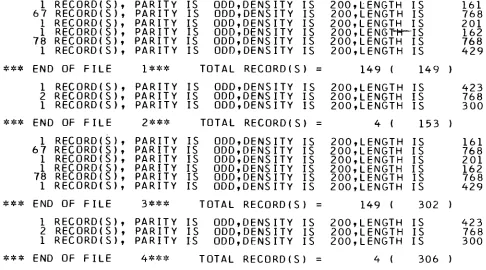
At each end of file the total n u m b e r of r e c o r d s of that file and the
total number of r e c o r d s on that tape a r e printed. F i g u r e 5 shows
a printout example. The length indication of r e c o r d s longer than
3000 words will not be c o r r e c t .
Halts and Output M e s s a g e s (on 1816 or 1053 t y p e w r i t e r ) :
1) ** CARD MISSING. CORRECT AND CONTINUE.
2) WRONG TAPE UNIT. CORRECT AND CONTINUE.
3) WRONG TRACK NUMBER. CORRECT AND CONTINUE.
4) END OF F I L E . TO CONTINUE PRESS START.
TO EXIT SET DATA SWITCH 0 ON AND PRESS START.
3. 04 Tape Duplication P r o g r a m T P D U P
The p r o g r a m (Fig. 6) s t a r t s with reading two control c a r d s specifying
the c h a r a c t e r i s t i c s of the input and output tape. When the input unit
i s identical with the output unit, a third control c a r d m u s t be provided
specifying an i n t e r m e d i a t e tape a s buffer unit. This c a s e i s usefull for
installations with only one 7 t r a c k tape unit when 7 - t r a c k tape
duplica-tions a r e to be p e r f o r m e d . In that c a s e a 9 t r a c k tape copy i s m a d e on
the buffer unit, and then this tape i s copied back on a new r e e l on the
7 - t r a c k d r i v e .
Tapes with r e c o r d s longer than 1500 w o r d s (3000 bytes) cannot be
duplicated. When the wrong p a r i t y i s specified for the input tape,
the p r o g r a m will t r y the other parity.
After each end-of-file m a r k the o p e r a t o r has the possibility to
con-tinue or to exit by setting data switch 0 O F F or ON respectively.
In the case of duplication on the s a m e unit, the p r o g r a m rewinds
both tape units and unloads the input tape. The o p e r a t o r m u s t r e
-place the original tape by a new r e e l and p r e s s consol s t a r t . Then
the r e e l on the buffer unit i s duplicated on the new one, without
19
The job ends with rewinding and unloading both tape units.
Note:
This p r o g r a m does not include 7-track tape to 7-track tape copies
with mixed parity.
Halts and Output M e s s a g e s
on 1816 or 1053
1) ±* CARD MISSING. CORRECT CONTROL CARDS AND CONTINUE.
2) UNIT ERROR. CORRECT CONTROL CARDS AND CONTINUE.
3) W R O N G TRACK NUMBER. CORRECT CONTROL CARDS AND CONTINUE.
4) W R O N G PARITY. CORRECT CONTROL CARDS AND CONTINUE.
5) W R O N G BYTES/WORD. CORRECT CONTROL CARDS AND CONTINUE.
6) W R O N G DENSITY. CORRECT CONTROL CARDS AND CONTINUE.
7) INFORMATION M A Y BE LOST.
8) END OF FILE.
9) TAPE ERRORS - EXIT.
10) TAPE RECORD TOO LONG - EXIT.
20
-4. P r o g r a m s for T e l e - P r o c e s s i n g System Connecting an IBM 1800
System with the Computers IBM 7090 and 360
4. 01 Card to Tape for T e l e - P r o c e s s i n g - Input for IBM 7090 (PEP8)
P r o g r a m P E P 8 p e r f o r m s the c a r d input for the IBM 7 090 computer,
which r e q u i r e s the following tape format: Each BCD c a r d is loaded a s
80 c h a r a c t e r s on tape followed by 4 so-called l o o k - a h e a d - b i t s . Each
binary c a r d (7-9 perforation in 1. col. ) is loaded a s 160 c h a r a c t e r s on
tape (row 12-3 of 1. col. d e t e r m i n e s the f i r s t c h a r a c t e r , row 4-9 of
1. col. the second etc. ) followed by 8 l o o k - a h e a d - b i t s .
The look-ahead bits a r e
for a BCD c a r d followed by a BCD card: bbbb
followed by a binary c a r d : 9977
for a binary c a r d followed by a BCD c a r d : b4bbblbb
followed by a binary card: b5blb5b4
where b m e a n s blank.
The u s e r can choose two different tape f o r m a t s , unblocked and blocked
r e c o r d s . In the c a s e of unblocked r e c o r d s , each BCD c a r d c o r r e s p o n d s
to a BCD r e c o r d (even parity) with a length of 84 c h a r a c t e r s , each
bina-r y c a bina-r d c o bina-r bina-r e s p o n d s to a binabina-ry bina-r e c o bina-r d (odd pabina-rity) with a length of
168 c h a r a c t e r s .
Because the t e l e - p r o c e s s i n g cannot t r a n s m i t r e c o r d s in mixed mode and
t r a n s m i s s i o n time i s d e c r e a s e d by t r a n s m i t t i n g blocked r e c o r d s , the
following format h a s been chosen: Up to a m a x i m u m length of 840 c h a r a c
-t e r s a r e blocked, p a r i -t y i s always binary.
A 7/8 c a r d i s r e g a r d e d as a BCD card.
F u r t h e r m o r e the p r o g r a m has the possibility to recognize special control
c a r d s of CETIS and completes the $ID c a r d (control c a r d for IBM 7090
under IBSYS) in the following way:
$ PUNCH s e t s a 12-perforation in col. 4 of the $ID c a r d
$ TIME XXX sets the t i m e XXX in col. 47-49 of the $ID c a r d
$ LINES XXX s e t s the l i n e s XXX in col. 51-53 of the $ID c a r d
$ FORTRAN 2 (VERS. 2) s e t s a 2-perforation in col. 4 of the $ID c a r d
$ DUMP I F EXECUTION TIME OVERFLOW
sets a 0-perforation in col. 5 of the $ID c a r d
Card input for P E P 8 :
1. Control c a r d
col. 1-2 ±*
3 F Normal c a r d to tape without recognition of special
control c a r d s for IBM 7090
blank Card to tape with recognition of the special control
c a r d s of CETIS and completion of the $ID card. A
l i s t of the $ID c a r d s i s printed on the 1443 p r i n t e r .
4 G The output tape i s not blocked. Each c a r d c o r r e s
21
-blank The output tape i s blocked, p a r i t y i s binary,
m a x i m u m r e c o r d length i s 840 c h a r a c t e r s .
2. Complete input deck for one o r s e v e r a l jobs for IBM 7090.
3. L a s t c a r d :
col. 1-3 END This c a r d causes an end-of-file m a r k to be
written on tape. The p r o g r a m p r i n t s the total
number of r e c o r d s and the t r a n s m i s s i o n time.
P r e s s i n g consol s t a r t causes continuation of
p r o g r a m P E P 8 starting by reading a new control
card, p r e s s i n g consol i n t e r r u p t a b o r t s the job.
Halts and output m e s s a g e s (on 1816 or 1053 t y p e w r i t e r ) :
1) THE CONTROL CARD IS MISSING OR WRONG. CORRECT AND CONTINUE.
2) TO CONTINUE PRESS START
22
4. 02 Card to Tape for T e l e - P r o c e s s i n g - Input IBM 360 (PEP7)
P r o g r a m P E P 7 r e a d s c a r d s of any type and s t o r e s them as 160
c h a r a c t e r s on a 7-track tape (unit 0), format i s binary, density
i s 200 c h a r a c t e r s / i n c h . R e c o r d s a r e blocked to a m a x i m u m of 800
c h a r a c t e r s (= 5 c a r d s ) . The input deck m a y also contain c a r d s b e
-ginning with / / b . No control c a r d s a r e needed except for the l a s t
card, the c a r d END in col. 1-3, which c a u s e s an end-of-file m a r k
to be written on tape. Then the p r o g r a m p r i n t s the n u m b e r of r e
-c o r d s and the t r a n s m i s s i o n t i m e and e x i s t s by statement EXIT.
Card input for P E P 7 :
1. Input deck to be t r a n s m i t t e d by t e l e - p r o c e s sing
2. L a s t c a r d
col. 1-3 END
23
-4. 03 Tape to Card for T e l e - P r o c e s s i n g - Output IBM 7090 (PEP9)
P r o g r a m P E P 9 punches c a r d s from a 7 - t r a c k tape (unit 0) with
density 200 b y t e s / i n c h , which h a s been p r e p a r e d by p r o g r a m
P E P 8 . F o r the tape format see 4. 01. The p r o g r a m t e s t s the
p a r i t y and d e t e r m i n e s the format of the tape, no control c a r d i s
needed. C a r d s beginning with $ or * and 7/8 c a r d s a r e l i s t e d on
the 1443 p r i n t e r .
Halts and output M e s s a g e s :
on 1816 or 1053 t y p e w r i t e r
1) TAPE NOT COMPATIBLE WITH P E P 9 - EXIT.
This o c c u r s on t h r e e consecutive tape e r r o r s .
2) TRANSMISSION ERRORS - PRESS START TO CONTINUE .
3) BLANK CARDS MISSING - CORRECT AND CONTINUE .
4) END OF F I L E - TO CONTINUE PRESS START - TO EXIT
CONSOL INTERRUPT.
5) TAPE ERROR(S) IN LAST RECORD. TO CONTINUE PRESS
START - TO EXIT CONSOL INTERRUPT.
on 1443 p r i n t e r
24
-4. 04 Tape to Card for T e l e - P r o c e s s i n g - Output IBM 360 (PEP10)
P r o g r a m P E P 1 0 punches c a r d s from a tape which has been p r e p a r e d
by p r o g r a m P E P 7 c. f. 4. 02.
A list of all c a r d s beginning with $ o r * and the 7/8 c a r d s a r e printed
on the 1443 p r i n t e r .
A detection of an end-of-filè c a u s e s the p r o g r a m to wait, p r e s s i n g
consol s t a r t m e a n s continuation with the next file, consol i n t e r r u p t
finishes the job.
Card input for P E P 10:
1. Control c a r d
col. 1-2 **
3 magnetic tape unit n u m b e r (0, 1,2 or 3)
5-6 density (200, 556 o r 800)
2. Blank c a r d s
Halts and output m e s s a g e s (on 1443 p r i n t e r )
1) BLANK CARDS NEEDED.
2) ERROR CONTROL CARD. CORRECT AND CONTINUE.
3) TAPE ERROR. START = SKIP THIS RECORD.
25
-4. 05 B C D - T A P E to P r i n t . ( P E P 2 )
P r o g r a m P E P 2 p e r f o r m s the list output of the IBM 7090 and 360 c o m
-p u t e r s . It -p r o d u c e s a l i s t from a - 7 - t r a c k ta-pe (unit 0) in BCD-format.
The input tape m a y be blocked or not. The m a x i m u m physical r e c o r d
length should not exceed 1000 computer words (= 2000 c h a r a c t e r s ) , the
logical r e c o r d length m u s t be s m a l l e r than 72 w o r d s . The end of a
logical r e c o r d is d e t e r m i n e d by a A - 8 - 2 c h a r a c t e r on tape. By m e a n s
of the data switches (see below) the u s e r can choose whether the l i s t
i s to printed with FORTRAN c a r r i a g e control or not and he has the
possibility to skip a job. The s t a r t of a job is d e t e r m i n e d by a $ID
line. The detection of an end-of-file m a r k c a u s e s the p r o g r a m to wait,
p r e s s i n g consol s t a r t m e a n s continuation of the p r o g r a m . Consol i n
-t e r r u p -t finishes -the job.
Control c a r d format:
col. 1-2 **
3-5 density of the tape (2 00 or 556)
Data Switches
0 O F F F i r s t c h a r a c t e r of a line controls the c a r r i a g e :
1 . . . new page
0 . . . skip one line
+ . . . s u p p r e s s the line feed
blank one line feed
F o r all other c h a r a c t e r s the p r o g r a m skips one
line.
ON S u p p r e s s c a r r i a g e control and print first
Charac-t e r . Skip Charac-to channel 1 (new page) only aCharac-t deCharac-tecCharac-tion
of channel 12 ( end of page).
1 O F F Normal tape to print.
ON Skip to next $ID-line o r end-of-file m a r k .
The data switches can be set at any t i m e .
Halts and output m e s s a g e s
on 1816 or 1053 t y p e w r i t e r
1) **CARD MISSING. CORRECT AND CONTINUE.
2) DATSW 0 ON = CONTROL CHARACTER NOT USED.
DATSW 1 ON = SKIP TO NEXT F I L E OR $ID.
3) WRONG DENSITY WAS ENTERED - REDO.
4) TO CONTINUE PRESS START
-TO EXIT PRESS CONSOL INTERRUPT .
5) DATSW 1 ON = SKIP TO NEXT F I L E OR $ID.
on 1443 p r i n t e r
1) ----, TAPE ERROR(S) IN NEXT RECORD
2) --- RECORD ON TAPE WAS TOO LONG
3) ***** END OF FILE *****
26
-4. 06 BCD-Tape to Card and P r i n t P r o g r a m ( P E P l l )
P r o g r a m P E P l l p r o c e s s e s BCD-tapes (7 t r a c k s ) which have the
following format: The r e c o r d length is 80 c h a r a c t e r s in BCD code
or a multiple of 80, m a x i m a l 3200 c h a r a c t e r s . Each c h a r a c t e r c o r
-responds to one card column. The p r o g r a m r e a d s this BCD-tape and
t r a n s l a t e s the c h a r a c t e r s to IBM card code, and then to p r i n t e r code
or EBCDIC format if n e c e s s a r y . The p r o g r a m r e a d s two control c a r d s
(see below) and controls thé data switches and p r o d u c e s a list of the
tape on the 1443 p r i n t e r if data switch 0 is off, punches the data in
c a r d s if data switch 1 is off and w r i t e s a tape in EBCDIC format if
data switch 2 is off. The output tape is compatible with IBM 1800
FORTRAN.
The detection of an end-of-file m a r k c a u s e s a m e s s a g e to be printed
on the 1443 p r i n t e r and an end-of-file m a r k to be written on the
out-put tape if t h e r e was an outout-put tape specified in the control card.
The main purpose of this p r o g r a m i s to p r o c e s s tapes received from
other computer c e n t e r s , for instance c e n t e r s with an IBM 1401.
Card input for P E P l l :
1.
col. 1-2 **
3 input tape unit number (0, 1,2 or 3)
5-7 density (200, 556 or 800)
2.
col. 1-2 **
3 output tape unit number or blank, if no output tape is
used. The density is always 8 00 b y t e s / i n c h , 3 bytes
per word, if a 7-track i s specified.
3. Blank c a r d s if n e c e s s a r y .
Data switches
The tape is listed on the 1443.
No list i s printed.
Data a r e punched in c a r d s .
No c a r d s a r e punched.
The input tape is t r a n s f o r m e d to EBCDIC
format and written on tape. In contrd. c a r d
2 an output tape number m u s t be specified,
otherwise data switch 2 has no meaning.
ON No tape i s written.
The data switches can be set at any t i m e .
0
1
2
O F F
ON
O F F
ON
27
-Halts and output m e s s a g e s (on 1443 p r i n t e r )
1) ERROR INPUT CARD. START AGAIN.
2) PROGRAM P E P l l
DATA SW 0 ON. . . NO LIST, DATA SW 1 ON. . . NO CARDS,
DATA SW 2 ON. . . NO TAPE. START.
3) TAPE ERROR IN RECORD NO. XXX. In that c a s e the r e c o r d with
e r r o r s is skipped.
4) RECORD NO. XXX TOO LONG.
5) BLANK CARDS NEEDED.
- 28
4. 07 P l o t t e r Tape T r a n s l a t i o n P r o g r a m for Off-line Operation of
Calcomp P l o t t e r (TRAN)
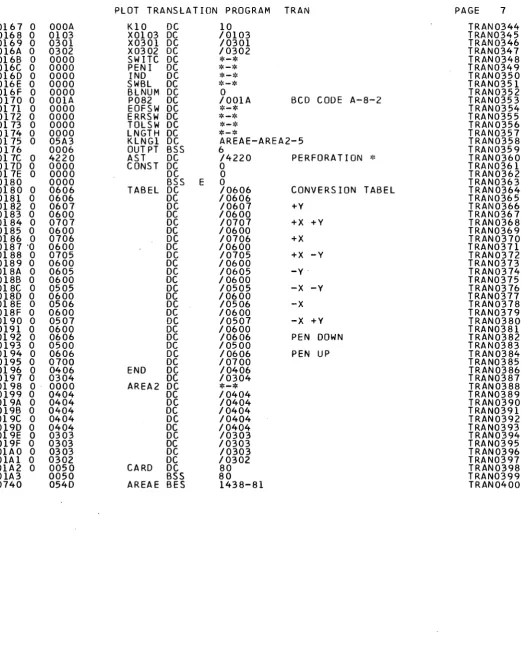
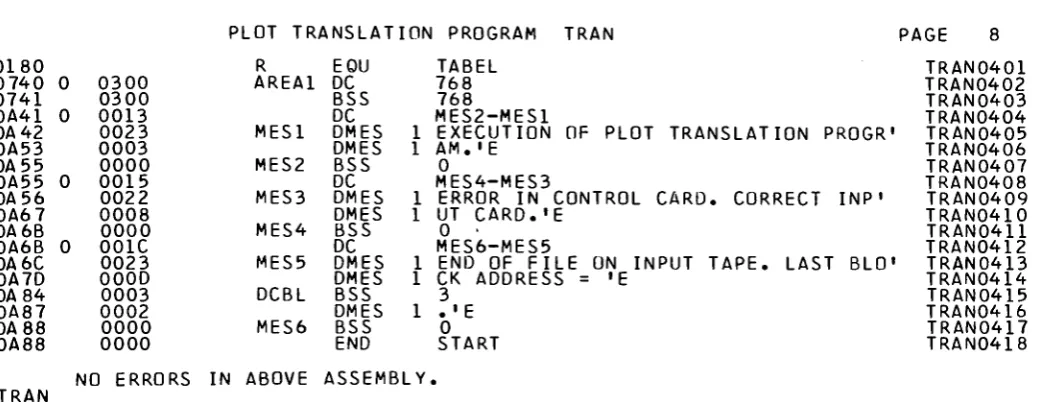
The p r o g r a m p e r f o r m s the t r a n s l a t i o n of a Calcomp tape (7 t r a c k s )
written by the IBM 7090 subroutines of CETIS (l) into original
Cal-comp code. The t r a n s l a t e d tapes a r e to be utilized with the CalCal-comp
magnetic tape unit 57 0 t o which the plotter i s connected (off-line
ope-ration of a Calcomp p l o t t e r ) . The p r o g r a m indicates an end-of-file
and the l a s t block a d d r e s s which has been written on tape and w a i t s .
Consol s t a r t m e a n s continuation of tape t r a n s l a t i o n , consol i n t e r
-rupt a b o r t s t h e job.
Control c a r d format:
1. Card
col. 1-2 **
3 input tape unit number (0, 1, 2 or 3)
5-7 density (200, 556 or 800)
2. Card
col. 1-2 **
3 output tape unit n u m b e r (0, 1, 2 or 3)
5-7 density (200, 556 or 800)
Halts and output m e s s a g e s (on 1443 p r i n t e r )
1) EXECUTION OF P L O T TRANSLATION PROGRAM
2) ERROR IN CONTROL CARD. CORRECT INPUT CARD. Put
both control c a r d s in c a r d hopper and p r e s s s t a r t .
29
4. 08 Tape to Plot for On-Line Operation of a Calcomp P l o t t e r (P7090)
P r o g r a m P7090 r e a d s a Calcomp tape (7 t r a c k s ) written by the IBM
7090 subroutines of CETIS (l) and controls the plotter s i m i l a r to any
other slow input/output device. The p r o g r a m u s e s the IBM l i b r a r y
routine PLOTX. Detection of an end-of-file m a r k stops the p r o g r a m .
P r e s s i n g consol s t a r t m e a n s continuation with the following file, p r e s
-sing consol i n t e r r u p t finishes the job.
Control c a r d format:
col. 1-2 **
3 magnetic tape unit number (0,1, 2 or 3)
5-7 density (200 or 556)
Halts and output m e s s a g e s (on 1443 p r i n t e r ) :
30
4. 09 P l o t t e r Tape Translation P r o g r a m for On-Line Use of a
Calcomp P l o t t e r in Time-Sharing Mode (T7090)
P r o g r a m T7090 p e r f o r m s the t r a n s l a t i o n of a Calomp tape (7 t r a c k s )
written by the IBM 7090 subroutines of CETIS (l) into a code, which
is compatible with the plotting s y s t e m in t i m e - s h a r i n g mode of the
CBNM at Geel (3). Detection of an öf-file m a r k c a u s e s an
end-of-file m a r k to be written on the output tape. Then the p r o g r a m
waits. Consol s t a r t m e a n s t r a n s l a t i o n of the following file, consol
interrupt finishes the job.
Control c a r d format:
1. Card
col. 1-2 **
3 input tape unit number (0, 1,2 or 3)
5-7 density (200, 556 or 800)
2. Card
col. 1-2 **
3 output tape unit n u m b e r (0, 1, 2 or 3)
The output tape h a s the density 800 b y t e s / i n c h ,
format is 3 b y t e s / w o r d , if 7-track tapes a r e used.
Halts and output m e s s a g e s (on 1443 p r i n t e r )
1) ERROR INPUT CARD. START AGAIN.
31
-Acknowledgement
The stimulating and helpful d i s c u s s i o n s with Dr. H. H o r s t m a n n
a r e gratefully acknowledged. We also thank the o p e r a t o r s Mr.
U. Meloni and Mr. C. Cervini for t h e i r help at the IBM 1800
computer.
5. R e f e r e n c e s
1) P . Moinil and J. P i r e , P r o g r a m m a t i o n relative au Calcomp,
EUR 2280 f (1965)
2) H. Schmid, A Contribution to the P r o g r a m m i n g of the Calcomp
Digital I n c r e m e n t a l P l o t t e r for Off-Line Operation, EUR 3634 e
(1967)
(TPDMP )
New page, p r i n t page
number
Read • · card
P r i n t • · ca rd
( Pause
VPrint a p p r o p r i a -te message on
1816 or 1053
y e s
Prepare c o n t r o l parameter for
r o u t i n e MAG
ER10
P r i n t : THIS RECORD CON-l TAINS ERRORS
ER9
P r i n t : THIS RECORD IS TOO LONG
Prepare record number
Convert f r o m EBCDIC t o printer code
EBC Branch
Recording o u t p u p f o r m a t
BCD
HEX
y e s Prepare a MOVE of 50 words
t o o u t p u t area
Compute t h e number of r e -m a i n i n g words,
move t h e m to output area ,
f i l l up w i t h »
yes
yes I n i t i a l i z e
for one l i n e
Compute the number of r e -maining words and t h e number
of * t o f i l l the line
Move the *
to o u t p u t a r e a
Convert to HEX and move t o
output a r e a
PAGE
1·
* * 0 7 0 2 2 0 0 HEX
1 2 3 4 5 6 7 8 9 0 1 2 3 4 5 6 7 8 9 0 1 2 3 4 5 6 7 8 9 0 1 2 3 4 5 6 7 8 9 0 1 2 3 4 5 6 7 8 9 0 1 2 3 4 5 6 7 8 9 0 1 2 3 4 5 6 7 8 9 0 1 2 3 4 5 6 7 8 9 0 1 2 3 4 5 6 7 8 9 0 1 2 3 4 5 6 7 8 9 0
ODD
ODD
ODD
ODD
ODD
ODD
ODD
ODD
ODD
ODD
ODD
ODD
ODD
ODD
ODD
ODD
ODD
ODD
ODD
ODD
ODD
ODD
ODD
ODD
ODD
ODD
ODD
ODD
ODD
ODD
ODD
ODD
ODD
ODD
ODD
ODD
ODD
ODD
ODD
ODD
ODD
ODD
ODD
ODD
ODD
ODD
ODD
ODD
ODD
ODD
ODD
ODD
ODD
ODD
•2
2
2
2
2
2
2
2
2
2
2
2
2
2
2
2
2
2
2
2
2
2
2
2
2
2
2
2
2
2
2
2
2
2
2
2
2
2
2
2
2
2
2
0000
0010
002 0
0030
0040
0050
0060
0070
0080
0090
OOAO
0000
0010
002 0
0030
004 0
0050
006 0
0070
0080
0090
OOAO
OOBO
OOCO
OODO
OOEO
OOFO
0100
0110
0120
0130
0140
0150
0160
0170
0180
0190
01A0
01B0
01C0
OÍDO
01E0
01F0
0200
0210
0220
0230
0240
0250
0260
02 70
0280
0290
02A0
0000
0101
0101
0101
0101
0101
0101
0101
0101
0101
1A1A
0000
0202
0102
0201
02 01
0202
0102
0202
0201
0202
0202
0102
0201
0201
02 02
0102
02 02
0201
02 02
0202
0102
0201
0201
0202
0102
0202
0201
0202
0202
0102
0201
0201
02 02
0102
02 02
0201
02 02
0202
0102
0201
0201
0202
0102
0000
0101
0101
0101
0101
0101
0101
0101
0101
0101
*** ^£ 4ε *** ***
"Τ* τ" "T* *T* "V
0000
0102
0201
0202
0202
0102
0202
0201
0202
0201
0102
0201
0202
0202
0102
0202
0201
0202
0201
01Ό2
0201
0202
0202
0102
0202
0201
0202
0201
0102
0201
02 02
0202
0102
0202
0201
0202
0201
0102
0201
0202
0202
0102
0202
0009
0101
0101
1A01
0101
0101
1A01
0101
0101
1A01
ψΦψψψψ
0001
0201
0202
0201
0102
0202
0102
0202
0201
0202
0201
0202
0201
0102
0202
0102
0202
0201
0202
0201
0202
0201
0102
0202
0102
0202
0201
0202
0201
0202
0201
0102
0202
0102
0202
0201
0202
0201
0202
0201
0102
0202
0102
1A01
0101
0101
0101
0101
0101
0101
0101
0101
0101
%l^ « V O * «J* «Α* «A*
*f* ^|* < p >|*» * p *p
0201
0202
0201
1A02
0202
0102
1A02
0201
0202
1A01
0202
0201
1A02
0202
0102
1A02
0201
0202
1A01
0202
0201
1A02
0202
0102
1A02
0201
0202
1A01
0202
0201
1A02
0202
0102
1A02
0201
0202
1A01
0202
0201
1A02
0202
0102
1A02
0101
0101
0101
0101
0101
0101
0101
0101
0101
0101
0101
0101
0101
0101
0101
0101
0101
0101
0101
0101
Λ ¿c ώ ¿i iic ¿ι ώ ¿; ω: ¿c ¿: ώ
*l* *T *T* *¥* nr* "τ* *r τ* *f *ττ τ *r
0202
0201
0202
0202
0102
0201
0201
0202
0102
0202
0201
0202
0202
0102
0201
0201
0202
0102
0202
0201
0202
0202
0102
0201
0201
0202
0102
0202
0201
0202
0202
0102
0201
0201
0202
0102
0202
0201
0202
0202
0102
0201
0201
0201
0202
0201
0102
0201
0202
0202
0102
0202
0201
0202
0201
0102
0201
0202
0202
0102
0202
0201
0202
0201
0102
0201
0202
0202
0102
0202
0201
0202
0201
0102
0201
0202
0202
0102
0202
0201
0202
0201
0102
0201
0202
0202
0101
0101
1A01
0101
0101
1A01
0101
0101
1A01
0101
%'- «Ar «Λ» «J«· «A» «A*
'i'"f"r"r"iwr'
0202
0201
0202
0201
0202
0201
0102
0202
0102
0202
0201
0202
0201
0202
0201
0102
0202
0102
0202
0201
0202
0201
0202
0201
0102
0202
0102
0202
0201
0202
0201
0202
0201
0102
0202
0102
0202
0201
0202
0201
0202
0201
0102
0101
0101
0101
0101
0101
0101
0101
0101
0101
0101
0101
0101
0101
0101
0101
0101
0101
0101
0101
0101
*A* «A* *Ae *J^ *Ae «A* «A* «A. ^ e *A# *A* ^l*
-r -Ρ ï- -,.. -,-* -,«■ -,* *>*. -Ï- f -,, -,,
0201
0202
1A01
0202
0201
1A02
0202
0102
1A02
0201
0202
1A01
0202
0201
1A02
0202
0102
1A02
0201
0202
1A01
0202
0201
1A02
0202
0102
1A02
0201
0202
1A01
0202
0201
1A02
0202
0102
1A02
0201
0202
1A01
0202
0201
1A02
0202
0202
0102
0202
0201
0202
0202
0102
0201
0201
0202
0102
0202
0201
0202
0202
0102
0201
0201
0202
0102
0202
0201
0202
0202
0102
0201
0201
0202
0102
0202
0201
0202
0202
0102
0201
0201
02 02
0102
0202
0201
0202
0202
0102
0101
0101
0101
0101
0101
0101
0101
0101
0101
0101
•A* «A* *A# *A* «A* *A#
0102
0202
0201
0202
0201
0102
0201
0202
0202
0102
0202
0201
0202
0201
0102
0201
0202
0202
0102
0202
0201
0202
0201
0102
0201
0202
0202
0102
0202
0201
0202
0201
0102
0201
02 02
0202
0102
0202
0201
0202
0201
0102
0201
0101
1A01
0101
0101
1A01
0101
0101
1A01
0101
0101
«A* *A* *A* *A* *A* «A* *r v* ^ *^ n* *r