ISSN Online: 2164-2834 ISSN Print: 2164-2818
The Impact of Depression and Apathy on
Sensory Language
David Kernot
1,2*, Terry Bossomaier
3, Roger Bradbury
11National Security College, The Australian National University, Canberra, Australia 2Defence Science Technology Group, Edinburgh, Australia
3The Centre for Research in Complex Systems, Charles Sturt University, Bathurst, Australia
Abstract
The debate that language strongly influences thought is equally met by those who suggest language does not influence thought. While historically, the abil-ity to communicate with words was believed to be intimately tied to an abilabil-ity to form thoughts, we would argue that thought and language are linked to-gether through our sensory and motor systems and severely impacted by de-pression and apathy. We test this by conducting parts of speech analysis from the comparative longitudinal studies of two highly creative and prolific writ-ers, where one is diagnosed with Alzheimer’s disease (AD), and the other lives a long and healthy life. We calculate function and contents word ratios, measure lexical repetition, and the use of sensory-based words in textual lan-guage to test for depression and apathy in AD which is supported by Mann- Whitney U-Testing and Principal Component Analysis. Our results support the hypothesis that thought and language are impacted by depression and apathy and revealed in a person’s writing style 12 years before a formal diag-nosis of Alzheimer’s disease presents. We find higher lexical repetition in language 12 years prior to one author being diagnosed with AD while not ap-parent in the other. We identify low olfactory word use and also find that an increased use of sensory-based adjectives might be a sign of the early onset of Alzheimer’s disease.
Keywords
Depression, Apathy, Thought, Sensory Language, Word Richness, Alzheimer’s Disease
1. Introduction
The debate over the notion that language strongly influences thought is met
How to cite this paper: Kernot, D., Bos-somaier, T., & Bradbury, R. (2017). The Impact of Depression and Apathy on Sen-sory Language. Open Journal of Modern Linguistics, 7, 8-32.
https://doi.org/10.4236/ojml.2017.71002
Received: December 19, 2016 Accepted: February 3, 2017 Published: February 6, 2017
Copyright © 2017 by authors and Scientific Research Publishing Inc. This work is licensed under the Creative Commons Attribution International License (CC BY 4.0).
equally by those who argue that language does not influence it, but historically, language was thought to be tied to an ability to form thoughts (Wicklund,
John-son, & Weintraub, 2004). Some believe that language and thought are combined
to modify language and thought further (Ammar & Gohar Ayaz, 2016). Others suggest human language is an instrument of thought and communicates the attributes of human culture (Lieberman, 2016), or that language allows us to share the knowledge and experiences of others to increase our mental resources
(Corballis, 2016). Through this embodied cognition, our concepts are grounded
in our sensory and motor systems to develop new abstract representations
(Ja-mrozik et al., 2016). We would argue that the way we think comes through
clearly in the multimodal sensory elements of our language, and that these as-pects of language (such as through sound and visual body language cues) impact on thought, but that disease impacts these.
While thought strongly influences language, depression and apathy severely impact thinking, as seen in dementia. There is a close link with depression in dementia, and apathy and depression are the most frequent neuropsychiatric symptoms in one type of dementia, Alzheimer’s disease (AD) (Robert, Bremond,
& David, 2016). In a different kind of language-based dementia, known as
Pri-mary Progressive Aphasia (PPA), patients who could not find the right words to express their thoughts, could still demonstrate they could think clearly
(Fedo-renko & Varley, 2016; Wicklund, Johnson, & Weintraub’s, 2004). While
lan-guage in PPA is a prominent dysfunction for the first two years of the disease, Alzheimer’s disease comes to medical attention because of forgetfulness, usually accompanied by apathy, but not from language dysfunction (Mesulam, 2003). Personal identity persists far into the end stage of the disease (Sabat, & Harré,
1992), while apathy is characterized by reduced motivation, social disinterest,
and emotional blunting in the absence of mood-related changes (Chau et al.,
2016).
If writing is the ability to think and put language on paper or some other visu-al mediums, then the impact of depression and apathy on thought and language might be measurable, but this concept is not new. The idea that cognitive decline in Alzheimer’s disease is visible in writing appeared in Snowdon et al.’s (1996)
findings of a longitudinal study of 678 Catholic sisters. Known as the Nun Study, researchers were able to correlate post-mortem markers for AD in the sister’s brains to the density of ideas (from Kintsch & Keenan, 1973 and Turner &
Greene, 1977) expressed in sentences using Parts of Speech (POS) Tag analysis.
(Lancashire, 2010), including Iris Murdoch and Agatha Christie (e.g. Garrard et
al, 2005;Van Velzen & Garrard, 2008; Lancashire & Hirst, 2009; Le, 2010;Le et
al., 2011) and political figures (Garrard, 2009) has highlighted that Alzheimer’s
disease may be apparent years or even decades before anyone becomes aware of any symptoms of cognitive deterioration. A recent study suggests that Alzhei-mer’s disease can be seen in people’s writing 10 - 12 years before the disease is diagnosed (Rajan et al., 2015). To test the hypothesis that thought and language are impacted by depression and apathy and revealed in a person’s writing style 12 years before a formal diagnosis of Alzheimer’s disease presents, we draw on earlier studies of AD.
We use the novels of Iris Murdoch and P.D. James, however, we use a larger, more complete set than previously used by Garrard et al. (2005) and Le et al.
(2011). We use broader Parts of Speech analysis techniques, and we also use a
new analytical technique from sensory adjectives, to determine what can be seen in language from the impact of depression and apathy in the early onset of Alz-heimer’s disease.
2. Methodology
In this section, we describe the two underlying concepts of the method, Richness and Sensory Adjectives, and what is done with the data in the pre-processing stage to visualise markers for depression, apathy, and Alzheimer’s disease in language.
2.1. Richness (R)
Richness Equation (1) is based on Menhinick’s (1964) species diversity equation, and for two documents of the same length, the one with more different (unique) words - a larger vocabulary - has greater richness. The Richness score can be de-termined by:
( )
Richness R w
N
= (1)
where w = number of unique words in the document, and N = the total docu-ment word count.
There are theoretical limitations to this equation, and the size of documents must be carefully controlled to avoid artifacts. Eventually, the value will reach an asymptote as no new words are found. Near that point, the larger the document size, the smaller the Richness score will be (0 as N→ ∞).
The type—token ratio (TTR) can also be considered a variant of the species diversity equation, and is text size dependent, however, it is a popular metric, and we mitigate any size impacts and avoid issues near the asymptote of word counts by keeping all the samples of each novel of equal size and at 4000 words, well below 10,000 where other techniques perform better; further, we use Rich-ness as part of a larger multivariate technique (Juola & Mikros, 2016; Kimura &
Gijsel, Speelman, & Geeraerts, 2005; Vermeer, 2000).
2.2. Sensory Adjectives (S)
While apathy is characterised by reduced motivation, social disinterest, and emotional blunting in the absence of mood-related changes, it has been asso-ciated with low norepinephrine levels in the brain (Chau et al., 2016). In the fol-lowing paragraphs, we describe the link between apathy and depression in people to different levels of norepinephrine in the brain, and how it might be apparent in sensory processing and impact the sensory language of Adjectives.
Many mental disorders have also been associated with alterations of neuro-transmitters in the brain (Heilman, Nadeau, & Beversdorf, 2003; Nonen et al.,
2016; Sun, Hunt, & Sah, 2015; Szot, 2016), and the neurotransmitter,
norepi-nephrine, has been seen to be lacking in depressed suicide victims (Khan et al.,
2016; Klimek et al., 1997; Ramirez, 2016). Norepinephrine levels have also been
linked to studies on creative people, where a reduction in their aural sensory processing, known as sensory gating is tied to the neurotransmitter, while crea-tive achievers have shown “leaky” sensory gating because they simultaneously focus on a large range of stimuli (Zabelina et al., 2015). They have low levels of norepinephrine which increase the size and distribution of the brain’s concept representations. Their ability to modulate the frontal lobe-locus coeruleus sys-tem and reduce norepinephrine levels leads to the discovery of novel orderly re-lationships, or creative innovation (Heilman, Nadeau, & Beversdorf, 2003). Oth-er creative people, divOth-ergent thinkOth-ers, on the othOth-er hand, reduce sensory gating, which is also a marker of psychosis, including schizophrenia (Zabelina et al.,
2015). They have high levels of norepinephrine that restricts their concept
re-presentations (Heilman, Nadeau, & Beversdorf, 2003), and therefore their sen-sory processing narrows to focus tightly on the task at hand. Here, thought in-fluences ideas and modifies aspects of the sensory cortex that feeds language.
The brain processes many Sensory (S) words as sight/feel and smell/taste word categories (Lynott, & Connell, 2009). Adjectives are used over verbs or nouns because they appear more frequently, and their context is not necessary. These 774 sensory-based adjectives (van Dantziget al., 2011) are recorded in two dif-ferent contexts to assess the dominant visual (V), auditory (A), haptic (H), ol-factory (O), or gustatory (G) modality. These sensory words are allocated a modality exclusivity score that reflects the brain’s Representational System
(Fer-nandino et al., 2015), and can be used to capture the sensory gating biomarker
characteristics of a person. There are five sensory categories, one each for V, A, H, O, G. If we let the number of words in each sensory category, i, be ϕi and
i
ϑ is the exclusivity value (see van Dantziget al., 2011 for values) and Nk be the
number of discrete word score, then the weight, or exclusivity score for each category then the Sensory score Equation (2) can be determined by:
(
1 5)
Sensory adjectives Nk i i
k
S
D
ϕ ϑ
− =
∑
(2)The overall Sensory adjectives (S) score is calculated by summing the five sen-sory categories.
2.3. Preparing the Text
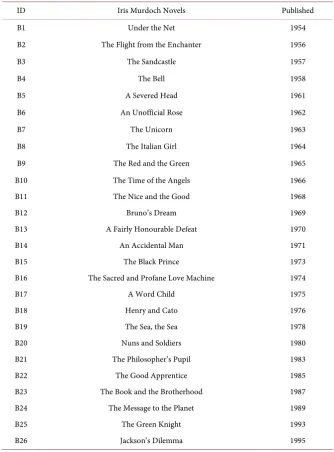
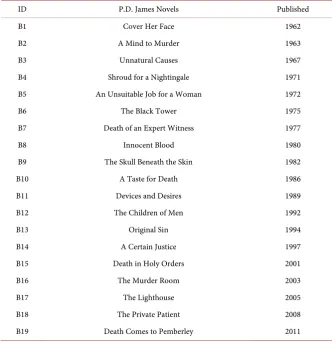
[image:5.595.205.540.280.733.2]A collective corpus of 180,000 words contains a 104,000-word sample from 26 Iris Murdoch novels and a 76,000-word sample from 19 P.D. James novels (see
Table 1 and Table 2). The 4,000-word novel sample is from the first 3,000 words
and the last 1,000 words. Generally, in a novel, this is where characters, rich in setting and plot, are introduced and at the end, a conclusion of the general novel ‘problem’ has been resolved and summarised. We process the files with the Stanford Parts Of Speech (POS) Tagger (Toutanova & Manning, 2000) and re-move all stop words (punctuation) before achieving each 4000-word sample per
Table 1. Iris Murdoch’s novels by year published.
ID Iris Murdoch Novels Published
B1 Under the Net 1954
B2 The Flight from the Enchanter 1956
B3 The Sandcastle 1957
B4 The Bell 1958
B5 A Severed Head 1961
B6 An Unofficial Rose 1962
B7 The Unicorn 1963
B8 The Italian Girl 1964
B9 The Red and the Green 1965
B10 The Time of the Angels 1966
B11 The Nice and the Good 1968
B12 Bruno’s Dream 1969
B13 A Fairly Honourable Defeat 1970
B14 An Accidental Man 1971
B15 The Black Prince 1973
B16 The Sacred and Profane Love Machine 1974
B17 A Word Child 1975
B18 Henry and Cato 1976
B19 The Sea, the Sea 1978
B20 Nuns and Soldiers 1980
B21 The Philosopher’s Pupil 1983
B22 The Good Apprentice 1985
B23 The Book and the Brotherhood 1987
B24 The Message to the Planet 1989
B25 The Green Knight 1993
Table 2. P.D. James’ novels by year published.
ID P.D. James Novels Published
B1 Cover Her Face 1962
B2 A Mind to Murder 1963
B3 Unnatural Causes 1967
B4 Shroud for a Nightingale 1971
B5 An Unsuitable Job for a Woman 1972
B6 The Black Tower 1975
B7 Death of an Expert Witness 1977
B8 Innocent Blood 1980
B9 The Skull Beneath the Skin 1982
B10 A Taste for Death 1986
B11 Devices and Desires 1989
B12 The Children of Men 1992
B13 Original Sin 1994
B14 A Certain Justice 1997
B15 Death in Holy Orders 2001
B16 The Murder Room 2003
B17 The Lighthouse 2005
B18 The Private Patient 2008
B19 Death Comes to Pemberley 2011
novel, and then we aggregate the works by individual word frequency. We also aggregate the data from the 45 POS types into 12 more general POS types, representing higher classes of Nouns, Verbs, Adverbs, Adjectives, Modal Verbs, Conjunctives, Prepositions, Determiners, Pronouns, Existential There, Articles, and Other categories, comprising Cardinal Numbers, Interjections, and Foreign words.
3. Results
In this section, we begin by testing for markers within the Richness (R) of lan-guage that can highlight Alzheimer’s disease (AD), and we support this with Mann-Whitney U-Testing. We use Parts of Speech (POS) analysis to group the data by Content and Function Words and use ratios to support the presence of AD in the data further, and we back up this claim with Mann-Whitney U-Testing. We test for markers within the Sensory (S) aspects of language to see if the variables can identify additional markers for AD, and support these results with Mann-Whitney U-Testing and Principal Component Analysis.
3.1. Testing for Alzheimer’s Disease Markers in Richness
higher frequency vocabulary (Garrard et al., 2005), and can be seen in people’s writing 10 - 12 years before the disease is diagnosed (Rajan et al., 2015). Iris Murdoch was diagnosed with Alzheimer’s disease in 1997 (aged 78), and she died two years later in 1999, just four months before her eightieth birthday, and a post-mortem confirmed the Alzheimer’s disease (Garrard et al., 2005). P.D. James was not diagnosed with Alzheimer’s disease or dementia and died in 2014 (aged 94).
From Richness, the total mean of Iris Murdoch’s writing is 29.5, while P.D. James’ is slightly higher at 31.9, suggesting there is less lexical repletion than Iris Murdoch’s. Separating the last 12 years of works highlights that this period in Iris Murdoch’s case is slightly lower (29.48 versus 29.52), while P.D. James’ is slightly higher (32 versus 31.86) and these do not appear to be significantly dif-ferent.
To test this, we conduct a Mann-Whitney U-Test on the Richness scores. In this hypothesis testing for differences in a person’s writing style, we use the Mann-Whitney U-Test because it is a non-parametric independent groups test. In this case, the total sample size for Iris Murdoch is 26, with the group sizes of 21 and 5, and for P.D. James, the total sample size is 19 with the group sizes be-ing 15 and 4. This test is ideal for unequal group sizes that are small, have dissi-milar variances, and a distribution that is not normal (Burns & Burns, 2012).
We find significant differences in the lexical repetition of Iris Murdoch’s works (see Table S1 and Table S2 in Supplementary Data) during the writing period 1984-1996, 12 years before her diagnosis when compared to the earlier period of writing 1954-1983 (U = 12.5, p = 0.009). There are no significant dif-ferences in the lexical repetition of P.D. James works (see Table S3 and Table S4
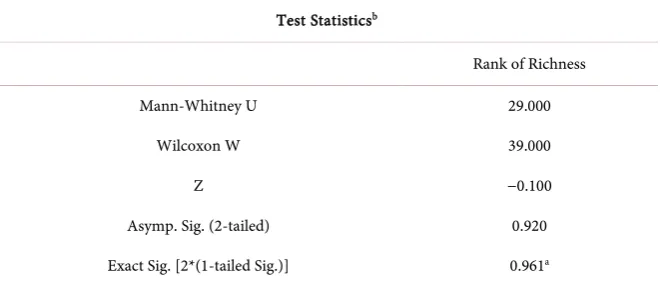
in Supplementary Data) during the writing period 1962-2001, 12-years before her death when compared to the period 2002-2011 (U = 29.0, p = 0.920).
3.2. Content and Function Word Analysis
It is generally understood that while the ratios of different word types is rela-tively uniform across age, sex, and level of education in normal speakers, that there is a lower use of Function Words over Content Words in people with De-mentia and different aphasia types that impact speech and language (Bird et al.,
2000). Function Words contain little meaning and tend to hold sentence
struc-ture together. They are word types such as pronouns, articles, prepositions, and conjunctions. Content Words, on the other hand, tend to describe the message of a sentence through verbs, nouns, adverbs, and adjectives.
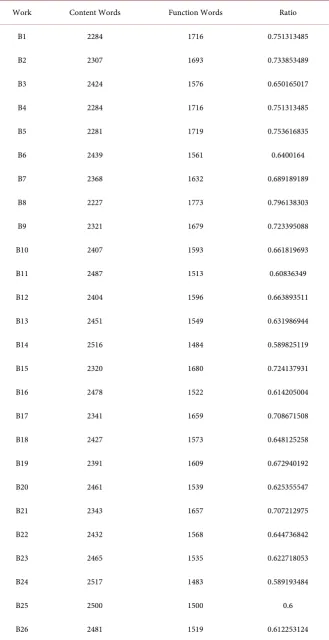
Given these differences in Function and Content Words (Bird et al., 2000), we would expect that as a person develops Dementia, there would be an increase in the use of Content Words, and in their Content to Function Word ratios. We test the use of Content Words by aggregating the 12 tagged Parts of Speech groups into Content Words and Function words (see Table S5 for Iris Murdoch
and Table S6 for P.D. James in Supplementary Data) and separate the last 12
Mur-doch, there is a mean increase in Content Words use of 3.16%, or 75.4 (2380.0 - 2456.3), and a mean decrease in Function Words use of 4.65%, or 75.4 (1619.1 - 1543.67) in the later 12 Years period (see Figure S1 and Figure S2 in Supple-mentary Data). In contrast, in P.D. James’, there is a mean increase in Content Words use of 1.77%, or 42.28 (2344.46 - 2386.75), and a mean decrease in Func-tion Words use of 2.55%, or 42.29 (1655.53 - 1613.25) in the later 12 Years pe-riod (see Figure S3 and Figure S4 in Supplementary Data). Iris Murdoch’s use of Content Words was approximately 44%, or 33.11 (42.29 - 75.4) larger in the period 12 years before her diagnosis of Alzheimer’s disease.
Having seen differences in Content Words, we test their Content to Function Word ratios for signs of Dementia. Drawing on a technique from Garrard et al.
(2005) and used in Le et al. (2011), we compare the first work of Iris Murdoch to
the period 12 years before her diagnosis of Alzheimer’s disease. We plot the Function to Content Word ratio (from Table S5 in Supplementary Data) and do the same for P.D. James (from Table S6 in Supplementary Data).
These results in Iris Murdoch’s writing (Figure 1), reflect the findings of
Gar-rard et al.’s (2005) observations that by her final book Jackson’s Dilemma (B26),
she was suffering from cognitive decline caused by Alzheimer’s disease. Here, we extend the data from three of her novels to seven and find the Function Word to Content Word ratios are all lower for the six works 12 years before the diagnosis of AD. There is a steady decline in Iris Murdoch’s work until the fourth work (B24) where the ratio is approximately level.
As we can see in P.D. James’ writing (Figure 2), the Function Word to Con-tent Word ratios are different and appear as a sawtooth pattern, and while two are much higher (B16 and B18), the other two are lower (B17 and B19). This suggests that there is neither a steady incline nor decline in the 12 years before P.D. James’ death.
These results are supported by the Mann-Whitney U-Tests, which show that there are significant differences in the use of Function Words and Content
Figure 2. P.D. James content to function word ratio comparison of her first work to the four works 12 years before her death. The increasing sawtooth pattern is neither higher or lower overall than her early work, and the results are very different to the Iris Murdoch results.
Words by Iris Murdoch (U = 24, p = 0.028) 12 years before her diagnosis of AD (see Table S7 and Table S8 in Supplementary Data). As we would expect in a person without dementia or AD, there is no significant difference for P.D. James (U = 17, p = 0.194) 12 years before her death (see Table S9 and Table S10 in Supplementary Data).
3.3. Testing for Sensory Alzheimer’s Disease Markers
Many sensory words are processed by the brain as sight/feel and smell/taste word categories (Lynott & Connell, 2009), and we use a group of 387 sensory adjectives and allocate them a modality exclusivity score that reflects the brain’s Representational System (van Dantzig et al., 2011). These sensory words can be used to capture the sensory gating biomarker characteristics of a person
(Fer-nandino et al., 2015) to create a unique signature of their inner self.
Examining the Sensory variable, we find that there is no overlap in the Stan-dard Errors, and the mean is higher in the last 12 years (see Figure 3). P.D. James’ Sensory variable 12 years before her death show a lower sensory score, and the Standard Errors also do not overlap (see Figure 4). Overall, Iris Mur-doch’s Sensory mean is slightly higher than P.D. James (0.022 versus 0.018).
These results are supported by the Mann-Whitney U-Tests, which show that there is significant differences in the use of Sensory Words by Iris Murdoch (U = 18, p = 0.011) 12 years before her diagnosis of AD. This is also true of P.D. James (U = 7, p = 0.021) 12 years before her death (refer detailed results Table S11-S14
in Supplementary Data), but in P.D. James’ case, her use of Sensory Words is lower, not higher.
Figure 3. Iris Murdoch sensory mean with standard error bars highlighting a higher use of sensory adjectives during the period 12 years before her diagnosis with AD. Note the error variance is smaller in the latter period, and there are no overlaps in the standard error bars.
Figure 4. P.D. James sensory mean with standard error bars highlighting a lower use of sensory adjectives during the period 12 years before her death. Note that these results are the reverse of the Iris Murdoch results in that the error variance is larger in the latter period with a lower mean. Again, there are no overlaps in the standard error bars.
Olfactory Standard Errors. In contrast, all of P.D. James Visual, Auditory, Hap-tic, Olfactory, and Gustatory (VAHOG) elements were lower in the 12 years be-fore her death, and there were no overlaps in the Standard Errors (see Figure
S5-S14 in Supplementary Data).
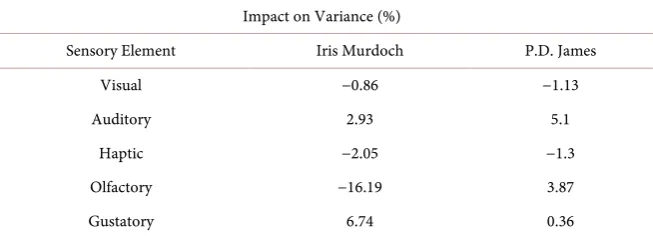
[image:10.595.209.539.315.493.2]Table 3. A comparison of the sensory contribution to PCA variance. Here it is clear that the impact on Iris Murdoch’s Olfactory variable is significantly larger than any other result for either author.
Impact on Variance (%)
Sensory Element Iris Murdoch P.D. James
Visual −0.86 −1.13
Auditory 2.93 5.1
Haptic −2.05 −1.3
Olfactory −16.19 3.87
Gustatory 6.74 0.36
from its removal, highlighting the significant contribution, and therefore differ-ence, which this element plays within the Iris Murdoch data. Alzheimer’s disease impacts normal olfactory function with suggestions that olfactory loss may be a biomarker for AD and cognitive decline (Wesson et al., 2010; Woodward et al.,
2015).
4. Discussion
Analysis of the Richness of each of the writer’s novels using a Mann-Whitney U-Test highlighted significant differences in the lexical repetition of Iris Mur-doch’s works in the last 12 years of her writing (1984-1996). However, there were no significant differences in the works of P.D. James 12 years before her death. When using Parts of Speech analysis to group each work into Content and Function words, there was an increase in the use of Content Words in the later 12 Years of their writing. In Iris Murdoch’s case, they were approximately 44% larger than P.D. James’. A decrease in Content to Function Word ratios as an indication of Dementia was observed in the overall works of Iris Murdoch 12 years before the diagnosis of AD, with four of the six works declining before the ratios levelled. A Mann-Whitney U-Test supported the significant differences in the later period of her writing. No such decrease or significant difference was observed in the works of P.D James, and the rising and falling sawtooth variation showed a pattern of neither steady incline nor decline in the 12 years before her death.
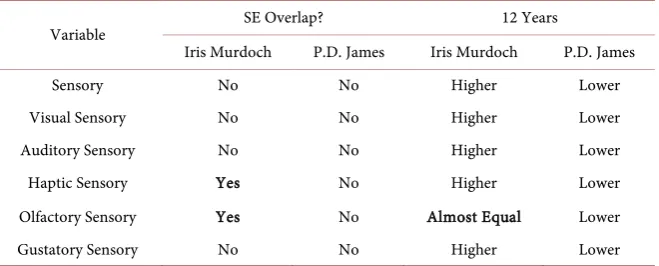
Table 4. Summary of sensory means of Iris Murdoch and P.D. James showing the overall higher sensory component in Iris Murdoch’s results during the 12 year period before her diagnosis of AD, where P.D. James’ results were all lower. Note that there was overlap in Murdoch’s Haptic and Olfactory scores and that the Olfactory value was equal, or only slightly higher than the earlier period.
Variable SE Overlap? 12 Years
Iris Murdoch P.D. James Iris Murdoch P.D. James
Sensory No No Higher Lower
Visual Sensory No No Higher Lower
Auditory Sensory No No Higher Lower
Haptic Sensory Yes No Higher Lower
Olfactory Sensory Yes No Almost Equal Lower
Gustatory Sensory No No Higher Lower
years before her death. These two points support the overall Sensory result. While there were overlaps in Iris Murdoch’s Haptic and Olfactory Standard Er-rors, Principal Component Analysis only supports the exceptionally low Olfac-tory element that is quite different in Iris Murdoch’s writing (see Table 3).
Both Richness and POS analysis supported by Mann-Whitney U-Test high-light the evidence of dementia and AD in Iris Murdoch’s writing in the latter 12 years before her diagnosis. These can be seen in Richness, a higher level use of Content Words, and a lower and lower Content to Function Word ratios. We also find that a higher Sensory mean might suggest the presence of AD in the period 12 Years before Iris Murdoch’s diagnosis. While this is supported by the analysis of the different means in the last 12 Years of writing and the earlier works, and the comparative differences in Principal Component Analysis va-riances, the exceptionally low Olfactory element is quite different in Iris Mur-doch’s writing.
Murdoch’s depression and apathy have been well documented through her prolific habit of writing about herself throughout her life (Dooley & Nerlich,
2014; Martin & Rowe, 2010; Murdoch, 2016; Wilson, 2004). Her sad decline into
Alzheimer’s disease has also been recorded by her husband (Bayley, 1998; 1999). We have stated earlier that there is a strong link between depression and apathy in dementia and particularly AD. It is known that while a depressed mood and apathy alter brain function in the prefrontal limbic network, and that it overlaps regions dealing with olfaction, such that depression can reduce olfactory ability
(Croy et al., 2014).
5. Conclusion
In a study of two highly creative and prolific authors, we have been able to draw on a more complete set of novels than that used by Garrard et al. (2005) and Le
et al. (2011) to characterise a person’s use of language through writing. In doing
so, we have applied both known techniques to identify linguistic markers for Alzheimer’s disease, depression and apathy (through lexical repetition and func-tion to content word ratios) and test a new technique based on sensory adjec-tives. Our results support the hypothesis that thought and language are impacted by depression and apathy and revealed in a person’s writing style 12 years before a formal diagnosis of Alzheimer’s disease presents. Using Richness to measure lexical repetition (a form of the type-token ratio) the writing of Iris Murdoch is statistically significantly lower in the last 12 years of her novel writing. This re-sult is also reflected in Iris Murdoch’s use of Function Words and Content Words). In contrast, a healthy P.D. James’ writing during the same period showed no decline in lexical repetition and function to content word ratios and was not different from her earlier writing. There were clear differences in their use of sensory adjectives, with higher Iris Murdoch’s use and lower P.D. James’ during their latter 12 years of writing, but in Iris Murdoch’s case, her use of ol-factory words, a biological sensory marker for Alzheimer’s disease, depression, and apathy, was low. It is possible that olfactory sensory words in language could be used to help identify depression and apathy in people. We suggest that cogni-tive diseases such as dementia impact on thinking, as seen through depression and apathy and can influence language use.
Acknowledgements
This research is supported by the Defence Science Technology Group, the Aus-tralian Government’s lead agency dedicated to providing science and technology support for the country’s defence and security needs.
References
Ammar, D. Z. A., & Gohar Ayaz, A. (2016). Language versus Thought, and Theory of Formation of Meanings. Global Journal of Human-Social Science Research, 15, 77-80. Arefin, A. S., Vimieiro, R., Riveros, C., Craig, H., & Moscato, P. (2014). An Information
Theoretic Clustering Approach for Unveiling Authorship Affinities in Shakespearean Era Plays and Poems. PLoS One, 9, e111445.
https://doi.org/10.1371/journal.pone.0111445
Bayley, J. (1998). Elegy for Iris. London: Macmillan.
Bayley, J. (1999). Iris: A Memoir of Iris Murdoch. New York: Gerald Duckworth & Co Ltd.
Bird, H., Ralph, M. A. L., Patterson, K., & Hodges, J. R. (2000). The Rise and Fall of Fre-quency and Imageability: Noun and Verb Production in Semantic Dementia. Brain and Language, 73, 17-49. https://doi.org/10.1006/brln.2000.2293
Burns, R. B., & Burns, R. A. (2012). Business Research Methods and Statistics Using SPSS. SAGE Publications.
Corballis, M. C. (2016). The Evolution of Language: Sharing Our Mental Lives. Journal of Neurolinguistics,In Press. https://doi.org/10.1016/j.jneuroling.2016.06.003
Croy, I., Symmank, A., Schellong, J., Hummel, C., Gerber, J., Joraschky, P., & Hummel, T. (2014). Olfaction as a Marker for Depression in Humans. Journal of Affective Disord-ers, 160, 80-86. https://doi.org/10.1016/j.jad.2013.12.026
Chau, S. A., Chung, J., Herrmann, N., Eizenman, M., & Lanctôt, K. L. (2016). Apathy and Attentional Biases in Alzheimer’s Disease. Journal of Alzheimer’s Disease, 51, 837-846.
https://doi.org/10.3233/JAD-151026
Dooley, G., & Nerlich, G. (2014). Never Mind about the Bourgeoisie: The Correspon-dence between Iris Murdoch and Brian Medlin 1976-1995. Cambridge: Cambridge Scholars Publishing.
Fedorenko, E., & Varley, R. (2016). Language and Thought Are Not the Same Thing: Evidence from Neuroimaging and Neurological Patients. Annals of the New York Academy of Sciences, 1369, 132-153. https://doi.org/10.1111/nyas.13046
Fernandino, L., Binder, J. R., Desai, R. H., Pendl, S. L., Humphries, C. J., Gross, W. L., Seidenberg, M. S. et al. (2015). Concept Representation Reflects Multimodal Abstrac-tion: A Framework for Embodied Semantics. Cerebral Cortex, 26, 2018-2034.
https://doi.org/10.1093/cercor/bhv020
Ferguson, A., Spencer, E., Craig, H., & Colyvas, K. (2014). Propositional Idea Density in Women’s Written Language over the Lifespan: Computerized Analysis. Cortex, 55,
107-121. https://doi.org/10.1016/j.cortex.2013.05.012
Garrard, P. (2009). Cognitive Archaeology: Uses, Methods, and Results. Journal of Neu-rolinguistics, 22, 250-265. https://doi.org/10.1016/j.jneuroling.2008.07.006
Garrard, P., Maloney, L. M., Hodges, J. R., & Patterson, K. (2005). The Effects of Very Early Alzheimer’s Disease on the Characteristics of Writing by A Renowned Author.
Brain, 128, 250-260. https://doi.org/10.1093/brain/awh341
Heilman, K. M., Nadeau, S. E., & Beversdorf, D. O. (2003). Creative Innovation: Possible Brain Mechanisms. Neurocase, 9, 369-379.
https://doi.org/10.1076/neur.9.5.369.16553
Jamrozik, A., McQuire, M., Cardillo, E. R., & Chatterjee, A. (2016). Metaphor: Bridging Embodiment to Abstraction. Psychonomic Bulletin & Review, 23, 1080-1089.
https://doi.org/10.3758/s13423-015-0861-0
Juola, P., & Mikros, G. K. (2016). Cross-Linguistic Stylometric Features: A Preliminary Investigation.
Khan, M. I., Sameem, B., Nikoui, V., & Dehpour, A. R. (2016). Is the War on Terror In-duced-Post Traumatic Stress Disorder. The Cause of Suicide Attack? An Approach from Psycho-Cognitive and Neurobiological Perspective. Advancements in Life Sciences, 3, 109-111.
Kimura, D., & Tanaka-Ishii, K. (2014). Study on Constants of Natural Language Texts.
Information and Media Technologies, 9, 771-789.
https://doi.org/10.5715/jnlp.21.877
Kintsch, W., & Keenan, J. (1973). Reading Rate and Retention as a Function of the Num-ber of Propositions in the Base Structure of Sentences. Cognitive Psychology, 5, 257- 274. https://doi.org/10.1016/0010-0285(73)90036-4
Kubát, M., & Milička, J. (2013). Vocabulary Richness Measure in Genres. Journal of Quantitative Linguistics, 20, 339-349. https://doi.org/10.1080/09296174.2013.830552
Lancashire, I. (2010). Forgetful Muses: Reading the Author in the Text. Toronto: Univer-sity of Toronto Press. https://doi.org/10.3138/9781442686328
Lancashire, I., & Hirst, G. (2009). Vocabulary Changes in Agatha Christie’s Mysteries as an Indication of Dementia: A Case Study. In 19th Annual Rotman Research Institute Conference, Cognitive Aging: Research and Practice (pp. 8-10).
Le, X. (2010). Longitudinal Detection of Dementia through Lexical and Syntactic Changes in Writing. Master’s Thesis. Toronto: Department of Computer Science, University of Toronto. http://ftp.cs.toronto.edu/pub/gh/Le-MSc-2010.pdf
Le, X., Lancashire, I., Hirst, G., & Jokel, R. (2011). Longitudinal Detection of Dementia through Lexical and Syntactic Changes in Writing: A Case Study of Three British No-velists. Literary and Linguistic Computing, 26, 435-461.
https://doi.org/10.1093/llc/fqr013
Lieberman, P. (2016). The Evolution of Language and Thought. Journal of Anthropolog-ical Sciences, 94, 1-20.
Lynott, D., & Connell, L. (2009). Modality Exclusivity Norms for 423 Object Properties.
Behavior Research Methods, 41, 558-564. https://doi.org/10.3758/BRM.41.2.558
Martin, P., & Rowe, A. (2010). Iris Murdoch: A Literary Life. London: Palgrave Macmil-lan. https://doi.org/10.1057/9780230282964
Mesulam, M. M. (2003). Primary Progressive Aphasia—A Language-Based Dementia.
New England Journal of Medicine, 349, 1535-1542.
https://doi.org/10.1056/NEJMra022435
Murdoch, I. (2016). Living on Paper: Letters from Iris Murdoch, 1934-1995. Princeton, NJ: Princeton University Press. https://doi.org/10.1515/9781400880300
Nonen, S., Kato, M., Takekita, Y., Wakeno, M., Sakai, S., Serretti, A., & Kinoshita, T. (2016). Polymorphism of rs3813034 in Serotonin Transporter Gene SLC6A4 Is Asso-ciated with the Selective Serotonin and Serotonin-Norepinephrine Reuptake Inhibitor Response in Depressive Disorder: Sequencing Analysis of SLC6A4. Journal of clinical psychopharmacology, 36, 27-31. https://doi.org/10.1097/JCP.0000000000000454
Ramirez, J. (2016). Suicide: Across the Life Span. Nursing Clinics of North America, 51,
275-286. https://doi.org/10.1016/j.cnur.2016.01.010
Rajan, K. B., Wilson, R. S., Weuve, J., Barnes, L. L., & Evans, D. A. (2015). Cognitive Im-pairment 18 Years before Clinical Diagnosis of Alzheimer Disease Dementia. Neurolo-gy, 85, 898-904. https://doi.org/10.1212/WNL.0000000000001774
Robert, P., Bremond, F., & David, R. (2016). Depression, Apathy and Alzheimer’s Dis-ease: New Perspectives. Neurobiology of Aging, 39, S29-S30.
https://doi.org/10.1016/j.neurobiolaging.2016.01.127
Sabat, S. R., & Harré, R. (1992). The Construction and Deconstruction of Self in Alzhei-mer’s Disease. Ageing and Society, 12, 443-461.
https://doi.org/10.1017/S0144686X00005262
Snowdon, D. A., Kemper, S. J., Mortimer, J. A., Greiner, L. H., Wekstein, D. R., & Mar-kesbery, W. R. (1996). Linguistic Ability in Early Life and Cognitive Function and Alz-heimer’s Disease in Late Life: Findings from the Nun Study. JAMA, 275, 528-532.
https://doi.org/10.1001/jama.1996.03530310034029
Sun, Y., Hunt, S., & Sah, P. (2015). Norepinephrine and Corticotropin-Releasing Hor-mone: Partners in the Neural Circuits That Underpin Stress and Anxiety. Neuron, 87,
Szot, P. (2016). Elevated Cerebrospinal Fluid Norepinephrine in the Elderly Can Link Depression and a Reduced Glymphatic System as Risk Factors for Alzheimer’s Disease.
Journal of Aging Science, 4, 158. https://doi.org/10.4172/2329-8847.1000158
Tanaka-Ishii, K., & Aihara, S. (2015). Computational Constancy Measures of Texts— Yule’s K and Rényi’s Entropy. Computational Linguistics, 41, 481-502.
https://doi.org/10.1162/COLI_a_00228
Toutanova, K., & Manning, C. D. (2000). Enriching the Knowledge Sources Used in a Maximum Entropy Part-of-Speech Tagger. In Proceedings of the 2000 Joint SIGDAT Conference on Empirical Methods in Natural Language Processing and Very Large Corpora: Held in Conjunction with the 38th Annual Meeting of the Association for Computational Linguistics (Volume 13, pp. 63-70). Association for Computational Linguistics. https://doi.org/10.3115/1117794.1117802
Turner, A., & Greene, E. (1977). The Construction and Use of a Propositional Text Base
(Technical Report 63). Boulder, CO: University of Colorado, Institute for the Study of Intellectual Behavior.
Van Dantzig, S., Cowell, R. A., Zeelenberg, R., & Pecher, D. (2011). A Sharp Image or a Sharp Knife: Norms for the Modality-Exclusivity of 774 Concept-Property Items. Be-havior Research Methods, 43, 145-154. https://doi.org/10.3758/s13428-010-0038-8
Van Gijsel, S., Speelman, D., & Geeraerts, D. (2005). A Variationist, Corpus Linguistic Analysis of Lexical Richness.
Van Velzen, M., & Garrard, P. (2008). From Hindsight to Insight-Retrospective Analysis of Language Written by a Renowned Alzheimer’s Patient. Interdisciplinary Science Re-views, 33, 278-286. https://doi.org/10.1179/174327908X392852
Vermeer, A. (2000). Coming to Grips with Lexical Richness in Spontaneous Speech Data.
Language Testing, 17, 65-83. https://doi.org/10.1191/026553200676636328
Wesson, D. W., Wilson, D. A., & Nixon, R. A. (2010). Should OLFACTORY dysfunction Be Used as a Biomarker of Alzheimer’s Disease? Expert Review of Neurotherapeutics, 10, 633-635. https://doi.org/10.1586/ern.10.33
Wicklund, A. H., Johnson, N., & Weintraub, S. (2004). Preservation of Reasoning in Pri-mary Progressive Aphasia: Further Differentiation from Alzheimer’s Disease and the Behavioral Presentation of Frontotemporal Dementia. Journal of Clinical and Experi-mental Neuropsychology, 26, 347-355. https://doi.org/10.1080/13803390490510077
Wilson, A. N. (2004). Iris Murdoch as I Knew Her. New York: Random House.
Woodward, M. R., Dwyer, M. G., Amrutkar, C. V., Zivadinov, R., & Szigeti, K. (2015). Olfactory Identification Deficit as a Predictor of White Matter Tract Integrity in Alz-heimer’s Disease. The American Journal of Geriatric Psychiatry, 23, S103-S104.
https://doi.org/10.1016/j.jagp.2014.12.104
Zabelina, D. L., O’Leary, D., Pornpattananangkul, N., Nusslock, R., & Beeman, M. (2015). Creativity and Sensory Gating Indexed by the P50: Selective versus Leaky Sensory Gat-ing in Divergent Thinkers and Creative Achievers. Neuropsychologia, 69, 77-84.
Supplementary Data
Table S1. Iris Murdoch richness mann-whitney U-test 12-year ranks.
Ranks
AD N Mean Rank Sum of Ranks
Rank of RICHNESS by AD
1 21 15.40 323.50
2 5 5.50 27.50
Total 26
Table S2. Iris Murdoch richness mann-whitney U-test 12-year statistics.
Test Statisticsb
Rank of RICHNESS by AD
Mann-Whitney U 12.500
Wilcoxon W 27.500
Z −2.605
Asymp. Sig. (2-tailed) 0.009
Exact Sig. [2*(1-tailed Sig.)] 0.006a
[image:17.595.208.540.249.390.2]a. Not corrected for ties. b. Grouping Variable: AD.
Table S3. P.D. James richness mann-whitney U-test 12-year ranks.
Ranks
AD N Mean Rank Sum of Ranks
Rank of Richness
1 15 10.07 151.00
2 4 9.75 39.00
Total 19
Table S4. P.D. James richness mann-whitney U-test 12-year statistics.
Test Statisticsb
Rank of Richness
Mann-Whitney U 29.000
Wilcoxon W 39.000
Z −0.100
Asymp. Sig. (2-tailed) 0.920
Exact Sig. [2*(1-tailed Sig.)] 0.961a
[image:17.595.209.540.574.717.2]Table S5. Iris Murdoch aggregated content and function word ratios.
Work Content Words Function Words Ratio
B1 2284 1716 0.751313485
B2 2307 1693 0.733853489
B3 2424 1576 0.650165017
B4 2284 1716 0.751313485
B5 2281 1719 0.753616835
B6 2439 1561 0.6400164
B7 2368 1632 0.689189189
B8 2227 1773 0.796138303
B9 2321 1679 0.723395088
B10 2407 1593 0.661819693
B11 2487 1513 0.60836349
B12 2404 1596 0.663893511
B13 2451 1549 0.631986944
B14 2516 1484 0.589825119
B15 2320 1680 0.724137931
B16 2478 1522 0.614205004
B17 2341 1659 0.708671508
B18 2427 1573 0.648125258
B19 2391 1609 0.672940192
B20 2461 1539 0.625355547
B21 2343 1657 0.707212975
B22 2432 1568 0.644736842
B23 2465 1535 0.622718053
B24 2517 1483 0.589193484
B25 2500 1500 0.6
Table S6. P.D. James aggregated content and function word ratios.
Work Content Words Function Words Ratio
B1 2400 1600 0.666666667
B2 2445 1555 0.63599182
B3 2317 1683 0.726370306
B4 2425 1575 0.649484536
B5 2373 1627 0.685630004
B6 2375 1625 0.684210526
B7 2267 1733 0.764446405
B8 2307 1693 0.733853489
B9 2382 1618 0.679261125
B10 2279 1721 0.75515577
B11 2308 1692 0.733102253
B12 2340 1660 0.709401709
B13 2328 1672 0.718213058
B14 2369 1631 0.68847615
B15 2252 1748 0.776198934
B16 2371 1629 0.687051877
B17 2404 1596 0.663893511
B18 2358 1642 0.696352841
B19 2414 1586 0.657000829
Table S7. Iris Murdoch function to content word ratio mann-whitney U-test statistics.
Test Statisticsb
Rank of Ratio
Mann-Whitney U 24.000
Wilcoxon W 45.000
Z −2.191
Asymp. Sig. (2-tailed) 0.028
Exact Sig. [2*(1-tailed Sig.)] 0.028a
[image:19.595.207.539.548.717.2]Table S8. Iris Murdoch function to content word ratio mann-whitney U-test ranks.
Ranks
AD N Mean Rank Sum of Ranks
Rank of Ratio
1 20 15.30 306.00
2 6 7.50 45.00
Total 26
Table S9. P.D. James function to content word ratio mann-whitney U-testranks.
Ranks
AD N Mean Rank Sum of Ranks
Rank of Ratio
1 15 10.87 163.00
2 4 6.75 27.00
[image:20.595.206.539.400.564.2]Total 19
Table S10. P.D. James function to content word ratio mann-whitney U-test statistics.
Test Statisticsb
Rank of Ratio
Mann-Whitney U 17.000
Wilcoxon W 27.000
Z −1.300
Asymp. Sig. (2-tailed) 0.194
Exact Sig. [2*(1-tailed Sig.)] 0.221a
[image:20.595.205.541.612.735.2]a. Not corrected for ties. b. Grouping Variable: AD.
Table S11. Iris Murdoch sensory word mann-whitney U-test 12 year ranks.
Ranks
Group N Mean Rank Sum of Ranks
Rank of Sensory by Group
1 20 15.60 312.00
2 6 6.50 39.00
Table S12. Iris Murdoch sensory word mann-whitney U-test 12-year statistics.
Test Statisticsb
Rank of Sensory by Group
Mann-Whitney U 18.000
Wilcoxon W 39.000
Z −2.559
Asymp. Sig. (2-tailed) 0.011
Exact Sig. [2*(1-tailed Sig.)] 0.009a
[image:21.595.205.540.380.503.2]a. Not corrected for ties. b. Grouping Variable: Group.
Table S13. P.D. James sensory word mann-whitney U-test 12 year ranks.
Ranks
Group N Mean Rank Sum of Ranks
Rank of Sensory
1 15 11.53 173.00
2 4 4.25 17.00
[image:21.595.205.539.381.647.2]Total 19
Table S14. P.D. James sensory word mann-whitney U-test 12-year statistics.
Test Statisticsb
Rank of Sensory
Mann-Whitney U 7.000
Wilcoxon W 17.000
Z −2.300
Asymp. Sig. (2-tailed) 0.021
Exact Sig. [2*(1-tailed Sig.)] 0.020a
a. Not corrected for ties. b. Grouping Variable: Group.
[image:21.595.243.505.521.677.2]Figure S2. Iris Murdoch Function Words POS Mean with Standard Error bars. We see the aggregated Function Words part-of-speech is part-of-speech is lower than the earlier work for the 12 year period before the diagnosis of AD, and there is no overlap between the Standard Error means. There is more variability in the 12 years period (25.6 versus 18.2).
Figure S3. P.D. James Content Words POS Mean with Standard Error bars. We see the aggregated Content Words part-of-speech is higher than the earlier work for the 10 - 12 year period before death, and there is no overlap between the Standard Error means. There is less variability in the 10 - 12 years period (13.28 versus 14.81).
[image:22.595.246.500.531.679.2]Figure S5. Iris Murdoch visual sensory mean with standard error bars.
Figure S6. Iris Murdoch auditory sensory mean with standard error bars.
Figure S7. Iris Murdoch haptic sensory mean with standard error bars.
[image:23.595.239.513.429.557.2] [image:23.595.239.511.594.713.2]Figure S9. Iris Murdoch gustatory sensory mean with standard error bars.
Figure S10. P.D. James visual sensory mean with standard error bars.
Figure S11. P.D. James auditory sensory mean with standard error bars.
[image:24.595.238.509.428.551.2] [image:24.595.238.508.581.713.2]Figure S13. P.D. James olfactory sensory mean with standard error bars.
Figure S14. P.D. James gustatory sensory mean with standard error bars.
Submit or recommend next manuscript to SCIRP and we will provide best service for you:
Accepting pre-submission inquiries through Email, Facebook, LinkedIn, Twitter, etc. A wide selection of journals (inclusive of 9 subjects, more than 200 journals)
Providing 24-hour high-quality service User-friendly online submission system Fair and swift peer-review system
Efficient typesetting and proofreading procedure
Display of the result of downloads and visits, as well as the number of cited articles Maximum dissemination of your research work
Submit your manuscript at: http://papersubmission.scirp.org/
[image:25.595.231.517.237.384.2]