The Future of Benthic Indicators: Moving up
to the Intertidal
Nicolas Spilmont
1,2,31University Lille Nord de France, Université Lille 1 Sciences et Technologies,
Laboratoire d’Océanologie et Géosciences (LOG), Wimereux, France
2CNRS, UMR 8187 Laboratoire d’Océanologie et Géosciences (LOG), Wimereux, France 3Environmental Futures Centre, Griffith University, Gold Coast Campus, Australia
Email: [email protected]
Received April 19, 2013; revised May 21, 2013; accepted June 2,2013
Copyright © 2013 Nicolas Spilmont. This is an open access article distributed under the Creative Commons Attribution License, which permits unrestricted use, distribution, and reproduction in any medium, provided the original work is properly cited.
ABSTRACT
The use of benthic indicators has increased dramatically during the last decades. The number of articles published on
the subject, as well as the number of citations, has been particularly increasing since the early 90’s, notably in relation
with the implementation of directives for the management of aquatic/marine ecosystems such as the Water Framework
Directive and the Marine Strategy Framework Directive. Current benthic indicators suffer from severe drawbacks and
their practical use is still discussed and might have reached a dead end. Indicators based on species composition are not
totally satisfactory, mainly because they exhibit a high spatio-temporal variability (e.g. variable at both seasonal and
pluri-annual scales) and are user-dependent (e.g. divergent results from US or Europe experts.) In turn, modifications of
behaviour, metabolism, phenotype or stable isotopes composition in invertebrates usually occur at short time scales,
compared to detectable changes in community composition, and makes their use particularly relevant as indicators of
perturbation. It is argued in this paper that these functional indicators might be relatively quickly implemented in the
intertidal, and represent an effective alternative to current benthic indicators.
Keywords:
Benthic Indicators; Intertidal; Ecosystem Functioning; Anthropogenic Disturbance; Global Change
1. Introduction
Global climate change is now unequivocal [1,2], and
publications on the topic are legion; see e.g. [3,4] for
reviews. Coastal ecosystems are increasingly threatened
by the combined effects of global warming and its direct
and indirect consequences (e.g. erosion and sea level rise)
and other major anthropogenic pressures (including
habitat change, invasive species, eutrophication, chemi-
cal pollution, overexploitation [5]), which justify the de-
velopment of ecological indicators to evaluate their
health (see [6] for a review). The concept of indicators in
aquatic ecology and ecosystem management is not recent
and indicators are now considered as “mainstream tools”
in assessing the quality of aquatic ecosystems [7]. Their
use has increased dramatically during the last few dec-
ades [8,9], notably in relation with the implementation of
international directions for the management of aquatic/
marine ecosystems such as the Water Framework Direc-
tive (WFD, 2000/60/EC) and the Marine Strategy
Framework Directive (MSFD, 2008/56/EC) in Europe
(see e.g. [10]). In this context, due to their sedentarily
and long life span, benthic organisms are considered as
good integrators of environmental changes in marine
ecosystems and have been extensively used as indicators
for ecosystem changes (e.g. [9,11,12]). The practical use
of current benthic indicators in marine ecosystems is,
however, still fiercely discussed (e.g. [6]). In this paper,
after a short review and bibliometric survey, I will stress
how the study of intertidal ecosystems could help to im-
plement new indicators that would, in tidal seas, com-
plete, if not replace, current benthic indicators.
2. Benthic Indicators: Where Are We?
ized journals such as
Marine
Pollution
Bulletin
([15] and
[16] with 363 and 272 citations, respectively) and
Eco-
logical
Indicators
([17-20] with 69, 70, 89 and 93 cita-
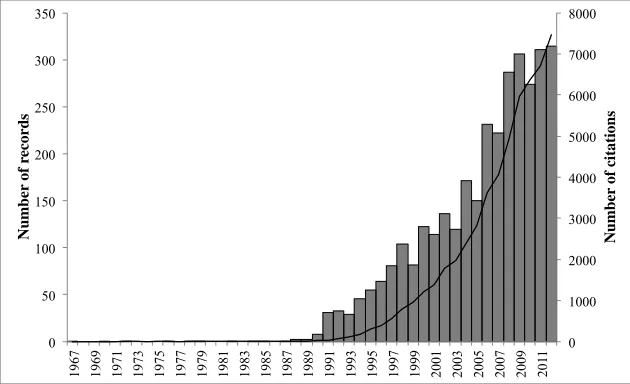
tions, respectively.) The number of articles published on
the subject, as well as the number of citations, has been
drastically increasing since the early 90’s (
Figure 1
).
The related mean annual growth rate [21,22] for the
period 1991-2012 has subsequently been estimated from
the slope
α
of the semi logarithmic plot of the number of
articles published
vs
. time as 12.4% (
Figure 2
).
It is, however, well known that the growth rate of sci-
entific publication is almost constantly raising [21,22].
Therefore, data from the ISI Web Of Science were also
collected for all published papers and for papers pub-
lished in marine sciences only (
i.e.
records containing
“marine”) for the period 1991-2012 (
Figure 2
). Using
the approach described above, the mean annual growth
rate for all fields combined was 4.1% and 7.0% for ma-
rine sciences specifically, both being significantly lower
than the 12.4% for benthic indicators (t-test for slope
comparison,
p
< 0.05.) Note that the sharp increase ob-
served in the early 90’s is also seen for marine sciences,
but not for the overall outputs from the Web of Science.
This feature was previously detected for several fields in
ecology [23], for example for studies related to coastal
biogeochemistry [24], pollution in estuaries [25] and
0 1000 2000 3000 4000 5000 6000 7000 8000
0 50 100 150 200 250 300 350
196
7
196
9
197
1
197
3
197
5
197
7
197
9
198
1
198
3
198
5
198
7
198
9
199
1
199
3
199
5
199
7
199
9
200
1
200
3
200
5
200
7
200
9
201
1
Nu
mb
er
o
f ci
ta
ti
o
n
s
Nu
m
b
er
of
r
ec
o
rd
[image:2.595.140.455.254.446.2]s
Figure 1. Number of publications (bars) and number of citations (solid line) in the field of marine benthic indicators (i.e. for the keywords combination “benthic indices or benthic indicator* and marine”) recovered from the ISI Web of Knowledge database (accessed early March 2013) for the period 1967 (first reference in the field)-2012.
0 1 2 3 4 5 6 7
1967 1972 1977 1982 1987 1992 1997 2002 2007 2012
Lo
g (
rec
ords +
1)
Benthic indicators WOS total Marine sciences
α = 0.051
α = 0.029
α = 0.017
Figure 2. Number of records in the ISI Web of Science database (accessed early March 2013, semi logarithmic scale) for ma- rine benthic indicators (i.e. for the keywords combination “benthic indices or benthic indicator* and marine”, circles), ma- rine sciences (i.e. for the keyword “marine”, triangles) and total number of records in the database (squares). The slopes α
[image:2.595.140.457.491.688.2]eutrophication [26]. Interestingly enough, there is no
significant change in the slope (summed cumulated func-
tion method [27]), hence in the growth rate, of publica-
tions on marine benthic indicators in the 2000’s. This
suggests that the vote and implementation of both the
WFD (2000) and MSFD (2008) did not have any signifi-
cant impact on the publication efforts, though more than
300 new methods were described for the WFD [9].
Due to the variety of existing benthic indicators, most
of the recent papers aimed to compare their efficiency
using different sampling methods (sampler and mesh size
[28]), taxonomic levels [29,30], or testing experts from
USA and Europe [31]. Numerous studies also compared
the consistency of different indicators for evaluating the
ecological status of a selected area [11,12,20,32-41].
Overall, these comparisons revealed inconsistencies
be-tween indicator responses, some sampling stations being
classified either in a “
poor
” or “
high
” ecological status
depending on the index used [32], or samples considered
as either “
unaffected
” or “
severely
affected
” depending
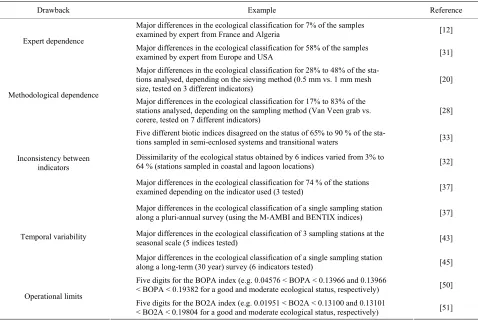
on the expert [12,31]. This short review demonstrates, as
recently stressed [6], that current benthic indicators
suf-fer from severe drawbacks (
Table 1
) and do not fulfil the
requirements for being “good indicators”
sensu
[42].
Most of them are usually specific to a habitat or geo-
graphical area (for a review see e.g. [20]) and highly
variable at both seasonal [43,44] and pluri-annual scales
[45]. Most authors usually agree on, for example, the
general efficiency of the AMBI and the derived M-
AMBI [34,37,40,41,46,47] or the relative ineffective-
ness of the BOPA index [32,48,49]. However, the prac-
tical use of benthic indicators might have reach a dead
end, since no real consensus has been reached yet and
inter-calibration and standardisation are still needed, as
shown by the ongoing inundation of papers related to
comparesons or intercalibrations (see references here
above).
[image:3.595.60.538.414.737.2]Recently, indices have been developed (or revised)
based on other benthic groups than macrofauna, such as
macroalgae either alone [52,53] or combined with mac-
rofauna [54], and meiofauna, including nematods [55]
and foraminifera [56,57]. These indices however share
disadvantages with macofauna-based indices, such as the
requirement of a high degree of specialisation (particu-
larly for some meiofaunal groups such as nematods [58]),
and contribute to the current indicator inundation that
sometimes leads to awkward situations when the indice
values are much more difficult to determine than the en-
vironmental factor it is supposed to be representative of
(e.g. living foraminifera assemblages diversity as an in
Table 1. Selected examples of the main drawbacks of current benthic indicators.
Drawback Example Reference
Major differences in the ecological classification for 7% of the samples
examined by expert from France and Algeria [12]
Expert dependence
Major differences in the ecological classification for 58% of the samples
examined by expert from Europe and USA [31]
Major differences in the ecological classification for 28% to 48% of the sta-tions analysed, depending on the sieving method (0.5 mm vs. 1 mm mesh size, tested on 3 different indicators)
[20]
Methodological dependence
Major differences in the ecological classification for 17% to 83% of the stations analysed, depending on the sampling method (Van Veen grab vs. corere, tested on 7 different indicators)
[28]
Five different biotic indices disagreed on the status of 65% to 90 % of the
sta-tions sampled in semi-ecnlosed systems and transitional waters [33]
Dissimilarity of the ecological status obtained by 6 indices varied from 3% to
64 % (stations sampled in coastal and lagoon locations) [32] Inconsistency between
indicators
Major differences in the ecological classification for 74 % of the stations
examined depending on the indicator used (3 tested) [37]
Major differences in the ecological classification of a single sampling station
along a pluri-annual survey (using the M-AMBI and BENTIX indices) [37]
Major differences in the ecological classification of 3 sampling stations at the
seasonal scale (5 indices tested) [43]
Temporal variability
Major differences in the ecological classification of a single sampling station
along a long-term (30 year) survey (6 indicators tested) [45] Five digits for the BOPA index (e.g.0.04576 < BOPA < 0.13966 and 0.13966
< BOPA < 0.19382 for a good and moderate ecological status, respectively) [50] Operational limits
Five digits for the BO2A index (e.g.0.01951 < BO2A < 0.13100 and 0.13101
dicator of dissolved O2 concentration [56].) Besides, the
claim that indicators’ outputs and interpretation should
be understood by non-scientists [38,59] (see however [60]
for criticisms), leads to a jargon where some terms do not
have any ecological reality anymore (this is the case for
the widely used “
reference
state
” [6,61]) or have differ-
ent meanings in a management and a purely ecological
context, such as “
ecosystem
” [62,63], which also con-
tributes to the general confusion.
3. Where to Go Next?
As stated above, benthic indicators based on species
composition are not totally satisfactory as communities
can be disrupted but exhibit only minor changes in their
composition (e.g. [64]). In turn, phenotypic and meta-
bolic changes can be observed in impacted areas, even if
the community structure (e.g. abundance, diversity) re-
mains unchanged. Behavioural, metabolic, phenotypic
and stable isotopes composition modifications in inver-
tebrates usually occur at short time scales [4], compared
to detectable changes in community composition (except
in the extreme case of catastrophic events such as oil
spills) and thus makes their use particularly relevant as
indicators of perturbation. Regarding for example be-
havioural analysis, they have previously been underlined
as “early warning” signals to assess the status of marine
environments [65].
Most of the highest predicted cumulated impacts of
humans on marine ecosystems are in areas of continental
shelf and slopes, including hard and soft continental
shelves and rocky reefs [5]. Ecosystem modifications in
response to these changes include extinctions, changes in
food web structures and shifts in geographical distribu-
tion of species [1]. In the latter case, intertidal organisms
are considered as being potential harbingers of climate-
driven changes in distribution patterns [66] because most
of them live very close to their thermal tolerance limits
[67,68]. Furthermore, intertidal areas are home to some
of the highest rates of primary production in the world
[69] and their status (sink/source) regarding the CO2
global cycle is still uncertain [70]. Understanding their
role in the global carbon cycle is, however, of primary
importance since the efficiency of the global ocean car-
bon pump is expected to decrease [1,71] and about 40%
of the carbon sequestration in the oceans occur along
continental margins [72]. Thus, intertidal areas do not
only occupy a keystone ecological position as a land/sea
and air/water interface but also represent a compartment
of primary importance to assess the impact of human
activities and global warming on marine ecosystems [67].
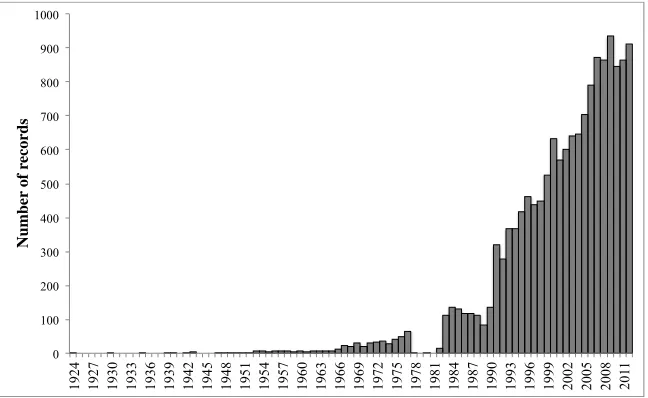
Intertidal ecology is a productive field in marine sciences,
as seen from the constant increase in published works on
the intertidal environment since the early 90’s (
Figure
3
).
Note that the related growth rate (5.7%), though sig-
nificantly lower than the ones for benthic indicators and
marine sciences, corresponds to a significantly more
pronounced increase than the one observed in general
sciences. One of the main advantages of the intertidal
environment is its accessibility and the subsequent rela-
tive ease to observe the distribution and behaviour of
organisms, and to perform manipulative experiments.
This is particularly true for rocky shores that have been
extensively used to study species interactions relatively
early (60’s and 70’s), notably with the work of Connell
[73], Paine [74] and Underwood [75]. Note that the re-
0 100 200 300 400 500 600 700 800 900 1000
19
24
19
27
19
30
19
33
19
36
19
39
19
42
19
45
19
48
19
51
19
54
19
57
19
60
19
63
19
66
19
69
19
72
19
75
19
78
19
81
19
84
19
87
19
90
19
93
19
96
19
99
20
02
20
05
20
08
20
11
N
u
m
b
er
of
r
[image:4.595.137.461.500.699.2]ecords
Figure 3. Number of publications in the field of intertidal ecology (i.e. for the keywords combination “intercotidal or inter-tidal”) recovered from the ISI Web of Knowledge database (accessed early March 2013) for the period 1924 (first reference
vival of interest in intertidal ecology in the early 80’s
(
Figure 3
) matches with the first papers published on the
primary production of microphytobenthos [76]. Ever
since, soft sediment functioning has been continuously
and increasingly studied, especially in areas where both
human uses and impacts are manifest,
i.e.
estuaries (mud-
flats) and sandy shores (beaches.)
In this framework, the intertidal represents an ideal
candidate for the development of new indicators and
studies concerning the impact of anthropogenic (direct
and indirect) disturbances on the functioning of intertidal
systems have been multiplying during the last decade.
Modifications in the behaviour, phenotype, metabolism
or isotopic composition of intertidal invertebrates might
be useful to detect non-natural changes in relation with
e.g. alien species introduction [77,78], topographic modi-
fications [79], the presence of plastic litter [80], metal
contamination in sediment [81], exposition to pesticides
[82,83], acidification [84,85] and temperature increase
[86-88]. Furthermore, tools usually used to trace organic
matter in the trophic network (
i.e.
stable isotopes and
fatty acids) have also been used as indicators for envi-
ronmental changes [89-91]. The monitoring of CO2
fluxes at the air/sediment interface also appears to be
particularly interesting since they are mainly dependent
on variations in light and temperature at several scales
[92,93], and have been shown to respond to direct and
indirect consequences of global change. This includes
climatic events (exceptional warm year [70]), micro- and
macro-algal deposits in soft sediments [94-97], canopy
loss on rocky shores [98], and most probably acidifica-
tion [99].
Potential benthic indicators are thus numerous in the
intertidal. However, the functioning of intertidal areas is
known to be particularly complex, hence the difficulties
in the estimation of the impact of climate change [66,
100]. Indeed, the interface position leads to sharp varia-
tions in the physical and chemical properties of the envi-
ronment between immersion and emersion conditions,
and the understanding of the impact of environmental
stress is made particularly difficult due to theirspatio-
temporal coincidence [101,102]. In addition, the sources
of organic matter are numerous [103], leading to often
challenging studies on trophic interactions and energy
flows [104]. Therefore, a proper knowledge of the func-
tioning of the main intertidal habitats (rocky shores,
sandflats, mudflats, seagrass meadows) is required as a
prerequisite to develop a baseline, or “relative reference
state” [61]. This would require, beside usual laboratory
experiments, long-term surveys and extensive field in-
vestigations. Long-term monitoring of CO2 exchanges
through automated measurements could be performed
using the non-invasive eddy correlation technique which
provides direct and continuous measurements of net CO2
exchange at time scales ranging from hours to years
[105], integrates large spatial scales, and has been proven
efficient in intertidal areas [106]. This method represents
a promising tool for large-scale estimations of CO2
fluxes, but techniques such as benthic chambers are more
amenable for the detection of fine processes. The situa-
tion is much more complicated for long-term, spatially
extended, surveys of species distribution in relation with
e.g. microhabitats or the collection of individuals for
morphometric analysis. This kind of surveys requires
important associated manpower and financial resources.
It is nowadays recognise that projects that seek to collect
field data on large geographical areas and/or over long
time periods can only succeed with the help of ‘citizen
scientists’ [107,108]. The intertidal being easily
accessi-ble and usually frequented by tourists or recurrent users,
the help of volunteers can be relatively easily
imple-mented. For example, citizen science has previously been
successfully used to assess the presence of invasive crabs
in the intertidal zone along more than 1000 km of coast
in the USA [109]. Though usually based on structural
factors (presence/richness of some species), citizen sci-
ence could also be powerful for functional factors with
the development of specific protocols and a minimum of
training.
4. Conclusion: Are Science and Policy
Compatible?
tion leads to 1) a profusion of publications related to
benthic indicators that, though probably helpful for the
bibliometric profile of some scientists, do not bring any
definitive solution (outputs
vs.
outcomes [59]), 2) ignores
the evolution of scientific knowledge that should be in-
cluded in new management directives and 3) ignores
exogenic unmanaged pressures. Elliott [59] recently
adressed these problems and stressed that both exogenic
unmanaged pressures and endogenic managed pressures
should both be tackled in a multidisciplinary approach,
and that the ‘health’ of the system should be considered
at six different biological levels (cell, tissue, individual,
population, community and ecosystem)···I further
sug-gest “in the intertidal”!
5. Acknowledgements
I am grateful to L. Barillé, J.-C. Dauvin, D. Davoult, S.
Lefebvre, L. Seuront and D.T. Welsh for their insightful
comments on my French HDR Thesis, which contained
most of the ideas that were developed in the present work.
Thanks are also due to the guest editor for helpful com-
ments, to C. Luczak for fruitful discussions and to an
anonymous referee for comments on an early version of
this manuscript.
REFERENCES
[1] M. L. Parry, O. F. Canziani, J. P. Palutikof, P. J. van der Linden and C. E. Hanson, “Climate Change 2007: Im- pacts, Adaptation and Vulnerability. Contribution of Working Group II to the Fourth Assessment Report of the Intergovernmental Panel on Climate Change,” Cambridge University Press, Cambridge, 2007.
[2] P. M. Chapman, “Global Climate Change Means Never Going Home Again,” Marine Pollution Bulletin, Vol. 62, No. 11, 2011, pp. 2269-2270.
doi:10.1016/j.marpolbul.2011.08.031
[3] X. Durrieu de Madron, C. Guieu, R. Sempéré, P. Conan, D. Cossa, F. d’Ortenzio, C. Estournel, F. Gazeau, C. Rabouille, L. Stemmann, S. Bonnet, F. Diaz, P. Koubbi, O. Radakovitch, M. Babin, M. Baklouti, C. Bancon- Montigni, S. Belviso, N. Bensoussan, B. Bonsang, I. Bou- loubassi, C. Brunet, J.-F. Cadiou, F. Carlotti, M. Chami, S. Charmasson, B. Charrière, J. Dachs, D. Doxaran, J.-C. Dutay, F. Elbaz-Poulichet, M. Eléaume, F. Eyrolles, C. Fernandez, S. Fowler, P. Francour, J. C. Gaertner, R. Galzin, S. Gasparini, J.-F. Ghiglione, J.-L. Gonzalez, C. Goyet, L. Guidi, K. Guizien, L.-E. Heimbürger, S. H. M. Jacquet, W. H. Jeffrey, F. Joux, P. Le Hir, K. Leblanc, D. Lefèvre, C. Lejeusne, R. Lemé, M.-D. Loÿe-Pilot, M. Mallet, L. Méjanelle, F. Mélin, C. Mellon, B. Mérigot, P.-L. Merle, C. Migon, W. L. Miller, L. Mortier, B. Mo- stajir, L. Mousseau, T. Moutin, J. Para, T. Pérez, A. Pe- trenko, J.-C. Poggiale, L. Prieur, M. Pujo-Pay, Pulido- Villena, P. Raimbault, A. P. Rees, C. Ridame, J.-F. Ron- tani, D. Ruiz Pino, M. A. Sicre, V. Taillandier, C. Tam- burini, T. Tanaka, I. Taupier-Letage, M. Tedetti, P. Testor,
H. Thébault, B. Thouvenin, F. Touratier, J. Tronczynski, C. Ulses, F. Van Wambeke, V. Vantrepotte, S. Vaz and R. Verney, “Marine Ecosystems’ Responses to Climatic and Anthropogenic Forcings in the Mediterranean,” Progress in Oceanography, Vol. 91, No. 2, 2011, pp. 97-166. doi:10.1016/j.pocean.2011.02.003
[4] C. J. M. Philippart, R. Anadón, R. Danovaro, J. W. Dipp- ner, K. F. Drinkwater, S. J. Hawkins, T. Oguz, G. O’Sul- livan and P. C. Reid, “Impacts of Climate Change on European Marine Ecosystems: Observations, Expecta- tions and Indicators,” Journal of Experimental Marine Biology and Ecology, Vol. 400, No. 1-2, 2011, pp. 52-69. doi:10.1016/j.jembe.2011.02.023
[5] B. S. Halpern, S. Walbridge, K. A. Selkoe, C. V. Kappel, F. Micheli, C. D’Agrosa, J. F. Bruno, K. S. Casey, C. Ebert, H. E. Fox, R. Fujita, D. Heinemann, H. S. Lenihan, E. M. P. Madin, M. T. Perry, E. R. Selig, M. Spalding, R. Steneck and R. Watson, “A Global Map of Human Im- pact on Marine Ecosystems,” Science, Vol. 319, No. 5865, 2008, pp. 948-952. doi:10.1126/science.1149345
[6] I. Rombouts, G. Beaugrand, L. F. Artigas, J.-C. Dauvin, F. Gevaert, E. Goberville, D. Kopp, S. Lefebvre, C. Luczak, N. Spilmont, M. Travers-Trolet, C. M. Villanueva and R. R. Kirby, “Tools to Derive Indicators of Marine Ecosys- tem Structure and Functioning: Case Studies Using Direct Observations and Modelling Methods,” Ecological Indi- cators, Vol. 24, 2013, pp. 353-365.
doi:10.1016/j.ecolind.2012.07.001
[7] S. Bevilacqua, S. Fraschetti, L. Musco, G. Guarnieri and A. Terlizzi, “Low Sensitiveness of Taxonomic Distinct- ness Indices to Human Impacts: Evidences Across Marine Benthic Organisms and Habitat Types,” Ecological Indi-cators, Vol. 11, No. 2, 2011, pp. 448-455.
doi:10.1016/j.ecolind.2010.06.016
[8] R. J. Diaz, M. Solan and R. M. Valente, “A Review of Approaches for Classifying Benthic Habitats and Evalu- ating Habitat Quality,” Journal of Environmental Man- agement, Vol. 73, No. 3, 2004, pp. 165-181.
doi:10.1016/j.jenvman.2004.06.004
[9] S. Birk, W. Bonne, A. Borja, S. Brucet, A. Courrat, S. Poikane, A. Solimini, W. van de Bund, N. Zampoukas and D. Hering, “Three Hundred Ways to Assess Europe’s Surface Waters: An Almost Complete Overview of Bio- logical Methods to Implement the Water Framework Di- rective,” Ecological Indicators, Vol. 18, No. 1, 2012, pp. 31-41. doi:10.1016/j.ecolind.2011.10.009
[10] G. Van Hoey, A. Borja, S. Birchenough, L. Buhl-Morten- sen, S. Degreaer, D. Fleisher, F. Kerckhof, P. Magni, I. Muxika, H. Reiss, A. Schröder and M. Zettler, “The Use of Benthic Indicators in Europe: From the Water Frame- work Directive to the Marine Strategy Framework Direc- tive,” Marine Pollution Bulletin, Vol. 60, No. 12, 2010, pp. 2187-2196. doi:10.1016/j.marpolbul.2010.09.015 [11] D. A. Smale, T. J. Langlois, G. A. Kendrick, J. J. Meeu-
wig and E. S. Harvey, “From Fronds to Fish: The Use of Indicators for Ecological Monitoring in Marine Benthic Ecosystems, with Case Studies from Temperate Western Australia,” Reviews in Fish Biology and Fisheries, Vol. 21, No. 3, 2011, pp. 311-337.
[12] J.-C. Dauvin, S. Alizier, C. Rolet, A. Bakalem, G. Bellan, J. L. Gomez Gesteira, S. Grimes, J. A. de-la-Ossa-Car- retero and Y. Del-Pilar-Ruso, “Response of Different Benthic Indices to Diverse Human Pressures,” Ecological Indicators, Vol. 12, No. 1, 2012, pp. 143-153.
doi:10.1016/j.ecolind.2011.03.019
[13] J.-C. Dauvin, G. Bellan and D. Bellan-Santini, “Benthic Indicators: From Subjectivity to Objectivity—Where Is the Line?” Marine Pollution Bulletin, Vol. 60, No. 7, 2010, pp. 947-953. doi:10.1016/j.marpolbul.2010.03.028 [14] U. Heink and I. Kowarik, “What Are Indicators? On the
Definition of Indicators in Ecology and Environmental Planning,” Ecological Indicators, Vol. 10, No. 3, 2010, pp. 584-593. doi:10.1016/j.ecolind.2009.09.009
[15] A. Borja, J. Franco and V. Perez, “A Marine Biotic Index to Establish the Ecological Quality of Soft-Bottom Ben- thos within European Estuarine and Coastal Environ- ments,” Marine Pollution Bulletin, Vol. 40, No. 12, 2000, 1100-1114. doi:10.1016/S0025-326X(00)00061-8 [16] R. M. Warwick, “The Level of Taxonomic Discrimina-
tion Required to Detect Pollution Effects on Marine Ben- thic Communities,” Marine Pollution Bulletin, Vol. 19, No. 6, 1988, pp. 259-268.
doi:10.1016/0025-326X(88)90596-6
[17] A. Borja and D. M. Dauer, “Assessing the Environmental Quality Status in Estuarine and Coastal Systems: Com- paring Methodologies and Indices,” Ecological Indicators, Vol. 8, No. 4, 2008, pp. 331-337.
doi:10.1016/j.ecolind.2007.05.004
[18] I. Muxika, A. Borja and W. Bonne, “The Suitability of the Marine Biotic Index (AMBI) to New Impact Sources Along European Coasts,” Ecological Indicators, Vol. 5, No. 1, 2005, pp. 19-31.
doi:10.1016/j.ecolind.2004.08.004
[19] F. Salas, J. M. Neto, A. Borja and J. C. Marques, “Eva- luation of the Applicability of a Marine Biotic Index to Characterize the Status of Estuarine Ecosystems: The Case of Mondego Estuary (Portugal),” Ecological Indi- cators, Vol. 4, No. 3, 2004, pp. 215-225.
doi:10.1016/j.ecolind.2004.04.003
[20] R. Pinto, J. Patricio, A. Baeta, B. D. Fath, J. M. Neto and J. C. Marques, “Review and Evaluation of Estuarine Bi- otic Indices to Assess Benthic Condition,” Ecological In- dicators, Vol. 9, No. 1, 2009, pp. 1-25.
doi:10.1016/j.ecolind.2008.01.005
[21] M. Mabe and M. Amin, “Growth Dynamics of Scholarly and Scientific Journals,” Scientometrics, Vol. 51, No. 1, 2001, pp. 147-162. doi:10.1023/A:1010520913124 [22] P. O. Larsen and M. von Is, “The Rate of Growth in Sci-
entific Publication and the Decline in Coverage Provided by Science Citation Index,” Scientometrics, Vol. 84, No. 3, 2010, pp. 575-603. doi:10.1007/s11192-010-0202-z [23] M. W. Neff and E. A. Corley, “35 Years and 160,000 Ar-
ticles: A Bibliometric Exploration of the Evolution of Eco- logy,” Scientometrics, Vol. 80, No. 3, 2009, pp. 657-682. doi:10.1007/s11192-008-2099-3
[24] J.-P. Gattuso, N. A. Dawson, C. M. Duarte and J. J. Mid- delburg, “Patterns of Publication Effort in Coastal Bio- geochemistry: A Bibliometric Survey (1971 to 2003),”
Marine Ecology Progress Series, Vol. 294, 2005, pp. 9- 22. doi:10.3354/meps294009
[25] J. Sun, M. H. Wang and Y.-S. Ho, “A Historical Review and Bibliometric Analysis of Research on Estuary Pollu- tion,” Marine Pollution Bulletin, Vol. 64, No. 1, 2012, pp. 13-21. doi:10.1016/j.marpolbul.2011.10.034
[26] H. Yi and W. Jie, “A Bibliometric Study of the Trend in Articles Related to Eutrophication Published in Science Citation Index,” Scientometrics, Vol. 89, No. 3, 2011, pp. 919-927. doi:10.1007/s11192-011-0479-6
[27] F. Ibanez, J.-M. Fromentin and J. Castel, “Application of the Cumulated Function to the Processing of Chronologi- cal Data in Oceanography,” Comptes Rendus de l’Aca- démie des Sciences Série III—Sciences de la Vie—Life Sciences, Vol. 316, 1993, pp. 745-748.
[28] I. Karakassis, P. D. Dimitriou, N. Papageorgiou, E. T. Apostolaki, N. Lampadariou and K. D. Black, “Meth- odological Considerations on the Coastal and Transitional Benthic Indicators Proposed for the Water Framework Directive,” Ecological Indicators, Vol. 29, 2013, pp. 26- 33. doi:10.1016/j.ecolind.2012.12.020
[29] T. Bacci, B. Trabucco, S. Marzialetti, V. Marusso, S. Lomiri, D. Vani and C. V. Lamberti, “Taxonomic Suffi- ciency in Two Case Studies: Where Does It Work Bet- ter?” Marine Ecology, Vol. 30, No. Suppl. 1, 2009, pp. 13-19. doi:10.1111/j.1439-0485.2009.00324.x
[30] J. A. de-la-Ossa-Carretero, N. Simboura, Y. Del-Pilar- Ruso, M. A. Pancucci-Papadopoulou, F. Giménez-Cas- ualduero and J. L. Sánchez-Lizaso, “A Methodology for Applying Taxonomic Sufficiency and Benthic Indices in Two Mediterranean Areas,” Ecological Indicators, Vol. 23, 2012, pp. 232-241. doi:10.1016/j.ecolind.2012.03.029 [31] H. Teixeira, A. Borja, S. B. Weisberg, J. A. Ranasinghe,
D. B. Cadien, D. M. Dauer, J.-C. Dauvin, S. Degraer, R. J. Diaz, A. Grémare, I. Karakassis, R. J. Llansó, L. L. Lov- ell, J. C. Marques, D. E. Montagne, A. Occhipinti-Am- brogi, R. Rosenberg, R. Sardá, L. C. Schaffner and R. G. Velarde, “Assessing Coastal Benthic Macrofauna Com- munity Condition Using Best Professional Judgement— De-veloping Consensus Across North America and Europe,” Marine Pollution Bulletin, Vol. 60, No. 4, 2010, pp. 589-600. doi:10.1016/j.marpolbul.2009.11.005 [32] A. Afli, R. Ayari and S. Zaabi, “Ecological Quality of
Some Tunisian Coast and Lagoon Locations, by Using Benthic Community Parameters and Biotic Indices,” Es- tuarine, Coastal and Shelf Science, Vol. 80, No. 2, 2008, pp. 269-280. doi:10.1016/j.ecss.2008.08.010
[33] H. Blanchet, N. Lavesque, T. Ruellet, J.-C. Dauvin, P.-G. Sauriau, N. Desroy, C. Desclaux, M. Leconte, G. Bach- elet, A.-L. Janson, C. Bessineton, S. Duhamel, J. Jourde, S. Mayot, S. Simon and X. de Montaudouin, “Use of Bi- otic Indices in Semi-Enclosed Coastal Ecosystems and Transitional Waters Habitats—Implications for the Imple- mentation of the European Water Framework Directive,”
Ecological Indicators, Vol. 8, No. 4, 2008, pp. 360-372. doi:10.1016/j.ecolind.2007.04.003
parison of Three Indices,” Ecological Indicators, Vol. 8, No. 4, 2008, pp. 395-403.
doi:10.1016/j.ecolind.2007.05.003
[35] A. Borja, J. G. Rodríguez, K. Black, A. Bodoy, C. Em- blow, T. F. Fernandes, J. Forte, I. Karakassis, I. Muxika, T. D. Nickell, N. Papageorgiou, F. Pravoni, K. Sevastou, P. Tomassetti and D. Angel, “Assessing the Suitability of a Range of Benthic Indices in the Evaluation of Environ- mental Impact of Fin and Shellfish Aquaculture Located in Sites Across Europe,” Aquaculture, Vol. 293, No. 3-4, 2009, pp. 231-240.
doi:10.1016/j.aquaculture.2009.04.037
[36] N. Lavesque, H. Blanchet and X. de Montaudouin, “De- velopment of a Multimetric Approach to Assess Perturba- tion of Benthic Macrofauna in Zostera noltii Beds,”
Journal of Experimental Marine Biology and Ecology, Vol. 368, No. 2, 2009, pp. 101-112.
doi:10.1016/j.jembe.2008.09.017
[37] R. Simonini, V. Grandi, G. Massamba-N’Siala, M. Lotti, G. Montarani and D. Prevedelli, “Assessing the Ecologi- cal Status of North-Western Adriatic Sea within the European Framework Directive: A Comparison of Bentix, AMBI and M-AMBI Methods,” Marine Ecology, Vol. 30, No. 2, 2009, pp. 241-254.
doi:10.1111/j.1439-0485.2009.00281.x
[38] S. J. Ware, H. L. Rees, S. E. Boyd and S. N. Birchen- hough, “Performance of Selected Indicators in Evaluating the Consequences of Dredged Material Relocation and Marine Aggregate Extraction,” Ecological Indicators, Vol. 9, No. 4, 2009, pp. 704-718.
doi:10.1016/j.ecolind.2008.09.010
[39] S. Grimes, T. Ruellet, J.-C. Dauvin and Z. Boutida, “Ecological Quality Status of the Soft-Bottom Communi- ties on the Algerian Coast: General Patterns and Diagno- sis,” Marine Pollution Bulletin, Vol. 60, No. 11, 2010, pp. 1969-1977. doi:10.1016/j.marpolbul.2010.07.032
[40] A. Borja, E. Barbone, A. Basset, G. Borgensen, M. Brkljacic, M. Elliott, J. M. Garmendia, J. C. Marques, K. Mazik, I. Muxika, J. M. Neto, K. Norling, J. G. Rodríguez, I. Rosati, B. Rygg, H. Teixeira and A. Tra- yanova, “Response of Single Benthic Metrics and Multi- Metric Methods to Anthropogenic Pressure Gradients, in Five Distinct European Coastal and Transitional Ecosys- tems,” Marine Pollution Bulletin, Vol. 62, No. 3, 2011, pp. 499-513. doi:10.1016/j.marpolbul.2010.12.009 [41] C. Murani and M. Mistri, “Ecological Status Assessment
and Response of Benthic Communities to Environmental Variability: The Valli di Comacchio (Italy) as a Case Study,” Marine Environmental Research, Vol. 81, 2012, pp. 53-61. doi:10.1016/j.marenvres.2012.08.008
[42] F. Salas, C. Marcos, J. M. Neto, J. Patrício, A. Pérez- Ruzafa and J. C. Marques, “User-Friendly Guide for Us- ing Benthic Ecological Indicators in Coastal and Marine Quality assessment,” Ocean and Coastal Management, Vol. 49, No. 5-6, 2006, pp. 308-331.
doi:10.1016/j.ocecoaman.2006.03.001
[43] H. Reiss and I. Kröncke, “Seasonal Variability of Benthic Indices: An Approach to Test the Applicability of Diffe- rent Indices for Ecosystem Quality Assessment,” Marine Pollution Bulletin, Vol. 50, No. 12, 2005, pp. 1490-1499.
doi:10.1016/j.marpolbul.2005.06.017
[44] J.-C. Dauvin, G. Bachelet, A.-L. Barillé, H. Blanchet, X. de Montaudouin, N. Lavesque and T. Ruellet, “Benthic Indicators and Index Approaches in the Three Main Estu- aries along the French Atlantic Coast (Seine, Loire and Gironde),” Marine Ecology, Vol. 30, No. 2, 2009, pp. 228-240. doi:10.1111/j.1439-0485.2008.00274.x
[45] I. Kröncke and H. Reiss, “Influence of Macro-Fauna Long-Term Natural Variability on Benthic Indices Used in Ecological Quality Assessment,” Marine Pollution Bulletin, Vol. 60, No. 1, 2010, pp. 58-68.
doi:10.1016/j.marpolbul.2009.09.001
[46] J. E. Fitch and T. P. Crowe, “Effective Methods for As- sessing Ecological Quality in Intertidal Soft-Sediment Habitats,” Marine Pollution Bulletin, Vol. 60, No. 10, 2010, pp. 1726-1733.
doi:10.1016/j.marpolbul.2010.06.027
[47] E. Quiroga, P. Ortiz, B. Reid and D. Gerdes, “Classifica- tion of the Ecological Quality of the Aysen and Bker Fjords (Patagonia, Chile) Using Biotic Indices,” Marine Pollution Bulletin, Vol. 68, No. 1-2, 2013, pp. 117-126. doi:10.1016/j.marpolbul.2012.11.041
[48] J. A. de-la-Ossa-Carretero, Y. del-Pilar-Ruso, F. Gimé- nez-Casalduero and J. L. Sánchez-Lizaso, “Testing BOPA Index in Seawage Affected Soft-Bottom Communities in the North-Western Mediterranean,” Marine Pollution Bulletin, Vol. 58, No. 3, 2009, 332-340.
doi:10.1016/j.marpolbul.2008.10.017
[49] R. Bermejo, J. J. Vergaga and I. Hernández, “Application and Reassessment of the Reduces Species List Index for Macroalgae to Assess the Ecological Status under the Water Framework Directive in the Atlantic Coast of Southern Spain,” Ecological Indicators, Vol. 12, No. 1, 2012, pp. 46-57. doi:10.1016/j.ecolind.2011.04.008 [50] J.-C. Dauvin and T. Ruellet, “Polychaete/Amphipod Ra-
tio Revisited,” Marine Pollution Bulletin, Vol. 55, No. 1-6, 2007, pp. 215-224.
[51] J.-C. Dauvin and T. Ruellet, “The Estuarine Quality Paradox: Is It Possible to Define an Ecological Quality Status for Specific Modified and Naturally Stressed Es- tuarine Ecosystems?” Marine Pollution Bulletin, Vol. 59, No. 1-3, 2009, pp. 38-47.
doi:10.1016/j.marpolbul.2008.11.008
[52] R. Gaspar, L. Pereira and J. M. Neto, “Ecological Refe- rence Conditions and Quality States of Marine Macroal- gae sensu Water Framework Directive: An Example from the Intertidal Rocky Shores of the Portuguese Coastal Waters,” Ecological Indicators, Vol. 19, 2012, pp. 24-38. doi:10.1016/j.ecolind.2011.08.022
[53] J. M. Neto, R. Gaspar, L. Pereira and J. C. Marques, “Marine Macroalgae Assessment Tool (MarMAT) for In- tertidal Rocky Shores. Quality Assessment under the Scope of the European Water Framework Directive,”
Ecological Indicators, Vol. 19, 2012, pp. 39-47. doi:10.1016/j.ecolind.2011.09.006
Assemblages, within Atlantic Iberian Coasts,” Ecological Indicators, Vol. 12, No. 1, 2011, 58-71.
doi:10.1016/j.ecolind.2011.05.014
[55] A. S. Alves, H. Adão, T. J. Ferrero, J. C. Marques, M. J. Costa and J. Patrício, “Benthic Meiofauna as Indicator of Ecological Changes in Estuarine Ecosystems: The Use of Nematodes in Ecological Quality Assessment,” Ecologi- cal Indicators, Vol. 24, 2013, pp. 462-475.
doi:10.1016/j.ecolind.2012.07.013
[56] V. M. P. Bouchet, E. Alve, B. Rygg and R. J. Telford, “Benthic Foraminifera Provide a Promising Tool for Ecological Quality Assessment of Marine Waters,” Eco- logical Indicators, Vol. 23, 2012, pp. 66-75.
doi:10.1016/j.ecolind.2012.03.011
[57] S. Donnici, R. Serandrei-Barbero, M. Bonardi and M. Sperle, “Benthic Foraminifera as Proxies of Pollution: The Case of Guanabara Bay (Brazil),” Marine Pollution Bulletin, Vol. 64, No. 10, 2012, 2015-2028.
doi:10.1016/j.marpolbul.2012.06.024
[58] M. Balsamo, F. Semprucci, F. Frontalini and R. Coccioni, “Meiofauna as a Tool for Marine Ecosystem Biomoni- toring,” In: A. Cruzado, Ed., Marine Ecosystems, InTech, Rijeka, 2012, pp. 77-104. doi:10.5772/34423
[59] M. Elliott, “Marine Science and Management Means Tackling Exogenic Unmanaged Pressures and Endogenic Managed Pressures—A Numbered Guide,” Marine Pol- lution Bulletin, Vol. 62, No. 4, 2011, pp. 651-655. doi:10.1016/j.marpolbul.2010.11.033
[60] B. Beliaeff and D. Pelletier, “A General Framework for Indicator Design and Use with Application to the As- sessment of Coastal Water Quality and Marine Protected Area Management,” Ocean and Coastal Management, Vol. 54, No. 1, 2011, pp. 84-92.
doi:10.1016/j.ocecoaman.2010.10.037
[61] E. Goberville, G. Beaugrand, B. Sautour and P. Tréguer, “Evaluation of Coastal Perturbations: A New Mathemati- cal Procedure to Detect Changes in the Reference State of Coastal Systems,” Ecological Indicators, Vol. 11, No. 5, 2011, pp. 1290-1300. doi:10.1016/j.ecolind.2011.02.002 [62] C. Luczak and N. Spilmont, “Are the Eastern and Wes-
tern Basins of the English Channel Two Separate Eco- systems? Get Back in Line with Some Cautionary Com- ments,” Marine Pollution Bulletin, Vol. 64, No. 7, 2012, pp. 1318-1319. doi:10.1016/j.marpolbul.2012.05.006 [63] J.-C. Dauvin, “Response by Dauvin to correspondence by
Christophe Luczak and Nicolas Spilmont on ‘Are the Eastern and Western Basins of the English Channel Two Separate Ecosystems? Get back in Line with Some Cau- tionary comments’,” Marine Pollution Bulletin, Vol. 64, No. 11, 2012, 2615-2616.
doi:10.1016/j.marpolbul.2012.07.004
[64] G. Allison, “The Influence of Species Diversity and Stress Intensity on Community Resistance and Resili- ence,” Ecological Monographs, Vol. 74, 2004, pp. 117- 134. doi:10.1890/02-0681
[65] J. Hellou, “Behavioural Ecotoxicology, an ‘Early War- ning’ Signal to Assess Environmental Quality,” Envi- ronmental Science and Pollution Research, Vol. 18, No. 1, 2011, pp. 1-11. doi:10.1007/s11356-010-0367-2
[66] B. Helmuth, C. D. G. Harley, P. M. Halpin, M. O’Donnell, G. E. Hofmann and C. A. Blanchette, “Cli- mate Change and Latitudinal Patterns of Intertidal Ther- mal Stress,” Science, Vol. 298, No. 5595, 2002, pp. 1015- 1017. doi:10.1126/science.1076814
[67] C. D. G. Harley, “Climate Change, Keystone Predation, and Biodiversity Loss,” Science, Vol. 334, No. 6059, 2011, pp. 1124-1127. doi:10.1126/science.1210199 [68] D. Madeira, L. Narciso, H. N. Cabral and C. Vinagre,
“Thermal Tolerance and Potential Impacts of Climate Change on Coastal and Estuarine Organisms,” Journal of Sea Research, Vol. 70, 2012, pp. 32-41.
doi:10.1016/j.seares.2012.03.002
[69] D. Raffaelli and S. Hawkins, “Intertidal Ecology,” Chap- man & Hall, London, 1996.
doi:10.1007/978-94-009-1489-6
[70] W. Klaassen and N. Spilmont, “Inter-Annual Variability of CO2 Exchanges between an Emersed Tidal Flat and the
Atmosphere,” Estuarine, Coastal and Shelf Science, Vol. 100, 2012, pp. 18-25. doi:10.1016/j.ecss.2011.06.002 [71] H. Thomas, Y. Bozec, K. Elkalay and H. J. M. de Baar,
“Enhanced Open Ocean Storage of CO2 from Shelf Sea
Pumping,” Science, Vol. 304, No. 5673, 2004, pp. 1005- 1008. doi:10.1126/science.1095491
[72] F. E. Muller-Karger, R. Varela, R. Thunell, R. Luerssen and J. J. Walsh, “The Importance of Continental Margins in the Global Carbon Cycle,” Geophysical Research Let- ters, Vol. 32, No. 1, 2005, Article ID: L01602.
doi:10.1029/2004GL021346
[73] J. H. Connell, “The Influence of Intra-Specific Competi- tion and Other Factors on the Distribution of the Barnacle
Chthamalus stellatus,” Ecology, Vol. 42, No. 4, 1961, 710-723. doi:10.2307/1933500
[74] R. T. Paine, “The Pisaster-Tegula Interaction: Prey Patches, Predator Food Preferences and Intertidal Com- munity Structure,” Ecology, Vol. 50, No. 6, 1969, pp. 950-961. doi:10.2307/1936888
[75] A. J. Underwood, “Comparative Studies on the Biology of Nerita atramentosa Reeve, Benbicium nancum (La- marck) and Cellanatramoserica (Sowerby) (Gastropoda: Prosobranchia) in S.E. Australia,” Journal of Experimen- tal Marine Biology and Ecology, Vol. 18, No. 2, 1975, pp. 153-172. doi:10.1016/0022-0981(75)90071-4
[76] F. Colijn, “Light Absorption in the Waters of the Ems- Dollard Estuary and its Consequences for the Growth of Phytoplankton and Microphytobenthos,” Netherlands Journal of Sea Research, Vol. 15, No. 2, 1982, 196-216. doi:10.1016/0077-7579(82)90004-7
[77] G. C. Jensen, P. S. McDonald and D. A. Armstrong, “East Meets West: Competitive Interactions between Green Crab Carcinusmaenas, and Native and Introduced Shore Crab Hemigrapsusspp,” Marine Ecology Progress Series, Vol. 225, 2002, pp. 251-262.
doi:10.3354/meps225251
[78] W. L. Whitlow, “Changes in Survivorship, Behavior, and Morphology in Native Soft-Shell clams Induced by Inva- sive Green Crab Predators,” Marine Ecology, Vol. 31, No. 3, 2010, pp. 418-430.
Rocky Shores in Northern Scotland and Some Possible Ecological Impacts,” Journal of Experimental Marine Bi- ology and Ecology, Vol. 400, No. 1-2, 2011, pp. 314-321. doi:10.1016/j.jembe.2011.02.012
[80] A. B. Aloy, B. M. Vallelo, Jr and M. A. Juinio-Meñez, “Increased Plastic Litter Cover Affects the Foraging Ac- tivity of the Sandy Intertidal Gastropod Nassarius pul- lus,” Marine Pollution Bulletin, Vol. 62, No. 8, 2011, pp. 1772-1779. doi:10.1016/j.marpolbul.2011.05.021 [81] C. V. M. Araújo, J. Blasco and I. Moreno-Garrido, “Mea-
suring the Avoidance Behaviour Shown by the Snail Hy- drobia ulvae Exposed to Sediment with a Known Con- tamination Gradient,” Ecotoxicology, Vol. 21, No. 3, 2012, pp. 750-758. doi:10.1007/s10646-011-0835-6 [82] J. D. Nuez, M. V. Laitano and M. Cledón, “An Intertidal
Limpet Species as a Bioindicator: Pollution Effects Re- flected by Shell Characteristics,” Ecological Indicators, Vol. 14, No. 1, 2012, pp. 178-183.
doi:10.1016/j.ecolind.2011.07.015
[83] B. Manachini, V. Arizza, A. Rinaldi, V. Montalto and G. Sarà, “Eco-Physiological Response of Two Marine Bi- valves to Acute Exposition to Commercial Bt-Based Pes- ticide,” Marine Environmental Research, Vol. 83, 2013, pp. 29-37. doi:10.1016/j.marenvres.2012.10.006
[84] S. Melatunan, P. Calosi, S. D. Rundle, A. J. Moody and S. Widdicombe, “Exposure to Elevated Temperature and PCO2 Reduces Respiration Rate and Energy Status in the
Periwinkle Littorina littorea,” Physiological and Bio- chemical Zoology, Vol. 84, No. 6, 2011, pp. 583-594. doi:10.1086/662680
[85] K. L. de la Haye, J. I. Spicer, S. Widdicombe and M. Briffa, “Reduced pH Sea Water Disrupt Chemo-Respon- sive Behaviour in an Intertidal Crustacean,” Journal of Experimental Marine Biology and Ecology, Vol. 412, 2012, pp. 134-140. doi:10.1016/j.jembe.2011.11.013 [86] C. Chapperon and L. Seuront “Behavioral Thermoregula-
tion in a Tropical Gastropod: Links to Climate Change Scenarios,” Global Change Biology, Vol. 17, No. 4, 2011, pp. 1740-1749. doi:10.1111/j.1365-2486.2010.02356.x [87] S. R. Cartwright and C. A. Williams, “Seasonal Variation
in Utilization of Biogenic Microhabitats by Littorinid Snails on Tropical Rocky Shores,” Marine Biology, Vol. 159, No. 10, 2012, pp. 2323-2332.
doi:10.1007/s00227-012-2017-3
[88] E. K. Fly, C. J. Monaco, S. Pincebourde and A. Tullis, “The Influence of Intertidal Location and Temperature on the Metabolic Coast of Emersion in Pisasterochraceus,”
Journal of Experimental Marine Biology and Ecology, Vol. 422-423, 2012, pp. 20-28.
doi:10.1016/j.jembe.2012.04.007
[89] S. G. Cheung, H. Y. Wai and P. K. S. Shin, “Fatty Acid Profiles of Benthic Environment Associated with Artifi- cial Reefs in Subtropical Hong Kong,” Marine Pollution Bulletin, Vol. 60, No. 2, 2010, 303-308.
doi:10.1016/j.marpolbul.2009.12.001
[90] K. Grangeré, S. Lefebvre and J. L. Blin, “Spatial and Temporal Dynamics of Biotic and Abiotic Features of Temperate Coastal Ecosystems as Revealed by a Combi- nation of Ecological Indicators,” Estuarine, Coastal and
Shelf Science, Vol. 108, 2012, pp. 109-118. doi:10.1016/j.ecss.2012.02.020
[91] N. G. Barr, B. D. Dudley, K. M. Rogers and C. D. Cor- nelisen, “Broad-Scale Patterns of Tissue-δ15N and Tis-
sue-N Indices in Frondose Ulvaspp.; Developing a Na- tional Baseline Indicator of Nitrogen-Loading for Coastal New Zealand,” Marine Pollution Bulletin, Vol. 67, No. 1-3, 2013, pp. 203-216.
doi:10.1016/j.marpolbul.2012.11.033
[92] N. Spilmont, A. Migné, L. Seuront and D. Davoult, “Short-Term Variability of Intertidal Benthic Community Production during Emersion and the Implication in An- nual Budget Calculation,” Marine Ecology Progress Se- ries, Vol. 333, 2007, pp. 95-101.
doi:10.3354/meps333095
[93] A. Migné, N. Spilmont, G. Boucher, L. Denis, C. Hubas, M.-A. Janquin, M. Rauch and D. Davoult, “Annual Budget of Benthic Production in Mont Saint-Michel Bay Considering Cloudiness, Microphytobenthos Migration, and Variability of Respiration Rates With Tidal Condi- tions,” Continental Shelf Research, Vol. 29, No. 19, 2009, pp. 2280-2285. doi:10.1016/j.csr.2009.09.004
[94] N. Spilmont, A. Migné, A. Lefebvre, L. F. Artigas, M. Rauch and D. Davoult, “Temporal Variability of Inter- tidal Benthic Metabolism under Emersed Conditions in an exposed Sandy Beach (Wimereux, Eastern English Channel, France),” Journal of Sea Research, Vol. 53, No. 3, 2005, pp. 161-167. doi:10.1016/j.seares.2004.07.004 [95] C. Hubas and D. Davoult, “Does Seasonal Proliferation of
Enteromorphasp. Affect the Annual Benthic Metabolism of a Small Macrotidal Estuary? (Roscoff Aber Bay, France),” Estuarine, Coastal and Shelf Science, Vol. 70, No. 1-2, 2006, pp. 287-296.
doi:10.1016/j.ecss.2006.06.019
[96] N. Spilmont, L. Denis, L. F. Artigas, F. Caloin, L. Cour- cot, A. Créach, N. Desroy, F. Gevaert, P. Hacquebart, C. Hubas, M.-A. Janquin, Y. Lemoine, C. Luczak, A. Migné, M. Rauch and D. Davoult, “Impact of the Phaeocystis globosa Spring Bloom on the Intertidal Benthic Com- partment in the Eastern English Channel: A Synthesis,”
Marine Pollution Bulletin, Vol. 58, No. 1, 2009, pp. 55- 63. doi:10.1016/j.marpolbul.2008.09.007
[97] A. Migné, V. Ouisse, C. Hubas and D. Davoult, “Fresh- water Seepages and Ephemeral Macroalgae Proliferation in an Intertidal Bay: II. Effect on Benthic Biomass and Metabolism,” Estuarine, Coastal and Shelf Science, Vol. 92, No. 1, 2012, pp. 161-168.
doi:10.1016/j.ecss.2010.12.023
[98] N. Valvidia, C. Golléty, A. Migné, D. Davoult and M. Molis, “Stressed but Stable: Canopy Loss Decreased Species Synchrony and Metabolic Variability in an Inter- tidal Hard-Bottom Community,” PloS One, Vol. 7, No. 5, 2012, Article ID: e36541.
doi:10.1371/journal.pone.0036541
[99] C. Golléty, D. Davoult and F. Gentil, “Secondary Produc- tion, Calcification and CO2 Fluxes in the Cirripedes
Chtalamusmontagui and Elminiusmodestus,” Oecologia, Vol. 155, No. 1, 2008, pp. 133-142.
doi:10.1007/s00442-007-0895-8
Intertidal Communities: Past Environmental Changes, Present Status and Predictions for the Next 25 Years,”
Environmental Conservation, Vol. 29, No. 2, 2002, pp. 168-191. doi:10.1017/S0376892902000115
[101] J. E. Fitch and T. P. Crowe, “Combined Effects of Tem- perature, Inorganic Nutrients and Organic Matter on Ecosystem Processes in Intertidal Sediments,” Journal of Experimental Marine Biology and Ecology, Vol. 400, No. 1-2, 2011, pp. 257-263. doi:10.1016/j.jembe.2011.02.005 [102] S. Pincebourde, E. Sanford, J. Casas and B. Helmuth,
“Temporal Coincidence of Environmental Stress Events Modulates Predation Rates,” Ecology Letters, Vol. 15, No. 7, 2012, pp. 680-688.
doi:10.1111/j.1461-0248.2012.01785.x
[103] T. Meziane, L. Bodineau, C. Retiere, and G. Thoumelin, “The Use of Lipid Markers to Define Sources of Organic Matter in Sediment and Food Web of the Intertidal Salt-Marsh-Flat Ecosystem of the Mont-Saint-Michel Bay, France,” Journal of Sea Research, Vol. 38, No. 1-2, 1997, pp. 47-58. doi:10.1016/S1385-1101(97)00035-X
[104] J. R. Kelly and R. E. Scheibling, “Fatty Acids as Dietary Tracers in Benthic Food Webs,” Marine Ecology Pro- gress Series, Vol. 446, 2012, pp. 1-22.
doi:10.3354/meps09559
[105] D. D. Baldocchi, “Assessing the Eddy Covariance Tech- nique for Evaluating Carbon Dioxide Exchange Rates in Ecosystems: Past, Present and Future,” Global Change Biology, Vol. 9, No. 4, 2003, pp. 479-492.
doi:10.1046/j.1365-2486.2003.00629.x
[106] P. Polsenaere, E. Lamaud, V. Lafon, J.-M. Bonnefond, P. Bretel, B. Delille, J. Deborde, D. Loustau and G. Abril, “Spatial and Temporal CO2 Exchanges Measured by
Eddy Correlation over a Temperate Intertidal Flat and Their Relationships to Net Ecosystem Production,” Bio- geosciences, Vol. 9, 2012, pp. 249-268.
doi:10.5194/bg-9-249-2012
[107] J. P. Cohn, “Citizen Science: Can Volunteers do Real Research?” BioScience, Vol. 58, No. 3, 2008, pp. 192-197. doi:10.1641/B580303
[108] J. Silvertown, “A New Dawn for Citizen Science,”
Trends in Ecology and Evolution, Vol. 24, No. 9, 2009, pp. 467-471. doi:10.1016/j.tree.2009.03.017
[109] D. G. Delaney, C. D. Sperling, C. S. Adams and B. Leung, “Marine Invasive Species: Validation of Citizen Science and Implications for National Monitoring Networks,”