Effects of the FITKids Randomized Controlled Trial on
Executive Control and Brain Function
WHAT’S KNOWN ON THIS SUBJECT: Physical activity programs
have been shown to have positive implications for children’s
cognitive performance and brain structure and function. However, additional randomized controlled trials are needed to determine
whether daily physical activity influences executive control and its
neural underpinnings.
WHAT THIS STUDY ADDS: The randomized controlled trial, designed to meet daily physical activity recommendations, used behavioral and electrophysiological measures of brain function to demonstrate enhanced attentional inhibition and cognitive
flexibility among prepubertal children.
abstract
OBJECTIVE:To assess the effect of a physical activity (PA) intervention on brain and behavioral indices of executive control in preadolescent children.
METHODS:Two hundred twenty-one children (7–9 years) were randomly assigned to a 9-month afterschool PA program or a wait-list control. In addition to changes infitness (maximal oxygen consumption), electrical activity in the brain (P3-ERP) and behavioral measures (accuracy, reaction time) of executive control were collected by using tasks that modulated attentional inhibition and cognitiveflexibility.
RESULTS:Fitness improved more among intervention participants from pretest to posttest compared with the wait-list control (1.3 mL/kg per minute, 95% confidence interval [CI]: 0.3 to 2.4; d = 0.34 for group difference in pre-to-post change score). Intervention participants exhibited greater improvements from pretest to posttest in inhibition (3.2%, 95% CI: 0.0 to 6.5;d= 0.27) and cognitiveflexibility (4.8%, 95% CI: 1.1 to 8.4;d= 0.35 for group difference in pre-to-post change score) compared with control. Only the intervention group increased atten-tional resources from pretest to posttest during tasks requiring in-creased inhibition (1.4mV, 95% CI: 0.3 to 2.6;d = 0.34) and cognitive
flexibility (1.5mV, 95% CI: 0.6 to 2.5;d= 0.43). Finally, improvements in brain function on the inhibition task (r= 0.22) and performance on the
flexibility task correlated with intervention attendance (r= 0.24).
CONCLUSIONS:The intervention enhanced cognitive performance and brain function during tasks requiring greater executive control. These
findings demonstrate a causal effect of a PA program on executive con-trol, and provide support for PA for improving childhood cognition and brain health.Pediatrics2014;134:e1063–e1071
AUTHORS:Charles H. Hillman, PhD,aMatthew B. Pontifex,
PhD,bDarla M. Castelli, PhD,cNaiman A. Khan, PhD, RD,a
Lauren B. Raine, BS,aMark R. Scudder, BS,aEric S.
Drollette, BS,aRobert D. Moore, MS,aChien-Ting Wu, PhD,d
and Keita Kamijo, PhDe
aDepartment of Kinesiology and Community Health, University
of Illinois at Urbana-Champaign, Urbana-Champaign, Illinois;
bDepartment of Kinesiology, Michigan State University, East
Lansing, Michigan;cDepartment of Kinesiology and Health
Education, University of Texas at Austin, Austin, Texas;
dDepartment of Exercise Science, Schreiner College, Kerrville,
Texas; andeSchool of Sport Sciences, Waseda University,
Tokorozawa, Saitama, Japan
KEY WORDS
cognition, physical activity, aerobicfitness, randomized controlled trial
ABBREVIATIONS
ANOVA—analysis of variance CI—confidence interval
ERP—event-related brain potential FITKids—Fitness Improves Thinking in Kids HR—heart rate
MVPA—moderate to vigorous physical activity SES—socioeconomic status
RT—reaction time
VO2peak—maximal oxygen consumption
Dr Hillman conceptualized and designed the study, drafted the initial manuscript, and critically reviewed the manuscript; Dr Pontifex coordinated and supervised data collection and reduction. He assisted in revising the initial manuscript and critically reviewed the manuscript; Dr Castelli conceptualized and designed the physical activity intervention, assisted in revising the initial manuscript, and critically reviewed the manuscript; Dr Khan, Ms Raine, Mr Scudder, Mr Drollette, Mr Moore, Dr Wu, and Dr Kamijo coordinated and supervised data collection and reduction. They also assisted in revising the initial manuscript and critically reviewed the manuscript; and all authors approved thefinal manuscript as submitted.
This trial has been registered at www.clinicaltrials.gov (identifier NCT01334359).
www.pediatrics.org/cgi/doi/10.1542/peds.2013-3219
doi:10.1542/peds.2013-3219
Accepted for publication Jul 25, 2014
Address correspondence to Charles H. Hillman, PhD, Department of Kinesiology and Community Health, University of Illinois at Urbana-Champaign, 317 Louise Freer Hall, 906 South Goodwin Ave, Urbana, IL 61801. E-mail: [email protected]
PEDIATRICS (ISSN Numbers: Print, 0031-4005; Online, 1098-4275).
Copyright © 2014 by the American Academy of Pediatrics
The pandemic of physical inactivity is a serious threat to global public health1
accounting for ∼10% of all premature deaths from noncommunicable dis-eases.2 Despite evidence that such
in-activity detrimentally affects brain health and aspects of cognition known as ex-ecutive control (also called cognitive control) in older adult populations,3,4this
area remains understudied in children. This is concerning because childhood is characterized by extensive changes in brain structure, function, and connec-tivity.5 Thus, an active lifestyle during
childhood may have protective effects on brain health across the lifespan, as is the case for physical health. However, the specific effects of physical activity (PA) on key cognitive processes and their neural underpinnings remain unknown.
Executive control, which consists of in-hibition (resisting distractions or habits to maintain focus), working memory (mentally holding and manipulating information), and cognitive flexibility (multitasking), is vital to success in school, vocation, and life.6Cross-sectional
stud-ies7,8 have demonstrated that aerobic fitness is positively related to executive control, with morefit children exhibiting superior attention, decision-making abil-ity, and differential brain function com-pared with their lesser-fit peers. In particular, event-related brain potentials (ERPs), derived from an EEG, allow for the real-time measurement of changes in electrical activity in brain function while children performed cognitive tasks. The most common way that brain ac-tivity is captured in an ERP is through the measurement of the various peaks of the waveform. A peak commonly used to assess brain activity is the P3, which has been robust in demonstrat-ing differences between individuals of higher and lowerfitness during tasks that tap executive control. The P3
re-flects neuronal activity thought to be associated with the processes of at-tention and working memory,9and can
be assessed relative to its size (measured in amplitude) and its timing (measured in latency). That is, larger P3 amplitude reflects greater allocation of attentional resources,10 and faster P3 latency re-flects faster cognitive processing speed.11
Our laboratory has previously demon-strated fitness-related differences in P3 such that higher-fit children exhib-ited larger P3 amplitude and shorter P3 latency, indicating greater atten-tional resource allocation and faster cognitive processing speed, respec-tively.7,8Therefore, differences infitness
account for a portion of the variability observed in executive control and un-derlying brain function in preadolescent children.
Despite available correlational evidence, few have manipulated PA or aerobic
fitness among children to investigate their effects on executive control and its neural underpinnings.12–15In addition, it
remains unknown whether attendance in a PA program correlates with mea-sures of executive control. Consequently, we investigated the effects of a 9-month randomized controlled PA trial (Fitness Improves Thinking in Kids [FITKids]) on brain and behavior during tasks re-quiring attentional inhibition and cogni-tive flexibility. We hypothesized that, relative to the wait-list control group, the FITKids intervention would result in (1) improvements in behavioral perfor-mance, (2) increased attention allocation (measured via P3 amplitude), and (3) faster cognitive processing speed (mea-sured via P3 latency). Finally, we pre-dicted a positive correlation between participation in the intervention and improvements in the cognitive outcomes.
METHODS
Study Design
Participants were randomly assigned to either the FITKids afterschool PA program (intervention group) or a wait-list control group. Randomization was performed by a staff member who was
not involved in the data collection. The randomization procedure was per-formed only after all participants had been recruited and group allocation was concealed from the research/data collection team. Due to the inclusion of siblings among 10 families, noninde-pendent observations were included. As such, analyses were rerun by using a randomly selected sibling from each family. Thefindings remained unchanged from those included in the results section. After baseline testing, pairs of partic-ipants were matched for age, gender, race, socioeconomic status (SES), and VO2max, and a coin wasflipped by the
independent researcher to determine group assignment. All participants com-pleted a 2-day protocol of testing at baseline (pretest) and postintervention (posttest). The study was conducted over the fall and spring semesters of the school years between 2009 and 2013. The institutional review board at the Univer-sity of Illinois approved the study pro-tocol. Parents provided written informed consent, and participants provided writ-ten assent.
Participants
Eligible participants were 8- to 9-year-olds residing in East Central Illinois. This age range was chosen based on preliminary research investigating fi t-ness and preadolescent cognition, which found reliable differences in neuro-imaging, behavioral, and academic achievement test performance occur at, or before, this age range. Four hundred seventy-five children were screened, and 221 children were randomly assigned to either study group (Fig 1). The exclusion criteria included special educational services related to cognitive or atten-tional disorders, neurologic diseases, and physical disabilities.
Study Procedures
On the first visit, demographic infor-mation, including age, gender, race/ ethnic group, and SES were collected.16
SES was determined by using a tri-chotomous index based on the following: (1) participation in free or reduced-price meal program at school, (2) the highest level of education obtained by the mother and father, and (3) number of parents who worked full-time.16
Partic-ipants completed the Kaufman Brief In-telligence Test17to assess IQ, a Tanner
Staging System questionnaire to assess pubertal status,18and the PA Readiness
Questionnaire19to screen for health
is-sues exacerbated by physical exercise. Participants were thenfitted with a Po-lar heart rate (HR) monitor (Model A1, Polar Electro, Finland), had their height and weight measured by using a Tanita WB-300 Plus digital scale and stadiometer (Tanita Corp, Tokyo, Japan), and com-pleted a maximal exercise test to as-sess aerobic fitness. On the second visit, participants performed cognitive tasks assessing attentional inhibition and cognitiveflexibility whilefitted with an EEG cap (Compumedics, Inc, Charlotte,
NC). Participants were then randomly assigned to the FITKids intervention or the wait-list as described earlier. After completion of the intervention, partic-ipants returned to the laboratory for their posttest assessments, which was identical to the baseline assessment.
Aerobic Fitness Assessment
Aerobicfitness was assessed by using a test of maximal oxygen consumption (VO2peak; see Supplemental Information).
This test employed a computerized in-direct calorimetry system while partic-ipants ran/walked on a motor-driven treadmill at a constant speed with in-cremental grade increases every 2 minutes until volitional exhaustion.20
Aerobic fitness percentiles were de-termined by using normative values for VO2peak.21
Cognitive Tasks
Response accuracy and reaction time (RT) were collected to assess behav-ioral performance on the attentional inhibition and cognitiveflexibility tasks.
Attentional inhibition was assessed by using a modifiedflanker task,22,23and
cognitive flexibility was assessed by using a color-shape switch task.24 A
modified flanker task is a method to measure inhibition in which children are engaged in a series of trials that, in this case, have arrays offish that either match (ie, congruent arrays) or do not match (ie, incongruent arrays). The task is to press either the right or left button as quickly and accurately as possible based on the direction in which the middle fish is facing. Task difficulty is manipulated by whether the flanking
fish face the same direction or the op-posite direction to the middlefish. The color-shape switch task is a measure of cognitiveflexibility, in which children are shown characters of different shapes (ie, square, circle) and color (ie, blue, green), and are asked to make a single judgment (ie, homogeneous task condi-tion) via a button press about either shape or color. Next, they are asked to
flexibly switch their decisions around both shape and color creating a more difficult decision process (ie, heteroge-neous task condition). The task con-ditions that require the greatest amount of executive control are the incongruent condition in the flanker task and the heterogeneous condition in the switch task (see Supplemental Information). In addition to behavioral measures, EEG activity was collected during the cognitive tasks from 64 electrode sites to derive the P3 amplitude and latency measures (see Supplemental Information).
PA Intervention
The 2-hour PA intervention occurred at a recreational facility on the University of Illinois campus after each school day, and focused on improvement of aerobic
fitness through engagement in a variety of age-appropriate physical activities. Children intermittently participated in at least 70-minutes of moderate-to-vigorous PA (recorded by E600 Polar HR monitors; Polar Electro). Specifically, FIGURE 1
the intervention included ∼30 to 40 minutes at PA stations. Next, a healthy snack and educational component were provided as a rest period, and children then engaged in low organizational games (45–55 minutes) centered on a skill theme (see Supplemental Infor-mation). The activities were aerobically demanding, but simultaneously provided opportunities to refine motor skills. The program was offered 150 days of the 170-day school year.
Statistical Analysis
Assuming a small effect size (d= 0.3), reliability of the within-subjects factor (r = 0.8), 2-sideda of 0.05, and 80% power, the required sample size was 90 to 100 participants per group. The primary outcomes assessed were be-havioral and brain function indices of performance in response to theflanker and switch tasks. Analyses were con-ducted by using a 2 (group: intervention, wait-list) 3 2 (time: pretest, posttest) multivariate repeated measures analy-sis of variance (ANOVA) with additional variables nested within the primary analytical procedure based on the out-come variable. Analysis of behavioral measures (response accuracy, RT) was conducted separately within 2 conditions
(congruency: congruent, incongruent) for the flanker task and within 2 con-ditions (switch: homogeneous, hetero-geneous) for the switch task. The P3 ERP component was assessed sepa-rately for amplitude and latency within the same 2 conditions for each task. To account for missing data, multiple im-putation was performed by using PASW Statistics, 19.0 to impute 20 values for each missing observation. Analyses were performed by using the combined multivariable modeling estimates. All statistical analyses were conducted witha= 0.05 by using the Greenhouse-Geisser statistic with subsidiary uni-variate ANOVAs and Tukey’s honest significant difference tests for posthoc comparisons. Findings reported herein are restricted to only those related to the intervention. For a more complete statistical summary, please refer to the Supplemental Information.
RESULTS
Participants
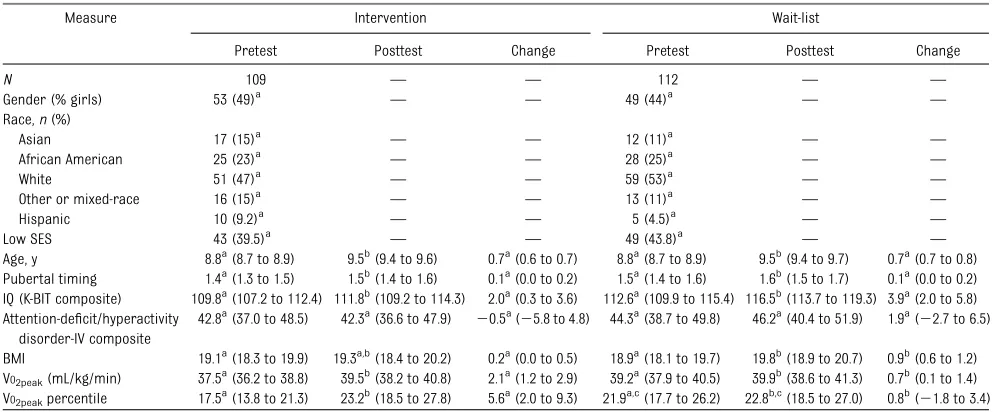
Demographic data are provided in Table 1. Over half of the participants in both groups were white, and over 40% of the participants were categorized as low SES. At baseline, there were no
significant differences between interven-tion and wait-list control groups relative to age (20.08 years, P= .32), pubertal timing (20.05, P= .48), aerobic fitness (21.73 mL/kg per minute,P= .07), BMI (0.2,P= .73), or IQ (22.5,P= .17).
Intervention Participation
Participants in the FITKids afterschool program attended 80.6% (615.1) of the sessions. Mean HR during these sessions was∼137 beats per minute (68.3) with children taking∼4246 steps (61039.9; see Supplemental Information).
Changes in Aerobic Fitness and Weight Status
Although both groups increased in aerobicfitness, the intervention group demonstrated a greater improvement from pretest to posttest than the wait-list control group (1.5 mL/kg per min-ute, 95% confidence interval [CI]: 0.5 to 2.5,d= 0.39 for group difference in pre-to-post change score). Furthermore, pre- to posttest change in aerobicfi t-ness percentile was significant only among intervention participants (5.5 per-centile, 95% CI: 1.9 to 9.1,d= 0.42 for inter-vention group pre-to-post change score) and not among wait-list participants
TABLE 1 Mean (95% CI) Values for Participant Demographic Data
Measure Intervention Wait-list
Pretest Posttest Change Pretest Posttest Change
N 109 — — 112 — —
Gender (% girls) 53 (49)a — — 49 (44)a — —
Race,n(%)
Asian 17 (15)a — — 12 (11)a — —
African American 25 (23)a — — 28 (25)a — —
White 51 (47)a — — 59 (53)a — —
Other or mixed-race 16 (15)a — — 13 (11)a — —
Hispanic 10 (9.2)a — — 5 (4.5)a — —
Low SES 43 (39.5)a — — 49 (43.8)a — —
Age, y 8.8a(8.7 to 8.9) 9.5b(9.4 to 9.6) 0.7a(0.6 to 0.7) 8.8a(8.7 to 8.9) 9.5b(9.4 to 9.7) 0.7a(0.7 to 0.8) Pubertal timing 1.4a(1.3 to 1.5) 1.5b(1.4 to 1.6) 0.1a(0.0 to 0.2) 1.5a(1.4 to 1.6) 1.6b(1.5 to 1.7) 0.1a(0.0 to 0.2) IQ (K-BIT composite) 109.8a(107.2 to 112.4) 111.8b(109.2 to 114.3) 2.0a(0.3 to 3.6) 112.6a(109.9 to 115.4) 116.5b(113.7 to 119.3) 3.9a(2.0 to 5.8) Attention-deficit/hyperactivity
disorder-IV composite
42.8a(37.0 to 48.5) 42.3a(36.6 to 47.9) 20.5a(25.8 to 4.8) 44.3a(38.7 to 49.8) 46.2a(40.4 to 51.9) 1.9a(22.7 to 6.5)
BMI 19.1a(18.3 to 19.9) 19.3a,b(18.4 to 20.2) 0.2a(0.0 to 0.5) 18.9a(18.1 to 19.7) 19.8b(18.9 to 20.7) 0.9b(0.6 to 1.2)
VO2peak(mL/kg/min) 37.5a(36.2 to 38.8) 39.5b(38.2 to 40.8) 2.1a(1.2 to 2.9) 39.2a(37.9 to 40.5) 39.9b(38.6 to 41.3) 0.7b(0.1 to 1.4)
VO2peakpercentile 17.5a(13.8 to 21.3) 23.2b(18.5 to 27.8) 5.6a(2.0 to 9.3) 21.9a,c(17.7 to 26.2) 22.8b,c(18.5 to 27.0) 0.8b(21.8 to 3.4)
(0.5 percentile, 95% CI:22.0 to 3.0,d= 0.06 for wait-list group pre-to-post change score). Both groups also increased in BMI; however, the wait-list group dem-onstrated a greater increase than the intervention group (0.5 kg/m2, 95% CI: 0.2 to 0.9,d= 0.37 for group difference in pre-to-post change score).
Changes in Attentional Inhibition
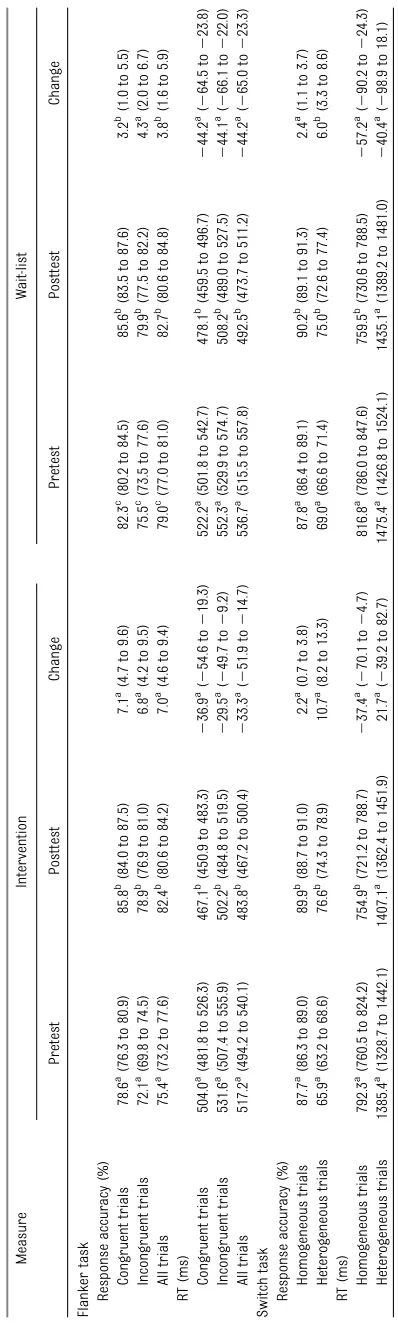
Pre- and posttest performance is sum-marized in Table 2. Although response accuracy increased in both groups, the intervention group demonstrated greater improvement from pretest to posttest than the wait-list control group (3.2%, 95% CI: 0.0 to 6.5,d= 0.27 for group dif-ference in pre-to-post change score; Fig 2). However, there was no influence of group assignment on RT (P$.18).
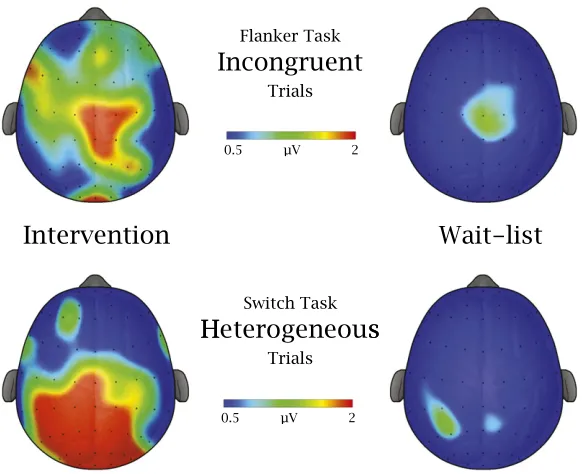
Only the intervention group demon-strated increased P3 amplitude from pretest to posttest on incongruent trials (1.4mV, 95% CI: 0.3 to 2.6,d= 0.34 for intervention group pre-to-post change score; Fig 3; also Supplemental Fig 9 in the Supplemental Information), and a greater change in P3 amplitude on incongruent trials from pretest to post-test relative to the wait-list group (1.9mV, 95% CI: 0.3 to 3.5,d= 0.31 for group difference in pre-to-post change score). The intervention group demon-strated faster P3 latency for incongruent trials at posttest relative to pretest (20.1 milliseconds, 95% CI: 2.6 to 37.6,d= 0.31 for intervention group pre-to-post change score), and a greater change in P3 la-tency from pretest to posttest relative to the wait-list group (32.0 milliseconds, 95% CI: 6.9 to 57.2,d= 0.34 for group difference in pre-to-post change score).
Changes in Cognitive Flexibility
Although both groups increased in pre-to posttest performance on homoge-nous and heterogeneous trials, the improvement in performance on the heterogeneous task was greater among
intervention participants (4.8%, 95% CI: TABLE
1.1 to 8.4,d= 0.35 for group difference in pre-to-post change score; Fig 2). An increase in P3 amplitude to the het-erogeneous trials from pretest to posttest was observed only for the in-tervention group (1.5mV, 95% CI: 0.6 to 2.5,d= 0.43 for intervention group pre-to-post change score), with a greater change in P3 amplitude relative to the wait-list group (1.4mV, 95% CI: 0.0 to 2.7,d= 0.27 for group difference in pre-to-post change score; Fig 3; also Sup-plemental Fig 10 in the SupSup-plemental
Information). No influence of group assignment was observed for homo-geneous trials or P3 latency (P$.06).
Attendance and Cognitive Task Performance
Attendance in the FITKids intervention was positively correlated with change in P3 amplitude (r= 0.22,P= .02) and negatively correlated with change in P3 latency (r=20.22,P= .02) from pre- to posttest, only for incongruent flanker task trials requiring greater amounts
of inhibitory control. No such relation-ship was observed for congruentflanker task trials requiring lesser amounts of inhibitory control. A similar relationship was observed for behavioral indices of the task-switching task, such that at-tendance was positively correlated with change in task performance on the more demanding heterogeneous condi-tion necessitating increased inhibicondi-tion, working memory, and cognitivefl exibil-ity (r= 0.24,P= .01), with no such effect realized for the homogeneous condition requiring lesser amounts of executive control (Fig 4).
DISCUSSION
The provision of a 9-month randomized controlled PA intervention, directed toward increasing aerobicfitness, sig-nificantly improved brain and behav-ioral indices of executive control. More importantly, these effects were selec-tive to aspects of cognition that required extensive inhibition and cognitivefl exi-bility, with no changes observed for task components requiring lower-order (ie, nonexecutive) aspects of cognition. Fur-ther, thefitness-related benefits appear to follow a dose–response relationship, as higher attendance rate in the FITKids program was associated with larger changes in neural indices of attention (ie, P3 amplitude), processing speed (P3 la-tency), and improved performance dur-ing the executive control tasks. Given that no significant differences were observed for children assigned to the wait-list control, the key implication from this study is that participating in a daily, afterschool PA program enhances ex-ecutive control.
Previous randomized controlled trials in this area have varied in outcomes studied, methodologies, and participant characteristics.12–15Among overweight
children, Davis et al12demonstrated
dose–response benefits of exercise on executive function and math achievement. Further, functional MRI results revealed FIGURE 2
Change in response accuracy (mean6SE) from pre- to posttest as a function of group and cognitive task.
FIGURE 3
Topographic scalp distribution of the change in P3 amplitude (spectrum scale: blue to red) during the
increased prefrontal and reduced pos-terior parietal cortex activity during an antisaccade task. In a similar sample, Krafft et al15 found that an exercise
intervention increased activation in re-gions involved in flanker accuracy in-cluding the anterior cingulate cortex and the superior frontal gyrus. Among a sample that varied in weight status, Chaddock-Heyman et al14observed that
children receiving a PA intervention improved performance on a flanker task and showed anterior frontal brain patterns and incongruent task perfor-mance similar to that of college-aged adults after the intervention. This pat-tern of results was not observed in the preadolescent wait-list control group. In a similar sample, Kamijo et al13
ob-served that daily PA improved working memory performance and increased frontal electrophysiological indices (ie, initial contingent negative variation)
associated with improvements in the executive control of working memory after a 9-month PA intervention. The results from the current study are broadly consistent with the aforemen-tioned studies revealing that daily PA not only improves aerobic fitness but also enhances brain function and be-havioral sequelae during tasks that require extensive amounts of executive control among prepubertal children. In addition, the current study extends these findings to electrophysiological indices of cognitive flexibility, a novel contribution to the literature.
Furthermore, the dose–response re-lationship observed between attendance rate, brain function, and executive con-trol demonstrates that brain and be-havioral changes resulted as a function of the degree of participation in the PA program. These results are consistent with Krafft et al25 who observed that
attendance in an 8-month exercise pro-gram was positively associated with improved white matter integrity among a group of sedentary and overweight (BMI $ 85th percentile) 8- to 11-year-olds (94% African American). However, the findings from the current study provide further support for the impor-tance of PA program attendance for cognitive benefit among a large hetero-geneous sample of children with varying weight status. Given that health factors (physical inactivity, excess adiposity) have been related to absenteeism,26the findings herein indicate that increased time spent engaging in PA improves both physical and brain health, which has broad public health implications for ef-fective functioning across the lifespan.
Although children in the FITKids inter-vention exhibited greater improvements in executive control relative to their wait-list control counterparts, there are some limitations of the current study. The use of a wait-list control renders it difficult to attribute the observed group differ-ences entirely to the PA participation because other aspects of the program such as the educational component, social interaction with peers and inter-vention staff, and refining motor skills may have contributed to the results. However, it is unlikely that the educa-tional component was the cause of group differences, given that it was brief and took place as part of the instruction for the PA intervention (see Supplemental Information). Another limitation of the study was that nonintervention PA was not measured. Therefore, we are unable to adjust for any influence of habitual PA on thefindings. Future research would benefit from study designs that include active control groups and account for the potential influence of lifestyle factors such as habitual PA.
CONCLUSIONS
Participation in the FITKids intervention improved aerobic fitness, as well as FIGURE 4
brain and behavioral indices of ex-ecutive control among prepubertal children. Importantly, these effects were selective to aspects of cognition that required extensive inhibition and cognitive flexibility. Given the rapid decline in PA opportunities for chil-dren at school, the dissemination of ourfindings is particularly important for educators and policy makers. Specifically, policies that reduce or replace PA opportunities during the school day (eg, recess), in an attempt to increase academic achievement,
may have unintended effects.27
In-deed, the current data not only provide causal evidence for the ben-eficial effects of PA on cognitive and brain health, but they warrant mod-ification of contemporary educa-tional policies and practices, and indicate that youth should receive more daily PA opportunities.28
Fi-nally, given that scholastic success in reading and mathematics is heavily reliant upon effective executive con-trol,29,30 our findings have broad
relevance for public health, the
educational environment, and the con-text of learning.
ACKNOWLEDGMENTS
We thank the participants, their families, and the Urbana School District 116 for participating in the study. We thank Bonnie Hemrick for herassistance in par-ticipant recruitment and randomization. We also thank Dominika Pindus for pro-viding valuable insight on the discussion and analysis of the data, and we thank the students and staff who aided in the implementation of the FITKids intervention.
REFERENCES
1. Ng SW, Popkin BM. Time use and physical activity: a shift away from movement across the globe.Obes Rev. 2012;13(8):659–680 2. Lee IM, Shiroma EJ, Lobelo F, Puska P, Blair
SN, Katzmarzyk PT; Lancet Physical Activity Series Working Group. Effect of physical inactivity on major non-communicable dis-eases worldwide: an analysis of burden of disease and life expectancy. Lancet. 2012; 380(9838):219–229
3. Hillman CH, Erickson KI, Kramer AF. Be smart, exercise your heart: exercise effects on brain and cognition.Nat Rev Neurosci. 2008;9(1):58–65
4. Kramer AF, Hahn S, Cohen NJ, et al. Ageing,
fitness and neurocognitive function.Nature. 1999;400(6743):418–419
5. Luna B. Developmental changes in cogni-tive control through adolescence.Adv Child Dev Behav. 2009;37:233–278
6. Diamond A, Barnett WS, Thomas J, Munro S. Preschool program improves cognitive control.Science. 2007;318(5855):1387–1388 7. Hillman CH, Buck SM, Themanson JR, Pontifex MB, Castelli DM. Aerobicfitness and cognitive development: Event-related brain potential and task performance indices of executive control in preadolescent children.Dev Psychol. 2009;45(1):114–129
8. Pontifex MB, Raine LB, Johnson CR, et al. Cardiorespiratory fitness and theflexible modulation of cognitive control in pre-adolescent children.J Cogn Neurosci. 2011; 23(6):1332–1345
9. Polich J. Updating P300: an integrative theory of P3a and P3b.Clin Neurophysiol. 2007;118(10):2128–2148
10. Duncan-Johnson CC. Young Psychophysiol-ogist Award address, 1980. P300 latency:
a new metric of information processing.
Psychophysiology. 1981;18(3):207–215 11. Verleger R. On the utility of P3 latency as an
index of mental chronometry. Psychophys-iology. 1997;34(2):131–156
12. Davis CL, Tomporowski PD, McDowell JE, et al. Exercise improves executive function and achievement and alters brain activation in overweight children: a randomized, con-trolled trial.Health Psychol. 2011;30(1):91–98 13. Kamijo K, Pontifex MB, O’Leary KC, et al. The effects of an afterschool physical activity program on working memory in preado-lescent children.Dev Sci. 2011;14(5):1046– 1058
14. Chaddock-Heyman L, Erickson KI, Voss MW, et al. The effects of physical activity on functional MRI activation associated with cognitive control in children: a randomized controlled intervention.Front Hum Neurosci. 2013;7:72
15. Krafft CE, Schwarz NF, Chi L, et al. An 8-month randomized controlled exercise trial alters brain activation during cogni-tive tasks in overweight children. Obesity (Silver Spring). 2014;22(1):232–242 16. Birnbaum AS, Lytle LA, Murray DM, Story M,
Perry CL, Boutelle KN. Survey development for assessing correlates of young adoles-cents’eating. Am J Health Behav. 2002;26 (4):284–295
17. Kaufman AS. Kaufman Brief Intelligence Test: KBIT. AGS. Circle Pines, MN: American Guidance Service; 1990
18. Taylor SJC, Whincup PH, Hindmarsh PC, Lampe F, Odoki K, Cook DG. Performance of a new pubertal self-assessment question-naire: a preliminary study.Paediatr Perinat Epidemiol. 2001;15(1):88–94
19. Thomas S, Reading J, Shephard RJ. Re-vision of the physical activity readiness questionnaire (PAR-Q). Can J Sport Sci. 1992;17(4):338–345
20. Armstrong L.ACSM’s Guidelines for Exercise Testing and Prescription/American College of Sports Medicine, 7th ed. Philadelphia, PA: Lippincott Williams & Wilkins; 2006
21. Shvartz E, Reibold RC. Aerobic fitness norms for males and females aged 6 to 75 years: a review. Aviat Space Environ Med. 1990;61(1):3–11
22. Eriksen CW, Eriksen BA. Effects of noise letters upon the identification of a target letter in a non-search task. Percept Psy-chophys. 1974;2(25):249–263
23. Pontifex MB, Saliba BJ, Raine LB, Picchietti DL, Hillman CH. Exercise improves behav-ioral, neurocognitive, and scholastic per-formance in children with attention-deficit/ hyperactivity disorder.J Pediatr. 2013;162 (3):543–551
24. Espy KA. The shape school: Assessing ex-ecutive function in preschool children.Dev Neuropsychol. 1997;13(4):495–499 25. Krafft CE, Schaeffer DJ, Schwarz NF, et al.
Improved frontoparietal white matter in-tegrity in overweight children is associ-ated with attendance at an after-school exercise program. Dev Neurosci. 2014;36 (1):1–9
26. Datar A, Sturm R. Childhood overweight and elementary school outcomes. Int J Obes (Lond). 2006;30(9):1449–1460 27. Sallis JF. We do not have to sacrifice
chil-dren’s health to achieve academic goals.
J Pediatr. 2010;156(5):696–697
Physical Education to School. Washington, DC: The National Academies Press; 2013
29. Bull R, Scerif G. Executive functioning as a predictor of children’s mathematics ability: inhibition, switching, and working memory.
Dev Neuropsychol. 2001;19(3):273–293 30. St Clair-Thompson HL, Gathercole SE. Executive
functions and achievements in school: Shift-ing, updatShift-ing, inhibition, and working memory.
Q J Exp Psychol (Hove). 2006;59(4):745–759 31. McKenzie TL, Strikmiller PK, Stone EJ, et al.
CATCH: physical activity process evaluation in a multicenter trial.Health Educ Q. 1994; (suppl 2):S73–S89
32. Luepker RV, Perry CL, McKinlay SM, et al. Outcomes of afield trial to improve chil-dren’s dietary patterns and physical activ-ity. The Child and Adolescent Trial for Cardiovascular Health. CATCH collaborative group.JAMA. 1996;275(10):768–776 33. Nader PR, Stone EJ, Lytle LA, et al.
Three-year maintenance of improved diet and
physical activity: the CATCH cohort. Child and Adolescent Trial for Cardiovascular Health.Arch Pediatr Adolesc Med. 1999;153 (7):695–704
34. Coleman KJ, Tiller CL, Sanchez J, et al. Pre-vention of the epidemic increase in child risk of overweight in low-income schools: the El Paso coordinated approach to child health.
Arch Pediatr Adolesc Med. 2005;159(3):217–224 35. Hoelscher DM, Springer AE, Ranjit N, et al. Reductions in child obesity among disad-vantaged school children with community involvement: the Travis County CATCH Trial.
Obesity (Silver Spring). 2010;18(suppl 1): S36–S44
36. Chatrian GE, Lettich E, Nelson PE. Ten per-cent electrode system for topographic studies of spontaneous and evoked EEG activity.Am J EEG Technol. 1985;25:83–92 37. Compumedics Neuroscan.SCAN 4.3: Offline
Analysis of Acquired Data, vol. II. El Paso, TX: Compumedics Neuroscan; 2003
38. Gamer M, Berti S. Task relevance and rec-ognition of concealed information have different influences on electrodermal ac-tivity and event-related brain potentials.
Psychophysiology. 2010;47(2):355–364 39. Sass SM, Heller W, Stewart JL, et al. Time
course of attentional bias in anxiety: emo-tion and gender specificity. Psychophysiol-ogy. 2010;47(2):247–259
40. Utter AC, Robertson RJ, Nieman DC, Kang J. Children’s OMNI Scale of Perceived Exertion: walking/running evaluation.Med Sci Sports Exerc. 2002;34(1):139–144
41. Freedson PS, Goodman TL. Measurement of oxygen consumption. In: Rowland TW, ed.
Pediatric Laboratory Exercise Testing: Clini-cal Guidelines. Champaign, IL: Human Ki-netics; 1993:91–113
42. Bar-Or O.Pediatric Sports Medicine for the Practitioner: From Physiologic Principles to Clinical Applications. New York, NY: Springer-Verlag; 1983
(Continued fromfirst page)
FINANCIAL DISCLOSURE:The authors have indicated they have nofinancial relationships relevant to this article to disclose.
FUNDING:All phases of this study were supported by theEunice Kennedy ShriverNational Institute of Child Health and Human Development (NICHD), National Institutes of Health (NIH) grant RO1 HD055352 (to Dr Hillman). Funded by the National Institutes of Health (NIH).
DOI: 10.1542/peds.2013-3219 originally published online September 29, 2014;
2014;134;e1063
Pediatrics
Wu and Keita Kamijo
Lauren B. Raine, Mark R. Scudder, Eric S. Drollette, Robert D. Moore, Chien-Ting
Charles H. Hillman, Matthew B. Pontifex, Darla M. Castelli, Naiman A. Khan,
Brain Function
Effects of the FITKids Randomized Controlled Trial on Executive Control and
Services
Updated Information &
http://pediatrics.aappublications.org/content/134/4/e1063
including high resolution figures, can be found at:
References
http://pediatrics.aappublications.org/content/134/4/e1063#BIBL
This article cites 35 articles, 1 of which you can access for free at:
Subspecialty Collections
http://www.aappublications.org/cgi/collection/neurology_sub Neurology
rning_disorders_sub
http://www.aappublications.org/cgi/collection/cognition:language:lea Cognition/Language/Learning Disorders
al_issues_sub
http://www.aappublications.org/cgi/collection/development:behavior Developmental/Behavioral Pediatrics
following collection(s):
This article, along with others on similar topics, appears in the
Permissions & Licensing
http://www.aappublications.org/site/misc/Permissions.xhtml
in its entirety can be found online at:
Information about reproducing this article in parts (figures, tables) or
Reprints
http://www.aappublications.org/site/misc/reprints.xhtml
DOI: 10.1542/peds.2013-3219 originally published online September 29, 2014;
2014;134;e1063
Pediatrics
Wu and Keita Kamijo
Lauren B. Raine, Mark R. Scudder, Eric S. Drollette, Robert D. Moore, Chien-Ting
http://pediatrics.aappublications.org/content/134/4/e1063
located on the World Wide Web at:
The online version of this article, along with updated information and services, is
http://pediatrics.aappublications.org/content/suppl/2014/09/24/peds.2013-3219.DCSupplemental
Data Supplement at:
by the American Academy of Pediatrics. All rights reserved. Print ISSN: 1073-0397.