http://www.scirp.org/journal/psych ISSN Online: 2152-7199
ISSN Print: 2152-7180
Measuring Customer Feedback, Response and
Satisfaction
Rebecca Milner
1, Adrian Furnham
1,21Research Department of Clinical, Educational and Health Psychology, University College London, London, UK
2Norwegian Business School (BI), Olso, Norway
Abstract
This paper reviews various different questionnaires designed to measure
cus-tomer response to a particular service. They differ on various criteria
includ-ing the dimensions that they are tryinclud-ing to evaluate their established
psycho-metric qualities and their usage. Recommendations for their use are made.
Keywords
Customer Feedback, Questionnaires, Inventories, Service, Quality
1. Introduction
Most service organisations are, quite rightly, very interested in measuring the
at-titudes, beliefs and perceptions of their customers. For some departments (like
marketing and sales), it is often one of their primary metrics. As a consequence,
various research teams have attempted to devise measures that are
comprehen-sive, reliable and robust. This short paper is a review of the major instruments
available to practitioners and researchers.
Customer satisfaction is an assessment of how well a company’s products or
services meet customer expectations. Customer satisfaction relates to a general
and specific psychological evaluation of a customer’s experience of a product or
service. It is well established that satisfied customers are key to long-term
busi-ness success
(McColl-Kennedy & Schneider, 2000)
. The idea of the service-profit
chain directly relates customer satisfaction to business success and profitability.
Customer satisfaction predicts customer retention, loyalty, and product
re-purchase. Customer satisfaction has also been suggested to have an impact on
future product search activity, alterations in “hopping behaviour”, as well as
tri-als of other available products in the sector.
Keiningham and Vavra (2001)
found
that for every percentage increase in customer satisfaction, there is an average
How to cite this paper: Milner, R., & Furn- ham, A. (2017). Measuring Customer Feed- back, Response and Satisfaction. Psycholo-gy, 8, 350-362.
https://doi.org/10.4236/psych.2017.83021 Received: December 31, 2016
Accepted: February 11, 2017 Published: February 14, 2017 Copyright © 2017 by authors and Scientific Research Publishing Inc. This work is licensed under the Creative Commons Attribution International License (CC BY 4.0).
increase of 2.37% of return on investment. Further, when a customer is satisfied
they spread this information, acting as marketers for the company.
Gitomer (1998)
proposed that nearly one half of American business is built on
“word-of-mouth” communication. Such findings demonstrate the importance of
customer satisfaction. Whilst some of these ideas and findings are disputed, the
measurement of customer reactions remains important. It is thus key to be able
to assess these reactions, in order to determine methods of improving business
effectiveness.
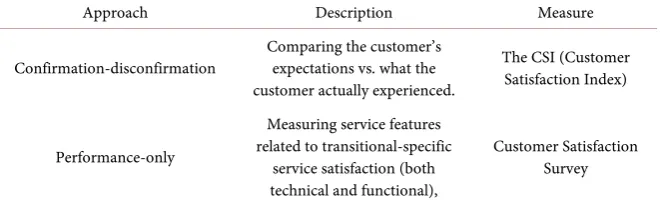
[image:2.595.209.541.632.734.2]Measuring customer service is highly important, yet there is no universally
accepted measurement scale. There are several theories proposing
how
we should
approach the assessment of customer service. These include the expectancy-dis-
confirmation approach, the performance-only approach, the technical and
func-tional dichotomy approaches, the service quality vs. service satisfaction approach,
and the attribute importance approach. Two of these approaches can be seen in
Table 1
.
However, measuring customer satisfaction is not simple partly because
per-sonal attitudes towards quality vary between individuals. What one may
con-sider to be superior quality may be seen as average by another.
Garvin (1984)
concludes that “quality lies in the eyes of the beholder” (p. 41). However
subjec-tive this may be there is clearly considerable agreement between customers,
par-ticularly at extremes of good and bad service.
As assessing quality in service is such a complex task, over the years, service
management literature has introduced a number of models to measure overall
service quality
(Seth, Deshmunkh, & Vrat, 2005;
Senić & Senić, 2008)
. The
ma-jority of these models are based on comparing what the customer expected from
the service or product, and the actual service quality levels perceived. This idea
was originally introduced by
Grönroos (1982)
. For instance, the service will be
considered excellent if perceptions exceed expectations, but bad if it does not
meet expectations
(Vázquez et al., 2001)
.
The aim of this paper is to review the various published measures of customer
service.
2. The Measures
Three of the most common scales are documented below in
Table 2
. They seem
to be widely used and reported in various academic papers.
Table 1. Two approaches to measurement.
Approach Description Measure
Confirmation-disconfirmation Comparing the customer’s expectations vs. what the customer actually experienced.
The CSI (Customer Satisfaction Index)
Performance-only
Measuring service features related to transitional-specific service satisfaction (both technical and functional),
Table 2. The most popular scales and their individual items.
Scale Items
SERVQUAL
Your expectations about firms offering ____ services. Tangibles
1. They should have up-to-date equipment
2. Their physical facilities should be visually appealing 3. Their employees should be well dressed and appear neat
4. The appearance of the physical facilities of these firms should be in keeping with the type of services provided Reliability
5. When these firms promise to do something by a certain time, they should do so 6. When customers have problems, these firms should be sympathetic and reassuring 7. These firms should be dependable
8. They should provide their services at the time they promise to do so 9. They should keep their records accurately
Responsiveness
10. They shouldn’t be expected to tell customers exactly when services should be performed (-) 11. It is not realistic for customers to expect prompt service from employees of these firms (-) 12. Their employees don’t always have to be willing to help customers (-)
13. It is okay if they are too busy to respond to customer requests promptly (-) Assurance
14. Customers should be able to trust employees of these firms
15. Customers should be able to feel safe in their transactions with these firms’ employees 16. Their employees should be polite
17. Their employees should get adequate support from these firms to do their jobs well Empathy
18. These firms should not be expected to give customers individual attention (-) 19. Employees of these firms cannot be expected to give customers personal attention (-) 20. It is unrealistic to expect employees to know what the needs of their customers are (-) 21. It is unrealistic to expect these firms to have their customers’ best interests at heart (-) 22. They shouldn’t be expected to have operating hours convenient to all their customers (-)
RSQS
Dimension 1 Physical Aspects 1 Appearance 1. The store has modern-looking equipment and fixtures
2. The store and its physical facilities (trial rooms and restrooms) are visually attractive
3. Materials associated with this store’s service (such as shopping bags, loyalty cards and catalogues) are visually appealing
4. The store has clean, attractive and convenient physical facilities (restrooms, fitting rooms) 2 Convenience
5. The store layout at this store makes it easier for customers to find what they need 6. The store layout at this store makes it easier for customers to move around in the store
Dimension 2 Reliability 3 Promises
7. When this store promises to do something (such as repairs, alterations) by a certain time, it will do so 8. This store provides its services at the time it promises to do so
4 Doing-it-Right 9. This store performs the service right the first time
10. This store has merchandise available when the customers want it 11. This store insists on error-free sales transactions and records
Continued
RSQS
5 Inspiring Confidence
12. Employees in the store have the knowledge to answer customers’ questions 13. The behaviour of employees in this store instils confidence in customers 14. Customers feel safe in their transactions with this store
6 Courteousness/Helpfulness 15. The employees in this store give prompt service to customers
16. Employees in this store tell customers exactly when services will be performed 17. Employees in this store are never too busy to respond to customer’s requests 18. This store gives customers individual attention
19. Employees in this store are consistently courteous with customers 20. Employees in this store treat customers courteously on the telephone.
(deleted as not applicable in Indian context)
Dimension 4 Problem Solving 21. This store willingly handles returns and exchanges
22. When a customer has a problem, this store shows a sincere interest in solving it 23. Employees of this store are able to handle customer complaints directly and immediately
Dimension 5 Policy 24. This store offers high quality merchandise
25. This store provides plenty of convenient parking for customers 26. This store has operating hours convenient to all their customers 27. This store accepts all major credit cards
28. The store has its own credit card
SERV-OR
Customer Treatment
1. Employees care for customers as they would like to be cared for 2. Employees go the “extra mile” for customers
3. We are noticeably more friendly and courteous than our competitors 4. Employees go out of their way to reduce inconveniences for customers
Employee Empowerment
5. Decisions are made “close to the customer.” In other words, employees often make important customer decisions
without seeking management approval
6. Employees have freedom and authority to act independently in order to provide excellent service
Service Technology
7. We enhance our service capabilities through the use of “state of the art” technology 8. Technology is used to build and develop higher levels of service quality
9. We use high levels of technology to support the efforts of men and women on the front line
Service Failure Prevention
10. We go out of our way to prevent customer problems
11. We go out of our way to “head off” or prevent customer problems rather than reacting to problems once they
occur
12. We actively listen to our customers
Service Failure Recovery
13. We have an excellent customer complaint handling system for service follow-up
14. We have established problem-solving groups to enhance our ability to resolve service breakdowns 15. We provide follow-up service calls to confirm that our services are being provided properly 16. We provide every customer with an explicit service guarantee
Service Standards Communication
17. We do not wait for customers to complain, we use internal standards to pinpoint failures before we receive
customer complaints
Continued
SERV-OR
19. Every employee understands all of the service standards that have been instituted by all departments 20. We have a developed chain of objectives linking together every branch in support of the corporate vision 21. Service performance measures are communicated openly with all employees regardless of position or function
Service Vision
22. There is a true commitment to service, not just lip service
23. Customers are viewed as opportunities to serve rather than as sources of revenue 24. It is believed that fundamentally, the organization exists to serve the needs of its customers
Servant Leadership
25. Management constantly communicates the importance of service
26. Management regularly spends time “in the field” or “on the floor” with customers and front-line employees 27. Management is constantly measuring service quality
28. Management shows that they care about service by constantly giving of themselves
29. Management provides resources, not just “lip service” to enhance employee ability to provide excellent service 30. Managers give personal input and leadership into creating quality service
Service Rewards
31. Management provides excellent incentives and rewards at all levels for service quality, not just productivity 32. This organization noticeably celebrates excellent service
Service Training
33. Every employee receives personal skills training that enhances his/her ability to deliver high quality service 34. We spend much time and effort in simulated training activities that help us provide higher levels of service when
actually encountering the customer
35. During training sessions we work through exercises to identify and improve attitudes toward customers
Parasuraman et al. (1985) built on Grönroos’s idea, and formulated the
five
gaps model
, which was the basis for a 22-item questionnaire assessing quality in
service, the SERVQUAL
(Parasuraman et al., 1988)
(see
Table 2
). The five most
critical dimensions of quality were identified as
reliability, responsiveness,
as-surance, empathy and tangibility
. To a large extent this model and measure
which has been critiqued and updated has dominated the field. The reason is
probably because the five dimensions are clear and important and the test is
short and the items interpretable in many settings.
Many instruments have been introduced for measuring service quality since.
The best known alternative to SERVQUAL is SERVPERF, constructed by
Cro-nin and Taylor (1992)
. Much discussion followed differentiating between the
two models in order to conclude which one was more valid when predicting
ser-vice quality.
A contrasting suggestion to
Grönroos’s (1982)
original idea of comparing
ex-pectations with experience is the idea that the measurement of service quality
should only include customer perceptions
(Caro & García, 2007)
.
Grönroos (1982)
suggests that service quality is comprised of two dimensions
,
functional
and
technical.
The functional dimension relates to
how
a service is
quality is determined by
functional quality, technical quality and corporate
im-age
: that is the image and reputation of the organisation for service in general.
Fonesca (2009)
supported this model, proposing that these three factors
repre-sent the main determinants of satisfaction. Therefore, it is argued, service quality
leads to satisfaction directly.
However, when measuring satisfaction, many challenges occur
(Maričić,
2008)
. Satisfaction is a subjective measure of a customer’s perception of the
quality of a product or service. The measurement of satisfaction also
encom-passes expectations of quality of a product or service.
Bateson (1995)
highlights
the difficulties of measuring service quality due to the fact of its intangibility,
heterogeneity, inseparability and perishability.
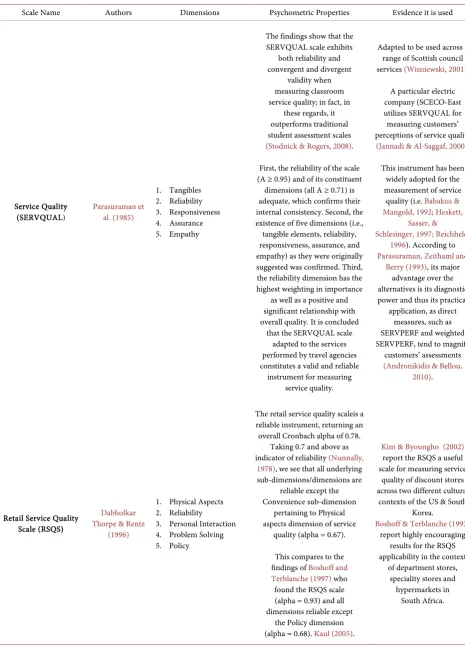
Table 3
describes a number of service quality and customer satisfaction
mod-els and scales. Each scale is comprised of different dimensions. Some of these are
consistent across models, such as reliability (SERVQUAL, RSQS, SERVPERF,
Weighted SERV-PERF, SERVQUAL-R), suggesting this is a key dimension of
customer satisfaction and service quality. The scales vary in the number of
di-mensions included, from 2 - 10, varying in the different factors they think it is
necessary to assess. Our research suggests that the SERVQUAL and the weighted
SERV-PERF are the most used, however it is only possible to assess the
pub-lished research in the area, and it may be that many of the other scales are widely
employed throughout business yet not published in either the academic or trade
literature.
These scales have not all been subjected to exacting and repeated
psychomet-ric assessment such as checking their dimensions through exploratory and
con-firmatory factor analysis, as well as the internal reliability (Cronbach’s Alpha) of
those dimensions. More importantly perhaps in this area, there are few good
norms so that those who use the measures can compare their data to that of a
large group of representative service providers.
3. Discussion
There are various ways to evaluate the different scales mentioned in the table.
The can be divided into psychometric and practical criteria. Psychometricians
are interested in such things as reliability, validity and dimensionality. They look
for evidence that the various scale items factor or cluster into the various
dimen-sions the authors proposed. They are also interested in the internal reliability of
the questionnaire, but most of all the validity: that is the proof that the
ques-tionnaire data predicts actual behaviour like sales. Some scales have been put to
the test while others have received much less attention. Whilst it is relatively
cheap and easy to develop a model and questionnaire items it is much more
ex-pensive in terms of time and money to psychometrically evaluate the scale.
Table 3. Research on these scales.
Scale Name Authors Dimensions Psychometric Properties Evidence it is used
Service Quality
(SERVQUAL) Parasuraman et al. (1985)
1. Tangibles 2. Reliability 3. Responsiveness 4. Assurance 5. Empathy
The findings show that the SERVQUAL scale exhibits
both reliability and convergent and divergent
validity when measuring classroom service quality; in fact, in
these regards, it outperforms traditional student assessment scales
(Stodnick & Rogers, 2008). First, the reliability of the scale (Α ≥ 0.95) and of its constituent dimensions (all Α ≥ 0.71) is adequate, which confirms their internal consistency. Second, the existence of five dimensions (i.e., tangible elements, reliability, responsiveness, assurance, and empathy) as they were originally suggested was confirmed. Third, the reliability dimension has the highest weighting in importance
as well as a positive and significant relationship with overall quality. It is concluded
that the SERVQUAL scale adapted to the services performed by travel agencies constitutes a valid and reliable
instrument for measuring service quality.
Adapted to be used across a range of Scottish council services (Wisniewski, 2001).
A particular electric company (SCECO-East utilizes SERVQUAL for measuring customers’ perceptions of service quality
(Jannadi & Al-Saggaf, 2000). This instrument has been
widely adopted for the measurement of service quality (i.e. Babakus & Mangold, 1992; Heskett,
Sasser, & Schlesinger, 1997; Reichheld,
1996). According to
Parasuraman, Zeithaml and Berry (1993), its major
advantage over the alternatives is its diagnostic power and thus its practical application, as direct
measures, such as SERVPERF and weighted SERVPERF, tend to magnify
customers’ assessments
(Andronikidis & Bellou, 2010).
Retail Service Quality Scale (RSQS)
Dabholkar Thorpe & Rentz
(1996)
1. Physical Aspects 2. Reliability 3. Personal Interaction 4. Problem Solving 5. Policy
The retail service quality scaleis a reliable instrument, returning an overall Cronbach alpha of 0.78.
Taking 0.7 and above as indicator of reliability (Nunnally,
1978), we see that all underlying sub-dimensions/dimensions are
reliable except the Convenience sub-dimension
pertaining to Physical aspects dimension of service
quality (alpha = 0.67). This compares to the findings of Boshoff and Terblanche (1997) who found the RSQS scale (alpha = 0.93) and all dimensions reliable except
the Policy dimension (alpha = 0.68). Kaul (2005).
Kim & Byoungho (2002)
report the RSQS a useful scale for measuring service
quality of discount stores across two different cultural
contexts of the US & South Korea.
Boshoff & Terblanche (1997)
report highly encouraging results for the RSQS applicability in the context
of department stores, speciality stores and
Continued
SERVPERF (the performance component of the Service Quality scale
(SERVQUAL) Parasuraman, Zeithaml, & Berry (1985, 1988) 1. Tangibles 2. Reliability 3. Responsiveness 4. Assurance 5. Empathy SERVPERF (performance-only) results in more reliable
estimations, greater convergent and discriminant validity,
greater explained variance, and consequently
less bias than the SERVQUAL scale
(Cronin and Taylor, 1992; Parasuraman et al., 1994; Quester, Wilkinson, & Romaniuk, 1995; Llusar
and Zornoza, 2000).
This study applies SERVPERF items to urban
community development issues by considering the utility of the SERVPERF items in predicting a
propensity to shop neighbourhood stores as compared to a propensity to shop in areas outside the neighborhood (Marshall &
Smith, 2000).
Weighted SERV-PERF Taylor (1992) Cronin &
1. Tangibles 2. Reliability 3. Responsiveness 4. Assurance 5. Empathy
This study compares all four alternatives (SERVQUAL,
SERVPERF, weighted SERVQUAL, weighted SERVPERF) within the auto-repair industry in Greece. Based on data from
1043 customers, overall results are in line with previous studies, confirming
the multidimensionality of the service-quality construct
and the five-factor SERVPERF pattern. In disagreement with previous
studies, findings show that the importance-weighted SERVPERF scale provides the greatest diagnostic
information
(Andronikidis & Bellou, 2010). In this paper, a weighted
SERVPERF model was expressed to assess taxi service quality of Hangzhou,
China (Yao & Ding, 2011).
American Customer Satisfaction Indexes (ACSI)/European Customer Satisfaction
Indexes (ECSI)
Fornell (1992) E-CSI:
The ACSI & ECSI have been extensively applied (Fornell et al., 1996; Anderson and
Fornell, 2000; Martensen, Grønholdt, & Kristensen, 2000; Dermanov and Eklof,
2001; Fornell, 2001; Eklof and Westlund, 2002; Yeung, Chew-Ging, &
Continued
SERVQUAL(R)
Parasuraman, Berry, & Zeithaml
(1991)
1. Access 2. Communication 3. Competence 4. Courtesy 5. Credibility 6. Reliability 7. Responsiveness 8. Security 9. Tangibility 10.Understanding
SERV*OR Hom and Lytle, Mokwa (1998)
1. Customer treatment 2. Employee
empowerment 3. Service technology 4. Service failure
prevention 5. Service failure
recovery 6. Service standards
communication 7. Service vision 8. Servant leadership 9. Service rewards 10.Service training
Electronic-Customer Satisfaction index
(e-CSI) Hsu (2008)
1. Information availability and content 2. Ease of use or
usability 3. Privacy/security 4. Graphic style
fulfilment
A survey of 89 customers in Sweden categorized into different industries, namely
automotive, other manufacturing, service, motor vehicle and remaining
industry, was utilized in the analysis of the European customer satisfaction index
(ECSI) model. Hardware, software and perceived value
were found to be the variables in the ECSI model to have the most effect on customer satisfaction (Dahlgaard &
Ciavolino, 2007).
Quality Perception Questionnaire (QPQ)
Coluccia, Ferretti, Lorini, & Calamai (2006)
To measure patients’ perceptions of quality during a recent hospital admission.
1. Doctors 2. Nurses 3. Auxiliary staff 4. Structures
Confirm the QPQ is a valid instrument-revealing the four factors as hypothesised by the authors. The factors explained about 72% of the total variance
(Coluccia, Ferretti, Cioffi, Lorini, & Vidotto, 2005). No differences were found in the QPQ scores
with respect to age or sex.
(Cioffi et al., 2012).
importantly there appears no research to indicate which of the various scales in
these measures relates most powerfully to the overall satisfaction of the customer
Further there is little evidence that the scales retain their properties when
translated into different languages. Similarly, it would be of interest to examine
demographic correlates of these scales to attempt to determine whether, for
in-stance age, social class or gender were related to the different factors in customer
evaluation.
There can be no validity without reliability but it appears that there is
rela-tively little published evidence on the validity of these scales. This research is not
easy and usually involves correlation customer service data and other salient
data like sales, profit, store visits or repeat purchases over time to assess the
ex-pected relationship between these measures. More interesting is how much
variance is accounted for by the customer service data compared to other issues,
like price which may attract customers. This could answer the question of
whether it is indeed a wise investment to spend money on attempts to improve
customer service.
The second and not always closely related criterion is always practical.
Table 3
shows some evidence of the applications of these scales. Practitioners want
ques-tions which are very short clear and easy for customers to complete and yet
measure the dimensions they are really interested in. They are often happy to
trade off length for psychometric reliability and add as well as remove items they
think not relevant to them.
They also like to use the same measure for different purposes. Some are
con-cerned that you may annoy customers by using such measures while other
be-lieve the opposite, namely that customers feel appreciative in being asked. Most
seem to be used in the hospitality industries but that is changing.
There are inevitable gaps in
Table 2
and
Table 3
. There may well be other
measures that are in use and many other papers that attempt to assess these
in-struments. In that sense these tables are, and will always be preliminary, but as
far as we know no one has attempted a review such as this.
4. Conclusion
Both those in pure and applied research want scales that are short,
psychometri-cally sound and sensitive to the various facets/dimensions that make up the
haviour (customer service) that is assessed. The review has located what we
be-lieve are the most well known and used measures and the evidence for them. We
hope to be able to update this report every so often as the literature and the use
of these measures increases.
References
Anderson, E. W., & Fornell, C. (2000). Foundations of the American Customer Satisfac-tion Index. Total Quality Management, 11, 869-883.
https://doi.org/10.1080/09544120050135425
Quality Construct: Consistencies and Contradictions. Journal of Marketing
Manage-ment, 26, 5-6.
https://doi.org/10.1080/02672570903498850Babakus, E., & Mangold, G. (1992). Adapting the SERVQUAL Scale to Hospital Services: An Empirical Investigation. Health Service Research, 26, 767-780.
Bateson (1995). SERVQUAL: Review, Critique, Research Agenda. European Journal of
Marketing, 30, 8-32.
Boshoff, C., & Terblanche, N. (1997). Measuring Retail Service Quality: A Replication Study. South African Journal of Business Management, 28, 123-128.
Caro, L. M., & Garcia, J. A. M. (2007). Measuring Perceived Service Quality in Urgent Transport Service. Journal of Retailing and Consumer Services, 14, 60-72.
https://doi.org/10.1016/j.jretconser.2006.04.001
Cioffi, R., Coluccia, A., Ferretti, F., Lorini, F., Saggino, A., & Furnham, A. (2012). A Psy-chometric Study of Quality Perception Questionnaire. Swiss Journal of Psychology, 71,
101-106. https://doi.org/10.1024/1421-0185/a000076
Coluccia, A., Cioffi, R., Ferrentti, F., Lorini, F., & Vidotto, G. (2006). Questionnaire of
Perceived Quality (QQP): A Study on the Differences of Gender.
Italian Journal of
Occupational Medicine and Ergonomics, 28, 53-60.
Coluccia, A., Ferretti, F., Cioffi, R., Lorini, F., & Vidotto, G. (2005). Quality Perception and Customer Satisfaction: A Study on the QPQ. Italian Journal of Forensic Medicine,
27, 303-319.
Cronin, J. J., & Taylor, A. S. (1992). Measuring Service Quality: A Reexamination and an
Extension. Journal of Marketing, 56, 55-67. https://doi.org/10.2307/1252296
Dabholkar, P. A., Thorpe, D. I., & Rentz, J. O. (1996). A Measure of Service Quality for Retail Stores: Scale Development and Validation. Journal of the Academy of Marketing
Science, 24, 3-16.
https://doi.org/10.1007/BF02893933Dagger, T. C., & Sweeney, J. C. (2006). The Effect of Service Evaluations on Behavioural
Intentions and Quality of Life. Journal of Service Research, 9, 3-18.
https://doi.org/10.1177/1094670506289528
Dahlgaard, J. J., & Ciavolino, E. (2000). Analysing Management Factors of Enterprise Performance. Asian Journal on Quality, 3, 1-10.
Dermanov, V., & Eklof, J. (2001). Using Aggregate Customer Satisfaction Index: Chal-lenges and Problems of Comparisons with Specific Reference to Russia. Total Quality
Management, 12, 1054-1063.
Eklof, J., & Westlund, A. (2002). The Pan-European Customer Satisfaction Index Pro-gramme-Current Work and the Way Ahead. Total Quality Management, 11, 1099-
1106.https://doi.org/10.1080/09544120200000005
Fonesca, J. (2009). Customer Satisfaction Study via a Latent Segment Model. Journal of
Retailing and Consumer Services, 16, 352-359.
https://doi.org/10.1016/j.jretconser.2009.04.001
Fornell, C. (1992). A National Customer Satisfaction Barometer: The Swedish Experience.
Journal of Marketing, 56, 6-21.
https://doi.org/10.2307/1252129Fornell, C. (2001). The Score of Satisfaction. Harvard Business Review, 79, 120-121. Fornell, C., Johnson, M., Anderson, E., Cha, J., & Bryant, B. (1996). The American
Cus-tomer Satisfaction Index: Nature, Purpose and Findings. Journal of Marketing, 60, 7- 18.https://doi.org/10.2307/1251898
Garvin, D. (1984). Product Quality: An Important Strategic Weapon. Business Horizons,
27, 40-43.
https://doi.org/10.1016/0007-6813(84)90024-7How to Make Customers Love You, Keep Them Coming Back, and Tell Everyone They
Know. Austin, TX: Bard Press.
Grönroos, C. (1982). Strategic Management and Marketing in the Service Sector. London: Chartwell-Bratt.
Heskett, J. L., Sasser, W. E. J., & Schlesinger, L. A. (1997). The Service Profit Chain. New York, NY: Free Press.
Hsu, S.-H. (2008). Developing an Index for Online Customer Satisfaction: Adaptation of American Customer Satisfaction Index. Expert Systems with Applications, 34, 3033-
3042.https://doi.org/10.1016/j.eswa.2007.06.036
Jannadi, O. A., & Al-Saggaf, H. (2000). Measurement of Quality in Saudi Arabian Service
Industry. International Journal of Quality & Reliability Management, 17, 949-966.
https://doi.org/10.1108/02656710010353867
Kaul, S. (2005). Measuring Retail Service Quality: Examining Applicability of
Interna-tional Research Perspectives in India (Working Paper 2005-10-02). Ahmedabad: Indian
Institute of Management.Keiningham, T. L., & Vavra, T. G. (2001). The Customer Delight Principle: Exceeding Customers’ Expectations for Bottom-Line Success. Chicago, IL: McGraw-Hill.
Kim, S., & Byoungho, J. (2002). Validating the Retail Service Quality Scale for US and Korean Customers of Discount Stores: An Exploratory Study. Journal of Services
Mar-keting, 7, 223-237.
https://doi.org/10.1108/08876040210427218Llusar, J. C. B., & Zornoza, C. C. (2000). Validity and Reliability in Perceived Quality Measurement Models: An Empirical Investigation in Spanish Ceramic Companies.
In-ternational Journal of Quality & Reliability Management, 17, 899-918.
https://doi.org/10.1108/02656710010325237
Lytle, R., Hom, P., & Mokwa, M. (1998). SERV OR: A Managerial Measure of
Organiza-tional Service-Orientation. Journal of Retailing, 74, 455-489.
https://doi.org/10.1016/S0022-4359(99)80104-3
Maričić, B. (2008). Ponašanjepotrošača. Belgrade: CID.
Marshall, K., & Smith, J. (2000). SERVPERF Utility for Predicting Neighborhood
Shop-ping Behavior. Journal of Nonprofit and Public Sector Marketing, 7, 45-57.
https://doi.org/10.1300/J054v07n04_05
Martensen, A., Grønholdt, L., &Kristensen, K. (2000). The Drivers of Customer Satisfac-tion and Loyalty: Cross-Industry Finding from Denmark. Total Quality Management,
11, 544-553.
https://doi.org/10.1080/09544120050007878McColl-Kennedy, J., & Schneider, U. (2000). Measuring Customer Satisfaction: Why,
What and How? Total Quality Management, 11, 883-889.
https://doi.org/10.1080/09544120050135434
Nunnally, J. C. (1978). Psychometric Theory. New York, NY: McGraw Hill.
Parasuraman, A., Berry, L. L., & Zeithaml, V. A. (1991). Refinement and Reassessment of SERVQUAL Scale. Journal of Retailing, 67, 420-450.
Parasuraman, A., Zeithaml, V. A., & Berry, L. L. (1985). A Conceptual Model of Service
Quality and Its Implications for Future Research. Journal of Marketing, 49, 41-50.
https://doi.org/10.2307/1251430
Parasuraman, A., Zeithaml, V. A., & Berry, L. L. (1988). SERVQUAL: A Multiple-Item Scale for Measuring Consumer Perception of Service Quality. Journal of Retailing, 64, 12-40.
Parasuraman, A., Zeithaml, V. A., & Berry, L. L. (1993). Research Note: More on
https://doi.org/10.1016/S0022-4359(05)80007-7
Parasuraman, A., Zeithaml, V. A., & Berry, L. L. (1994). Reassessment of Expectations as a Comparison Standard in Measuring Service Quality: Implications for Future
Re-search. Journal of Marketing, 58, 111-124.https://doi.org/10.2307/1252255
Quester, P., Wilkinson, J. W., & Romaniuk, S. (1995). A Test of Four Service Quality
Measurement Scales: The Case of the Australian Advertising Industry. Working Paper
39, Nantes: Centre de Recherche Et D’études Appliquées, Group esc Nantes Atlantique, Graduate School of Management.Reichheld, E. E. (1996). The Loyalty Effect. Boston, MA: Harvard Business School Press. Senić, R., & Senić, V. (2008). Menadžment I marketing usluga. Prizma: Kragujevac,
Ser-bia.
Seth, N., Deshmunkh, S. G., &Vrat, P. (2005). Service Quality Models: A Review.
Interna-tional Journal of Quality and Reliability Management, 22, 913-949.
https://doi.org/10.1108/02656710510625211
Stodnick, M., & Rogers, P. (2008). Using SERVQUAL to Measure the Quality of the
Classroom Experience. Journal of Innovative Education, 6, 115-133.
https://doi.org/10.1111/j.1540-4609.2007.00162.x
Vázquez et al. (2001). Expectations a Comparison Standard in Measuring Service Quality: An Assessment of a Reassessment. Journal of Marketing, 58, 132-139.
Wisniewski, M. (2001). Using SERVQUAL to Assess Customer Satisfaction with Public
Sector Services. Managing Service Quality: An International Journal, 11, 380-388.
https://doi.org/10.1108/EUM0000000006279
Yao, Z.-G., & Ding, X.-D. (2011). Measuring Passenger’s Perceptions of Taxi Service Quality with Weighted SERVPERF: A Case of Hangzhou, China. Applied Mechanics
and Materials, 97-98, 1181-1184.
https://doi.org/10.4028/www.scientific.net/amm.97-98.1181
Yeung, M., Chew-Ging, L., & Ennew, C. (2002). Customer Satisfaction and Profitability: A Reappraisal of the Nature of the Relationship. Journal of Targeting, Measurement,
Analysis and Marketing, 11, 24-31.
https://doi.org/10.1057/palgrave.jt.5740064Submit or recommend next manuscript to SCIRP and we will provide best
service for you:
Accepting pre-submission inquiries through Email, Facebook, LinkedIn, Twitter, etc. A wide selection of journals (inclusive of 9 subjects, more than 200 journals)
Providing 24-hour high-quality service User-friendly online submission system Fair and swift peer-review system
Efficient typesetting and proofreading procedure
Display of the result of downloads and visits, as well as the number of cited articles Maximum dissemination of your research work