Regression Models for Binary
Time Series with Gaps
Bernhard Klingenberg
Department of Mathematics and Statistics
Williams College, Williamstown, MA 01267
email: [email protected]
Abstract
Time series of discrete random variables present unique statistical challenges due to serial correlation and uneven sampling intervals. While regression models for a series of counts are well developed, only few methods are discussed for the analysis of moderate to long (e.g. from 20 to 152 observations) binary or binomial time series. This article suggests generalized linear mixed models with autocorrelated random effects for a parameter driven approach to such series. We use a Monte Carlo EM algorithm to jointly obtain maximum likelihood estimates of regression parameters and variance components. The likelihood approach, although computationally extensive, allows estimation of marginal joint probabilities of two or more serial events. These are crucial in checking the goodness of fit, whether the model adequately captures the serial correlation and for predicting future responses. The model is flexible enough to allow for missing observations or unequally spaced time intervals. We illustrate our approach and model assessment tools with an analysis of the series of winners in the traditional boat race between the universities of Oxford and Cambridge, re-evaluating a long-held belief about the effect of the weight of the crew on the odds of winning. We also show how our methods are useful in modeling trends based on the General Social Survey database.
KEY WORDS: Autocorrelated random effects; Correlated binary data; Discrete time series; Generalized linear mixed models; Logistic regression
1
Introduction
Generalized Linear Mixed models (GLMMs) are now a well established class to model correlated discrete data from clustered or longitudinal studies. In general, however, such studies are only concerned with a few repeated measurements and often assume exchangeable correlation structures where the time lag between observations is not accounted for. In this article we develop GLMMs for much longer (e.g. 152 obser-vations) and unequally spaced time series of discrete observations with a decaying correlation pattern.
Let Yt be a discrete response at time t, t = 1, . . . , T, observed together with a vector of covariates denoted byxt, whose effect is described by a parameter vector β. A basic generalized linear model (GLM) models the mean ofYtthrough a link function l(.) depending on a linear predictor x0
tβ, but assumes independent observations. To accommodate time series, extensions of basic GLMs are characterized by the way serial correlation is built into them. Inmarginal models, a (working) correlation is specified directly while intransitional, observation-driven or Markov chain models correlation is introduced by including functions of past responses in the linear predictor. The mean is then modeled conditional on these past responses. In contrast, random effects or
parameter-driven models such as the GLMM induce correlation by including random effects and model the conditional mean of Yt given these random effects.
The way serial correlation is built into a model also determines the type of infer-ence. Typically, marginal models for discrete time series are fit by a quasi-likelihood approach using generalized estimating equations (GEE). Estimation in transitional models is based on a conditional or partial likelihood and inference in random effects models often relies on a computationally intensive full likelihood approach. This is exemplified by the analysis of a data set on 168 monthly counts of cases of poliomyeli-tis in the United States. All three major modeling approaches were used to analyze
this time series of counts, starting with Zeger (1988), who used GEE methodology to fit a marginal Poisson model. Li (1994), Fahrmeir and Tutz (2001) and Benjamin et al. (2003) proposed transitional models based on a conditional Poisson or negative binomial assumption. Chan and Ledolter (1995) developed GLMMs with AR(1) ran-dom effects (see also Kuk and Cheng, 1999). Davis et al. (2000) discussed testing and estimation in these parameter driven models further and Davis and Rodriguez-Yam (2005) fitted state space models (Durbin and Koopman, 2000) to the polio data, a model class closely related to GLMMs. Jung et al. (2006) compared many of these models and proposed efficient estimation routines. Chen and Ibrahim (2000) consid-ered a Bayesian analysis of the basic model by Zeger (1988), focusing on constructing informative priors from historical data and evaluating the predictive ability of com-peting models. Hay and Pettitt (2001) gave a fully Bayesian treatment for series of counts, using AR(1) and alternative distributional assumptions for the random effects. Regression models for binary time series received less attention and are confined to methods developed for a small number of repeated observations in a longitudinal context, see Diggle et al. (2002) or Fitzmaurice et al. (2004) for a detailed discussion. Kedem and Fokianos (2002) and Fokianos and Kedem (2004) discuss transitional models for long binary time series, using a partial likelihood approach. However, two drawbacks of these models are that unequally spaced time series cannot be routinely handled and interpretation of regression parameters depends on and changes with the number of past responses conditioned on. MacDonald and Zucchini (1997) describe Hidden Markov models which assume a discrete-state Markov chain for the evolution of random effects over time. An advantage of these models over a GLMM or state space approach is that maximum likelihood estimation is relatively straightforward, but methods for unequally spaced data are also not available. In the Bayesian literature, Sun et al. (1999, 2000) explore models with autoregressive random effects for discrete time series. One of their results applied to Poisson or binary data states that the
posterior might be improper whenYt= 0 in the Poisson case andcannot be proper in the binary case when common improper priors on the autoregressive random effects are used. Hence the binary time series considered in this article can only be fit by their methods when a proper prior on the random effects is used. Czado (2000) and Liu (2001) also describe Bayesian models for binary time series, based on the multivariate probit model developed in Chib and Greenberg (1998). In a spatial context, Pettitt et al. (2002) model the latent variable that leads to the probit model via tresholding by a Gaussian conditional autoregressive process, maintaining computational simplicity for simulating from the posterior via MCMC. They consider irregularly spaced observation sites and allow for covariates in the mean of the latent variable.
Although all approaches above incorporate the serial dependence in one way or another, (i) unequally spaced time intervals or missing observations, (ii) the appro-priateness of the assumed serial correlation structure, (iii) the fit of the model and (iv) forecasting future observations are usually not discussed in a single framework. This is natural for longitudinal data and a marginal approach, where the correlation is considered a nuisance and scientific interest focuses on marginal parameters, which are robust to misspecification of the correlation. Similarly, for time series, the main focus is on describing its trend, but emphasis must also be on an appropriate model for the serial correlation and its interpretation. The contribution of this paper is to address these goals together with points (i)−(iv). We propose GLMMs with autoregressive random effects as a general framework of modeling discrete time series. The model and its implied higher order marginal properties, useful for model checking and forecasting, are derived in Section 2. Algorithmic details of obtaining maximum likelihood esti-mates, incorporating unequally spaced observations, are given in Section 3, together with a simulation study. In Section 4, time series from two different backgrounds are analyzed and procedures for model checking and forecasting are developed. Section 5 concludes with a summary and brief discussion.
2
GLMMs with autoregressive random effects
In this section, we allow for multiple observations Yit, i = 1, . . . , k at a common time point t, although later we will focus on the case k = 1, but see the example in Section 4.2. To incorporate serial dependence in a discrete time series model, we initially follow the parameter driven approach of Chan and Ledolter (1995) by including a latent autoregressive process {ut} in the linear predictor of a GLMM (see also Diggle et al. 2002, Chpt. 11.2). Conditional on this latent process, observations
Yt = (Y1t, . . . , Ykt) at time points t = 1, . . . , T (not necessarily equally spaced) are assumed independent with distributions f(yt|ut) =
Qk
i=1f(yit|ut) in the exponential
family. With inverse link functionl−1(.), the model for the conditional mean has form
µit=E[Yit|ut] = l−1(x0itβ+ut),
and we establish a link between successive means through ut+1 = ρdtut+²t, t = 1, . . . , T −1,where ρ is an autocorrelation parameter, dt is the time lag between ob-servingYit andYi(t+1),²tind.N(0, σ2[1−ρ2dt]) andu1 ∼N(0, σ2). The AR(1) process
{ut}, parameterized such that Var(ut) = σ2 for all t and Corr(ut, ut0) = ρ Pt0
k=tdk, describes unobserved factors that induce heterogeneity and serial correlation. In the following, we will focus on GLMMs with AR(1) random effects for a single binary time series, but similar results can be derived for binomial, Poisson or negative binomial outcomes. Further, we will consider the logit link, as it is the natural parameter to model when it comes to interpreting effects and correlation over time.
2.1
Binary time series
Conditional on time specific random effects{ut}Tt=1, let {Yt}Tt=1be independent binary
random variables with conditional success probabilities πt(ut) =P(Yt = 1|ut). Using a logit link, a GLMM with AR(1) random effects (AR-GLMMs) allowing for serially
correlated log-odds is given by
logit[πt(ut)] =x0tβ+ut, ut+1 =ρdtut+²t. (1) Marginally, observations {Yt} have means E[Yt] = πtM = E[πt(ut)] and variances Var[Yt] = πtM(1−πtM). Because Cov[Yt, Yt+h] = Cov [πt(ut), πt+h(ut+h)], correlated random effects induce a marginal serial correlation among observations. For binary time series, especially those with gaps, it is more intuitive to measure this association with the Lorelogram (Heagerty and Zeger, 1998), defined as the log odds ratio between two binary observationsh time units apart,
θt(h) = log · P(Yt= 1, Yt+h = 1)×P(Yt= 0, Yt+h = 0) P(Yt= 1, Yt+h = 0)×P(Yt= 0, Yt+h = 1) ¸ . (2)
Evaluating these marginal expressions is important for model interpretation and for assessing the appropriateness of the assumed correlation structure, but no closed forms exist. However, they can be approximated through Monte Carlo integration or, analytically, by exploiting connections between (conditional) logit and probit links. For any subsequence of p responses {Ytk}
p
k=1 (not necessarily consecutive) with
out-comes a1, . . . , ap ∈ {0,1}, rewrite the linear predictor in (1) as ηtk = x
0
tkβ+σztk, where σ is interpreted as a regression parameter for the standardized random effect ztk. Conditional on z= (zt1, . . . , ztp), we wish to determine coefficientsc1, . . . , cp such that the joint p−dimensional probabilities are approximately equal under the logit and probit models, i.e.,
p Y k=1 exp(akηtk)/[1 + exp(ηtk)]≈ p Y k=1 Φ£(−1)1−akη tk/ck ¤ , (3)
where Φ denotes the standard normal cdf. Note that for (ηt1, . . . , ηtp) = 0, both the left and right hand side in (3) are, in fact, equal to 1/2p for all possible a
k’s. One way to determine c1 through cp through a first order approximation is to equate the gradients, evaluated at (ηt1, . . . , ηtp) = 0. It is straightforward to show that this
yields c1 = . . . = cp =
p
8/π ≈ 1.6. Hence, parameters under a probit model are scaled by a factor of 1.6 compared to those from a logit model. This proportional relationship also implies that the correlation parameter ρ is approximately the same in both models. Marginal moments in logit models can be approximated by taking expectations in (3) w.r.t. the joint distribution of z = (zt1, . . . , ztp), yielding, using results from multivariate normal calculus
P(Yt1 =a1, . . . , Ytp =ap) ≈ Ez à p Y k=1 Φ£(−1)1−akη tk(ztk)/ck ¤! (4) = Φp h³ (−1)1−a1x0 t1β˜, . . . ,(−1) 1−apx0 tpβ˜ ´ ,S i , where ˜β =β/1.6, ˜σ =σ/1.6 and Φp[(v1, . . . , vp),S] is the cdf of ap-variate mean-zero normal variable with covariance matrix
S =S(t1, . . . , tp) = 1 + ˜σ2 (−1)2−a1−a2 σ˜2ρdt1 · · · (−1)2−a1−apσ˜2ρPpk−=11dtk . 1 + ˜σ2 · · · (−1)2−a2−apσ˜2ρPpk−=21dtk ... ... . .. ... . . · · · 1 + ˜σ2 .
With p = 1 and a1 = 1, (4) simplifies to the marginal approximation P(Yt = 1) ≈ Φ ³ x0 tβ˜/ √ 1 + ˜σ2 ´
, which, by invoking the relationship between logit and probit links again, is approximately logit−1(x0
tβ/
√
1 + ˜σ2), both of which results are well
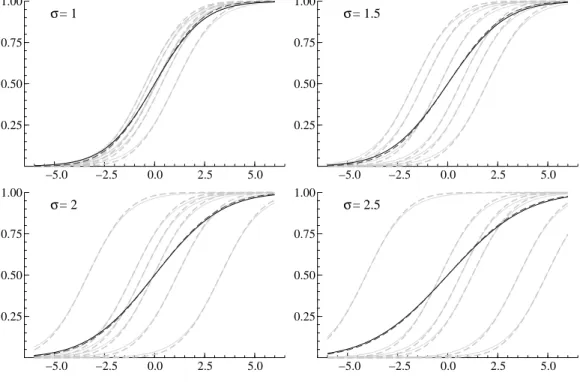
doc-umented in the literature (e.g., Diggle et al., 2002, Demidenko, 2004). Section 4 illustrates and shows the quality of the approximation inhigher dimensions compared to computer-intensive Monte Carlo methods. Note that these approximations are ex-pected to break down when (ηt1, . . . , ηtp) is far from0, as is the case when we expect extremely small or large success probabilities over time, or when σ is large. How-ever, Figure 1 shows the good quality of the approximation (for both conditional and marginal probabilities) with linear predictor ranging from -6 to 6 andσ from 1 to 2.5. In summary, fitting the logit GLMM allows for the usual interpretation of param-eters as conditional effects on the log-odds. Through exploiting connections between
logit and probit links, we can give accurate closed form approximations for marginal probabilities, odds and correlations, useful for model interpretation, checking and fore-casting. This is in the spirit of Lee and Nelder (2004), who regard the conditional model as the fundamental formulation from which marginal predictions are derived.
3
Maximum likelihood fitting of AR-GLMMs
Maximum likelihood estimation of β and variance components ψ = (σ, ρ) in AR-GLMMs is a challenging task, because it involves integrals with dimension equal to T. Let y = (y1, . . . , yT) and u = (u1, . . . , uT) be the vector of all observations and random effects, with densities f(y|u;β) =QTt=1f(yt|ut;β) and g(u;ψ), respectively. The likelihood functionL(β,ψ;y) is given by the marginal density of y, obtained by integrating over the AR(1) random effects,
L(β,ψ;y) = Z f(y1|u1;β)g(u1;ψ) T Y t=2 f(yt|ut;β)g(ut|ut−1;ψ)du. (5)
This integral has no closed-form solution and numerical procedures are necessary to calculate and maximize it. Letβ(k−1)andψ(k−1)denote current (at the end of iteration
k−1) estimates of parameter vectorsβ and ψ. With the Monte Carlo EM (MCEM) algorithm, (5) is indirectly maximized by maximizing the Monte Carlo approximation
Qm(β,ψ|β(k−1),ψ(k−1)) = 1 m m X j=1 logf(y|u(j);β) + 1 m m X j=1 logg(u(j);ψ). (6)
of the so-calledQfunction (Wei and Tanner, 1990). This approximation uses a sample
u(1), . . . ,u(m) from the conditional distribution h(u|y;β(k−1),ψ(k−1)) of the random
effects given the observed data, which is described in Appendix A. Let Q1
m and Q2m be the first and second sum in (6). Maximizing Q1m with respect toβis equivalent to fitting an augmented GLM with known offsets u(j). We duplicate
the original data set m times and attach the known offset u(j) to the jth replicate.
The log-likelihood equations for this augmented GLM are proportional to Q1
m and
maximization can follow along the lines of well known, iterative Newton-Raphson or Fisher scoring algorithms. Maximizing Q2
m with respect toψ is equivalent to finding MLEs of σ and ρ for the sample of u(1), . . . ,u(m), pretending they are independent.
With unequally spaced time series, this is more involved. For fixedρ, maximizingQ2
m with respect toσ is possible in closed form, but iteration has to be used for finding the MLE ofρ, except in the case of equally spaced time series. Appendix B gives details.
3.1
Convergence criteria
Due to the stochastic nature of the algorithm, parameter estimates of two successive it-erations can be close together just by chance, although convergence is not yet achieved. To reduce the risk of stopping prematurely we declare convergence if the maximum relative change in parameter estimates λ(k) = (β(k)0,ψ(k)0)0 is less than some ²
1, i.e.,
maxi
³
|λ(ik)−λi(k−1)|±|λ(ik−1)|
´
≤ ²1 for c (e.g. 4) consecutive times. An exception to
this rule occurs when the estimated standard error of a parameter is substantially larger than the change from one iteration to the next (Booth and Hobert, 1999). Es-timated standard errors for the MLE ˆλ are obtained by approximating the observed information matrix I(ˆλ) = −∂2logL(λ;y)/∂λ∂λ0|
λ=λˆ. Louise (1982) showed that
I(ˆλ) can be written in terms of the first and second derivative of the complete data likelihood, i.e., I(ˆλ) = −Eu|y[l00(ˆλ;y,u)|y]−Varu|y[l0(ˆλ;y,u)|y]. An
approxima-tion to this matrix uses the sample u(1), . . . ,u(m) from the current MCEM iteration.
To further safeguard against stopping prematurely, we use a second convergence criterion based on the Qm function (which is guaranteed to increase in deterministic EM). We declare convergence only if successive values of Q(mk) are within a small neighborhood. More importantly, however, is that we accept the k-th parameter
update λ(k) only if the relative change in the Q
m function is larger than some small negative constant, e.g.,
³
Q(mk)−Q(mk−1)
´
/Q(mk−1) ≥²2, which avoids a step in the wrong
direction. Whenever this is not met, we re-run iterationk with a bigger sample size. If this still doesn’t improve theQ−function, we continue, possibly letting the algorithm temporarily move into a lower likelihood region.
3.2
A simulation study
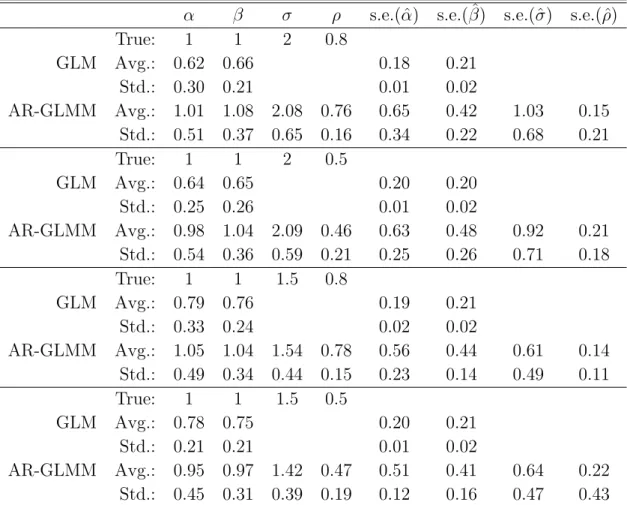
We conducted simulation studies to evaluate the performance and convergence of the proposed MCEM algorithm. Among others, we generated 100 time series of T = 152 (the number of observation in the first example of Section 4) unequally spaced binary observations and then used the MCEM algorithm to fit the logistic AR-GLMM (1). As expected with likelihood based methods, Table 1 shows that parameter estimates and standard errors are close to the true parameters and empirical standard deviations, for the combinations ofσ and ρ we considered. This is in contrast to some efficiency loss with pseudo-likelihood inference such as the pairwise likelihood method reported by Renard et al. (2004).
For each simulation, we also computed estimates under a GLM, assuming inde-pendence. The simulations clearly show that although the GLM estimates agree well with the implied marginal estimates from the AR-GLMM (i.e., scaled by a factor of
√
1 + ˜σ2), standard errors are severely underestimated. Simulations with longer (e.g.,
T = 300) time series, including ones with negative correlation, showed similar results. We can predict random effects through a Monte Carlo approximation of their con-ditional mean ˆu =E[u|y], using the generated sample from the last iteration of the MCEM algorithm. In our simulations and examples we noted that the temporal struc-ture of the estimated random effects{uˆt}reflects the dynamics of the data. Estimated positive random effects are usually associated with successes and negative ones with
failures. The magnitude of the estimated random effects increases (decreases) the closer the start (end) of a sequence of previous and future successes or failures. This behavior can be explained with the form of the full univariate conditional distribution of ut, which depends on yt, ut−1 and ut+1, which, in turn, depend on yt−1 and yt+1.
4
Examples
The boat race between rowing teams representing the Universities of Cambridge and Oxford has a long history. The first race took place in 1829 and was won by Oxford, but overall Cambridge holds a slight edge by winning 79 out of currently 153 races. There are 26 years, such as during both world wars, when the race did not take place. No spe-cial handling of these missing data is required with our methods of maximum likelihood estimation. In 1877, the race was ruled a dead heat, which we treat as another missing value in the sense that for this year no winner could be determined. The data are avail-able online athttp://www.theboatrace.org/article/introduction/pastresults
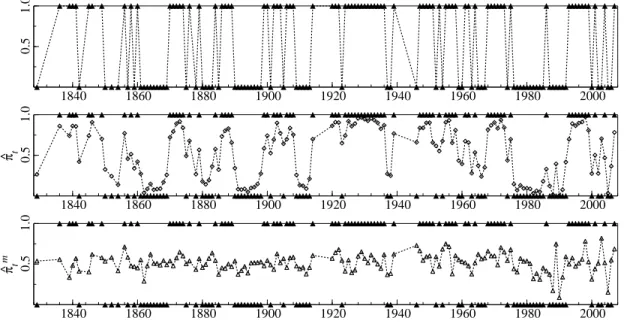
and plotted in the first panel of Figure 2.
Boat race legend has it that the heavier crew has an advantage when it comes to race day. In fact, an estimate of a weight effect in a simple logistic model equals 0.118, with a s.e. of 0.036. However, the odds of winning are potentially correlated over the years, due to hard to quantify factors such as overlapping crew members, physical and psychological training methods, rowing techniques, experience, etc., questioning the significance of the results obtained with the logistic model. For example, cross-classifying races one, two or three years apart, with Wt and Lt denoting Cambridge wins and losses in year t,
lag 1 Lt Wt Lt−1 43 25 Wt−1 25 48 lag 2 Lt Wt Lt−2 44 23 Wt−2 24 46 lag 3 Lt Wt Lt−3 40 25 Wt−3 29 44
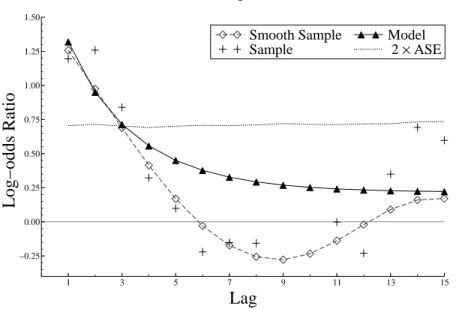
the sample log-odds ratios (asympt. s.e.) are given by 1.19 (0.35), 1.30 (0.36) and 0.89 (0.35), respectively. Figure 3 shows a smooth estimate of the sample Lorelogram and the strong associations at these first few lags. This motivates the use of a logistic AR-GLMM, where the autoregressive random effects {ut} account for the unobserved factors mentioned earlier that induce the serial correlation. Let yt equal 1 for a Cambridge win in year t, and 0 otherwise. We model the conditional log-odds of a Cambridge win as
logit[πt(ut)] =α+βxt+ut, ut+1 =ρdtut+²t, ²t ind∼ N(0, σ2[1−ρ2dt]),
wheredtis the gap (in years) between race tand t+ 1 and xtdenotes the average (per crewman) weight difference between the Cambridge and Oxford team. (A quadratic weight effect proved insignificant.) Durbin and Koopman (2001) model these log-odds as a random walk, estimating parameters via an approximating Gaussian model, while Varin and Vidoni (2006) use pseudo-likelihood methods to fit a stationary time series for the corresponding probits. Neither considers the effect of weight or checks the implied correlation structure and fit of the model.
The MCEM algorithm for a full likelihood analysis yields MLEs (s.e.’s) ˆα = 0.250 (0.436), ˆβ = 0.139 (0.060), ˆσ = 2.03 (0.81) and ˆρ = 0.69 (0.12), with a fi-nal Monte Carlo sample size of m = 32,714. The maximized log likelihood increases from -98 for the logistic model to an estimated -80 for the AR-GLMM, using the harmonic mean approximation (Newton and Raftery, 1994). While the asymptotic distribution of likelihood ratio tests in mixed models with one or several (often inde-pendent) random effects are known to be mixtures of Chi-squares (Stram and Lee, 1994, Molenberghs and Verbeke, 2007), this theory is not easily extended to the special
structure of AR random effects. However, an increase of 36 in twice the log-likelihood at the cost of two additional parameters in the marginal model seems like a substantial improvement. To evaluate the Monte Carlo error in the MLEs and in the marginal likelihood approximation, we continued sampling from the posterior h(u|y), evalu-ated at the MLEs and re-estimating these quantities using each sample. The results indicate that the Monte Carlo error in the MLEs is negligible (less than 0.5×10⁻⁴
for β and ρ and less than 0.5×10⁻³ for α and σ). Also, the marginal likelihood
approximation showed relative small variability, with a Monte Carlo standard error of 1.5.
The weight effect in the AR-GLMM is still significant, translating (using (4)) into an increase of 54% in the estimated marginal odds of a Cambridge win for every 5 pounds the average Cambridge crewman weighs more. The marginal 95% confidence interval of [9%,110%] (obtained via the Delta method) for this increase is shifted to the left relative to [27%,157%] for the effect under the logistic regression model and shows a more moderate effect. Still, headlines such as “Cambridge sets course record with heaviest and tallest crew in Boat Race history” in 1998 and “Oxford wondespite
heaviest crew of all times” in 2005 are not as contradictory as they may seem.
The significant correlation for races one year apart indicates a strong association between successive outcomes. The model based estimate of the Lorelogram at lag 1 is 1.30. That is, the odds of a Cambridge win over an Oxford win are estimated to be 3.7 times higher if Cambridge had won the previous race than if they had lost it (assuming equal crew weights). The estimated conditional (using ˆu) and marginal winning probabilities for the Cambridge crew are plotted in Figure 2.
4.1
Model assessment, prediction and forecasting
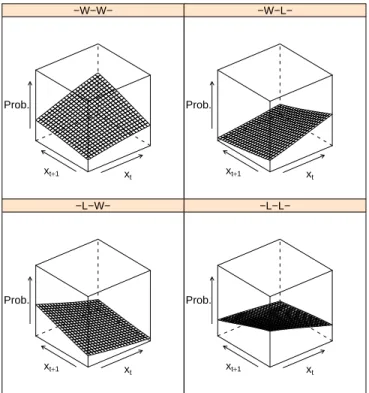
Before interpreting these estimates we should check if the AR-GLMM is capable of reproducing the correlation found in the data and if it fits well. Note that contrary to marginal or transitional models for time series, or pseudo-likelihood inference in GLMMs, our full likelihood approach specifies marginal joint probabilities, such as the probability of a sequence of two or three successive outcomes. With the inclusion of a time varying covariate, these probabilities are not stationary. Figure 4 shows the non-stationary behavior of the estimated marginal probabilities of two successive outcomes in dependence on the weight differences at timetand t+ 1, computed using approximation (4) with p = 2. These probabilities appear in the definition of the Lorelogram (2). For now, we set xt equal to the median observed weight difference of
−0.9 lbs for alltto compute these probabilities. Figure 3, comparing smoothed sample and model implied Lorelograms, shows good agreement between the two, especially at the most important first three lags, implying that the model adequately captures the associations observed in the data.
Using (4) with p= 3, we can estimate 3-dimensional transition probabilities, such as the probability of a Cambridge win immediately followed by a loss and another win. This probability is estimated as 0.081 (assuming xt = xt+1 = xt+2 = −0.9 lbs). We
will use this computations for a goodness of fit analysis, something that is impossible with marginal or transitional approaches. To this end, we multiply the approximate joint probability of a particular sequence with the number of all possible sequences of same length to obtain a predicted count for that sequence, e.g. 134×0.081 = 10.8 for the sequence above. Table 2 shows good agreement between observed and predicted counts for sequences of wins and losses up to order three, an indication that the model fits well. As a reference, predicted counts obtained from a Monte Carlo integration of joint probabilities based on the logit model are also shown, closely agreeing with
the analytic ones. Some lack of fit seems to occur for the counts concerning three Cambridge wins or three losses in a row. The observed median weight difference for all sequences of type –W–W–W– and –L–L–L– was 1.0 lbs and -2.4 lbs, respectively, quite different from the overall median of -0.9 lbs. Settingxt = 1.0 andxt=−2.4 for all three races, the predicted counts increase to 36.4 and 30.8, respectively, which is much closer to the observed values. Repeating this procedure with all other sequences produces estimates similar to the ones shown in Table 2.
The availability of marginal joint distributions also allows us to consider one-step-ahead forecast distributions such as
P(YT+1 =yT+1|YT =yT, . . . , YT−s+1 =yT−s+1) =
P(YT+1 =yT+1, . . . , YT−s+1 =yT−s+1)
P(YT =yT, . . . , YT−s+1 =yT−s+1)
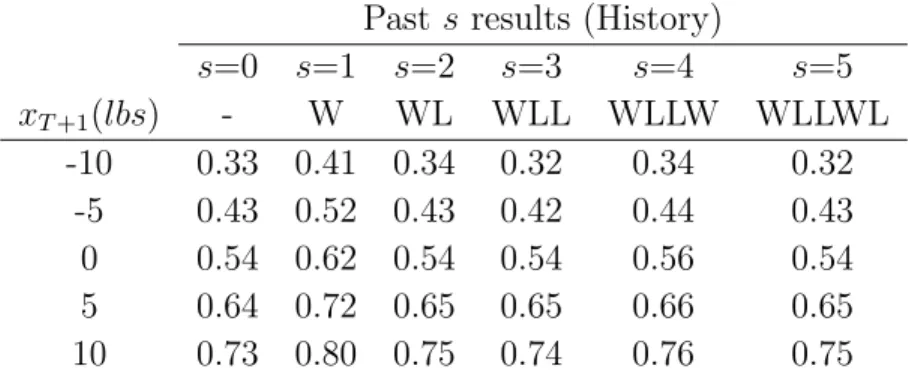
for an outcome at timeT + 1, given the pastsobservations. Extrapolating the model and AR(1) process to timeT + 1, the numerator (and similarly the denominator) can be approximated by multivariate normal cdf’s using (4). Table 3 shows estimated forecast probabilities of a Cambridge win in 2008 for various values of s and xT+1.
The crews weigh in four days prior to the race, so that xT+1 will be available before
the race.
4.2
Data from the General Social Survey
As a second, quite different illustration we analyze data from the General Social Survey (GSS). The GSS, second only to the census, gathers data on contemporary American society in order to monitor and explain trends in attitudes, behaviors and attributes. The questionnaire contains a standard core of variables whose wording is retained throughout the years to facilitate time trend studies. One question included in 20 of the surveys between 1973 and 2004 recorded attitude towards homosexual relation-ships. It was observed in years 1973-74, 1976-77, 1980, 1982, 1984-85, 1987-1991,
1993-94, and then bi-annually until 2004. Figure 5 shows the sample proportions of respondents who agreed with the statement that homosexual relationships are not wrong at all for the two race cohorts white and black respondents. Data from the GSS (available athttp://sda.berkeley.edu/archive.htm) are different from longi-tudinal studies in that responses are from cross-sectional surveys of different subjects in each year. The two features, a discrete response variable (most of the attitude questions) observed through time and unequally spaced observations make it a prime resource for applying the models developed in this article to investigate trends.
LetYit denote the number of respondents in year t and of racei(i= 1 for whites) who agreed with the statement. We assume a conditional Binomial(nit, πit) distribu-tion for each member of the two time series {Y1t}t and {Y2t}t. With x1t representing the year variable and x2i the indicator variable for race, a conditional model for πit allowing for a cubic time effect and a linear time-by-race interaction has form
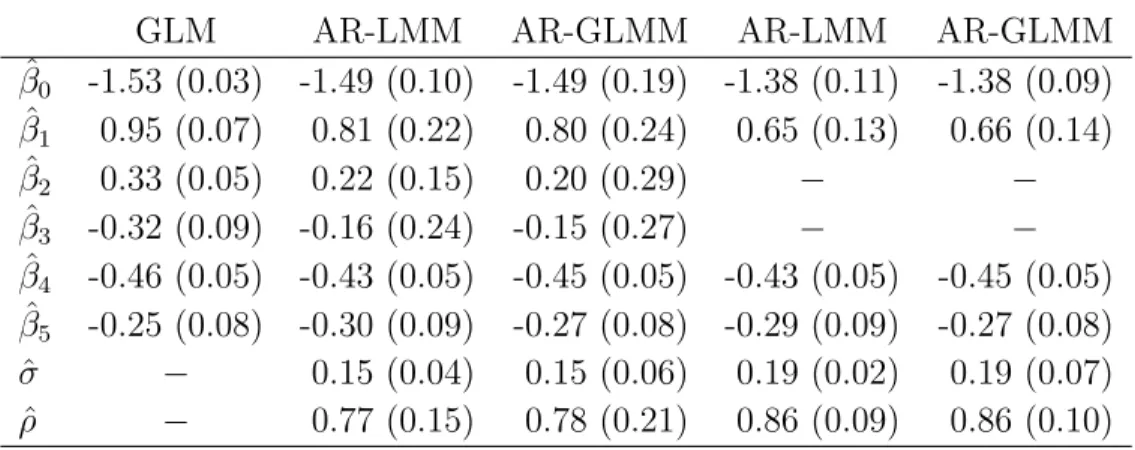
logit(πit(ut)) =β0+β1x1t+β2x21t+β3x31t+β4x2i+β5x1tx2i+ut. (7) On top of the fixed effects in (7), the random time effectsut capture dependencies in the log-odds (across race and time) due to various factors (e.g., awareness of AIDS, overall political/religious preferences, mass media influence, etc.) By modeling ut through an autoregressive process, we acknowledge a gradual shift in these factors over time. The ML estimate ˆρ= 0.78 (0.21) indicates a substantial correlation among log-odds of approval over time. ML estimates under a GLM and AR-GLMM (see Table 4) do not differ much, as there is little heterogeneity (ˆσ = 0.15 (0.06)) in the series on top of what is not captured by the fixed effects structure. However, for lack of a correlation structure, the GLM declares the quadratic and cubic time effect as highly significant, whereas the AR-GLMM attributes these to the autocorrelation. Hence, without adjusting for the correlation, p-values (and confidence intervals) for certain effects are too small and can be misleading, and the model might be unrealistic to hold
outside the observation window. For instance, over the period of 20 years from 1984 to 2004, the estimated marginal odds of approval increased by a factor of 2.5 (95% C.I.: [1.77, 3.25]) for white respondents and by a factor of 1.7 [1.17, 2.41] for black respondents. These estimates are based on the MLEs for the AR-GLMM without the insignificant quadratic and cubic effect (see Table 4). The point estimate and confidence intervals are shifted and wider than their GLM counterparts of [3.03, 3.88] and [1.94, 3.08], respectively, which is mostly due to the fact that the ratio of the estimate of β1 to its s.e. is 2.7 times larger under the AR-GLMM. The marginal odds
of approval for white respondents in 1984 are estimated to be 1.36 [1.27, 1.61] times those for black respondents in that year. Twenty years later, in 2004, this factor increases to 2.04 [1.69, 2.47]. As these contrasts don’t involve the quadratic or cubic effects, results are similar to a GLM. Finally, the estimated odds of approval for black respondents in 2004 are almost equal to the estimated odds for white respondents 16 years back in 1988.
Since sample sizes nit are large for these data, a normal approximation of the log odds could be sensitive. However, the right panel in Figure 5 clearly shows the non-constant behavior of the empirical standard deviations [nitpit(1−pit)]−1/2 of the log odds, where pit =yit/nit are the sample proportions. This is due to the trend in the probabilities (sample proportions range from 0.05 to 0.35) and non-constant sample sizes (e.g.,n1t is much larger thann2t and only half as many subjects were sampled in 1988 to 1993). For fitting a normal linear mixed model (LMM), we therefore introduce weightsωit which are the inverse of these empirical standard deviations and model the standardized log-odds (we fix the residual standard error from the normal mixed model at 1). Such weighted LMM can be fitted in e.g., SAS, which also allows for unequally spaced autocorrelated random effects. Estimates in Table 4 show that results are almost identical to the AR-GLMM analysis, albeit computationally much simpler to obtain. However, the inability of the LMM to model the variance as a function of
the mean (which we circumvented by considering standardized log-odds) renders this model class not suitable for analyzing binomial time series in general.
5
Summary and Discussion
Ignoring correlation in discrete time series can lead to wrong inference (based on wrong standard errors) which was apparent for the two examples and the simulations. At the cost of increased computational time and complex algorithms (MCEM with Gibbs sampling), we based inferential procedures for AR-GLMMs on the joint likelihood of the T serially correlated observation, leading to efficient estimation and enabling ap-proximations to marginal higher-order moments. These are useful for assessing the parametric correlation assumption, constructing tables for checking the fit and pre-dicting future observations. Further, our models and estimation routines are flexible enough to handle gaps in the series without any additional procedures or adjustments, such as ignoring the gaps and artificially treating the series as equally spaced or try-ing to impute values. Unlike GEE, our methodology should be practical when not all subjects are measured at common time points or missing at random.
It is not accidental that certain sequences, such as –W–L– and –L–W– or –W–W– L– and –L–W–W– in Table 2 have equal expected marginal probabilities (and hence predicted counts) when a time dependent covariate is held at a constant level. This is due to the symmetry in the bi- and trivariate normal distribution of (ut−1, ut) and (ut−2, ut−1, ut) which dictates that φ2(ut−1, ut) ≡φ2(ut, ut−1) and φ3(ut−2, ut−1, ut)≡ φ3(ut, ut−1, ut−2), where φk is the k-dim. normal density of{ul}tl=t−k,k = 2,3. (Note, however, that φ3(ut−2, ut−1, ut) 6= φ3(ut−2, ut, ut−1) and hence sequences –W–W–L–
and –W–L–W– are not modeled as exchangeable. They, indeed, have a different dynamical structure.) Hence, AR-GLMMs for binary time series possess reasonable
exchangeability properties for certain sequences of successes and failures when the mean is held constant.
In an influential article in the political science literature, Beck et al. (1998) include dummy variables or cubic splines to model temporal association in binary time series cross-sectional data, but note that this “cannot provide a satisfactory explanation [of an event] by itself, but must, instead, be the consequence of some important, but unobserved, variable”. AR-GLMMs, which have less stringent assumptions and model this unobserved variable seem to be an attractive alternative.
Acknowledgements
The author would like to thank Drs. Agresti, Booth and Casella for serving on his Ph. D. committee under which part of this work was done. Most computations and graphs were carried out in the fast program language OX, developed by Jurgen Doornik at the Univ. of Oxford.
Appendix A: Generating Samples from h(u|y)
Let yt = (y1t, . . . , ykt) denote the vector of i = 1, . . . , k binomial (nit, πit(ut)) obser-vations at time point t. For a single binary time series, k = 1 and n1t = 1 for all t. In the following, we suppress dependencies on parameters β and ψ as densities are always evaluated at their current estimates. The full univariate conditionals for the AR(1) random effects depend only on their immediate neighbors ut−1 and ut+1, i.e.,
g(ut|u1, . . . , ut−1, ut+1, . . . , uT)∝g(ut|ut−1)g(ut+1|ut), t = 2, . . . , T −1, and, fort = 1 and t = T, only on u2 and uT−1, respectively. The full univariate conditionals can
be expressed asht(ut|ut−1, ut+1,yt)∝f(yt|ut)gt(ut|ut−1, ut+1),where, using standard
multivariate normal theory results, g1(u1|u2) = N ¡ ρd1u 2, σ2[1−ρ2d1] ¢ gt(ut|ut−1, ut+1) = N µ ρdt−1[1−ρ2dt−1]u t−1+ρdt[1−ρ2dt−1]ut+1 1−ρ2(dt−1+dt) , σ2[1−ρ2dt−1 −ρ2dt +ρ2(dt−1+dt)] 1−ρ2(dt−1+dt) ¶ , t= 2, . . . , T −1 gT(uT|uT−1) = N ¡ ρdT−1u T−1, σ2[1−ρ2dT−1] ¢ .
For equally spaced data (without loss of generalitydt = 1 for allt) these distributions reduce to the ones derived in Chan and Ledolter (1995).
Direct sampling from ht is not possible. However, it is straightforward to imple-ment an accept-reject algorithm with candidate density gt, since ht/gt < L(yt) with L(yt) = Qki=1(yit/nit)yit(1−yit/nit)nit−yit. Given u(j−1) =
³
u(1j−1), . . . , u(Tj−1)
´
from the previous iteration, the Gibbs sampler with accept-reject sampling from the full univariate conditionals generates components u(tj) ∼ ht(ut(j)|u(t−j)1, u
(j−1)
t+1 ,yt) through generating ut from candidate density gt(ut|ut(−j)1, u(t+1j−1)) and w ∼ Unif[0,1] and then
settingu(tj) =utifw≤f(yt|ut)/L(yt) or repeating the process otherwise. The sample
u(1), . . . ,u(m) (after allowing for burn-in) is then used to approximate the E-step in
Appendix B: MLEs for σ and ρ for unequally spaced time series
For unequally spaced AR(1) random effects and a sampleu(1), . . . ,u(m) fromh(u|y),
Q2 m has form Q2 m(σ, ρ) ∝ −T logσ− 1 2 T−1 X t=1 log(1−ρ2dt)− 1 2σ2 1 m m X j=1 u(1j)2 − 1 2σ2 1 m m X j=1 T−1 X t=1 h u(tj+1) −ρdtu(j) t i2 1−ρ2dt ,
where u(tj) is the t-th component of the j-th sampled vector u(j). Denote the parts
depending on ρand the generated sample u(1), . . . ,u(m) by
at(ρ,u) = 1 m m X j=1 ³ u(tj+1) −ρdtu(j) t ´2 and bt(ρ,u) = 1 m m X j=1 ³ u(t+1j) −ρdtu(j) t ´ u(tj). Then the MLE of σ at iteration k of the MCEM algorithm has form
ˆ σ(k) = Ã 1 T m m X j=1 u(1j)2+ 1 T T−1 X t=1 1 1−ρ2dt at(ρ,u) !1/2 .
No closed form solutions exist for ˆρ(k) when random effects are unequally spaced. Let
ct(ρ) = dtρdt−1 1−ρ2dt and et(ρ) = ρ dt [ct(ρ)]2 be terms depending onρ but not on u. Then,
∂ ∂ρQ 2 m = T−1 X t=1 ρdtc t(ρ) + 1 σ2 T−1 X t=1 [ct(ρ)bt(ρ,u)−et(ρ)at(ρ,u)].
Since the range of ρ is restricted to (−1,1), we suggest the simple interval-halving
method on ∂
∂ρQ2m|σ=ˆσ(k) to find the root ˆρ(k). For the special case of equidistant time points, alldtare equal and ˆρ(k)is the closed-form solution of a third degree polynomial.
References
Beck, N., Katz, J. N., Tucker, R., 1998. Taking time seriously: Time-serious-cross-section analysis with a binary dependent variable. Amer. J. Political Science 42, 1260–1288.
Benjamin, M. A., Rigby, R. A., Stasinopoulos, M. D., 2003. Generalized autoregressive moving average models. J. Amer. Statist. Assoc. 98, 214–223.
Booth, J. G., Hobert, J. P., 1999. Maximizing generalized linear mixed model likeli-hoods with an automated Monte Carlo EM algorithm. J. Roy. Statist. Soc. Ser. B 61, 265–285.
Chan, K. S., Ledolter, J., 1995. Monte Carlo EM estimation for time series models involving counts. J. Amer. Statist. Assoc. 90, 242–252.
Chen, M.-H., Ibrahim, J., 2000. Bayesian predictive inference for time series count data. Biometrics 56, 678–685.
Chib, S., Greenberg, E., 1998. Analysis of multivariate probit models. Biometrika 85, 347–361.
Czado, C., 2000. Multivariate regression analysis of panel data with binary outcomes applied to unemployment data. Statist. Papers 41, 281–304.
Davis, R. A., Dunsmuir, W. T. M., Streett, S. B., 2000. On autocorrelation in a Poisson regression model. Biometrika 87, 491–505.
Davis, R. A., Rodriquez-Yam, G., 2005. Estimation of state-space models; an approx-imate liklihood approach. Statist. Sinica 15, 381–406.
Diggle, P., Heagerty, P., Liang, K.-Y., Zeger, S. L., 2002. Analysis of Longitudinal Data, 2nd Edition. Oxford University Press, Oxford.
Durbin, J., Koopman, S. J., 2000. Time series analysis of non-Gaussian observations based on state space models from both classical and Bayesian perspectives. J. Roy. Statist. Soc. Ser. B 62, 3–56.
Durbin, J., Koopman, S. J., 2001. Time Series Analysis by State Space Methods. Oxford: Oxford University Press.
Fahrmeir, L., Tutz, G., 2001. Multivariate Statistical Modelling Based on Generalized Linear Models, 2nd Edition. Springer, New York.
Fitzmaurice, G. M., Laird, N. M., Ware, J. H., 2004. Applied Longitudinal Analysis. Wiley, Hoboken, N.J.
Fokianos, K., Kedem, B., 2004. Partial likelihood inference for time series following generalized linear models. J. Time Ser. Anal. 25, 173–197.
Hay, J. L., Pettitt, A., 2001. Bayesian analysis of time series of counts. Biostatistics 2, 433–444.
Heagerty, P. J., Zeger, S. L., 1998. Lorelogram: A regression approach to exploring dependence in longitudinal categorical responses. J. Amer. Statist. Assoc. 93 (441), 150–162.
Jung, R. C., Kukuk, M., Liesenfeld, R., 2006. Time series of counts data: modeling, estimation and diagnostics. Comput. Statist. Data Anal. 51, 2350–2364.
Kedem, B., Fokianos, K., 2002. Regression Models for Time Series Analysis. Wiley, New York.
Kuk, A. Y. C., Cheng, Y. W., 1999. Pointwise and functional approximations in Monte Carlo maximum likelihood estimation. Statist. and Comput. 9, 91–99.
Lee, Y., Nelder, J. A., 2004. Conditional and marginal models: Another view. Statist. Science 19, 219–238.
Li, W. K., 1994. Time series models based on generalized linear models: Some further results. Biometrics 50, 506–511.
Liu, S.-I., 2001. Bayesian model determination for binary-time-series data with appli-cations. Comput. Statist. Data Anal. 36, 461–473.
Louis, T. A., 1982. Finding the observed information matrix when using the EM algorithm. J. Roy. Statist. Soc. Ser. B 44, 226–233.
MacDonald, I. L., Zucchini, W., 1997. Hidden Markov and other Models for Discrete-Valued Time Series. Chapman & Hall, New York.
Molenberghs, G., Verbeke, G., 2007. Likelihood ratio, score and Wald tests in a con-strained parameter space. The Amer. Statist. 61, 22–27.
Newton, M. A., Raftery, A. E., 1994. Approximate Bayesian inference with the weighted likelihood bootstrap. J. Roy. Statist. Soc. Ser. B 56, 3–48.
Pettitt, A., Weir, I., Hart, A., 2002. A conditional autoregressive Gaussian process for irregularly spaced multivariate data with application to modelling large sets of binary data. Statist. and Comput. 12, 353–367.
Renard, D., Molenberghs, G., Geys, H., 2004. A pairwise likelihood approach to esti-mation in multilevel probit models. Comput. Statist. Data Anal. 44, 649–667. Stram, D. O., Lee, J. W., 1994. Variance components testing in the longitudinal mixed
Sun, D., Speckman, P. L., Tsutakawa, R. K., 2000. Random effects in generalized linear mixed models. In: Dey, D., Ghosh, S., Mallick, B. (Eds.), Generalized Linear Models: A Bayesian perspective. Marcel-Dekker, New York.
Sun, D., Tsutakawa, R. K., Speckman, P. L., 1999. Posterior distribution of hierar-chical models using CAR(1) distributions. Biometrika 86, 341–350.
Varin, C., Vidoni, P., 2006. Pairwise likelihood inference for ordinal categorical time series. Comput. Statist. Data Anal. 51, 2365–2373.
Wei, G. C. G., Tanner, M. A., 1990. A Monte Carlo implementation of the EM algorithm and the poor man’s data augmentation algorithms. J. Amer. Statist. Assoc. 85, 699–704.
Zeger, S. L., 1988. A regression model for time series of counts. Biometrika 75, 621– 629.
Table 1: A simulation study to assess properties of the proposed MCEM algorithm and compare standard errors (s.e.) from GLM and AR-GLMM fits. For each set of true parameters, 100 binary time series with T = 152 and 27 random gaps of size dt from 2 to at most 6 were generated according to the model logit[πt(ut)] =α+βxt+ut, with xt∼N(0,1) andut+1 =ρdtut+²t,²t ∼N(0, σ2[1−ρ2dt]). Avg. and Std. denote simulation average and standard deviation.
α β σ ρ s.e.(ˆα) s.e.( ˆβ) s.e.(ˆσ) s.e.(ˆρ)
True: 1 1 2 0.8 GLM Avg.: 0.62 0.66 0.18 0.21 Std.: 0.30 0.21 0.01 0.02 AR-GLMM Avg.: 1.01 1.08 2.08 0.76 0.65 0.42 1.03 0.15 Std.: 0.51 0.37 0.65 0.16 0.34 0.22 0.68 0.21 True: 1 1 2 0.5 GLM Avg.: 0.64 0.65 0.20 0.20 Std.: 0.25 0.26 0.01 0.02 AR-GLMM Avg.: 0.98 1.04 2.09 0.46 0.63 0.48 0.92 0.21 Std.: 0.54 0.36 0.59 0.21 0.25 0.26 0.71 0.18 True: 1 1 1.5 0.8 GLM Avg.: 0.79 0.76 0.19 0.21 Std.: 0.33 0.24 0.02 0.02 AR-GLMM Avg.: 1.05 1.04 1.54 0.78 0.56 0.44 0.61 0.14 Std.: 0.49 0.34 0.44 0.15 0.23 0.14 0.49 0.11 True: 1 1 1.5 0.5 GLM Avg.: 0.78 0.75 0.20 0.21 Std.: 0.21 0.21 0.01 0.02 AR-GLMM Avg.: 0.95 0.97 1.42 0.47 0.51 0.41 0.64 0.22 Std.: 0.45 0.31 0.39 0.19 0.12 0.16 0.47 0.43
Note: Starting values for fixed effects were regular GLM estimates and for σ and ρ the
variance and correlation of the empirical log-odds. For 4 of the 100 generated time series, the Monte Carlo sample size at parameter convergence was not large enough to give a positive definite estimate of the covariance matrix. In these cases, the algorithm continued until a positive definite estimate was found. The median Monte Carlo sample size at convergence was 9683 (IQR: 12,945). The median computation time to convergence was 1.2 hours (IQR: 3 hours) on a Pentium 4 processor with 2Ghz of RAM.
Table 2: Observed and predicted counts of sequences of wins (W) and losses (L) for the Cambridge crew, evaluated at the median observed weight difference of−0.9 lbs.
predicted
sequence observed logit-probit Monte Carlo
–W– 79 78.9 78.8 –L– 73 73.0 73.1 –W–W– 48 47.8 47.2 –W–L– 25 25.3 26.0 –L–W– 25 25.3 26.0 –L–L– 43 42.4 42.0 –W–W–W– 34 31.8 30.9 –W–W–L– 13 13.8 14.0 –W–L–W– 12 10.8 11.2 –W–L–L– 11 13.2 13.5 –L–W–W– 11 13.8 14.0 –L–W–L– 10 10.2 10.5 –L–L–W– 11 13.2 13.5 –L–L–L– 32 27.0 26.4
Table 3: Estimated probabilities of a Cambridge win in 2008 for various weight dif-ferences xT+1, conditional on s past results.
Past s results (History)
s=0 s=1 s=2 s=3 s=4 s=5 xT+1(lbs) - W WL WLL WLLW WLLWL -10 0.33 0.41 0.34 0.32 0.34 0.32 -5 0.43 0.52 0.43 0.42 0.44 0.43 0 0.54 0.62 0.54 0.54 0.56 0.54 5 0.64 0.72 0.65 0.65 0.66 0.65 10 0.73 0.80 0.75 0.74 0.76 0.75
Table 4: MLEs for modeling the log-odds of approval in the GSS data set via a GLM and AR-GLMM. Results are also displayed for fitting a linear mixed model with autocorrelated random effects (AR-LMM) to the standardized log-odds. The last two columns present the result of the AR-LMM and AR-GLMM when dropping the insignificant quadratic and cubic time effect.
GLM AR-LMM AR-GLMM AR-LMM AR-GLMM
ˆ β0 -1.53 (0.03) -1.49 (0.10) -1.49 (0.19) -1.38 (0.11) -1.38 (0.09) ˆ β1 0.95 (0.07) 0.81 (0.22) 0.80 (0.24) 0.65 (0.13) 0.66 (0.14) ˆ β2 0.33 (0.05) 0.22 (0.15) 0.20 (0.29) − − ˆ β3 -0.32 (0.09) -0.16 (0.24) -0.15 (0.27) − − ˆ β4 -0.46 (0.05) -0.43 (0.05) -0.45 (0.05) -0.43 (0.05) -0.45 (0.05) ˆ β5 -0.25 (0.08) -0.30 (0.09) -0.27 (0.08) -0.29 (0.09) -0.27 (0.08) ˆ σ − 0.15 (0.04) 0.15 (0.06) 0.19 (0.02) 0.19 (0.07) ˆ ρ − 0.77 (0.15) 0.78 (0.21) 0.86 (0.09) 0.86 (0.10)
Figure 1: Conditional (grey) and marginal (black) success probabilities based on logit (solid) and scaled probit (dashed) links, for linear predictor values ranging from -6 to 6. Each pair of grey (solid,dashed)-curves in each panel corresponds to one out of 6 randomly sampled random effectszt. The two black lines in each panel represent the implied marginal probability, the true one (obtained by a Monte Carlo sum, averaging over 100,000 randomly sampled zt’s) represented as a solid line, and the one based on approximation (4) by a dashed one. The four panels correspond to four different values of the random effects standard deviation, σ= 1,1.5,2 and 2.5.
−5.0 −2.5 0.0 2.5 5.0 0.25 0.50 0.75 1.00 σ= 1 −5.0 −2.5 0.0 2.5 5.0 0.25 0.50 0.75 1.00 σ= 1.5 −5.0 −2.5 0.0 2.5 5.0 0.25 0.50 0.75 1.00 σ= 2 −5.0 −2.5 0.0 2.5 5.0 0.25 0.50 0.75 1.00 σ= 2.5
Figure 2: Plot of the Oxford vs. Cambridge boat race data. Observed series (first panel, 1 denotes a Cambridge win, 0 a loss) and estimated conditional (second panel) and marginal (third panel) probabilities of a Cambridge win.
1840 1860 1880 1900 1920 1940 1960 1980 2000 0.5 1.0 1840 1860 1880 1900 1920 1940 1960 1980 2000 0.5 1.0 ^πt 1840 1860 1880 1900 1920 1940 1960 1980 2000 0.5 1.0 ^πt m
Figure 3: Comparison of sample and model based Lorelogram. 1 3 5 7 9 11 13 15 −0.25 0.00 0.25 0.50 0.75 1.00 1.25 1.50 Lorelogram Log−odds Ratio Lag Smooth Sample Sample Model 2 × ASE
Figure 4: Estimated marginal probabilities P(Yt = yt, Yt+1 = yt+1) of two successive
Cambridge wins (–W–W–), a win and a loss (–W–L–), a loss and a win (–L–W–) and two Cambridge losses in a row (–L–L–), for combination of crew weight differences (xt, xt+1) ranging from (-15,-15) lbs to (15,15) lbs. The probability axis (labeled Prob.)
ranges from 0 to 1. xt xt+1 Prob. −W−W− xt xt+1 Prob. −W−L− xt xt+1 Prob. −L−W− xt xt+1 Prob. −L−L−
Figure 5: Sample proportions and implied marginal model for the GSS data set for whites (squares) and blacks (solid circles) agreeing with the statement that homosexual relationships are not wrong at all (left panel). Asymptotic standard error (ASE) of the sample log-odds (right panel). To put their magnitude into perspective, the left-hand panel has one y-axis on the log-odds scale.
1975 1980 1985 1990 1995 2000 2005 0.0 0.1 0.2 0.3 0.4 Year Probability −3 −2 −1 −0.5 Log−Odds 1975 1980 1985 1990 1995 2000 2005 0.00 0.10 0.20 0.30 Year ASE log−odds