© 2017, IRJET | Impact Factor value: 5.181 | ISO 9001:2008 Certified Journal
| Page 738
Differential Evolution and Simulated Annealing Technique for Design
and Developing of Process Plan to Perform Optimization on Finite
Capacity Scheduling for Simultaneous System of Machines
Somanath B.
M.Tech.1, Dr. K Mallikarjuna
M.Tech., Ph.D.2, Samson Yohannes
M.Sc.3,
Srinivas K R
M.E. (Ph.D.) 41
Assistant Professor, Department of Mechanical Engineering, Madda Walabu University, Bale Robe, Ethiopia.
2Head of the Dept. of Mechanical Engineering, G. Pullaiah college of Engg & Technology, Andrapradesh, India.
3
Head of the Department of Mechanical Engineering, Madda Walabu University, Bale Robe, Ethiopia.
4Department of Mechanical Engineering, Debre Tabor University, Ethiopia.
---***---Abstract
Differential evolution and simulated annealingtechnique for simultaneous scheduling of machines is defined as any computer program that uses advanced mathematical algorithm for logic to perform optimization and simultaneous on finite capacity scheduling and others. This work addresses the problem of simultaneous system of machine and Automated Guided Vehicles in Flexible Manufacturing System so as to minimize make span and mean tardiness. Non-traditional approach is most effective algorithm that aims to converge and give optimal solution in a shorter time. Therefore, in this work a suitable simultaneous scheduling mechanism is design to generate accurate scheduling using simulated annealing and differential evolution methodology, which gives optimum solution for the bench mark problem chosen from literature
Key Words: Automated Guided Vehicles, Make-span,
Tardiness, Simultaneous Scheduling, Differential Evolution, Simulated Annealing
1. INTRODUCTION
The objective of scheduling is to find a way to assign and sequence the use of these shared resources such that production constraints are satisfied and production costs are minimized. Simultaneous scheduling in the manufacturing environment can be defined as the process of deciding what happens when and where. In scheduling theory, it is often assumed that the time taken to move jobs from one machine to another is negligible. But in many real life situations, this Movement can have a significant effect on the complete time of the jobs, thus adding a parameter to the optimization function. This work looks at the situation where the job travelling time between machines is taken into account. Author, therefore, present a differential evolution (DE) and simulated annealing (SA) for the simultaneous scheduling of machines and AGVs in an FMS for process plan design. Scheduling is the process of allocating shared resources over time for competing activities is known as scheduling. It has been the subject of a significant amount of literature in the operations research field. A flexible manufacturing system is a highly automated manufacturing system well suited for the simultaneous production of a wide variety of part types in low to mid volume quantities at a low cost while
maintaining a high quality of the finished products.
1.2 LITERATURE SURVEY
The importance of the material handling system for the efficiency of the overall system has been emphasized by several researchers.
Medikondu.Nageswararao et al., proposed an efficient and optimized Automated Guided Vehicles (AGVs) operation plays a critical role in improving the performance of a Flexible Manufacturing System (FMS).It is proven that the method is capable to provide better solution compared to others [1].
Noboru Murayama and Seiichi Kawata. Focused on simultaneous scheduling of processing machines and multiple-load automated guided vehicles and proposed a simulated annealing method for the simultaneous scheduling problems of machines and multiple-load AGVs to obtain relatively good solutions for a short time [2].
K. V. Subbaiah et al., proposed a Simultaneous scheduling problem using a dynamic programming approach. They tested different machines and AGV scheduling rules in FMS against the mean flow time criterion [3].
I. A. Chaudhry et al., proposed a Production scheduling is concerned with the efficient allocation of resources over time for manufacturing. Scheduling problems arise whenever a common and finite set of resources (labour, material and equipment) must be used to make a variety of different products during the same period of time [4].
© 2017, IRJET | Impact Factor value: 5.181 | ISO 9001:2008 Certified Journal
| Page 739
2.
MATERIALS AND METHODS
2.1 Methodology
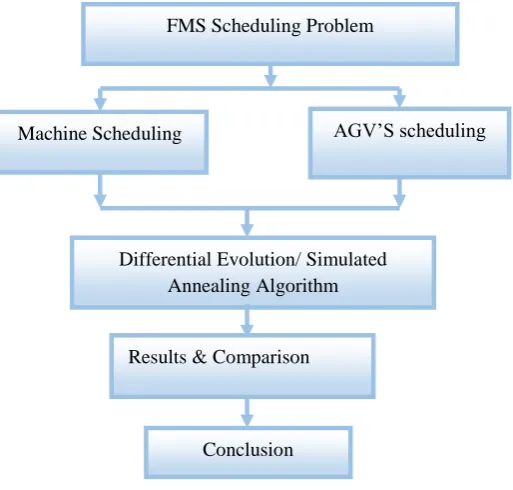
Authors have considered 2 different layouts and 2 job sets consisting of 1- 10 different job sets and operations on machines to be performed. The problem is formulated as a nonlinear mixed integer programming model. Its objective is makespan minimization, mean makespan, mean tardiness and CPU time.
Figure 1: DE and SA Method
2.1 Objectives function
Operation completion time = Oij = Tij+Pij
J = Job operation i = Job
Tij = Traveling time
Pij = Operation processing time
Tardiness = Ti = Ci ─Di where Di = It is due date
Mean Tardiness = Ti
Where, n = number of jobs;
Job Completion Time = Ci = Oij
Make span = Cmax . i.e., c1, c2 ….cn
2.3 Algorithms Used
The algorithm applied for the present study is the differential evolution (DE) and simulated algorithm (SA).
Simulated Annealing: Annealing is the process of obtaining low energy states of a solid in heat treatment. Annealing
process starts with melting the solid by heat treatment. Particles constituting the solid are arranged according to that heat treatment. Then, temperature is decreased which results in minimum energy state.
Differential Evolution: In this study, authors propose a DE algorithm, in which both trial vector generation strategies and their associated control parameter values in generating promising solutions. Consequently, a more suitable generation strategy along with its parameter settings can be determined adaptively to match different phases of the search/evolution. The performance of the DE algorithm is extensively evaluated using codes.
[image:2.595.26.283.234.479.2]3. RESULT AND DISCUSSION
Table 1: Comparison of make-span for optimum solution using literature review & proposed methods for t/p >0.25
Problem
Number STW UGA AGA PGA SFHA DE SA
EX39 110 105 106 105 94 69 68
EX310 143 143 141 139 127 80 95
EX49 125 123 122 122 126 59 74
EX410 171 164 159 159 173 73 110
[image:2.595.333.536.595.708.2]Inference 1.1: Table 2 shows that the comparison of make-span for optimum solution using literature review and proposed methods (DE and SA) for t/p >0.25. Make-span for differential evolution can find better solutions than those of literature review and proposed method of simulated annealing algorithm, for every stage of EX39, EX310, EX49 and EX410 problems
Table 2: Comparison of make-span for DE and SA for t/p ratio >0.25
Problem No. DE SA
EX39 69 68
EX310 80 95
EX49 59 74
EX410 73 110
Inference 1.2: From table 6.8 it is observed that the comparison of make-span for optimum solution using proposed methods (DE and SA) for t/p >0.25. Make-span for FMS Scheduling Problem
Machine Scheduling AGV’S scheduling
Differential Evolution/ Simulated Annealing Algorithm
Results & Comparison
© 2017, IRJET | Impact Factor value: 5.181 | ISO 9001:2008 Certified Journal
| Page 740
differential evolution can find better solutions than those ofsimulated annealing algorithm, for every stage of EX39, EX310, EX49 and EX410 problems.
3.1 Charts for benchmark problems
Chart - 1: Comparison of Make-span Performance for literature review for t/p ratio >0.25
Inference 1.2: Chart 1 shows that the graph plotted problem number v/s Make-span for optimum solution using literature review and proposed methods for t/p >0.25. Mean Tardiness for DE can find better solutions than those of SA algorithm, for problem numbers
.
Chart -2: Convergence of Make-span Performance for problem no EX39, for t/p >0.25
Inference 1.3: Chart 2 shows that the Convergence graph plotted No. of Generations v/s Make-span for optimum solution using proposed methods for t/p >0.25. Make-span for DE can find better solutions than those of SA algorithm, for Problem No. EX39.
Chart 4: Convergence of Makespan Performance for problem no EX310, for t/p >0.25
Inference 1.4: Chart 4shows that the Convergence graph plotted No. of Generations v/s Makespan for optimum solution using proposed methods for t/p >0.25. Makespan for DE can find better solutions than those of SA algorithm, for Problem No. EX310.
Chart - 3: Convergence of Make-span Performance for problem no EX410, for t/p >0.25
© 2017, IRJET | Impact Factor value: 5.181 | ISO 9001:2008 Certified Journal
| Page 741
Chart 4: Convergence of Makespan Performance for problemno EX49, for t/p >0.25
Inference 1.5: Chart 4 shows that the Convergence graph plotted No. of Generations v/s Makespan for optimum solution using proposed methods for t/p >0.25. Makespan for DE can find better solutions than those of SA, for Problem No. EX49.
4. DISCUSSION ABOUT OBTAINED
RESULTS
In all these problems there are four machines, two layouts, two job set and 2vehicles. Table 1 consists of problems whose t/p ratios are greater than 0.25 and charts 1 to N consists of graphs for particular problem whose t/p ratios are greater than 0.25. From table 1 for
all the 4 benchmark problems, it gives better results
using proposed algorithm of differential evolution. From charts 1 to N for all the 4 benchmark problems, the graph charts show the performance of DE is more effective than SA and other five literature algorithms. A code is used to designate the example problems which are given in the tables. The digits that follow EX indicate the layout and job set. Looking DE closer in all tables and figures (graph charts).
5. CONCLUSIONS
Efficient scheduling of all the resources plays a vital role in achieving the required targets in a flexible manufacturing system. The following conclusions are obtained during results and discussion.
For a number of well-studied problems in combinatorial optimization of DE, SA and five literature algorithms usually leads to the conclusion that DE algorithm is more efficient and more effective than literature algorithms and SA.
DE has potential of finding minimum Make-span,mean Make-span and mean tardiness than other
five literature algorithms.
For convergence chart of all the problems, from chart 1 to 4 (graph chart) and from table 1 and 2, DE gives effective results like- minimum Make-span, Mean Make-span and Mean tardiness when compared with proposed algorithm of SA.REFERENCES
[1]. Medikondu Nageswararao, DR. K. Narayana Rao and DR.G. Rangajanardhana “Integration of strategic tactical and Operational level planning of scheduling in FMS by Metaheuristic Algoritham”.
[2]. Noboru Murayama, Seiichi Kawata “Simulated Annealing Method for Simultaneous Scheduling of Machines and Multiple-load AGVs”. Tokyo Metropolitan University University, Minami-Oshawa, Hachioji-Shi, 1-1, Minami-Oshawa, Hachioji-Shi, Tokyo 192-0397, Japan Tokyo 192-0397, Japan.
[3]. K. V. Subbaiah, M. Nageswara Rao and K. Narayana Rao “Scheduling of AGVs and machines in FMS with make span criteria using sheep flock heredity algorithm”. Dept. of Mechanical Engg, Andhra University of Engineering, Visakhapatnam.
[4]. A. Chaudhry, S. Mahmood, M. Shami “Simultaneous scheduling of machines and automated guided vehicles in flexible manufacturing systems using genetic algorithms”. National University of Sciences & Technology (NUST), Islamabad, PAKISTAN.
[5]. B. Siva Prasad Reddy and C.S.P. Rao. “Simultaneous Scheduling of Machines and Material Handling System in an FMS”. Department of Mech. Engg., KITS, Warangal-506 015 (A.P) INDIA. Department of Mech. Engg., REC, Warangal-506 004 (A.P) INDIA.
[6]. Somanath B. and Samson Yohannes " Design of Process Plan for Simultaneous Scheduling of Machines and AGV’s Using Non Traditional Optimization Technique” Department of Mechanical Engineering, Madda Walabu University, Bale Robe, Ethiopia.
© 2017, IRJET | Impact Factor value: 5.181 | ISO 9001:2008 Certified Journal
| Page 742
[8]. Srinivas, K. R., Premkumar Naik, and B. Somanath."Experimental Comparison of E-Glass Fiber Reinforced Thermosetting and Thermoplastic Composites for
Tensile Strength." Department of Mechanical
Engineering MITE, Karnataka, India and MW, Bale Robe Ethiopia.
[9]. Pradeep Kale, Samson Yohannes, Somanath B and Karunakar P “Beef Tallow Biodiesel as an Alternative
Transportation Fuel”. Department of Mechanical
Engineering and Department of Electrical Engineering Madda Walabu University, Bale Robe, Ethiopia.
[10]. Dr. Shnataraja M, Srinivas K R “Comparison of Rivited Panel and Integrated Panel for Damage Tolerance by Using FEA” Department of Mechanical Engineering, UVCE, Karnataka, India.
[10]. Sanghamitra Bandyopadhyay. “A Simulated Annealing-Based Multi objective Optimization Algorithm: AMOSA” Members, IEEE, Department of Mechanical Engineering, Indian Institute of Techno Kanpur, India.
BIOGRAPHIES
Somanath B working an Assistant Professor Department of Mechanical Engineering at MWU, Bale Robe Ethiopia. Having teaching experience of 6 years. There are many international papers with his name. Attended many workshops, conferences and short terms trainings. His area of interest is Design, Vibration, CAD & FEM.
Dr. K Mallikarjuna is Professor and Head of the Mechanical Engineering Department at GPCET Kurnool, India. Having teaching experience of 17 years which includes 9 years Research experience. There are 25 plus international/national papers to his credentials out of which 2 springers and one Elsevier paper. His area of interest is CAD/CAM, CIM, FEM, Nano composites
Samson Yohannes is a Head of the Mechanical Engineering Department at MWU, Bale Robe Ethiopia. Having teaching experience of 5 years. There are many international papers with his name. His area of interest is Design, Vibration & FEM.