© 2017, IRJET | Impact Factor value: 5.181 | ISO 9001:2008 Certified Journal
| Page 368
e-Water supply system using Python, Raspberry Pi and IOT
REVANTH C.B
1, Asst.Prof Madhusudan K
21
M.Tech (VLSI Design and Embedded Systems),CMR Institute of Technology Bangalore-37, Karnataka
2
Assistant Professor CMR Institute of Technology Bangalore-37, Karnataka
---***---
Abstract: In urban areas the water supply to residence and commercial establishments are provided at a fixed flow rate. There are incidents of excess water drawing by certain customers/users by connecting motor-pump sets to the water lines which is considered as water theft. In this project it is proposed to develop an embedded based remote water monitoring and theft prevention system by recording the flow rates at the consumer/user end. In order to implement the proposed water supply system, each consumer end should be provided with a web based mobile application consisting of so many options for the user to record the flow rate using a level sensor and to transmit the same to a remote monitoring station using IOT and it is also provided with an electrically operated solenoid valve to supply water to the consumers. The valve turns on/off by the central processing unit Raspberry Pi to stop the water supply whenever the flow rate exceed a predefined limit. It is proposed to employ a Internet of things for wireless communication so that the information can be passed to many responsible officers cell phone for immediate action.Keywords: Raspberry pi, Solenoid valve, Ultrasonic sensor, Moisture sensor, Relay
1.INTRODUCTION
With the continuous economic growth, the water demand of enterprises is also increasing. The monitoring of water resource for these enterprises can prevent the occurrence of stealing water and leaking water effectively. Therefore, the monitoring system of urban water supply has aroused extensive attention in recent years. Urban water supply networks form the link between drinking water supply and drinking water consumers. These large-scale networks are vital for the survival of urban life, for maintaining a healthy level of economic development, and for the continuous operation of factories and hospitals.
In world, urban water supply systems are public enterprises, usually part of a local government, and the recent increased interest in privatizing public enterprises has not led to reforms of water systems. Nevertheless, in about 50 cities in the developing world, the water system either has been privatized or franchised to a non-governmental entity for its operation and maintenance.
In this research work it is proposed to develop an embedded based remote water monitoring and theft prevention system by recording the flow rates at the consumer/user end. . In order to implement the proposed water supply system, each consumer end should be provided with a web based mobile application consisting of so many options for the user to record the flow rate using a level sensor and to transmit the same to a remote monitoring station using IOT and it is also provided with an electrically operated solenoid valve to supply water to the consumers.
With the rapid development of global system Internet infrastructure and information communication technology in the past few decades has made the communication is reliable for transmitting and receiving information efficiently. So here we used IOT for efficient communication purpose. Digital Water safeguards supplies by ensuring responsible water use, reducing waste and matching demand to sustainable supplies. The Digital Water system provides utilities with an exceptional ability to understand and control water use. Utilities are able to save water and conserve supplies with real-time understanding of consumer water use and confidence that all water is used according to need .Preventing water waste also reduces energy consumption used in water delivery and treatment .The Digital Water System provides:
Knowledge- how much water is being used
Control – water delivery according to need and costs.
Protection – leaks, drips ,excess use and theft prevented.
1.1 PROBLEM STATEMENT
© 2017, IRJET | Impact Factor value: 5.181 | ISO 9001:2008 Certified Journal
| Page 369
all channels gets water supply, evaluating the amount of water flow in appropriate channels, intimation on over consumption by the users, ensuring that the supplied water is with good quality. Every area is provided with a centralized water distribution unit which distributes water to all home units in that particular area. This unit contains overall amount of water needed to provide proper supply to all home units. To assure perfect supply, connections to all home units have to be made very clearly. Automated supply ensures that supplied water is not wasted. The water supply systems are part of the urban infrastructure which must assure the continuity of the water distribution and the water quality control .In earlier developed systems, urban water is supplied to the home with the help of some man power. Allocated person will go to that distribution unit and will initiate the system to supply water to all home units. This type of operation needs man power. Time consumption is very high in this method. Also if operator does not do the proposed task perfectly then the output of the task will not be good. Because of this supply people will use enormous water if it is supplied beyond time limit which leads to scarcity of water. Over consumption of water is termed as water theft.When water is supplied there will be huge usage and when there is no supply normal life will be spoiled due to absence of required water quantity. Water is the basic needs of the humans. It has to be provided at correct time to fulfill the daily activities . The theft can be avoided only when people are aware of water usage and when they report about water theft. It will be done only when water usage is reduced by the people so that there will be less demand for water.2. EXISTING SYSTEM
The water supply system are part of the urban infrastructure which must assure the continuity of the water distribution, the water quality control and the monitoring and control of the technological process parameters, and deal with the restrictions imposed by the water availability, hydrological conditions, the storage capacity of the tanks and water towers and increasing the diversity of the water use.
In existing system, urban water is supplied to the home with the help of some man power. The person in charge will go the place and then open d valve to that particular area. Once the time is over the person will go again to that place and close the valve. This type of operation needs man power. This is waste of time to go that place and come back often .Also the people may take excess water for their personal use with the help of motor or some other equipment. Due to this many people will not receive sufficient water for their use.
Water is the basic need of the humans. So it should be supplied properly and at right time. The theft can be prevented only when any public inform the officials about the theft .But the public is informing to higher officers are rare .So the theft prevention or one who does the theft is difficult to identify in the early methods.
3. PROPOSED SYSTEM
In this research work, it is proposed that the usage of Anti-theft control system for drinking water supply. By implementing this proposed system in a real time; surely it will be able to control the drinking water theft in the domestic areas. In urban areas the water supply to residence and commercial establishments are provided at a fixed flow rate. There are incidents of excess water drawing by certain customers\users by connecting the motor pump sets to the water lines which is considered as water theft. In this work, it is proposed to develop embedded based remote water monitoring and theft prevention system by recording the flow rates at the consumer\user end. In order to implement the proposed system, each consumer end should be provided with an embedded based water flow monitoring system consisting of a microcontroller to record the flow rate using a flow sensor and to transmit the same to remote monitoring station using wireless transmitter. The system is provided with an electrically operated solenoid valve to supply water to consumers. The valve turns on\off by the central processing station PC to supply water for a particular time period.
4. SYSTEM DESCRIPTION
© 2017, IRJET | Impact Factor value: 5.181 | ISO 9001:2008 Certified Journal
| Page 370
central processing unit Raspberry Pi to supply the water for a particular time period. The system is provided with an electrically operated solenoid valve to stop the water supply whenever the flow rate exceeds a predefined limit. The processor will switch ON/OFF the solenoid valve using a TRAIC switch. It has been employed IOT for wireless communication so that the information can be passed among consumer and service provider.4.1 INTENTION OF DEVELOPED IDEA
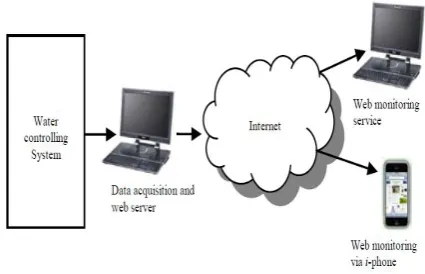
[image:3.595.175.388.327.464.2]In this work the disadvantages of existing system are overcome by certain techniques. To avoid the wastage of water during supply to water distribution unit related areas, automated supply has been formulated. It involves the process of supplying water to a particular area at particular time. Water supply will be stopped automatically after reaching fixed value limit. Over consumption can be intimated by measuring the flow of water to every connection in water supplying network. This measurement can be done by using flow sensor at every channel (connection). On the basis of this measured value, usage of water by every home unit is calculated. By comparing fixed value and measured value overconsumption can be easily formulated .Automated supply also focuses proper supply of water to all connections. Water quality can be assured by employing pH sensor. If the supplied water is with desired quality then many issues will be avoided. Automated supply avoids the wastage of water and the quality of supplied water can be assured by utilizing pH sensor. Flow measurement on each channel enhances the method to intimate over consumption alert
Fig 1: Block Diagram
4.3 Working principle:
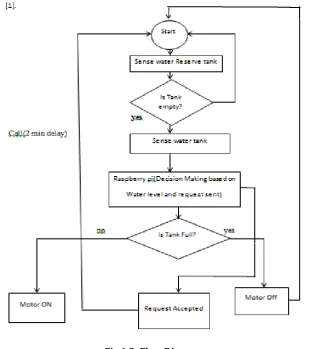
The main water supply tank will be provided with an ultrasonic sensor which have been used for the sensing of the water level in the tank. When the water content is less the sensor will immediately sends the message to the operator indicating that switch on the motor .As soon as the message received by the operator he is going to switch on the motor. Once the motor is switch on it will be in on state for until next message received by the sensor .As soon as the water reaches the specific height in the tank again the sensor sends the message indicating that switch of the motor. As soon as the message received by the operator he is going to switch off the motor. Depending upon the requirement message sent by the user the water will be supplied to that particular tank. Each user request has been accepted and that much amount of water is supplied to the tank. Each tank has been given with an specified amount of water. Once the water had been filled in the tank the user the use that much of water foe his daily work. Suppose in case if he\she is not able with that much amount of water again the request can be send. The request can be sent through the java based application.
4.4 SYSTEM ARCHITECTURE
© 2017, IRJET | Impact Factor value: 5.181 | ISO 9001:2008 Certified Journal
| Page 371
Fig 1.2: System design for proposed ideaBut it is needed to switch on the water distribution unit. These tasks are meant to supply water to all areas properly. Also quality of supplied water is very much important so to ensure that, quality must be check.
4.4.1 DESIGN AND IMPLEMENTATION
For experiment this design we have been using an 8 bit microcontroller, an inverter, a reserve tank (res. tank), water tank and water pump. Water pump has been controlled using water level sensor. Four homemade water level sensors are used to detect the water level. Inverted sensor data used to pass as the input of microcontroller [6]. We used MPLAB programming software to write into PIC 16F84A memory [1].
[image:4.595.143.477.415.765.2]© 2017, IRJET | Impact Factor value: 5.181 | ISO 9001:2008 Certified Journal
| Page 372
4.4.2 IMPLEMENTATION
All the planned modules can be implemented by using Raspberry pi. Automated supply can be well executed by embedding all the details such as time and quantity to the raspberry pi module. Flow measurement on each channel can be easily measured by employing flow sensors. Voltage is produced when water flow through the sensor and by modulating the calculated value, flow can be easily found. All home units will not be consuming water evenly. Some may consume water quantity beyond the desired level which leads to scarcity among other home units. By measuring flow in all home units, the one with high water consumption can be easily found and over consumption alert is produced. To check the quality of water pH sensors are used. It comprises of two electrodes such as measuring electrode and reference electrode. Hydrogen ions plays important role in checking quality. For each solutions reference value is known and for the used solution, hydrogen ion quantity can be found by using measuring electrode. Water is said to be with perfect quality if its pH value is 7. Communication support is provided by Web application. Finally the overall water distribution unit is built upon automated supply, proper flow measurement and over consumption alert along with assurance of quality.
The components of the system are:
A .Ultrasonic Sensor
An ultrasonic sensor is mounted on the top of the tank and transmits an ultrasonic pulse down to the tank. This pulse travelling at the speed of sound is reflected back to the transmitter from the liquid surface. These sensors are easy to install on tank containing liquid. These are found to be simple those devices with on board programming capability can be configured in minutes. Since these sensors are not in contact with the media and no moving parts, the devices are virtually maintenance free. As these device is non-contacting the level measurement is unaffected by changes in the liquid density, dielectric or viscosity and performs well on aqueous liquids and many chemicals.
B. Signal Conditioning Circuits
The signal conditioning unit accepts input signals from the analog sensors and gives a conditioned output of (0-5)V DC corresponding to the entire range of each parameter. This unit also accepts the digital sensor inputs and gives outputs in a binary form with a positive voltage level of +5v.The voltage of a phase of the power system is stepped down using a 230\9V potential transformer. The secondary voltage of the PT is rectified to convert it to a DC signal and applied to channel of ADC. The phase voltage are sensed and signal conditioned and then applied to 3-channel of ADC respectively.
C. Solenoid Valve
The valve that has been selected here is 2\2 way normally open valve. It enables the water flow in its resting position. It has two ports and one orifice seat. A short electrical impulse enables the solenoid valve to be opened or closed. The residual effect of a permanent magnet is sufficient for maintaining the valve in a particular working position with no electrical energy consumption. The opposite polarity of the electrical impulse will make the valve to retain its original position i.e., to open the valve.
D. Relay
They are basically used as switch for the raspberry pi controller.
E. Moisture sensor
They have been used to provide an leakage detection to server.
5. INTERNET OF THING
© 2017, IRJET | Impact Factor value: 5.181 | ISO 9001:2008 Certified Journal
| Page 373
bringing a large challenge to existing telecommunication and infrastructure. Furthermore, IOT provides immediate information regarding access to physical objects with high efficiency. The concept of IOT is very much helpful to achieve real time monitoring of sensor data.
IOT is a kind of network technology, which is based on information sensing equipment such as RFID, infrared sensors, GPS, laser scanners, gas sensors and so on, can make anything join the internet to exchange the information,according to the protocol which gives intelligent identification ,monitoring and management. The application area of IOT includes building and home automation, smart city project, smart manufacturing of various products, water supply system ,health care systems and devices, automotiveetc.
6. CONCLUSION
Enormous growth of developing world has lead to huge need of water. Automated water distribution and performance monitoring system focuses on various entities such as proper supply, over consumption alert and water quality assurance. Those factors can be effectively monitored by employing flow sensors and pH sensors along with communication support
provided by Raspberry Pi. Future work deals with tasks such as water level detection and intimation of less volume of water in main tanks which are gathered from other tanks located in different place. With the help of Digital Water Supply
the need of a common man is fulfilled at his fingertips .Most of the problems occurring in the supply process are avoided as there is no human intervention .Hence this system not only used to monitor the water supply but also used to find and avoid the water theft. Also there is no waste age of water and hence promoting water conservation.
References:
[1] Gouthaman.J, Bharathwajanprabhu.R & Srikanth.A “Automated urban drinking water supply control and water theft identification system” Proceeding of the 2011 IEEE Students' Technology Symposium, IIT Kharagpur pp.87-91, 2011. [2] S.Leirens, C. Zamora, R.R. Negenborn, and B. De Schutter “Coordination in urban water supply networks using distributed model predictive control” Proceedings of the 2010 American Control Conference, Baltimore, Maryland, pp. 3957–3962, 2010.
[3] Shicheng Dong, Hao Jin “Design of wireless monitoring system for urban water supply based on embedded technology” International Conference on Measurement, Information and Control (MIC), pp.348-351, 2012
[4] Lingjuan Wu, Jennifer Trezzo, Diba Mirza, Paul Roberts, Jules Jaffe, Yangyuan Wang, Fellow and Ryan Kastner IEEE Members.”Designing an Adaptive Acoustic Modem for Underwater Sensor Networks”.
[5] Peng Jiang , Hongbo Xia , Zhiye He and Zheming Wang “Design of a Water Environment Monitoring System Based on Wireless Sensor Networks” Sensors, ,pp. 6411-6434, 2009.
[6] H.G.Rodney Tan, C.H.Lee and V.H.Mok, “Automatic Power Meter Reading System Using GSM Network”, 8th International Power Engineering Conference (IPEC),pp-465-469, 2007. [7] Ma Ming, “Design of embedded system application platform based on ARM”, Manufacturing Automation, vol.34, pp 15-16, 2012.
[8] Hen Hui, Zhou Wenchao and so on, “Design of the embedded remote meter reading system based on Ethernet”, Electronic Design Engineering, vol. 20 pp. 184-186, 2012.
[9] Stancil, Stoian and Kovacs, “Urban water supply distributed system”, vol.3, pp.316-321, 2008.
[10] K.Veeranna Reddy, Y.Tirumala Babu,“A study on auto theft prevention using GSM”, International Journal of Engineering Trends and Technology,vol.2, pp. 60-64, 2011.
BIOGRAPHY:
Revanth C.B pursuing his M.tech
in VLSI Design and Embedded system
CMRIT,
Bangalore, Karnataka. Area of interest includes