© 2017, IRJET | Impact Factor value: 5.181 | ISO 9001:2008 Certified Journal
| Page 2505
ENERGY EFFICIENT ROUTING PROTOCOL FOR WIRELESS SENSOR
NETWORKS
Apoorva S.K
1, Dr. Sreerangaraju M.N
21
M.Tech Scholar Digital Electronics and Communication ,Dept. of Electronics and Communication Engineering
BIT,Bangalore,Karnataka,India
2
Professor Dept. of Electronics and Communication Engineering
BIT,Bangalore,Karnataka,India
---***---Abstract - A wireless sensor network involves a group oftransducers approach used here is hybrid hierarchical clustering. The proposed protocol is compared with two layer LEACH and performance is analyzed.
Key Words: Wireless networks, LEACH ,Routing protocols, TL LEACH, Fuzzy C means.
1. INTRODUCTION
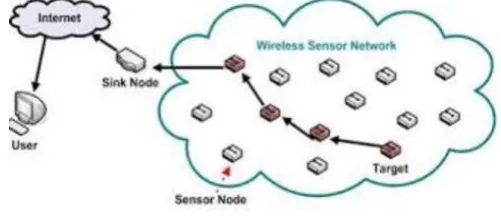
Wireless sensor networks (WSN) are generally considered as a standout amongst the most paramount technologies for the twenty first century. In the past decades, it has acquired tremendous consideration in environment monitoring such as war field patrolling, habitat monitoring etc[1].. A WSN consists of a low cost, low power and multifunctional wireless sensor nodes, with sensing and computation capabilities. They have resource constraints, limited memory and these sensor nodes can be homogeneous or heterogeneous. Node deployment in wireless sensor networks is done randomly[2]. These nodes are capable of collecting information about various parameters such as temperature, pressure , light etc.
The information sensed is processed it is then forwarded to other nodes present in the network. The wireless sensor networks are used in various applications such as environmental monitoring, military and ecological applications etc. One of the challenging task involved in WSN is routing due to its inherent characteristics. Global addressing scheme cannot be applied to WSN because it involves large number of sensor nodes here overhead of ID maintenance is also difficult. In WSN communication task will consume more energy when compared with sensing and processing tasks. The lifetime of the network has to be improved. In wireless sensor networks if all the nodes are communicating directly with the base station it requires lot of energy so in order to overcome this problem one node is elected as cluster head this node will gather the data from sensor nodes and send the gathered information to the base
station[3]. The protocol stack of WSN consist of seven layers. Each layer will consume energy depending on its requirements. However most of the energy is consumed by network layer it involves routing operation. Efficient use of the available resources is very much essential to retain and prolong the lifetime of the network[4]. Adopting an energy efficient routing strategy can save energy to a great extend thereby enhancing the lifetime of WSN’s.
Large number of protocols are proposed to reduce energy consumption and to improve the lifetime of the network. Routing protocols in WSN can be classified as flat routing protocol, hierarchical routing protocol and location based routing protocol[5]. But energy consumption can be significantly reduced with the help of hierarchical routing protocol. It is a cluster based routing protocol involves layering hierarchy. One commonly used method for energy efficient routing is clustering. It is a technique of grouping the nodes using an algorithm to perform certain tasks efficiently as per the requirements. Each cluster will be assigned a cluster head accountable for routing the data. Data transmission happens through intra cluster and inter cluster routing. The hierarchical routing protocols mainly focus on attaining energy efficiency through clustering[6]. This routing structure has many advantages. Clustering at different levels can be done based on the requirement. The stability can be attained by reducing the complexity of routing tables.
[image:1.596.317.568.618.728.2]© 2017, IRJET | Impact Factor value: 5.181 | ISO 9001:2008 Certified Journal
| Page 2506
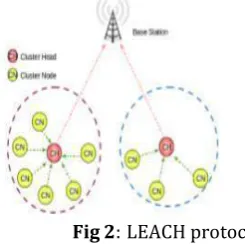
1.1 LEACHLow Energy adaptive Clustering Hierarchy(LEACH) is a hierarchical routing protocol it is also called as data aggregation algorithm[7]. The main aim of this algorithm is to collect and aggregate data from the sensor nodes in such a way that the energy consumption should be reduced and the lifetime of the network has to be improved. In wireless sensor networks if all the nodes are communicating directly with the base station it requires lot of energy so in order to overcome this problem one node is elected as cluster head this node will gather the data from sensor nodes and send the gathered information to the base station.
LEACH is a self-organizing protocol that uses the rotation of cluster heads to distribute energy equally throughout the network[8]. The operation of the leach protocol is carried out in rounds. In each round protocol involves two phases setup phase and steady state phase. Setup phase involves cluster formation and cluster head selection .
The CH selection process depends on two factors.
1.Percentage of nodes capable of becoming cluster heads denoted as P
2. History of nodes that has served as cluster heads.
For each node random number is generated that should lie between 0 and 1.A threshold Tn is calculated using the formula.
Where p is the percentage of cluster heads ,r is the current round, G is the group of nodes which are not cluster heads in the previous rounds, n is the number of nodes.
Generated random number is compared with the threshold value. If the random number is less than that of the threshold value node which is assigned to that random number is elected as cluster head for that round. Now the cluster head will broadcast the CH advertisement message the nodes which are ready to join that cluster will reply with Join request message. Inter cluster communication is carried out based on TDMA schedule[9]. In steady state phase cluster head will create a TDMA schedule for each node in order to send data cluster head will collect the data compress it and then sends the compressed data to the base station
using carrier sense multiple access with collision avoidance mechanism.
Fig 2: LEACH protocol
2. PROPOSED METHODLOGY
2.1 Improvements made in the cluster head selection process
In the setup phase of leach protocol cluster head is elected. Here the selection of cluster head is done based on probability. This process have some disadvantages such as
1) In probabilistic approach node which is having the lowest energy may be elected as cluster head.
2) Data transmission process requires lot of energy if a node is present at the end of the cluster is elected as cluster head.
In the proposed protocol improvements are made in the cluster head selection process it is based on three parameters energy, mobility and number of neighbouring nodes[10]. In a cluster node with highest energy, least mobility and with largest number of neighbouring nodes will be elected as cluster head.
2.2Three Layer LEACH
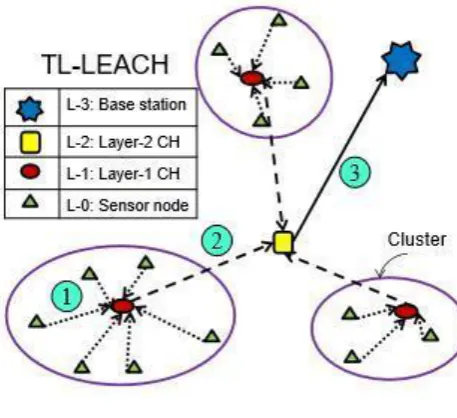
In two layer LEACH protocol cluster head have to spend more energy in order to send data to the base station, this problem can be overcome by using three layer leach here one more layer is introduced which involves grid head[11]. The clustering approach used here is hybrid hierarchical clustering it is a combination of distributed clustering and centralized clustering.
In the proposed three layer LEACH layer 0 consist of sensor nodes, layer 1 contains cluster heads and layer 2 contains grid heads. Cluster heads are
elected depending upon energy, mobility
[image:2.596.354.477.128.250.2]© 2017, IRJET | Impact Factor value: 5.181 | ISO 9001:2008 Certified Journal
| Page 2507
nearer to base station is elected as grid head.
Fig 3:Three layer LEACH
2.3 RADIO ENERGY DESSIPATION MODEL
The basic LEACH protocol and the proposed three layer LEACH protocol uses the following radio energy model. It consist of transmitter circuit, receiver circuit and transmitter amplifier[13]. The distance between transmitter and receiver is d. The transmitter requires energy to transmit a bit and the receiver requires energy to receive a bit. The energy that a amplifier requires is related to transmission distance.The general equation for energy dissipation in transmitter is given below.
Fig 4: First order radio model
Energy consumed for transmission over different path loss models.
Where
Here L indicates the bits, Eelec is the energy consumed per bit in the transmitter and receiver circuits Efs and Emp are free space and multipath radio models energy consumption amplification factor. d0 indicates threshold value. Here free space or multipath fading model can be used based on distance [14]. If the distance is less than threshold distance (d0) free space model is used otherwise multipath fading model is used. If the distance is less than threshold distance (d0) free space model is used otherwise multipath fading model is used.
3. SIMULATION RESULTS
Simulation is implemented using network simulator 2.It involves two languages C++ and OTCL. Network animator is used to obtain graphical view of the network[15]. In this section proposed approach three layer Leach is compared with two layer leach and performance is evaluated based on three parameters energy, packet drop and packet delivery ratio.
3.1Energy
Fig 5 shows the simulation results based on energy depletion in the network for the TL leach and Two layer leach. The TL leach consumes less energy when compared with two layer leach.
[image:3.596.43.272.125.334.2] [image:3.596.39.265.515.661.2] [image:3.596.315.568.544.721.2]© 2017, IRJET | Impact Factor value: 5.181 | ISO 9001:2008 Certified Journal
| Page 2508
3.2 Packet dropFig 6 show the simulation results based on number of packets lost during communication process. From the graph we can observe that TL leach encounters less number of packet loss when compared with two layer leach.
Fig 6: Number of packets versus time
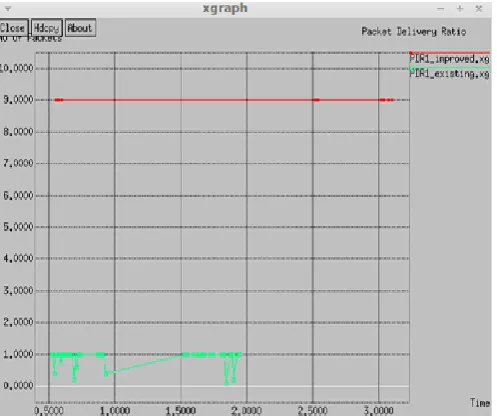
3.3 Packet delivery ratio
It is defined as the ratio of number of packets received to the number of packets transmitted. Fig 7 shows the simulation results based on packet delivery ratio. Packet delivery ratio for TL leach is more compared to two layer leach.
Fig 7: Number of packets versus time
4. CONCLUSION
In this paper the performance of the two layer LEACH protocol is compared with three layer LEACH by considering parameters such as energy ,packet drop and packet delivery ratio.
The experimental results show that the proposed TL leach protocol provides better performance than the two layer leach.
REFERENCES
[1] Akiildiz F , Su W, Sankarasubramaniam Y and E Cayirci, “Wireless Sensor Networks: A Survey,” Computer Networks ,vol.38, no 4,pp. 393-422,2002.
[2] Arampatzis T, Lygeros J and S.Manesis, “A Survey of Applications of Wireless Sensors and Wireless Sensor Networks ”Proceedings of the 13th Mediterranean
Conference on Control and Automation Limassol, Cyprus, pp.719-724,2005
[3] Jawhar I, Mohamed N, Mohamed M.M and Aziz J,”A Routing Protocol and Addressing Scheme for Oil ,Gas and Water pipeline Monitoring using Wireless Sensor Networks” in Proceedings of the 5th IFIP International Conference on Wireless and Optical Communications Networks ,pp.1-5,2008
[4] Eslaminejad M. and Razak S.A ,” Fundamental Lifetime Mechanisms in Routing Protocols for Wireless Sensor Networks: A Survey and Open Issues” 2012. [5] Troung T.T., Brown K.N.,Sreenan C.J., ”Using Mobile Sinks in Wireless Sensor Networks to Improve Building Emergency Response,” in Proceedings of Royal Irish Academy Research Colloquium on Wireless as an Enabling Technology,2010.
[6] Al-karaki J N and Kamal A.E ,”Routing Techniques in Wireless Sensor Network: A Survey”, IEEE Wireless Communications , vol.11,no.5,pp. 6-28,2005.
[7] Biradar R. and Patil V, “Classification and comparison of routing protocols in Wireless Sensor Networks”, Special Issue on Ubiquitous Computing Security Systems 2009
[8] Bhattacharyya D, Kim T.H ,Pal S,”A Comparative Study of Wireless Sensor of Wireless Sensor Networks and their Routing protocols”, Sensors, vol.12,no.10,pp 10506-10523,2010.
[9] Anisi M.H, Abdullah A.H, Razak S.A and Ngadi A, “An Overview of data routing approaches for Wireless Sensor Networks” 2012.
[10] Heinzelman W.R ,Chandrakasan A and Balakrishnan H,”Energy –Efficient Communication Protocol for Wireless Micro sensor Networks” in Proceedings of the 33rd Annual Hawaii International Conference on System Sciences, pp. 1- 10 2000.
[image:4.596.45.294.189.369.2] [image:4.596.36.285.509.717.2]© 2017, IRJET | Impact Factor value: 5.181 | ISO 9001:2008 Certified Journal
| Page 2509
of the International Conference Of Wireless Communication 2005.
[12] Rahman M.N. and Matin M. a, “Efficient Algorithm for Prolonging Network Lifetime of Wireless Sensor Networks,” Tsinghua Sci. Technol., vol.16 , no.6,pp. 561-568,2011.
[13] Manfredi S. ”Reliable and Energy-Efficient Cooperative Routing Algorithm for Wireless Monitoring Systems,” IET Wirel.Sens.Syst.,vol. 2,no,p.128,2012. [14] Heinzelman W.B ., Chandrakasan .P .,and Balakrishnan H., “An Application- Specific Protocol Architecture for Wireless Microsensor Networks,” IEEE Transactions on Wireless Communication 2002.