© 2017, IRJET | Impact Factor value: 5.181 | ISO 9001:2008 Certified Journal
| Page 1678
AN EFFICIENT USE OF PADRA ALGORITHM TO SECURE DATA LOSS IN WSN
Shaiqua S. Sayed
1, Prof. Archana A. Nikose
2,
1
Dept. of Computer Sci.& Eng,Priyadarshini Bhagwati college of Engineering, Nagpur, India,
2S
1Dept. of Computer Sci.& Eng,Priyadarshini Bhagwati college of Engineering, Nagpur, India.
---***---
Abstract –
In communication environment WSNtechnology evolving rapidly where Wireless sensor networks consist of set of especially electronic devices called nodes. Each sensor node has an ability of collecting information from the environment it is used for. Node will collect environmental conditions such as, sound, vibration pressure, temperature, motion from different locations. Because of this WSN may suffer from certain situations like the data routing path will break, data loss at the time of transmission, battery power of sensor node will reduce during transmission. The sensor node will consume more energy for sending and receiving the data.Hence the battery power of the node will decrease to a limit, which means the sensor node becomes unusable or fault also the electro-magnetic or nuclear radiation affects the sensor node which make a node transfaulty node. Therefore maintaining WSN lifetime for reliable and secure communication in order to avoid data loss during communication it should be replaced. This paper proposes an efficient detection and recovery algorithm PADRA to identify a transfaulty node efficiently and to recover the Wireless Sensor Networks by replacing only few sensor nodes along with often used alternative routes.
Key Words
:
WSN, HOP, Transfaulty, Partition Recovery Algorithm, PADRA, Data Loss, Sensor Node, Transmission, Data loss,Etc.
1. INTRODUCTION
The Wireless sensor network is a collection of sensors that are spread over large geographic area wireless sensors are made of small, inexpensive, low power tiny devices [1]. Sensor nodes are equipped with capability of internal memory, battery source, and wireless communication, local processing and. Sensors are generally have limited capabilities due to internal battery source [2]. Thousands of sensor node are deployed to operate in attended mode to sense physical parameters and transmit this information to the base station through wireless communication called as wireless sensor network. Sensor nodes send the sensed data to base station through single-hop or multi-single-hop transmission and then base station make further decisions [3].
The wireless sensor network sometimes affected by unexpected problems due to various situations like Hardware issues, environmental problems, and software issues [1]. The sensor nodes are powered by tiny batteries. So the nodes may fail due to the discharging of battery power during the data transmission as well as data reception where a data loss may occur. The failure of the battery is a major problem in WSN [3].As the sensors are hugely spread and enormous in numbers, the possible occurrences of faults in the network are also much more as a fault surface increase.
Another problem with sensor node is its transfaulty behavior. A sensor node behaves as a transfaulty , when it may sense its physical surrounding correctly but fails to communicate with its neighbor in proper way due to the failure of communication attributed to electro-magnetic or nuclear radiation exposure[4][5][6]. The presence of electro-magnetic or nuclear exposure is temporary. Therefore, the sensor node behaves normally with the resumption of favorable condition. A sensor node exhibit this behavior as transfaulty node.
This transfaulty nodes becomes temporary isolated from the network which create a hole in a network[7]. And during transmission one cannot bear such holes because it leads to a data or packet loss during communication, hence to detect such holes(tansfaulty) and faulty node in WSN an efficient algorithm is proposed which detect such faulty and transfaulty node before routing a packet or data to the transmission path i.e PADRA which performs secure reliable and efficient communication with limited use of energy and coverage an efficient detection and replacement algorithm take such issues like routing, security, coverage, energy etc., into account and performs the fault detection and recovery mechanisms.
2. MOTIVATION
© 2017, IRJET | Impact Factor value: 5.181 | ISO 9001:2008 Certified Journal
| Page 1679
3. RELATED WORKA. Ladder Diffusion Algorithm [8]
Ladder diffusion (LD) algorithm is used to map out the data relay routes in wireless sensor nodes. The algorithm focuses on balancing the data transmission load, increasing the lifetime of sensor nodes and their transmission efficiency. This study evaluates the performance of this algorithm for random wireless sensor networks with regard to the number of sensor nodes and relay hops required for data collection. The ladder diffusion algorithm is used to identify routes from sensor nodes to the sink node and avoid the generation of circle routes using the ladder diffusion process. The LD algorithm is fast and completely creates the ladder table in each sensor node based on the entire wireless sensor [9][8][10].
B. Directed Diffusion Algorithm [1]
The directed diffusion algorithm (DD) was proposed by C.Intanagonwiwat et al. is a query driven transmission protocol. The information’s which are collected by the nodes are transmitted only when it matches the query message in the form of attribute-value pairs to other sensor nodes in the network by broadcasting it. The sensor nodes will sends the collected data back to the sink node only when the query matches.network by issuing the ladder create packet that is created from the sink node[12],[13].[10][3][11]
C. Grade Diffusion Algorithm [1]
The Grade Diffusion (GD) algorithm is presented by H.C Shih et al. which improve the ladder diffusion algorithm using ant colony optimization [14] that clearly used for wireless sensor routing. The GD algorithm is not only for routing but also used for identify the neighbour nodes of all sensor nodes. It also records some information about the data relay and grade values for all nodes. Hence the GD algorithm updates the routing path in real time.
D. ReDAST Approach. [4]
ReDAST approach construct a homogeneous sensor node which operates in dual mode of communication. The dual mode includes, Radio frequency (RF) and Acoustic communication mode. Usually a communication in WSN take place using RF communication mode of a sensor node. But RF mode get easily affected due to radiation which disable the node. Therefore when Radiation affects the node the sensor node switch its communication mode to Acoustic communication mode. Acoustic mode does not get affected by the radiation. When the sensor node behaves normally and not in radiation affect then it
changes its communication mode to RF communication mode.
4. PROPOSED WORK
In WSN, communication without data loss is very important but in WSN as sensor nodes are deployed in vast geographical area they may get affected via surrounding environment due to which sensor node gets faulty. Also with some electro-magnetic and nuclear radiation affect the sensor node, therefore sensor node behaves like transfaulty nodes. In such case if sender transmits packet from such an environment then there is a chance of packet drop. In existing research there are few detection and recovery techniques which detect and recover the faulty node after routing the packet to the transmission path which results a lot of energy consumption, data loss and also suffer with the data security. Hence the current approach deals with this issue and in order to correct it here the “Pre Detection and Recovery” method is used.
[image:2.612.334.478.373.537.2]A. System Design
Fig.1. System Design
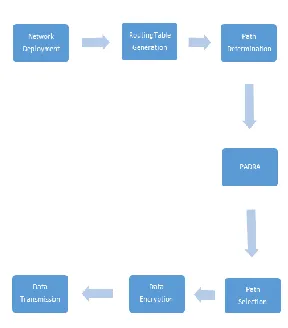
The system architecture of the implementation is as shown in the Fig.1. The nodes are deployed bounded within the area limits.
1. Node Deployment Algorithm: This algorithm deploys the sensor node in particular area in order to form a WSN.
© 2017, IRJET | Impact Factor value: 5.181 | ISO 9001:2008 Certified Journal
| Page 1680
3. Path Determination: In this process the shortest possible path from the routing table is identified from the list. A path must be found in such a way that battery consumption is reduced and overall network lifetime is also increased. But the path is only chosen here not selected until an algorithm satisfies that path does not have any hole or faulty node.
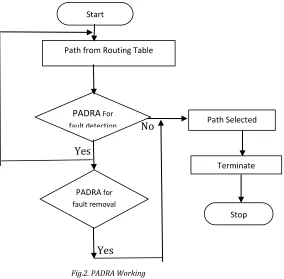
4. PADRA Algorithm: After selecting the best possible path for data routing a detection and recovery algorithm i.e., Partition detection and recovery Algorithm (PADRA) is applied.
PADRA performs in following ways.
No
Yes
Yes
Fig.2. PADRA Working
5. Data Encryption: In this step the data is encrypted by using ECC algorithm to maintain the security of a data so that receiver will receive the data what sender send without any modification.
6. Data Transmission: Here the encrypted data now routed into the path selected by padre algorithm to transmit it to the destination.
5. Simulation Environment creation
The network topology each of the simulation nodes where distributed over the space. We add 30 nodes in the
simulator. Each having its own range. We can set anyone node as the source node and anyone as destination node. The data packet were exchanged between source to destination
Randomly. Energy of each node will determine whether the node is faulty or not.
5.1 EXPERIMENTAL RESULTS
The PADRA algorithm increases the WSN lifetime by detecting and replacing the faulty and transfaulty nod. In addition to enhancing the reliability of data and reducing the data losses, the
[image:3.612.35.319.266.545.2]PADRA algorithm reduces the relayed energy consumption by reducing the number of data relayed, as the replaced nodes are usually used the most. Using the proposed
scheme, the WSN had consumed less power.
Fig. 1 shows the energy consumption of wireless network in both the cases, transmission of packet with faulty node and transmission of packet after PADRA applied. By applying a PADRA algorithm WSN will consume comparatively less energy as shown in the figure.
Fig 1. Energy consumption by WSN for data transmission.
Fig. 2 shows total Packet Data Ratio (PDR) before and after faulty node replacement. Communication with faulty node suffers from heavy data loss where, as communication using PADRA algorithm for Non faulty communication decreases the data loss in WSN communication in the presence of faulty and transfaulty node.
Start
Path from Routing Table
PADRA For fault detection
)
()
PADRA forfault removal
Path Selected
pathpp
Terminate
[image:3.612.326.568.409.553.2]© 2017, IRJET | Impact Factor value: 5.181 | ISO 9001:2008 Certified Journal
| Page 1681
[image:4.612.38.584.344.720.2]Fig 2. PDR in WSN while communication.
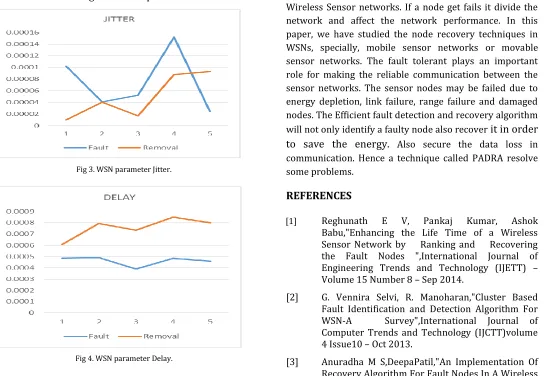
Fig 3, 4, 5 and 6 relatively shows the comparison of
the parameters like jitter, delay and throughput in
WSN communication when PADRA is used to remove
Faulty node from the network path and when PADRA
is not used. The plotted graph figure
Shows that PADRA gives better performance.
Fig 3. WSN parameter Jitter.
Fig 4. WSN parameter Delay.
Fig 5. WSN parameter Throughput
5. CONCLUSION
From the last few years, Wireless Sensor Networks have got the attention of lots of researchers due to their real time applications. Fault tolerance is the major issue of Wireless Sensor networks. If a node get fails it divide the network and affect the network performance. In this paper, we have studied the node recovery techniques in WSNs, specially, mobile sensor networks or movable sensor networks. The fault tolerant plays an important role for making the reliable communication between the sensor networks. The sensor nodes may be failed due to energy depletion, link failure, range failure and damaged nodes. The Efficient fault detection and recovery algorithm will not only identify a faulty node also recover it in order
to save the energy. Also secure the data loss in
communication. Hence a technique called PADRA resolve some problems.REFERENCES
[1] Reghunath E V, Pankaj Kumar, Ashok Babu,"Enhancing the Life Time of a Wireless Sensor Network by Ranking and Recovering the Fault Nodes ",International Journal of Engineering Trends and Technology (IJETT) – Volume 15 Number 8 – Sep 2014.
[2] G. Vennira Selvi, R. Manoharan,"Cluster Based Fault Identification and Detection Algorithm For WSN-A Survey",International Journal of Computer Trends and Technology (IJCTT)volume 4 Issue10 – Oct 2013.
© 2017, IRJET | Impact Factor value: 5.181 | ISO 9001:2008 Certified Journal
| Page 1682
Sensor Network",International Journal OfResearch in Engineering and Technology eISSN:2319-1163|pISSN:2321-7308.
[4] Pushpendu Kar, Sudip Misra,"Reliable and Efficient Data Acquisition in Wireless Sensor Network in the Presence of Transfaulty Nodes",IEEE Transactions On Network And Service Management 1932-4537(C)2015.
[5]
S.S.Mcclure,L.D.Edmonds,R.Mihailovich,A.H.Jhonst on,P.Alonzo,J.DeNat ale, J. lehman, and C. Yui,"Radiation Effects in Micro-Electromechanical System(MEMS):RF Relays," IEEE Transaction on Nuclear Science, Vol.49,no.6,pp.3197-3202,December 2002.
[6] H.R.Shea,"Radiation Sensitivity of Microelectromechanical System Devices", Journal of Micro/Nanolithography,MEMS and MOEMS,Vol.8,no3,pp.1-11,July 2009.
[7] W. Dargie and C. Poellabauer, Fundamentals of Wireless Sensor Networks, X. Shen and Y. Pan, Eds. Jhon Wiley and Sons,Ltd.,2010.
[8] Chaitrali Brahme, Srushti Gadadare, Rutushree Kulkarni, Pranjal Surana, Prof. M. V. Marathe,"Fault Node Recovery Algorithm for a Wireless Sensor Network", International Journal of Emerging Engineering Research and Technology, Volume 2,Issue 9, December 2014. [9] Ayesha Mulla, Komal Mohite, Madhuri Mane, Prof.
S. A. Bhuskute, "Reliable Transmission with Fault Node Recovery Algorithm in Wireless Sensor Network", International Journal of Science and Research (IJSR), ISSN (Online):2319-7064.
[10] Aiswarya Sudhakar, "Lifetime Enhancement Using Fault Node Recovery Algorithm For Wireless ad-hoc Network", International Journal of Advanced Trends in Computer Science and Engineering, Vol.3, No.4, Pages : 77-82 (2014).
[11] Divyashree S, Sanjay Kumar N.V, Dr. Y. P. Gowramma, "A Fault Node Recovery Algorithm To Reinforces The Lifetime And Routing In Wireless Sensor Network", International Journal of Advanced Technology in Engineering and Science www.ijates.com, Volume No 03, Special Issue No. 01, March 2015.
[12] T. P. Hong and C. H. Wu, “An Improved Weighted Clustering Algorithm For Determination Of Application Nodes In Heterogeneous Sensor
Networks”, J. Inf. Hiding Multimedia Signal Process, vol. 2, no. 2, pp. 173-184, 2011.
[13] M.Gen and R. Cheng, "Genetic Algorithms and Engineering Design", New York, NY, USA: Wiley,
1997. ISSN: 2231-5381
http://www.ijettjournal.org Page 413.
[14] J. H. H, H. C. Shih, B. Y. Liao and S. C. Chu,” A Ladder Diffusion Algorithm Using Ant Colony Optimization for Wireless Sensor Networks”, Information Sciences, (2011).
[15] Hong-Chi Shih, Jiun-Huei Ho, Bin-Yih Liao, “Fault node recovery algorithm for wireless sensor networking” IEEE SENSORS JOURNAL, VOL. 13, NO. 7, JULY 2013.
[16] A.Yenegur and B. S.Mathpati.“An Algorithm For Fault Node Recovery Of Wireless Sensor Network”. International Journal Of Research In Engineering And Technology,vol.3,no.-3,pp.-172175,May 2014.
[17] Dheer Singh &Er.Amit Kumar.” A review on node recovery techniques, RIM and LDMR, used in WSNs “.Imperial Journal of Interdisciplinary Research (IJIR) Vol-2, Issue-11, 2016 ISSN: 2454-1362, http://www.onlinejournal.in.
[18] H. Ho, H. C. Shih, B. Y. Liao, and S. C. Chu, “A ladder diffusion algorithm using ant colony optimization for wireless sensor networks,”Inf. Sci., vol. 192, pp. 204–212, Jun. 2012.
[19] I. F. Akyildiz, W. Su, Y. Sankarasubramaniam, and E. Cayirci, “A Survey on Sensor Networks”, IEEE Communications Magazine, vol. 40, no. 8, pp. 102-114, 2002.