© 2017, IRJET | Impact Factor value: 5.181 | ISO 9001:2008 Certified Journal
| Page 1899
EFFECT OF OBLIQUE COLUMN AND VISCOUS DAMPER ON PODIUM
STRUCTURE USING ETABS
VIVEK NARAYANAN 1, AISWARYA S 2
1 PG scholar, Department of Civil Engineering SBCE Elavumthitta , Pathanamthitta, Kerala, India
2 Assistant Professor, Department of Civil Engineering SBCE Elavumthitta, Pathanamthitta, Kerala, India
---***---
Abstract: Nowadays the space requirement was the major problem which results into the congestion of structures and also they are very unsafe whenever lateral forces i.e. earthquakes forces are experienced by the structures. Podium is the structure which was used as a multi-usage platform for making the regular or irregular structures. Podium may consist of commercial to certain height, residential and also for many other purposes. The stiffness variation can also be seen throughout the height of the structure, which results in large oscillation of the building. Hence in order to fulfil the space requirement and also for the safety purpose the podium structure and its analysis is been made. In the present study the static analysis and the dynamic analysis is been done. Also the dynamic analysis was been carried out by the response spectrum method. The whole analysis is been carried out in the ETABS software and also the time histories of builings with or without large slab below the foundation which forms the podium structure , different types of column like normal and oblique and also with and without damper is compared by applying time history of different Indian earthquakes and response of the building is studied.
Keywords—Static analysis, response spectrum analysis, Time history method, Podium structure.
1.INTRODUCTION
Nowadays population was a major problem and is increasing day by day thus resulting in construction of more vertical housing due to shortage of land. Earthquake was a common disastrous phenomenon that each and every structure on earth may suffer to certain damage. The seismic waves affect the building more violently that leads to building collapse. The aim of the structural engineer was to know the reason of building collapse due to earthquake and find out appropriate solution for that may be designing a structure to withhold the lateral forces etc. Among the different structures available Podium structure is one among them which can solve the above mentioned problem.
1.1PODIUM STRUCTURE
Podium was the multi-tasking structures in which large variation in plan and elevation was seen. Structure has the stiffness variation while observing the elevation of the podium structure. This stiffness variation creates a large drift to the podium that results in the disturbance of the structure. Thus in order to make the structure more stable and to withstand desirable seismic forces engineer has to design the structure by using proper techniques and many design software. By using proper design techniques and software, stability of the building can also be achieved if each and every member of the structure are properly analyzed and designed for the worst condition of seismic forces. The member such as beam, column, slab etc., which are the main part of structure, must withstand large lateral forces even in the high magnitude of earthquake.
1.2OBLIQUE COLUMN
© 2017, IRJET | Impact Factor value: 5.181 | ISO 9001:2008 Certified Journal
| Page 1900
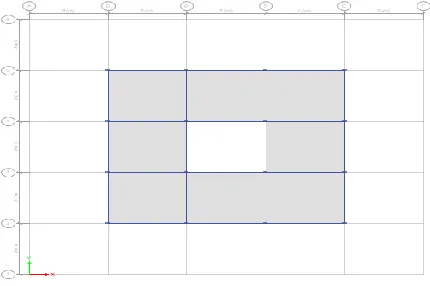
Fig:1: Typical Figure of Podium structure
Fig:2 Typical Figure of Oblique Column
2. OBJECTIVES
• To investigate the seismic performance of a multistory podium structural building with normal and oblique column by Response Spectrum analysis and Time history analysis
• To compare podium structure with ordinary structure
• To study the effect of damper in a structure
3. DESCRIPTION OF MODEL
In this study two models of vertical and three oblique column model were prepared using ETABS software and analysed . The properties of the considered building configurations in this study are given below.
Table 1: Details and dimension of the building models
Type of building: Ordinary moment resisting frame
Number of stories G + 7 Seismic zone IV Floor height 3m Grade of Concrete 25Mpa Grade of steel Fe 500
Beam dimension 300mm 500mm Column dimension 230mm 450mm Slab depth 150mm
Podium dimension 4000mm×2000mm Damping coefficient
Cd 810 kN-s/m
Velocity exponent 0.3
Table 2: Dead load and live load data
Dead load 1.5 kN/m2
Live load : 2 kN/m2
Importance factor(IF): 1 Response reduction factor: 3
4. MODELS CONSIDERED FOR ANALYSIS
Total five models were considered, vertical column building with and without podium, oblique column building with and without podium and final with damper. Response Spectrum Method is used for the analysis of the models
[image:2.612.45.573.38.764.2] [image:2.612.63.260.236.346.2] [image:2.612.329.544.399.542.2]© 2017, IRJET | Impact Factor value: 5.181 | ISO 9001:2008 Certified Journal
| Page 1901
Fig 4: D view of vertical column building without and 3-D view of oblique column with podium
5. RESULT AND DISCUSSION
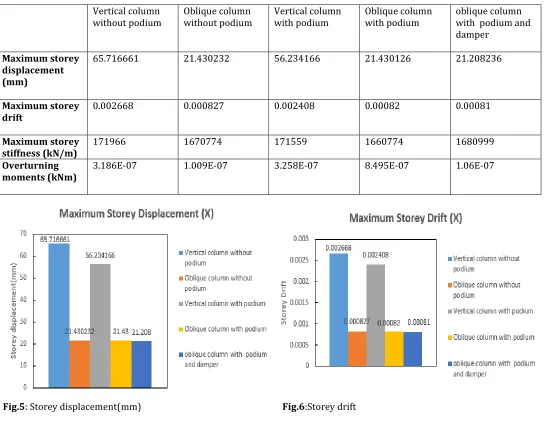
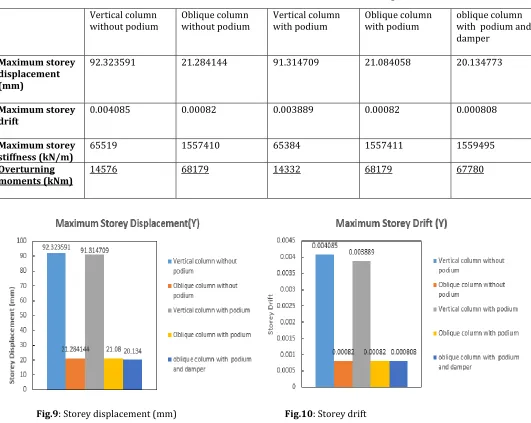
The modelling and seismic analysis for all models were carried out using the software ETABS. The results obtained are tabulated below. The parameters which are to be studied are maximum storey displacement, maximum storey drift, storey stiffness and overturning moments
Table 3: Values Obtained For Different Models in X Heading
Vertical column
without podium Oblique column without podium Vertical column with podium Oblique column with podium oblique column with podium and damper
Maximum storey displacement (mm)
65.716661 21.430232 56.234166 21.430126 21.208236
Maximum storey
drift 0.002668 0.000827 0.002408 0.00082 0.00081
Maximum storey
stiffness (kN/m) 171966 1670774 171559 1660774 1680999
Overturning
moments (kNm) 3.186E-07 1.009E-07 3.258E-07 8.495E-07 1.06E-07
[image:3.612.42.288.100.230.2] [image:3.612.34.582.296.717.2]© 2017, IRJET | Impact Factor value: 5.181 | ISO 9001:2008 Certified Journal
| Page 1902
Fig.7:Storey stiffness (kN/m) Fig.8: Overturning moment(kNm)
Vertical column
without podium Oblique column without podium Vertical column with podium Oblique column with podium oblique column with podium and damper
Maximum storey displacement (mm)
92.323591 21.284144 91.314709 21.084058 20.134773
Maximum storey
drift 0.004085 0.00082 0.003889 0.00082 0.000808
Maximum storey
stiffness (kN/m) 65519 1557410 65384 1557411 1559495
Overturning
moments (kNm) 14576 68179 14332 68179 67780
[image:4.612.44.542.95.231.2]Fig.9: Storey displacement (mm) Fig.10: Storey drift
[image:4.612.38.569.266.689.2]© 2017, IRJET | Impact Factor value: 5.181 | ISO 9001:2008 Certified Journal
| Page 1903
Fig.11: Storey stiffness(kN/m) Fig.12: Overturning moment(kNm)
6. CONCLUSION
All five models of vertical, oblique and oblique with and without podium modelled The selected models where analysed using the response spectrum method in ETABS and the conclusions obtained from the analysis are:
Structure provides more resistance in the oblique column building which makes the structural system more effective
Introduction of viscous damper provides more stability to the structure in seismic loading.
Oblique column more effective seismic loading.
The podium structure provides better stability to the building.
Building with oblique column and viscous damper, with podium will provides more stability during seismic loading.
7.REFERENCES
[1] A.R. Rathod , M. G. Vanza (2014) “ Seismic Response of Podium Type Building considering Static and Dynamic Analysis” International Journal for Scientific Research & Development| Vol. 2, Issue 10, 2014
[2] Kona Narayana Reddy, Dr.E.Arunakanthi (2017) “A Study on Multi-Storeyed Building with Oblique Columns by using ETABS”International Journal of Innovative Research in Science, Engineering and TechnologyVol. 6, Issue 2, February 2017
[3] NishithB.Panchal, Dr. V.R.Patel, Dr. I.I.Pandya(2014) “Diagrid structural system: strategies to reduce lateral forces on high-rise buildings” International Journal of Engineering Research & Technology Volume: 03 Issue: 04 Apr-2014
[4] PuneethSajjan, Praveen Biradar (2016) “study on the effect of viscous damper for rcc frame Structure” International Journal of Science Technology & Engineering ,Volume: 05 Issue: 09 | Sep-2016