© 2017, IRJET | Impact Factor value: 6.171 | ISO 9001:2008 Certified Journal | Page 1293
Raspberry Pi based Wireless Sensor Network in Heating, Ventilation
and Air Condition Application
Prashant Khot
1, Nagnath Hulle
21
Student, Department of Electronics & Telecommunication, GHRIET, Pune, Maharashtra, India
2Vice Principal, Department of Electronics & Telecommunication, GHRIET, Pune, Maharashtra, India
---***---Abstract –
The Era of Wireless Sensor Network increases during the last few years. This network is mainly distributed network that together sense environmental parameters and may control the one of the parameters in an environment, also gave the ability of interaction between computers or user and the environment. The Application of wireless sensor network we used is heating, ventilation and air conditioning where we have distributed sensor network. This sensor network, traditionally connected with MODBUS or RS232 which increase setup cost and Maintenance cost. In this paper, we implemented a wireless sensor network with nodes as ESP-12E and Supervisory server as Raspberry Pi, which interact with the help of Wireless LAN (Router). The Limitation of Nodes is 254 per Router. The Web-UI on Raspberry Pi is channeled between System and User, where user can view the current status of each nodes and Control Application. The main advantage of this system is its power consumption is very low as compare to traditional systems.Key Words: Wireless Sensor Network, Heating, Ventilation
and Air- Conditioning (HVAC), Raspberry Pi, ESP-12E, Internet of Things (IoT),
1. INTRODUCTION
A Wireless Sensor Network (WSN) is described as n no. of nodes network that sense parameters of environment and can control the parameter of an environment. WSN also has the ability to communicate between Environment and User over Computer or Mobile. The wireless protocol like IEEE 802.11 Wi-Fi, Bluetooth, ZigBee, etc. are taken into consideration for low power, data/signal processing time and cross layer design approach.
Heating, ventilation and air conditioning is the indoor comfort technology where thermal comfort as well as indoor air quality is the main goal of system. The design of HVAC system is done by calculating various factor like area under system, air pressure, minimum and maximum temperature, Indoor/Outdoor ambient, etc.
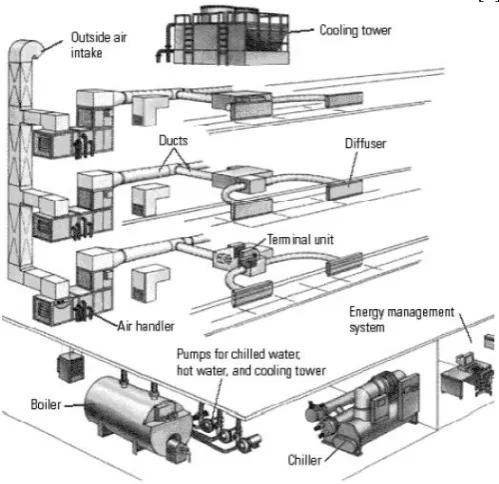
The Basic HVAC application configuration consist of following block as shown in Fig. 1.
Chiller – A machine, which ingests warm from a fluid by means of a vapor-pressure or retention cycle.
Boiler- is utilized to change over the water into vapors and utilizations gravity and strain to convey the warmth.
Condenser Water Pump
Cooling Tower- used to arrange the undesirable/additional heat from a chiller. They mounted at the highest point of Building.
Air Handling Unit (AHU) - flow of air in HVAC and air quality direction.
Heat Exchangers- used to exchange warm between at least two liquids.
[image:1.595.308.558.325.567.2][7]
Fig -1: Basic HVAC System Design
2. OBJECTIVE AND LITERATURE REVIEW
© 2017, IRJET | Impact Factor value: 6.171 | ISO 9001:2008 Certified Journal | Page 1294 The Internet of Things is a network or concept where
devices in our home or wherever they are, have the capability to communicate with each other via the internet. Building IoTs based system has advanced significantly in the last couple of years since it has started a new era of information and communication technologies with each other.
From the innovation, a number of HVAC monitoring and control methods have been developed for System deployment. These methods change from simple techniques to more sophisticated/Advanced techniques such as genetic algorithms, neural networks, fuzzy logic, etc. In this Section, we first reviewed a few works that are simple development of the traditional HVAC application control techniques.
Recent studies have analyze the use of smart methods to monitor and control HVAC systems. The category of controllers includes Neural Network based 2, Genetic Algorithms 3 based, Fuzzy Logic 4 based Controllers, and other evolutionary techniques.
These techniques are mainstream because of their appealing highlights like human learning and thinking and additionally propelled advancement strategies. Neural systems are helpful when the framework models are not systematically known completely. Fuzzy logic control is another well-known controlling decision. It is strong to changes in conditions as it depends on the operational experience of human master. The fundamental favorable position of Fuzzy logic controllers when contrasted with customary control approaches dwells in the way that no numerical demonstrating is required for the outline of the controller. Genetic algorithms are appealing for streamlining purposes without including the scientific hypothesis. Both neural systems and Fuzzy logic control strategies can be joined with genetic algorithms for assist improvement.
3. DESIGN OF SYSTEM
According to Literature Survey, the present system utilizes custom method for correspondence [1]. In spite of the fact that they are reliable from numerous years, Installation charges, cabling and maintenance work isn't economical. Because of this, the Wireless node arrangement in HVAC is helpful as we can undoubtedly change node without changing link from server to node and the other way around.
Wireless Network utilizes IEEE 802.11n protocol, which has run from 50-100m and speed of 2.5GHz and information rate of 11 or 54 Mbps. The examination between wireless technology like RF, ZigBee and Wi-Fi gives the conclusion that RF has its range uncertain amount in light of which it works in little territory just, while ZigBee has less information rate speed on event than Wi-Fi.
The Block diagram of WSN with server and node is shown in Fig. 2. It consists of Remote Nodes at low stage,
Raspberry Main Server on middle stage and Supervisory node as Top level. The Nodes connected to only local router whereas Main Server connected to Internet.
ESP-12E
ESP-12E
ESP-12E
Display(Optional) Contol Circuit Sensor
Display(Optional) Contol Circuit Sensor
Display(Optional) Contol Circuit Sensor
INTERNET
Wi-FI Raspberry Pi
3 Model B
Web Server Local
Database (MySQL)
Sensor & Control
Circuit
[image:2.595.308.561.125.314.2]User with Laptop/ PC or Smartphone
Fig – 2: Block Diagram of Wireless Sensor Network System
4. IMPLEMENTATION
The implementation of system is divided in two parts- Supervisory and Wireless nodes. The system also categories into hardware and software Module.
4.1 Supervisory Node (Raspberry PI 3 Model B)
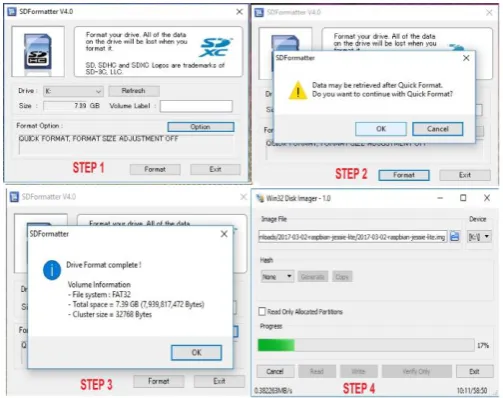
For first time utilization of Raspberry Pi, we have to take after some progression to get it boot. As Pi utilizes SD card for boot, we need to introduce OS in SD card. The Linux Based Raspbian Jessie OS can be downloaded from Raspberry Official webpage [5]. Utilizing SDFormatter and Win32DiskImager programming as appeared in Fig. 3 we prepared micro SD card for Pi.
[image:2.595.307.559.530.729.2]© 2017, IRJET | Impact Factor value: 6.171 | ISO 9001:2008 Certified Journal | Page 1295 For OS establishment, we require no less than 8GB SD
card. For top of the line application, we can go for higher capacity limit. This SD card at that point embedded into Raspberry Pi SD card Slot. For first boot-up, we have to design Pi for our application using HDMI Cable and Screen or Ethernet link and PC.
To introduce Apache2 and php in Pi we expected to use underneath command.
sudo apt-get update sudo apt-get upgrade
sudo apt-get install mysql-server php5-mysql
sudo apt-get install apache2 php5 libapache2-mod-php5 sudo apt-get install python-serial
sudo apt-get install python-mysqldb
[image:3.595.310.564.276.425.2]Apache2 is the HTTP webserver, which is used for making Web UI. In the wake of introducing Apache2, we can run localhost where we can see default index.html page as appeared in Fig. 4. Apache2 is generally utilized as a part of Linux framework, windows, Solaris, Mac OS, and so on.
Fig – 4: Apache2 Web Page (index.html)
MySQL is lightweight Database used to store sensor information progressively. We made database as TempLog in which we make table for putting away Sensor ID, Timestamp, and Sensor Value. We can approach MySQL database on web through establishment of phpmyadmin.
We made php page which will demonstrate temperature and humidity floor shrewd and controllable gadgets in each floor. The Apache2-MySQL-PHP-Python used to make finish WebUI of HVAC System
.4.2 Wireless Node (ESP-12E)
We are viewed as an aggregate cost for usage of Wireless system, in this way, here we use a vitality effective and Low cost ESP-12E Wi-Fi module for conveying Wireless Sensor
Network [2]. ESP-12E module design such that it ought to give high coordination execution.
At the point when ESP isn't utilized, we can go for power management and Power down Logic, which gives a vitality productive ESP-12E Wi-Fi based remote sensor arrange. ESP-12E requires 60uA in deep sleep mode with RTC clock as yet running and lesser than 1 mA to remain alert/associated with the access point (AP).
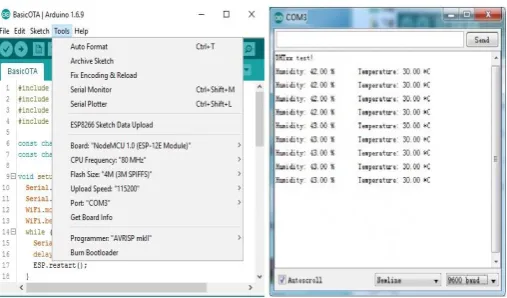
The nodemcu firmware is utilized for ESP-12E. To program ESP-12E we utilized Arduino IDE as appeared in Fig. 5 and related library like DHT11, DS18B20, and so forth. The sensor information is perused from sensor and spared in node i.e. ESP-12E until the point that server read it. So there is no information misuse and dependability is guaranteed.
Fig. -5: Arduino IDE for ESP-12E
The best favorable position of ESP-12E module is that we can program it over the air. Along these lines, we can refresh firmware or program whenever even after installation at remote area with Wi-Fi. In ESP-12E node, we utilized DHT11 Sensor, which will read temperature and humidity as appeared in Fig. 5.
The last interface is done through HTML POST technique, which is more secure than GET strategy. ESP-12E post information on URL while principle server will get information from node. At that point this information is put away in nearby MySQL database and appeared on Web-UI Immediately. We can likewise observe recorded perusing in table configuration.
4.3 Control Circuit
[image:3.595.37.288.376.556.2]© 2017, IRJET | Impact Factor value: 6.171 | ISO 9001:2008 Certified Journal | Page 1296
Fig - 6: Control Circuit Diagram
The control circuit give separation/isolation between ac circuit and dc circuit. For the inductive load, snubber circuit should use. For Three-phase application, same circuit can be used to energized relay coil and then switch on a three phase appliances.
5. RESULT
The System we designed is at module level. The Communication between server node and remote node set up through wireless LAN. Server node is currently available for LAN only, by Creating Static IP, we will get remote access of server node.
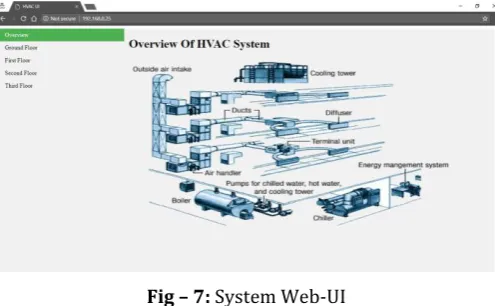
The accompanying Fig. 7 demonstrates the Web UI which keeps running on Apache2 webserver. The Temperature, Humidity and air quality measured from all nodes is store at MySQL database and effectively accessible on site. We can control remote nodes from Website through server node i.e. Raspberry Pi. For security reason, User must login to start with, thus, there is no odds of malware work. The individual node control parameter effectively changed from site with client validation.
Fig – 7: System Web-UI
The Control Circuit is also gets activated with set point assigned from Web-UI. For e.g. if temperature rises above set point of 25°C, the chiller will be switch on and corresponding duct will open for cold air. Therefore, the rise in temperature will again decrease for maintaining set temperature.
The energy efficiency is better than traditional HVAC Control System. As Raspberry Pi (1.2W) and ESP-12E (max. 170mA) consumes less power, the total power consumption moderately improved in this Implementation.
6. CONCLUSIONS
In this paper, we are outlining the HVAC application, sensor utilized as a part of use and choice of sensor as per condition parameter. The Implementation of Wireless Sensor Network with ESP-12E and Linux Raspberry Pi in Heating, Ventilation and Air Conditioning Application is done on model based. The Prototype show finished up the utilization of this System in real field level application, as it is more economical and Low Power System than regular HVAC System.
In any case, more sensors can be added to have full control of a HVAC Application. This can incorporate light sensors, smoke identifier, optical/electromagnetic sensors, glass break, inside siren, miscellaneous detectors, pressure sensors, motion detector, and so on.
REFERENCES
[1] Sudhir G. Nikhade,”Wireless Sensor Network System using Raspberry Pi and ZigBee for Environmental Monitoring Applications” in International Conference on Smart Technology and Management for computing Communication, 2015
[2] Tejas Thaker, “ESP8266 based Implementation of Wireless Sensor Network with Linux Based Web-Server” in Symposium on Colossal Data Analysis and Networking( CDAN), 2016
[3] Vamsiikrishna Patchava, Hari Babu Kandala, P ravi Babu, “A Smart Home Automation Technique with Raspberry Pi using IOT” in International Conference on Smart Sensors and Systems, 2015
[4] Sanket Thakre, Akshay Shriyan, Vikas Thale, Prakash yasarp, keerthi Unni, “Implementation Of Energy Monitoring and Control Device based on IOT” 2016
[5] Raspberry Pi Foundation. http://www.raspberry.org
[6] ESP8266. Esp8266.com.
[7] http://www.brighthubengineering.com/hvac/50160-chilled-water-central-air-conditioning-system
BIOGRAPHIES
Prashant Khot received B.E. (2013) in
Electronics Engineering from RAIT, Nerul, [image:4.595.38.286.489.642.2]© 2017, IRJET | Impact Factor value: 6.171 | ISO 9001:2008 Certified Journal | Page 1297 Nagnath Hulle is currently Vice Principal