© 2017, IRJET | Impact Factor value: 6.171 | ISO 9001:2008 Certified Journal | Page 1973
Study on Mechanical Properties of Concrete by Partial Replacement of
Crushed Glass as Fine Aggregate with M 20 Grade
S.LOKESH
1, P.VAISYA
2, Dr.P.CHANDRASEKARAN
31
Assistant Professor, Department of civil engineering, Ambal Professional group of Institution, Tamilnadu, India
2Pre-Final year student, Department of Civil engineering, Ambal Professional group of Institution,
Tamilnadu, India
3
Professor, Department of Civil Engineering, Kongu Engineering College, Tamilnadu, India
---***---Abstract - Glass is vitally used in Human lives in terms of
manufactured products such as sheet glasses, bottles, glassware, and vacuum tubing. Glass is a material which supports the process of recycling. It produces recycled glass which helps in energy saving. The growing Awareness of glass recycling speeds up researches on the use of waste glass with different forms in various fields. In our construction fields significant contributions is too utilized for concrete production. To identify the effects on workability and mechanical strength properties due to the addition of these waste crushed glass bottles. The waste crushed glass bottles was partially replaced in the ratio of 5%, 10% and 15% .The feasible mix grade of concrete is M20.The data presented in this paper showed that there is great potential for the utilization of waste Glass bottles which can be cost effective.
Key Words: Glass bottle, Compression test, Split tensile test, etc
1. INTRODUCTION
Glass is a transparent material produced by melting a mixture of materials such as silica, soda ash, and CaCo3 at high temperature followed by cooling where solidification occurs without crystallization (10). Glass is an ideal material for Recycling. The waste glass bottles produced in the world is discarded, stockpiled or land filled once they are used. This pattern has influenced environmental organizations to pressure the professional community to lower the amount of glass being discarded as well as find use to the non recycled glass in a new application (11). The waste crushed glass bottles is one of the issues of environmental Problem. In relation, the recycling of waste glass of a component in concrete gives waste glass a sustainable alternative to land filling and therefore makes it economically viable.
The waste glass is one of the issues of environmental problem. Glass is used in a variety of applications right from construction, automobiles, nose-diving bottles, soft-drink bottles, etc. Hence, the usage of glass has increased noticeably, which plays a major role in waste disposal. In addition, glass waste is considered as non-decaying material that pollutes the surrounding environment.
1.1
GLASS
The glass has been used as an engineering material since ancient times. But because of the rapid progress made in glass industry in recent times the glass has come out as the most versatile engineering material of the modern times. The first glass objects made by man were of natural glass such as obsidian and rock crystal.
1.2. CLASSIFICATION OF GLASS
The glass is a mixture of a number of metallic silicates, one of which is usually that of an alkali metal. It is an amorphous, transparent or translucent. It may also be considered as a solidified super cooled solution of various metallic silicates having infinite viscosity.
For the purpose of classification the glass may be grouped into the following two categories:
1.2.1. SODA-LIME GLASS
This glass has good chemical as well as physical properties and it is suitable for the products that resist momentarily the impact of chemical medium and limitedly also temperature differences. Both types of pipettes are produced from the soda-lime glass.
1.2.2. BOROSILICATE GLASS
Physical and chemical properties of this type of glass enable using of this glass not only for production of laboratory glassware but for various other purposes, as for instance in the pharmacy (vials), medicine (glass syringes), at production of brilliant lighting unit, at various branches of the textile industry (fingers) and in other further ranges where is required higher temperature and chemical resistance.
1.3. PROPERTIES OF GLASS
© 2017, IRJET | Impact Factor value: 6.171 | ISO 9001:2008 Certified Journal | Page 1974 Following are the properties of glass which have 3 made
glass popular and useful:
colures.
2. MATERIALS AND METHODS
The methodology comprised of preliminary investigations and experimental investigations carried out using the study material and the investigation are presented as follows:
2.1Preliminary Investigations
The preliminary investigations of cement, Fine aggregate, coarse aggregate, cursed glass particles were subjected to physical analyses to determine whether they are fulfill the criteria’s of the standard used. The present investigation is an effort towards developing a better insight into the effect of compressive strength ,split tensile strength and flexural strength on varying proportion of crushed Glass , an water cement ratio of 0.40 and crushed Glass replacement percentages of 0, 5, 10, 15% respectively by weight of fine aggregate .
2.2. Experimental Investigations
Materials details
2.2.1Cement:
Ordinary Portland cement of 53 grades in one lot was procured and stored in air light container. The cement used was fresh i.e., used within three months of manufacture. It should satisfy the requirement of IS 12269. The properties of cement are determined as per the IS 4031: 1968 and results are tabulated in the Table 1.
Table -1: Properties of Cement
Properties Values
Grade of cement 53 MPA
Specific gravity 3.15
Initial Setting Time 30 minutes Final Setting Time 10 hours Standard Consistency 29 %
2.2.2. Fine Aggregate:
The fine aggregate used for casting is clean river sand from karur and it was clean and dry. It is of size pass through 1.19 mm sieve. It should satisfy the requirement of IS 383. The properties of the fine aggregates are given in Table 2.
Table -2: Properties of Fine Aggregate
Properties Values
Size Passing through 4.75mm sieve
Specific gravity 2.65 Water Absorption 1.0% Fineness Modulus 3.5
2.2.3 Coarse Aggregate:
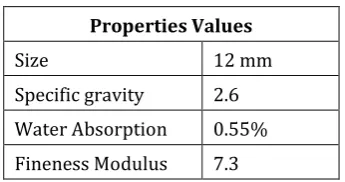
[image:2.595.348.521.416.507.2]The coarse aggregate used was broken granite-crushed stone and it was free from clay, lumps, weeds, and other organic matters are non-porous. The water absorption capacity is less than 1%. The size of which pass through 26 mm sieve and retained on 19 mm sieve. The properties of the coarse aggregate are given in Table 3.
Table -3: Properties of Coarse Aggregate
Properties Values
Size 12 mm
Specific gravity 2.6 Water Absorption 0.55% Fineness Modulus 7.3
2.1.4. Water:
Potable water was used for casting all specimens of this investigation. The quality of water was found to satisfy the requirement of IS 456-2000.
2.1.5 Crushed glass
© 2017, IRJET | Impact Factor value: 6.171 | ISO 9001:2008 Certified Journal | Page 1975
Table -4: properties of crushed glass
Properties Values
SiO2 % 70.22
CaO% 11.13
Fe2O3% 0.52
Al2 O3% 1.64
Na2O3% 15.26
Loss of ignition% 0.80
Density 2.42
Specific gravity 2.65
2.2 METHODS:
2.2.1 CASTING
Metal moulds were arranged and oil was applied for easy remolding of specimens. Materials were weighed according to the mix ratio and were dropped in the mixer machine in the order of coarse aggregate, fine aggregate and cement. They were mixed in dry form initially and then water was added to make it a wet mix. Waste crushed glass bottles is partially replaced as the last material in the mixing and to get Concrete. After thorough mixing, the concrete was transferred to the cubical. Concrete was placed in three layers and each layer was compacted by tamping rod. The casting of cylinders and prisms followed the same pattern as that of cube casting.
CUBES
Size of cubes 150mm x 150mm x 150mm for each Waste glass bottles powder. Concrete mix, namely 0%, 5%, 10% and 15% were cast.
CYLINDERS
Diameter of cylinders 100mm and height 150mm for each Waste glass bottles powder. concrete mix, namely 0%, 5%, 10% and 15% were cast.
PRISM
The size of prism 400mm x 100mm x 100mm for each Waste glass bottles powder concrete mix, namely 0%, 5%, 10% and 15% were cast.
2.3. CURING
The final process is a curing process. Curing process is increase the strength of concrete. Curing is the process in which the concrete is protected from loss of moisture and kept within a reasonable temperature range. The result of this process is increased strength and decreased permeability. Curing is also a key player in mitigating cracks in the concrete, which severely impacts durability. Cracks allow open access for harmful materials to bypass the low
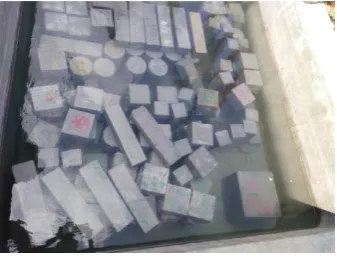
Permeability concrete near the surface. Good curing can help mitigate the appearance of unplanned cracking. With proper curing, concrete becomes stronger, more impermeable, and more resistant to stress, abrasion, and freezing and thawing. The improvement is rapid at early ages but continues more slowly thereafter for an indefinite period. After remolding of specimens there were placed in curing tank containing portable water for proper curing until testing period of 7 days, 14 days, and 28 days.
Fig -1: Curing
3. RESULTS & DISCUSSION
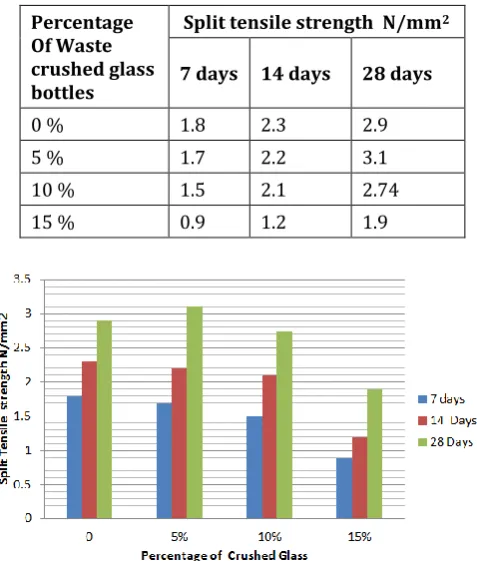
Strengths were measured at 7, 14 and 28 days on samples of cube, cylinder, prism . The values at age levels of 7, 14 and 28 days have been presented in table. The table shows the compressive strengths, split tensile strength and flexural strength at different (0, 5, 10 and 15% by Fine aggregate) with water cement ratio of 0.40. The 7, 14 and 28 days moist curing gives higher compressive strength, split tensile strength and flexural strength when Fine aggregate replaced with 5% . In other hand, when fine aggregate is replaced with crushed glass of percentage 10 and 15% with FA replacement the results is reduce compare to the other .
[image:3.595.350.519.198.333.2]compressive strengths, split tensile strength and flexural strength graphs are shown in figure 1 to 5
Table -3: Compressive Strength of Concrete (M20 Grade)
Percentage Of Waste crushed glass bottles
Compressive strength N/mm2
7 days 14 days 28 days
0 % 13.9 16.7 22.5
5 % 14.5 16.2 23.2
10 % 12.2 16.14 22.3
[image:3.595.332.515.597.735.2]© 2017, IRJET | Impact Factor value: 6.171 | ISO 9001:2008 Certified Journal | Page 1976
[image:4.595.292.555.66.230.2]Fig -1: Compressive Strength Results
Table -3: Split tensile Strength of Concrete (M20 Grade)
Percentage Of Waste crushed glass bottles
Split tensile strength N/mm2
7 days 14 days 28 days
0 % 1.8 2.3 2.9
5 % 1.7 2.2 3.1
10 % 1.5 2.1 2.74
15 % 0.9 1.2 1.9
Fig -2: Split tensile Strength Results
Table -3: Flexural Strength of Concrete (M20 Grade)
Percentage Of Waste crushed glass bottles
Flexural strength N/mm2
7 days 14 days 28 days
0 % 4.4 4.9 5.5
5 % 4.6 4.9 6
10 % 3.7 3.9 4.7
15 % 3.32 3.74 4.21
Fig -3: Flexural Strength Results
3. CONCLUSIONS
To justify my objective 3 test has been conducted: Compression, Split tensile strength and Flexural strength. Four different ratio mixtures are taken as basis for the purpose of evaluation to prove my result. In the entire three tests together 5% mixture of glass with other materials has been proved to be the best combination when compared to other ratio mixtures. In general, considering the similar performance with replaced material, glass addition can reduce cost of cement production also. In addition, production of every six ton glass powder concrete results in the reduction of each ton CO2 emission from cement production and save the environment significantly by reducing green-house gas and particulate production.
REFERENCES
[1] Chirag Vijaykumar Shukla and Prof. Ashok R. Mundhada
“Effect of Crushed Waste Borosilicate Glass Particles as Partial Replacement of Fine Aggregates on Concrete Properties” International Journal of Innovative and Emerging Research in Engineering Volume 3, Special Issue 1, ICSTSD 2016 pp.328-331.
[2] Vaibhav S. Sangole, Prof. Ashok R. Mundhada,“Addition
of crushed waste glass particles as partial replacement of fine aggregate in concrete” IJAERD, voleme 2, may 2015
[3] Sadoon abdallah, Mizi Fan,“Characteristics of concrete
with waste glass as fine aggregate replacement”, IJETR, issn: 2321-0869, volume-2, issue-6, 2014
[4] M. Iqbal Malik, Muzafar Bashir, Sajad Ahmad, Tabish
Tariq, Umar Chowdhary, “study of concrete involving use of waste glass as partial replacement of fine aggregates” students, civil engineering, iust, awantipora, J & K, India. (2013)
[5] Willium Tchoundi Mbadie, “Beneficial use of waste glass
[image:4.595.40.279.300.581.2]© 2017, IRJET | Impact Factor value: 6.171 | ISO 9001:2008 Certified Journal | Page 1977
[6] Abdullah A. Siam, “Properties of concrete mixes with
waste glass”, The Islamic University of Gaza (2011)
[7] D. Kornack and P. Rakic, “Cell Proliferation without
Neurogenesis in Adult Primate Neocortex,” Science, vol.
294, Dec. 2001, pp. 2127-2130,
doi:10.1126/science.1065467.
[8] M. Young, The Technical Writer’s Handbook. Mill Valley,
CA: University Science, 1989.
[9] R. Nicole, “Title of paper with only first word
capitalized,” J. Name Stand. Abbrev., in press.
[10] Mohammad Iqbal Malik and Aarif Manzoor et al.
“Positive Potential Of Partial Replacement Of Fine Aggregates By Waste Glass (<600 Micron) In Concrete” nternational Journal of Civil Engineering and Technology (IJCIET), ISSN 0976 – 6308 (Print), ISSN 0976 – 6316(Online), Volume 5, Issue 11, November (2014), pp. 146-153.
[11] Bakulamba Devi T and S Natesh M G “An Experimental