© 2017, IRJET | Impact Factor value: 5.181 | ISO 9001:2008 Certified Journal | Page 3048
An Improved Enhanced Real Time Routing Protocol (IERT) for mobile
wireless sensor networks
1
Vishnu kumar prajapati ,
2Kapil Kumawat ,
3Praveen Kumar Singh
1
Lecturer government Polytechnic College by pass road, Sheopur (M.P)
2Assistant Professor SGSITS, Ujjain (M.P.)
3
Scientific Assistance National Informatics Centre, Lucknow (U
.P.)
---***---Abstract -
Mobile wireless sensor network (MWSN) is awireless ad hoc network which consists of large number of sensor nodes and mobile sensor nodes communicating to each other. In real time routing protocol has capabilities to mobility and sensing within a range. As privies research the sensor nodes have a limited of power energy, processing and limited data storage when Improvement Enhanced Real Time Routing Protocol can take a replica in the Personal Area Network (PAN) Coordinator, if PAN Coordinator is fail or below of threshold than Voice PAN Coordinator work as a PAN Coordinator. By using voice PAN coordinator overall network life time increase up to 30% compare to previous ERTLD protocol. In ERTLD protocol takes that the corona width is equal to sensor transmission range, if transmission range is tilding some angle than corona width are less than the transmission range, so that the performance and throughput are increasing. In the fast forwarding mechanism give better performances if the network is static but network has mobility than backward mechanism give better performance by simulating with ns2 simulator.
Key Words: Corona Management, Network Life Time,
voice pan coordinator, packet velocity, Delivery ratio, packet reception rate.
1. INTRODUCTION
Sensor node has limited range of sensing capacity, computing power and communication ranges. These sensors can perform combinable and if monitored by such sensors will not produce precise results. These sensor nodes have an autonomous capability and it works intelligent network. Technology review at MIT [1] and global future [2] conclude that sensor technology is one most emerging technologies which will change the world. A WSN embracing of sensor nodes which is connected to network topology and they have the sensing, computing and communicating capability. A sink node is communicated with outside the world. Such network is capable to monitoring activities and phenomenon which cannot be monitored easily by human beings. These networks have basic characteristics [2] such as topology dynamicity due to scheduling of sensor nodes in a network into different states, such as wake up or sleep states and dying nodes in the network, dense deployment within topology, autonomous intelligent in the network topology
management, limited node energy, multi hop communication[1], limited storage capacity and limited bandwidth.
[image:1.595.325.557.492.685.2]A sensor networks consist of group of microcomputers equipped with sensors. These microcomputers, called nodes [1], which is associated in as usual task. The nodes have wireless communication capacities that allow the formation of the network, a small microcontroller, and an energy source which is normally battery. A network infrastructure does not typically exit but the nodes can act as emitter, receiver or router. The nodes send their collected information to as special node called base station or sink node [3]. In WSN, sensors gather information about the base station or sink node and physical world (outside of that network topology) makes decision and performs appropriate action upon the conduction. It is very different from computer networks as it comprises actions upon the environment as shown the following figure 1. It is very differ from traditional network as it comprises of a large number of nodes that produce large amount of data [7].
Figure 1: WSN with multi hop communication [5]
© 2017, IRJET | Impact Factor value: 5.181 | ISO 9001:2008 Certified Journal | Page 3049 necessary in many WSN application for example a cricket
match, the bats man where appropriate action should be made in the event area immediately as delay may cause the boll hit to the wickets so that bats man goes to out [3]. Currently, WSNs have several applications in several fields such as atmosphere or medical observation, military superintendence [4], domestic characteristics of such kind of networks, which have limited power supplies in the sensor nodes, so that there are node failures and communication failures common phenomena and dynamicity at network topology, easy to deployment and self configuration.
In sensor network, researches is growing with specific communication and perform the routing by using suitable routing protocol for attending to the characteristics of sensor networks [6]. Monitoring of all resources and nodes by using protocols for example, routing of the network may change the conditions using star topology data can be aggregated to reduce the real transmitted data to the sink node while preparing the actual data and time managing schemes, the sensor nodes are idle, in that cases sensor nodes switch off so that save the energy.
2.
LITERATURE REVIEW
To work properly, the protocols in wireless sensor networks must handle different issues, such as energy of the sensors, routing information, data transmission to base station, Routing Hole Problem, etc. By A Ahmed a Mobile Wireless Sensor Network (MWSN) is a collection of distributed sensor nodes, which are capable to moving, sensing, and communicating within its range. The MWSN consist of moving sensor (Laptop or PDA) and static sensor nodes as shown the figure 2. It may have mobile sink node and mobile node to communicating between them. Each sensor nodes have the capabilities of collecting data and routing data peer to peer to base station. It has not only such capabilities in static but also have the mobility by adding robotic base and driver board. A base station or mobile sink is used as a bridge between the sensor network and another network or platform, such as the internet. The mobile nodes have several advances such as scalability, maintain load balancing, and conserve energy. In MWSN have more challenge compare to WSN such as hard to optimize routing path, sensor nodes have limits in terms of energy, processing and storage capacities, so they require effective resource management policies[8].
Real time routing protocol is widely using in WSN. In Real Time Routing Protocol for Wireless sensor network (RTLD) works as a centric sink node and there are multi hope routing with respect to sink node. RTLD protocol is developed by A. Ahmed, N. Fisal in 2008. After that 2013 by A. Ahmed developed a ERTLD protocol based on previous RTLD protocol. It works on Mobile Wireless Sensor (MWSN) with load distribution and it also use
[image:2.595.310.559.191.385.2]corona mechanism to reduced the routing hole problem and neighbor management. Main objective of our research is to Improvement ERTLD protocol and achieved the goal are to increase the total life time in WSN and MWSN, to achieved the minimum end to end delay and high packet delivery ratio, to reduced the Routing Hole problem and to increase the performance.
Figure 2: MWSN Architecture [8]
© 2017, IRJET | Impact Factor value: 5.181 | ISO 9001:2008 Certified Journal | Page 3050 most power full strength of WSN. Self-organization and
wireless communication to be deployed in ad-hoc fashion by using these capability of sensor node the also capable to find the location without need of existing infrastructure. By using multi-hope communication, these sensor nodes can communicate as far from the base station, such properties provide the expanding the monitor area in the network and hence it provide the property of scalability and flexibility. Replacements of batteries are not feasible because of thousands of sensor nodes, so the main challenge of sensor networks is to maximize the lifetime of the sensor nodes. In several research the main task to made the energy efficient by computing and communicating operations. The data transmission protocols have much energy efficient and data transmission takes 70 % of total energy consumption of a WSN [2]. Several kinds of sensor nodes are commercially available in the real world. University of Berkeley has developed mica mote sensor node which is used for special purpose. [2] several special purpose sensor nodes which is like Spec, Mica2, Telos etc. there are other high bandwidth sensor like BT Node, Imote1.0, etc.
Generally for analyzing the performance of WSN are simulation based on computer, analytical and physical measurement [18]. This technology is relatively new and there only a computer simulation feasible approach. To study the behavior of computer network, the network simulation is providing a powerful technique. Observation and investigation to perform a simulation experiments and particular routing protocol were used to mimic the sensor network.
3.
METHODOLOGY
AND
DESIGNING
PROTOCOL
In the ERTLD Protocol have four fields which are corona mechanism, routing management, neighbor management and power management. The previous protocol RTLD based on location management in place of corona mechanism. In the location management calculate the sensor node location base on three pre determine neighbored, When static WSN it work well but the mobility it not work effective, so the ERTLD work with corona mechanism in place of location management. In the previous protocol [7] computes optimal forwarding node based on Packet Reception Rate (PRR), packet velocity over one-hop and remaining power of sensor nodes. PRR reflects the diverse link qualities within the transmission range and approximately calculated as the probability of successfully receiving a packet between two neighbor nodes, another [8] protocol utilizing the RSSI value so that save the calculation time and RSSI is built in physical layer and no need to extra calculation. By A Ahmed and etc. find out that if sensor nodes does not forward the data packets to the next-hop then it follow the backwards mechanism and inform to its parent to stop sending data and parents
will select dynamicity to forwarding, hence backward mechanism provide the guarantees to dropping the data packet which is not founded at previous protocol [7].
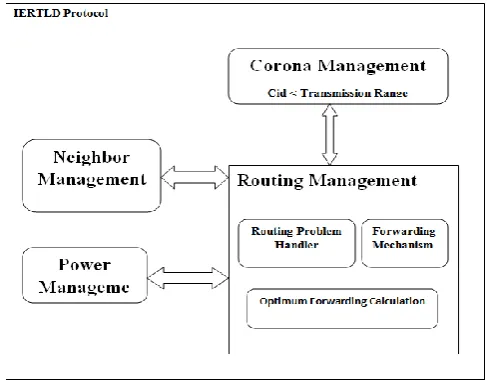
In the Improve Enhanced Real Time Routing Protocol have same four fields in the previous protocol, but we manage the corona and there is corona ID is always less the transmission range in a sensor node. We have shown the following figure 3.1, so that there are total four fields which are corona management, routing management, neighbor management and power management.
[image:3.595.312.556.352.543.2]The corona mechanism calculates the sensor node corona level based on the distance to the sink. The power management determines the state of the transceiver and the transmission power of the sensor node. The neighbor management discovers a subset of forwarding candidate nodes and maintains a neighbor table of the forwarding candidate nodes. The routing management computes the optimal forwarding choice, makes a forwarding decision and implements a routing problem handler.
Figure 3: IERT Protocol Block Diagram
3.1 Corona Management
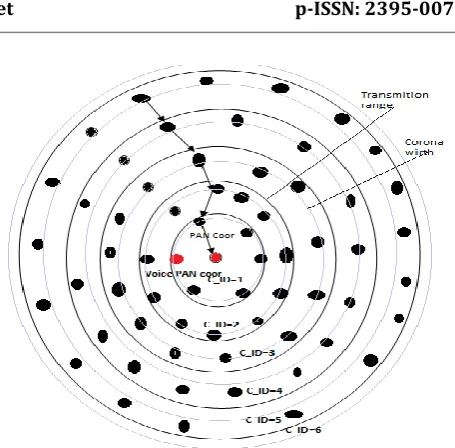
© 2017, IRJET | Impact Factor value: 5.181 | ISO 9001:2008 Certified Journal | Page 3051 concentric to PAN or sink Coordinator as figure 3.1 (c), if
PAN coordinator are travelling and changing the MWSN system so according to each sensor node may change the corona ID as figure 3.1 (c). This figure is also showing the forwarding of data packet from Mobile node (MN) to PAN coordinator or PAN coordinator to MN node. The travelling of data from MN to PAN coordinator is higher level to lover level of corona. Forwarding data from MN (high level corona) to low level corona if does not have any candidate (Mobile Node) in the neighbour table with low level corona, than data packet will be forwarded to MN which have same corona level. Corona mechanism will start broadcasting the corona control packet (CCP) from PAN coordinator to all one hope neighbour and than one hope neighbour will forward the data packet to the next hope neighbour and neighbour table will maintain the record.
Figure 3.1 (a): MESN immediately after deployment
Figure 3.1 (b): MWSN using corona concentric to PAN coordinator
Figure 3.1 (c): PAN after traveling and changing of MWSN coordinator system
In the Corona control packet (CCP) which have CCP_ID and initially C_ID value is zero. If any mobile node received CCP, it will fetch the CCP_ID and C_ID after fetching these id MN will check receive CCP_ID has received or not, if MN received the CCP than it will discard otherwise it will increases C_ID field in CCP packet and get new value of C_ID as its corona level. After receiving it will broadcast CCP to local one hope neighbour, if applicable than neighbour will change the value otherwise will remains. There are only PAN coordinator will produce only one CCP packet at a time. In case mobile node does not receive such CCP packet (because of another constrains like these nodes are in sleep mode or any hidden problem) than it will utilize the previously C_ID value (old C_ID). In case of C_ID is equal to zero that mean the MN will change the status of idle mode and wait until it gets new C_ID. In dynamic scenario the PAN coordinator will send the periodically broadcasting CCP and maintain the previous stages which is required.
3.2 Routing management
[image:4.595.324.552.67.291.2] [image:4.595.37.290.307.495.2] [image:4.595.56.274.528.715.2]© 2017, IRJET | Impact Factor value: 5.181 | ISO 9001:2008 Certified Journal | Page 3052 The routing management consists of three sub functional
processes forwarding metrics calculation, forwarding mechanism and routing problem handler. Specifically, the chosen optimal nodes rely on RSSI, the delay per hop and the remaining battery level of the forwarding nodes. The routing problem handler is used to solve the routing hole problem due to hidden sensor nodes in MWSN. Unicast is used to select the way to forward data.
To solving the routing hole problem, unicasting process are apply to forwarding the data so that no need to extra power for forwarding data to other sensor nodes. The forwarding mechanisms are used to calculate the data by using optimal forwarding. In the optimal forwarding we calculate packet velocity, RSSI value as link quality [7] and power (remaining battery) for every one hope neighbour.
The process of forwarding mechanism in IERT protocol which is using unicast forwarding to route data packet from mobile node to destination which is always sink node. The unicasting process first checked the C_ID of each neighbour from the neighbour table. If C_ID is less or equal in any neighbour than source node C_ID will choose the optimal neighbour by using optimal forwarding algorithm. If no one have less or equal C_ID than source node C_ID, the source node will invoke neighbour discovery from neighbour table. In case of obtained by optimal forwarding choice than data packet will be unicast to selected sensor node. Process will continue until selected node’s neighbour find the PAN coordinator. This forwarding policy may fail to find forwarding node, these failures routing management recovers by routing problem handler.
3.2.1 Routing problem handler
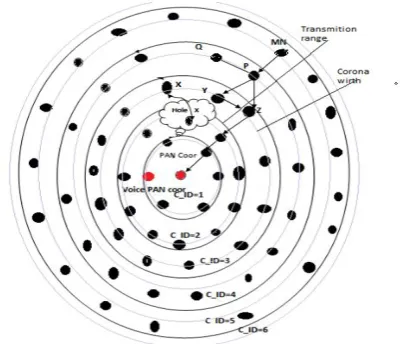
Wireless sensor network may have a routing problem. It may fail to find route in the presence of wsn holes even neighbour discovery. Such wsn holes may appear due to gap in node deployment or failures a node over lifetime of the network. In previous protocol ERTLD routing management solves these problems by using fast recovery using power adaptation and slow recovery using backward mechanism. Diameter of routing hole is smaller than the transmission range in this way fast recovery method applies at maximum power. But we need to save power because we have limited power so we don’t need to apply the fast recovery. Because of in 87 % time (70 times I have checking out of them 61 times it will need to apply slow recovery) the fast recovery method is not solving the routing hole problem due to not finding within the diameter of transmission range in MWSN. Figure 3.2.1 shows the slow recovery in IERT, in this figure optimal forwarding (OF) one hope node X has data packet from parent node (PAN coordinator), MN or PAN coordinator will search in its neighbor table about higher corona (C_ID of MN + 1) and will select OF from different candidates and then node X will send data packet to higher corona
[image:5.595.336.538.229.401.2]C_ID of MN+1 and if higher corona level node may deploy or it may sleep mode so firstly node X stop sending data packet and it uses backward mechanism and process will gain continued. Lets P node send data packet to node Y and node Y will send data packet to mobile node X , in case mobile node X may change position immediate so that their routing hole and then parent node Y inform to its parent node P to stop data sending and node Y use backward to parent P. node P use OF to another node and send data packet to node Z and so on.
Figure 3.2.1 Feedback mechanism in routing hole problem handler
3.3 Neighbour management
Neighbour mangement designing goal is to discover a subset of forwarding nodes and manage neighbour table of the forwarding nodes. In this management we have limited memory and a large number of neighbours so the neighbour table keeps a small set of forwarding nodes that are most useful in the meeting one hop end-to-end delay with optimal packet reception rate and remaining power. This neighbour table contains one-hop end-to-end delay, C_ID, node ID, RSSI value, CCP_ID, remaining power, location information and expire time. In our system, neighbour table have maximum 16 sensor node information at a time.
© 2017, IRJET | Impact Factor value: 5.181 | ISO 9001:2008 Certified Journal | Page 3053
3.3.1 Voice PAN Coordinator
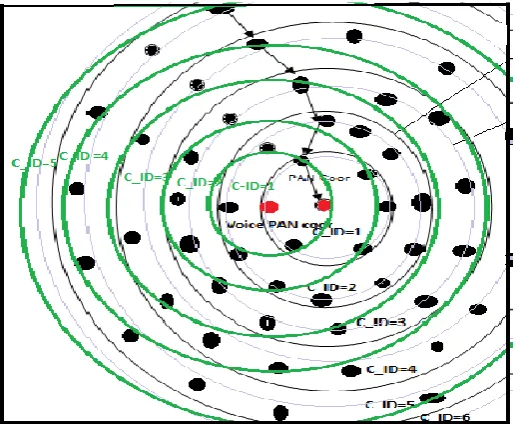
[image:6.595.38.296.342.554.2] [image:6.595.311.562.569.722.2]Voice PAN Coordinator (VPAN coor) is work as a PAN coordinator, when PAN coordinator is fail or below of threshold value. VPAN coor continuous communicate to the PAN coor and maintain the previous state, if PAN coor fail or below of threshold than the VPAN coor work as a PAN coor and broadcast the packet to neighbour by using C_ID and C_ID set as dynamic to its value according to around us (C_ID=1). Shown the below figure 5, the PAN coor is fail and VPAN coor work as PAN coor. Here the VPAN coor change the corona ID and broadcast the CCP to the all neighbours and further all other mobile sensor nodes or sensor nodes can broadcast until the whole network and the entire mobile sensor node find the corona ID and corona control packet. Further all processes work as previous section like PAN coordinator. By using the voice PAN coordinator the network life time are increases up to 30 % compare to previous ERTLD protocol on our experiment result.
Figure 3.3.1: Voice PAN Coordinator work as PAN coordinator when PAN coordinator is fail or below of
threshold value
3.4 Power management
The main function of power management is to adjust the power of the transceiver and select the level of transmission power of the sensor node. It significantly reduces the energy consumed in each sensor node between the source and the destination in order to increase node lifetime span. To minimize the energy consumed, It minimizes the energy wasted by idle listening and control packet overhead. The transceiver component in TelosB consumes the most energy compared to other relevant components of the TelosB. The radio has four different states, sleep or down state (1 lA)
with voltage regulator idle, off state (20 lA) with voltage regulator on, send state (17 mA) at 1 mW power transmission and receive state (19.7 mA) [19]. According to the data sheet values, the receive mode has a higher power consumption than the all other states. In improve enhanced real time routing protocol with load distribution, the sensor node sleeps most of the time and it changes its state to idle if it has neighbour in the direction of the destination. In addition, if the sensor node wants to broadcast request to route, it changes its state to transmit mode. After that, it changes to receive mode if it receives replies or data packet from its neighbour. Since the time taken to switch from sleep state to idle state takes close to 1ms [20], it is recommended that a sensor node should stay in the idle state if it has neighbours. Thus, the total delay from the source to the destination will be decreased. In addition, a sensor node should change its state from idle to sleep if it does not have at least one neighbour in the neighbour table that can forward data packets to the destination.
4.
SIMULATION RESULTS
Simulation has done by using ns 2 simulator. At the static as well as dynamic we have compare previous protocols like RTLD and ERTLD.
4.1. Result based on static sensor nodes
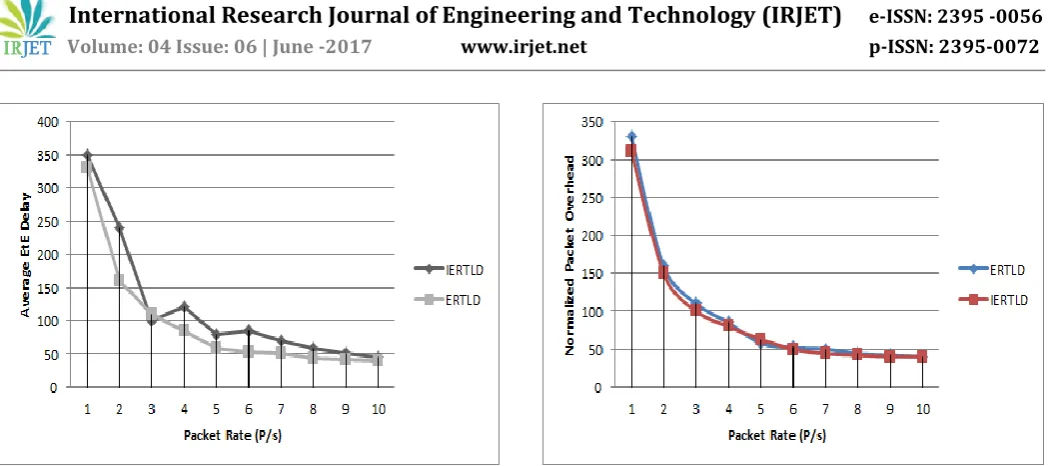
These result based on static network. In the static network, result may same with some better performance compare to pervious protocols like RTLD and ERTLD. Compare the two protocols on the basis of Data Packet Received (packet rate) per Unit Energy Consumed (Energy per packet) with network size. Here the protocol IERT performed better compare to ERTLD protocol in average for small networks but better in the large networks. As shown the following Figure 4.1.1 and Figure 4.1.2.
© 2017, IRJET | Impact Factor value: 5.181 | ISO 9001:2008 Certified Journal | Page 3054
Figure 4.1.2: packet rate v/s Average EtE Delay
[image:7.595.39.300.490.679.2]Compare the two protocols on the basis of Data Packet Received (packet rate) per Average EtE delay with network. Here the protocol ERTLD performed much better compare to IERTLD protocol in average and small networks but in the large networks IERTLD work better. As shown the Figure 4.1.3 and Figure 4.1.4. Compare the two protocols on the basis of Data Packet Received (packet rate) and Delivery ratio, in case of static networks, delivery ratio are increases in average as compare to ERTLD protocol. In another result, the packet rate v/s normalized packet overhead, it will remain same as previous protocol.
[image:7.595.53.553.499.693.2]Figure 4.1.3: Packet rate v/s Delivery ratio
Figure 4.1.4: Packet rate v/s Normalized packet overhead
4.2
. Result based on Mobile sensor network
Compare two protocols on the basis of Data Packet
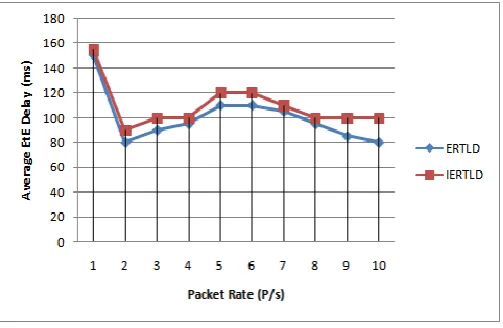
Received (packet rate) per Unit Energy Consumed (Energy per packet) with network size, simulate NS2.35 simulator. Here the protocol IERT performed better compare to ERTLD protocol when mobility is added on different-different sensor nodes (average case mobility at 20%, 30% and 40%) in the networks. As shown the following first figure 4.2.1. Compare the two protocols on the basis of Data Packet Received (packet rate) per Average EtE delay with network. Here the protocol ERTLD performed better compare to our design IERT protocol in the network. In this case my design protocol gives worst performance compare to previous protocol.Figure 4.2.1: packet rate v/s energy per packet
[image:7.595.270.554.523.693.2]© 2017, IRJET | Impact Factor value: 5.181 | ISO 9001:2008 Certified Journal | Page 3055 performance as compare to ERTLD protocol. In the new
[image:8.595.37.289.179.343.2]design protocol give 76% delivery ratio that is 12% greater than previous ERTLD protocol. In case of packet reception rate the new protocol (IERT) give better performance as compare to ERTLD protocol as shown Fig 5.7 and Fig 5.8.
[image:8.595.37.289.375.552.2]Figure 4.2.2: packet rate v/s Average EtE Delay
Figure 4.2.3: Packet rate v/s Delivery ratio
Figure 4.2.4: Packet rate v/s Normalized packet overhead
5.
CONCLUSIONS
The IERT protocol provides good performance in delivery ratio, normalized per packet and energy per packet of the mobile sensor networks. The packet delivery ratio is increase 12% compare to other existing protocol. It will reduce the energy consumption by using backward mechanism. Backward mechanism provides the guarantee to deliver the data packet to the neighbour, so that the delivery ratio is increase. The packet reception rate and normalize packet are also in favor. At the static sensor network the delivery ratio, energy per packet and EtE delay may same but the highly mobility the new IERT protocol give better response compare to other existing protocols. When applying the corona birth are less than the transition range then the EtE delay increase, which is not a favorable. Voice sink node, the overall life time or aliveness of the sensor network are increase because of the sink node scattered or fail, than the voice sink manage all the processing and transceiver activity to the sink node. Network aliveness is increase 30% compare to pervious ERTLD protocol.
6.
REFERENCES
[1] Akyildiz I. F., Su W, Sankarasubramaniam Y, Cayirci E, 2002 "Wireless sensor network: a survey”, Computer Networks, 393-422.
[2] Al-Karaki J. N. and Kamal A. E., 2004 "Routing techniques in wireless sensor Networks: A survey," IEEE Wireless Communications, vol. 11, 6
[3] T. He, J. Stankovic, C. Lu, T. Abdelzaher, SPEED: a stateless protocol for real-time communication in sensor networks, in: IEEE Proceedings of the 23rd International Conference on Distributed Computing Systems, 2003, pp. 46 to 55.
[4] Mainwaring A., Anderson J., Polastre J., Culler D., Szewczyk R. ,2002 "Wireless Sensor Networks for Habitat Monitoring," Proceedings of the 1st ACM International workshop on Wireless Sensor Networks and applications, 88-97,
[5] Heinzelman, W. Application-Specific Protocol Architectures for Wireless Networks. PhD thesis, Massachusetts Institute of Technology, June 2000
[6] Muruganathan S.D., Ma D.C.F., Bhasin R.I, and Fpojuwo A.O., 2005 "A centralized energy-efficient routing protocol for wireless sensor networks," Communication magazine, IEEE, Pp. 8-13.
© 2017, IRJET | Impact Factor value: 5.181 | ISO 9001:2008 Certified Journal | Page 3056 [8] A Ahmed, An enhanced real time routing protocol with
load distribution for mobile wireless sensor networks, Elsevier Computer Communication February 19 (2013) 1459 to 1473.
[9] Akkaya K. and Younis M., 2005 "A survey on routing protocols for wireless Sensor Network," journal of Adhoc Networks, vol 3, 325-349.
[10] Gupta, G. Younis, M., 2003 "Load-balanced clustering of wireless sensor networks," Anchorage, AK, United States.
[11] Heinzelman W.R.,Chandrakasan A, and Balakrishnan
H., 2000 "Energy Efficient Communication Protocol for Wireless Micro sensor Networks," Proc. 33rd Hawaii Int‟l. Conf. Sys. Sci
[12] Nauman Israr and Irfan Awan, July 2006 “Multihop routing Algorithm for Inter cluster Head Communication”, “22nd UK Performance Engineering Workshop Bournemouth UK”, Pp.24-31
[13] Heinzelman W.B, Chandrakasan A.P, and Balakrishnan
H. 2002 "Application specific Protocol Architecture for Wireless Sensor Network," vol. PhD: Massachusetts institute of technology.
[14] C. Lu, B.M. Blum, T.F. Abdelzaher, J.A. Stankovic, T. He, RAP: a real time communication architecture for large-scale wireless sensor networks, in: IEEE Conference on Real-Time and Embedded Technology and Applications Symposium, 2002, pp. 55 to 66.
[15] T. He, J. Stankovic, C. Lu, T. Abdelzaher, SPEED: a stateless protocol for real-time communication in sensor networks, in: IEEE Proceedings of the 23rd International Conference on Distributed Computing Systems, 2003, pp. 46 to 55.
[16] E. Felemban, C. G. Lee, E. Ekici, R. Boder and S. Vural, Probabilistic QoS guarantee in reliability and timeliness domains in wireless sensor networks, in: IEEE Proceedings of the 24th Annual Joint Conference of the IEEE Computer and Communications Societies, 2005, pp. 2646 to 2657.
[17] G. M. Arau´ jo, L.B. Becker, A network conditions aware geographical forwarding protocol for real-time applications in mobile wireless sensor networks, in: AINA 2011 IEEE International Conference, 2011,pp. 38 to 45.
[18] Nutan sindhwani, rohit vaid, V LEACH: An energy efficient communication protocol for WSN, ISSN, January (2013) 2320 to 2491.
[19] Chipcon, CC2420 Low Power Radio Transceiver,
<http://www.chipcon.com>, (accessed on June 2011).
[20] B. Bougard, F. Catthoor, D. Daly, A. Chandrakasan, W.
![Figure 1: WSN with multi hop communication [5]](https://thumb-us.123doks.com/thumbv2/123dok_us/8162195.806078/1.595.325.557.492.685/figure-wsn-multi-hop-communication.webp)
![Figure 2: MWSN Architecture [8]](https://thumb-us.123doks.com/thumbv2/123dok_us/8162195.806078/2.595.310.559.191.385/figure-mwsn-architecture.webp)