Implementation of Finger Vein Authentication using Infra Red Imaging
Ramesh Kumar.C
1, Priya.R
2, Priyadharshini.S
3, Priyavarshini.M
4, Varshini Prethi Bobbili
51Asst Professor, Dept of Electronics and Communication Engineering, Panimalar Engineering College, Chennai 600123,Tamil Nadu.
2,3,4,5 Students, Dept of Electronics and Communication Engineering, Panimalar Engineering College, Chennai 600123, Tamil Nadu.
---***---Abstract— As the automation in biometric authentication
is increasing there is demand for the high security for protecting private information and access control with increased speed and accuracy. However, the existing biometric systems are not suitable. Thus a biometric authentication based on finger-vein recognition system is proposed.
Vein patterns are different for each finger and for each person, and as they are hidden underneath the skin’s surface, forgery is extremely difficult. The proposed system is implemented using maximum curvature points algorithm and various other parameters .The analysis shows that the finger vein recognition is easier and reliable where Simulation is performed using MATLAB.
Keywords—finger-vein recognition, infra-red imaging
and extraction, image quality assessment, matching nerve images
1) Introduction
Biometric identification technology compared with traditional identification method is not easy to damage, forge, forget and take advantages of carrying and readily available[3],[13].
So it is more secure, confidential and convenient [13].Common biometric identification technology is: face recognition, fingerprint recognition, iris recognition, and so on. As such, biometrics systems, which are highly accurate and use a part of one’s body, have become the ideal answer to these heightened security needs and are already being adopted worldwide. Among biometrics, fingerprint and iris were first to be applied, but recently finger vein authentication has been a focus of popular attention and has already been adopted by Japan’s major financial institutions[3]. For example, if the mobile devices are lost or stolen, then private information stored in mobile devices, such as names, addresses, message and images, may be stolen[2].
To protect the information stored in mobile consumer devices, traditional ways are used by passwords or PINs(Personal identification number)[1]. Although these ways are easy to implement, passwords or PINs have the risk of exposure, and also being forgotten[2]. Therefore, a more reliable and friendly way of identification is required.
In this method, the pattern is compared with registered patterns in a database[13]. This method involves the following four steps :
image acquisition
pre-processing,
vein extraction
vein matching
A finger image captured using infrared light contains veins that have various widths and brightness , which may change with time because of fluctuations in the amount of blood in the vein, caused by changes in temperature, physical conditions, etc[1]. To identify a person with high accuracy, the pattern of the thin/thick and clear/unclear veins in an image must be extracted equally[3]. Furthermore, the pattern should be extracted with little or no dependence on vein width and brightness fluctuations.
The centerlines are detected by searching for positions where the curvatures of a cross-sectional profile of a vein image are locally maxima[7]l .Our method of detecting the maximum curvature positions is robust against temporal fluctuations[5]. The positions are connected with each other, and finally the vein pattern is obtained.
2) Existing Methods
Fingerprint Recognition
Fingerprint recognition is one of the most well known biometrics, and is the commonly used biometric solution for authentication on computerized systems. It is widely applicable due to the small size of its devices, yet because the fingerprint is a trait found on the exterior of the body,
itis not only easily stolen but also has issues with low user
enrollment rates due to the fact that certain people’s fingerprints are worn away or sweaty and cannot be registered.
Disadvantage:
1) It has complicated calculation 2) Could not detect vein
4) Scanning is not possible for the person who used mehandhi or water in fingers etc.
Iris Recognition
Iris recognition is known for low error rates of authentication, but some users feel psychological resistance to the direct application of light into their eyes. Moreover, as precise positioning of the eyes is required for accurate iris authentication, it becomes necessary to adopt high-cost position adjustment mechanisms.
[image:2.595.90.235.283.458.2]3) Proposed system
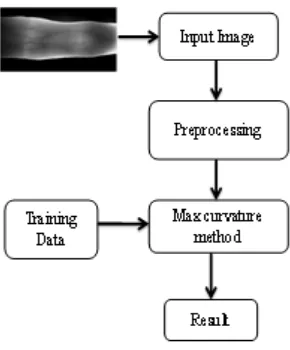
Figure 1.1 Block Diagram of Finger Vein Authentication
In proposed system, we have used finger vein detection for personal identification is shown in Figure 1.2 i.e., security purposes. The image is processed and it is segmented using Maximum curvature and lee region; it is extracted by SVM (Support Vector Machine) techniques and it is compared with the database to get the result is shown in Figure 1.1.
Figure 1.2 Hardware implementation of finger vein.
Steps In Operation
a.)Image Acquisition: The light source is illuminated on the ventral side of the finger, and the image is collected through the reflection of the light[13].
b.)Preprocessing Image: The process of image preprocessing generally include: denoising, edge extraction, position calibration, scale normalized, gray-scale normalized, etc[2][13].
c.)Finger Vein Extraction: one kind is the threshold based image segmentation algorithm, another is image content based segmentation algorithm. the classical threshold extraction algorithm include: fixed threshold method, iterative threshold method, fuzzy threshold method, etc[13]. We have used maximum curvature and lee region for segmentation process. At last we take mean and standard deviation.
d.)Matching Recognition: Matching definition is to find the common scene of the two images or according to the known patterns in an image and then finds another image for the corresponding mode[13]. Such as the number of feature points, the distance between the feature points and the location of feature points.
Advantages:
Detect automatically
The result will not change
Security purpose
Software:
MATLAB R2013a
4)Algorithm
:
The algorithm used in this paper is LEE REGION for MASKING and MAXIMUM CURVATURE for segmentation process and SVM for Feature extraction to classify. There are 3 stages in this algorithm:
(1) Preprocessing stage:
Filter selection in noise reduction.
Threshold in edge detection.
(2) Feature extraction stage:
Probability of selecting neighboring pixels;
Width of the profile;
The distance between tracking point and cross
point;
The number of repeated times;
Threshold in binarization;
(3)Matching stage:
Displacement between two templates
These steps are detailed below:
(1)Preprocessing techniques
Preprocessing techniques are needed on colour, grey-level or binary document images containing text and/or graphics. In character recognition systems most of the applications use grey or binary images since processing colour images is computationally high[2]. Such images may also contain non-uniform background and/or watermarks making it difficult to extract the document text from the image without performing some kind of preprocessing, therefore; the desired result from preprocessing is a binary image containing text only. Thus, to achieve this, several steps are needed, [a] some image enhancement techniques to remove noise or correct the contrast in the image, [b] thresholding to remove the background containing any scenes, watermarks and/or noise, [c] page segmentation to separate graphics from text, [d]character segmentation to separate characters from each other and, finally, morphological processing to enhance the characters in cases where thresholding and/or other preprocessing techniques eroded parts of the characters or added pixels to them.
(2)Feature extraction
Feature extraction a type of dimensionality reduction that efficiently represents interesting parts of an image as a compact feature vector. This approach is useful when image sizes are large and a reduced feature representation is required to quickly complete tasks such as image matching and retrieval[1].
Feature detection, feature extraction, and matching are often combined to solve common computer vision
problems such as object detection and recognition,
content-based image retrieval, face detection
and recognition, and texture classification.
Analysis of features and extraction methods
The feature is defined as a function of one or more measurements, each of which specifies some quantifiable property of an object, and is computed such that it quantifies some significant characteristics of the object. The various features classified and currently employed are:
General features: Independent features such as color, texture, and shape According to the abstraction level, they can be further divided into:
Pixel-level features: Features calculated at each
pixel, e.g. color, location.
Local features: Features calculated over the results
of subdivision of the image band of an image segmentation or edge detection.
Global features: Features calculated over the
entire image or just regular sub-area of an image.
Domain-specific features: Application of
dependent features such as human faces, fingerprints and conceptual ones.
All features can be coarsely classified into low-level features and high-level features. Low-level features can be extracted directly from the original images, whereas high-level feature extraction depends on low high-level features. The issue of choosing the features from the extracted vector should be guided by the following concerns:
a. The features should carry enough information
about the image and should not require any domain-specific knowledge for their extraction.
b. They should be easy to compute in order to
approach the feasibility of a large image collection and rapid retrieval.
c. They should relate well to the human perceptual
characteristics since users finally determine the suitability of the images retrieved.
The Skeleton And Minutiae Points Of The Vein Pattern
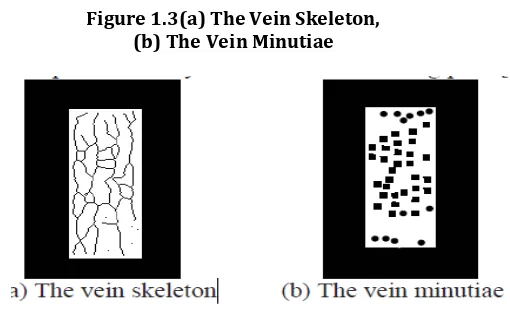
Many techniques can be applied to analyze of skeleton or minutiae features of vein pattern is shown in Figure 1.3(a),(b). However, due to the accuracy of the minutiae extraction, the noise points greatly affect the equal error rate (EER) of minutiae features recognition, and so the analysis based on skeleton of vein pattern is preferred to minutiae features.
Vein detection
Figure 1.3(a) The Vein Skeleton, (b) The Vein Minutiae
(3) Vein Matching:
[image:3.595.316.571.551.712.2]the Federal Bureau of Investigation and the Central Intelligence Agency this method of identification is still in development and has not yet been universally adopted by crime labs as it is not considered as reliable as more established techniques, such as fingerprinting. However, it can be used in conjunction with existing forensic data in support of a conclusion.
While other types of biometric scanners are more popular for security systems, Vascular scanners are growing in popularity. Fingerprint scanners are more frequently used, but Naito says they generally do not provide enough data points for critical verification decisions. Since fingerprint scanners require direct contact of the finger with the scanner, dry or abraded skin can interfere with the reliability of the system. Skin diseases, such as psoriasis can also limit the accuracy of the scanner, not to mention direct contact with the scanner can result in need for more frequent cleaning and higher risk of equipment damage.
Vascular scanners do not require contact with the scanner, and since the information they read is on the inside of the body, skin conditions do not affect the accuracy of the reading. Vascular scanners also work with extreme speed, scanning in less than a second. As they scan, they capture the unique pattern veins take as they branch through the hand.
5)Equations:
Inmathematics,curvature is the amount by which a
geometric object such as a surfacedeviates from being
aflatplane, or acurvefrom beingstraightas in the case of
aline, but this is defined in different ways depending on
the context. There is a key distinction betweenextrinsic
curvature, which is defined for objects embedded in
another space (usually aEuclidean space) – in a way that
relates to theradius of curvatureof circles that touch the
object – andintrinsic curvature, which is defined in terms
of the lengths of curves within aRiemannian manifold.
This article deals primarily with extrinsic curvature. Smaller circles bend more sharply, and hence have higher
curvature. The curvature of asmooth curveis defined as
the curvature of itsosculating circleat each point.
Curvature is normally ascalarquantity, but one may
also define acurvature vectorthat takes into account the
direction of the bend in addition to its magnitude. The
curvature of more complex objects (such assurfacesor
even curvedn-dimensionalspaces) is described by more
complex objects fromlinear algebra.
Step 1: Express the points on the spline parametrically, so the spline is the set of points of the form (x(t),y(t))(x(t),y(t)), where ‘t’ is a parameter. Here x(t) represents the x-coordinate as a function of the parameter ‘t’ and y(t) represents the y-coordinate. Since
this is a cubic spline, you can find
functions x(t),y(t)x(t),y(t) that are cubic polynomials with known coefficients that provide this parametric expression.
Step 2: Use the formula for computing the curvature, given a parametric representation of the curve. This gives you a formula for the curvature as a function of ‘t’, namely, κ(t)κ(t). Note that since x(t)x(t) and y(t)y(t) are cubic polynomials, you can explicitly compute their first and second derivatives, so you can analytically compute an explicit expression for κ(t)κ(t), i.e., for the curvature as a function of t.
Step 3: Find the value of ‘t’ that maximizes κ(t)κ(t).
Note that we are now dealing with a
function κ:R→Rκ:R→R, i.e., we are in the one-dimensional case. Thus, we can find the maximum numerically using any of a number of methods: gradient descent, Newton's method, or a number of other methods.
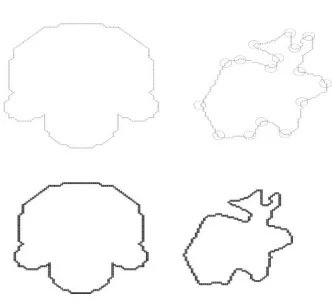
Figure 1.4 Vein Matching
6) Database:
[image:4.595.357.523.346.497.2]The database for the experiment is stored in a excel worksheet is shown in Table 1.1. The specimen and their corresponding scores are stored as mathematical values. the scores are nothing ,but the standard deviation values obtained for the respective vein image. The standard deviation values are obtained with the help of MATLAB software.
Table 1.1 The Performance of Finger Vein Identification in Database
Person Score value
1 3.16E-01
1 3.15E-01
2 2.60E-01
7) Results:
Based on the experiments done, the following results has been obtained and verified. initially the people who should be authorized needs their finger vein image to be taken and their corresponding standard deviation values are obtained through MATLAB. These values obtained are then stored in the database. When such a person tries to unlock the security system or to enter a secured place then the software immediately compares it with the database values and displays the corresponding person’s name and other details and allows them access calling them ‘authorised person’.
When an unknown person accesses it with his finger vein image, it repeats the procedure and since it does not find that person’s value registered, it displays ’unauthorised person’ and blocks their access .it serves as a fool-proof security system.
Advantages
The vein patterns are unique to each individual.
apart from size, the pattern does not change over time. this feature makes it suitable for one-to-many matching
Vein recognition technology has a false rejection
rate (frr) of 0.01% and a false acceptance rate (far) of 0.0001%, hence making it suitable for high-security applications.
veins are located underneath the skin surface and
are not prone to external distortion the this reduces the high failure to enroll (fte) rate caused by bad samples.
User friendliness: this technology overcomes
aversion to fingerprinting and related privacy concerns since its traditional association to criminal activity is non-existent.
In countries such as japan, where there is strong
opposition to fingerprinting, vein recognition has become the biometric technology of choice. it is relatively quick as it takes less than 2 seconds to authenticate.
Some non-contact models are more hygienic than
fingerprint readers.
Potential fusion with other biometric
technologies: with the popularity of multimodal biometrics, vein recognition technology could be used in conjunction with hand or fingerprint
biometrics.
8) Conclusion
In this paper, we find the parameters affect a lot on the performance of an algorithm when it is applied on a
dataset or on different datasets. It is very important to adjust the parameters in practical.
Based on the experiments, we also suggest 2 possible solutions, which are accurate, fast and scalable, to find the best parameters. There are several directions where this work can be extended.
We should continue studying the possible
solutions, to overcome the problem taken by the worst case.
We should do experiments with more algorithms
to further verify the above conclusions.
We may find the facts on other biometric traits,
such as finger print, iris, face, etc.
When we try to adjust the parameters, we should
pay attention to the physical significance of each parameter. This may indicates more direct relationship between the parameter and the system performance. For example, the width of vein (as a parameter) may be related to the gender component of a dataset.
User-dependent parameter adjustment maybe
significant in further improving the performance
References
[1] Y. Nakamaru, M. Oshina, S. Murakami, B. Edgington, and R. Ahluwalia, “Trends in finger vein authentication and deployment in Europe,” Hitachi Rev., vol. 64, no. 5, pp. 275–279, 2015.
[2] D. Wang, J. Li, and G. Memik, “User identification based on finger vein patterns for consumer electronics devices,” IEEE Trans. Consum. Electron., vol. 56, no. 2, pp. 799–804, May 2010.
[3] J. Hashimoto, “Finger vein authentication technology and its future,” in Symp. VLSI Circuits Tech. Dig., 2006, pp. 5–8.
[4] Y. Lu, G. Yang, Y. Yin, and R. Xiao, “Sliding window-based region of interest extraction for finger vein images,” Sensors, vol. 13, no. 3, pp. 3799–3815, 2013.
[5] N. Miura, A. Nagasaka, and T. Miyatake, “Extraction of finger-vein patterns using maximum curvature points in image profiles,” IEICE Trans. Inf. Syst., vol. 90, no. 8, pp. 1185–1194, 2007.
[7] N. Miura, A. Nagasaka, and T. Miyatake, “Feature extraction of fingervein patterns based on repeated line tracking and its application to personal identification,” Mach. Vis. Appl., vol. 15, no. 4, pp. 194–203, 2004
[8] W. Song, T. J. Kim, H. C. Kim, J. H. Choi, H. J. Kong, and S. R. Lee, “A finger-vein verification system using mean curvature,” Pattern Recognit. Lett., vol. 32, no. 11, pp. 1541–1547, 2011.
[9] L. Yang, G. Yang, Y. Yin, and L. Zhou, “A survey of finger vein recognition,” Biometric Recognition (Lecture Notes in Computer Science), vol. 8833. Springer, 2014, pp. 234–243.
[10] J. H. Choi, W. Song, T. Kim, S.-R. Lee, and H. C. Kim, “Finger vein extraction using gradient normalization and principal curvature,” Proc. SPIE. Int. Soc. Opt. Eng., vol. 7251, p. 725111, Feb. 2009.
[11] P. Tome et al., “The 1st competition on counter measures to finger vein spoofing attacks,” in Proc. IEEE Int. Conf. Biometrics Special Interest Group, May 2015, pp. 513–518.
[12] Yang Jinfeng, Yan Minfu. An improved method for finger-vein image enhancement[C]/ /Proceedings of the 20 I 0 IEEE 10thinternationai Conference on Signal Processing (ICSP ' IO),Beijing, China, Oct24-28, 2010. Washington, DC, USAIEEE Computer Society, 2010: 1706-1709.