Journal of Chemical and Pharmaceutical Research, 2014, 6(5):1536-1543
Research Article
CODEN(USA) : JCPRC5
ISSN : 0975-7384
Two-sided software platform: Operating strategies under multi-homing users
Xia Chen
1,
Yu Li
2, Tingjie Lu
1and Longfei Guo
11
School of Economics and Management, Beijing University of Posts and Telecommunications,
Beijing, China
2
China Unicom Research Institute, Beijing, China
__________________________________________________________________________________________
ABSTRACT
Compared with previous research, this paper, builds a multi-homing model for multi-homing users using new software platforms under free decision-making conditions, analyzes the relationship among the scale, pricing and profits of platform and users on both two sides at equilibrium. It’s concluded that the total number of multi-homing users is in positive correlation with profits and users on both sides grow asynchronously and the platform needs to restrain multi-homing behavior of users.
Key Words—Software platform; Two-sided; Network Effect; Profit; multi-homing
____________________________________________________________________________________________
INTRODUCTION
In the environment of Internet-based software platforms, the multi-homing cost of both the end-users and the third-party application providers is significantly reduced and two-sided multi-homing are becoming the norm[1].Thus the relationship among platforms’ pricing, scale and profit, and strategies of platforms to enhance competitiveness have become key issues of the operation of enterprises of software platform.A software platform-centered economic structure is a typical two-sided market.
However, most current studies of software platform operation using the two-sided market theory proceed from the traditional PC operating system and focus on issues like platform structure, pricing, industrial efficiency and other relevant platform behavior[2,3].Studies of new Internet-based software platforms are largely based on discussion on model[4]and analysis on case or phenomenon[5], which are lack of theoretical study and analysis for the important market conduct of “multi-homing” in new software platforms.
On one hand, a number of scholars have made a theoretical foundation for the research on users’ multi-homing behavior under the two-sided market conditions[6-8]. Poolsombat and Vernasca[9]defined that partial multi-homing means that some of the users subscribe to more than one platform ,and studied the condition where equilibrium exists.
On the other hand, many scholars have applied the theoretical study to the analysis of specific industry, which generally focused on just a single issue such as pricing[10,11] or tying[12,13], etc.
This paper, builds a multi-homing model for two-sided users using new software platforms under free decision-making conditions, analyzes the relationship among the scale, pricing and profits, and do profound discussion and simulated analysis to this model
____________________________________________________________________________
1537
deduce the Cournot equilibrium. In Section 3,we analyze the equilibrium of two-sided market with multi-homing. And we conclude in section 4.
II.MODEL AND HYPOTHESIS
2.1the model
Assuming that there are only two software platforms: A and B. Their related services and features are basically the same. However,there are some differences in terms of performance. Each user or third-party application providers have different preferences for platforms.Also,the need of platforms that users prefer may not be fully met. As a result, users have to afford the cost of unmet predilection when making a choice.
First, the logical framework hotelling model is used to describe an oligopolistic market during modeling. We suppose that the two platforms are at both ends of a line segment which is 1 in length, and the user at x = 0 has the greatest preference for platform A while the user at x = 1 has the greatest preference for platform B. At the same time, end users and application providers are evenly arranged on the segment. t1andt2 are respectively used to denotes the unit transportation cost of end users and application providers(its economic implication is the difference of consuming preferences of two-sided users). Besides, the total number of two-sided users is assumed to be 1.
Second, in terms of the registrations of both platforms, defined variablesnUA(or nUB) denotes the number of end users of platform A(or B) while nDA�or nDB� indicates the number of application providers of platform A(or B). Because of the assumption that the end-user and application providers can simultaneouslyaccess two platforms and each user or application provider must choose a platform to access, nUA+ nUB−1 represents the number of multi-homing end users. Similarly, nDA+ nDB−1 is for the number of multi-homing application providers.
Third, with regard to Indirect network externalities, defined variable α1 is for cross-network externality the unit application provider Cross-network externalities.This paper only considers the situation when cross-network externalities is positive, namely, suppose α1> 0,α2> 0.
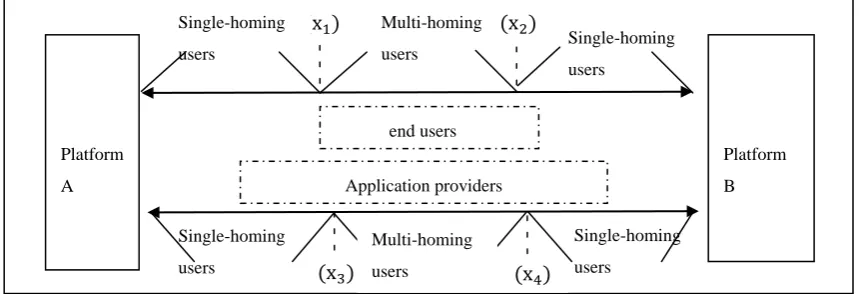
[image:2.595.121.551.449.596.2]At last, defined variables PUA(或PUB),PDA(或PDB) denote the access pricings for end users and application providers platform A or B set on. So that, under the conditions of two-sided multi-homing users the platform structure model is as shown in Figure1.
Figure 1: Multi-homing User Structure in Two-sided Software Platform
2.2 Derivation
Firstly, a user utility model needs to be built. Take the end-user side as an example, in such market structure, the utility of end-users whose predilection is x can be shown by U:
U =�
α1nDA−PUA−t1x Platform A only
α1nDB−PUB−t1(1−x) Platform B only
α1− �PUA+ PUB� −t1 platform A and B (1)
When an end user adds only platform A, regardless of the inherent utility, the secured utility is the indirect network externalities α1nDA of the other side of application provider. And in order to joinplatform A, the user pays the platform access feesPUA and the cost of different user preferencet1x. If the end useraccess only platform B, then the
(x4)
(x3)
(x2)
(x1)
Single-homing
users Single-homing
users
Single-homing
users
Multi-homing
users Single-homing users
Platform
A
Platform
B
Multi-homing
users end users
____________________________________________________________________________
1538
obtained utility is α1nDB. The access fee isPUB, and the cost of different user preference ist1(1−x). When multiple registration, users have to afford access fees of both two platforms as well as the cost of different user preference. And because all application providers must choose one or two platforms, the secured utility of users will be α1.
Assumingly, it is the utility that decides that the end user adds only the platform nearby or simultaneously access to both platforms. The critical point of adding only platform A and simultaneously access to both platforms is x1, as shown in Figure 1. x2stands for the critical point of adding only platform B and simultaneously access to both platforms. So that the critical condition is as following:
α1nDA−PUA−t1x1=α1− �PUA+ PUB� −t1(1)
α1nDB−PUB−t1(1−x2) =α1− �PUA+ PUB� −t1(2)
Solving the equations (1)、(2) respectively, we can get the corresponding critical value: x1= 1 t1[α1�nD
A−1�+
PUB+ t1];x2=t11[α1�1−nDB� −PUA]
Combining the structure shown in Figure 1, end-users whose preference is at the right side of x1 will ultimately add platform B, whether they are multi-homing or not. And end-users whose preference is at the left side of x2 will ultimately add platform A. So that, the ultimate scale of end-users of platform A is:
nUA =t1
1�α1�1−nD B� −P
UA�(3) the ultimate scale of end-users of platform B is:
nUB= 1−t1 1[α1�nD
A−1�+ P
UB+ t1] (4)
imilarly, because of symmetry, the scale of application providers of platform A and B can be shown as: nDA=t1
2�α2�1−nU B� −P
DA� (5)
nDB= 1−t1 2[α2�nU
A−1�+ P
DB+ t2] (6)
Then, the equation of the scale of two-sided users can be deduced. As the result of simultaneous equations (3)、(4)、
(5)、(6), the ultimate homing scale of end-users and application providers can be shown as:
⎩ ⎪ ⎪ ⎪ ⎨ ⎪ ⎪ ⎪
⎧nUA=αt1(t2− α2) 1t2− α1α2−
t2 t1t2− α1α2PU
A+ α1 t1t2− α1α2PD
B
nDA=αt2(t1− α1) 1t2− α1α2−
t1 t1t2− α1α2PD
A+ α2 t1t2− α1α2PU
B
nUB=αt1(t2− α2) 1t2− α1α2−
t2 t1t2− α1α2PU
B+ α1 t1t2− α1α2PD
A
nDB=αt2(t1− α1) 1t2− α1α2−
t1 t1t2− α1α2PD
B+ α2 t1t2− α1α2PU
A (7)
From the equations above, we can see that the number of the one-side platform users is not only inversely proportional to the price on users of this side set by the platform, but also in direct proportion to the pricing of access on the other side. For software platforms, this can be read as: the lower the price on end-users is, or the higher the price set by the other platform on application providers is, the smaller the scale of application providers getting access to the other software platform is.
We suppose that xUA(or xUB) stands for the number of end-users single-homed by platform A (or B); xDA(or xDB) is for the number of application providers single-homed by platform A (or B).
____________________________________________________________________________
1539 ⎩ ⎪ ⎪ ⎪ ⎨ ⎪ ⎪ ⎪⎧xUA=t t2− α1 1t2− α1α2+
t2 t1t2− α1α2PU
B− α1 t1t2− α1α2PD
A
xDA=t t1− α2 1t2− α1α2+
t1 t1t2− α1α2PD
B− α2 t1t2− α1α2PU
A
xUB=t t2− α1 1t2− α1α2+
t2 t1t2− α1α2PU
A− α1 t1t2− α1α2PD
B
xDB=t t1− α2 1t2− α1α2+
t1 t1t2− α1α2PD
A− α2 t1t2− α1α2PU
B (8)
Therefore, from the equations above, it can be seen that while the scale of one side users is in direct proportion to the pricing of access on its users on the other side, it is also inversely proportional to the access pricing on application providers of the other side. That is to say, the higher the pricing on end-users is, or the lower the pricing set by the other platform on application providers is, the bigger the scale of application providers getting access to the other software platform is.
Thirdly, the platform cost is not considered in this paper. Profits of software platforms A and B can be respectively shown as: πA= PUAnUA+ PDAnAD和πB= PUBnUB+ PDBnDA
Fourthly, through Cournot equilibrium model, the scale of end-users and application providers can be obtained during market equilibrium.
Substituting the pricing equationinto the profit equation, function can be got. As for platform πi, i=A, B, the essence is to maximize platform profit by different pricing and user scale selection; hence becoming the issue of dual functionextremum. The extremum condition equation can be shown as:
⎩ ⎪ ⎪ ⎪ ⎨ ⎪ ⎪ ⎪ ⎧dπA
dnUA=α1−2t1nU A− α
1nDB= 0 dπA
dnDA =α2−2t2nD A− α
2nUB = 0 dπB
dnUB=α1−2t1nU B− α
1nDA= 0 dπB
dnDB =α2−2t2nD B− α
2nUA = 0
(9)
Namely, the scalesof the users on the two sides of the two platforms are: (nUA)∗= (nUB)∗=α4t1(2t2− α2)
1t2− α1α2; (nDA)∗= (nDB)∗=α4t2(2t1− α1)
1t2− α1α2 (10)
That is, in equilibrium, the scales of end-users and application providers of the two platforms are the same.
As for platform pricing in equilibrium, substituting the equation of two-sided users in equation (7), platform pricing in equilibrium can be as following:
(PUA)∗= (PUB)∗=α4t1t1(2t2− α2) 1t2− α1α2 ; (PDA)∗= (PDB)∗=α24tt2(2t1t2− α1)
1t2− α1α2 (11)
Finally, substituting equations (10) and (11) profit equation, the maximum platform profit is:
πA∗=πB∗= t1[α4t1(2t2− α2) 1t2− α1α2]
2+ t
2[α4t2(2t1− α1) 1t2− α1α2]
2
πA∗=πB∗=α1 2α
22(t1+ t2)−4t1t2α1α2(α1+α2) + 4t1t2(t2α12+ t1α22) [4t1t2− α1α2]2 (12) III.EQUILIBRIUM ANALYSIS
____________________________________________________________________________
1540
suppose t1= t2= 1. Put the scale of two-sided users, the scale of single-homing user, pricing and profits into Chart1. The following analysis on market equilibrium is based on related formulas of Chart1 and gets emulated through Matlab.
Chart1: user scale, pricing and profit in equilibrium
end-user side application providers side the scale of access users α1(2− α2)
4− α1α2 (10)
α2(2− α1) 4− α1α2 (10)
The number of single-homing users 2(2− α1)
4− α1α2 (10)
2(2− α2) 4− α1α2 (10)
access pricing α1(2− α2)
4− α1α2 (11)
α2(2− α1) 4− α1α2 (11)
maximum platform profit π∗=2α1
2α
22−4α1α2(α1+α2) + 4(α12+α22)
(4− α1α2)2 (12)
Under the multi-homing condition, end users and application providers will choose one of the two platforms or two for access. Moreover, the total user number in the model is 1. So that the total user number and application providers scale of the two platforms are in the interval of [1,2]. That is:
1 < (nUA)∗+ (nUB)∗=24tα1(2t2− α2) 1t2− α1α2 < 2 1 < (nDA)∗+ (nDB)∗=2α4t2(2t1− α1)
1t2− α1α2 < 2
Substituting t1= t2= 1 into the inequation, then: 0.5 <α41(2− α− α2)
1α2 < 1,0.5 <
α2(2− α1) 4− α1α2 < 1
At the same time, access user scale of any platform must be greater than the number of users single-homing to the platform on the side.
α1(2− α2) 4− α1α2 >
2(2− α1) 4− α1α2 ,
α2(2− α1) 4− α1α2 >
2(2− α2) 4− α1α2
Solving the equations simultaneously, one can get a condition equation of cross-group network externalities that sustain the platform market of two-sided multi-homing users.
⎩ ⎪ ⎪ ⎪ ⎨ ⎪ ⎪ ⎪
⎧ 0.5 <α41(2− α− α2) 1α2 < 1 0.5 <α42(2− α− α1)
1α2 < 1
α1(2− α2) 4− α1α2 >
2(2− α1) 4− α1α2
α2(2− α1) 4− α1α2 >
2(2− α2) 4− α1α2
α1,α2> 0. Solve the inequality equations. Then the conditions of cross-group network externalities of two-sided multi-homing users are:
�
α1> 2
α2> 2
α1α2+ 4 > 4α1
α1α2+ 4 > 4α2
Further solving the inequalities, it can be shown that all conditions can be met when α1> 4,α2> 4; specific
analyses are needed when α1、α2are in the interval resultof [2,4].
CONCLUSION
Based on the discussions above, the conditions of maintaining two-sided multi-homing are:
____________________________________________________________________________
1541
cross-group network externalities, multi-homing behavior is more likely to occur.
That is because that the platform will make efforts to attract the side having greater cross-group network externalities and reduce its multi-homing cost, thus provides conditions for multi-homing.
Correlated variables α1,α2 below are set in the range of [4, 5]for simulated analysis. Through simulation calculation, it is found that in this range, unilateral users account for 60%-75% of total users, single-homing 25%-40%, basically covering main users under two-sided multi-homing conditions. In this circumstance, this study arrives at the following conclusions by simulated-analyzing the operation of equilibrium software platform from different perspectives.
Conclusion 2: Under the two-sided multi-homing condition, the end user scale of platform i(i=A,B) (𝐧𝐔𝐢) varies inversely with that of application providers (𝐧𝐃𝐢)
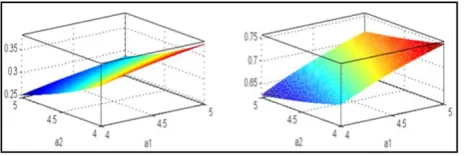
[image:6.595.193.422.294.375.2]Under the two-sided multi-homing condition,figure 2 shows the comparison between the scale of end user two-sidedly accessing into the platform and application providers, and the relation of end user scale with cross-group network externalities.In those two subgraphs, the vertical axis respectively represent the value of scale of end users and application software providers. Conclusion 2 can be concluded from the figure 2.
Figure 2 Comparison between scale of end users and application software providers under the multi-homing condition at equilibrium
Owing to the high cross-group network externalities the scale of access of two-sided users makes up 60%-75% of the total scale. The augmentation of numbers on one side is largely caused by the multi-homing behavior of its users with no propositional augmentation of its single-homing users. Under the condition of oligopoly, users of the other side need not access into two platforms at the same time.
This conclusion also proves that software platform needs to develop a balance of two-sided users, because profits is in positive correlation with the number of total users and in no marked correlation with users on one side and further because the augmentation of total users is insynchronical with that of unilateral users.
Conclusion 3:Under the two-sided multi-homing condition, the total number of application software providers is in direct conclusion to that of single-homing end users.
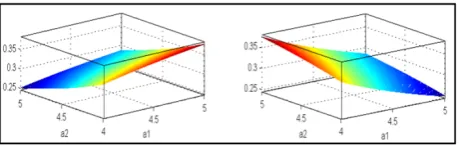
There is simulated analysis of relationship between the scale of single-homing end users to platform and application software providers in figure 3, in which the left subgraph presents the variation of single-homing end user. The right one presents the scale of its providers. conclusion 3 is proved by both subgraphs altering synchronically. The two subgraphs vary synchronically, from which conclusion 3 is proved.
Figure 3 Comparison between the whole scale of single-homing end users and application software providers
[image:6.595.191.424.604.682.2]____________________________________________________________________________
1542
Conclusion 4: Under the multi-homing condition, the augmentation of single-homing end users is in the direct proportion to the scale of application providers, while the scale of single-homing application providers diminishes.
Figure 4 below presents single-homing scale of end user and that of application providers at equilibrium, and the relationship between them and cross-group network externalities.
Figure 4 Comparison between single-homing scale of end user and application software providers
Similar to multi-homing, the augmentation of single-homing end user doesn’t cause single-homing application providers to vary synchronically. It’s because that providers surely plan to cover end users of another platform for more profits. From the left subgraph, it can be concluded that the scale of single-homing end user reaches less than 0.45 of total users at most. That is to say, another platform will outnumber it by 0.5. Owing to symmetry, single-homing user at 0.45 more of less, so providers is sure to access into two platforms in the meantime. The extreme circumstance can be the competitive bottleneck.In the basis of analysis of figure 2, 3 and 4, conclusion 4 is proved.
Considering the impact of cross-group network on users, it can be found that the total number of single-homing users on the one side of the platform is basically in positive correlation with the cross-group network externalities on the other side but in negative correlation with that of its own.
[image:7.595.192.422.140.213.2]Conclusion 5: Under the two-sided multi-homing conditions, the platform sets a positive price and its pricing is in the direct conclusion to the number of users on one side, but not symmetrically pricing for users of both two sides. Figure 5 below presents the variation of price set by the platform on its end users and application providers.
Figure 5Comparison between the price set by platform on end users and application providers
As figure 5 indicates, the platform set a price asymmetrically, with high price on end users and low price on application provider. Thus the strategy of setting price asymmetrically is shown, though the platform makes no compensation for both users at equilibrium.
When this study analyzes the setting-price equation at equilibrium and under the condition of multi-homing, it can be concluded that the platform fixes a positive price on users and it is in direct conclusion to the number of users.Hence conclusion 5 proved.
Conclusion 6: Profits vary synchronically with the scale of users on both sides, but no marked correlation with users on any one side. So platform must introduce enough two-sided users for profits
[image:7.595.192.422.429.504.2]____________________________________________________________________________
1543
Figure6 Comparison between scale of multi-homing user and profits of software platform
Acknowledgment
The research is supported by National Basic Research Program of China (973 Program) (2012CB315805), Project of National Natural Science Foundation of China (71172135,71231002), and the Fundamental Research Funds for the Central Universities(2013RC0603).”
REFERENCES
[1]LI Yu, Beijing university of posts and telecommunication,pp.136-137, 2013.
[2]LI Quan, CHEN Hongmin,” JOURNAL OF SYSTEMS & MANAGEMENT,vol.4,pp.951-968,2008.
[3]N.Economides and E.Katsamakas,Management Science vol.52, no.7,pp.1057-1071,2006.
[4]H. Heitkoetter, K F Hildebrand, C A Usener, “Mobile Platforms as Two-sided Markets”,Proceedings of the Eighteenth Americas Conference on Information Systems, August 9-11,2012.
[5]J.West and M. Mace, Telecommunications Policy ,vol.34,no.5,pp. 270-286, 2010.
[6]B.Caillaud andB. Jullien, RAND journal of Economics, pp.309-328,2003.
[7]M.Armstrong and J. Wright, IDEI Working Paper, 2004.
[8]M.Armstrong and J.Wright, Economic Theory,vol.32, no.2,pp. 353-380, 2007.
[9]R.Poolsombat and G.Vernasca, “Partial multihoming in two-sided markets”,2006.
[10]JI Hanlin, systems engineering-theory & practice,vol.31, no.001,pp.75-83, 2011.
[11]Yao Lequan, CHINA ECONOMIST,vol.3, pp.51-53, 2008.
[12]J. C.Rochet and J. Tirole, International Journal of Industrial Organization ,vol.26, no.6, pp.1333-1347, 2008.