Development of MSc. in Nuclear Engineering via Knowledge Sharing
and Transfer Mechanism: A UTHM-ANM Collaboration
Chee-Ming Chan, Ahmad Shakri Mat Seman, and Alina Shamsuddin Uiliversiti TIIII Htrssein 01111, Malaysia, c l i a r ~ @ f ~ t l i ~ ~ r . e d ~ r . ~ ~ i y
ABSTRACT
The design and delivery of an acade~nic programme have always been perceived as the sole responsibility of an institution of higher learning. Tlie ease and speed of internet access coupled with tlie seemingly li~nitless co~n~nunication powers ,has perhaps made obsolete the clichC of a world without boundaries. T o attempt to create competitive yet timely relevant acade~nic programmes withih the solitary contines of a university is an uphill, if not i~npossible task these days. The expertise stemming from specitic knowledge and skills cannot always be found in the university, and to expend in an in-house talent pool would incur exorbitant costs barely justifiable in these era of tightened purse strings. An alternative to continuously develop and offer quality and relevant acade~nic programmes within these limitations is \with tlie share-anci-transfer ~iiechanism establishecl between the university and an expelt research institution. UTHM has joint effort with Agensi Nuklear Malaysia (ANM) using this strategy to develop the MSc. in Nuclear Engineering programme. Tlie co~nple~nentary and symbiotic partnership have enabled tlie develop~nent of a progrannne which is si~nultaneously offering forefi-ofit technological and knowledge advancement in nuclear engineering, bridging the expertise gap in tlie University and enriching tlie in-house talent pool with external connections. This paper describes the procpranlme's develop~nental processes, challenges and greater vision for nation building.
of higher learning are the very place where the nation's talents are nurtured and skilled \\orkforce is cultivated. Without institutional support to acco~n~nodate and enable the creation and enrichment of our talent pool en masse, especially in advanced technology and knowledge, tlie chasm between expectations and results will only grow larger. In today's \vorld of mininiization due to both the depleting natural resources and a growing conscience for austerity, it is ahnost unthinkable for a university to assemble an expelt team in-house for evely other acade~nic programme required. Yet there is a ~nultitude of existing highly qualitied and experienced professionals in administrative offices, agencies and research establish~nents throughout tlie country with an untapped wealth of knowledge. These people are not unlike live repository of expelt knowledge and knowhow, waiting to be roped into the graduate education system where their brains could be, literally, picked.
After all, knowledge management is propounded to be a continuous process of managing knowledge in anticipation of current and future needs (Carrillo et al. 2004), involving the processes of creation, acquisition and utilization of tlie pooled knowledge (Laurie 1997). By involving expelts from outside the university could kill two birds with one stone, i.e. (1) to till in the lectu~ing positions of certain knowledge area in slio~tage, and (2) to utilize the enibedded practical knowhow and field experiences usually found wanting in an academician.
Econo~nic lirallli
Key\vords: university, academic programme, check. steering and realignment industry, knowledge sharing and transfer.
Blueprint for natio~i
1 INTRODUCTION Government huildinp and econo~iiic
( P o l ~ c y ~iiaker) s u s l a i ~ i a h ~ l ~ t y The very existence of a university is substantiated by
tlie need for a place of higher learning, to acquire advanced knowledge and skills for self betterment and most likely, career advancement. Hence tlie acade~nic PI-ogralnmes offered by a university is in a way '~ilarket-driven'. \\,it11 the industries serving as a sounding board for identifying gaps in highly trained personnel and workforce. Tlic industrial needs, on the other hand, are driven by the blueprint for nation building and econo~nic sustainability. This unique inter-relationship (Figure 1) has placed universities in a critical, if not pivotal position, as these institutions
Fullilli~~p llie Ellgape and
I ~ B I I O I I ' S e c o ~ l o ~ l i ~ e Industries deploy a li~glily and develop~i~enl (Ecolio~ny driver) tra~ned aiid expen
needs work hrce
Pro\,idi~ig
a d \ ~ a ~ i c c ~ I Uni\,crsity
rrai11111: :111d (tliglicr cducalio~i provider) knowledge
eolianceliient
Figure 1. A klarkel-Driven l l i p h r r Education For Nation Rlrildinr
K~io~vledge Mo~irr,oeriie~i/ ~ I I / ~ I - I I ~ I ~ ~ I I C I ~ Co17fere1ice (KMICe) 2014, 12 - I5 Al~g~i.cl 2014, Mrtlr~.vsia
It is perhaps not wrong to add the tern1 'optimisation' in the definition of the rnanagelnent philosophy, when sharing and lever-aging what we know as a whole instead of separate standalone entities (Gurteen 1999) actually sets in motion a mechanism of coordination to convert the pooled resources into capabilities (Darroch 2005). The university, housing students, providing facilities and amenities as well as administering the academic records, is most apt to play the role of coordinator in a university-industry collaboration to maintain the programmes after their first inception. Knowledge untapped and unused remain useless and non-beneficial, where they need to be converted to tangible and rewarding outputs with the aid of suitable infrastructure and delivery system (Duta et al. 2005). As such, one should not overlook the impel-tance of the proper ~nanage~nent of knowledge in preventing the stagnation and deterioration of intellectual assets, where a good knowledge management system could effectively enhance the collective intelligence and organizational adaptability of a university by providing it with a competitive edge (Grant 1996). It is with this pretext tliat the University has initiated collaboration with Agensi Nuklear Malaysia (ANM) to develop a graduate progrannne in Nuclear Engineering, which does not cater only for the power industry, but a larger econo~nic prospect for Malaysia and tlie region. Tlie following discourse puts tlie programme development process into the context of knowledge management, with a knowledge sharing and transfer perspective.
I1 MECHANISM: HOW DID IT WORK?
[image:2.456.246.435.58.196.2]In order for tlie knowledge residing outside tlie University to be channeled into the system, some form of robust connection needs to be established. The connecting corridor has to enable a 2-way tlow of ideas, actions and responses. Tlie extent of the accessibility of the transfer meclianis~n will ensure effective sharing of knowledge between organizations, such as liigliliglited by Coliendet and Meyer-Kralnner (2001).
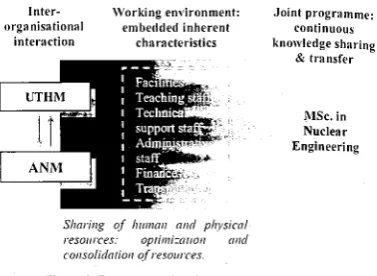
Figure 2 illustrates the general programme develop~nent pathway between UTHM and ANM to facilitate kno\vletlge sharing and transfer. It is apparent tliat tlie 2-way interaction enconipasses all the inherent characteristics of both organizations, i.e. the good and the bad, and bound by certain shared limitations as botli are public organizations. Tlie co~nmunications between the organizations were arguably tlie determining success factor of the joint effort, in the entire process of knowledge transfer: initiation, implementation, ramp-up and integration (Szulanski 2000). On-going exchanges, adoptions and adaptations of ideas involve high levels of acco~nmodation, motivated by the growing sense of belonging in a team as well as the reward awaiting at
Inter- \Vorking environment: Joint programme: organisational enibetlded inherent continuous
interaction cheracteristics knowledee sharinp
& transfer
MSc. in
Nuclear
Engineering
Figure 2. Programme D e ~ e l o p m e n t Pathway
the end of the endeavour. Regular face-to-face meetings and other f o ~ i n s of co~n~nunication help to ensure ~nultiple iterations and feedback, creating a strategic collaborative mechanism for tlie free tlow of ideas in botli directions (e.g. Inkpen & Dinur 1998, Nobeoka 1995). A number of workshops and meetings were organized between UTHM and ANM tlirougliout the develop~nent process, witli invaluable bartering of information and ideas, friendly arguments ant1 decision-making, leading to tlie final product ~nutually agreed upon.
I11 COMPONENTS: WHAT WERE INVOLVED?
Depending on the ultimate aim of collaboration, the output from a knowledge sharing and transfer exercise may valy from case to case. So are the co~nponents involved. For instance, Tai et al. (20 12) proposed a framework which links the learning organization and performance witli knowledge management to gauge the performance of public learning organisations in Dubai. For tlie Multimedia Super Corridor initiatives in Malaysia, Tas~nin & Yap (2010) repo~ted,tliat tlie effectiveness of knowledge management depend on culture, information technology, organizational structure ant1 veoule. Deriving from case studies of tlie global trend 'in 'knowledge-~nanagelnent, Bhojaraju (2005) categorised the co~nponents of knowledge management into classes of people, process and technology.
People Culture
Bhojni-<cj~r (2iiO.i) structure
7 ~
, , I , , , ) , , , LC ; ,,D t:l;lfI,
Learning organization (people)
Knowledge Orga~i~sat~onal ~i~anage~iient perfoniiance
Figure3. Components In Knowleclge Rlanagement (Adapted From \'arious Authors)
Financial Return UTllRl
Acadeniic Commentlation
Programme and Recognition
[image:3.460.26.216.50.405.2] [image:3.460.23.218.258.402.2],
',
Ne\! Research GroundsFigure 4. Greater Good Generated From T h e Partnership
documented but not promulgated or bequeathed to the next generation.
With an acade~nic progl.amme, that is assiduously designed and structured in a ~nethodical manner, continuously i~nproved and retined while being delivered to the public, the deposited knowledge would be assured a fol-ma1 channel for transfer to greater good. Moreover a university, entrusted witli the task as the custodian of acade~nic excellence, is granted the legitimate authority to award degrees. It follows that a partnership as such would make the knowledge transfer exercise even Inore attractive, if not lucrative to all involved.
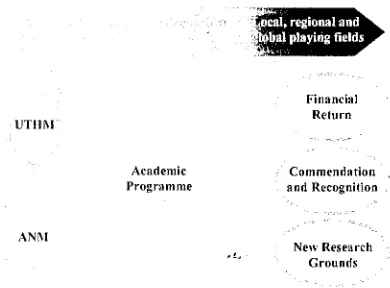
As illustratetl in Figure 4, the jointly developed acatle~nic programnle has positive repercussions to both institutions in the long run. A vibrant acade~nic environment would help spur novelty in I-esearcli, breaking new grounds for further expanded work. The exe~nplary teaching and learning as well as research
Kiioi~!ledge Mrriirrgeiiie~it Iiita-~irrtioncrl Coi!fi.rence (KMICe) /ittp://~vww. kliiice. ct~is. net niy/
activities would win accolades as due recognition of the quality and relevance of tlie programme offered. A good acade~nic programme, appropriately delivered, would also help assuage the often misplaced concelns on the danger of nuclear power and related studies. If knowledge is power, then people would be moved to enrol for the distinguished programme and to obtain such noteworthy knowledge, resulting in monetary gain for the programme providers, i.e. the university and its partner. The cycle continues, with the income generated used for further research, making new tindings and creating state-of-the-art discove~ies, enriching the knowledge repository for both enhancement of the programme and expansion of the useful applications.
IV S T R U C T U R E OF PARTNERSHIP
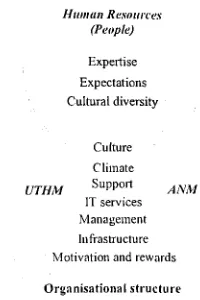
Figure 5 su~n~narizes the partnership between tlie 2 orgnisations. Essentially it takes into account the factors and co~nponents colnlnon to both parties and these can be generally seen as the organizational and human aspects. The pyramidal model indicates a foundation lain by the combined effort of both institutions, providing a sturdy and robust support for the programme as built from scratch. Referring to F i g ~ ~ r e 3 and tliscourse in tlie previous section, it is apparent that tlie lnost valuable and crucial colnponent of 'people' \\.auld be relying on this foundation to ensure the success of the collaboration. Included in the figure are tlie sub-co~nponents or factors.
The people of both institutions are experts in their respective fields, with the scientists from ANM transferring the knowledge and expe~tise to the programme, and tlie acade~nic stat'f from UTHM transforming and acclimatizing the body of knowledge into an 01-ganised standard deliverable fonnat, with aligned etlucational objectives and learning outco~nes (section V). In order to ooti~nize on the talents and expertise of the human resources, the organization is obliged to take into consideration the exuectations and cultiral diversity of tlie people. The& include the personal characteristics and collective traits borne of the diverse background they hail from.
Hu11ro11 Resorrrr.cs (Pcople)
Expertise Expectations Cultural diversity
Culture Climate
UTH,W Support AI\~,W
IT services Management llifrastructure Motivatiai and rewards
[image:4.461.78.178.69.219.2]Organisational structure
Figure 5. UTHRI-ANRI Partnership For E f f e c t i ~ e Knonleclge Transfer Ancl Sharing
achieved with much coordination between the management team of both organizations, to consolidate the resources for drawing out the best p e ~ l o ~ i n a n c e from the staff.
Management aside, it is also of importance to introduce a fair and accessible motivation and reward system. This allows for self retlection and assessment space for the staff, especially in the face of rising work pressure, for instance. It is of colnfort to know that there is a d a c e to turn to for advice and no ti vat ion. simultaneously creating a work environment which pol-trays institutional support for the wellbeing of the staff. Such a caring atmosphere would instill a strong sense of belonging alnong the workers, invariably leading to improved productivity and perfonnance. The reward system, on the other hand, is aimed at making public recognilion of the staffs achievements. Knowing that one's work is appreciated and recognized is a significant driving force to maintain and enhancc the perfonnance level of an organization. Of course, the satisfaction of transferring one's knowledge ant1 experience into physically deliverable fo~ins, such as the curriculu~n and syllabus of the prograninie, surely is a reward on its own. The long tenn rewards would be reaped by Inany others, far ant1 wide, unforeseeable for now but of certainty in time to come.
V PUTTING INTO CONTEXT: MSC. IN NUCLEAR ENGINEERING
Certain standards and qualifications must be attained before a master's degree can be awarded. The Malaysian Qualification Agency (2012) clearly stipulates that in the relevant standards. Essentially, a qualified graduate should be able to demonstrate the ~nastely of knowledge of the field of study. The practical skills gained in the study should be applicable in the respective fields with creativity and
innovation. A keen awareness of societal needs and the ability to response accordingly is expected of the graduate too. The programme should also groom the students to be law-abiding citizens, always conscientious and self regulating, and able to perform his or her duties in accordance with the ethical and professional codes of practice with mini~nal supervision. Leadership alnong peers as well as the coln~nunity at large in formulating effective solutions to proble~ns in various disciplines is within the expectations of a graduate too. In addition, the thirst and quest for knowledge should be a lifelong indulgence, a realization gained while in the progralnlne and practiced throughout the graduate's life.
The progralnlne educational objectives, as envisaged after half a decade of co~npleting the study, are as follows:
1. T o contribute to the develop~nent of knowledge and nuclear engineering technology via research, consultation, writing and publication- knowledge and skills.
2. T o recom~nend effective solutions to problems associated with nuclear engineering- hu~nanity skills.
3. T o i~nplement knowledge and technological transfer to the coln~nunity in an ethical and effective manner- humanity skills.
As for the learning outcomes to be attained immediately upon completion of study, i.e. programme learning outcomes, 8 targets have been identitied to retlect the overall achievement and colnpetencies of the graduate. A well trained graduate should be able to:
1. elaborate on the principles of nuclear engineering via the teaching and learning processes (knowledge).
2. identify and analyze proble~ns, develop solutions and improve nuclear plant operations (technical skills).
3. deliver advanced technical concepts in oral and written forms (communication skills).
4. analyze and resolve issues on the operations arid niaintenance of nuclear plant infrastructure in a creatice, innovative and effective way (critical thinking).
5. effectively play the roles of both member and leader in teamwork (teamworking).
6. practice lifelong learning and information management effectively (lifelong learning ant1 infonnation management).
7. study and resolve safety as well as environmental issues in a responsible and ethical manner based on standards and best practice recom~nentlations (professional ethics and ~noral values).
a real de~nocratization and popula~ization of expert knowledge.
VI CONCLUSION
Driven by the nat~on's economic needs, UTHM has
Graduates
collaborated w ~ t h ANM to develop a master's
Engineering) prograrnlne in nuclear engineering. The process
depicts a remarkable knowledge sharing and transfer mechanism, though not without glitches. The result was a co~npetitive and relevant academic programme, with a feasible c u ~ ~ i c u l u m design and delivery system. The mechanism and colnponents of knowledge
a
sharing and transfer involved were elaborated in the
-
paper, within the unique merged organizational platform with shared facilities and human resources. Finally a su~nrnal-y of the programlne developed was given, in line with the requirements of the latest educational standards. In a nutshell, the UTHM-ANM joint programme exe~nplifies an unconventional form of knowledge transfer mechanism, which optimizesFigure 6 . Beyand Aleeting T h e Energ)' Demand: .Job Prospect
Job prospect for the graduates does not lie within the narrow confines of nuclear power industry alone. As shown in Figure 6, there is,,more to nuclear engineering than com~nonly perceived. The World Nuclear Association (2013) highlighted the inter- dependency of the global energy and environment development, where a sustainable energy system is feasible with wide benefits, but advanced technology is slow in develop~nent for the clean energy sector, hindered primarily by the high costs incurred. Nonetheless investment in clean energy makes econo~nic sense, for every additional USD dollar spent in the respect would generate 3 USD in future fuel savings by year 2050. Hence energy security and the mitigation of climate change are inseparable issues, though they are often regarded as contesting matters on opposite sides of a coin, with emphasis on one resulting in the inevitable negligence of the other. The pl-ogramme may not solve such co~nplicated issues, but it certainly helps to educate people from various disciplines and areas of expertise, with direct or indirect contact with nuclear engineering, to at least eliminate the so~netilnes irl-ational fear and resistance towards the vely likely power source for man's s ~ ~ r v i v a l in the foreseeable future. In a way, it would make a success story of transferring knowledge of rocket science level to layman's terms.
physical and human resources by co~nplementing the strengths and weaknesses of one another. It ]nay be a strategic solution to overcome the impedance of acadeniic develop~nent and expansion in local vars~ties due to linancial constraints in today's challenging econo~nic conditions.
ACKNOWLEDGMENT
Appreciation is due to ANM for their unfaltering commit~nent to the programme, and the financial support made available to the Centre for Graduate Studies via the Contract Research Grant by ORICC, U T H M .
REFERENCES
Bl10jara.j~. G . (2005). Knowledge ~ n a n a g e ~ i i e n t : w l ~ y do w e need it I'or corporates? K~\,lnlq'srorr Jo~~r>rnl o/ Lib~nr,, R l~!/oi-~rmrio~i Scre~ice.
lo(?). 37-50.
Carrlllo. P. R L . Robinso~l. S. H.. Al-G11assa111. S. H . b A ~ i u l n b a . C. J . (2004). K~~owledgelnent Inallagelnent In LIK constructio~l: strategies. resources nlld ban-~ers. PI-ojecr ~\{<i~loge~rie~~r ./~III.I~<~/. 35( 1). 45-46. C o l ~ r ~ ~ d e t . 1'. & hleycr-Krab~nur. F. (2001). T l ~ e ll~roret~cal illid I)IIIICY
i ~ n p l ~ c a t ~ o l l s of k~lowledge cod~licat~oli. Reseo~.cI~ l'olrc~.. 30. 15C13- 1591.
Darroch. .I. (2005). Knowledge Inanagelnellt. ~ t ~ l l o v a l i o l ~ and tinn pertbrlnance ./orii~iol ofKiroi~~Ier1:e h/~rirc~ge~lie,ri. 9(3). 101-1 15. Duta. 5.. Narasi~nllan. 0 . b R a j ~ v , S. (2005). Collccptualls~ng a n d
~nensuring capabilities lnerl~odolopies and en~pirical n p p l ~ c a t l o ~ ~ Snn~egic h41irraxei11e111 J u ~ r r ~ i c r l . 26. 277-285.
Grant, R. h.1. (1996). Toward a knowledge-based view of tlie l i r ~ n . Sri.oiegic i l l o ~ ~ n g e ~ ~ ~ e r r ~ Jo~ri ~rrrl, 17, 109-1 22.
Guneen. D. (1999). Knowledge creativity and innovation. J O I I I I I ~ ~ o/ Kri011~le11ge ~ ~ ~ I I I ~ I : ~ I I W I ~ I , 2( I). 5-14,
Inkpen. A . C. b D ~ n u r . A. (1998). Knowledge managelnent processes and i~iternational joint ventures. Orpn~rrsntiorl Scier~ce. 9(3)7. 356-367.
Laurie. B . 1. (2005) Haniessing power of illtrllcctual capital T i . r i r i ~ i i ~ ~
n~rrl D r ~ . ~ l o p ~ i ~ e i i r . 51( 12). 25-30
hlalaysia~i Qualitical~oli .+\gelicy ( h l ( l i \ ) . (2012). S ~ a n < l a ~ . d s h l a s t e ~ - s 311~1
doctoral degree by coursework a n d nixed mode. hlalaysia: lvIQi\. Nobeoka. K. (1')95). Multl-prqjecl strategy, desipl~ transfer and prqlect
petionnance: a sunJey of'auto~noblle de\~eloplnel~t projects in the (IS and lapin. IEEE Fn~rsocr~oris oil Crgi~ieeri~rg i2./niinge,11e111. 42(4),
397-409.
[image:5.468.24.217.72.325.2]