Exploring the Effect of Climate for Creativity on
Organizational Innovativeness
Nor Hazana Abdullah, Alina Shamsuddin, Eta Wahab and Nor Aziati Hamid
Faculty of Technology Management and BusinessUTHM Johor, Malaysia
Abstract—Scholars are in agreement that ‘innovation is the successful implementation of creative ideas within an organization’. This notion implies intricate interconnections between constructs. However, creativity per se would not lead to innovation. It must be coupled with conducive organizational climate to enable successful innovations. Empirical evidence have shown favorable trend towards this direction. Nonetheless, studies on the relationship between climate for creativity and organizational innovation are scarce and fragmented in nature especially in the context of small and medium firms in Malaysia. A face-to face survey was used to collect data from thirty-six Malaysian SMEs using established instruments adopted from Amabile’s KEYS and Wang and Ahmad. Collected data were subjected to data cleaning, editing and transformation prior to data analysis. Both descriptive and inferential statistics were used to describe the data and to test the hypotheses. Process innovation is mostly affected by climate for creativity followed by behavioral, market and product. However, strategic innovation is not affected by climate for creativity. Firms which invested their resources to foster climate for creativity would benefited from higher innovations in various forms.
Keywords—Climate for Creativity, Organizational Innovativeness, Small Business.
I. INTRODUCTION
The importance of creativity and innovation has received substantial attention long before Amabile’s seminal paper in 1983 (e.g. [1]). The zeal to understand the dynamics and complexity in managing innovation is partly attributed to rapid growth of market changes and increased diversity of consumers’ behaviors and needs ([2]). The pivotal role of creativity has been reaffirmed by Khalil [3]who succinctly regards ‘creativity is the engine of innovation’ and in agreement with Amabile [4], who claimed that, both people and environment, affect creativity and eventually innovation. Jain and Triandias [5] assert that a creative environment must permits people to work in areas of their greatest interest, encourage employees to have broad contact with stimulating colleagues, allow moderate risks to be taken , tolerates failures and non-conformity and provides rewards and recognition. Companies such as Glaxo Smithkline [6] and Toshiba [7] value creative ideas from all levels of employees to produce solutions while Sharp marks ‘Sincerity and Creativity’ as their business creed to inculcate organizational values and commitment for being creative among all its employees
(http://www.sharpworld.com/corporate/info/philosophy/index. html). These giant companies have capitalized employees’ creativity to gain competitive advantage
In retrospect, creativity and innovation has higher significance among small firms or SMEs since they constitute the largest number of business entities in any country’s economy. Acs and Audretsch [8] [9] found that SMEs are seedbed of innovation and various measures should be taken to further stimulate innovation activities among SMEs. In order to compete with larger firms, SMEs need to comprehend how to become more innovative.
It is evident that various scholars are in agreement that creativity is a prerequisite of innovation through climate for creativity. Despite the large theoretical corpus, the empirical studies observing this phenomenon are still lacking. A brief literature scan done covering two major databases (Emerald and Science Direct revealed that from 222,068 hits on the term ‘innovation’, only 1,472 hits are related to creativity. Further scrutiny indicates that less than 10 percent of the related hits are focusing on climate for creativity. Moreover, majority of related studies have been focusing on individual level analysis [e.g 10] and large organizations [11]. Thus, there is a chasm of empirical evidence in this regards. In addition, Klijn and Tomic [12] further argued that there is a need for more empirical studies to validate instruments to determine creativity and this study would contribute to this effort.
In terms of practical issues, SMEs in Malaysia have been striving to improve their competitiveness through increased innovation. However, the current statistics based on National Innovation Survey [13] showed that innovation activities among SMEs are still below par. Low innovation level might lead to performance issues. Therefore, understanding what factor would drive innovation activities among SMEs is vital.
II. LITERATURE REVIEW
A. Organizational Inovativeness
Innovation has various definitions based on its root approach. For example, one of the early works on innovation looks at organizational innovation as consisting of product, market and process [14]. Oslo Manual [15], however, defined innovation mainly as on new and significantly improved goods and services and processes On the other hand, Wang and
Ahmed [16] perceive innovation as innovation capabilities which include behavioral, market and strategic innovation.
Despite the various conceptualizations of organizational innovation, its importance remains strong. Organizational innovativeness has been linked with superior performance ([17] [18]), higher profitability [19] and long term business sustainability [20] [21]. This is because organizations with greater capacity to innovative will be more responsive to their environments [17] by developing new capabilities to achieve competitive advantage [22].
Predictors of organizational varies from structural predictors such as organizational size and structure (REF) to social interaction processes such as human resource management [23], organizational culture ([24], and individual predictors such as employee innovativeness [25] and leadership [11], [26]. According to Skuza and Waldu [18], organizational and managerial predictors have more impact on organizational innovativeness than individual predictors. In essence, they found that ‘creating favorable conditions for innovation is much more important for increasing organizational innovation than individual attitudes and abilities.’ (p. 16). Favorable conditions include management involvement in supporting openness, initiatives and employees participation in decision making. Michaelist et . al. [27] concur and further explained that climate for initiative would moderate the relationship between leadership and followers’ innovation implementation behavior. Thus, focus on climate for creativity is not only warranted but required.
B. Climate for Creativity
Trice and Beyer [28] and Stringer [29], take orthodoxy’s view by imposing that culture and climate are two separate and distinct concepts. Culture, Stringer [29] asserts, is conservative in nature while climate is manageable and thus changeable. Yet, later on in his arguments, he does acknowledge that climate is a part of culture and that changing climate will “affect all the important cultural variables” (p.17)
Given these contradictory arguments , Denison [30], found that the differences are “more apparent than real” and rooted in “dominant theoretical traditions of their time, climate research growing out of Lewinian field theory and culture research growing out of the social construction framework. Schein [31]recently provides a more optimistic view of the relationship between the two concepts. Climate according to Schein [31], is “embedded in physical look of the place, the emotionality exhibited by employees, the experiences of visitors of new employees upon entry and myriad of other artefacts that are seen, heard and felt”. Therefore, climate can be considered as a cultural artefact (the first layer of his model) resulting from espoused values and shared tacit assumptions. Current studies show that both organizational cultures and climate are conceptually and empirically inter-related than had previously been assumed. According to Schneider et al. [32], “climate is an important construct… (which) can complement culture thinking and research” . Thus, this study adopted an eclectic approach of climate as the overt layer of organizational culture that can be measured. As such, some studies which use the term’culture’ are also included in the discussion.
According to Amabile [4], climate for creativity involves stimulating working environment which elicit flows of creativity in organizations. Dul and Ceylan [33] argued that ‘creative employees who are placed in productivity-driven organizations with formal structures, time constraints, strict regulations, daily similar tasks, standardized workplaces, etc, may not be stimulated to show the desired creative behavior’. As such, these employees are less likely to come up with new ideas for product or process innovation. They compiled 21 elements of organizational climate that would foster creativity. These elements include both psychological and physical elements. Psychological elements include challenging job, working in teams, task rotation, job autonomy, coaching by superior, time for thinking, creative goals, recognition and incentive for creative ideas and results while physical elements include furniture, indoor plants and flowers, colors, lighting, window, smell and sound. Mostafa [34]found that low commitment from the organization, lack of management support; risk aversion, time pressure, threatening evaluation and rigid rules are barriers to creativity. He further asserts that organizational climate one of the most difficult development areas to address to promote creativity. Sun et al. [35]found different types of firm ownerships and development stages have different climate for innovation or creativity.
Klijn and Tomic [12] reviewed various creativity theories and models and found that componential theory of creativity [36] has received substantial empirical supports compared to other theories. Thus, this study adopted Amabile’s model of climate for creativity which include organizational and supervisory encouragement, work group support, freedom, sufficient resources, challenging work, workload pressure and organizational impediments.
Thus, this study hypothesized that climate of creativity has significant effects on organizational innovativeness.
III. METHODOLOGY
The study employed hypothetico-deductive approach since hypotheses were developed based on theoretical propositions. Cross sectional survey was used to collect organizational level data from thirty-six SMEs. Data were collected using face-to-face interviews with the owner-managers of the SMEs. The respondents were selected based on the fact that orientation towards innovation must originate from the highest levels of management [4], which are the owner-managers.
A. Sampling and Procedures
The sampling used for this study was purposive sampling. This sampling type was selected since research among SMEs in Malaysia is not encouraging (). The limitation of purposive sampling is weighted against the data collection strategy which was via face-to-face interview. Although representativeness of sample was not attained, the reliability and validity of the data gathered through interview was higher.
Majority of SMEs (30.6%) was from retail industry, followed by service (27.8%), automotive (25%), manufacturing, and construction (8.3% for each). Majority of respondents hold post of managing director (36.1%), followed by manager (41.7%) and supervisors (22.2%). Majority of SMEs were classified as small companies (86.1%) while the rest (13.9% ) was classified as medium companies based on the number of employees.
B. Instruments Reliabiltiy and Validity
The instruments used in this study were in forms of items in questionnaires. Twenty-four items to measure climate for creativity were adopted from Amabile’s KEYS (1996) while twenty items to measure organizational innovativeness were adopted from Wang and Ahmed (2004). All items were measured using 5-Likert scale ranging from 5 – Strongly Agree and 1-Strongly Disagree. Both instruments showed above acceptable level of Alpha Cronbach of 0.869 and 0.898 respectively.
Factor Analyses using Varimax rotation were performed for both instruments to gauge their construct adequacy and thus validity. The Keiser-Meyer-Olkin (KMO) measure of sampling adequacy for climate of creativity was 0.729 and Bartlett’s Test of Sphericity (BTS) was significant with 604.386 (df=276, p<0.001). Seven dimensions of climate for creativity were extracted (eigenvalues > 1) to account for 71.12% of variance by the construct. KMO for organizational innovativeness was 0.692 with BTS of 433.356 (df=190, p<0.001). Five dimensions were extracted (eigenvalues >1) with 76.62% variance explained by the construct. All items loadings in both instruments exceeded 0.5 which indicate that both instruments had acceptable construct validity.
IV. RESULTS
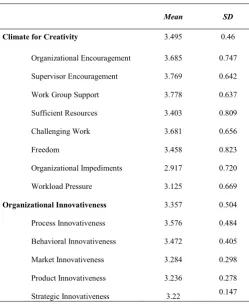
The mean and standard deviations of climate for creativity and its dimensions and organizational innovativeness and its dimensions were shown in Table 1. It is evident that the process innovation was the most common innovation activities among the companies, followed by behavioral innovation and product innovation. Market innovation and Strategic innovation were the least common. However, it is interesting to observe that innovation activities were still not encouraging since the highest mean is slightly above 3.5 which indicate very slight inclination to ‘Agree’. The higher value of standard deviation for process innovation indicates high variability among responses.
[image:3.595.309.559.279.586.2]Work support group has the highest mean of 3.778 followed by supervisor encouragement, organizational encouragement, and challenging work. Organizational impediment has the lowest mean of 2.917 (SD=0.720).
TABLE I. MEAN AND STANDARD DEVIATIONS
Mean SD
Climate for Creativity 3.495 0.46
Organizational Encouragement 3.685 0.747 Supervisor Encouragement 3.769 0.642 Work Group Support 3.778 0.637 Sufficient Resources 3.403 0.809 Challenging Work 3.681 0.656
Freedom 3.458 0.823 Organizational Impediments 2.917 0.720
Workload Pressure 3.125 0.669
Organizational Innovativeness 3.357 0.504
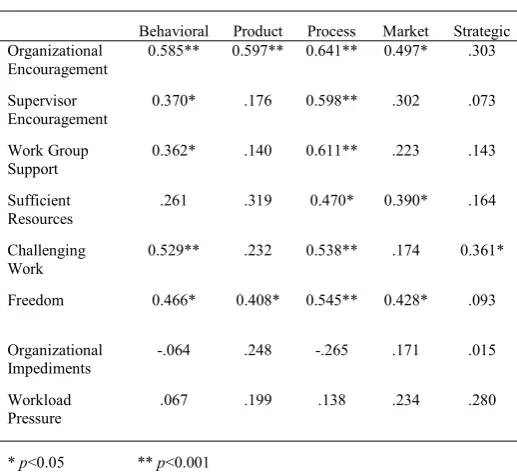
TABLE II. CORRELATIONS
Behavioral Product Process Market Strategic Organizational
Encouragement 0.585** 0.597** 0.641** 0.497* .303 Supervisor
Encouragement
0.370* .176 0.598** .302 .073 Work Group
Support
0.362* .140 0.611** .223 .143 Sufficient
Resources
.261 .319 0.470* 0.390* .164 Challenging
Work
0.529** .232 0.538** .174 0.361* Freedom 0.466* 0.408* 0.545** 0.428* .093 Organizational
Impediments
-.064 .248 -.265 .171 .015 Workload
Pressure .067 .199 .138 .234 .280 * p<0.05 ** p<0.001
Pearson correlations were conducted to determine the correlations among constructs as shown in Table II. Organizational encouragements and freedom were significantly correlated with all types of innovations except for strategic innovation. In fact, only challenging work is the only dimension of climate for creativity that significantly correlated with strategic innovation. Process innovation has majority of significant correlations with dimensions of climate for creativity except for organizational impediments and workload pressure.
Multiple linear regressions were used to analyze the relationship between climate for creativity and organizational innovativeness. Prior to performing the regression, assumptions of normality, homoscedasticity, independence of errors and linearity were tested. Table III shows the effect of climate for creativity on different dimensions of organizational innovativeness. Fifty one percent of climate for creativity explained process innovation while climate for creativity accounts for 32.2% of variance in behavioral innovation, 20% of market innovation and 19% of product innovation.
Climate for creativity is significantly related to four dimensions of organizational innovativeness except for strategic innovation.
TABLE III. REGRESSIONRESULTS Climate for Creativity R2 B Sig.
Product 0.190 0.461 0.005* Process 0.511 0.725 0.001* Behavioral 0.322 0.568 0.001* Market 0.200 0.472 0.004* Strategic 0.075 0.320 0.107
* Significant at p < 0.05
V. DISCUSSION AND CONCLUSIONS
Despite the exploratory nature of this study, its findings substantiate previous studies on the importance of climate for creativity on organizational innovativeness [10][37][33][38]. Different dimensions of organizational climate seem to affect different types of organizational innovativeness. Looking at constructs’ measure of central tendency, it is clear that process innovation has had higher mean compared to other types of innovation and strategic innovativeness seems to have the lowest mean. This could indicate that SMEs in Malaysia have been focusing more on process innovation but not the product and strategic innovations. It should be acknowledged that all means are very much relative to each other and concentrated in the middle. This finding confirms with the National Survey of Innovation which find that SMEs are mostly non-innovating.
Correlation coefficients among dimensions of climate for creativity and dimensions of organizational innovativeness revealed illuminating results. Organizational encouragement and freedom are important dimensions to stimulate all the four types of organizational innovativeness except strategic innovativeness. Since strategic innovativeness is very much depended on the SME’s owner-managers ability to envision future strategies and cleaver positioning of their role in the present and future market, this finding somehow point out this capability deficiency. Challenging work, despite compelling evidence on its importance on innovativeness, influences only process, behavioral and strategic innovations. Furthermore, these findings indicate the importance of further scrutiny on the roles of each dimensions comprises the climate for creativity on different types of organizational innovativeness.
Nonetheless, the effect of climate for creativity in its entirety has been quite large on the total sum of organizational innovativeness. Thus, its roles should not be ignored. Future studies should address various limitations posed by the present study especially in terms of sample size and research design. Nonetheless, this study offers insights for further future validation on the hypothesized relationship.
ACKNOWLEDGMENT
The authors would like to thank the Universiti Tun Hussein Onn Malaysia for the financial assistance and Ms Anis Fadzlina Borhanudin for the data collection assistance.
REFERENCES
[1] F. Barron, Creativity and Personal Freedom. Princeton NJ: Van Nostrand, 1968.
[2] J. Jansson, A. Marell, and A. Nordlund, “Green consumer behavior: determinants of curtailment and eco-innovation adoption,” J. Consum. Mark., vol. 27, no. 4, pp. 358–370, Jun. 2010. [3] T. Khalil, Management of Technology. McGraw-Hill Education
(India) Pvt Limited, 2009, p. 483.
[4] T. M. Amabile, “Creativity and Innovation in Organization,”
[image:4.595.33.292.63.299.2][5] R. K. Jain and H. C. Triandis, Management of Research and Development Organizations: Managing the Unmanageable. John Wiley & Sons, 1997.
[6] T. Yamada, “Innovation at GlaxoSmithKline: is it the safest way?: How to ensure creativity enhances your business without
threatening the bottom line,” Strateg. Dir., vol. 20, no. 7, pp. 16–18, 2004.
[7] S. Stevens, “Toshiba sparks a wave of innovation: New structures and incentives stimulate employee creativity,” Hum. Resour. Manag. Int. Dig., vol. 14, no. 6, pp. 5–7, 2006.
[8] Z. A. Acs and D. B. Audretsch, Innovation and Small Firms. MIT Publisher, 1990, p. 220.
[9] Z. J. Acs and D. B. Audretsch, “Entrepreneurship and Innovation,” no. May, 2005.
[10] M. Ismail, “Creative climate and learning organization factors: their contribution towards innovation,” Leadersh. Organ. Dev. J., vol. 26, no. 8, pp. 639–654, 2005.
[11] T. Mazzarol, “The Impact of Leadership on Organisational Innovation Performance among Malaysia’s Multimedia Super Corridor (MSC) SME,” no. December, 2010.
[12] M. Klijn and W. Tomic, “A review of creativity within
organizations from a psychological perspective,” J. Manag. Dev., vol. 29, no. 4, pp. 322–343, 2010.
[13] “National Survey of Innovation 2005-2008.” [Online]. Available: http://www.mastic.gov.my/documents/10156/6c742042-d9c7-4d3a-bc4b-67ce3a26ea57. [Accessed: 07-Feb-2014].
[14] J. A. Schumpeter, The Theory of Economic Development. Cambridge: Harvard University Press, 1934.
[15] OECD, Oslo manual. European Commission, 2005. [16] “The Development and Validation of the Organisational
Innovativeness Construct Using Confirmatory Factor Analysis .” [Online]. Available: http://digirep.rhul.ac.uk/file/ae467650-fbe0-797a-008e-e1db36432da1/1/Wang C EJIM-Org Innovativeness final.pdf. [Accessed: 07-Feb-2014].
[17] J. C. Naranjo-Valencia, D. Jiménez-Jiménez, and R. Sanz-Valle, “Innovation or imitation? The role of organizational culture,”
Manag. Decis., vol. 49, no. 1, pp. 55–72, Aug. 2011. [18] A. Skuza and H. G. Woldu, “Individual, Organizational, and
Managerial Predictors of Organizational Innovation: The Case of Poland,” J. Transnatl. Manag., vol. 17, no. 1, pp. 4–20, Jan. 2012. [19] P. Geroski, S. Machin, and J. Van Reenen, “The Profitability of
Innovating Firms,” RAND J. Econ., vol. 24, no. 2, pp. 198–211, 1993.
[20] “Why Sustainability Is Now the Key Driver of Innovation - Harvard Business Review.” [Online]. Available: http://hbr.org/2009/09/why-sustainability-is-now-the-key-driver-of-innovation/. [Accessed: 07-Feb-2014].
[21] “Innovation for Sustainability: Implementation challenges.” [Online]. Available:
http://www.imd.org/research/challenges/implementation-challenges-aileen-ionescu-francisco-szekely.cfm. [Accessed: 07-Feb-2014].
[22] H. Urbancova, “Competitive Advantage Achievement through Innovation and Knowledge,” J. Compet., vol. 5, no. 1, pp. 82–96, Mar. 2013.
[23] N. H. Abdullah, E. Wahab, and A. Shamsuddin, “Human resource management practices as predictors of innovation among Johor SMEs,” in 2010 International Conference on Science and Social Research (CSSR 2010), 2010, pp. 872–877.
[24] E. Group and P. Limited, “Creating a culture of innovation: How can small and medium-sized enterprises (SME) compete?,” Dev. Learn. Organ., vol. 27, no. 2, pp. 26–29, 2013.
[25] S. G. Scott and R. A. Bruce, “Determinants Of Innovative Behavior: A Path Model Of Individual Innovation In The Workplace.,” Acad. Manag. J., vol. 37, no. 3, pp. 580–607, Jun. 1994.
[26] I. Submission, “A Preliminary Investigation on Leadership and Product Innovations among SMEs.”
[27] B. Michaelis, R. Stegmaier, and K. Sonntag, “Shedding light on followers’ innovation implementation behavior: The role of transformational leadership, commitment to change, and climate for initiative,” J. Manag. Psychol., vol. 25, no. 4, pp. 408–429, 2010. [28] H. M. Trice and J. M. Beyer, The Cultures of Work Organizations.
Prentice Hall, 1993, p. 510.
[29] R. Stringer, Leadership and Organizational Climate. Prentice Hall, 2001, p. 308.
[30] “What is the Difference between Organizational Culture and Organizational Climate? A Native’s Point of View on a Decade of Paradigm Wars.” [Online]. Available:
http://www.tamu.edu/faculty/bergman/denison1996.pdf. [Accessed: 07-Feb-2014].
[31] The Handbook of Organizational Culture and Climate. SAGE, 2011, p. 650.
[32] B. Schneider, M. G. Ehrhart, and W. H. Macey, “Organizational climate and culture.,” Annu. Rev. Psychol., vol. 64, pp. 361–88, Jan. 2013.
[33] J. Dul and C. Ceylan, “Work environments for employee creativity.,” Ergonomics, vol. 54, no. 1, pp. 12–20, Jan. 2011. [34] M. Mostafa, “Factors affecting organisational creativity and
innovativeness in Egyptian business organisations: an empirical investigation,” J. Manag. Dev., vol. 24, no. 1, pp. 7–33, 2005. [35] R. Sun, J. Zhao, and X. Y. Chen, “Exploratory analysis about the
status quo and differences of organizational innovative climate in China,” Nankai Bus. Rev. Int., vol. 2, no. 2, pp. 195–212, 2011. [36] T. M. Amabile, “The social psychology of creativity: A
componential conceptualization.”
[37] F. J. L. Montes, A. R. Moreno, and L. M. M. Fernández, “Assessing the organizational climate and contractual relationship for perceptions of support for innovation,” Int. J. Manpow., vol. 25, no. 2, pp. 167–180, 2004.