School of Information Technology & Mathematical Sciences
Division of Information Technology, Engineering and the Environment
An evidence-based cloud
incident handling framework
By
Nurul Hidayah Ab Rahman
Principal Supervisor: Associate Professor Kim-Kwang Raymond Choo
Co-Supervisor: Professor Andy Koronios
A thesis submitted for the degree of
Doctor of Philosophy
ii
Table of contents
Table of contents ... ii
List of figures ... vi
List of tables ... vii
Abbreviations ... viii
Abstract ... x
Declaration ... xii
Acknowledgements ... xiii
1 Introduction ... 1
1.1 Research background ... 1
1.2 Problem statement ... 2
1.3 Research aim and questions ... 3
1.4 Research scope ... 4
1.5 Structure of the thesis ... 4
2 Information security incident handling: An overview ... 7
2.1 Incident handling: A survey... 7
2.1.1 Standards and guidelines ... 9
2.1.2 Related works ... 11
2.2 The main phases of incident handling... 17
2.2.1 Preparation ... 17
2.2.2 Detection and analysis ... 18
2.2.3 Incident response ... 18
2.2.4 Post-incident ... 19
2.3 The role of digital forensics in incident handling... 20
2.4 Discussion ... 26
2.4.1 Current research trends ... 26
2.4.2 Are we cloud ready? ... 32
2.4.3 A conceptual cloud incident handling framework ... 38
2.5 Chapter summary ... 44
3 Users’ perception of implications of the cloud to incident handling and digital forensics ... 45
iii
3.1.1 Routine Activity Theory ... 46
3.1.2 Data collection and analysis ... 47
3.1.3 Cyber threat landscape from a RAT perspective ... 49
3.1.3.1 Motivation ... 49
3.1.3.2 Opportunity ... 50
3.1.3.3 Guardianship ... 52
3.1.4 Discussion ... 56
3.2 Factors influencing the adoption of cloud incident handling strategy: A preliminary study in Malaysia ... 59
3.2.1 Conceptual model and hypotheses ... 60
3.2.2 Instrument design ... 63
3.2.3 Data collection ... 66
3.2.4 Data analysis and results ... 67
3.2.4.1 Demographic analysis ... 67
3.2.4.2 Construct validity and reliability analysis ... 69
3.2.4.3 Hypotheses testing ... 70
3.2.5 Discussion ... 72
3.3 Chapter summary ... 75
4 Cloud incident handling: The framework ... 77
4.1 Background of the study ... 77
4.1.1 Cloud computing infrastructure ... 77
4.1.2 Incident handling in cloud computing ... 79
4.2 Cloud incident handling framework: A snapshot ... 80
4.3 Case study simulation: ownCloud ... 83
4.3.1 Preparation and forensic readiness ... 84
4.3.2 Identification ... 85
4.3.3 Assessment, forensic collection and analysis ... 86
4.3.4 Action and monitoring ... 88
4.3.5 Recovery ... 89
4.3.6 Evaluation and forensic presentation ... 90
4.4 Chapter Summary ... 93
5 Validation of the cloud incident handling framework: Cloud storage as a case study ... 94
5.1 Understanding the security responsibility of CSP and CSU... 94
5.1.1 Related work ... 98
iv
5.2.1 Experiment procedures ... 100
5.2.2 Assessment, forensic collection and analysis procedures ... 101
5.3 Results ... 103
5.3.1 Preliminary incident assessment ... 104
5.3.2 Examining and analysing app databases ... 105
5.3.2.1 Dropbox... 106
5.3.2.2 Google Drive ... 107
5.3.2.3 OneDrive ... 108
5.3.2.4 Cache files and clearing traces ... 109
5.3.3 Network packet analysis ... 110
5.4 Discussion ... 114
5.5 Chapter summary ... 116
6 Validation of the framework: The role of mobile forensics in terrorism investigations ... 117
6.1 The possible use of smart mobile technology in terrorism activities ... 117
6.2 Experimental setup and procedures ... 120
6.3 Assessment, forensic collection and analysis of mobile comm. apps ... 121
6.3.1 Account artefacts ... 121
6.3.2 Contact artefacts ... 122
6.3.3 Chat log ... 123
6.3.4 Shared media or document artefacts ... 125
6.3.5 Sharing location data ... 126
6.3.6 Network log analysis ... 126
6.3.7 Summary of findings ... 129
6.4 Chapter summary ... 133
7 Importance of forensic-by-design: Using Cyber-Physical Cloud System as a discussion ... 134
7.1 Background of the Cyber-Physical Cloud System (CPCS) ... 134
7.2 Security breach: A matter of ‘when’ not ‘if’ ... 136
7.3 The needs of forensic-by-design... 137
7.4 Related work ... 138
7.4.1 Digital forensics readiness ... 138
7.4.2 System security engineering ... 140
7.5 Conceptual forensic-by-design framework for CPCS ... 141
v
7.7 Chapter summary ... 147
8 Conclusion ... 149
8.1 Research aim and questions ... 149
8.1.1 Research aim ... 149
8.1.2 Research questions ... 149
8.2 Contributions of the study ... 152
8.2.1 Theoretical ... 152
8.2.2 Application ... 152
8.2.3 Policy ... 153
8.3 Limitations and recommendations ... 153
References ... 155
Appendix A List of publications ... 181
Appendix B Survey questions (Part 1) ... 183
Appendix C Survey questions (Part 2) ... 186
Appendix D List of GovDocs1 dataset ... 196
Appendix E Samples of cloud storage tables ... 198
vi
List of figures
Figure 1 What is incident management? ... 8
Figure 2 Degree of proactiveness ... 13
Figure 3 Incident handling phases and research areas ... 17
Figure 4 The main digital forensics activities in the incident handling ... 23
Figure 5 Generated keywords from publications ... 27
Figure 6 Categorisation of cloud security challenges ... 33
Figure 7 Conceptual cloud incident handling framework ... 39
Figure 8 Job role of respondents ... 48
Figure 9 Incident classification and percentages of informants ... 49
Figure 10 Conceptual Model ... 62
Figure 11 Survey participant by industry type ... 67
Figure 12 Cloud deployment model reported by survey participants ... 68
Figure 13 Cloud architecture reported by survey participants ... 68
Figure 14 The scope of control between CSP and CSU on cloud computing architecture ... 78
Figure 15 The refinement cloud incident handling framework ... 81
Figure 16 An event of password detected unencrypted ... 86
Figure 17 Suspicious network packet ... 87
Figure 18 An overview of the Assessment phase ... 88
Figure 19 Simulation of file sharing activities ... 100
Figure 20 Flowchart of capture of network packets experiments ... 101
Figure 21 Example of malware warning (Google Drive screenshot) ... 104
Figure 22 Example of result from antivirus tool ... 104
Figure 23 An example of a Dropbox network packet ... 111
Figure 24 Comparison of the number of packets between anonymous and non-anonymous networks ... 112
Figure 25 Example of result from keyword searches on Google Drive packets ... 113
Figure 26 Flowchart of capturing network packets experiments ... 121
Figure 27 Example of WhatsApp user preferences XML code fragments ... 122
Figure 28 No result using ‗Telegram‘ keywords ... 127
Figure 29 Related network packet on Telegram ... 128
vii
List of tables
Table 1 Comparative summary of incident handling models in international standards
and guidelines ... 15
Table 2 Comparative summary of academic incident handling model ... 16
Table 3 Comparative summary of digital forensic models ... 24
Table 4 Research areas and themes in incident handling ... 28
Table 5 Research areas and themes in digital forensic ... 31
Table 6 Summary of incident handling issues for the cloud and potential mitigation strategies ... 36
Table 7 Conceptual cloud incident handling framework ... 41
Table 8 Region and industry type of respondents ... 47
Table 9 The identified information security management elements ... 53
Table 10 The identified proactive and reactive technical solutions ... 54
Table 11 SA level and the relevance PMT factors ... 62
Table 12 Measurement Items ... 65
Table 13 Interview participants‘ information ... 66
Table 14 Factor loading based on principle component analysis with Varimax ... 69
Table 15 Correlation coefficients and descriptive statistics ... 71
Table 16 Multiple regression model predicting incident handling strategy adoption ... 72
Table 17 An Example of insecure SSH connection attempt event ... 86
Table 18 Security practices based on Situational Crime Prevention Theory ... 91
Table 19 A snapshot of potential evidence in cloud services ... 97
Table 20 Experiment specifications ... 99
Table 21 Summary of actions ... 103
Table 22 Sender and receiver account artefacts from Account.db ... 106
Table 23 Example of Dropbox upload log ... 106
Table 24 Metadata for Dropbox ... 107
Table 25 Metadata of Google Drive ... 108
Table 26 Metadata of OneDrive ... 108
Table 27 Permission_scopes table ... 109
Table 28 Permission_entity table ... 109
Table 29 Clearing trace artefacts for cloud storage services ... 110
Table 30 Summary of evidence artefacts from cloud storage apps ... 114
Table 31 Hardware and software specifications ... 120
Table 32 Metadata of qik_main.db ... 122
Table 33 Metadata of main.db account ... 122
Table 34 Accounts metadata ... 123
Table 35 Metadata of messages table (Viber) ... 124
Table 36 Example of Telegram chat history ... 124
Table 37 Metadata of group_participants (WhatsApp) ... 125
Table 38 An example of Viber network event ... 126
Table 39 Share media activities on Viber ... 127
Table 40 Share media activities on Telegram ... 127
Table 41 Summary of communication apps findings ... 130
viii
Abbreviations
API Application Programming Interface
Apps Applications
CPCS Cyber-Physical Cloud System
CPS Cyber-Physical System
CSA Cloud Security Alliance
CSIRT Computer Security Incident Response Team
CSP Cloud Service Provider
CSU Cloud Service User
DFR Digital Forensic Readiness
EFA Exploratory Factor Analysis
ENISA European Network and Information Security Agency
FBD Forensic by Design
FTP File Transfer Protocol
IaaS Infrastructure as a Service
ICT Information and Communications Technology
IDS Intrusion Detection System
IHSA Incident Handling Strategy Adoption
IPS Intrusion Prevention System
IS Information Security
ISO International Organization for Standardization
KMO Kaise-Mayer-Olkin
NIST National Institute of Standards and Technology
OBU On Board Unit
OSSIM Open Source Security Information and Event Management
ix PMT Protection Motivation Theory
PSEV Perceived Severity
PVUL Perceived Vulnerability
RAT Routine Activity Theory
RCO Response Cost
REF Response Efficacy
RSU Road Side Unit
SA Situational Awareness
SaaS Software as a Service
SEF Self-efficacy
SIEM Security Information and Event Management
SMTP Simple Mail Transfer Protocol
SSH Secure Shell
StaaS Storage as a Service
VANET Vehicular Ad Hoc Network
VM Virtual Machine
x
Abstract
Cloud computing is increasingly adopted by both individual and organisational users;
thus, ensuring the security and privacy of data stored in the cloud is a crucial
requirement in an organisation‘s business continuity and risk assessment strategies. An
incident handling strategy is key to mitigating risks to the confidentiality, integrity and
availability of information assets, particularly those outsourced to the cloud located in
one or more different countries. Thus, organisational cloud users may face challenges
or be limited in their capability to handle security incidents (e.g. security breaches) on
their sites since the infrastructure on which the data resides belongs to the cloud
providers.
Surveys were conducted with industry practitioners to identify: (1) the implications of
emerging technologies and its information security threats on the incident handling
practices, and (2) the factors influencing incident handling adoption for organisational
cloud users. The results indicated that the current landscape of information security
threats have impacted on their security strategic planning, resulting in practitioners
being more proactive, requiring better tactical tools, and cultivating a culture of
information security. The factors identified as having a significant influence on the
adoption were determined using an integration of Situational Awareness and Protection
Motivation Theory. Users are more likely to adopt if they are aware of cloud security
and privacy related risks, confident in their capability, understand the benefits, and
understand the impact due to an ineffective strategy.
The cloud incident handing framework presented in this thesis draws upon principles
and practices from both incident handling and digital forensics. The integration of
digital forensic principles and practices facilitates the collection of digital evidence,
reconstructing of events and establish facts of who, what, when, where, how, and why
an incident took place. The framework consists of six phases, namely: Preparation
(integrated with forensic readiness principles); Identification; Assessment (integrated
with forensic collection and analysis practices); Action and Monitoring; Recovery; and
Evaluation (integrated with forensic presentation practices). A feasibility study was
conducted that simulates private cloud storage (i.e. ownCloud) in a virtual environment.
A security information and event management tool was used to demonstrate that each
xi
This framework was also validated using two case studies: mobile cloud storage
(Google Drive, Dropbox, and OneDrive) and mobile communication (Viber, Telegram,
Skype, WhatsApp and Messenger) applications. Both studies simulated typical user
activities on the studied applications on the Android platform. Mobile forensics and
network tools were deployed for the collection and analysis of evidence artefacts. The
first case study simulated uploads, share, read and download files. The artefacts were
then analysed based on the activities. The second case study was setting up the scenario
of terrorists‘ use of mobile communication applications by simulating chat
conversation, adds contacts, and shared media files activities. The artefacts were
classified into accounts, contacts, chat logs, shared media files, and location data to
facilitate terrorism investigations.
This research has shown that the framework supports organisational users in both the
incident handling and forensic investigations, as well as informing the design of security
xii
Declaration
This thesis presents work carried out by myself and does not incorporate without
acknowledgment any material previously submitted for a degree or diploma in any
university; to the best of my knowledge it does not contain any materials previously
published or written by another person except where due reference is made in the text;
and all substantive contributions by others to the work presented, including jointly
authored publications, are clearly acknowledged.
Nurul Hidayah Ab Rahman
xiii
Acknowledgements
I am very thankful and grateful to have crossed paths with many wonderful people who
have helped me in many ways in my pursuit of a PhD at the School of Information
Technology and Mathematical Sciences, University of South Australia.
Foremost, I would like to express my gratitude to my principal supervisor, Associate
Professor Kim-Kwang Raymond Choo, and co-supervisor, Professor Andy Koronios,
for their supervision and advice from the very early stages of this study through to the
completion of this thesis. Their guidance and support have been of great value.
Special thanks go to my co-authors, family, friends, Research Education Advisers from
the Teaching Innovation Unit, and all the Information Assurance Research Lab
members, who have helped and supported me over these years.
This study was financed with the aid of scholarships from the Ministry of Education in
Malaysia and the Universiti Tun Hussein Onn Malaysia, and I would like to thank them
1
1
Introduction
1.1 Research background
The pervasive interconnectivity of systems (e.g. cloud computing and Internet of
Things) used in our Internet-connected society can potentially be, and have been,
exploited by actors with malicious intents, ranging from cyber criminals acting alone to
organised groups of financially-, criminally- and issue/ideologically-motivated crime
groups to state-sponsored actors (Choo 2011). It is not surprising that information
security incidents are increasing in both number and the level of sophistication. For
example, Symantec Corporation (2016) reported that more than 430 million new types
of malware were discovered, the number of spear-phishing attacks targeting employees
increased 55 percent, and crypto-style ransomware grew 35 percent in the fiscal year
2015. Of note, the report highlighted that security incidents moved to new targets such
as smart phones, Mac and Linux systems, and cloud computing environments.
The increasing trend of organisations moving sensitive data to cloud infrastructure has
resulted in an urgent need to ensure that security and privacy safeguards are in place, as
cloud services are potential criminal targets due to the amount of sensitive
organisational data stored in the cloud. As surveyed by the Cloud Security Alliance
(CSA) (2016), industry experts identified 12 critical issues to cloud security with data
breaches, poor credential management, and insecure application programming interfaces
(APIs) being the top three. A proactive incident handling strategy is one key approach
to mitigating risks to the confidentiality, integrity and availability (CIA) of assets, as
well as minimising loss (e.g. financial, reputational and legal) in a dynamic cloud
environment. Existing information security incident handling strategies, however, may
not be adequate as cloud data would generally be virtualised, geographically distributed
and ephemeral, presenting both technical and jurisdictional challenges. This is
2
Cloud Computing‘, which highlights three critical focus areas, namely Incident
Response, Notification and Remediation (Cloud Security Alliance 2011).
In investigating and responding to computer security incidents, digital forensics can
play a crucial role (Cichonski et al. 2012; Freiling & Schwittay 2007; Gurkok 2013).
Forensic tools and techniques are not only useful for criminal prosecution in a court of
law, but also for various other tasks within an organisation, such as event reconstruction
(i.e. who, what, when, where, how, and why an incident took place), data or system
recovery, and system operation troubleshooting (Kent et al. 2006). Similarly, incident
handling is not only for responding to incidents, but more importantly, identifying the
root causes to prevent similar breaches from reoccurring. Therefore, incorporating
forensically sound practices in an incident handling strategy would support cloud
service users (CSUs) to be better prepared, more proactive, and forensically ready when
analysing an incident.
In this thesis, an evidence-based cloud incident handling framework that integrates
digital forensic practices into incident handling strategies is presented, which is
designed to allow organisational cloud service users to respond to and investigate
incidents more effectively.
1.2 Problem statement
A successful security incident occurrence or breach can cause direct (e.g. theft of
intellectual property or customer data) and/or indirect losses (e.g. reputational or legal)
to organisation assets, and can have significant financial implications. Cloud service
users (CSUs) and cloud service providers (CSPs) are increasingly at risk of cyber
incidents, both intentional and unintentional, and by both individuals and organised
groups (Choo 2010; Hooper, Martini & Choo 2013; Martini & Choo 2012).
Despite the associated security risks, organisations benefit from migrating to
cloud-based services such as cost-effectiveness, scalability, and flexibility. Hence, engaging a
strategy to handle security incidents is the key to striking a balance between
cost-effectiveness and security controls. Both CSPs and CSUs may find that ‗traditional‘
incident handling procedures are not fit-for-purpose due to the challenges posed by the
nature of cloud infrastructure such as scope of user control, location and
3
2015; Yang et al. 2015). For example, a security incident of the hacking of Sony‘s
network in 2011 was attributed to a hacker who rented the Amazon EC2 service
(Ouedraogo & Mouratidis 2013). Another high profile incident is the iCloud data breach
that resulted in the dissemination of nude photos and videos of popular celebrities
(Apple Press Info 2014). The incident has generally affected the reputation of the cloud
service provider even though Apple‘s investigation revealed that the breach was not a
result of their system flaws.
Furthermore, the requirements and challenges of the incident handling principles faced
by CSUs and CSPs are likely to differ, for example in terms of how and where to collect
potential evidence and undertake post-incident investigation. Various studies have
examined the challenges posed by cloud computing (Birk & Wegener 2011; Grobauer
& Schreck 2010; Martini & Choo 2013; Monfared & Jaatun 2011a, 2011b; Quick &
Choo 2013a, 2013b, 2013c, 2014; Ruan et al. 2011).When this research commenced in
mid-2013, there were relatively few academic publications, suggesting that research in
the area of cloud incident handling is somewhat elusive and still in its infancy.
1.3 Research aim and questions
The aim of this research is to design, develop, and validate an evidence-based cloud
incident handling framework. This study consists of one overarching research question
and three sub-research questions. The main research question is: How should security
incidents for organisational cloud users is handled effectively?
The following sub-questions must be answered in order to address the above main
question.
a) What are the impacts of cloud computing infrastructure on incident handling
strategies (including post-incident investigations)?
b) Are changes to existing incident handling strategies required to better
support organisational cloud users, and if so, what changes are required?
4
1.4 Research scope
The focus of this research was narrowed to the development and validation of the cloud
incident handling framework. The framework is generally involves phases such as
preparation, detection and analysis, incident response and post incident, which will be
further discussed in Chapter 4. Technical experiments were conducted in a controlled
environment such as virtual machine and mobile platform for framework validation.
1.5 Structure of the thesis
This thesis is organised into eight chapters. The following provides an overview of the
structure.
Chapter 2 introduces information security incident handling, and discusses the role of digital forensics in incident handling, current research trends, and challenges posed by
cloud computing to the landscape of incident handling. Subsequently, a high-level
conceptual cloud incident handling framework is proposed.
Material presented in this chapter has appeared in the following publication:
Ab Rahman, NH & Choo, K-KR 2015, ‗A Survey of Information Security Incident Handling in the Cloud‘, Computers & Security, vol. 49, pp. 45–69.
Chapter 3 presents a study in two parts, undertaken to obtain viewpoints from industry practitioners. The first part was conducted to identify the challenges of emerging threats
to incident handling and digital forensics by utilising Routine Activity Theory. In the
second part, a conceptual model that draws upon the Situational Awareness Model and
the Protection Motivation Theory was applied to identify the factors influencing the
adoption of incident handling in the cloud.
Material presented in this chapter has appeared in the following publications:
Ab Rahman, NH & Choo, K-KR 2015, ‗Factors influencing the adoption of cloud incident handling strategy : A preliminary study in Malaysia‘, in
Proceedings of 21st Americas Conference on Information Systems (AMCIS
2015).
Ab Rahman, NH, Kessler, G, and Choo, K-KR 2016. ‗Implications of emerging
5
activity theory‘, in K-KR Choo & A Dehghantanha (eds), Contemporary Digital
Forensic Investigations of Cloud and Mobile Applications, Syngress, an Imprint
of Elsevier [In press].
Chapter 4 demonstrates the feasibility of the framework using an ownCloud (open source private Storage as a Service (StaaS) solution) case study simulation. It also
explains how the Situational Crime Prevention Theory can be used in the framework to
design mitigation strategies.
Material presented in this chapter has appeared in the following publication:
Ab Rahman, NH & Choo, K-KR 2015, ‗Integrating Digital Forensic Practices in Cloud Incident Handling: A Conceptual Cloud Incident Handling Model‘, in R
Ko & K-KR Choo (eds), Cloud Security Ecosystem, Syngress, an Imprint of
Elsevier, Waltham, MA, pp. 383–400.
Chapter 5 validates the framework using mobile cloud storage as a case study. Three popular cloud storage applications were deployed, namely Dropbox, Google Drive, and
OneDrive. The utility of the framework was demonstrated for organisational cloud users
to undertake incident investigations (e.g. collect and analyse residual data from cloud
storage applications).
Material presented in this chapter has appeared in the following publication:
Ab Rahman, NH, Cahyani, NDW & Choo, KKR 2016, ‗Cloud incident handling
and forensic-by-design: cloud storage as a case study‘, Concurrency and
Computation: Practice and Experience. DOI:
http://dx.doi.org/10.1002/cpe.3868
Chapter 6 presents further validation of the framework using mobile communication applications as a case study. Five applications were deployed, namely WhatsApp,
Telegram, Skype, Messenger and Viber. A scenario of the possible use of smart mobile
technology in terrorism activities was considered. Common user activities were
simulated to examine the potential evidence artefacts and their association with incident
6
Material presented in this chapter has appeared in the following publications:
Cahyani, NDW, Ab Rahman, NH, Xu, Z, Glisson, WB and Choo, K-K R 2016, ‗The role of mobile forensics in terrorism investigations involving the use of
cloud apps‘, in Proceedings of the 9th International Conference on Mobile
Multimedia Communications (MOBIMEDIA 2016),[In press].
Cahyani, NDW, Ab Rahman, NH, Glisson, WB and Choo, K-K R 2016, ‗The
role of mobile forensics in terrorism investigations involving the use of cloud
apps and communication apps‘, Journal of Mobile Networks and Applications,
[In press].
Chapter 7 explores the importance of forensic-by-design (FBD) principles into a system or architecture. The concept of FBD is proposed as future work to ensure more
proactive incident handling activities. Cyber-Physical Cloud System (CPCS)
infrastructure is used as a discussion to illustrate the concept.
Material presented in this chapter has appeared in the following publication:
Ab Rahman, NH, Glisson, WB, Yang, Y & Choo, K-KR 2016,
‗Forensic-by-Design Framework for Cyber-Physical Cloud Systems‘, IEEE Cloud
Computing, vol. 3, no. 1, pp. 50–59.
Chapter 8 presents the key findings and implications of this research, and highlights the scope for future research.
The thesis also includes a number of appendices that contain additional information in
support of the main discussion, including a sample questionnaire and a sample of
SQLite database acquisition results.
7
2
Information security incident handling: An
overview
This chapter presents an insight into incident handling in the domain of information
security and cloud computing, commencing by establishing definitions of incident
management, incident handling, and incident response. It continues by discussing the
common phases in incident handling and the role of digital forensics in incident
handling. The next part discusses research trends based on the located materials, and
follows with challenges posed by cloud computing to the landscape of incident
handling. Subsequently, a high-level conceptual cloud incident handling framework is
proposed.
Material presented in this chapter has appeared in the following publication:
Ab Rahman, NH & Choo, K-KR 2015, ‗A Survey of Information Security Incident Handling in the Cloud‘, Computers & Security, vol. 49, pp. 45–69.
2.1 Incident handling: A survey
Information security management is relatively mature, as evidenced by the number of
international standards and guidelines, as well as the academic literature on the topic.
Despite the maturity of this area, there is a lack of consistency in describing incident
management, incident handling, and incident response in the literature. This section
presents the distinctions between these terminologies, as explained in the remainder of
8
Figure 1 What is incident management? (Adapted from: Alberts et al. 2004; British Standards Institution 2007; Cichonski et al. 2012)
As explained by Alberts et al. (2004), incident management is not only about
responding to an incident; it also includes vulnerability handling, artefact handling,
security awareness training, and other related services.
Incident handling consists of incident reporting, incident analysis, and incident response
(Killcrece 2003). Incident response refers to the collective actions taken to resolve or
mitigate an incident, coordinate and disseminate information, and implement follow-up
strategies to prevent future similar incidents. Similarly, the National Institute of
Standards and Technology (NIST) (Cichonski et al. 2012) defines incident handling as
the whole lifecycle that includes incident response. The latter relates to the ability to
react to a security incident.
Grobauer and Schreck (2010) further explain that response should incorporate
containment, eradication, and recovery phases, which is consistent with the proposed
guidelines for Computer Security Incident Response Teams (CSIRT) (Alberts et al.
2004) and NIST (Cichonski et al. 2012). This is the definition adopted in this chapter,
namely incident management is the ‗big picture‘ (as presented in Figure 1) that
comprises incident handling and incident response. The grey boxes in the Figure 1
9
2.1.1 Standards and guidelines
This section briefly describes several key international standards and guidelines, and
our reviews of existing academic incident handling models.
Computer Emergency Response Team Coordination Centre (CERT/CC):
CERT/CC, part of the Software Engineering Institute (SEI), located in Carnegie Mellon
University (CMU), published a series of four guidelines for managing information
security incidents. The Handbook for Computer Security Incident Response Teams
(CSIRT) (West-Brown et al. 2003) is the main publication designed to provide specific
in-depth guidance to support organisations in forming and operating a CSIRT
(West-Brown et al. 2003). The State of the Practice for CSIRTs (Killcrece 2003) is designed to
assist new and existing teams in understanding best practices and recommendations for
handling incidents and related CSIRT services. The Organisational Models for CSIRT
publication (Killcrece et al. 2003) focuses on selecting the right model for an
organisation‘s incident response capabilities. Defining incident management processes
for CSIRTs: A work in progress (Alberts et al. 2004) provides an overview of the
processes and functions, and supporting people, technology, and procedures that are
involved in incident management.
CERT/CC discusses four phases of the incident handling process model (i.e. receiving
an incident report, triage, incident response, and analysing), which consists of 14
sub-phases.
NIST Special Publication (NIST SP 800-61): NIST is a non-regulatory federal agency within the US Department of Commerce. The Computer Security Division of NIST
publishes Special Publications in the 800 series for the computer security community.
SP 800-61 (Cichonski et al. 2012) is one of the 800 series documents that discusses
computer security handling guidelines.
This guideline outlines four incident handling phases, namely (1) preparation, (2)
detection and analysis, (3) containment, eradication, and recovery, and (4) post-incident
activity. In NIST‘s incident handling model, the second (i.e. detection and analysis) and
third (i.e. containment, eradication, and recovery) phases are illustrated as iterative,
10
This guideline includes a detailed description of each phase, and highlights some key
points, such as recommendations for conducting incident analysis, incident
documentation, and the sharing of information between team members and external
parties.
International Organization for Standardization (ISO): ISO/IEC 27035:2011, an ISO information security incident management standard, is designed for large and
medium-sized organisations (ISO 2011). The standard is not limited to incident handling, and
covers processes for managing information security events and vulnerabilities.
Five phases are incorporated in the standard, namely (1) planning and preparation, (2)
detection and reporting, (3) assessment and decision-making, (4) responses, and (5)
lessons learnt. The phases are depicted as a lifecycle, as each phase is connected to the
following phase, including the final phase being linked to the first phase.
This standard also provides a collection of reporting form templates for information
security events, incidents, and vulnerabilities.
European Network and Information Security Agency (ENISA): ENISA is an agency of the European Union (EU) that was established to improve network and
information security in the EU. As an agency of expertise, ENISA is actively
contributing to specific technical and scientific tasks.
The Incident Management Guide is one ENISA publication that provides practical
information and guidelines for the management of incident handling phases (ENISA
2010). The phases consist of six major sequence components, these being (1) incident
report, (2) report registration, (3) triage, (4) incident resolution, (5) incident closure, and
(6) post-analysis. ENISA‘s approach closely follows the CERT/CC approach, except for
the inclusion of incident closure and post-analysis as the final phase. The guideline also
incorporates a formal framework for a Computer Emergency Response Team (CERT),
such as roles, workflows, and basic CERT policies.
SANS Institute: The SANS Institute is a well-known private US company that specialises in Internet Security training. In addition, the SANS research archive is
publicly available, and is referred to as the SANS Reading Room. Many publications in
various computer security areas can be accessed from the Reading Room, including
11
The SANS Incident Handler‘s Handbook (Kral 2011) provides information for IT
professionals and managers to create incident response policies, standards, and teams
for their organisations. It incorporates six phases as follows, (1) preparation, (2)
identification, (3) containment, (4) eradication, (5) recovery, and (6) lessons learnt. This
handbook is quite brief compared to the other five guidelines discussed in this section.
Its contents include a checklist for the incident handler, and guidelines on anomaly
searching for Windows and UNIX operating systems.
Information Technology Infrastructure Library (ITIL): ITILis a set of practices for IT service management (ITSM) that focuses on aligning IT services with the needs of
the organisation. The ITIL publication consists of five volumes, and each one covers an
ITSM lifecycle stage.
BIP 0107:2008—Foundations of IT Service Management Based on ITIL V3 (British
Standards Institution 2007)—is a model for IT service management. Incident
management is one of the service management areas. It consists of five main phases, (1)
incident detection and recording, (2) classification and initial input, (3) investigation
and diagnosis, (4) resolution and recovery, and (5) incident disclosure. These five
phases are described as a process workflow. Event management is another service area
that is closely related to incident management. It is concerned with monitoring events
and detecting any triggered events for the incident management process.
2.1.2 Related works
A number of academic models or frameworks (both terms are used interchangeably)
have been proposed by various authors, who discuss key phases and activities involved
in the incident handling model.
Mitropoulos et al. (2006) proposed a framework that draws upon principles of digital
forensics and incident handling and responses. It comprises six phases, namely (1)
preparation, (2) identification, (3) containment, (4) eradication, (5) recovery and (6)
follow-up. These phases are in line with the existing standards and recommendations,
such as SANS (Kral 2011) and NIST (Cichonski et al. 2012). Another more recent
study (Line 2013), based on the existing ISO/IEC 27035:2011 standard, presented a
qualitative analysis that investigated current practices concerning information security
12
Focusing on small-scale organisations and CSIRT, Kim et al. (2011) proposed a
systematic approach for comprehensive incident handling that focused on bot response,
covering detection, analysis, and response phases. The authors noted that the other
phases of incident handling (i.e. preparation and post-incident) will be expanded on by
large CSIRTs. The model of Khurana et al. (2009) uses a collaborative incident
response and investigation mitigation strategy for multiple sites, which comprises four
parallel phases at two sites (i.e. local and collaborative centre sites). The phase starts
with incident preparation at both sites. It is followed by incident detection and strategy
development at the local site, and in the meantime the collaborative centre starts using
incident analysis once it has received an incident detection report. Both sites then
conduct their investigations independently and finally close the incident collaboratively.
The emergence of cloud computing in recent years has led to several researchers
examining incident handling in the cloud. For example, Grobauer and Schreck (2010)
analysed the challenges and approaches that would be suitable for incident handling and
response in the cloud. The challenges and approaches are examined for the following
five common steps: (1) detection, (2) analysis, (3) containment, (4) eradication and
recovery, and (5) preparation/continuous improvement.
Using an OpenStack environment (Infrastructure as a Service—IaaS) as a case study,
Monfared and Jaatun (2012) demonstrated that the NIST incident handling guideline
can be adapted for deployment in the cloud computing environment by introducing
cloud specific strategies in each of the five phases.
The five key cloud strategies are specific cloud incident handling approaches,
responsible stakeholder(s) for the approaches, service impacted, enforcement
challenges, and specific platform and library dependencies.
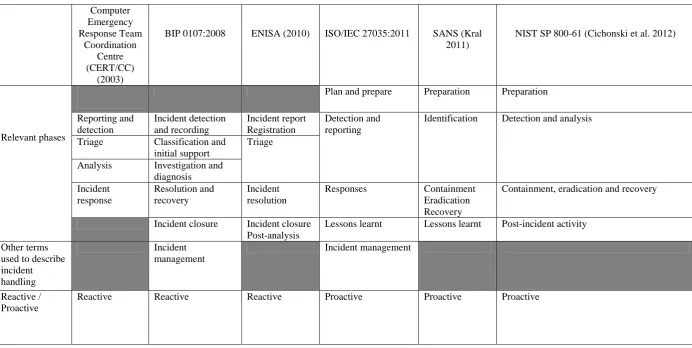
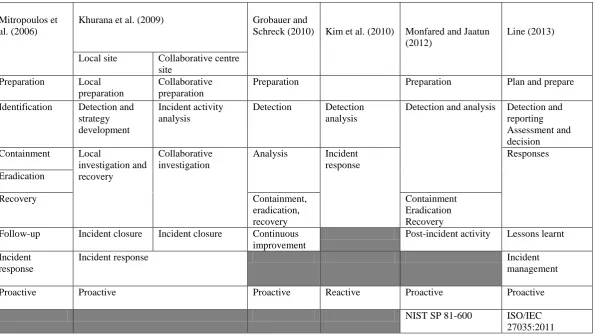
A comparative summary of the six standards and guidelines, and the existing academic
incident handling model is presented in Tables 1 and 2 respectively. As outlined in
Table 1, the standards and guidelines of CERT/CC, BIP 0107:2008 and ENISA are
reactive (i.e. services are triggered by an event or request). Both CERT/CC and ENISA
incorporate incident preparation as part of the incident management framework,
whereas BIP 0107:2008 discusses the issue with reference to event management (other
sub-areas). This is consistent with several other published works (Anuar et al. 2011;
13
other hand, only one academic model is reactive. This particular model, however,
focuses on small-scale incidents. The remaining standards and guidelines in Table 1,
and models in Table 2, incorporate proactive elements (i.e. provide assistance and
information to help prepare, protect, and secure). This is not surprising due to the
changing trend in information security and the threat landscape, which increasingly
requires proactive defence and real-time incident response to defend an organisation
against myriad security issues.
As mentioned earlier, incident response and incident handling have been used
interchangeably in the literature. Two studies in Table 2 used the ‗incident response‘
terminology to describe incident handling activities, in contrast to previous studies and
recommendations (Alberts et al. 2004; Cichonski et al. 2012; Grobauer & Schreck
2010). Despite the use of different terminologies to describe the various phases in the
standards, guidelines, and academic models, four common main incident handling
phases are identified in Tables 1 and 2.
Incident handling generally starts with incident preparation, followed by detection and
analysis of the (detected) incidents, executing response activities, discussing the
incident issues in the post-incident phase, and finally implementing improvements for
future actions. Therefore, the four main phases in incident handling are: (1) preparation,
(2) detection and analysis, (3) incident response (includes containment, eradication, and
recovery), and (4) post-incident. It is further proposed that each phase requires different
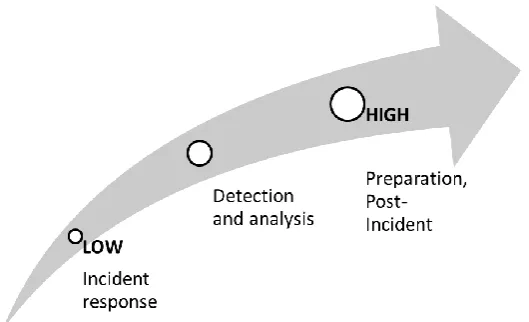
[image:26.595.151.416.528.689.2]degrees of proactiveness, from low (or reactive) to high (see Figure 2).
14
It can be argued that both the preparation and post-incident phases require high degrees
of proactiveness, as both phases actively incorporate mechanisms to prepare, protect
and secure an organisation‘s assets. Incident response is mainly reactive, and the
15
Table 1 Comparative summary of incident handling models in international standards and guidelines Computer Emergency Response Team Coordination Centre (CERT/CC) (2003)
BIP 0107:2008 ENISA (2010) ISO/IEC 27035:2011 SANS (Kral
2011)
NIST SP 800-61 (Cichonski et al. 2012)
Relevant phases
Plan and prepare Preparation Preparation
Reporting and detection Incident detection and recording Incident report Registration Detection and reporting
Identification Detection and analysis
Triage Classification and
initial support
Triage
Analysis Investigation and
diagnosis Incident response Resolution and recovery Incident resolution
Responses Containment
Eradication Recovery
Containment, eradication and recovery
Incident closure Incident closure
Post-analysis
Lessons learnt Lessons learnt Post-incident activity
Other terms used to describe incident handling Incident management Incident management Reactive / Proactive
16
Table 2 Comparative summary of academic incident handling models
Mitropoulos et al. (2006)
Khurana et al. (2009) Grobauer and
Schreck (2010) Kim et al. (2010) Monfared and Jaatun
(2012)
Line (2013)
Relevant phases
Local site Collaborative centre
site
Preparation Local
preparation
Collaborative preparation
Preparation Preparation Plan and prepare
Identification Detection and
strategy development
Incident activity analysis
Detection Detection
analysis
Detection and analysis Detection and reporting Assessment and decision
Containment Local
investigation and recovery
Collaborative investigation
Analysis Incident
response
Responses
Eradication
Recovery Containment,
eradication, recovery
Containment Eradication Recovery
Follow-up Incident closure Incident closure Continuous
improvement
Post-incident activity Lessons learnt
Other terms used to describe incident handling
Incident response
Incident response Incident
management
Reactive / Proactive
Proactive Proactive Proactive Reactive Proactive Proactive
Standard /
guideline adoption
NIST SP 81-600 ISO/IEC
17
2.2 The main phases of incident handling
In this section, the four main phases of incident handling (see Figure 3) are discussed
based on the objective and its key activities.
2.2.1 Preparation
In the preparation phase, the organisation should be in a state of readiness to minimise
the impacts of security incidents, and maintain business continuity (Taylor 2013). The
proactive degree in this phase should be high to ensure that unforeseen or black swan
events (i.e. events due to unexpected and highly unpredictable causes) are prepared for
well. Information Security (IS) management (e.g. IS culture, training, and policy
compliance) is one popular approach to pre-incident preparation, which includes
establishing corporate security policies and regular updates, the incident notification
process, the development of an incident containment policy, creation of incident
handling checklists, a staff training program, and ensuring the security risk assessment
process is functioning and active (Johnson 2014).
From a technological perspective, it is crucial to address logical security control. This
includes, for example, firewall implementation, malware protection, vulnerability
assessment, network monitoring, and data security protection (such as encryption
systems and authentication systems). An example of recent technology is Security
[image:30.595.88.499.199.329.2]Information and Event Management (SIEM), which provides real-time monitoring and
18
historical reporting of security events captured by networks, systems, and appliances
(Anuar et al. 2010). Physical and environmental security complements logical
protection. Another key backbone in the preparation phase is the establishment of a
Computer Security Incident Response Team (CSIRT) that is responsible for
determining what happened, what actions need to be taken, and then undertaking these
actions.
2.2.2 Detection and analysis
Preparation aims to minimise incident risk, yet not all incidents can be prevented. It is,
therefore, necessary to rapidly detect and analyse an incident occurrence. The degree of
proactiveness gradually changes from high to medium, based on particular processes.
The detection phase begins as soon as a suspicious or unusual event is detected and
reported. Some examples include unfamiliar file names, unexplained new files,
excessive unsuccessful login attempts, and suspicious entries in the network system
account. The detection can originate from an automated tool (e.g. intrusion detection
system) or be manually reported by people (users and employees). To systematically
organise the flow of reports, an incident reporting model must be established in an
organisation.
Incident analysis is then conducted to determine the report‘s validity (probably false
alarm), and the potential impact(s) on the organisation‘s core services and assets. Risk
management (including risk assessment, mitigation, and evaluation) is the key to
estimating the damage that such impacts can have on an organisation. Furthermore, the
results of risk assessment are needed to determine incident prioritisation if multiple
incidents occur simultaneously.
2.2.3 Incident response
Once an incident has been detected, an effective response reaction must be undertaken.
As explained by Baskerville et al. (2014), response is generally a quick and effective
reaction to an event to mitigate its harmful effects. In this phase, the proactive degree is
low, which suggests that reactive activities are taking place. Containment, eradication,
and recovery are important actions in the incident response phase (Alberts et al. 2004;
Cichonski et al. 2012). Some examples of containment and eradication action are
shutting down the infected system, locking compromised accounts, blocking all
19
efforts for backup and recovery are emphasised in order to improve performance,
technique, and utilisation of advanced technologies (e.g. online backup, cloud storage).
No two crime scenes are alike. Similarly, when responding to security incidents, there is
no one-size-fits-all approach or strategy. Cichonski et al. (2012), for example, suggest
the following criteria to assist the formulation of an incident response strategy:
potential damage to, and theft of, resources need for evidence preservation
service availability (e.g. network connectivity and services provided to external
parties)
time and resources needed to implement the strategy
effectiveness of the strategy (e.g. partial or full containment)
duration of the solution (e.g. emergency workaround to be removed in four
hours, temporary workaround to be removed in two weeks, and permanent
solution).
Ideally, response selection techniques should align with the particular incident scenario
so that the incident response process can be rapidly deployed, say using an automated
tool. One example is the automated intrusion response system (AIRS), which can be
deployed as a decision-making process where appropriate response options are
automatically selected to provide immediate responses (as demonstrated in the studies
of Anuar et al. (2013) and Stakhanova et al. (2007)). Researchers such as Shameli-Sendi
and Dagenais (2013), and Zonouz et al. (2014) have also demonstrated that AIRS is
able to reduce significantly the delay between detection time and response time,
especially in relation to complex and multistage attacks (i.e. significant improvement in
the incident response rate).
2.2.4 Post-incident
The post-incident phase constitutes the final phase after an incident has been resolved.
The degree of proactiveness is switched to high, as the relevant personnel must take the
initiative to recognise and reflect on new threats, and improve protection mechanisms.
Information or results from this phase will be used as feedback to improve incident
handling. A recently recognised feature of the post-incident phase is transferring
20
refers to the ability to change and learn from past experiences (Ahmad, Hadgkiss &
Ruighaver 2012; Shedden, Ahmad & Ruighaver 2011).
Despite its importance and the impact it makes, adaptive incident learning is not widely
studied compared to the technical aspects of incident handling (Shedden, Ahmad &
Ruighaver 2010). It also appears from our literature survey that organisational learning
theory has been used as the theoretical lens to examine how organisations are able to
develop knowledge to guide practice behaviour through forms, rules, procedures, and
strategies. Another approach in knowledge management is ontology, which provides a
formal specification of machine concepts interpretable to various domains and the
relationships between them, which is claimed to facilitate effective learning from the
CSIRT to a wider audience (Ping, Haifeng & Guoqing 2010).
The post-incident phase is mainly concerned with collecting information from the three
previous phases for the purpose of learning and improving, and usually takes the form
of a report (Taylor 2013). It also involves formal reporting to top management and
recommending improvements to incident handling from technical and managerial
perspectives. As described by Taylor (2013), a generic information content and template
study would be useful to help prepare a comprehensive and informative report,
particularly if the report is to be used by law enforcement agencies or in a court of law.
Existing practices, however, seldom consider digital forensics despite the
interconnected processes that exist between incident handling and digital forensics. The
role of digital forensics in incident handling is discussed in the next section.
2.3 The role of digital forensics in incident handling
Digital forensics and incident handling are usually discussed separately, although the
processes may overlap and are interrelated. To the best of our knowledge, there is no
comprehensive survey on incident handling. For example, a recently published
systematic review has been conducted by Tøndel et al. (2014), examining whether
current incident management practice and experience are consistent with the
ISO/IEC 27035:2011 standard. This review is, however, limited in scope, only
21
Digital forensics is a scientific discipline concerned with the collection, analysis, and
interpretation of digital data connected to a computer security incident (Freiling &
Schwittay 2007), as well as ‗any crime that involves a digital device capable of storing
electronic information‘ (Simon & Choo 2014). The discovery and acquisition process
for digital evidence must be conducted in a manner such that the evidential data
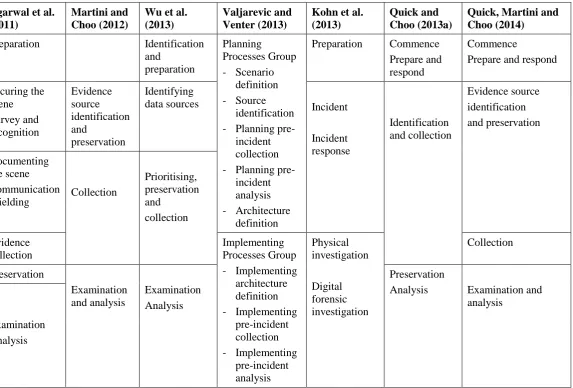
collected is admissible in a court of law. There are several digital forensics models (see
Table 3), and one widely used model is that of McKemmish (1999), which comprises
the following four phases:
1 Identification—involves identification of an incident from its source(s) and
determines its type
2 Preservation—involves the isolation, securing and preservation of the state of
evidential data
3 Analysis—involves determining significance, reconstructing fragments of evidential
data, and drawing conclusions based upon the evidence found
4 Presentation of digital evidence—involves the summary of results and conclusions.
Technological advances have spurred the need for a digital forensics model in specific
domains. Pili et al. (2010) proposed a network forensics model to deal with data found
across a network connection. Wu et al. (2013) presented a forensics capability
architecture with reference to critical infrastructure. The first cloud forensics framework
was, probably, proposed by Martini and Choo (2012), which was subsequently
validated using ownCloud (Martini & Choo 2013) and Amazon EC2 (Thethi & Keane
2014). Another cloud forensics framework was proposed a year later by Quick and
Choo (2013a), and validated using Dropbox (Quick & Choo 2013b), SkyDrive (Quick
& Choo 2013a), Google Drive (Quick & Choo 2014) and XtreemFS—a distributed file
system supporting cloud systems (Martini & Choo 2014a). These two frameworks were
subsequently merged into one (Quick, Martini & Choo 2014).
The current focus of incident handling is generally on responding to incident breaches,
without due consideration to collecting evidence that may provide valuable input to
current investigations, as well as future prosecution of the offender in a court of law.
Historically, there has been very little discussion of using evidence collected from the
investigation of previous incidents to assist with current or other investigations. There is
22
noted by researchers such as Freiling and Schwittay (2007) that both incident handling
and digital forensics use similar security tools, such as log monitoring and data
acquisition, in a range of activities. For example, when a system is compromised, digital
forensics processes, such as those of Valjarevic and Venter (2013), and techniques, such
as those of Quick and Choo (2013c), can be used to facilitate the collection of evidence
from compromised cloud servers and client devices for analysis. This would allow
subsequent reconstruction of the incident and establish facts such as:
where the attack came from
what vulnerabilities were exploited
what data and /or which systems were compromised.
The evidence collected can be used to inform a risk mitigation strategy as well as be
used in the prosecution of the offender in a court of law. It is, therefore, not surprising
that there have been attempts to integrate forensic practices into incident handling or
vice versa. For example, Pili et al. (2010) and Kohn et al. (2013) integrated the incident
response phase into their proposed forensic model. Another similarity is the concept of
forensic readiness, a state of proactive digital forensics that is capable of determining in
advance what evidence is required when an incident occurs (Pangalos, Ilioudis &
Pagkalos 2010). There is increased discussion on the importance of being proactive in
digital forensics investigations, such as forensic readiness, in recent times.
Conceptually, forensic readiness aligns with the proactive nature of incident handling,
and seven of the nine models reviewed in Table 3 incorporate the forensic readiness
phase. Increasingly, digital forensics specialists are found in most CSIRTs (Ruefl et al.
2014).
The need to integrate digital forensic science and incident handling has been noted in
several studies (Cichonski et al. 2012; Freiling & Schwittay 2007; Gurkok 2013), and in
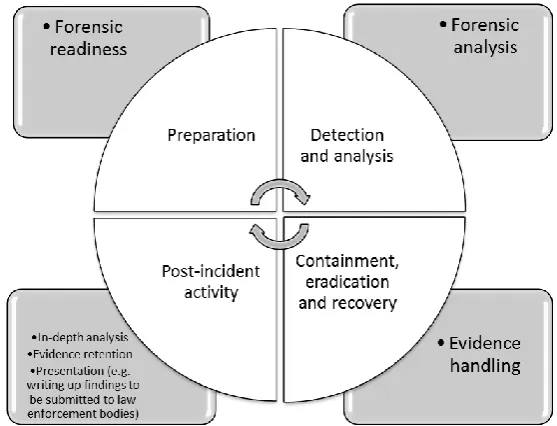
this chapter, forensic activities (or sub-areas) in each phase of the incident handling
model are integrated as illustrated in Figure 4. Forensic tools and techniques are not
only useful for criminal prosecution in a court of law, but also for various other tasks
within an organisation, such as event reconstruction (i.e. who, what, when, where, how,
and why an incident took place), data or system recovery, and system operation
23
For instance, findings from forensic analysis in the detection and analysis phase can
assist the organisation in identifying key assets and the vulnerabilities and threats that
could be exploited to target such assets in the organisation. This will subsequently help
to inform the implementation of suitable risk assessment, security controls, and
mitigation strategies. An appropriate and effective risk assessment and mitigation
strategy can also help to ensure that the organisation is forensically ready, and when an
incident occurs, the investigators responding to the incident know where potential
digital evidence resides in the organisation‘s systems. This will facilitate a more
[image:36.595.172.451.266.479.2]efficient and timely incident response and forensic examination.
Figure 4 The main digital forensics activities in the incident handling
24
Table 3 Comparative summary of digital forensic models
Cohen (2009) Pilli et al. (2010)
Agarwal et al. (2011)
Martini and Choo (2012)
Wu et al. (2013)
Valjarevic and Venter (2013)
Kohn et al. (2013)
Quick and Choo (2013a)
Quick, Martini and Choo (2014)
Phases
Preparation and
authorisation
Preparation Identification and preparation Planning Processes Group - Scenario definition - Source identification - Planning
pre-incident collection - Planning
pre-incident analysis - Architecture
definition
Preparation Commence Prepare and respond
Commence
Prepare and respond
Identification Detection of incident / crime Securing the scene Survey and recognition Evidence source identification and preservation Identifying
data sources Incident
Incident response Identification and collection Evidence source identification and preservation Incident response Documenting the scene Communication
shielding Collection
Prioritising, preservation and
collection
Collection Collection Evidence collection Implementing Processes Group - Implementing architecture definition - Implementing pre-incident collection - Implementing pre-incident analysis Physical investigation Digital forensic investigation Collection Transportation Storage
Preservation Preservation
Examination and analysis
Examination Analysis
Preservation
155
References
Abadi, M, Abelson, H, Acquisti, A, Barak, B, Bellare, M, Bellovin, S, Blaze, M, Camp, L, Canetti, R, Cranor, LF, Dwork, C, Feigenbaum, J, Felten, E, Ferguson, N, Fischer, M, Ford, B, Franklin, M, Garay, J, Green, M, Halevi, S, Jha, S, Juels, A, Kaashoek, M, Krawczyk, H, Landau, S, Lee, W, Lysyanskaya, A, Malkin, T, Mazieres, D, McCurley, K, McDaniel, P, Micciancio, D, Myers, A, Pass, R, Paxson, V, Peha, J, Ristenpart, T, Rivest, R, Rogaway, P, Rose, G, Sahai, A, Schneier, B, Shacham, H, Shelat, A, Shrimpton, T, Silberschatz, A, Smith, A, Song, D, Tsudik, G, Vadhan, S, Wright, R, Yung, M & Zeldovich, N 2014, Open letter from US researchers in cryptography and information security, viewed 18 June 2014, <http://masssurveillance.info>.
Abdi, H 2003, 'Factor rotations in factor analyses', in M Lewis-Back, A Bryman, & T Futing (eds), Encyclopedia of Social Sciences Research Methods, Thousand-Oaks (Sage), California.
ACCA 2014, Cloud Readiness Index 2014 - Executive Summary, Asia Cloud Computing Association, viewed 16 February 2014,
<http://asiacloudcomputing.org/research/cri2014>.
Afzaal, M, Di Sarno, C, Coppolino, L, DAntonio, S & Romano, L 2012, ‗A resilient architecture for forensic storage of events in critical infrastructures‘, in Proceedings of the 14th IEEE International Symposium on High-Assurance Systems Engineering, pp. 48–55.
Agarwal, A, Gupta, M, Gupta, S & Gupta, SC 2011, ‗Systematic digital forensic investigation model‘, International Journal of Computer Science and Security (IJCSS), vol. 5, no. 1, pp. 118–167.
Ahmad, A, Hadgkiss, J & Ruighaver, AB 2012, ‗Incident response teams – challenges in supporting the organisational security function‘, Computers & Security, vol. 31, no. 5, pp. 643–652.
Ahmad, AR & Hamasaeed, NH 2014, ‗The role of social media in the Syrian Civil War‘, in Proceedings of the 3rd Conference on Communication, Media, Technology and Design, pp. 284–289.
Alazab, M, Venkatraman, S & Watters, P 2009, ‗Effective digital forensic analysis of the NTFS disk image‘, Ubiquitous Computing and Communication Journal, vol. 4, no. 3, pp. 551–558.
Albakri, SH, Shanmugam, B, Samy, GN, Idris, NB & Ahmed, A 2014, ‗Security risk assessment framework for cloud computing environments‘, Security and
Communication Networks, vol. 7, no. 11, pp. 2114–2124.
156
Aleem, A & Sprott, CR 2013, ‗Let me in the cloud: analysis of the benefit and risk assessment of cloud platform‘, Journal of Financial Crime, vol. 20, no. 1, pp. 6–24.
Allan, D, Hahn, T, Whitmore, J & Buecker, A 2010, Security in development : the IBM secure engineering framework, IBM Redbooks, viewed 6 May 2015,
<http://www.redbooks.ibm.com/abstracts/redp4641.html>.
Almulla, S, Iraqi, Y & Jones, A 2013, ‗Cloud forensics: A research perspective‘, in Proceeding of the 9th International Conference on Innovations in Information Technology (IIT), pp. 66–71.
Amazon Web Services 2014a, Amazon CloudWatch, viewed 28 October 2014, <http://aws.amazon.com/cloudwatch/>.
― 2014b, Penetration testing, viewed 3 May 2014, <https://aws.amazon.com/security/penetration-testing/>.
― 2014c, Vulnerability reporting, viewed 3 May 2014, <https://aws.amazon.com/security/vulnerability-reporting/>.
― 2016, AWS shared responsibility model, viewed 8 February 2016, <https://aws.amazon.com/compliance/shared-responsibility-model/>.
Amble, JC 2012, ‗Combating terrorism in the new media environment‘, Studies in Conflict & Terrorism, vol. 35, no. 5, pp. 339–353.
Antonio, P & Labuschangne, L 2012, ‗A conceptual model for digital forensic
readiness‘, in Proceedings of the 11th Information Security for South Africa (ISSA), pp. 1–8.
Anuar, NB, Furnell, S, Papadaki, M & Clarke, N 2011, ‗A risk index model for security incident prioritisation‘, in Proceedings of the 9th Australian Information Security Management Conference, pp. 24–39.
Anuar, NB, Papadaki, M, Furnell, S & Clarke, N 2010, ‗An investigation and survey of response options for Intrusion Response Systems ( IRSs )‘, in Proceedings of the 9th Information Security for South Africa (ISSA), pp. 1–8.
― 2012, ‗A response strategy model for intrusion response systems‘, in D Gritzalis, S Furnell & M Theoharidou (eds), Information Security and Privacy Research, Springer Berlin Heidelberg, pp. 573–578.
― 2013, ‗A response selection model for intrusion response systems : Response Strategy Model (RSM)‘, Security and Communication Networks, vol. 7, no. 11, pp. 1831–1848.
Anwar, T & Abulaish, M 2014, ‗A social graph based text mining framework for chat log investigation‘, Digital Investigation, vol. 11, no. 4, pp. 349–362.