International Journal of Emerging Technology and Advanced Engineering
Website: www.ijetae.com (ISSN 2250-2459, Volume 2, Issue 5, May 2012)100
Anonymous Mission Network for Task-oriented ESP Training
Zhongwen LIU
Department of Elementary Courses, Liaoning Police Academy, Dalian, 116036, China
Abstract—English for Policing as a sphere of English for Specific Purpose is taught to equip students with proactive vocational skills in English. Anonymous Mission Network is based on social constructivist approach and previous studies on network-mediated interactions and developed with the emphasis on standard mission design and utilizing free online messaging tools rather than animation technologies. The essay expounds on the basic elements in the mission design, the application of the anonymous mission training in ESP learning, the tertiary indexes in the quantitative assessment and multi-modal interactions achieved on the Network. Implementation outcomes of the Network indicate that a career-focused task enhances students’ learning interests and experiences, anonymous training helps students to concentrate more on the communication, and standardized assessing strengthens the motivation of online learning. Other factors like autonomy, familiarity and technical obstacles are also discussed with current research focuses presented.
Keywords—Anonymous Mission Network, ESP learning, task-oriented training, mission design, interaction, quantitative assessment, anonymity
I. INTRODUCTION
The rapid development of science and technology, together with severe employment competition have generated increasing pressure on vocational institutions to implement more practical and efficient pedagogies to equip the students with proactive participation in the demanding work force. An anonymous and task-oriented program towards this goal is proposed in the essay by enhancing multimodal interactions in a simulated working environment through networks and free messaging programs. Students fulfil their mission with virtual status to reduce the inhibition that impedes language learning.
Part II of the essay outlines the task-oriented ESP learning program based on constructivist principles on learning and the related research findings. Part III describes the definition and components of Anonymous Mission Network, illustrates the elements in designing a standard mission and the tertiary index quantitative assessment system.
Part IV demonstrates the operation of the anonymous mission training through multi-modal interactions on the network. Part V analyzes the outcomes of the Network application with the highlights of the on-going research.
II. TASK-ORIENTED ESP TRAINING PROGRAM
A. Theoretical Framework
Foreign language learning nowadays is influenced by and reflects to a great extent the essence of social constructivism. The social constructivist approach is based on the assumption that individuals learn by constructing their knowledge through interaction with others. Knowledge is not presented to the individuals, but emerges from active dialogue where people create their own learning paths and knowledge [1].
B. Related Studies
International Journal of Emerging Technology and Advanced Engineering
Website: www.ijetae.com (ISSN 2250-2459, Volume 2, Issue 5, May 2012)101 Recently, an emerging trend in EFL learning is to constructing virtual or simulated environment with Virtual Real or 3D technology. A one-year ethnographic study was conducted to evaluate learner experiences in communication in VEC3D. The field trial results showed the effectiveness of motivating advanced EFL undergraduate students, triangulated with the attitudes questionnaire, acquiring communication strategies, and further extending autonomy in virtual communication through integrating goal-based design, role-play, and 3D VR. One option, avatar-masking, allows the learners to remain anonymous to reduce the inhibition that impedes language learning [4].
Advantages of anonymous learning are also supported by the research on foreign language learning in Second Life. An avatar’s anonymity (although this is optional) and the inherent fact that one can hide behind an avatar can be beneficial to some students. Asian students in particular suffer from performance anxiety in real life. Culturally it is not acceptable to them to make mistakes and they don’t like to embarrass themselves in public so they don’t speak up [5].
C. Task-oriented ESP Training Program
English for Specific Purposes (hereinafter referred to as ESP) consists of English language teaching which is designed to meet specified needs of the learner; related in content (i.e. in its themes and topics) to particular disciplines, occupations and activities [6]. The task-oriented ESP training program, which is carried out through an Anonymous Mission Network, is intended to solve the prevailing problem of overemphasizing foreign language learning with little attention to knowledge application.
Disadvantages of traditional ESP learning are mostly monotonous and unappealing to the students for the lack of integration of meaningful training in the learning process. A traditional ESP college class consists of the study of new words and expressions, learning of the text on a specific aspect of the subject, exercises of vocabulary consolidation, cloze, translation or writing, with instructional strategies focusing on more receptive aspects of instruction (tell and ask) and placing the students on the passive roles, while more attention should be directed to show and do to motivate the students and sustain their learning interests as Frank L. Greitzer suggested, that effective learning environments should be problem-based, actively engage students in learning activating prior experience (relates to real world), demonstrating (tell and show), applying (ask and do) and integrating (transfer to
real world) skills [7]. The other reason why students are not motivated in ESP learning is that they normally don’t see the connection between what they are studying and what they will use, they hear and see the knowledge, may or may not understand the knowledge, but they have a long way to go before applying the knowledge which is considered as the ultimate goal of learning according to Xun Zi, one of the most sophisticated and influential philosophers of China's Warring States period.
The learning English for Policing as a sphere of ESP in Liaoning Police Academy starts after three-semester college English learning which emphasizes the language itself rather than viewing it as a tool. About one third of the students are able to follow lectures on general topics in English, participate in a discussion in English or deliver a presentation in English after a certain period of preparation, which is the basis of program design for the task-oriented English for Policing program.
The program is also based on that mastery of complicated cognitive performance requires higher level, more abstract learning and opportunities for exercising skills in realistic situations.
III. ANONYMOUS MISSION NETWORK
Anonymous Mission Network (hereafter referred to as the Network) is constructed to sustain students’ learning interests with confidence, motivation and the sense of achievement.
Anonymous is defined as ―made or done by someone whose name is not known or not made public” in Cambridge Dictionary. Anonymous, first of all, is determined by the nature of fulfilling a future work as the student has to be one of the roles in the simulated work situation, the student is allowed to act as any desirable vocational characters though the student is strongly recommended to try the posts step by step as promoted in accordance with the achievements gained in the real life. Secondly, anonymity is encouraged for the sake of being more immersed in the virtual situation, less embarrassed and more concentrated on the expression without being known who the student is by the other party even if face-to-face communication or live video chat helps to reveal the authentic feels through body language.
Mission is defined as “ an important job, especially a
military one, that someone is sent somewhere to do or any work that someone believes it is their duty to do”
International Journal of Emerging Technology and Advanced Engineering
Website: www.ijetae.com (ISSN 2250-2459, Volume 2, Issue 5, May 2012)102 working policemen, ESP students from other universities), mentors (English teachers, specialized course teachers, computer teachers, police experts, native English speakers) and visitors who are interested in policing or practicing English.
A. Components
The Network consists of Login, English for Policing Learning, Anonymous Mission Training, Student Voice Forum, Student Reflections and Assessment.
English for Policing Learning is also utilized in live classroom instruction as a courseware for English for Policing course, containing police recruitment, training, police administration, administration of entry and exit, traffic control, criminal technology, criminal investigation, criminal justice, Internet safety administration and international liaison. The contents are presented with visual policing transcripts in English speaking countries, audio listening and speaking, textual background information, case study and police documents writing.
Anonymous Mission Training serves as the application of English for Policing learning in a series of holistic missions to train the practical skills step by step. It’s utilized as the application of the knowledge learning in face-to-face instruction and installed in the LAN multimedia classrooms and in a server accessed via the Campus net for e-training.
Student Voice Forum is a platform for the participants to share and express their views, proposals or criticisms on the program to reassure that the opinions of the students are taken into account in the development of the program.
Reflections refer to the training experiences, lessons and deficiencies written or shared by the participants of the program, allowing them to be constantly aware of the impact of the training. Reflecting on the real work problems can help to identify how best to apply what we know in practice. It can help deal with ambiguity, stress and change. Reflection is not a bland or innocuous process – it is central to becoming a powerful, critical professional who is prepared to challenge the way things are done [8].
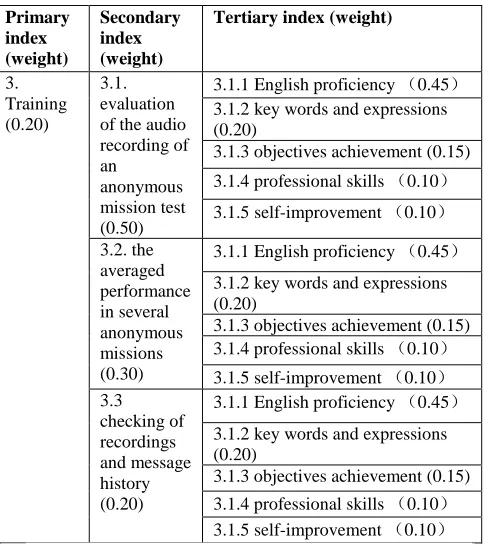
Assessment is a tertiary index quantitative system for evaluating the performance of the students online with standards and fairness. Students are encouraged to record their online performance with Screen Recording Expert V7.5 and keep their massage history. The tertiary index system is built to overcome the common problem of ambiguous assessment in most of the current e-learning, resulting in students’ resentment and boredom.
The primary index contains 1. Motivation and prospect (weight 0.05), 2. Learning (0.20), 3.Training (0.20), 4. Forum participation (0.05), 5. Reflections (0.05), 6. Homework (0.15), 7. Quiz and test (0.20) and 8. Self-assessment and other’s Self-assessment (0.10).
B. Design of an Anonymous Mission
The mission is adapted from a real police work or designed with the following basic elements:
Curricular connections: A mission is the application of the learnt knowledge and creation of new knowledge in the process of mission accomplishment. According to Constructivism, the purpose in education is to become creative and innovative through analysis, conceptualizations, and synthesis of prior experience to create new knowledge. The educator’s role is to mentor the learner during heuristic problem solving of ill-defined problems by enabling quested learning that may modify existing knowledge and allow for creation of new knowledge [9].
Settings: Including time and places of the policing mission, like in a police academy, in the 110 dispatcher headquarters, at a police station, at a crime scene or on the road. The description of place should be as concrete as possible and the background effect can be improved by Virtual Real, 3D, flash or animation technologies.
Characters: One character must be a Chinese Police Officer who is, under most of the circumstances, classified in detail into a police academy student, a criminal detective, a traffic policeman, a dispatcher, a liaison officer. Other characters are English speakers such as victims, witnesses, a drunk driver or a visitor. Avatars are provided after the character for the students to change their icons before starting a mission.
Objectives: In order to compel the students to master certain words, expressions or language usage in a specific setting, objectives of a mission is clearly stated in most cases, the settled objectives may constrain the natural and free expression in English which is more applicable to the practice for preliminary language learning, but they are helpful in advanced English learning to apply specific, professional or technical terms in English.
International Journal of Emerging Technology and Advanced Engineering
Website: www.ijetae.com (ISSN 2250-2459, Volume 2, Issue 5, May 2012)103
TABLEI
TERTIARY INDEX QUALITATIVE ASSESSMENT OF 3.TRAINING (0.20)
Primary index (weight)
Secondary index (weight)
Tertiary index (weight)
3. Training (0.20)
3.1. evaluation of the audio recording of an
anonymous mission test (0.50)
3.1.1 English proficiency (0.45)
3.1.2 key words and expressions (0.20)
3.1.3 objectives achievement (0.15) 3.1.4 professional skills (0.10)
3.1.5 self-improvement (0.10) 3.2. the
averaged performance in several anonymous missions (0.30)
3.1.1 English proficiency (0.45)
3.1.2 key words and expressions (0.20)
3.1.3 objectives achievement (0.15) 3.1.4 professional skills (0.10)
3.1.5 self-improvement (0.10) 3.3
checking of recordings and message history (0.20)
3.1.1 English proficiency (0.45)
3.1.2 key words and expressions (0.20)
3.1.3 objectives achievement (0.15) 3.1.4 professional skills (0.10)
3.1.5 self-improvement (0.10)
References: Optional references are available for the students to assist the accomplishment of the mission, the references derive from the previously learnt material, revised or edited for a specific mission.
[image:4.612.52.295.157.429.2]Figure 1 is the screenshot of a mission with references in Unit 1 POLICE ACADEMY after the learning of listening and speaking material on Meeting a Foreign Delegation, reading of A General Introduction to Liaoning Police Academy.
Figure 1. The Anonymous Mission: Meeting a Foreign Delegation
IV. INTERACTIVE TRAINING ON THE NETWORK
One channel for a student to starts the anonymous mission training is via a platform developed with Microsoft Visual Studio 2005 asp.net(c#) to login with real name and student number, retrieve with key words like drunken driving, traffic control, establish a criminal case to find a mission, choose or create a character, set requirements for other characters in the mission on English proficiency or gender preference, start with the mission with qualified participants acting the vacant characters.
The other channel is making use of the free messaging program of QQ International, the English teacher creates and administrates a QQ number for group discussion, other participants take part in the group under the permission of the administrator, change icons and names according to a specific mission, and fulfil the mission anonymously with other participants with textual, audio or visual chat.
There is a rich literature to support that there is a link between interaction and learning. The result of a research study by Leily Ziglar shows that if teachers try to provide opportunities for oral discussion in their classes, encourage learners to initiate topics and put some responsibility on the part of their learners, the class would be enjoyable, creative and initiative [10]. Anonymous Mission Network provides participants opportunities to interact with one another in fulfilling a mission.
A. Interactions among Mentors
Mentors include English teachers, professional police course teachers, computer teachers and policing experts who are responsible to provide guidance and consultations on anonymous mission training in English, standard policing service, accurate computer operation and improved and efficient policing skills. They meet regularly or communicate with one another through messaging tools like QQ, emails or online group discussion on the running and administration of the Network, design of missions and assess the performance of the students. They also interact with the students by acting characters other than Chinese police officers in a mission, recommending alternative solutions to a challenging situation, introducing working police officers to study and training on the Network.
B. Live Interactions among Teachers and Students
[image:4.612.62.295.542.696.2]International Journal of Emerging Technology and Advanced Engineering
Website: www.ijetae.com (ISSN 2250-2459, Volume 2, Issue 5, May 2012)104 The class is divided into several groups and the teacher may take part in one group or supervise the whole activity.
C. Interactions among the Trainees
Trainees on the Network include police academy students, working police officers and others interested in policing work. They act for most of the time as Chinese Police Officers doing different police jobs, but they also encouraged to act other characters in the mission like victims, suspects, criminals or witnesses.
D. Human-computer Interaction
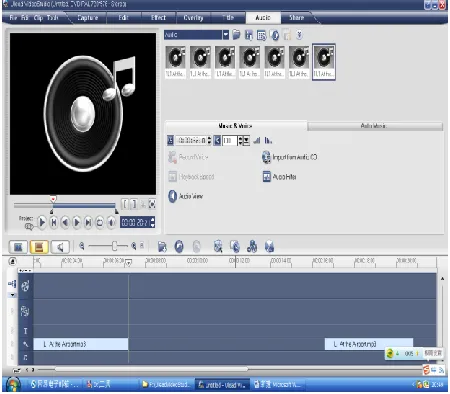
[image:5.612.333.566.136.274.2]The anonymous mission can also be accomplished through interactions with the computer for basic expressions practice before interacting with other participants. A dialogue between two speakers is separated into two categories for each speaker with multimedia editing software Ulead visual studio 11, and then a new audio is made with the other speaker silent, as shown in Figure 2.
Figure 2. Cutting an original dialogue into two categories with the other speaker silent
[image:5.612.328.577.334.485.2]The scripts of the two speakers are edited by a lyric editing tool LRC and Winamp player to set the accurate time when the scripts are shown. The student plays the role of one speaker and practice with the computer reading the other speaker’s scripts when the edited audio is played by Duomi music player, with scripts showing on the screen as an optional as shown in Figure 3.
Figure 3. Human-computer interaction in dialogue practicing
The multi-modal interactions achieved through the Anonymous Mission Network is illustrated in Figure 4.
Figure 4. Multi-modal interactions through Anonymous Mission Network [11]
V. OUTCOMES AND DISCUSSIONS
The Network has been in use for nearly 3 years in EFL learning of undergraduates of grade 2007, 2009 and 2011. As a designer and a teacher, the author observes with notes and interviews with the following findings:
Students are especially sensible to words, terms, stories, information, case studies on their major. It’s obviously stimulating to integrate ESP into EGP (English for General Purpose) learning; observations confirm that during an EGP learning when some of the students get detached from the lecturing, a major-related story or joke can defeat the absent-mindedness. When the students are compelled to get involved in an active and effective communication with desirable roles, their English competences are being built through strengthening motivation and confidence.
English Teachers
Academy Student Working
Policeman
Other Trainee Police
Experts
Policing Teachers
Computer Other
[image:5.612.64.289.384.581.2]International Journal of Emerging Technology and Advanced Engineering
Website: www.ijetae.com (ISSN 2250-2459, Volume 2, Issue 5, May 2012)105 Anonymous mission training after class is assessed and evaluated by three approaches. One is the averaged score of several English teachers marked on the audio recording of the student in an anonymous mission test. The second is the averaged score judged by mentors acting a certain characters in the missions because they know the authentic identity of the students while the students don’t know who is behind the avatar. The third is the checking of V7.5 recordings and message history. Interviews show that most of the students believe the assessment to be ―fare‖. ―Self-improvement‖ is the first chosen answer to ―which index is most reasonable?‖ as it focuses on the process of improvement through hard-working rather than the acquired English competences. The encouragement on self-improvement is most rewarding to those students whose English is not as good as their counterparts.
A survey for majors of Cyber Crimes Investigation of grade 2011 showed that 88% of the students approve the anonymous mission training to be useful and interesting, 12% think it as the same as other exercises with on one thinks it as useless. The training is also commented as ―Interesting and exciting, helpful to improve my English competence and communicative abilities‖, ―making learning enjoyable, practical, realistic and impressive.‖ In analyzing the necessary of anonymity from the students’ perspectives, the students are asked to rearrange the sequence in preference of the way they’d like to conduct the training in the survey: 1. In front of the classroom, 2. On the seats, 3. Real name in the multimedia classroom, 4.Anonymously in the multimedia classroom, 5. Real name on the Network after class, 6. Anonymously on the Network after class. The first choice to the last one is rated as 5 points to 0, the sequence and score is shown in Table 2:
TABLEIII
SEQUENCE OF FAVOURITE TRAINING WAYS FROM THE STUDENTS’ PERSPECTIVES
1 Anonymously in the multimedia classroom (63)
2 Anonymously on the Network after class (47)
3 Real name on the Network after class (41)
4 In front of the classroom (40)
5 On the seats (38)
6 Real name in the multimedia classroom (28)
The results show a great preference of anonymity over real name, other preference factors include familiarity, autonomy and excitement involved, because multimedia classroom is the place where interactions among familiar participants (classmates and the teacher) take place, and among all the real name choices, training on the Network is autonomous than in the classroom, and training in front of the classroom is more exciting than on the seats, it’s neither exciting nor anonymous for a real name training in the multimedia classroom.
Another reason why anonymous training on the Network wasn’t the first choice is due to the slow net speed, financial expenses and limited free time in a police academy.
Nowadays, our research is focusing on, firstly, the construction of Anonymous Mission Base with retrieving functions to make the targeting of a mission easier and faster; Secondly, inviting more and more vocational students from other universities to get involved in the anonymous mission training to mutually improve professional skills in English, who are majoring in business, tourism and fashion design. ―As heaven maintains vigor through movements, a man of virtue should strive for self-improvement‖ is not only a quotation to encourage the students to work on the Anonymous Mission Network, but also a teaching for the English teachers in the task-oriented ESP learning program to apply in depth with perseverance.
Acknowledgment
This paper is the research achievements of 2012 Liaoning Economic and Social Development Research Project No. 2012LSLKTWX-08 A Study on the Construction and Integration of Foreign Language Virtual Service Learning Environments approved by Liaoning Provincial Federation of Social Science Circles.
REFERENCES
[1] Palloff, R. M., & Pratt, K. 2007. Building online learning communities: Effective strategies for the virtual classroom (2nd ed.). San Francisco: Jossey-Bass.
[2] Qiuyun Lin. The Role of Web-Based Activities in Mediating Student Interaction and Engagement in Four Teacher Education Classes. MERLOT Journal of Online Learning and Teaching. Vol. 7, No. 1, March 2011, 99-107
[3] Wu, W.-C. V., Yen, L. L., & Marek, M. (2011). Using Online EFL Interaction to Increase Confidence, Motivation, and Ability. Educational Technology & Society, 14 (3), 118–129
[4] Ya-ChunShih, Mau-Tsuen Yang (2008). A Collaborative Virtual Environment for Situated Language Learning Using VEC3D.
[image:6.612.54.287.555.682.2]International Journal of Emerging Technology and Advanced Engineering
Website: www.ijetae.com (ISSN 2250-2459, Volume 2, Issue 5, May 2012)106
[5] Hundsberger, S. 2009. Arcadia: Foreign Language Learning in Second Life and the Implications for Resource Provision in Academic Libraries. P. 24. Cambridge, UK: Cambridge University, UK.
[6] Kristen Gatehouse. 2001. Key Issues in English for Specific Purposes (ESP) Curriculum Development.The Internet TESL Journal. 7.10
[7] Frank L. Greitzer. 2005. Ingredients of Effective and Engaging Online Learning. Inter-lab 2005 Conference. http://www.pnl.gov/cogInformatics/media/pdf/InterLab-Greitzer-distribution.pdf (accessed 12/3/2012)
[8] QIA Key Skills Support Programme. Reflection in learning. University of Warwick. (accessed 11/4/2012)
[9] Kolb, D. 1976. Learning style inventory technical manual. Boston, MA: McBer.
[10]Leily Ziglar. 2008. The Role of Interaction in L2 Acquisition: An Emergentist Perspective. European Journal of Scientific Research. 23,3. 446-453
[11]Zhongwen Liu. 2011. Computer-mediated Interactions through English for Elite Police Network. In Proceedings of the 2011 3rd