Journal of Chemical and Pharmaceutical Research, 2015, 7(8):987-992
Research Article
ISSN : 0975-7384
CODEN(USA) : JCPRC5
Estimation of hydration number and its allied parameters of aqueous
Diammonium phosphate solution by ultrasonic studies at different
temperatures
K. Renuka Devi* and S. Geetha
Department of Physics, Government Arts College for Women (Autonomous), Pudukkottai, Tamilnadu, India _____________________________________________________________________________________________
ABSTRACT
Ultrasonic velocity of liquids and solutions are a simpler but accurate method of analyzing the interaction between the molecules. The passage of ultrasonic waves through solutions and liquids disturbs the equilibrium between the solute and solvent molecules. The velocity of such a wave is a thermodynamic quantity and it is related to the physico-chemical properties of the medium. Ultrasonic velocity (U), density (ρ) and viscosity (η) of Diammonium phosphate fertilizer in aqueous media have been measured at 303, 308, 313, 318, and 323 0 K to estimate hydration number and its allied parameters like apparent molal volume (φv), apparent molal compressibility (φk), molar
solvated volume (φs), limiting apparent molal compressibility (φk0), and limiting apparent molal volume (φv0) and
their constants Sk and Sv. The datas have been interpreted in terms of solute - solvent interactions.
Keywords: Adiabatic compressibility, molar hydration number, apparent molal compressibility, limiting apparent
molal compressibility, molar solvated volume.
_____________________________________________________________________________________________
INTRODUCTION
_____________________________________________________________________________________
molal hydration number (nh’), apparent molal volume (φv), apparent molal compressibility (φk), molar solvated volume (φs), limiting apparent molal compressibility (φk0), and limiting apparent molal volume (φv0) and the constants Sk and Sv were calculated to shed more light on various types of intermolecular interactions between the components.
EXPERIMENTAL SECTION
Aqueous solutions of Diammonium phosphate were prepared using AR grade salt at different concentrations ranging from 0.1 to 0.6m. The ultrasonic velocities of the solutions were measured using an ultrasonic interferometer (Mittal F – 81 D) with a single crystal at a frequency of 2 MHz with an accuracy of 0.5%. The density of solutions at various temperatures was measured using 10 ml specific gravity bottles by relative method. The temperature was maintained using constant temperature bath with an accuracy of + 0.10 C. Ostwald’s viscometer was used for viscometric studies.
RESULTS AND DISCUSSION
Adiabatic Compressibility:
Adiabatic Compressibility is a fractional decrease of volume per unit increase of pressure when no heat flows in or out5. Increase in compressibility value indicates the weakening of molecular interaction. The increase in velocity and decrease in compressibility was attributed to the formation of hydrogen bonds between solute and solvent molecules 6
. The adiabatic compressibility of DAP solution was calculated using the relation,
β = 1/(U 2ρ ) (1)
where U-Ultrasonic velocity and ρ-density of solution.
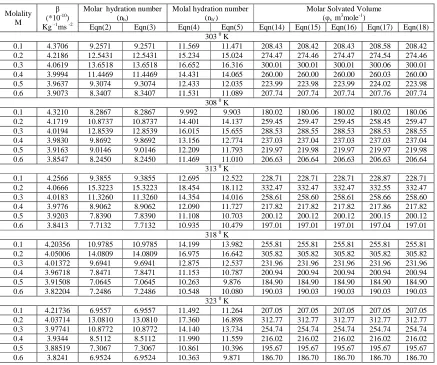
The compressibility of DAP solution appears to be decreasing with hydrogen bond strength formed by DAP and water molecules. The adiabatic compressibility values given in table (1) are found to decrease with the increase of concentration and temperature which shows a strong molecular association/interaction is exist between the solute and solvent molecules.
Hydration Number:
When an electrolyte is added to water, some water molecules get arranged around each ion due to their large dipole moment. The interaction between the ion and the surrounding water molecules is referred as hydration 7. Positive values of hydration number indicate an appreciable solvation of solute. This result provides an added support for the structure promoting nature of the solute as well as the presence of appreciable dipole-dipole interaction between solute and water molecules. It also suggests that compressibility of the solution will be less than that of pure solvent. As a result the solute will gain mobility and have more probability of contacting solvent molecules which may enhance the interaction between solute and solvent molecules8.
The molar hydration number nh is obtained from the Passynski’s relation given as follows,
nh = [n1 – βN/β0] / n2 (2)
where β and β0 be the compressibility of solution and solvent respectively, n1 is the number of moles of the solvent present in 1000 cc of the solution of molar concentration n2 and N is the number of moles of the solvent in 1000 cc of the solvent. The molar hydration number can also be obtained using Barnatt’s equation,
nh = n1( 1 – Vβ / n1V1β0] / n2 (3)
where V1 is the molar volume of the solvent and V = 1000 cc.
The values of molar hydration number obtained from equations (2) and (3) are in good agreement. Similarly, the molal hydration number nh' given by Passynski has been computed using the following two relations,
_____________________________________________________________________________________
nh' = [1 – β/β0]n1 / n2 (5)
where N' is the number of moles of solvent in 1000 gm of solvent and n2' is the molal concentration of the solution. The values of molal hydration number obtained from equations (4) and (5) are in agreement. The values of hydration number are found to decrease at higher concentrations at all temperatures which may be due to lack of solvent molecules for ions or occurrence of ion pairing in the solution. The decrease in hydration number at higher concentrations suggests that the strength of interaction gets weakened between the solute and solvent molecules. However, the magnitude of nh is found to be greater at 313 0 K. Apparent Molal Volume: It is defined as change in volume of the solution for the added concentration of solute at a constant temperature and pressure. It is a thermodynamic property helps in elucidating solvation behaviour of electrolyte in the solution. Positive values of φv indicate the presence of strong solute-solvent interactions 9. The apparent molal volume in both molal and molar scales were arrived through the following equations φv =V1 ((N∆β)/(n2 β0) ) - nh (6)
φv = (1000(ρ0 – ρ))/(n2 ρ0) + M2/ (7)
φv = V1 ( N (nh’/n1) - nh) (8)
φv = (β0 nh’/∆β) (( V/ n1) - V1)) (9)
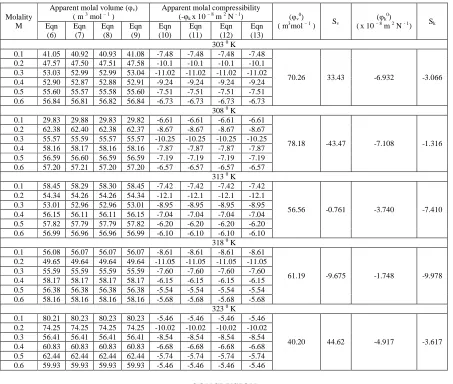
where, M2 = molecular weight of solute The plot of φv versus concentration was constructed which satisfies the relation, φv = φv0 + S v√c The intercept φv0 and slope Sv values were found using least square fitting technique and are given in table (2). φv0 known as limiting apparent molal volume is the measure of solute-solvent interaction whereas the slope Sv measures solute-solute interactions. In the present study, positive non-linear variations were observed for φv and the values obtained by the equations (6-9) are all in good agreement. The positive values of φv0 indicate the presence of solute-solvent interactions and the negative values of Sv suggest the presence of weak solute-solute interactions. Apparent Molal Compressibility: As apparent molal compressibility φk depends on adiabatic compressibility which in turn depends on concentration, it can be said that the apparent molal compressibility φk is also related to concentration. It represents the magnitude of ion-solvent interaction 10. φk values were calculated using the relations given below, φk = - V1β0 nh (10)
φk = - nh’V1 β0 + φv β (11)
and also by the traditional method relations, φk = (1000(ρ0 β– ρβ0)/n2 ρ0) + M2 β0/ρ0 (12)
φk = ( 1000/ n2)( β– β0)+β0 φv (13)
and all are found to be identical. From these values, limiting apparent molal compressibility (φk0) and the constant Sk were evaluated and are given in table (2).
_____________________________________________________________________________________
Appreciable negative values of φk0 at all temperatures reinforce existence of ion-solvent interaction in the present system. The negative values of Sk suggest the presence of weak solute-solute interactions.
Molar Solvated Volume: The molar solvated volume φs measures the volume of solvated part of the solute present
in the solution and φs values were calculated using the equations,
φs = (V nh’) / n1 (14)
φs = V ∆β / n2β0 (15)
φs =( nh’ V1 β0 ) / β - ( nhV1 ∆β) / β (16)
φs = ( V- (n1- n2 nh)V1) /n2 (17)
φs = φv + ( nhV1 ) (18)
There is a perfect agreement between the values computed by the equations (14-18) and are given in table (1). The
[image:4.595.81.518.364.729.2]φs values have the cumulative effect of φv and nh V1 as seen from the equation (18). From the result, it is clear that φs is mainly detailed by the hydration number rather than by φv.
Table 1 – Values of adiabatic compressibility (β), molar hydration number (nh), molal hydration number (nh’), and molar solvated volume (φs) of aqueous DAP solution
Molality M
β
(*10-10) Kg -1ms -2
Molar hydration number (nh)
Molal hydration number (nh’)
Molar Solvated Volume (φs m3mole-1)
Eqn(2) Eqn(3) Eqn(4) Eqn(5) Eqn(14) Eqn(15) Eqn(16) Eqn(17) Eqn(18)
303 0 K
0.1 4.3706 9.2571 9.2571 11.569 11.471 208.43 208.42 208.43 208.58 208.42
0.2 4.2186 12.5431 12.5431 15.234 15.024 274.47 274.46 274.47 274.54 274.46
0.3 4.0619 13.6518 13.6518 16.652 16.316 300.01 300.01 300.01 300.06 300.01
0.4 3.9994 11.4469 11.4469 14.431 14.065 260.00 260.00 260.00 260.03 260.00
0.5 3.9637 9.3074 9.3074 12.433 12.035 223.99 223.98 223.99 224.02 223.98
0.6 3.9073 8.3407 8.3407 11.531 11.089 207.74 207.74 207.74 207.76 207.74
308 0 K
0.1 4.3210 8.2867 8.2867 9.992 9.903 180.02 180.06 180.02 180.02 180.06
0.2 4.1719 10.8737 10.8737 14.401 14.137 259.45 259.47 259.45 258.45 259.47
0.3 4.0194 12.8539 12.8539 16.015 15.655 288.53 288.55 288.53 288.53 288.55
0.4 3.9830 9.8692 9.8692 13.156 12.774 237.03 237.04 237.03 237.03 237.04
0.5 3.9163 9.0146 9.0146 12.209 11.793 219.97 219.98 219.97 219.97 219.98
0.6 3.8547 8.2450 8.2450 11.469 11.010 206.63 206.64 206.63 206.63 206.64
313 0 K
0.1 4.2566 9.3855 9.3855 12.695 12.522 228.71 228.71 228.71 228.87 228.71
0.2 4.0666 15.3223 15.3223 18.454 18.112 332.47 332.47 332.47 332.55 332.47
0.3 4.0183 11.3260 11.3260 14.354 14.016 258.61 258.60 258.61 258.66 258.60
0.4 3.9776 8.9062 8.9062 12.090 11.727 217.82 217.82 217.82 217.86 217.82
0.5 3.9203 7.8390 7.8390 11.108 10.703 200.12 200.12 200.12 200.15 200.12
0.6 3.8413 7.7132 7.7132 10.935 10.479 197.01 197.01 197.01 197.04 197.01
318 0 K
0.1 4.20356 10.9785 10.9785 14.199 13.982 255.81 255.81 255.81 255.81 255.81
0.2 4.05006 14.0809 14.0809 16.975 16.642 305.82 305.82 305.82 305.82 305.82
0.3 4.01372 9.6941 9.6941 12.875 12.537 231.96 231.96 231.96 231.96 231.96
0.4 3.96718 7.8471 7.8471 11.153 10.787 200.94 200.94 200.94 200.94 200.94
0.5 3.91508 7.0645 7.0645 10.263 9.876 184.90 184.90 184.90 184.90 184.90
0.6 3.82204 7.2486 7.2486 10.548 10.080 190.03 190.03 190.03 190.03 190.03
323 0 K
0.1 4.21736 6.9557 6.9557 11.492 11.264 207.05 207.05 207.05 207.05 207.05
0.2 4.03714 13.0810 13.0810 17.360 16.898 312.77 312.77 312.77 312.77 312.77
0.3 3.97741 10.8772 10.8772 14.140 13.734 254.74 254.74 254.74 254.74 254.74
0.4 3.9344 8.5112 8.5112 11.990 11.559 216.02 216.02 216.02 216.02 216.02
0.5 3.88519 7.3067 7.3067 10.861 10.396 195.67 195.67 195.67 195.67 195.67
_____________________________________________________________________________________
Table 2 - Values of apparent molal volume (φv), apparent molal compressibility (φk), Limiting apparent molal volume (φv0), Limiting apparent molal compressibility (φk0), constants Sk and Sv of aqueous Diammonium phosphate at 303 0 K, 308 0 K, 313 0 K, 318 0 K, and
323 0 K
Molality M
Apparent molal volume (φv)
( m 3 mol – 1 ) Apparent molal compressibility (-φ
k x 10 – 8 m 2 N - 1) (φv0)
( m3mol – 1 ) Sv (
φk0)
(x 10 – 8 m 2 N - 1) Sk
Eqn (6) Eqn (7) Eqn (8) Eqn (9) Eqn (10) Eqn (11) Eqn (12) Eqn (13) 303 0 K
0.1 41.05 40.92 40.93 41.08 -7.48 -7.48 -7.48 -7.48
70.26 33.43 -6.932 -3.066
0.2 47.57 47.50 47.51 47.58 -10.1 -10.1 -10.1 -10.1
0.3 53.03 52.99 52.99 53.04 -11.02 -11.02 -11.02 -11.02
0.4 52.90 52.87 52.88 52.91 -9.24 -9.24 -9.24 -9.24
0.5 55.60 55.57 55.58 55.60 -7.51 -7.51 -7.51 -7.51
0.6 56.84 56.81 56.82 56.84 -6.73 -6.73 -6.73 -6.73
308 0 K
0.1 29.83 29.88 29.83 29.82 -6.61 -6.61 -6.61 -6.61
78.18 -43.47 -7.108 -1.316
0.2 62.38 62.40 62.38 62.37 -8.67 -8.67 -8.67 -8.67
0.3 55.57 55.59 55.57 55.57 -10.25 -10.25 -10.25 -10.25
0.4 58.16 58.17 58.16 58.16 -7.87 -7.87 -7.87 -7.87
0.5 56.59 56.60 56.59 56.59 -7.19 -7.19 -7.19 -7.19
0.6 57.20 57.21 57.20 57.20 -6.57 -6.57 -6.57 -6.57
313 0 K
0.1 58.45 58.29 58.30 58.45 -7.42 -7.42 -7.42 -7.42
56.56 -0.761 -3.740 -7.410
0.2 54.34 54.26 54.26 54.34 -12.1 -12.1 -12.1 -12.1
0.3 53.01 52.96 52.96 53.01 -8.95 -8.95 -8.95 -8.95
0.4 56.15 56.11 56.11 56.15 -7.04 -7.04 -7.04 -7.04
0.5 57.82 57.79 57.79 57.82 -6.20 -6.20 -6.20 -6.20
0.6 56.99 56.96 56.96 56.99 -6.10 -6.10 -6.10 -6.10
318 0 K
0.1 56.08 56.07 56.07 56.07 -8.61 -8.61 -8.61 -8.61
61.19 -9.675 -1.748 -9.978
0.2 49.65 49.64 49.64 49.64 -11.05 -11.05 -11.05 -11.05
0.3 55.59 55.59 55.59 55.59 -7.60 -7.60 -7.60 -7.60
0.4 58.17 58.17 58.17 58.17 -6.15 -6.15 -6.15 -6.15
0.5 56.38 56.38 56.38 56.38 -5.54 -5.54 -5.54 -5.54
0.6 58.16 58.16 58.16 58.16 -5.68 -5.68 -5.68 -5.68
323 0 K
0.1 80.21 80.23 80.23 80.23 -5.46 -5.46 -5.46 -5.46
40.20 44.62 -4.917 -3.617
0.2 74.25 74.25 74.25 74.25 -10.02 -10.02 -10.02 -10.02
0.3 56.41 56.41 56.41 56.41 -8.54 -8.54 -8.54 -8.54
0.4 60.83 60.83 60.83 60.83 -6.68 -6.68 -6.68 -6.68
0.5 62.44 62.44 62.44 62.44 -5.74 -5.74 -5.74 -5.74
0.6 59.93 59.93 59.93 59.93 -5.46 -5.46 -5.46 -5.46
CONCLUSION
Various solvation properties of aqueous Diammonium phosphate fertilizer solution were studied at different temperatures. Adiabatic compressibility and apparent molal volume are computed. The values of molar and molal hydration numbers, apparent molal compressibility and molar solvated volume were computed from different theories available in literatures and found to be in good agreement From the investigation it may be presumed that
(i) The existence of ion-solvent or solute-solvent interactions resulting in attractive forces which promote the structure breaking influence of DAP on the solvent.
(ii)The interactions taking place may be due to ion-dipolar/hydrophilic group between the ions (NH4+, HPO 4- ) of DAP and (H +, OH -) group of water.
REFERENCES
[1] Monalisa Das, Smrutiprava Das, and Ajaya Kumar Patnaik., International Journal of Advanced Chemistry, 2014, 2(2), 66-69.
[2] A Passynski, Acta Physiochem., 2014, 8, 385. [3] S.J Barnartt., Chem.Phys., (1952), 20, 278.
_____________________________________________________________________________________
[5] C Shanmugapriya, S Nithya, G Velraj, and A.N Kannappan., International Journal of Advanced Science and Technology, May 2010, Vol.18.
[6] R Palani., A Geetha, and Rabindra Kumar Swara, Rasayan J.Chem, 2009, Vol.2.No.3, 602-608. [7] R Palani, S Balakrishnan, and G. Arumugam, Journal of Physical Science, 2011 Vol.22(1), 131-141.
[8] R Palani, G Srinivasan, and Geetalakshmi, International Journal of ChemTech Research, Jan-Mar 2011, Vol.3, No.1, pp284-289.
[9] Yasmin Akthar, S.F Ibrahim, Arabian Journal of Chemistry, 2011, (4), 487-490.