International Journal of Emerging Technology and Advanced Engineering
Website: www.ijetae.com (ISSN 2250-2459,ISO 9001:2008 Certified Journal, Volume 3, Issue 7, July 2013)
549
Biogeographic-Based Optimization Algorithm for Load
Dispatch in Power System
Jyoti Jain
1, Rameshwar Singh
21
M.Tech Control System Deptt. of Electrical Engg. NITM Gwalior
2Assistance Prof. Deptt. Of Electrical Engg. NITM Gwalior
Abstract-- This paper presents a biogeographic-based optimization (BBO) algorithm to solve Economic Load Dispatch (ELD) problem with generator constraints in power plants. Biogeography is basically a science of geographical distribution of the biological species. The models of biogeography explain how an organism arises, immigrate from an environment to another and gets eliminated. This method is based on two steps mutation and migration. Unlike other GA & PSO, BBO also have some common features. The purpose of this work is to find out the advantages of application of the evolutionary computing technique and BBO in particular to the economic load dispatch problem. This technique is implemented in MATLAB environment.
Keywords-- Economic Load Dispatch (ELD), Biogeographic-Based Optimization (BBO), Artificial Intelligence (AI), Migration, Mutation.
I. INTRODUCTION
Economic Load Dispatch (ELD) problem is one of the important problem in an power system. ELD seeks the best generation schedule for the generating plants to supply required demand at minimum cost of production [1]. Till now there are various conventional methods applied on ELD problem. Some of these methods include Lagrange multiplier method, direct search method, Newton-Raphson method, Lambda iteration method, other efficient methods [2-4] but these methods were failed to solve the ELD problem because the characteristic of modern power plants is very nonlinear due to constraints like ramp rate limits, valve-point loadings, and multi-fuel options. However this problem should be solve considering power demand, prohibited operating zones and transmission losses in practical systems thus conventional methods cannot reach to global optimum for obtaining global minimum generation cost.
The science of biogeography can be traced to the work of nineteenth century naturalists such as Alfred Wallace and Charles Darwin. The application of biogeography to engineering is similar to what has occurred in the past few decades with genetic algorithms (GAs), neural networks, fuzzy logic, particle swarm optimization (PSO), and other areas of computer intelligence[5].
Various investigations on Economic Load Dispatch have been undertaken until date, as better solutions would result in significant economical benefits.
In recent years certain artificial intelligence (AI) techniques such as Fuzzy Logic (FL)[6], Artificial Neural Network (ANN)[7], Genetic Algorithm (GA) [8], Particle Swarm Optimization (PSO) [9], Bacteria Foraging Optimization (BFO)[10], Differential Evolution (DE) [11] etc. have been successfully applied to the ED problems for units having non-linear cost functions. Although the GA model has been employed successfully in various optimization problems, recent researches show some difficulties with its implementation. GA shows quiet a large inefficiency when being implemented to objective functions in which the parameters to be optimized are highly correlated. Also premature convergence is another problem that reduces its searching capability. PSO, inspired by social behavior of bird flocking or fish schooling, has been found to be more robust in solving such nonlinear optimization problems.
International Journal of Emerging Technology and Advanced Engineering
Website: www.ijetae.com (ISSN 2250-2459,ISO 9001:2008 Certified Journal, Volume 3, Issue 7, July 2013)
550
Good properties remain in the high HSI habitat and at the same time appear in low HSI habitats as a new feature. This accepting of good features from good solutions may help the low HSI habitats to be a high HSI habitat. BBO has the feature of sharing information between solutions. The BBO algorithm has some advantages in comparison to other algorithms. In BBO and PSO each solution stay survive to the end of optimization procedure but in most of evolutionary based algorithms, solutions die at the end of each generation. In some of evolutionary due to crossover step, good solutions lose their efficiency but in BBO do not have crossover step.II. ECONOMIC LOAD DISPATCH FORMULATION
The ELD problem having an objective function minimizes the total generation cost, FT, while fulfilling
various constraints when supplying the required load demand of a power system[1]. The objective function is given by Eq. 1:
(∑ ( )) (∑
) (1)
where, PGi is the output power generated by the ith
generator, Fi (PGi) is the Generation cost function of ith
generator and Ai, Bi, Ci are the Cost coefficients of ith
generator, n is the number of generators.
Two constraints are considered in this problem, i.e., the generation capacity of each generator and the power balance of the entire power system.
Constraint 1: This constraint is an inequality constraint for each generator. For normal system operations, real power output of each generator is within its lower and upper bounds and is known as generation capacity constraint given by Eq. 2:
≤ (2)
Where, and are the lower and upper limit of the power generated by ith generator.
Constraint 2:This constraint is an equality constraint. In which the equilibrium is met when the total power generation must equals the total demand PD and the real
power loss in transmission lines PL. This is known as
power balance constraint can be expressed as given in Eq. 3:
∑ = PD + PL (3)
The transmission losses are considered as afunction of the generators output, can be expressed asgiven in Eq. 4:
PL=∑ ∑ ∑ (4)
Where, Bij, Boi, Boo are the transmission power loss B
coefficients, which are assumed to be constant. In the summary, the objective of economic power dispatch optimization is to minimize FT subject to the constraints
given by the Eq. 2-4.
III. PROPOSED THEORY
A. BIOGEOGRAPHY
International Journal of Emerging Technology and Advanced Engineering
Website: www.ijetae.com (ISSN 2250-2459,ISO 9001:2008 Certified Journal, Volume 3, Issue 7, July 2013)
551
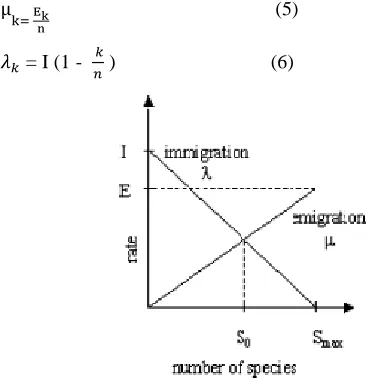
When the number of creatures increases and habitat becomes populated, large number of creatures can leave their own habitats and seek a new habitat for live and consequently emigration rate increases. The maximum emigration rate Occurs when the number of creatures is Smax. In the Fig. 1 the immigration and emigration lines are in form of straight lines but these lines might be more complicated lines. Calculation of immigration an emigration values in BBO algorithm is so important. Immigration and emigration rate have a important role in selecting those SIV‟s that migration process should be apply on them.With regard to immigration and emigration diagrams in figure 1, we can extract the following formulas:
(5)
[image:3.612.48.233.304.494.2]= I (1 - ) (6)
Fig. 1. Full model of immigration rate and emigration rate
Where μk is emigration rate for k number of creatures and λk is immigration rate for k number of creatures. If , E = 1 , with combining of above equations will results
+ = E (7)
B. BIOGEOGRAPHY-BASED OPTIMIZATION
This section refers to application of biogeography-based optimization in solving problems and surveying different parts of this algorithm. The basis of BBO algorithm is based on two main parts: Migration and Mutation.
a. Migration
In BBO algorithm, a population is selected as a solution. This solution can represent as a vector of real numbers that each real number is a SIV in BBO algorithm[13]. The fitness of each solution can be calculated with its objective function. This fitness is the same HSI in BBO algorithm.
In BBO solutions with high HSI represents a good solution and solution with low HSI represents a bad solution. The information of habitats probabilistically shares between other habitats using emigration rate and immigration rate of each solution. Each solution can modify on basis of Pmod, modification probability of each solution. In BBO one solution Si is selected for modification and then using immigration rate of that solution, is decided that modification be imposed on which SIV in that solution. Emigration rate of other solution is used for choosing a SIV that with that SIV, modification will be apply and then a SIV will select randomly to migrate to the solution Si in BBO algorithm an elitism process is included to prevent deterioration of best solution During the migration. In this process, a number of best solutions are transferred to next iteration without migration procedure.
b.Mutation
Sudden changes in climate of one habitat or other incidents will cause the sudden changes in HSI of that habitat[13]. In BBO algorithm, this situation can be model in the form of sudden changes in value of SIV. The probability of any organism can be calculated by the following equation.
PS={
( )
( )
( )
1 i Smax -1
(8)
Each member of one habitat has its own probability.If this probability is too low, then this solution has high chance to mutate. In the same manner, if probability of a solution is high that solution has a little chance to mutate. Consequently, solutions with high HSI and low HSI have a little chance to development a better SIV in the next iteration. Unlike high HSI and low HSI solutions, medium HSI solutions have a greater chance to development better solutions after mutation procedure.
In the following equation mutation rate of each solution can be calculated.
m (s) = mmax(
) (9)
Where,
m(s) : the mutation rate for habitat containing exactly s species
: user defined parameter
International Journal of Emerging Technology and Advanced Engineering
Website: www.ijetae.com (ISSN 2250-2459,ISO 9001:2008 Certified Journal, Volume 3, Issue 7, July 2013)
552
This kind of mutation is inclined to increase diversity between solutions. At this stage, there is also a elitism to prevent the answers from getting worse after mutation procedure. In this case, if a SIV is selected for mutation operation, one authorized random number is substituted.C. BBO ALGORITHM APPLIED TO ELD
The BBO algorithm as applied to ELD problem has been summarized below[14].
Step 1: Initialization of BBO parameters: Choose the number of generators i.e. number of SIVs, number of habitats i.e. population size, power demand, loss coefficients, habitat modification probability 𝑜𝑑 𝑓𝑦 = 1, mutation probability = 0.01, maximum mutation rate
𝑎𝑥, maximum immigration rate I = 1, maximum emigration rate E = 1, step size for numerical integration dt = 1, elitism parameter = 2.
Step 2: Initialization of SIVs: Each SIV of a habitat is initialized randomly while satisfying the constraints of (3). Each habitat represents a potential solution to the given problem.
Step 3: Calculation of HSIs: HSI for each habitat is calculated for given immigration and emigration rates. HSI represents the fuel cost of the generators.
Step 4: Identification of elite habitats: Based on the HSI values, elite habitats are identified i.e. those habitats for which the fuel cost is minimum, are selected.
Step 5: Performing migration operation: For each of the non-elite habitats, migration operation is performed. HSI for each habitat is recomputed. SIVs obtained after migration must satisfy the constraints of (3).
Step 6: Performing mutation operation: Species count probability of each habitat is updated using (7). Mutation operation is carried out on the non-elite habitats. HSI value of each new habitat set is recomputed.
Step 7: Stopping criterion: Go to step 3 for next iteration. If the predefined number of iterations is reached, stop the process.
IV. TEST SYSTEM AND RESULTS
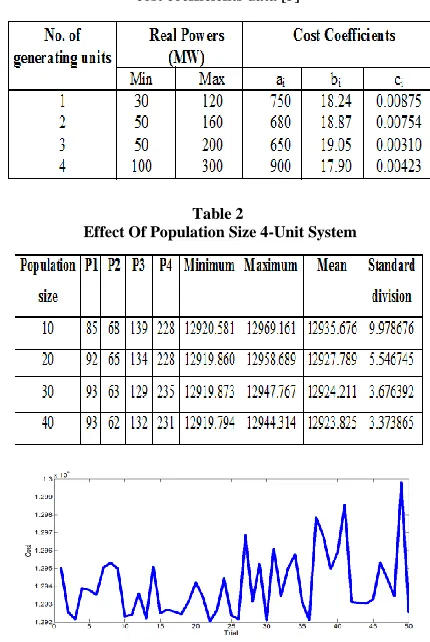
In order to show the effectiveness of the BBO technique, two generating systems have been taken into consideration. The system has 4-generating units. The cost data has been taken from [3].and show in the table 1 The load demand is 520 MW.
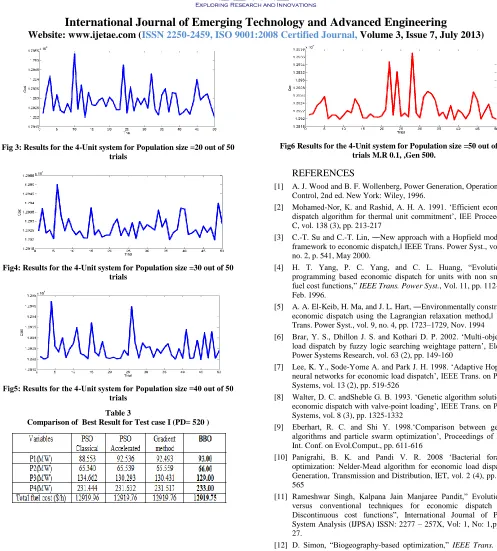
Transmission loss has not been considered here. The results obtained from proposed BBO algorithm have been compared with gradient –based method or PSO .and found to match very closely. Their best results are shown in Table 3. It can be observed from Table 2 that the maximum, minimum, mean and standard deviation of the population out of 50 trials goes on improving with increase in population. It can be observed that the population size= 10,
20, 30 and 40 are show in the Fig 2,Fig 3,Fig4,and Fig 5. That the population size= 50, and M.R. =0.1are best
parameters of this case after 50 Trials, which is very close to global minima. The solutions of 50 trials of this case are plotted in Fig 6
[image:4.612.335.550.301.622.2]Table 1 cost coefficients data [3]
Table 2
Effect Of Population Size 4-Unit System
International Journal of Emerging Technology and Advanced Engineering
Website: www.ijetae.com (ISSN 2250-2459,ISO 9001:2008 Certified Journal, Volume 3, Issue 7, July 2013)
553
Fig 3: Results for the 4-Unit system for Population size =20 out of 50 trials
Fig4: Results for the 4-Unit system for Population size =30 out of 50 trials
[image:5.612.50.547.90.641.2]Fig5: Results for the 4-Unit system for Population size =40 out of 50 trials
Table 3
Comparison of Best Result for Test case I (PD= 520 )
Fig6 Results for the 4-Unit system for Population size =50 out of 50 trials M.R 0.1, ,Gen 500.
REFERENCES
[1] A. J. Wood and B. F. Wollenberg, Power Generation, Operation, and Control, 2nd ed. New York: Wiley, 1996.
[2] Mohamed-Nor, K. and Rashid, A. H. A. 1991. „Efficient economic dispatch algorithm for thermal unit commitment‟, IEE Proceedings C, vol. 138 (3), pp. 213-217
[3] C.-T. Su and C.-T. Lin, ―New approach with a Hopfield modeling framework to economic dispatch,‖ IEEE Trans. Power Syst., vol. 15, no. 2, p. 541, May 2000.
[4] H. T. Yang, P. C. Yang, and C. L. Huang, “Evolutionary programming based economic dispatch for units with non smooth fuel cost functions,” IEEE Trans. Power Syst., Vol. 11, pp. 112–118, Feb. 1996.
[5] A. A. El-Keib, H. Ma, and J. L. Hart, ―Environmentally constrained economic dispatch using the Lagrangian relaxation method,‖ IEEE Trans. Power Syst., vol. 9, no. 4, pp. 1723–1729, Nov. 1994 [6] Brar, Y. S., Dhillon J. S. and Kothari D. P. 2002. „Multi-objective
load dispatch by fuzzy logic searching weightage pattern‟, Electric Power Systems Research, vol. 63 (2), pp. 149-160
[7] Lee, K. Y., Sode-Yome A. and Park J. H. 1998. „Adaptive Hopfield neural networks for economic load dispatch‟, IEEE Trans. on Power Systems, vol. 13 (2), pp. 519-526
[8] Walter, D. C. andSheble G. B. 1993. „Genetic algorithm solution of economic dispatch with valve-point loading‟, IEEE Trans. on Power Systems, vol. 8 (3), pp. 1325-1332
[9] Eberhart, R. C. and Shi Y. 1998.„Comparison between genetic algorithms and particle swarm optimization‟, Proceedings of IEEE Int. Conf. on Evol.Comput., pp. 611-616
[10] Panigrahi, B. K. and Pandi V. R. 2008 „Bacterial foraging optimization: Nelder-Mead algorithm for economic load dispatch‟, Generation, Transmission and Distribution, IET, vol. 2 (4), pp. 556-565
[11] Rameshwar Singh, Kalpana Jain Manjaree Pandit,” Evolutionary versus conventional techniques for economic dispatch with Discontinuous cost functions”, International Journal of Power System Analysis (IJPSA) ISSN: 2277 – 257X, Vol: 1, No: 1,pp-18-27.