International Journal of Advanced Engineering Research and Applications May – 2015
www.ijaera.org 28
SOMANI’S Approximation Method (SAM): An Innovative Method for finding
optimal Transportation Cost
Chirag Somani
Assistant Professor, Department of Applied Science & Humanities Engineering College Tuwa, Godhra, Gujarat - 388713 Gujarat Technological University, Ahmadabad, INDIA
Email: [email protected]
Abstract: Transportation problem is one of the sub classes of Linear Programming Problem (LPP) in which the objective is to transport various quantities of a single product that are stored at various origins to several destinations in such a way that the total transportation cost is minimum. The costs of shipping from sources to destinations are indicated by the entries in the matrix. To achieve this objective we must know the amount and location of available supplies and the quantities demanded. The different solution procedure of such type of problem illustrate in given paper.
Keywords:Transportation problem, Source, Destination, SAM Method
I. INTRODUCTION
All The Transportation problem is one if the original application of Linear Programming Problem. The main objective of transportation problem is to minimize the cost of transportation from the source to destination while satisfying supply as well as demand [1, 2]. Two contributions are mainly responsible for such type of problem which involves a number of sources and the number of destinations. Transportation problems may involve movement of a product from plants to warehouses, warehouses to wholesalers, wholesalers to retailers and retailers to customers. This problem can be used for a variety of situations such as scheduling, inventory control, personnel assignment, plant location etc. [1-8]
Basic Hypothesis in Transportation Problem
1) Total quantities of the items are available at a different source, equally the total demand at different destination.
2) Product can be transported easily from all sources to destinations.
3) The unit transportation cost of the item from all sources to destinations is known.
4) The transportation cost on a given route is directly proportion to the number of units shipped on that route.
5) The Main objective is to minimize the total transportation cost for the organization [2,11]
Mathematical Representation of Transportation Problem
The transportation problem can be formulated into a LP problem. Let xij, i = 1 ….m, j = 1
…n be the number of units transported from origin i to destination j. The LP problem is as follows:
www.ijaera.org 29
Subject to: 𝑛𝑗 =1𝑥𝑖𝑗 ≤ 𝑠𝑖 (i = 1, 2, - - -, m)
𝑥𝑖𝑗 ≥ 𝑑𝑗
𝑚
𝑖=1 (j = 1, 2, - - -, n)
𝑥𝑖𝑗 ≥ 0 (i = 1, 2, - - -, m, j = 1, 2, - - - n)
A transportation problem is said to be balanced, if
𝑠𝑖 = 𝑑𝑗 𝑛
𝑗 =1 𝑚
𝑖=1
Figure 1: A sample transportation model showing origins and destinations [8, 9]
II. PROPOSED METHOD (SOMANI’SAPPROXIMATION METHOD)
The SOMANI’S method (SAM) for Minimum Transportation Cost proceeds as follows:
Step 1: Make transportation table for given problem and convert into balance one if it is not.
Step 2: Find minimum element of each row.
Step 3: Compare the minimum element of each row and put the demand according the supply on which element that the mathematical value is minimum.
Step 4: If, the row demand and supply is equal then next step we will find the remaining rows minimum element and follow step -3 whenever the demand and supply are not satisfy.
Step 5: In case, demand and supply are not equal then we again find the minimum element of each rows and follow step -3.
Step 6: If, the minimum element are same then, we can firstly allocate those minimum element which demand is minimum.
Step 7: Now, same process follows whenever all given supply and demand are not satisfy.
Step 8: After satisfying demands and supply of each column and row, multiply the allocated row or column element with allocation values.
www.ijaera.org 30 III. ACASE STUDY
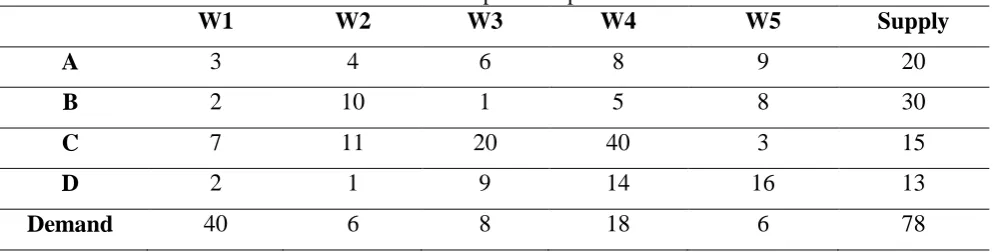
Solve the given transportation problem. Table 1 show the demand and supply for origins and destinations for a sample transportation problem.
Table 1: A transportation problem
W1 W2 W3 W4 W5 Supply
A 3 4 6 8 9 20
B 2 10 1 5 8 30
C 7 11 20 40 3 15
D 2 1 9 14 16 13
Demand 40 6 8 18 6 78
Step- 1: Supply and demand of Product is equal so the problem is balanced.
Step -2: Find the minimum element of each row, as shown below:
A 3
B 1
C 3
D 1
Step -3: Compare the minimum element of each row and put the demand according the supply on which element that the mathematical value is minimum. So the minimum value is B=1 and D=1. Allocation s made on D because the demand of D is minimum to B.
W1 W2 W3 W4 W5 Supply
A 3 4 6 8 9 20
B 2 10 1 5 8 30
C 7 11 20 40 3 15
D 2 61 9 14 16 13
Demand 40 6 8 18 6 78
Step- 4: The demand of W2 is over. Now, again find the minimum value of each row excluding W2.
A 3
B 1
C 3
D 2
www.ijaera.org 31
W1 W2 W3 W4 W5 Supply
A 3 4 6 8 9 20
B 2 10 81 5 8 30
C 7 11 20 40 3 15
D 2 61 9 14 16 13
Demand 40 6 8 18 6 78
Step -5: Follow the same process, whenever all demand and supply are not satisfy. In case the minimum element is same then we can firstly allocate those minimum elements which demand is minimum.
The demand of W3 is over. Now again find the minimum value of each row excluding W2 & W3.
A 3
B 2
C 3
D 2
Minimum Value is B=2 and D=2. So first we will allocate D=2
W1 W2 W3 W4 W5 Supply
A 3 4 6 8 9 20
B 2 10 81 5 8 30
C 7 11 20 40 3 15
D 72 61 9 14 16 13
Demand 40 6 8 18 6 78
The demand of W1 is not over. But supply of D is over. Now again find the minimum value of each row excluding W2, W3 & D.
A 3
B 2
C 3
Minimum Value is B=2. Now allocation is made on B=2.
W1 W2 W3 W4 W5 Supply
A 3 4 6 8 9 20
B 222 10 81 5 8 30
C 7 11 20 40 3 15
D 72 61 9 14 16 13
www.ijaera.org 32
The demand of W1 is not over. But supply of B is over. Now again find the minimum value of each row excluding W2, W3, D & B.
A 3
C 3
Minimum Value is A=C=3. Now allocation is made on A=3 because its demand is minimum to C.
W1 W2 W3 W4 W5 Supply
A 113 4 6 8 9 20
B 222 10 81 5 8 30
C 7 11 20 40 3 15
D 72 61 9 14 16 13
Demand 40 6 8 18 6 78
The demand of W1 is over. Now, again find the minimum value of each row excluding W1, W2, W3, D & B.
A 8
C 3
Minimum Value is C=3. Now allocation is made on C=3.
W1 W2 W3 W4 W5 Supply
A 113 4 6 8 9 20
B 222 10 81 5 8 30
C 7 11 20 40 63 15
D 72 61 9 14 16 13
Demand 40 6 8 18 6 78
The demand of W5 is over. The last column W4 is remaining. Put the demand according to supply of each row.
W1 W2 W3 W4 W5 Supply
A 113 4 6 98 9 20
B 222 10 81 5 8 30
C 7 11 20 940 63 15
D 72 61 9 14 16 13
Demand 40 6 8 18 6 78
Step -6: After completion of all allocation the allocated element multiplied by same row element.
Minimum Transportation Cost = 11*3 + 9*8 + 22*2 + 8*1 + 9 *40 + 6*3 + 7*2 + 6*1 = 555 Units
www.ijaera.org 33
IV. CONCLUSION
This method gives a basic feasible solution for a given transportation problem. The solution of given problem obtained from NWC, ROW Minima, Diagonal Minima, Column Minima is 878, 656, 383, 405. So the solution getting from this new method is nearby all this method. Hence, the SAM method gives an optimal solution of any type of transportation problems.
V. REFERENCES
[1] Sultan, A. & Goyal, S.K. (1988). Resolution of Degeneracy in Transportation Problems, J Opl Res Soc 39, 411-413.
[2] Sharma J K. Quantitative Techniques (2007). (6th ed.). New Delhi: Macmillan.
[3] Munkres, J. (1957). Algorithms for the Assignment and Transportation Problems. Journal of the Society for Industrial and Applied Mathematics, 5(1),32-38.
[4] Koopman T.C. (1947). Optimum utilization of transportation system. Proc. Intern. Statics. Conf. Washington D.C.
[5] Khurana, A. and Arora, S. R. (2011). Solving Transshipment Problem with mixed constraints. International journal of Management Science and Engineering Management. 6(4):292-297.
[6] Ji Ping & Chu, K. F. (2002). A dual matrix approach to the transportation problem. Asia-Pacific Journal of Operations Research, 19, 35-45.
[7] Goyal S. K. (1984). Improving VAM for the Unbalance Transportation Problem, J Opl Res Soc 35, 1113-1114.
[8] Dantzig, G. B.; Fulkerson, R.; Johnson, S. M. (1954). Solution of a large-scale traveling salesman problem", Operations Research 2 (4): 393–410.
[9] Adlakha, V., Kowalski, K. & Lev, B. (2006). Solving Transportation Problem with Mixed Constraints, JMSEM 1, 47-52.
[10] Ammar E. E. & Youness E. A. (2005). Study on multi-objective transportation problem with fuzzy numbers. Applied Mathematics and Computation, 166: 241-253
![Figure 1: A sample transportation model showing origins and destinations [8, 9]](https://thumb-us.123doks.com/thumbv2/123dok_us/1288913.1635509/2.595.82.542.202.417/figure-sample-transportation-model-showing-origins-destinations.webp)