Chapter 2 - Linear Programming: Model Formulation and Graphical Solution 1
Chapter 2
Linear Programming: Model
Formulation and Graphical Solution
Introduction to Management Science
8th Edition
by
Bernard W. Taylor III
Chapter 2 - Linear Programming: Model Formulation and Graphical Solution 2
Chapter Topics
Model Formulation
A Maximization Model Example
Graphical Solutions of Linear Programming Models
A Minimization Model Example
Irregular Types of Linear Programming Models
Characteristics of Linear Programming Problems
Objectives of business firms frequently include maximizing profit or minimizing costs.
Linear programming is an analysis technique in which linear algebraic relationships represent a firm’s decisions given a business objective and resource constraints.
Steps in application:
Identify problem as solvable by linear programming.
Formulate a mathematical model of the unstructured problem.
Solve the model.
Linear Programming
An Overview
Decision variables - mathematical symbols representing
levels of activity of a firm.
Objective function - a linear mathematical relationship
describing an objective of the firm, in terms of decision variables, that is maximized or minimized
Constraints - restrictions placed on the firm by the
operating environment stated in linear relationships of the decision variables.
Parameters - numerical coefficients and constants used in
the objective function and constraint equations.
Chapter 2 - Linear Programming: Model Formulation and Graphical Solution 5 Resource Requirements
Product Labor (hr/unit)
Clay (lb/unit)
Profit ($/unit)
Bowl 1 4 40
Mug 2 3 50
Problem Definition
A Maximization Model Example (1 of 2)
Product mix problem - Beaver Creek Pottery Company
How many bowls and mugs should be produced to maximize profits given labor and materials constraints?
Product resource requirements and unit profit:
Chapter 2 - Linear Programming: Model Formulation and Graphical Solution 6
Problem Definition
A Maximization Model Example (2 of 3)
Resource 40 hrs of labor per day
Availability: 120 lbs of clay
Decision x1= number of bowls to produce per day
Variables: x2= number of mugs to produce per day
Objective Maximize Z = $40x1+ $50x2
Function: Where Z = profit per day
Resource 1x1 + 2x2 ≤40 hours of labor
Constraints: 4x1 + 3x2≤120 pounds of clay
Non-Negativity x1 ≥0; x2 ≥0 Constraints:
Problem Definition
A Maximization Model Example (3 of 3)
Complete Linear Programming Model:
Maximize Z = $40x1+ $50x2 subject to: 1x1+ 2x2 ≤40
4x2+ 3x2 ≤120 x1, x2 ≥0
A feasible solution does not violate any of the constraints: Example x1 = 5 bowls
x2 = 10 mugs
Z = $40x1+ $50x2 = $700 Labor constraint check:
1(5) + 2(10) = 25 < 40 hours, within constraint Clay constraint check:
4(5) + 3(10) = 70 < 120 pounds, within constraint
Chapter 2 - Linear Programming: Model Formulation and Graphical Solution 9
An infeasible solution violates at least one of the constraints:
Example x1= 10 bowls x2= 20 mugs
Z = $1400 Labor constraint check:
1(10) + 2(20) = 50 > 40 hours, violates constraint
Infeasible Solutions
Chapter 2 - Linear Programming: Model Formulation and Graphical Solution 10
Graphical solution is limited to linear programming models containing only two decision variables (can be used with three variables but only with great difficulty).
Graphical methods provide visualization of how a solution for a linear programming problem is obtained.
Graphical Solution of Linear Programming Models
Coordinate Axes
Graphical Solution of Maximization Model (1 of 12)
Maximize Z = $40x1 + $50x2 subject to: 1x1+ 2x2 ≤40 4x2+ 3x2 ≤120
x1, x2 ≥0
Figure 2.1
Coordinates for Graphical Analysis
Labor Constraint
Graphical Solution of Maximization Model (2 of 12)
Maximize Z = $40x1+ $50x2 subject to: 1x1+ 2x2 ≤40 4x2+ 3x2 ≤120
x1, x2 ≥0
Figure 2.1
Chapter 2 - Linear Programming: Model Formulation and Graphical Solution 13
Labor Constraint Area
Graphical Solution of Maximization Model (3 of 12)
Maximize Z = $40x1 + $50x2 subject to: 1x1+ 2x2 ≤40 4x2+ 3x2 ≤120
x1, x2 ≥0
Figure 2.3
Labor Constraint Area
Chapter 2 - Linear Programming: Model Formulation and Graphical Solution 14
Clay Constraint Area
Graphical Solution of Maximization Model (4 of 12)
Maximize Z = $40x1+ $50x2 subject to: 1x1+ 2x2 ≤40 4x2+ 3x2 ≤120
x1, x2 ≥0
Figure 2.4
Clay Constraint Area
Both Constraints
Graphical Solution of Maximization Model (5 of 12)
Maximize Z = $40x1 + $50x2 subject to: 1x1+ 2x2 ≤40 4x2+ 3x2 ≤120
x1, x2 ≥0
Figure 2.5
Graph of Both Model Constraints
Feasible Solution Area
Graphical Solution of Maximization Model (6 of 12)
Maximize Z = $40x1+ $50x2 subject to: 1x1+ 2x2 ≤40 4x2+ 3x2 ≤120
x1, x2 ≥0
Figure 2.6
Chapter 2 - Linear Programming: Model Formulation and Graphical Solution 17
Objective Solution = $800
Graphical Solution of Maximization Model (7 of 12)
Maximize Z = $40x1 + $50x2 subject to: 1x1+ 2x2 ≤40 4x2+ 3x2 ≤120
x1, x2 ≥0
Figure 2.7
Objection Function Line for Z = $800
Chapter 2 - Linear Programming: Model Formulation and Graphical Solution 18
Alternative Objective Function Solution Lines
Graphical Solution of Maximization Model (8 of 12)
Maximize Z = $40x1+ $50x2 subject to: 1x1+ 2x2 ≤40 4x2+ 3x2 ≤120
x1, x2 ≥0
Figure 2.8
Alternative Objective Function Lines
Optimal Solution
Graphical Solution of Maximization Model (9 of 12)
Maximize Z = $40x1 + $50x2 subject to: 1x1+ 2x2 ≤40 4x2+ 3x2 ≤120
x1, x2 ≥0
Figure 2.9
Identification of Optimal Solution
Optimal Solution Coordinates
Graphical Solution of Maximization Model (10 of 12)
Maximize Z = $40x1+ $50x2 subject to: 1x1+ 2x2 ≤40 4x2+ 3x2 ≤120
x1, x2 ≥0
Figure 2.10
Chapter 2 - Linear Programming: Model Formulation and Graphical Solution 21
Corner Point Solutions
Graphical Solution of Maximization Model (11 of 12)
Maximize Z = $40x1 + $50x2 subject to: 1x1+ 2x2 ≤40 4x2+ 3x2 ≤120
x1, x2 ≥0
Figure 2.11
Solution at All Corner Points
Chapter 2 - Linear Programming: Model Formulation and Graphical Solution 22
Optimal Solution for New Objective Function
Graphical Solution of Maximization Model (12 of 12)
Maximize Z = $70x1+ $20x2 subject to: 1x1+ 2x2 ≤40 4x2+ 3x2 ≤120
x1, x2 ≥0
Figure 2.12
Optimal Solution with Z = 70x1+ 20x2
Standard form requires that all constraints be in the form of equations.
A slack variable is added to a ≤constraint to convert it to an equation (=).
A slack variable represents unused resources.
A slack variable contributes nothing to the objective function value.
Slack Variables
Linear Programming Model
Standard Form
Max Z = 40x1+ 50x2+ s1+ s2 subject to:1x1 + 2x2 + s1 = 40 4x2+ 3x2 + s2 = 120
x1, x2, s1, s2 ≥0 Where:
x1= number of bowls x2= number of mugs s1, s2are slack variables
Figure 2.13
Chapter 2 - Linear Programming: Model Formulation and Graphical Solution 25
Problem Definition
A Minimization Model Example (1 of 7)
Chemical Contribution
Brand Nitrogen
(lb/bag)
Phosphate (lb/bag)
Super-gro 2 4
Crop-quick 4 3
Two brands of fertilizer available - Super-Gro, Crop-Quick.
Field requires at least 16 pounds of nitrogen and 24 pounds of phosphate.
Super-Gro costs $6 per bag, Crop-Quick $3 per bag.
Problem: How much of each brand to purchase to minimize total cost of fertilizer given following data ?
Chapter 2 - Linear Programming: Model Formulation and Graphical Solution 26
Problem Definition
A Minimization Model Example (2 of 7)
Decision Variables:
x1 = bags of Super-Gro x2 = bags of Crop-Quick
The Objective Function:
Minimize Z = $6x1 + 3x2
Where: $6x1= cost of bags of Super-Gro $3x2= cost of bags of Crop-Quick
Model Constraints:
2x1+ 4x2 ≥16 lb (nitrogen constraint) 4x1+ 3x2 ≥24 lb (phosphate constraint) x1, x2≥0 (non-negativity constraint)
Model Formulation and Constraint Graph
A Minimization Model Example (3 of 7)
Minimize Z = $6x1+ $3x2 subject to: 2x1+ 4x2 ≥16
4x2+ 3x2 ≥24 x1, x2 ≥0
Figure 2.14
Graph of Both Model Constraints
Feasible Solution Area
A Minimization Model Example (4 of 7)
Minimize Z = $6x1+ $3x2 subject to: 2x1+ 4x2 ≥16
4x2+ 3x2 ≥24 x1, x2 ≥0
Figure 2.15
Chapter 2 - Linear Programming: Model Formulation and Graphical Solution 29
Optimal Solution Point
A Minimization Model Example (5 of 7)
Minimize Z = $6x1+ $3x2 subject to: 2x1+ 4x2 ≥16
4x2+ 3x2 ≥24 x1, x2 ≥0
Figure 2.16
Optimum Solution Point
Chapter 2 - Linear Programming: Model Formulation and Graphical Solution 30
Surplus Variables
A Minimization Model Example (6 of 7)
A surplus variable is subtracted from a ≥constraint to convert it to an equation (=).
A surplus variable represents an excess above a constraint requirement level.
Surplus variables contribute nothing to the calculated value of the objective function.
Subtracting slack variables in the farmer problem constraints:
2x1 + 4x2- s1 = 16 (nitrogen) 4x1+ 3x2 - s2= 24 (phosphate)
Minimize Z = $6x1+ $3x2+ 0s1+ 0s2
subject to: 2x1+ 4x2 – s1= 16
4x2+ 3x2– s2 = 24
x1, x2, s1, s2≥0
Figure 2.17
Graph of Fertilizer Example
Graphical Solutions
A Minimization Model Example (7 of 7)
For some linear programming models, the general rules do not apply.
Special types of problems include those with:
Multiple optimal solutions
Infeasible solutions
Unbounded solutions
Chapter 2 - Linear Programming: Model Formulation and Graphical Solution 33
Objective function is parallel to a constraint line.
Maximize Z=$40x1+ 30x2 subject to: 1x1 + 2x2 ≤40 4x2+ 3x2 ≤120
x1, x2 ≥0 Where:
x1= number of bowls x2= number of mugs
Figure 2.18
Example with Multiple Optimal Solutions
Multiple Optimal Solutions
Beaver Creek Pottery Example
Chapter 2 - Linear Programming: Model Formulation and Graphical Solution 34
An Infeasible Problem
Every possible solution violates at least one constraint:
Maximize Z = 5x1+ 3x2 subject to: 4x1 + 2x2≤8
x1≥4 x2≥6 x1, x2 ≥0
Figure 2.19
Graph of an Infeasible Problem
Value of objective function increases indefinitely:
Maximize Z = 4x1+ 2x2 subject to: x1≥4
x2≤2 x1, x2≥0
An Unbounded Problem
Figure 2.20
Graph of an Unbounded Problem
Characteristics of Linear Programming Problems
A linear programming problem requires a decision - a choice amongst alternative courses of action.
The decision is represented in the model by decision variables.
The problem encompasses a goal, expressed as an
objective function, that the decision maker wants to
achieve.
Constraintsexist that limit the extent of achievement of the
objective.
Chapter 2 - Linear Programming: Model Formulation and Graphical Solution 37
Proportionality- The rate of change (slope) of the
objective function and constraint equations is constant.
Additivity- Terms in the objective function and constraint
equations must be additive.
Divisability-Decision variables can take on any fractional
value and are therefore continuous as opposed to integer in nature.
Certainty- Values of all the model parameters are
assumed to be known with certainty (non-probabilistic).
Properties of Linear Programming Models
Chapter 2 - Linear Programming: Model Formulation and Graphical Solution 38
Problem Statement
Example Problem No. 1 (1 of 3)
Hot dog mixture in 1000-pound batches.
Two ingredients, chicken ($3/lb) and beef ($5/lb).
Recipe requirements:
at least 500 pounds of chicken
at least 200 pounds of beef
Ratio of chicken to beef must be at least 2 to 1.
Determine optimal mixture of ingredients that will minimize costs.
Step 1:
Identify decision variables.
x1= lb of chicken
x2= lb of beef
Step 2:
Formulate the objective function.
Minimize Z = $3x1 + $5x2
where Z = cost per 1,000-lb batch $3x1= cost of chicken
$5x2= cost of beef
Solution
Example Problem No. 1 (2 of 3)
Solution
Example Problem No. 1 (3 of 3)
Step 3:
Establish Model Constraints x1+ x2= 1,000 lb x1≥500 lb of chicken x2≥200 lb of beef x1/x2≥2/1 or x1- 2x2≥0
x1, x2≥0
The Model: Minimize Z = $3x1 + 5x2
subject to: x1 + x2= 1,000 lb x1≥50
Chapter 2 - Linear Programming: Model Formulation and Graphical Solution 41
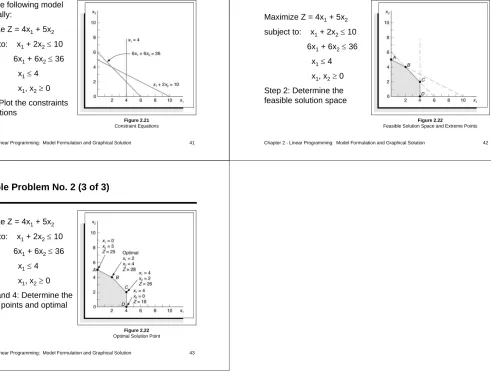
Solve the following model graphically:
Maximize Z = 4x1 + 5x2
subject to: x1 + 2x2≤10 6x1+ 6x2 ≤36
x1≤4 x1, x2 ≥0 Step 1: Plot the constraints as equations
Example Problem No. 2 (1 of 3)
Figure 2.21
Constraint Equations
Chapter 2 - Linear Programming: Model Formulation and Graphical Solution 42
Example Problem No. 2 (2 of 3)
Maximize Z = 4x1+ 5x2
subject to: x1+ 2x2≤10 6x1+ 6x2≤36
x1≤4 x1, x2≥0 Step 2: Determine the feasible solution space
Figure 2.22
Feasible Solution Space and Extreme Points
Example Problem No. 2 (3 of 3)
Maximize Z = 4x1 + 5x2
subject to: x1 + 2x2≤10 6x1+ 6x2 ≤36
x1≤4 x1, x2 ≥0
Step 3 and 4: Determine the solution points and optimal solution