Lecture 8
Message Authentication
protects against active attacks
verifies received message is authentic
contents unaltered
from authentic source
timely and in correct sequence
can use conventional encryption
only sender & receiver have key needed
or separate authentication mechanisms
Message
Hash Function Requirements
applied to any size data
H produces a fixed-length output.
H(x) is relatively easy to compute for any given x one-way property
computationally infeasible to find x such that H(x) = h
weak collision resistance
computationally infeasible to find y ≠ x such tha H(y) = H(x)
strong collision resistance
computationally infeasible to find any pair (x, y) such that H(x)
Hash Functions
two attack approaches
cryptanalysis
exploit logical weakness in alg
brute-force attack
trial many inputs
strength proportional to size of hash code (2n/2)
SHA most widely used hash algorithm
SHA-1 gives 160-bit hash
more recent SHA-256, SHA-384, SHA-512 provide
Public Key Authentication
Public Key Infrastructure (PKI)
Public Key Infrastructure (PKI)
:
integrated
system of software, encryption methodologies,
protocols, legal agreements, and third-party
services enabling users to communicate
securely
PKI systems based on public key
PKIX Management
functions:
registration initialization certificationkey pair recovery key pair update
revocation request cross certification
protocols:
PKI services
PKI protects information assets in several ways:
Authentication – Digital Certificate
To identify a user who claim who he/she is, in order to access the
resource.
Non-repudiation – Digital Signature
To make the user becomes unable to deny that he/she has sent the
message, signed the document or participated in a transaction.
Confidentiality - Encryption
To make the transaction secure, no one else is able to read/retrieve
the ongoing transaction unless the communicating parties.
Integrity - Encryption
To ensure the information has not been tampered during transmission.
Authorization. Digital certificates issued in a PKI environment can
Digital Signatures
Encrypted messages that can be
mathematically proven to be authentic
Created in response to rising need to verify
information transferred using electronic
systems
All copyrights reserved by C.C. Cheung 2003.
Digital Signature
Digital signature can be used in all electronic
communications
Web, e-mail, e-commerce
It is an electronic stamp or seal that append to
the document.
Ensure the document being unchanged during
All copyrights reserved by C.C. Cheung 2003.
How digital Signature works?
User A
User B Use A’s private key to sign the document
Transmit via the Internet
User B received the document with signature attached Verify the signature
All copyrights reserved by C.C. Cheung 2003.
Digital Signature Generation and
Verification
Message Sender Message Receiver
All copyrights reserved by C.C. Cheung 2003.
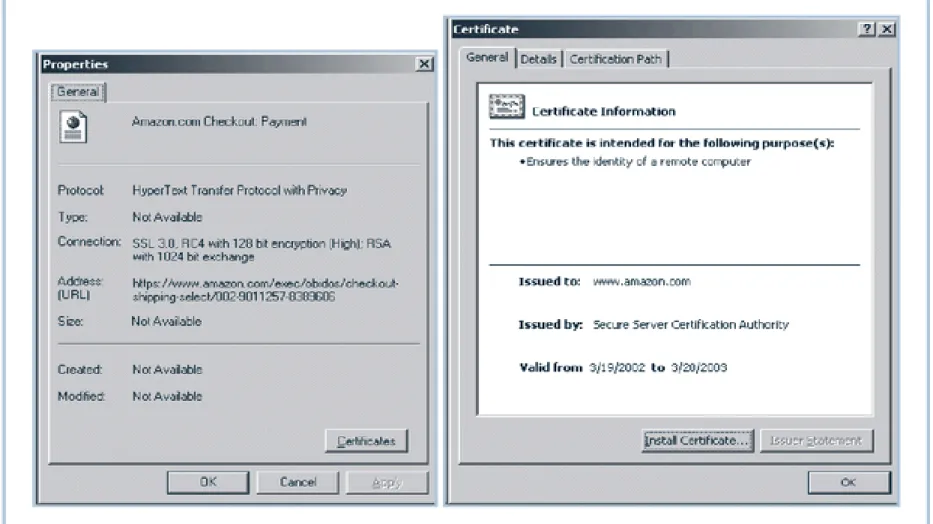
Digital Certificates
Digital Certificate is a data with digital
signature from one trusted Certification
Authority (CA).
This data contains:
Who owns this certificate Who signed this certificate The expired date
Digital Certificates
Electronic document containing key value and
identifying information about entity that
controls key
All copyrights reserved by C.C. Cheung 2003.
Digital Certificate
All copyrights reserved by C.C. Cheung 2003.
Certification Authority (CA)
A trusted agent who certifies public keys for
general use (Corporation or Bank).
User has to decide which CAs can be trusted.
The model for key certification based on friends
and friends of friends is called “Web of Trust”.
The public key is passing from friend to friend.
Works well in small or high connected worlds.
What if you receive a public key from someone you don’t
know?
A Certificate Authority is an agency that
manages the issuance of certificates and serves as the electronic notary public to verify their
Principles of Information Security, 2nd edition
Protocols for Secure
Communications
Secure Socket Layer (SSL) protocol: uses public
key encryption to secure channel over public
Internet
Secure Hypertext Transfer Protocol (S-HTTP):
extended version of Hypertext Transfer Protocol;
provides for encryption of individual messages
between client and server across Internet
S-HTTP is the application of SSL over HTTP; allows
encryption of information passing between
Principles of Information Security, 2nd edition
Protocols for Secure Communications (continued)
Securing E-mail with S/MIME, PEM, and PGP
Secure Multipurpose Internet Mail Extensions
(S/MIME): builds on Multipurpose Internet Mail Extensions (MIME) encoding format by adding encryption and authentication
Privacy Enhanced Mail (PEM): proposed as
standard to function with public key
cryptosystems; uses 3DES symmetric key encryption
Pretty Good Privacy (PGP): uses IDEA Cipher for
Principles of Information Security, 2nd edition
Protocols for Secure Communications (continued)
Securing Web transactions with SET, SSL, and
S-HTTP
Secure Electronic Transactions (SET): developed by
MasterCard and VISA in 1997 to provide protection from electronic payment fraud
Uses DES to encrypt credit card information
transfers
Provides security for both Internet-based credit
References & further readings
Computer Security: Principles and
Practice :
Chapter 2 – Cryptographic Tools
by
William Stallings and Lawrie Brown