Impact of Information Access on Poverty
Alleviation Effectiveness: Evidence From China
JIAPING ZHANG 1,2, YI ZHANG3, MINGWANG CHENG 1, NING YU4,5,
XINYU WEI1, AND ZHENYU ZHANG 1,6
1School of Economics and Management, Tongji University, Shanghai 200092, China
2School of Management and Labor Relations, Rutgers University, New Brunswick, NJ 08854, USA 3School of Information Engineering, Nanjing Audit University, Nanjing 211815, China 4Institute for Social and Economic Research, Nanjing Audit University, Nanjing 211815, China 5Rural Education Action Program, Stanford University, Stanford, CA 94305, USA
6Shanghai Municipal Engineering Design Institute (Group) Company Ltd, Shanghai 200092, China
Corresponding author: Mingwang Cheng ([email protected])
This work was supported in part by the National Social Science Foundation of China under Grant 18BJY108, in part by the National Natural Science Foundation of China under Grant 71873095 and Grant 71903151, in part by the Major Project of Philosophy and Social Sciences Research for Education Ministry of China under Grant 15JZD026, in part by the International Exchange Program for Graduate Students of Tongji University under Grant 201902028, in part by the Major Project of the 13th Five-year Plan for Education Science in Shandong Province under Grant ZZ2019066, and in part by the Ministry of Education in China (MOE) Projects of Humanities and Social Sciences under Grant 19YJC790181.
ABSTRACT In studying China’s targeted poverty alleviation policy, this paper models the interaction between local governments and poor households with an evolutionary game. The model predicts that bolstering information access of rural residents can significantly improve the effectiveness of poverty alleviation. Using data from the Chinese General Social Survey (CGSS) for 2015, we test this prediction by employing Internet use, TV-viewing and radio-listening as proxy variables of information access. OLS and probit regressions show significant positive effects of targeted people’s information access on various measures of poverty alleviation success. Estimations through propensity score matching (PSM) yield similar results. The findings highlight the importance of information access in global poverty alleviation efforts.
INDEX TERMS Information access, poverty alleviation effectiveness, targeted poverty alleviation, evolu-tionary game.
I. INTRODUCTION
Eliminating poverty is a panhuman goal and aspi-ration [1]–[4], which is also an important measure to improve human welfare and ensure economic sustainability. Many international organizations have been working to reduce the world’s poor population numbers and incidences of poverty [5]–[7]. A growing body of studies have been con-ducted in an attempt to fully understand the definition and reality of poverty, and to find the most effective poverty reduction policies [8]–[16]. However, poverty alleviation research still has a long way to go.
As the most populous country in the world, China has made great progress in reducing the number of people living in poverty [7]. The numbers of rural poor in China decreased by nearly 67 million from 2010 to 2012 [17]. The United Nations
The associate editor coordinating the review of this manuscript and
approving it for publication was Eunil Park .
‘‘Millennium Development Goals Report 2015’’ shows that the number of people living in extreme poverty in the world decreased from 1.9 billion in 1990, to 836 million in 2015. China’s contribution rate in terms of this reduction was over 70% [18]. For a very long time, China’s anti-poverty experi-ence has been receiving attention from scholars all over the world [19]–[25].
At the 19th Communist Party of China (CPC) National Congress, the Chinese government pointed out that ‘‘Chi-nese society’s principal contradiction has evolved to be that between unbalanced and inadequate development and the people’s ever-growing need for a better life’’ [26]. The report states that the Chinese government will continue to put poverty alleviation work at a new level for a new period of time. As a major government initiative, the targeted poverty alleviation policy has received extensive attention from academic researchers [7], [27]. Poor households and poverty-stricken villages are the targets and the main body
of the targeted poverty alleviation policy. The local govern-ments are the main coordinators, promoters and supervisors of targeted poverty alleviation work. However, the reality is that the levels of information awareness, voice and the right to dialogue between the poor households, villages and local governments are in a state of asymmetry with regard to the process of poverty alleviation. The poor households also belong to the vulnerable rural groups. The new strat-egy may form a system dominated by local governments, in which poor households are passive participants. In such cases, it is difficult to arouse the enthusiasm of the poor households to the point where they will actively participate in anti-poverty programs. This could eventually lead to a phenomenon whereby, ‘‘in the end, local governments are trapped in passive poverty alleviation, and poor households are lifted out of poverty passively’’. In this case, those tar-geted for poverty alleviation will fall into the ‘‘prisoner’s dilemma,’’ negatively influencing the efficiency of the gov-ernment’s poverty alleviation work [28], [29].
Specifically, this paper mainly attempts to solve the fol-lowing practical problem: how do we make targeted poverty alleviation work more efficient in China? The current study attempts to use evolutionary game theory to depict the limited rational game relationship between poor households and local governments, in order to provide some policy implications for the targeted poverty alleviation work. Compared with existing literature, this paper makes two main contributions. First, to the best of our knowledge, the evolutionary game model is adopted for the first time, in order to dynamically analyze the strategy choices between local governments and poor households in the process of China’s targeted poverty alleviation. We find that improve rural residents’ ability to obtain information can significantly improve the efficiency of China’s targeted poverty alleviation work. Secondly, based on data from the Chinese General Social Survey for 2015, this study empirically examines the effect of information access (to rural residents) on the efficiency of China’s tar-geted poverty alleviation work. Also, OLS and probit estima-tion results show that improving informaestima-tion access capabil-ity to rural residents can significantly reduce the incidence of poverty for rural residents, which has important policy implications for China’s targeted poverty alleviation work. In order to obtain a more reliable conclusion, we conducted two supplementary analyses. Firstly, we adopt the logarithm of per capita household income as the proxy of the effi-ciency of targeted poverty alleviation. Secondly, we employ propensity score matching (PSM) to deal with possible selec-tive bias. Through these steps, the main conclusions remain consistent.
The remainder of this paper is organized as fol-lows: Section 2 briefly reviews the relevant literature. Section 3 constructs an evolutionary game model to analyze how to make targeted poverty alleviation work more efficient in China. Section 4 builds an econometric model to fully examine the conclusion drawn from the evolutionary game analysis. Then, Section 5 summarizes the main conclusions
and provides corresponding policy suggestions to China’s targeted poverty alleviation.
II. LITERATURE REVIEW
A. TARGETED POVERTY ALLEVIATION
A targeted poverty alleviation policy has become the core objective of China’s new stage of poverty alleviation and development. In November 2013, China’s General Secretary, XI Jinping, put forward ‘‘targeted poverty alleviation’’ for the first time. Investigations started in Xiangxi, Hunan province, after which many scholars paid constant and close attention to China’s targeted poverty alleviation practices. The focus mainly includes the following aspects:
Firstly, some scholars mainly discussed the connotation of targeted poverty alleviation. Compared to previous measures, the current targeted poverty alleviation strategy requires more targeted efforts to eliminate the various factors affecting the poverty levels of poor households [7]. Li et al. [13] and Wang [30] pointed out that the targeted poverty alle-viation strategy uses scientific and effective procedures to accurately identify, help and manage the poverty-stricken objects. The resulting strategy depends on the environment of the different poverty-stricken areas and the situation of different poverty-stricken farmers. Guoet al.[31] discussed the connotation of targeted poverty alleviation in China and believed that targeted poverty alleviation is an innovative poverty alleviation strategy, which contributes to overcome the island effect of poverty distribution and help policymakers to formulate targeted measures to efficiently improve the situation in China’s rural areas.
Secondly, the problems and dilemmas faced by targeted poverty alleviation work is also important research topic in the field. Generally speaking, developing local industry is one of the most effective ways to achieve targeted poverty alleviation [7]. However, the problem of land supply has become an important factor hindering the promotion of indus-trial poverty alleviation in China. Meanwhile, Liuet al.[32], Liet al.[33], Loet al.[34], and Longet al.[35] all found that, with the rapid development of urbanization, a large num-ber of young rural laborers enter into urban non-agricultural employment, while the older people remain in the rural areas. As a result, China’s rural areas have experienced the unique phenomenon of simultaneous population hollowing and aging [7]. What’s more, Zhouet al. [7] and Liu [36] point out that the problem of diseases in rural areas and insufficient funding of education pose a great challenge to poverty alleviation. These factors greatly increase the diffi-culty and cost for a poverty-stricken population, making it almost impossible to eliminate poverty. Other scholars point out that the current land policy and household registration regime have also shown great resistance to China’s targeted poverty alleviation [6], [37].
in targeted poverty alleviation. For example, Rogerset al.[42] suggested that without public participation, targeted poverty alleviation creates new tensions at the village level concern-ing who should be designated as poor and who should receive the benefits. Similarly, Lo et al. [43] held that everyone should be informed about the policies and be given the oppor-tunity to provide feedback, such that the government can understand the challenges the poor must over-come in order to participate in poverty alleviation. Taking Hebei Province as an example, Huang and Yang [44] found that improving inclusive finance in poverty-stricken areas and promoting close cooperation between financial institutions and govern-ment departgovern-ments played an important role in the efficiency of targeted poverty alleviation work.
B. EVOLUTIONARY GAME THEORY
A game is a process in which strategies and behavior actions are chosen when facing certain environmental conditions and specific rules, either simultaneously or successively. The cor-responding game results are then taken for some individual, team or organization, respectively. A game normally involves the following four aspects: 1) the game participants (players); 2) the strategies or actions of all participants can be chosen; 3) the order of the game, and 4) each player’s payoff. As a branch of economics, game theory makes up for the difficul-ties found in microeconomics and macroeconomics, namely being able to analyze the mutual influences between multiple and individual decisions [45]. Traditional game theory is based on the complete rationality of game players. However, when a game player or decision-maker is in a complex social environment and faces a complicated decision, the rational choices of the decision-makers often have obvious limita-tions. In this case, it is difficult to use a traditional static game or comparative static game method for analysis purposes. In the 1970s, with the development of the evolution game theory, which is based on the principle of biology evolution, the complicated dynamic behaviors of game systems can now also be studied through game theory [46]–[49]. Evolution game theory combines game theory and dynamic evolution theory, breaking through the traditional game theory’s strict requirements that all game players must be completely ratio-nal. An evolutionary game’s attention is focused on the evolu-tionary stable strategy (ESS), which expands the application space of game theory [50], [51]. Essentially, ESS is a state of equilibrium, where agents that have different strategies are not constricted by unsatisfactory strategies [45].
III. ANALYSIS OF THE STRATEGY CHOICES BETWEEN LOCAL GOVERNMENTS AND POOR HOUSEHOLDS BY USING EVOLUTIONARY GAME THEORY
A. GAME MODEL HYPOTHESIS
There are complex game relationships among poor house-holds (or poor villages), non-poor househouse-holds (or non-poor villages), local governments and superior governments in China’s targeted poverty alleviation work. This paper mainly
focuses on the model of an evolutionary game between local governments and poor households. In the process of tar-geted poverty alleviation, both the poor households and local governments play important roles. Poor households are the accurate objects in poverty alleviation, and the local govern-ments are the accurate coordinators, drivers and supervisors for poverty alleviation work. However, many information asymmetry situations exist between the poor households and the local governments in the process of poverty alleviation. The right to having a voice is also not equal between them. In many instances, the local government acts as a ‘‘giver’’, lacking the necessary support work and enthusiasm for anti-poverty efforts from the poor household. On the other hand, due to the fact that local governments and the poor house-holds experience many information asymmetry phenomena, the cost to local governments involved in poverty alleviation is large. Therefore, some local governments have negative attitudes regarding poverty alleviation. The result is that, even though a lot of money is poured into poverty allevia-tion funds, the incomes of poor households have not been significantly improved. Poor households are just passively involved in anti-poverty measures. In addition, due to the lack of proven scientifically-based anti-poverty methods, the costs and risks to poor households in anti-poverty strategies are bigger. Therefore, the poor households react negatively to anti-poverty strategies. This reaction, in turn, has serious negative effects on the targeted poverty alleviation. In order to construct an evolutionary game model between the poor households and local governments, the following hypotheses are made:
1) Under the condition of limited theory, the two partic-ipants in the game are: the local government and the poor household (set to 1 and 2, respectively). The local govern-ment and poor household are randomly selected and matched, respectively, from different members of the game. In order to find the optimal strategy, the game between the two sides hap-pens through constant learning and adjustment of a repeated dynamic game, and eventually, equilibrium is reached. The adjustment process of the strategy choice can use a more general evolutionary game of replicator dynamic equations to simulate.
2) The local governments’ policy options are included in S1(s11: actively participating in poverty alleviation,s12:
negatively participating in poverty alleviation). The poor households’ strategy options are included inS2(s21: active
anti-poverty, s22: negative anti-poverty).
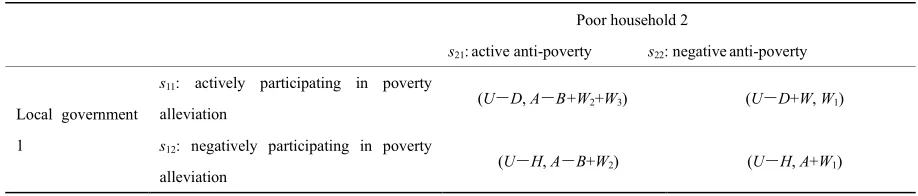
B. PAYOFF MATRIX
The payoff parameters of both local governments’ strategy selections and poor households’ strategy selections are set as follows:
TABLE 1. The game payoff matrix of the local government and the poor household.
punished by a superior government or public opinion for H, and the cost to local governments that choose the active participation strategy for poverty alleviation is D. Assume also that poverty alleviation cost D depends only on the information access capability to rural residents (F), and∂∂DF < 0. Generally speaking, with the improvement of farmers’ information access ability, farmers can better understand the relevant poverty alleviation policies, so they can make bet-ter use of policies to achieve their own poverty alleviation. In addition, improving farmers’ information acquisition abil-ity can also help the government to popularize the policy of benefiting farmers in time, accurately assess farmers’ living conditions to determine who is the real poor household, and give dynamic feedback to the whole process of poverty alle-viation, so as to reduce the information asymmetry between poor households and local governments. In other words, the higher the information access ability for poor households, the lower the cost for local governments to actively participate in poverty alleviation work, and to guide or supervise the poor households’ negative and lazy behavior for the anti-poverty strategy.
2) Assume that the pure income of the poverty house-hold is W1 before targeted poverty alleviation. After the
poor household actively participates in the anti-poverty strat-egy, the pure income for the poverty–stricken household isW2.
3) The poor household gets a total amount of poverty funds forA. When the poor household chooses the strategy to neg-atively participate in the anti-poverty strategy, and the local government chooses to actively participate in the poverty alleviation strategy, the local government can observe the poor households’ behavior and recover the poverty funds. The local government will then get rewards forWfrom superior government or public opinion by adopting this behavior. When the local governments observe the poor households’ active behavior, the reward forW3will be given to the poor
household for their active behavior.
4) The cost of choosing active anti-poverty for the poor household isB;Bdepends on the health and education level of the poor household, as well as macroeconomic conditions, such as industrial structures.
According to the above parameters, Table 1 has a 2×2 game yield matrix for the local government and poor household.
C. THE REPRODUCTION DYNAMIC PROCESS OF THE LOCAL GOVERNMENT AND THE POOR HOUSEHOLD Assuming that the probability of the local government choos-ing the active poverty alleviation strategy isx (0< x <1), Therefore, the probability of the local government using the passive poverty alleviation strategy is 1−x. The probability of the poor household choosing the positive anti-poverty strat-egy isy(0< y<1). Homoplastically, the probability of the poor household selecting the negative anti-poverty strategy is 1−y. The finite rational repeated game process is simulated, based on the replication dynamic equation.
The expected benefitsu11for the local government when
selecting the active participation in the poverty alleviation strategy can be calculated as:
u11 =y(U−D)+(1−y)(U−D+W)
=U+W −D−yW (1)
The expected benefitsu12for the local government when
selecting the negative participation in the poverty alleviation strategy can be calculated as:
u12 =y(U−H)+(1−y)(U−H)
=U−H (2)
The average benefitsu¯1 for the local government can be
calculated as:
u1 =xu11+(1−x)u12
=x(U+W −D−yW)+(1−x)(U−H) (3)
The expected benefits u21 for the poor household when
selecting the active anti-poverty strategy can be calculated as:
u21 =x(A−B+W2+W3)
+(1−x)(A−B+W2)
=A+W2−B+W3x (4)
The expected benefits u22 for the poor household when
selecting the negative anti-poverty strategy can be calculated as:
u22 =xW1+(1−x)(A+W1)
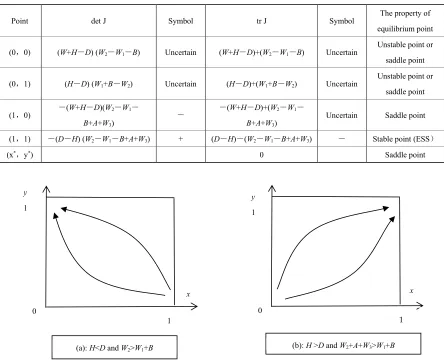
TABLE 2. The stability of each equilibrium point (whenH<DandW2>W1+B).
The average benefits u¯2 of the poor household can be
calculated as:
u2 =yu21+(1−y)u22
=y(A+W2−B+W3x)
+(1−y)(A+W1−Ax) (6)
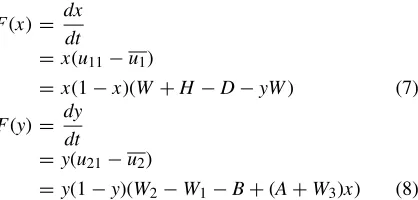
The dynamic analysis of the game between the local gov-ernment and the poor household is carried out separately. The dynamic equation of the local government F(x) and the poor household F(y) can be obtained by:
F(x)= dx
dt
=x(u11−u1)
=x(1−x)(W +H−D−yW) (7)
F(y)= dy
dt
=y(u21−u2)
=y(1−y)(W2−W1−B+(A+W3)x) (8)
According to the above replication dynamic equation, let-ting F(x) = 0 and F(y) = 0, and the five replication dynamic equilibrium points are obtained for (0, 0), (0, 1), (1, 0), (1, 1) and (W1+B−W2
A+W3 ,
W+H−D W ). Let x
∗ = W1+B−W2
A+W3 ,
y∗=W+H−D
W .
The Jacobian matrix J of the above replication dynamic equation is as follows:
J =
dF(x) dx
dF(x) dy dF(y)
dx
dF(y) dy
=
(1−2x)(W+H−D−yW) −Wx(1−x)
y(1−y)(A+W3) (1−2y)(W2−W1−B+(A+W3)x)
(9)
According to the above Jacobian matrix (9), the determinant of the matrix (detJ) and trace (trJ) are respectively:
detJ = dF(x)
dx dF(y)
dy − dF(x)
dy dF(y)
dx
=(1−2x)(W +H−D−yW)(1−2y) ×(W2−W1−B+(A+W3)x)
+y(1−y)(A+W3)Wx(1−x) (10)
trJ = dF(x)
dx + dF(y)
dy
=(1−2x)(W +H−D−yW)+(1−2y) ×(W2−W1−B+(A+W3)x) (11)
According to Friedman [42], the equilibrium stability judg-ment method of a dynamic replication system is proposed: WhendetJ>0, and trJ<0, the corresponding equilibrium point is the system’s stabilization strategy (ESS). Further-more, at the equilibrium point (except for (x∗,y∗) point), we have:detJ = dF(x)
dx dF(y)
dy ,trJ = dF(x)
dx +
dF(y)
dy . Therefore,
the judgment conditions of whether an equilibrium point is the ESS are equal to:dF(x)dx <0 and dF(y)dy <0.
From the results of the game, when the poor household using its endogenous power to choose the anti-poverty strat-egy is the optimal choice for society, this means the dynamic stability of the complex system point strategy is point (0, 1) or point (1, 1). According to the above judgment method, considering that point (0, 1) is the final steady state strategy, the equilibrium point (0, 1) needs to satisfy the following requirements:
dF(x) dx
x=0,y=1 =H−D<0
dF(y) dy
x=0,y=1 =W2>W1+B
(12)
The stability of the other equilibrium point is given in Table 2. At the same time, assuming thatH is constant,W1 +Bis
defined as the opportunity cost for the poverty household when selecting the active anti-poverty strategy. According to the above definition,W2is the pure income when poor
house-holds choose the active anti-poverty strategy. According to the results of Equation (12) and Table 2, when theDis large, namely poor household has limited access to information, by making theW2>W1+B(making the future pure income
TABLE 3. The stability of each equilibrium point (whenH>DandW2+A+W3>W1+B).
FIGURE 1. Strategy evolution diagram of both local governments and poor households.
adopting the active anti-poverty strategy) will the local gov-ernment and the poor household adopt the negative poverty alleviation strategy and positive anti-poverty strategy, respec-tively. The equilibrium point (0, 1) will become the only dynamic complex system stable strategy (ESS), as shown in Fig. 1(a).
Similarly, when the equilibrium point (1, 1) is a stable strategy for the dynamic complex system, the conditions of satisfaction are shown in Table 3, which also gives the stability of other equilibrium points. The equilibrium point (1, 1) needs to satisfy the following conditions:
dF(x) dx
x=1,y=1 =H−D>0
dF(y) dy
x=1,y=1 =W2+A+W3>W1+B
(13)
Define W2 + A +W3 as the total income of the poor
household after choosing the active anti-poverty strategy. The results show that, whenD<H, namely poor household has a better information acquisition ability, as long as the total income (including government incentives, poverty alleviation
government can ensure that the poverty households’ stable, future total income level will be greater than the oppor-tunity cost of anti-poverty behavior, the local government will choose to actively participate in the proposed poverty alleviation strategy, and the poor households will actively par-ticipate in the anti-poverty strategy. In this case, the poverty alleviation work can achieve effective and remarkable results.
Targeted poverty alleviation requires the joint efforts of local governments and poor households. As shown above, if poor household has limited access to information, this may eventually lead to a situation of negative poverty alle-viation by the local government (Fig. 1 (a)). However, the poor households belong to a vulnerable group within society. If the poor households only rely on themselves to eliminate poverty, they would face numerous risks and uncertainties. What’s more, poor households are also less able to withstand the associated risks, due to low educa-tion levels or health condieduca-tions. Therefore, it is necessary to constantly reduce the inadequacy of information between poverty-stricken households and local governments, so that both poor households and local governments can actively participate in targeted poverty alleviation, as shown in Fig. 1(b).
By summarizing the above evolutionary game analysis, increasing the information access ability for poor households can encourage both local governments and poor households to actively participate in the targeted poverty alleviation work. Ultimately, the efficiency of China’s targeted poverty alleviation work could be improved dramatically. Therefore, we propose the following hypothesis:
Research hypothesis: there is a significant positive rela-tionship between rural residents’ information access ability and the efficiency of China’s targeted poverty alleviation work.
Furthermore, this paper will employ the econometric model to test the above assumptions.
IV. THE EMPIRICAL ANALYSIS A. DATA SOURCE
The data used in the empirical research of this section is from the China General Social Survey for 2015 (CGSS2015). CGSS has mainly been implemented by the Renmin Uni-versity of China, starting in 2003. Each year, more than 10,000 household samples across the country are investi-gated. The CGSS2015 covers 28 provinces in mainland China (not including Hainan, Tibet, Xinjiang, Macau, Hong Kong and Taiwan), including 134 counties, and 487 neighborhood communities (villages). In each village or neighborhood com-munity, about 25 families were randomly surveyed, and in each family, one person was randomly surveyed. In 2015, 10968 samples were surveyed, including 6470 city-dwelling samples and 4498 rural-dwelling samples. The respondents ranged from 18 to 95 years of age, so the data has a good representative mix. This study mainly uses rural-dwelling samples for research purposes.
B. ESTIMATION MODEL AND VARIABLE SETTINGS
Our empirical purpose is to test whether increasing the poor households’ information access ability can improve the effi-ciency of China’s targeted poverty alleviation work. There-fore, this study formulated the following regression model:
Probit(Yi)
=α0+α1Asymmetryi+βk K X
k=1
Costk,i+CXi+εi (14)
where subscriptsi = 1,2, . . .indexes theith rural resident andεi represents the error term. We use the probability of
eliminating poverty for a rural resident as the measure of the efficiency of China’s targeted poverty alleviation work. Therefore, the dependent variable probit (Yi) represents the
probability of eliminating poverty for rural residenti, which is equal to 1 when the rural resident i is not a poor household. It is equal to 0 if the rural residentiis from a poor household. Since the reform and opening up of the country’s economy, China has adopted three different poverty standards, namely the ‘‘1978 standard’’, ‘‘2008 standard’’ and ‘‘2010 standard’’. This paper adopts the ‘‘2010 standard’’, which set the poverty line at 2300 yuan per person per year (at 2010 prices). We cal-culate the constant price in 2014 according to the annual consumer price index of rural residents and get 2610 yuan per person per year for the poverty line in 2014. Therefore, when the per capita household income of rural residents is greater than 2610 yuan, the probit (Yi) is equal to 1; otherwise it is 0.
The independent variables are asymmetryi and costkk,i,
whereasymmetryi is key variable concerned in this paper
represents the information access ability of rural residents, and costkk,i is a set of variables representing the cost of
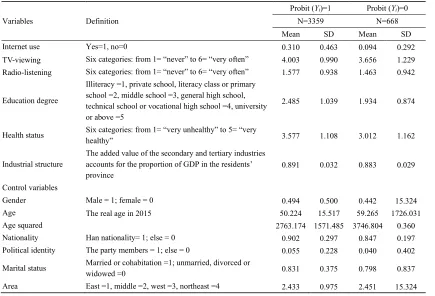
TABLE 4. Variable definition and descriptive statistics.
such as the human capital of rural residents and the regional industrial structure [46]–[63]. Therefore, we use the educa-tion degree, health status of rural residents, and the industrial structure of their provinces to reflect the cost of poverty alleviation.
In addition,Xiis a set of control variables that may
influ-ence the probability of rural resident ifalling into poverty. Those variables include gender, age, age squared, politi-cal identity, nationality, marital status and regional dummy variables. We removed samples with unclear or abnormal answers to related questions. Eventually, 4027 samples were obtained, including 3359 samples from non-poor households and 668 samples from poor households. Table 4 shows the detailed definitions and descriptive statistics of all variables.
C. ESTIMATED RESULTS AND ANALYSIS
Since the dependent variable (probit (Yi)) is a binary variable,
the probit model is employed to estimate the benchmark model. However, as long as the model is set accurately, there is no absolute advantage or disadvantage between the results of ordinary least squares (OLS) and probit estima-tion [64], [65]. Therefore, we report both the estimaestima-tion results of OLS and probit estimation, and we use the robust standard error in all results.
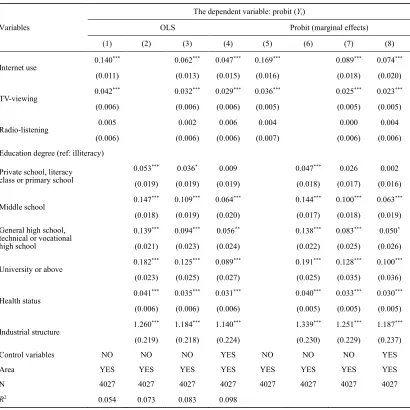
As shown in Table 5, the results under OLS and probit estimation are basically consistent, indicating that the esti-mation results in this paper are relatively stable. Model (1)
and Model (5) only investigate the impact of information access ability on rural residents’ probability of eliminating poverty. Model (2) and Model (6) only investigate the impact of the cost of poverty alleviation on the probability of rural residents eliminating poverty. Model (3) and Model (7) con-sider both information access ability and the cost of poverty alleviation factors. Model (4) and Model (8) add the control variables.
The results in Table 5 show that the coefficients of the three variables reflecting information access ability are positive in all models and pass the significance level of 1% except for receiving radio. The effect of receiving radio on the probability of eliminating poverty is not significant, which may be because television and the Internet have gradually replaced radio as the main access to information for rural res-idents. In general, the above results show that increase in the information access ability to rural residents can significantly increase the probability of eliminating poverty among rural residents. Therefore, the research hypothesis in this study is verified.
TABLE 5. The effect of information access on the probability of eliminating poverty for rural residents.
With the increase in the proportion of non-agricultural industries in the total economic output of various provinces, the probability of rural residents eliminating poverty is greater. According to the analysis above, an improvement in education level, improvement of health conditions and an increase in the proportion of non-agricultural industries in various regions are closely related to the cost of poverty alleviation for rural residents. Therefore, reducing the cost of poverty alleviation for rural residents can also significantly improve the efficiency of China’s targeted poverty alleviation work.
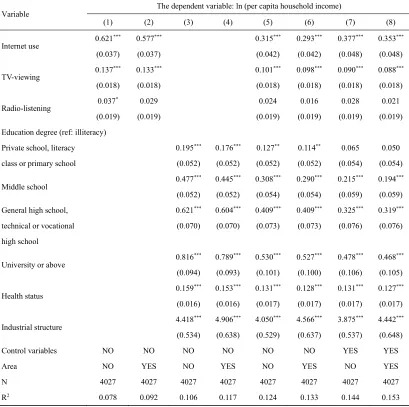
Generally speaking, rural residents’ income is the most direct reflection of poverty alleviation work efficiency. There-fore, we further tested the robustness with the logarithm of per capita household income as the dependent variable. The estimation results using OLS are shown in Table 6. It can be seen that the empirical results in Table 6 are basically
consistent with the foregoing, so the main conclusions are reliable.
TABLE 6. The effect of information access on rural residents’ logarithm of per capita household income.
Summarizing the above empirical results, the theoretical hypotheses has been verified effectively, namely increasing information access ability to rural residents can significantly increase the probability of rural residents eliminating poverty. Therefore, the results of the above evolutionary game are further verified.
V. RESEARCH CONCLUSIONS AND POLICY IMPLICATIONS
China’s targeted poverty alleviation work has made outstand-ing contributions to global poverty reduction and has attracted worldwide attention. This study was conducted in order to analyze how to make targeted poverty alleviation work more efficient. Based on the bounded rationality game theory, this paper used the evolutionary game to dynamically analyze strategy choices between local governments and poor house-holds in the process of China’s targeted poverty alleviation
work. The main conclusion of this study is that, when poor household has limited access to information, it is difficult to mobilize the enthusiasm of poor households and local govern-ments to participate in poverty alleviation at the same time. Poverty alleviation work is difficult to undertake at this time. When poor household has a better information access ability, it can achieve a more ideal situation that both poor households and local governments can actively participate in targeted poverty alleviation. In this case, the poverty alleviation work will achieve effective and remarkable results.
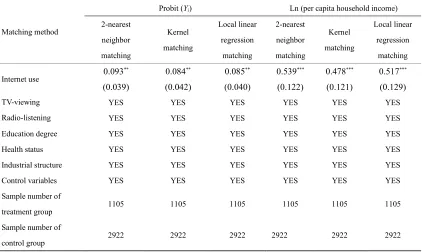
TABLE 7. Results of PSM estimation to deal with the selective bias for Internet use.
alleviation work. Analysis of the evolutionary game shows that increasing information access ability to rural residents can encourage both local governments and poor households to actively participate in the targeted poverty alleviation work, thereby improving the efficiency of that targeted poverty alleviation work.
Finally, we use the CGSS in 2015 to examine the effect of information access ability to rural residents on the efficiency of China’s targeted poverty alleviation work. We use the prob-ability of rural residents eliminating poverty as the dependent variable and find that increasing information access ability for the rural resident can markedly reduce the incidence of poverty for rural residents. The empirical results are consis-tent with the evolutionary game conclusions. Based on these conclusions, several important policy implications could be derived, as follows:
Firstly, as China’s economic development has entered the ‘‘new normal’’, all types of economic activity (in terms of China’s poverty alleviation work) is also in a state of dynamic change. The poverty alleviation work should fully arouse the internal, spontaneous enthusiasm of poor households to choose and engage in the anti-poverty strategy. All regions should constantly cultivate their own economies, industrial structures and ‘‘characteristic industries’’. Secondly, infor-mation and communication technology (such as big data) should be used to promote the information symmetry between the participating subjects in the process of targeted poverty alleviation work. Traditional methods of poverty alleviation find it difficult to solve the information asymmetry problem between each of the main bodies participating in the process
continuously injecting vitality into poverty alleviation work. Moreover, China should establish a platform for the exchange of market services and promote poor households closely linked with the external market.
It is often difficult to use empirical evidence to verify the conclusions of game theory in a study. In addition, due to data limitations, the theoretical part of our paper is not perfectly connected to the empirical part. In spite of this, we have still tried to verify the theoretical part of the paper, and the relevant results also tested the theory to some extent. From this point of view, this paper still has some theoretical and practical value. However, these limitations also give us some direction for future research.
ACKNOWLEDGMENT
(Jiaping Zhang and Yi Zhang are co-first authors.)
REFERENCES
[1] M. Bapna, ‘‘World poverty: Sustainability is key to development goals,’’ Nature, vol. 489, p. 367, Sep. 2012.
[2] E. Herman and M. A. Georgescu, ‘‘Employment strategy for poverty reduction. A romanian perspective,’’Procedia-Social Behav. Sci., vol. 58, pp. 406–415, Oct. 2012.
[3] Y. Liu and Y. Xu, ‘‘A geographic identification of multidimensional poverty in rural China under the framework of sustainable livelihoods analysis,’’Appl. Geography, vol. 73, pp. 62–76, Aug. 2016.
[4] X. Yu, ‘‘Engel curve, farmer welfare and food consumption in 40 years of rural China,’’China Agricult. Econ. Rev., vol. 10, no. 1, pp. 65–77, 2017. [5] J. Haushofer and E. Fehr, ‘‘On the psychology of poverty,’’Science,
vol. 344, pp. 862–867, May 2014.
[6] K. Zhang, J. A. Dearing, T. P. Dawson, X. Dong, X. Yang, and W. Zhang, ‘‘Poverty alleviation strategies in eastern China lead to critical ecological dynamics,’’Sci. Total Environ., vols. 506–507, pp. 164–181, Feb. 2015. [7] Y. Zhou, Y. Guo, Y. Liu, W. Wu, and Y. Li, ‘‘Targeted poverty alleviation
and land policy innovation: Some practice and policy implications from China,’’Land Use Policy, vol. 37, pp. 53–65, May 2018.
[8] Y. Zhang and G. Wan, ‘‘The impact of growth and inequality on rural poverty in China,’’J. Comparative Econ., vol. 34, pp. 694–712, Dec. 2006. [9] X. Wang and S. Alkire, ‘‘Measurement of multi-dimensional poverty in China: Evaluation and policy implications,’’ (in Chinese),Chin. Rural Economy, vol. 12, pp. 4–10, Dec. 2009.
[10] M. Mason, ‘‘Education, policy and poverty reduction,’’ Int. J. Educ. Develop., vol. 32, pp. 494–498, Jul. 2012.
[11] T. Glauben, T. Herzfeld, S. Rozelle, and X. Wang, ‘‘Persistent poverty in rural China: Where, why, and how to escape?’’World Develop., vol. 40, no. 4, pp. 784–795, 2012.
[12] A. Rodríguez-Pose and D. Hardy, ‘‘Addressing poverty and inequality in the rural economy from a global perspective,’’Appl. Geography, vol. 61, pp. 11–23, Jul. 2015.
[13] Y. Li, Y. Li, and B. Su, ‘‘Realizing targeted poverty alleviation in China,’’ China Agricult. Econ. Rev., vol. 8, no. 3, pp. 443–454, 2016.
[14] J. Rewilak, ‘‘The role of financial development in poverty reduction,’’Rev. Develop. Finance, vol. 7, pp. 169–176, 2017.
[15] M. T. Magombeyi and N. M. Odhiambo, ‘‘Dynamic impact of FDI inflows on poverty reduction: Empirical evidence from south Africa,’’Sustain. Cities Soc., vol. 39, pp. 519–526, May 2018.
[16] C. Li, B. Kang, L. Wang, S. Li, M. Feldman, and J. Li, ‘‘Does China’s anti-poverty relocation and settlement program benefit ecosystem services: Evidence from a household perspective,’’Sustainability, vol. 11, p. 600, Jan. 2019. doi:10.3390/su11030600.
[17] Y. Ge, Y. Yuan, S. Hu, Z. Ren, X. Wang, and Y. Wu, ‘‘Space–time variability analysis of poverty alleviation performance in China’s poverty-stricken areas,’’Spatial Statist., vol. 21, pp. 460–474, Aug. 2017. [18] United Nations Development Programme. (2015). Millennium
Development Goals (MDGs) Report 2015. Accessed: Feb. 26, 2019. [Online]. Available: https://www.cn.undp.org/content/china/en/home/ library/mdg/mdgs-report-2015-.html
[19] M. Ravallion and J. Jalan, ‘‘China’s lagging poor areas,’’Amer. Econ. Rev., vol. 89, pp. 301–305, May 1999.
[20] A. Park, S. Wang, and G. Wu, ‘‘Regional poverty targeting in China,’’ J. Public Econ., vol. 86, pp. 123–153, Oct. 2002.
[21] L. Meng, ‘‘Evaluating China’s poverty alleviation program: A regression discontinuity approach,’’J. Public Econ., vol. 101, pp. 1–11, May 2013. [22] G. Wan and Y. Zhang, ‘‘Chronic and transient poverty in rural China,’’
Econ. Lett., vol. 119, pp. 284–286, Jun. 2013.
[23] X. Lü, ‘‘Intergovernmental transfers and local education provision—Evaluating China’s8-7 national plan for poverty reduction,’’ China Econ. Rev., vol. 33, pp. 200–211, Apr. 2015.
[24] P. S. Ward, ‘‘Transient poverty, poverty dynamics, and vulnerability to poverty: An empirical analysis using a balanced panel from rural China,’’ World Develop., vol. 78, pp. 541–553, Feb. 2016.
[25] Y. Zhou, L. Guo, and Y. Liu, ‘‘Land consolidation boosting poverty allevia-tion in China: Theory and practice,’’Land Use Policy, vol. 82, pp. 339–348, Mar. 2019.
[26] The State Council of the People’s Republic of China. (2017).Report of 19th Communist Party of China (CPC) National Congress. Accessed: Feb. 26, 2019. [Online]. Available: http://www.xinhuanet.com//2017-10/27/c_1121867529.htm
[27] H. Zhang, Z. Xu, C. Sun, and E. Elahi, ‘‘Targeted poverty alleviation using photovoltaic power: Review of Chinese policies,’’Energy Policy, vol. 120, pp. 550–558, Sep. 2018.
[28] L. S. Xu, C. Li, and S. W. Huang, ‘‘Analysis of game analysis and counter-measures in precision poverty alleviation,’’ (in Chinese),Rural Economy, vol. 8, pp. 15–21, Aug. 2016.
[29] L. J. Gong, ‘‘Research on the construction and innovation model of market-based poverty alleviation mechanism under the leadership of the government-based on the perspective of targeted poverty alleviation,’’ (in Chinese),Chin. Soft Sci., vol. 5, pp. 154–162, May 2016.
[30] S. Wang. (2016). Precision Poverty Relief: China’S New Anti-Poverty Strategy. China Pictorial. Accessed: Oct. 7, 2019. [Online]. Available: http://www.chinapictorial.com.cn/en/features/txt/2016-03/02/ content_714504_2.htm
[31] Y. Guo, Y. Zhou, and Y. Liu, ‘‘Targeted poverty alleviation and its practices in rural China: A case study of Fuping county, Hebei Province,’’J. Rural Stud., to be published. doi:10.1016/j.jrurstud.2019.01.007.
[32] Y. Liu, F. Fang, and Y. Li, ‘‘Key issues of land use in China and implications for policy making,’’Land Use Policy, vol. 40, pp. 6–12, Sep. 2014. [33] Y. Li, Y. Li, H. Westlund, and Y. Liu, ‘‘Urban–rural transformation in
relation to cultivated land conversion in China: Implications for optimizing land use and balanced regional development,’’Land Use Policy, vol. 47, pp. 218–224, Sep. 2015.
[34] K. Lo, L. Xue, and M. Wang, ‘‘Spatial restructuring through poverty alle-viation resettlement in rural China,’’J. Rural Stud., vol. 47, pp. 496–505, Oct. 2016.
[35] H. Long, S. Tu, D. Ge, T. Li, and Y. Liu, ‘‘The allocation and management of critical resources in rural China under restructuring: Problems and prospects,’’J. Rural Stud., vol. 47, pp. 392–412, Oct. 2016.
[36] Y. Liu. (2016). Improving the effectiveness of Poverty Alleviation by Implementing Precision Measures. People’s Daily. Accessed: Jan. 1, 2018. [Online]. Available: http://politics.people.com.cn/n/2014/0409/c369091-24855570.html
[37] M. S. Emran and Z. Hou, ‘‘Access to markets and rural poverty: Evidence from household consumption in China,’’Rev. Econ. Statist., vol. 95, no. 2, pp. 682–697, 2013.
[38] W. Liu, J. Xu, J. Li, and S. Li, ‘‘Rural households’ poverty and relocation and settlement: Evidence from Western China,’’Int. J. Environ. Res. Public Health, vol. 16, p. 2609, Jul. 2019. doi:10.3390/ijerph16142609. [39] K. Lo and M. Wang, ‘‘How voluntary is poverty alleviation resettlement in
China?’’Habitat Int., vol. 73, pp. 34–42, Mar. 2018.
[40] C. Li, S. Li, M. W. Feldman, J. Li, H. Zheng, and G. C. Daily, ‘‘The impact on rural livelihoods and ecosystem services of a major relocation and settlement program: A case in Shaanxi, China,’’Ambio, vol. 47, no. 2, pp. 245–259, 2017.
[41] L. Ren, J. Li, C. Li, S. Li, and G. C. Daily, ‘‘Does poverty matter in payment for ecosystem services program? Participation in the new stage sloping land conversion program,’’Sustainability, vol. 10, no. 6, p. 1888, 2018. doi:10.3390/su10061888.
[43] K. Lo, J. Li, M. Wang, C. Li, S. Li, and Y. Li, ‘‘A comparative analysis of participating and non-participating households in pro-poor tourism in southern Shaanxi, China,’’Tourism Planning Develop., vol. 16, no. 3, pp. 318–333, 2019.
[44] L. Huang and S. Yang, ‘‘Study on the sustainable development of targeted poverty alleviation through financial support,’’Urban Stud., vol. 6, no. 1, pp. 174–179, 2018.
[45] E. Ozkan-Canbolat, A. Beraha, and A. Bas, ‘‘Application of evolutionary game theory to strategic innovation,’’Procedia-Social Behav. Sci., vol. 235, pp. 685–693, Nov. 2016.
[46] J. M. Smith, Evolution and the Theory of Games. Cambridge, U.K.: Cambridge Univ. Press, 1982.
[47] M. Broom and C. Cannings,Evolutionary Game Theory. Cambridge, MA, USA: MIT Press, 1997.
[48] J. Hofbauer and K. Sigmund,Evolutionary Games and Population Dynam-ics. Cambridge, U.K.: Cambridge Univ. Press, 1998.
[49] S. A. Levin,Games, Groups, and the Global Good. Berlin, Germany: Springer, 2009.
[50] D. Friedman, ‘‘Evolutionary games in economics,’’Econometrica, vol. 59, no. 3, pp. 637–666, 1991.
[51] D. Friedman, ‘‘On economic applications of evolutionary game theory,’’ J. Evol. Econ., vol. 8, no. 1, pp. 15–43, 1998.
[52] A. D. P. Sweeney, ‘‘Electronic government-citizen relationships,’’J. Inf. Technol. Politics, vol. 4, pp. 101–116, Oct. 2008.
[53] H. Hong, ‘‘The Internet, transparency, and government–public relation-ships in Seoul, South Korea,’’Public Relations Rev., vol. 40, pp. 500–502, Sep. 2014.
[54] J. Zhang, M. Cheng, X. Wei, X. Gong, and S. Zhang, ‘‘Internet use and the satisfaction with governmental environmental protection: Evidence from China,’’J. Cleaner Prod., vol. 211, pp. 1025–1035, Mar. 2019. [55] S. F. Verkijika and L. De Wet, ‘‘E-government adoption in
sub-Saharan Africa,’’Electron. Commerce Res. Appl., vol. 30, pp. 83–93, Jul./Aug. 2018.
[56] N. V. Loayza and C. Raddatz, ‘‘The composition of growth matters for poverty alleviation,’’J. Develop. Econ., vol. 93, no. 1, pp. 137–151, 2010. [57] J. Ge and Y. Lei, ‘‘Mining development, income growth and poverty alle-viation: A multiplier decomposition technique applied to China,’’Resour. Policy, vol. 38, no. 3, pp. 278–287, 2013.
[58] H. Zhang, ‘‘The poverty trap of education: Education–poverty connections in Western China,’’Int. J. Educ. Develop., vol. 38, pp. 47–58, Sep. 2014. [59] J. Gamu, P. Le Billon, and S. Spiegel, ‘‘Extractive industries and poverty:
A review of recent findings and linkage mechanisms,’’Extractive Ind. Soc., vol. 2, pp. 162–176, Jan. 2015.
[60] K. Silverman, A. F. Holtyn, and B. P. Jarvis, ‘‘A potential role of anti-poverty programs in health promotion,’’Preventive Med., vol. 92, pp. 58–61, Nov. 2016.
[61] F. Hernandez-Trillo, ‘‘Poverty alleviation in federal systems: The case of México,’’World Develop., vol. 87, pp. 204–214, Nov. 2016.
[62] O. Attanasio, C. Meghir, E. Nix, and F. Salvati, ‘‘Human capital growth and poverty: Evidence from Ethiopia and Peru,’’Rev. Econ. Dyn., vol. 25, pp. 234–259, Apr. 2017.
[63] Y. Liu, J. Liu, and Y. Zhou, ‘‘Spatio-temporal patterns of rural poverty in China and targeted poverty alleviation strategies,’’J. Rural Stud., vol. 52, pp. 66–75, May 2017.
[64] A. Ferrer-I-Carbonell and P. Frijters, ‘‘How important is methodology for the estimates of the determinants of happiness?’’Econ. J., vol. 114, pp. 641–659, Jul. 2004.
[65] J. D. Angrist and J.-S. Pischke,Mostly Harmless Econometrics: An Empiri-cist’s Companion. Princeton, NJ, USA: Princeton Univ. Press, 2008.
JIAPING ZHANG received the B.S. degree in mechanical engineering and automation from Jilin University, China, in 2014, and the M.S. degree in industrial economics from Shaanxi Normal Uni-versity, China, in 2017. He is currently pursu-ing the Ph.D. degree in industrial economics with Tongji University, China. He is also a Visiting Scholar with Rutgers University, USA. His current research interests include information economics and development economics.
YI ZHANGreceived the B.S. degree in computer science and technology from the Jiangxi University of Science and Technology, China, in 2002, the M.S. degree from Hohai University, China, in 2009. He is currently pursuing the Ph.D. degree with Southwest Jiaotong University, China. He is also with Nanjing Audit University. His current research interests include big data auditing and quantitative finance.
MINGWANG CHENGreceived the B.S. degree in economics from Yantai University, China, in 1997, the M.S. degree from Guangxi University, China, in 2004, and the Ph.D. degree in manage-ment from Shanghai Jiao Tong University, China, in 2007. He was a Postdoctoral Fellow in applied economics with Rutgers University, USA, from 2012 to 2014. He is currently a Professor with the School of Economics and Management, Tongji University, Shanghai, China. His current research interests include industrial economics and labor economics.
NING YUreceived the Ph.D. degree in economics from Stanford University and the Ph.D. degree in management from Shanghai Jiao Tong University. He is currently a Professor with the Institute for Social and Economic Research, Nanjing Audit University, and a Research Scholar with the Rural Education Action Program of Stanford University. His current research interests include economics, health, and China.
XINYU WEIreceived the B.S. degree in agricul-ture and forestry economics management from Hainan University, China, in 2017. She is currently pursuing the Ph.D. degree in urban and regional economics with Tongji University, China. Her cur-rent research interests include health economics, environmental economics, and development economics.