Open Access
Research
Transient expression vectors for functional genomics,
quantification of promoter activity and RNA silencing in plants
Roger P Hellens*, Andrew C Allan, Ellen N Friel, Karen Bolitho,
Karryn Grafton, Matthew D Templeton, Sakuntala Karunairetnam,
Andrew P Gleave and William A Laing
Address: HortResearch, Mt Albert Research Centre, Private Bag 92169, Auckland, New Zealand
Email: Roger P Hellens* - [email protected]; Andrew C Allan - [email protected]; Ellen N Friel - [email protected]; Karen Bolitho - [email protected]; Karryn Grafton - [email protected];
Matthew D Templeton - [email protected]; Sakuntala Karunairetnam - [email protected]; Andrew P Gleave - [email protected]; William A Laing - [email protected]
* Corresponding author
Abstract
Background: We describe novel plasmid vectors for transient gene expression using
Agrobacterium, infiltrated into Nicotiana benthamiana leaves. We have generated a series of pGreenII cloning vectors that are ideally suited to transient gene expression, by removing elements of conventional binary vectors necessary for stable transformation such as transformation selection genes.
Results: We give an example of expression of heme-thiolate P450 to demonstrate effectiveness of this system. We have also designed vectors that take advantage of a dual luciferase assay system to analyse promoter sequences or post-transcriptional regulation of gene expression. We have demonstrated their utility by co-expression of putative transcription factors and the promoter sequence of potential target genes and show how orthologous promoter sequences respond to these genes. Finally, we have constructed a vector that has allowed us to investigate design features of hairpin constructs related to their ability to initiate RNA silencing, and have used these tools to study cis-regulatory effect of intron-containing gene constructs.
Conclusion: In developing a series of vectors ideally suited to transient expression analysis we have provided a resource that further advances the application of this technology. These minimal vectors are ideally suited to conventional cloning methods and we have used them to demonstrate their flexibility to investigate enzyme activity, transcription regulation and post-transcriptional regulatory processes in transient assays.
Background
Agrobacterium tumefaciens is the primary tool used to
gen-erate transgenic plants [1]. During early stages of co-culti-vation, single-stranded T-DNA is transferred from the
bacteria to plant cells [2]. Once moved into the plant cell by bacterial and plant encoded proteins [3,4], this T-DNA becomes double-stranded and migrates to the nucleus. Only a small percentage is integrated into the host
chro-Published: 18 December 2005
Plant Methods 2005, 1:13 doi:10.1186/1746-4811-1-13
Received: 19 August 2005 Accepted: 18 December 2005
This article is available from: http://www.plantmethods.com/content/1/1/13
© 2005 Hellens et al; licensee BioMed Central Ltd.
mosomes leading to stably transformed cells that can sub-sequently be regenerated into transgenic plants. Although the long-term fate of the T-DNAs that do not integrate into the chromosomes is unclear, for a time, these pieces of DNA are transcriptionally competent; this is the basis of
the Agrobacterium-mediated transient expression systems
[5]. While Agrobacterium-mediated stable plant gene trans-formation requires binary vectors that allow plasmid manipulation in both E. coli and Agrobacterium and a selectable marker to recover transformed plants [1], no selectable marker is needed for transient expression. Omission of the selectable marker allows the cloning vec-tors to be smaller and easier to handle (e.g. less chance of duplicate restriction sites occurring) and may lead to increased frequency of plasmid ligation and bacterial transformation [6].
We have constructed a series of binary cloning vectors that have been specifically designed for transient gene expres-sion in plant cells. Using plants as an expresexpres-sion system offers several advantages over prokaryotic or non-plant expression systems. For instance, genes that contain introns are processed and both subcellular targeting and post-translational modifications are possible. In addition, components necessary for transcriptional initiation, RNA processing, and translation initiation are already present in the plant.
In this study, we describe our plasmid vectors and tran-sient gene expression system, drawing on examples of (i) assigning function to a heme thiolate (TH)-P450 gene, (ii) identifying a transcription factor target promoter, and (iii) exploring the role of RNA processing in dsRNA hairpin-induced RNA silencing.
Plasmid map of the transient expression vector pGreenII 62-SK Figure 1
Plasmid map of the transient expression vector pGreenII 62-SK.
pGreenII 62-SK
3342 bp
NptI
LB
RB
35S promoter
pSa
pUC-Ori
CaMV term
+,
,
5,
G,,,
,
,
,
59
,
,
,,
,
%,
,
,
,
,
,,
Proteins of the HT-P450 class of genes are of particular importance to secondary metabolism. They catalyse a NADP-dependent hydroxylation step on a variety of plant metabolites that allows for modification of the base com-pound (e.g. terpene, phenyl propanoid) by other enzymes such as methyl transferases or alcohol acyl transferases. Heme thiolate-P450s are one of the largest families of enzymes in plants; there are 246 HT-P450 genes in the
Arabidopsis genome: Arabidopsis Cytochrome P450))[7],
though very few have been functionally characterised [8]. As these enzymes are membrane bound and require an NADPH HT-P450 reductase (EC 1.6.2.4) for activity, assaying these enzymes in vitro is difficult. Although yeast expression systems have been developed that allow these genes to be analysed [9], we show that our transient expression system can be used to assay the apple homo-logue of the HT-P450, cinnamic acid 4-hydroxylase,
MdC4H1 (EC 1.14.13.11). Cinnamic acid is a metabolite in the phenyl propanoid pathway, a key pathway in plants leading to, among others, the production of lignin, lig-nan, flavonoids and anthocyanins [10].
Transcription factors (TF) are a large class of genes with DNA binding motifs [11]. Mechanistically these proteins bind to sequence elements within a gene's promoter and regulate transcription. TFs are able to coordinately regu-late complex developmental processes or control entire metabolic pathways [11]. There are over 1400 known TFs in the Arabidopsis genome [11] and identifying the targets for each of these is a challenging task. We have taken advantage of a simple, commercial dual luciferase assay system that allows expression of both the target promoter controlling expression of the firefly luciferase (LUC) reporter gene and a control promoter (CaMV 35S)
regulat-A, conversion of cinnamic acid to p-coumaric acid by the action of a heme thiolate P450; AdC4H Figure 2
A, conversion of cinnamic acid to p-coumaric acid by the action of a heme thiolate P450; AdC4H. B, HPLC peak height of (▲) coumaric acid and (●) p-cinnamic acid at time points (minutes) after the infiltration of coumaric acid substrate. C, HPLC peak height of (▲) coumaric acid and (●) p-cinnamic acid at time points (days) after infiltration of Agrobacterium into plant leaves.
0 40 80 120
0 5 10 15 20 25 30 35
O
O H
H O
O
O H C 4 H
HPLC
peak
h
e
ight
(r
a
w
dat
a
units
)
Minutes after substrate addition
B
0 2 4 6
Days after Agrobacterium infiltration
C
ing expression of the Renilla luciferase (REN) reporter gene. We were able to determine the relative effectiveness of different TFs in stimulating expression of a reporter pro-moter-gene sequence construct.
Both protein over-expression and genetic approaches have benefited from recent advances in RNA silencing, a sequence-specific RNA degradation mechanism [12]. There are, however, aspects of RNA biochemistry, such as the effect of RNA processing, which may influence gene silencing, that remain poorly understood [13]. There are several RNA processing events such as intron-mediated enhancement [14], that are known to act post-transcrip-tionally, and a link between RNA processing and gene silencing remains possible. Using the transient assay sys-tem with dual reporter genes we were able to investigate hairpin expression constructs that differ in the intron con-figuration and speculate on the role RNA processing may play in influencing the expression of neighboring genes.
Results and Discussion
Vector constructs for over expression
In the second step of the phenyl propanoid pathway, cin-namic acid is hydroxylated at the four position (see Fig. 2A) by HT-P450 hydroxylase, C4H (EC1.14.13.11), to produce p-coumaric acid. An apple orthologue, MdC4H1, was identified from the HortResearch apple EST database by sequence similarity [15] to the Arabidopsis gene, At-C4H (At2g30490), and a full length cDNA clone inserted into the pGreenII 62-SK vector (Fig. 1). As NADPH(+) HT-P450-reductase activity (EC 1.6.2.4) has been shown to be necessary for assaying HT-P450 activity in both bacteria [16] and yeast [9], we also identified a cDNA homologous to the Arabidopsis HT-P450 reductase (At4g30210), corre-sponding to Ad HT-P450 reductase, from kiwifruit and inserted it into pGreenII 62-SK.
Transient expression of heme-thiolate P450
Initial experiments assessed the level of enzyme activity from transiently expressed Md-C4H1 and the effect of Ad-P450 reductase 10 days after Agrobacterium infiltration. The extent of conversion from cinnamic acid to p-cou-maric acid, measured by HPLC, was similar for both the MdC4H1 and the MdC4H1 + Ad-P450 reductase, and sig-nificantly higher than for a transiently transformed empty vector control (data not shown). In addition, assaying
Agrobacterium cultures just before infiltration did not
reveal endogenous C4H enzyme activity in the bacteria. This suggested that the endogenous activity in the tobacco leaf provided sufficient NADP-dependent P450 reductase capacity and that additional transient expression of the reductase was not necessary. In this regard, transient assays in plants differ from other expression systems where an exogenous reductase is required for optimal enzymatic activity. The additional expression of the viral
silencing suppressor P19 did not significantly increase the enzyme activity (data not shown). While expression of P19 has been shown to enhance the expression of other transiently expressed genes in other studies [5], in the case of HT-P450 it appears that gene expression levels are not impaired by gene silencing. This indicates that either the microsomal membrane surface area available to facilitate the reaction or the availability of the infiltration substrate is limiting
Transient expression time course
Having established our ability to measure the conversion of cinnamic acid to p-coumaric acid, we further optimized the assay to determine the optimal period for substrate infiltration. The HPLC peak heights for both substrate (cinnamic acid) and product (p-coumaric acid) were plot-ted as a function of the time between substrate infiltration and extraction. The conversion of cinnamic acid to p-cou-maric acid increased up to one hour, although subse-quently the level of p-coumaric acid dropped (Fig. 2B). The concentration of cinnamic acid decreased over the whole time period tested. No p-coumaric acid was detected in the control. This decrease in the product may suggest that p-coumaric acid was modified by endog-enous enzymes during that time. This is further supported by the appearance of a second product peak at an earlier retention time in the 2 h time point chromatograph.
We next investigated the time between infiltration of
Agro-bacterium and the substrate. Time points were chosen up
to six days (with 60 min between substrate infiltration and extracting leaves) (Fig. 2C). At t = 0, there was also lit-tle conversion of cinnamic acid to p-coumaric acid, dem-onstrating a low endogenous C4H activity of the N.
benthamiana leaf and the absence of C4H activity from the
infiltrated Agrobacterium (Fig. 2C). The levels of un-reacted cinnamic acid declined as p-coumaric acid accu-mulated over the time period to six days (Fig. 2C). Thus it was concluded that six days' infiltration of Agrobacterium and 60 min infiltration of substrate provided a sensitive assay of HT-P450s.
A vector for the analysis of promoter transcription factor interactions
The promoter sequences for four chalcone synthase (CHS) genes (EC 2.3.1.74) from each of four species:
Ara-bidopsis, apple (Malus domestica), pea (Pisum sativum) and
petunia (Petunia hybrida) were each inserted into the mul-tiple cloning site of pGreenII 0800-LUC (Fig. 3). In all cases the promoter was modified to introduce an NcoI site at the 3' end of the sequence (at the CHS initiation codon, ATG), allowing the promoter to be cloned as a transcrip-tional fusion with the LUC gene. Thus, TFs that bind the promoter and increase transcription could be identified by an increase in LUC activity. The promoters for Malus
domestica MdCHS1 [GenBank: DQ026297] identified as a
1.3 Kb PCR fragment in the Ecl136II-linker-ligation library [genebank DQ022678], Arabidopsis CHS (TT4; AT5G13930 insert reference), petunia CHS-A [GenBank: X14591] and Pisum sativum CHS-1a [GenBank: X80007]
were isolated from genomic DNA. In the same construct, a REN gene under the control of a 35S promoter provided an estimate of the extent of transient expression (Fig. 3). Activity is expressed as a ratio of LUC to REN activity.
The reporter construct, transformed into Agrobacterium, was mixed with an Agrobacterium strain carrying a 35S-MYB construct and co-infiltrated into tobacco leaves.
Transient analysis of Transcription Factors
In the absence of a MYB TF, the LUC to REN ratio was low. This background level of activity presumably represents basal levels of MYBs present in tobacco leaves. In virtually all cases, the addition of a TF to the infiltration mixture increased the relative level of LUC activity compared with the background promoter activity in the absence of
Agro-bacterium containing a candidate TF (Fig. 4). The majority
of TFs tested showed a similar, slightly higher than
back-T-DNA region of the transient expression vector pGreenII 0800-LUC Figure 3
T-DNA region of the transient expression vector pGreenII 0800-LUC.
pGreenII 0800-LUC
3894 bp
REN LUC
RB 35S promoter
LB
CaMV term
CaMV term
,
+,
59
G,,,
,
,
,
,,
,
,
,
,
,
,
,
ground, level of activity. We speculate that many of these TFs will have a low affinity to these promoter sequences, and thus cause a small non-specific trans-activation. We hypothesize that where the interaction between TF and promoter was more specific trans-activation, there is a sig-nificant increase in the LUC activity relative to REN (Fig. 4). For six of the promoter-TF comparisons, multiple repeats of the assay using six independently infiltrated leaves with the same Agrobacterium culture were used to
generate the standard error of the data (Fig. 4B). Prelimi-nary assays showed there were little day-to-day, plant to plant or leaf positional effects on the calculated ratio (data not shown). In addition, the concentration of
Agrobacte-rium in the infiltration buffer did not affect the ratio
sig-nificantly (data not shown). In these experiments an error of 14–17% was observed, similar to previous transient assay error estimations. We chose not to estimate the error for the remaining assay but set a threshold such that the
Relative LUC activity from transient expression analysis of 4 CHS promoters co-infiltrated with a plasmid containing genes for apple transcription factors fused to the 35S promoter
Figure 4
REN value had to be above 100 relative light units (RLU) to be assured of a comparable degree of error in the remainder of the data.
The utility of the luciferase vector was demonstrated by identification of specific TFs that showed significantly higher LUC to REN ratios than background, compared with the average of other TFs. Instances where a promoter-TF interaction was identified usually resulted in at least ten times higher LUC to REN ratio than the average back-ground compared with other MYBs, which showed a 1 to 2 fold increase in the relative LUC activity of the promoter alone. Thus we have identified from a pool of 20 tran-scription factors, those TFs likely to be involved in the reg-ulation of the CHS gene (Fig. 4).
The ability of these transient assays to discriminate between strong and weak trans-activation was signifi-cantly influenced by the period of transient expression and the ratio of Agrobacterium carrying the transcription and luciferase reporter cassettes. Transient expression demonstrated clear distinctions between TFs after three to four days. However, prolonged transient expression over eight days (data not shown) reduced differences between TFs, suggesting an accumulation of TF protein to levels that are able to interact with a range of promoter sequences in a generic fashion, rather than with those tar-get promoters that would be utilized in vivo. This promis-cuous behavior is not surprising, given the sequence conservation within the R2R3 MYB DNA binding domain [19]. It is therefore important to note that the non-specific
A, relative LUC activity from transient expression analysis of Arabidopsis DFR promoter (At5g42800), co-infiltrated with tran-scription factors as in Fig. 4
Figure 5
A, relative LUC activity from transient expression analysis of Arabidopsis DFR promoter (At5g42800), co-infiltrated with tran-scription factors as in Fig. 4. B, Frequency distribution of the relative LUC activity from Fig. 5A. Region 1; transient expression considered background promoter activity, region 2, partial promoter activations and region 3, strong promoter activation.
0.00 0.02 0.04 0.06 0.08 0.10
0 2 4 6 8
F
requ
enc
y
Relative LUC activity BINs
1 2 3
B
AtM
Y
B75
Md
C
B
F
1
Md
MY
B
11
Md
MY
B
13
Md
MY
B
14
Md
MY
B
18
Md
MY
B
19
Md
MY
B
2
Md
MY
B
20
Md
MY
B
21
Md
MY
B
22
Md
MY
B
23
Md
MY
B
24
Md
MY
B
4
Md
MY
B
6
Md
MY
B
7
Md
MY
B
91
Md
MY
B
92
Md
MY
B
R
2
Md
MY
B
R
5
Md
MY
B
R
6
C
ont
ro
l
0.00 0.02 0.04 0.06 0.08
LU
C/
R
E
N
ra
tio
A
trans-activation in transient assays can be avoided by opti-mising the period of time between inoculation and assay.
We also found that increasing the ratio of the
TF-contain-ing Agrobacterium to the promoter-LUC-REN fusion
con-taining Agrobacterium gave a clearer difference between high and low strength trans-activation. We were unable to determine TF interactions when the promoter-LUC fusion compromised less than 10% of the total infiltrate; this was because the correspondingly low luciferase activity made ratio measurements more variable.
There were significant trans-activation similarities between most of these CHS promoters; notably
MdMYB22 [GenBank: DQ074470] was the strongest TF in
trans-activating LUC in three of the CHS promoters tested:
Arabidopsis (Fig. 4A), Petunia (Fig. 4D) and Apple (Fig.
4B). MdMYB22 has sequence homology to the maize P gene [GenBank: M73029] and AtMYB12 [AT2G47460] which has been shown to regulate genes involved in the flavanol biosynthesis pathway [20]. In addition MdMYB18 [GenBank: DQ074466] up-regulated LUC when fused to the Pea CHS-1a promoter (Fig. 4C).
For each promoter tested there was a distribution of back-ground trans-activation, which could be distinguished from a specific promoter interaction by the distribution of
trans-activation (Fig. 5A). By examining the petunia
CHS-Transient expression analysis of hairpin constructs Figure 6
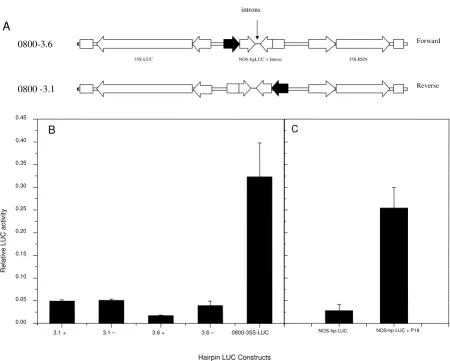
Transient expression analysis of hairpin constructs. A, pGreenII 0800-3.6 and pGreenII 0800-3.1 constructs contain the LUC and REN genes fused to the CaMV 35S promoter. Between these two reporter genes a LUC hairpin construct is fused to the NOS promoter in forward and reverse orientations. Both hp constructs contain an intron between the inverted repeats in both + and - orientation. B, Relative LUC activity for the pGreenII 0800-3.1 and 3.6 cassettes (for both +ve and -ve intron ori-entations) and pGreenII 1598-1, a LUC and REN construct with no hpLUC. C, The effect of P19 on silencing of the NOS-hpLUC cassette. The control (un-silenced) for this experiment is the 0800-35S-LUC in Fig 6B.
3.1 + 3.1 – 3.6 + 3.6 – 0800-35S-LUC 0.00
0.05 0.10 0.15 0.20 0.25 0.30 0.35 0.40 0.45
0800-3.6
0800 -3.1
35S-LUC NOS-hpLUC + Intron 35S-REN
R
elati
ve
LU
C
ac
tiv
ity
Hairpin LUC Constructs
A
B
NOS-hp-LUC
C
NOS-hp-LUC + P19
Forward
A promoter data there appear to be three groups of TFs. Group 1 showed little or no trans-activation; this we take to be the background promoter activity in these assay con-ditions. Group 2 showed a normal distribution of activi-ties significantly above background. This group included MdMYB18 [GenBank: DQ074466] and represents interac-tions we take to be poor or non-specific trans-activation. Group 3, in this case MdMYB22 [GenBank: DQ074470], was a TF that appears to have a specific trans-activation of the promoter. None of the apple MYB TFs was able to
trans-activate the Arabidopsis dihydro flavonoid reductase
promoter (TT3, At5g42800) (Fig. 5B), although AtMYB-75 (AtPAP1, At1g56650), which is known to regulate the anthocyanin pathway [21] was able to trans-activate this promoter fusion; this further demonstrates that the trans -activation profile for these CHS promoters was specific.
Vector to investigate RNA silencing
We have adapted the transient assay system in order to measure the effects on RNA silencing of the structure of the dsRNA hairpin and the influence of silencing sup-pressers. We were particularly interested in determining the role that RNA processing might play in efficient dsRNA production, and whether the presence of introns within hairpin cassettes can enhance the efficiency of RNA silencing activation [22]. Our RNA silencing assay system consists of the LUC and REN luciferase reporter genes in opposite orientation on a single T-DNA, each under the transcription regulation of the 35S promoter (Fig. 6A). Between the two reporter genes is a LUC hairpin sequence (hpLUC), under the control of the nopaline synthase (NOS) promoter. In the absence of a NOS-hpLUC hairpin both the LUC and REN activities accumulated (Fig. 6B).
Absolute and relative LUC and REN expression levels from the pGreenII 1598-1 construct following 5,10 and 16 days infiltra-tion into N. Benthamina
Figure 7
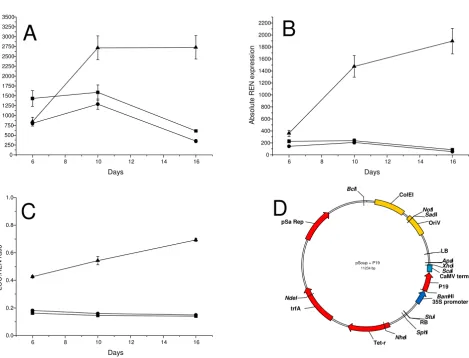
Absolute and relative LUC and REN expression levels from the pGreenII 1598-1 construct following 5,10 and 16 days infiltra-tion into N. Benthamina leaves. (▲) pSoup helper plasmid, (■) pSoup0000 helper plasmid and (❍) pSoup-P19 helper plasmid. A, Absolute LUC activity. B, Absolute REN activity. C, LUC to REN ratio. D, plasmid map of the pSoup-P19 helper plasmid.
6 8 10 12 14 16
0 250 500 750 1000 1250 1500 1750 2000 2250 2500 2750 3000 3250 3500
6 8 10 12 14 16
0 200 400 600 800 1000 1200 1400 1600 1800 2000 2200
6 8 10 12 14 16
0.0 0.2 0.4 0.6 0.8 1.0
D
C
B
A
bso
lu
te
LU
C
exp
re
ssi
on
Days
A
pSoup + P19
11234 bp
Tet-r trfA
pSa Rep
P19 LB
RB
35S promoter OriV ColEI
CaMV term ApaI
BamHI
NheI NotI
SacII
ScaI
SphI StuI
XhoI
NdeI
BclI
A
bso
lu
te
R
E
N
exp
re
ssi
on
Days
LUC:RE
N
rati
o
To test the efficiency of transient silencing and to quantify the effect that an intron has on this efficiency, we built two constructs: pGreenII 0800-3.6 (+) and pGreenII 0800-3.6 (-), each including an intron in either splicable (+) or inverse (-) orientation of the hairpin (Fig. 6B). Both the NOS-hpLUC cassettes were effective in significantly reducing the level of LUC activity (Fig. 6B). This reduction in LUC activity was the result of the activation of RNA silencing because the co-infiltration of Agrobacterium expressing P19, a viral suppressor of gene silencing [5], was effective in overcoming the silencing effect of the LUC hairpin, and restoring LUC levels to those of the control (Fig. 6C).
Notably, the relative level of LUC in the hairpin construct that contained a functional, splicable intron was lower (0.0171 ± 0.0014) than from the equivalent cassette where the intron was in an inverted orientation (0.0394 ± 0.0099) such that it cannot be processed. This observation appears to be consistent with previous reports [22] which showed an increased in the percentage of transgenic plants with a gene silencing phenotype when the dsRNA hairpin constructs contained an intron. However, in these transient assays the absolute levels of LUC were very sim-ilar for both hairpin constructs, and the difference in rela-tive luciferase level could also be achieved by elevating the levels of REN in the construct that contained the splicable intron. As the NOS-hpLUC cassette and the 35S-REN cas-settes are in tandem, it is possible that the NOS promoter or the processing of the intron is influencing the transcrip-tional activity of the REN gene. To test this possibility we built and assayed a further two constructs, pGreenII 0800-3.1 (+) and (-) (Fig. 6B). In these constructs the NOS-hpLUC cassette directs transcription in the opposite orien-tation to that of pGreenII 0800-3.6, such that any cis-acti-vation from the NOS cassette should influence 35S-LUC activity, but not 35S-REN activity. In transient assays using these constructs there was no significant difference between the hairpin with a splicable intron (0.0492 ± 0.0032) and the equivalent construct with an inverted intron (0.0504 ± 0.0029). This suggests that including an intron in the construction of a cassette that generates a dsRNA hairpin may function to influence the expression of any downstream tandem genes. In the case of the pHannibal vector, [13] this would correspond to the kan-amycin resistance gene NptII, used for transformation selection. This suggests that the enhanced percentage of silencing described by Smith et al [22] may in part be due to enhanced recovery or stability of transgenic lines through improved expression of the kanamycin selection gene. We were unable to identify by RT-PCR, any RNA species that represented a hybrid RNA between the NOS promoter and either the LUC or REN gene, suggesting that the processing event may act as a transcriptional enhancer
rather than effect the initiation of transcription at a dis-tance.
Measuring viral suppression of RNA silencing in
transient assays
After 4–5 days of Agrobacterium infiltration the levels of transient expression would be expected to drop because of the activation of RNA silencing resulting from the high level of gene expression [5]. The viral suppressor of RNA silencing, P19 from tomato bushy stunt virus (TBSV), is known to remove the small interfering (si)RNAs responsi-ble for amplifying RNA silencing [23]. Transient expres-sion can be enhanced and extended for several weeks by co-expressing P19 protein in the agro-infiltration mixture [5]. This is usually achieved by mixing different recom-binant strains of Agrobacterium containing either the P19 construct or the gene of interest. The pGreen system requires an additional helper plasmid, pSoup, to enable binary plasmid replication in the Agrobacterium cell [24]. We introduced a P19 expression T-DNA into pSoup (Fig. 7), such that enhanced transient expression could be achieved without the need to mix Agrobacterum strains.
transient gene expression where significant levels of pro-tein are requited.
Conclusion
We have presented a simple method using transient expression of genes in tobacco to test for a range of gene functions. Vectors have also been developed to exclude the transformation selection genes present in many binary vectors. Removing the transformation selection reduced plasmid size and improved cloning efficiency. We described a method to characterize the enzymatic activity of proteins encoded by genes cloned into these
Agrobacte-rium vectors, a method to screen the relative
transcrip-tional activities of TFs, and a method to study gene silencing through dsRNA. By incorporating both luci-ferase and renilla chemiluminescent reporter genes on a single T-DNA we are able to effectively reduce the intrinsic variability of leaf infiltration, allowing reproducible pro-moter activity determinations.
Materials and methods
Nicotiana benthamiana plants were grown in a glasshouse
at 22°C and using natural light with daylight extension to 16 h. Plants were grown until they had six leaves and the youngest leaves over 1 cm long were infiltrated with
Agro-bacterium and maintained in the glasshouse for the
dura-tion of the experiment.
Agrobacterium tumefaciens, GV3101(MP90) [25] were
cul-tured on Lennox agar (Invitrogen) supplemented with 50
µg.ml-1 kanamycin (Sigma) and incubated at 28°C. A 10
µl loop of confluent bacterium were re-suspended in 10 ml of infiltration media (10 mM MgCl2, 0.5 µM acetosy-ringone), to an OD600 of 0.2, and incubated at room tem-perature without shaking for 2 h before infiltration. Infiltrations were performed according to the methods of Voinnet et al. (2003) [5]. Approximately 300 µl of this
Agrobacterium mixture was infiltrated into a young leaf of
N. benthamiana and transient expression was assayed from
three to 14 days after inoculation.
Each of the promoter-LUC fusions in pGreenII 0800-LUC were used in transient transformation by mixing 100 µl of
Agrobacterium transformed with the reporter cassette and
900 µL of a second Agrobacterium strain transformed with a cassette that contained the TF gene fused to the 35S pro-moter in either a pART27-derived or pGreenII 62-SK binary vectors described below.
Oligonucleotides
RPH-138: GTGAGAGGTCCTAAGCTTATGTCCGGTTAT; RPH-139: CTTGACTGGCGAGAATTCCCACGATCTCTTT; RPH-140: ATTGACAAGGATGGATCCCTACATTCTGGA; 141: CACGATCTCTTTTTCCGTCATCGTCT; 146: TGGCCTTTATGAGGGAATTCCTGATTTTTC;
RPH-179: TGGCGGTTTTGGTACCCCGGGTCAAC; RPH-180: CCATCACCATGGTAGTATACACCAAC; RPH-198: CACACAGTTGGGAGGAGTTGCTGTCCC; RPH-199: CTTGCGAACTTCTTCGACGGTCACCAT; RPH-212: AATTGGTACCGATATCGAGCTC; RPH-213: AGCT-GAGCTCGATATCGGTACC; RPH-332: ACTCCTCGACT-GTCACCATGGTTGCTTG; RPH-333: GCGGAAGGGTACCGAATTCATAGCAACTGG
Construction of pGreenII-62-SK
The cauliflower mosaic virus (CaMV) 35S expression cas-sette (KpnI-BglII) of pJIT-62 [26] was inserted into the multiple cloning site (MCS) (KpnI-BamHI) of pGreenII-0000 [24]. Flanking sequences from the LB to the 35S-promoter and from the CaMV-terminator to the RB were deleted by digestion, (StuI-KpnI and SpeI-HpaI respec-tively), T4 pol and re-ligation to produce pGreenII-62-1. The pUC9 MCS was converted to the pBluescript MCS by ligating two oligonucleotides (RPH-212 and RPH-213) to the EcoRI-HindIII cut vector, generating KpnI and SacI sites, then inserting a KpnI-SacI fragment from pBluescript SKII+ (Stratagene).
Construction of the plasmids containing genes for enzymes and TFs
The HortResearch apple EST libraries were constructed in either the Lambda ZAP Express or the Lambda ZAP II vec-tor systems (Stratagene), resulting in cDNAs cloned unidi-rectionally as EcoRI-XhoI fragments in pBK-CMV or pBluescript SK-, respectively.
Genes encoding various enzymes and transcription fac-tors were cloned into one of two plant expression vecfac-tors derived from the pART7/27 binary vector system [27]. Both vectors carry the same transcriptional regulatory sig-nals for plant gene expression, namely the CaMV35S pro-moter and octopine synthase terminator. The T-DNA border elements, chimeric kanamycin selectable marker and vector backbone are identical in both vectors. The two derivatives differ in that one is suitable for conventional restriction enzyme cloning of cDNAs whilst the second facilitates Gateway recombination cloning of the cDNAs.
In order to improve the compatibility of restriction sites in the multiple cloning site of pART7 with those of the pBK-CMV or pBluescript SK- EST library vectors, the XhoI-XbaI
Where conventional cloning was more problematic, due to the lack of suitable restriction sites, a Gateway-adapted version of the pART7/27 plant transformation system was utilised. This Gateway-adapted version was produced by cloning the CaMV35S promoter, multiple cloning site and octopine synthase transcriptional terminator cassette of pART7 as a NotI fragment into pART27. Subsequently, the 1711 bp Gateway RfA cassette (Invitrogen Corp.) was cloned into the SmaI site of the multiple cloning site to generate pHEX2 (35S-attR1-CmR-ccdB-attR2-ocs3').
cDNAs from the EST libraries were cloned into pHEX2 using Gateway recombination technology and all Gate-way reactions were performed as recommended by the manufacturer (Invitrogen Corp.). cDNAs were amplified using universal primers designed to the multiple cloning site regions of the pBK-CMV or pBluescript SK-. The
prim-ers used for pBluescript SK- clones were 5- GGGGACAAGTTTGTACAAAAAAGCAGGCTCCCCG-GGCTGCAGGAATTC-3' and 5'- GGGGACCACTTTGTA-CAAGAAAGCTGGGTCCGGGCCCCCCCTCGAG-3' and the primers used for pBK-CMV clones were 5'-
GGGGACAAGTTTGTACAAAAAAGCAGGCTTC-GACACTAGTGGATCCAAAGAATTC-3' and 5'-GGGGAC-CACTTTGTACAAGAAAGCTGGGTGCCGCTCTAGAAGTA CTCTCGAG-3'
Amplification with these primers results in PCR products with attB ends which were recombined with the attP sites of the Gateway pDONR201 vector, creating pENTRY vec-tors. All pENTRY vector clones were sequence verified to ensure the fidelity of the cDNA sequence. Gateway attP × attR reactions were then carried out with the pENTRY vec-tor and the pHEX2 Destination vecvec-tor, to generate the plant gene expression construct.
Enzyme expression plasmids. The apple cDNA clone of MdC4H1 [GenBank: DQ075002] was inserted into pGreenII 62-SK as an EcoRI-XhoI fragment. The genes for galactose dehydrogenase [GenBank: AY176585] and L-galactose-1-P phosphatase [GenBank: AY787585] from kiwifruit were cloned as previously described [18] and transformed into Agrobacterium using standard methods.
Construction of pGreenII 0800-LUC
The Renilla reporter gene pRL-null (Promega, Madison,
WI) was modified to remove the mammalian 5'UTR intron by digestion with NheI-SpeI, T4 Pol, followed by re-ligation. This gene was inserted into the expression cas-sette p35S-2 [24], and the flanking sequences deleted as above. This cassette was inserted into the HpaI site of pGreenII 0000, to produce pGreen 0800-1. A 35S-LUC-expression cassette was inserted into pGreenII 0800 to produce pGreenII 0800-35S-LUC. The flanking sequence between the CaMV terminator and the RB was deleted (SpeI-StuI, T4 pol, ligation). Finally the pBluescript MCS
replaced the 35S promoter to produce pGreenII 0800-LUC. These vectors are available on request.
Promoter cloning into pGreenII 0800-LUC
A 0.97 kb region of the Arabidopsis CHS promoter (At5g13930) was amplified by PCR from the Arabidopsis ecotype Columbia using the primers 179 and RPH-180, then digested with KpnI and NcoI and cloned into the MCS of pGreenII 0800-LUC. The 1.04 kb pea CHS-1a pro-moter [GenBank: X80007] was subcloned into pGreenII 0800-LUC as an EcoRI-NcoI fragment [28]. A 0.92 kb Petu-nia CHS-A promoter [GenBank: X14591] was amplified by PCR using primers RPH-332 and RPH-333 from a V26 genomic DNA, digested with KpnI and NcoI and cloned into pGreenII 0800-LUC. The 1.3 kb Apple CHS1 pro-moter [GenBank: DQ022678] was isolated from Malus
domestica Royal Gala, using the Genome Walker kit
(Clonetech) with gene specific primers RPH-198 and RPH-199, then cloned into pGEM T-easy (Promega) and subcloned as a SalI-NcoI fragment into pGreenII 0800-LUC. pwo-Polymerase (Roche) was used for all PCR amplifications and cloned genes were sequenced to con-firm no sequence modifications were incorporated.
Construction of hp-cassette
configuration did not. The nos-hpLUC cassette and intron containing derivatives were inserted into a LUC, 35S-REN cassette; pGreenII 0800 35S-LUC, as an EcoRV frag-ment. In this way the reporter cassettes were generated with the intron containing NOS-hpLUC cassette in both orientations. pGreenII 0800-3.6 had the NOS promoter directing transcription in the same orientation as the 35S-REN and towards the T-DNA Right border (forward). pGreenII 0800-3.1 had the NOS promoter directing tran-scription of the hpLUC in the same orientation as the 35S-LUC and towards the T-DNA left border (reverse) (Fig. 6A).
Construction of pSoup-P19
The pSoup helper plasmid [24] was converted to a T-DNA carrying version by inserting a BglII fragment that con-tained the T-DNA from pGreen0000 into the unique BamHI site of pSoup creating pSoup0000. A 35S-P19-CaMV fusion was isolated from pBIN-61-P19 [5] as a Sac I-BglII partial and inserted into the pSoup0000 multiple cloning site to produce pSoup-P19.
Enzyme assays
C4H assay
0.5 mM cinnamic acid, pH 7.0 (trans-cinnamic acid 99+%, Aldrich, Milwaukee) was infiltrated into the tobacco leaves after Agrobacterium infiltration and allowed to incubate in the leaf for up to 2 hours before extraction.
The infiltrated leaves were removed from the N. benthami-ana plant and frozen in liquid nitrogen. The material was crushed in a pestle and mortar before extraction with 10 ml of ethyl acetate for 18 hours. Post extraction, the plant material was removed by filtering and the organic solvent evaporated. The residue was re-dissolved in 1 mL metha-nol and used for HPLC analysis.
Twenty µl of the methanolic extracts were run on a HP1100 HPLC system on a Vydac® RP 300Å C18 HPLC
column (250 × 4.6) (Phenomenex, CA, USA). The mobile phases were A: 1% phosphoric acid and B: 100% ace-tonitrile (BDH). The separation of the product and the substrate was performed using gradient elution [29] at room temperature with a flow rate of 1 ml/min. The sub-strate and product were monitored using UV at 275 and 310 nm. The peak areas were quantified with cinnamic and p-coumaric acid (trans 98%, Aldrich, Milwaukee) standards.
Galactose dehydrogenase and Galactose-1-P phosphatase assays
Tobacco leaves were harvested approximately 70 hours after infiltration with Agrobacterium containing the plas-mid encoding the respective genes under control of the 35S promoter. Tissue was frozen in liquid nitrogen,
pro-tein was extracted as described by [30] and assayed as described by [18,17].
Firefly Luciferase and Renillia luciferase were assayed using the dual luciferase assay reagents (Promega, Madi-son, USA). After inoculation and a transient incubation of 2–4 days, 2 cm leaf discs were harvested and ground in 500 µl of Passive Lysis Buffer. Five µl of a 1/100 dilution of this crude extract was assayed in 40 µl of Luciferase Assay Buffer, and the chemiluminescence measured. 40 µl of Stop and Glow™ buffer was then added and a second chemiluminescence measurement made. Absolute RLU were measured in a Turner 20/20 luminometer, with a 5 second delay and 15-second measurement. Data was col-lected as ratio or, for multiple data points (e.g. several leaves of different ages were infiltrated), the regression-gradient and regression-standard-error were used as a measure of relative promoter strength. Ratios are without units as both the light measurement and protein concen-trations are identical. Background controls were run with only the promoter-LUC, 35S-REN reporter plasmid (no TF). In some cases, positive controls were run using a TF with known activity.
Authors' contributions
RPH for experimental design, vector construction, pro-moter Isolation, data collection and manuscript prepara-tion.
ACA and WAL for transcription factor mining, data analy-sis and manuscript preparation.
ENF and MDT for mining, enzyme analysis, data collec-tion and manuscript preparacollec-tion.
APG for vector strategy design, sequence editing and assembly, manuscript preparation
SK, KG and KB for vector construction and microbiology.
Acknowledgements
Lesley Beuning for apple EST libraries, Ross Crowhurst for Bioinformatics, Robin M. MacDiarmid and Ralf Dietzgen for assistance with the PTGS reporter construct and for useful comments on the manuscript, Denis Lau-ren and Wendy Smith for some of HPLC analysis and Julie Nicholls for maintaining N. benthamiana plants.
References
1. Hellens R, Mullineaux P, Klee H: Technical focus: A guide to Agro-bacterium binary Ti vectors. Trends Plant Sci 2000, 5:446-451. 2. Zupan JR, Zambryski P: Transfer of T-DNA from Agrobacterium
to the plant cell. Plant Physiol 1995, 107:1041-1047.
3. Tzfira T, Li J, Lacroix B, Citovsky V: Agrobacterium 2004, 20:375-383. 4. Tzfira T, Citovsky V: Partners-in-infection: host proteins involved in the transformation of plant cells by Agrobacte-rium. Trends Cell Biol 2002, 12:121-129.
Publish with BioMed Central and every scientist can read your work free of charge "BioMed Central will be the most significant development for disseminating the results of biomedical researc h in our lifetime."
Sir Paul Nurse, Cancer Research UK Your research papers will be:
available free of charge to the entire biomedical community
peer reviewed and published immediately upon acceptance
cited in PubMed and archived on PubMed Central
yours — you keep the copyright
Submit your manuscript here:
http://www.biomedcentral.com/info/publishing_adv.asp
BioMedcentral gene silencing by the p19 protein of tomato bushy stunt
virus. Plant J 2003, 33:949-956.
6. Molecular cloning: A Laboratory Manual NY: Cold Spring Harbor Labo-ratory Press; 1989.
7. Arabidopsis Cytochrome P450s [http://www.p450.kvl.dk/ p450.shtml]
8. Schuler MA, Werck-Reichhart D: Functional Genomics of P450s.
Annu Rev Plant Biol 2003, 54:629-667.
9. Schoch GA, Attias R, Belghazi M, Dansette PM, Werck-Reichhart D:
Engineering of a water-soluble plant cytochrome P450, CYP73A1, and NMR-based orientation of natural and alter-nate substrates in the active site. Plant Physiol 2003,
133:1198-1208.
10. Blount JW, Korth KL, Masoud SA, Rasmussen S, Lamb C, Dixon RA:
Altering expression of cinnamic acid 4-hydroxylase in trans-genic plants provides evidence for a feedback loop at the entry point into the phenylpropanoid pathway. Plant Physiol 2000, 122:107-116.
11. Riechmann JL, Ratcliffe OJ: A genomic perspective on plant tran-scription factors. Curr Opin Plant Biol 2000, 3:423-434.
12. Waterhouse PM, Helliwell CA: Exploring plant genomes by RNA-induced gene silencing. Nature Rev Genet 2003, 4:29-38. 13. Wesley SV, Helliwell CA, Smith NA, Wang M, Rouse DT, Liu Q,
Gooding PS, Singh SP, Abbott D, Stoutjesdijk PA, Robinson SP, Gleave AP, Green AG, Waterhouse PM: Construct design for efficient, effective and high-throughput gene silencing in plants. Plant J 2001, 27:581-590.
14. Rose AB: Requirements for intron-mediated enhancement of gene expression in Arabidopsis. RNA 2002, 8:1444-1453. 15. Altschul SF, Gish W, Miller W, Meyers EW, Lipman DJ: Basic local
alignment search tool. J Mol Bio 1990, 215:403-410.
16. Hotze M, Schroder G, Schroder J: Cinnamate 4-hydroxylase from Catharanthus roseus and a strategy for the functional expression of plant cytochrome P450 proteins as transla-tional fusions with P450 reductase in Escherichia coli. FEBS Let-ters 1995, 374:345-350.
17. Laing WA, Frearson N, Bulley S, MacRae E: Kiwifruit l-galactose dehydrogenase: molecular, biochemical and physiological aspects of the enzyme. Funct Plant Biol 2004, 31:1015-1025. 18. Laing WA, Bulley S, Wright M, Cooney J, Jensen D, Barraclough D,
MacRae E: A highly specific L-galactose-1-phosphate phos-phatase on the path to ascorbate biosynthesis. PNAS 2004,
101:16976-16981.
19. Stracke R, Werber M, Weisshaar B: The R2R3-MYB gene family in Arabidopsis thaliana. Curr Opin Plant Biol 2001, 4:447-456. 20. Mehrtens F, Kranz H, Bednarek P, Weisshaar B: The Arabidopsis
transcription factor MYB12 is a flavonol-specific regulator of phenylpropanoid biosynthesis. Plant Physiol 2005,
138:1083-1096.
21. Borevitz JO, Xia Y, Blount J, Dixon RA, Lamb C: Activation tagging identifies a conserved MYB regulator of phenylpropanoid biosynthesis. The Plant Cell 2000, 12:2383-2394.
22. Smith NA, Singh SP, Wang MB, Stoutjesdijk PA, Green AG, Water-house PM: Total silencing by intron-spliced hairpin RNAs.
Nature 2000, 407:319-320.
23. Voinnet O, Pinto YM, Baulcombe DC: Suppression of gene silenc-ing: a general strategy used by diverse DNA and RNA viruses of plants. Proc Natl Acad Sci USA 1999, 96:14147-14152.
24. Hellens RP, Edwards EA, Leyland NR, Bean S, Mullineaux PM:
pGreen: a versatile and flexible binary Ti vector for Agrobac-terium -mediated plant transformation. Plant Mol Biol 2000,
42:819-832.
25. Koncz C, Schell J: The promoter of TL-DNA gene 5 controls
the tissue-specific expression of chimeric genes carried by a novel type of Agrobacterium binary vector. Agrobacterium 1986,
204:383-396.
26. Guerineau F, Mullineaux P: Plant transformation and expression vectors. In LABFAX Edited by: Croy RRD. UK: Blackwell Scientific Publications; 1993:121-147.
27. Gleave AP: A versatile binary vector system with a T-DNA organisational structure conducive to efficient integration of cloned DNA into the plant genome. Plant Mol Biol 1992,
20:1203-1207.
28. Hellens RP: Structure and regulation of CHS-1 genes of pea.
PhD thesis University of East Anglia; 1994.
29. Howles PA, Sewalt VJH, Paiva NL, Elkind Y, Bate NJ, Lamb C, Dixon RA: Overexpression of L-Phenylalanine Ammonia-Lyase in Transgenic Tobacco Plants Reveals Control Points for Flux into Phenylpropanoid Biosynthesis. Plant Physiol 1996,
112:1617-1624.
30. Laing W, Christeller J: Extraction of proteins from plant tissues.