Chiwona‑Karltun et al. Environ Evid (2017) 6:2
DOI 10.1186/s13750‑016‑0080‑9
What is the evidence that gender affects access
to and use of forest assets for food security? A
systematic map protocol
SYSTEMATIC MAP PROTOCOL
What is the evidence that gender affects
access to and use of forest assets for food
security? A systematic map protocol
Linley Chiwona‑Karltun
1*, Ngolia Kimanzu
1,2, Jessica Clendenning
3, Johanna Bergman Lodin
1,
Chad Ellingson
1, Gun Lidestav
4, David Mkwambisi
5, Esther Mwangi
3, Isilda Nhantumbo
6, Caroline Ochieng
7,
Gillian Petrokofsky
3,8and Murat Sartas
1Abstract
Background: There is increasing awareness of the importance of gender in natural resource management. Especially for communities dependent upon forests for their livelihoods, gender roles and relations can affect access to for‑ est resources, income and food generating activities. As a consequence, gender mediated access to forest products may lead to different food security outcomes for women, men and children. Because gender is a cross‑cutting issue of importance for many development, research and state institutions, this study examines the existing evidence base related to gendered access to forest products and food security in low to middle income countries. Hence, the primary question for this study is: what is the evidence that gender affects access to and use of forest assets for food security? The study will systematically map the evidence in order to get a comprehensive understanding of what evidence exists in terms of type of studies, geographical distribution, length of assessment periods, methodological approaches, and document outcomes related to food security as well as identify gaps for further research.
Methods: This systematic map protocol describes the methodology that will be used to search, identify and describe the evidence on gender and access to and use of forest resources in low and middle‑income countries. The searches will be conducted for the period from 1970 to 2015 using main bibliographic databases and grey literature sources. To identify relevant evidence, predefined inclusion and exclusion criteria will be used to screen the title, abstracts and full text of the secured literature. This will be followed up with a study appraisal and data mapping process describing the methods and outcomes reported in the studies. The final output will be a simple descriptive statistical narrative report and an evidence map.
Keywords: Access, Equity, Forests, Gender relations, Income, Livelihoods, Non‑timber forest products
© The Author(s) 2017. This article is distributed under the terms of the Creative Commons Attribution 4.0 International License (http://creativecommons.org/licenses/by/4.0/), which permits unrestricted use, distribution, and reproduction in any medium, provided you give appropriate credit to the original author(s) and the source, provide a link to the Creative Commons license, and indicate if changes were made. The Creative Commons Public Domain Dedication waiver (http://creativecommons.org/ publicdomain/zero/1.0/) applies to the data made available in this article, unless otherwise stated.
Background
Global estimates show that more than 1.6 billion peo-ple depend on forests to varying degrees for their live-lihoods, and about 60 million indigenous people are almost wholly dependent on forests [1]. Moreover, the world’s forests directly support nearly half of the global population who live on $2 or less per day [2], and provide resources such as shelter, food, and fuel wood that act as
safety nets for their livelihoods [3–5]. Importantly, the World Bank’s Forest Strategy states that, “Sustainable use of forests requires the participation of all rural popula-tions, including women” [2]. Over the last two decades, a number of publications have shown that gender inequali-ties in access to forest resources, as well as extension, education and health services may be linked to higher levels of poverty [6–9]. Due to embedded socio-cultural practices and gendered power relations, women’s needs and priorities, especially in regard to natural resources, can easily be overlooked [10, 11], which places increased
Open Access
*Correspondence: [email protected]
Page 3 of 10 Chiwona‑Karltun et al. Environ Evid (2017) 6:2
importance on understanding the role of gender relations for development research.
In this paper, gender is defined as socially constructed, gendered norms and practices translating into differ-ent rights, opportunities and constraints across cultures, families and livelihoods. Gendered norms influence a person’s ability to access, use, own goods and resources, and overall affect one’s ability to exert agency over their livelihood strategies [12]. Gender relations affect power, roles and responsibilities between women and men [13]. In low-income rural areas in particular, gender relations can define how men and women access forest resources, and can place a disproportionately large burden on women to manage the household including food sourc-ing responsibilities, as compared to men. Other studies show that when women and men have more equal posi-tions and bargaining power within a household, they also access and utilise forest resources in more equitable ways [14, 15]. Furthermore, a number of studies also point to the role women play in managing forest resources, even though these contributions remain largely unrecognised [12, 16, 17]. While, others highlight the important dif-ferences between the management and utilisation of for-est resources for household needs by women and men’s forest groups [17]. More revealing is that, these studies indicate that awareness of the power relations between men and women may influence how, when and why for-est resources are used or exploited. Increasing awareness could help to inform the design of programs and policies to promote more equitable access to natural resources and facilitate development objectives [18].
Ribot and Peluso [8] argue for an understanding of access that extends well beyond property rights as pre-viously theorised and defined by Schlager and Ostrom [19], as the right to enter a defined physical property. In this paper, we summarise access as “the ability to benefit from things in and from the forest”. We go further and also include physical dimensions, such as distance to forests and the right to enter, in our definition of access.
Gender and non‑timber forest products
Women in rural areas in low and middle-income coun-tries are generally responsible for collecting firewood for household cooking and preparation of food [20]. Also, there are some studies that have observed that women may be more knowledgeable than men about medicinal plants and other non-timber forest products (NTFPs) [21–23]. In the study by Baland et al. [20], from rural Nepal they found that women spent substantially more time on collecting firewood than men. Similarly, a study with women in West Africa, found indications that not only do women allocate more time to collecting and pre-serving NTFPs, but they seemed to also be more adept
at identifying various edible species from the forest than men. For example, in some areas women were found to be more knowledgeable than men in identifying and using NTFPs, collecting fuel wood, preparing food, and feeding their families [24].
Gender, forests and food security
The definition of food security is an evolving concept and has in the past had no less than 200 definitions according to Maxwell [25]. A comparison of the definitions goes to underscore the considerable reconstruction of our think-ing around food security that has occurred over the past 35 years [26]. Food security outcome studies have alluded to the important role that women play in the provisioning of nutritious diets especially with forest resources [27]. This is an aspect of particular importance during the agri-cultural lean or hungry season and can impact the food security trajectory of a household [1]. In this paper we use the definition of food security as agreed upon during the World Food Summit organized by the Food and Agricul-tural Organization (FAO) [28] and elaborated upon in the context of forests by Arnold et al. [3]. Food security exists when all people, at all times, have physical and social economic access to sufficient, safe and nutritious food to meet their dietary needs and foods preferences for an active and healthy life. Access to food is a combination of various factors, namely physical access as well as financial abilities. However, access alone is not enough as factors such as age, gender and culture may also play a role.
Depending on the type of forests, forest products make a significant contribution to the diets of communities, by: (a) providing supplemental calories as snacks or as complementary foods; (b) increasing the diversity of diets, especially during the lean season; and (c) creating employment for many rural and urban dwellers [27, 29]. Provisional on the specific combination of foods, NTFPs may contribute towards ameliorating specific nutrient and micronutrient deficiencies [30].
Other factors such as land tenure ownership and active participation play important roles in women’s activi-ties and in decisions over their access and use of forests resources [6]. For example, a study from Nepal showed that while women have actively participated in commu-nity forestry, their voice and decision-making influence have been circumscribed due to the prevailing patriar-chal structures in society. Though, with the out migration of men a window of opportunity seems to be opening up for more women’s participation in community forestry activities [32].
Earlier studies seem to support these findings [12] and to reinforce observations that there continues to be lit-tle understanding of the role gender relations play in influencing access to and use of forest resources. This is despite the important role that forests play in the provi-sioning of food and ecosystem services.
There are other studies that have argued that women contribute significantly towards household food and income security because their forest activities are often directly related to resources for their families [22]. Simi-lar studies tend to affirm that when women derive and control their own income it is more likely to be spent on food and children’s needs compared to the income men control [33–35].
A study from Laos also supports observations that women were more able than men at collecting different food and medicinal products: women collected 18 differ-ent animal food species, 37 differdiffer-ent types of food and 68 different medicinal products compared to men [15]. Sim-ilar evidence from Mali concur with these observations, showing that elder women could identify approximately 20 of 25 depicted medicinal plants and more than 20 of 25 depicted food plants during photo recognition exer-cises [24].
Objective of the map
The objective of this systematic map is to collate and describe the evidence base on gender mediated access to and use of forest assets for food security in low income to middle-income countries. The countries are defined according to the recent World Bank categorisation of 2014.
A stakeholder and author workshop was held from 18 to 21 February 2014 to discuss the current knowledge base on how gender mediates access to and use of forest assets, and the need for a systematic map protocol among academics and practitioners representing related disci-plines of agriculture, social and human geography, eco-nomics, gender, forestry, natural resource management, nutrition, policy, public health and rural development. The workshop was hosted at the Centre for Interna-tional Forestry Research (CIFOR) in Bogor, Indonesia,
and the purpose was to formulate and agree on the pri-mary research question, the inclusion and exclusion cri-teria, and to discuss the available evidence on men’s and women’s roles in using forest resources. Participants sug-gested that the outcomes of food security were important as climate change, forest management programmes such as Reducing Emissions from Deforestation and Forest Degradation (REDD+) and land use changes (e.g. biofu-els, cash crops, mono-cropping or large scale agro invest-ments) are gaining increasing importance in many low and middle income countries. Specifically, the map will describe the geographic distribution of studies, the num-ber of studies per geographical area, the outcomes (e.g. food security, income security) measured across stud-ies, and the robustness of the study design. The map also aims to highlight what knowledge gaps exist on studies concerning gender, forest access, and food security. The primary research question is: What is the evidence that gender affects access to and use of forest assets for food security?
The sub-questions of the map are:
(i) What is the evidence that women’s access to forest resources (or assets) improves household food secu-rity compared to men?
(ii) What does the evidence show as gender disparities in access to and use of forests?
Methods Search strategy
An initial literature search was conducted using three major terms: “gender” AND “forests” AND “food security”.
Page 5 of 10 Chiwona‑Karltun et al. Environ Evid (2017) 6:2
and related countries using the Boolean operator AND to connect subject terms produced a more sensitive and more specific search (approximately 13,000 hits in Sco-pus). Two members of the team using titles and abstracts made relevancy decisions about additional generated terms and continued trialling search string combinations and field codes, which is discussed in the search compre-hensiveness section below. This is what resulted in the final search term combination.
Search terms and languages
Searches will be carried out using the English terms listed in Table 1. The search strategy is structured in five sec-tions linked by Boolean operator AND: gender, NTFP, food security, forest and the population of low to middle-income economies. The search will include published and unpublished literature and be restricted to literature pub-lished in English between January 1970 and December 2015, i.e. the start of forest gender literature. To ensure transparency and repeatability, the full search string used for each bibliographic database, website, and internet search will be saved and recorded in an appendix of the systematic map.
The following lists of terms will be supplemented with other subject-specific terms and indexing codes that are used in individual databases. CAB Abstracts, for exam-ple, uses sophisticated lists of controlled vocabulary and CABI CODES that we will also use. Search strategies will be trialled against a reference list of studies that were identified by the expert group during the workshop in 2014 to include the necessary elements for inclusion (see Additional file 1: Appendix 1). The reference list will be applied to test the comprehensiveness of the search strat-egy. Table 1 outlines the elements of the systematic map’s question.
Exposure
(1) (gender OR “female headed” OR “male headed” OR “sexual roles” OR “role conflicts” OR “woman’s sta-tus” OR “women’s rights” OR “man’s stasta-tus” OR “men’s rights” OR “sexual discrimination” OR house-hold* OR widow)
AND
(2) (labor* OR “cash crop” OR tenure OR “tenure sys-tem*” OR “land tenure” OR “agricultural tenure” OR “agricultural households” OR nonfarm OR property OR forag* OR “staple food” OR “land rights” OR
asset* OR resource* OR bushmeat OR fuelwood OR firewood OR charcoal OR vegetable OR plant OR fruit OR mushroom OR timber OR honey OR access OR “forest product” OR ntfp OR participatory OR education)
AND
Outcomes
(3) (“food security” OR income OR cash OR wealth OR poverty OR hunger OR nutriti* OR malnutrition OR vitamin* OR diet OR livelihood* OR rights OR diver-sity OR consumption OR equity)
AND
Subject
(4) (forest* OR tree* OR agroforest* OR woodland OR mangrove OR savanna* OR shrub OR wood OR bush OR “rights to land” OR biodiversity)
AND
(5) (Angola OR Afghanistan OR Albania OR Algeria OR “American Samoa” OR Angola OR Argentina OR Armenia OR Azerbaijan OR Bangladesh OR Belarus OR Belize OR Benin OR Bhutan OR Bolivia OR Bos-nia OR Botswana OR Brazil OR Bulgaria OR “Bur-kina Faso” OR Burundi OR “Cabo Verde” OR Cam-bodia OR Cameroon OR “Central African Republic” OR Chad OR China OR Colombia OR Comoros OR Congo OR “Costa Rica” OR “Côte d’Ivoire” OR Cuba OR Djibouti OR Dominic* OR Ecuador OR Egypt OR Salvador OR Eritrea OR Ethiopia OR Fiji OR Gabon OR Gambia OR Georgia OR Ghana OR Grenada OR Guatemala OR Guinea OR Guyana OR Haiti OR Honduras OR Hungary OR India OR Indonesia OR Iran OR Iraq OR Jamaica OR Jordan OR Kazakhstan OR Kenya OR Kiribati OR “North Korea” OR Kosovo OR “Kyrgyz Republic” OR Lao* OR Lebanon OR Lesotho OR Liberia OR Libya OR Macedonia OR Madagascar OR Malawi OR Malay-sia OR Maldives OR Mali OR “Marshall Islands” OR Mauritania OR Mauritius OR Mexico OR Microne-sia OR Moldova OR Mongolia OR Montenegro OR Morocco OR Mozambique OR Myanmar OR Burma OR Namibia OR Nepal OR Nicaragua OR Niger OR Nigeria OR Pakistan OR Palau OR Panama OR Papua OR Paraguay OR Peru OR Philippines OR Romania OR Rwanda OR Samoa OR “São Tomé” OR Senegal OR Serbia OR Seychelles OR “Sierra Leone” OR
Table 1 Elements of the systematic map question
Subject Exposure Comparators Outcomes
Forest resources and assets in low and middle income countries (as defined by the World Bank, 2014)
Women or female headed house‑ holds who access and use forest resources and assets
Men or male‑headed households who access and use forest resources and assets
“Solomon Islands” OR Somalia OR “South Africa” OR “Sri Lanka” OR Lucia OR Grenadines OR Sudan OR Suriname OR Swaziland OR Syria* OR Tajikistan OR Tanzania OR Thailand OR Timor OR Togo OR Tonga OR Tunisia OR Turkey OR Turkmenistan OR Tuvalu OR Uganda OR Ukraine OR Uzbekistan OR Vanuatu OR Venezuela OR Vietnam OR Gaza OR Yemen OR Zambia OR Zimbabwe OR Africa OR Asia OR “South America” OR “Latin America”)
Search combinations
The three main categories of terms (exposure, outcome and subject) will use the Boolean operator ‘OR’ between each search term and will use the Boolean operator ‘AND’ to combine each search string. Searches on larger databases will use codes to focus the search, such as ‘TOPIC’ and TITLE-ABS-KEY in Web of Science and Scopus, respectively. An example of the full search string is included in appendix 2, and illustrated below.
1 AND 2 AND 3 AND 4 AND 5
Nevertheless, as some search engines have limitations on search string length, the search combinations will be shortened but follow a similar combination of keywords. Google Scholar, for instance, will use key words such as:
(Gender OR household) AND (Access* OR use) AND (Forest* OR tree* OR agroforest*) AND (Asset* OR Resource* OR plant OR wood) AND (Nutriti* OR diet* OR deficienc*) AND (Food* OR Crop* OR Fish*).
All search combinations, the database and/or website will be recorded for transparency and repeatability.
Search comprehensiveness
Twenty articles of known relevance to the study were selected, to test for search comprehensiveness (Additional file 1: Appendix 1). Using the search string described above (and found in Additional file 2: Appendix 2), all 20 articles were identified in Web of Science, while 17 were identi-fied in Scopus during searches in August 2014. The three articles not found in Scopus were due to the database not containing the articles. Google Scholar will also be used to find any studies missed from the databases, particularly for grey literature. A series of search combinations similar to the one listed above will be trialled in Google Scholar until a point of saturation (i.e., few new titles are retrieved), with the first 100 titles from each search screened for relevance. These results will be checked for duplicates and included for the screening process.
Publication databases
• AGRIS; International Information System for Agri-cultural Science and Technology, FAO (1974-) (http://www.agris.fao.org)
• JSTOR (http://www.jstor.org)
• ProQuest Dissertation and Theses (1995-) (http:// www.proquest.com).
• Scopus (http://www.scopus.com) (1823-)
• Web of Science (http://www.wokinfo.com) including:
• Web of Science Core Collection (1945-) • CAB Abstracts (1910-)
• MEDLINE Opens (1950-) • Zoological Record (1990-)
Internet searches
• Google Scholar (http://www.scholar.google.com)
• Google (http://www.google.com)
Grey literature specialist search
• African Forest Forum (AFF) (http://www.afforum. org)
• African Network for Agriculture, Agroforestry and Natural Resources Education (ANAFE) (http://www. anafeafrica.org)
• Consultative Group on International Agriculture Research Centres (http://www.cgiar.org)
• Bioversity International, The World Agroforestry Centre (ICRAF), Centre for International Forestry Research (CIFOR), World Fish, International Food Policy Research Institute (IFPRI), International Livestock Research Institute (ILRI)
• Food and Agriculture Organization [including old copies of Forest, Trees and People and Community Forestry Programme publications (from the 1990s)] (http://www.fao.org)
• Ford Foundation (http://www.fordfoundation.org)
• International Institute for Environment and Develop-ment (IIED) (http://www.iied.org)
• International Institute for Sustainable Development (IISD) (http://www.iisd.org)
• International Union for Conservation of Nature (IUCN) (http://www.iucn.org)
• International Union of Forest Research Organiza-tions (IUFRO) (http://www.iufro.org)
• Southern Africa Forestry and Indigenous Resources (SAFIRE) (http://www.safireweb.org)
• The Centre for Forests and People (RECOFTC) (http://www.recoftc.org)
• The Green Belt Movement ( http://www.greenbelt-movement.org)
• United Nations-Women (formerly UNIFEM) (http:// www.unwomen.org)
• United Nations Development Programme (UNDP) (http://www.undp.org)
Page 7 of 10 Chiwona‑Karltun et al. Environ Evid (2017) 6:2
• Women Organizing for Change in Agriculture and Natural Resource Management (WOCAN) (http:// www.wocan.org)
• Women’s Environments and Development Organiza-tion (WEDO) (http://www.wedo.org)
• World Farmers Organization (http://www.wfo-oma. com)
• World Health Organization (WHO) (http://www. who.int)
• WUR Centre for Tropical Agriculture (CTA) Nether-lands (http://www.wageningenur.nl)
• YOUTH-Agriculture for Research and Development (http://www.ypard.net)
Article screening and study inclusion criteria
Literature retrieved will be screened sequentially for rel-evance at the (1) title, (2) abstract and (3) full text stages. Titles and abstracts of articles will first be downloaded to reference software (i.e., EndNote) and also saved in Microsoft Excel. Initially, the search results will be screened for duplicates and only unique entries left in the database. Then two reviewers will remove obviously irrel-evant articles through an initial title screening. To ensure consistent understanding of the inclusion criteria, a ran-dom sample of at least 100 articles will be selected to compare the level of screening agreement between mul-tiple reviewers. A Kappa score of greater than or equal to 0.6 will be used to demonstrate sufficient reviewer agree-ment [36]. If the Kappa score is not achieved, reviewers will repeat the screening process with a new random sample of studies. During this process reviewers will dis-cuss any disagreements in applying the inclusion criteria and record any changes made. After title and abstract screening stages, reviewers will download the remaining articles for full text screening. In cases where full text is unavailable online or through the available library sys-tems, the reviewers will attempt to contact the author.
Study inclusion criteria
In order to be included in the map, a study must fulfil all of the following study inclusion criteria:
Relevant subjects include: Studies that describe how men or women use or access forest resources or assets in low to middle income countries. All natural and planted forest types will be included (see exclusion criteria below).
Relevant exposures include: The study relates or links how women or female-headed households access and use the forest and its resources.
Relevant outcomes include: The study describes an effect or outcome concerning food security.
Relevant study designs include: Both qualitative and quantitative studies from peer-reviewed and unpublished sources. Primary studies that use experimental (rand-omized), quasi-experimental (non-random, longitudinal studies and surveys), observational, ethnographic and qualitative methods will be included. Secondary studies, such as literature reviews and systematic reviews will be considered during the contextual analysis, but will not be used in the map.
Studies will be excluded if they:
• Do not include forests and for example only focus on agricultural land or agroforestry.
• Do not link forest access/use/benefits to household income, food security or consumption outcomes [37].
• Are not based on primary data, for example purely conceptual, theoretical or editorial studies.
Potential effect modifiers and other reasons for heterogeneity
Factors that could influence the outcomes that this map will assess include:
• Country, region, coastal,
• Climate
• Elevation (lowland, highland)
• Types of forests (natural, planted)
• Setting (rural, peri-urban)
• Proximity to the forest
• Proximity to urban areas
• Market or road access
• Land ownership/tenure
• Climate change and or shocks and natural disasters
• Differences in the types of forest management regimes (state, private, commons, community)
• Culture (matriarchy or patriarchy)
• Education
• Project or programme implementation in a certain area
evidence, they recommend the Cochrane Collaboration system developed by The Grades of Recommendation, Assessment, Development and Evaluation (GRADE) hier-archy of study designs is split into ‘randomised controlled trials’ and ‘observation studies’. However, this creates problems for the social sciences where quasi-experimen-tal designs are frequently employed, e.g. difference in dif-ferences, regression discontinuity and propensity score matching. We expect, in this mapping exercise that some of the studies with these quasi-experimental study designs will meet the inclusion criteria of the systematic map. We therefore, propose to use concurrently both the environ-mental risk of bias tool as recommended by Bilotta et al. [37] and an extensively cited hierarchy of study designs from the social sciences [39, 40].
A data extraction template that is based on the use of the two methods above will be used to assess the quality of the studies. The template will also contain a summary explanation of the assigned rating. We have designed the data extraction so that where possible, fixed answers are selected from coded dropdown lists. We tested the tem-plate using studies in the test library and have attached the table as Additional file 3: the data coding template. The categories in Table 2 will help in guiding the screen-ing of the full texts and fillscreen-ing in of the Additional file 3. An end note library will be used to enter final results from the searches. Data extraction will be done by use of Microsoft Excel and at a minimum; two members of the team will test the repeatability of the data extraction and coding. Qualitative studies will be recorded as such with-out any further appraisal.
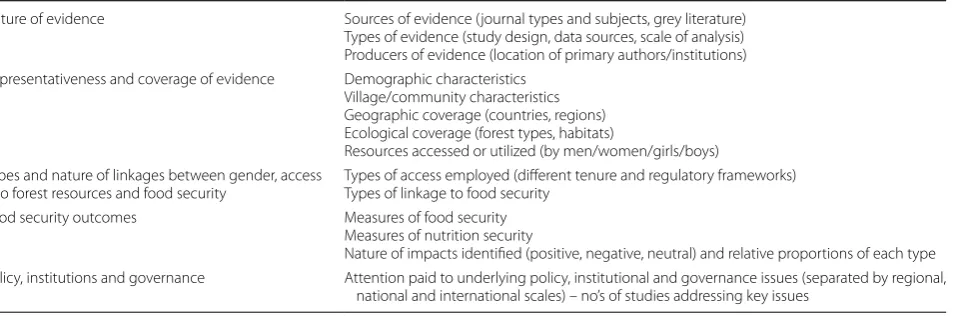
The data extraction strategy will record evidence across five main categories. These include the nature of evi-dence (source, type and producers of the evidence); the
coverage of evidence (men/women, community or village
information, forest type and resource use/access infor-mation); the types and nature of linkages between gender, access and food security outcomes; the types of food secu-rity outcomes reported and the underlying policy, institu-tional and governance frameworks (at regional, national or international levels) considered in the study. All of the data will be disaggregated by gender. Table 2 further outlines these main categories. We will provide a list of articles excluded at the full text review along with the reasons for exclusion.
Study mapping and presentation
Descriptive statistics will be used to show the number of studies, general information about the type of publica-tion, year, locapublica-tion, populations, households, countries and regions of where research was undertaken. Further statistics will be used to show examples of the types of forest resources used, related livelihood activities, and the gendered differences in where they are or are not reported. Forest typologies and food security outcomes, where relevant will also be presented.
Data presentation
The final output of this exercise will be a systematic map with the data presented as descriptive statistics. The data will highlight food security and socio-economic out-comes; population studied; geographical evidence base and methods employed. We anticipate a wide range of study designs will be used to measure food security, and we will use a narrative synthesis to discuss the com-monalities and difficulties found in how studies capture food and income from forest resources. The discussion will explore what research and or methodological gaps exist in the gender and food security literature, providing clearer justification for areas that need further study.
Table 2 Systematic map data categories
Nature of evidence Sources of evidence (journal types and subjects, grey literature) Types of evidence (study design, data sources, scale of analysis) Producers of evidence (location of primary authors/institutions) Representativeness and coverage of evidence Demographic characteristics
Village/community characteristics Geographic coverage (countries, regions) Ecological coverage (forest types, habitats)
Resources accessed or utilized (by men/women/girls/boys) Types and nature of linkages between gender, access
to forest resources and food security Types of access employed (different tenure and regulatory frameworks)Types of linkage to food security Food security outcomes Measures of food security
Measures of nutrition security
Nature of impacts identified (positive, negative, neutral) and relative proportions of each type Policy, institutions and governance Attention paid to underlying policy, institutional and governance issues (separated by regional,
Page 9 of 10 Chiwona‑Karltun et al. Environ Evid (2017) 6:2
Authors’ contributions
This review map protocol stems from a draft review paper on gender, forests and food security by LCK, NK and EM with LCK as the team leader. The draft was discussed in stages with GP and JC, and then developed into a systematic map. MS developed a draft activity scheme for operationalising searches, eligibility checks and quality assessment including software and reporting tools. CE and MS made the initial testing of the search terms and queries with support of JC. During the authors’ and stakeholder workshop, all authors listed here contributed and participated in refining the review question, and draft‑ ing the protocol. LCK, NK, JC, JBL, GL, and GP have at various stages worked on the revisions. Extensive revisions have been undertaken by LCK, NK and JC particularly responding to the reviewers’ comments and approving of the final manuscript. All authors read and approved the final manuscript.
Author details
1 Department of Urban & Rural Development, Swedish University of Agricul‑ tural Sciences, Box 7012, 75007 Uppsala, Sweden. 2 Salvation Army, Box 5090, 102 42 Stockholm, Sweden. 3 Centre for International Forestry Research (CIFOR), Jalan, Bogor 16115, Indonesia. 4 Swedish University of Agricultural Sciences, Skogsmarksgränd, 901 83 Umeå, Sweden. 5 Lilongwe University of Agriculture and Natural Resources, Box 219, Lilongwe, Malawi. 6 Inter‑ national Institute for Environmental Development (IIED), 4 Hanover Street, Edinburgh EH2 2EN, Scotland, UK. 7 Stockholm Environmental Institute (SEI), Box 24218, 104 51 Stockholm, Sweden. 8 Biodiversity Institute, Oxford, The Tinbergen Building, South Parks Road, Oxford OX1 3PS, England, UK.
Acknowledgements
We also thank Susanne von Walter for her invaluable input during the stake‑ holder workshop. The authors wish to thank Kyla Krogseng and Björn Schulte‑ Herbrüggen for their critical contributions during the revision process. This review has greatly benefitted from the comments of anonymous reviewers and the authors would like to extend their sincere thanks to them.
Competing interests
The authors declare that they have no competing interests.
Funding
Funding for the protocol and forthcoming systematic review were gener‑ ously provided by a Grant from the United Kingdom Department for Interna‑ tional Development (DFID) through the Evidence Based Forestry Initiative at the Centre for International Forestry Research (CIFOR). The Swedish Ministry of Foreign Affairs special initiative for food security, through the Swedish Uni‑ versity of Agricultural Sciences (SLU), supported the preparatory workshop on conducting systematic map protocols, as well as the participation of LCK and CE.
Received: 3 December 2015 Accepted: 7 December 2016
References
1. Aguilar L, Shaw DMP, Quesada‑Aguilar AE. Forests and gender. 2011. 2. World Bank. Sustaining forests: a development strategy. World Bank
Group. 2004.
3. Arnold M, Powell B, Shanley P, Sunderland T. Editorial: forests, biodiversity and food security. Int For Rev. 2011;13(3):259–64.
4. Lopez C, Shanley P, Fantini A, editors. Riches of the forest: fruits, remedies and handicrafts in Latin America. CIFOR: Bogor. 2004.
Additional files
Additional file 1. Appendix 1. References for search comprehensiveness. Additional file 2. Appendix 2. Scoping of gender review search combinations.
Additional file 3. Data coding and extraction.
5. Shyamsundar P, Ghate R. Rights, responsibilities and resources: examining community forestry in South Asia. Working Paper—South Asian Network for Development and Environmental Economics (SANDEE). 2011, (59–11). 6. Agarwal B. Gender and command over property: a critical gap in eco‑
nomic analysis and policy in South Asia. World Dev. 1994;22(10):1455–78. 7. FAO. Global forest resources assessment—main report. 2010, Rome. 8. Ribot JC, Peluso NL. A theory of access*. Rural Sociol. 2003;68(2):153–81. 9. World Bank. Gender in agriculture source book. Washington, D.C.: World
Bank; 2009.
10. Bose P. Forest Rights: The Micro‑politics of Decentralisation and Forest Tenure Reform in Tribal Indian. Doctoral Dissertation. Wageningen: Wage‑ ningen University. 2012.
11. Coulibaly‑Lingani P, Tigabu M, Savadogo P, Oden P‑C, Ouadba J‑M. Deter‑ minants of access to forest products in southern Burkina Faso. Forest Policy Econ. 2009;11(7):516–24.
12. Agarwal B. “Bargaining”and gender relations: within and beyond the household. Fem Econ. 1997;3(1):1–51.
13. Orloff AS. Gender and the social rights of citizenship: the compara‑ tive analysis of gender relations and welfare states. Am Sociol Rev. 1993;58(3):303–28.
14. FAO. Gender: the key to sustainability and food security. SD Dimensions. 1997.
15. Lindeborg AK. Where gendered spaces bend: the rubber phenomenon in northern Laos. 2012. Uppsala: Uppsala University, PhD Dissertation. 16. Mwangi E, Meinzen‑Dick R, Sun Y. Gender and Sustainable Forest Man‑
agement in East Africa and Latin America. Ecol Soc. 2011;16(1):17. 17. Sun Y, Mwangi E, Meinzen‑Dick R. Is gender an important factor influenc‑
ing user groups’ property rights and forestry governance? Empirical anal‑ ysis from East Africa and Latin America. Int For Rev. 2011;13(2):205–19. 18. Larson AM, Ribot JC. The poverty of forestry policy: double standards on
an uneven playing field. Sustain Sci. 2007;2(2):189–204.
19. Schlager E and Ostrom E. Property‑rights regimes and natural resources: a conceptual analysis. Land Econ. 1992: 249–62.
20. Baland JM, Bardhan P, Das S, Mookherjee D, Sarkar R. The environmental impact of poverty: evidence from firewood collection in rural Nepal. Econ Dev Cult Change. 2010;59(1):23–61.
21. Banana AY, Bukenya M, Arinaitwe E, Birabwa B, Ssekindi S. Gender, tenure and community forests in Uganda. CIFOR Working Paper. 2012, (87). 22. Mairena E, Lorio G, Hernandez X, Wilson CE, Muller P, and Larson A. Gen‑
der and forests in Nicaragua’s autonomous regions. Legal architecture. 2012. Bogor.
23. Shackleton S, Paumgarten F, Kassa H, Husselman M, Zida M. Opportuni‑ ties for enhancing poor women’s socioeconomic empowerment in the value chains of three African non‑timber forest products (NTFPs). Int Rev. 2011;13(2):136–51.
24. Müller J, Boubacar R, Guimbo I. The, “How” and “Why” of including gender and age in ethnobotanical research and community‑based resource management. Ambio. 2014;44:1–12.
25. Maxwell JA. Understanding and validity in qualitative research. Harvard Educ Rev. 1992;62(3):279–301.
26. Clay E. Food security: concepts and measurement. 2002. Food and Agri‑ cultural Organization, Rome. Paper for FAO expert consultation on trade and food security: conceptualising the linkages, Rome, 11‑12 July 2002. 27. Ogle B. People’s dependency on forests for food security. Curr Issues Non‑
Timber For Prod Res. 1996: 219–42.
28. World Food Summit. Rome Declaration on World Food Security and World Food Summit Plan of Action. FAO.1996.
29. Hasalkar S, Jadhav V. Role of women in the use of non‑timber. forest produce: a review. J Soc Sci. 2004;8(3):203–6.
30. Ogle BM, Xuan Dung NN, Thanh Do T, Hambraeus L. The contribution of wild vegetables to micronutrient intakes among women: an example from the Mekong Delta, Vietnam. Ecol Food Nut. 2001;40(2):159–84. 31. Shackleton S, Delang C, Angelsen A. From subsistence to safety nets and
cash income: exploring the diverse values of non‑timber forest products for livelihoods and poverty alleviation. In: Shackleton S, Shackleton C, Shanley P, editors. Non‑timber forest products in the global context. Berlin: Springer; 2011. p. 55–81.
• We accept pre-submission inquiries
• Our selector tool helps you to find the most relevant journal
• We provide round the clock customer support
• Convenient online submission
• Thorough peer review
• Inclusion in PubMed and all major indexing services
• Maximum visibility for your research Submit your manuscript at
www.biomedcentral.com/submit
Submit your next manuscript to BioMed Central
and we will help you at every step:
33. Kennedy E, Peters P. Household food security and child nutrition: the interaction of income and gender of household head. World Dev. 1992;20(8):1077–85.
34. Smith LC, Haddad LJ. Explaining child malnutrition in developing coun‑ tries: A cross‑country analysis, vol. 60. Int Food Policy Res Inst. 2000. 35. Van Den Bold M, Quisumbing AR, and Gillespie S. Women’s empower‑
ment and nutrition. An evidence review, in IFPRI discussion paper 01294. Washington DC. 2013.
36. Viera AJ, Garrett JM. Understanding interobserver agreement: the kappa statistic. Fam Med. 2005;37(5):360–3.
37. Bilotta GS, Milner AM, Boyd IL. Quality assessment tools for evidence from environmental science. Environ Evid. 2014;3(1):1–14.
38. Wells K, Littell JH. Study quality assessment in systematic reviews of research on intervention effects. Res Social Work Prac. 2008: 1–11. 39. Farrington D, Gottfredson D, Sherman L, Welsh B. The Maryland scientific
methods scale. In: Sherman L, et al., editors. Evidence‑based crime pre‑ vention. London: Routledge; 2002. p. 13–21.