1
Low-dissipation thermosets derived from oligo(2,6-dimethyl
phenylene oxide)-containing benzoxazines
Chien-Han Chen,a Kuan-Wei Lee,a Ching-Hsuan Lin,a* Tzong-Yuan Juangb
aDepartment of Chemical Engineering, National Chung Hsing University, Taichung, Taiwan.
bDepartment of Cosmeceutics, China Medical University, Taichung, Taiwan
Abstract
Poly(2,6-dimethyl phenyl oxide) (PPO) is known for its low dissipation factor. To achieve
insulating materials with low dissipation factor for high-frequency communication application, a
monomer-type benzoxazine (P-APPO) and a main-chain-type benzoxazine (BPA-APPO) were
prepared from an amine end-capped oligo (2,6-dimethyl phenylene oxide) (APPO). The APPO was
prepared from a nucleophilic substitution of a phenol-end capped oligo (2,6-dimethyl phenylene oxide)
(a commercial product, SA 90) with fluoronitrobenzene, and followed by catalytic hydrogenation.
After self-curing or curing with a dicyclopentadiene-phenol epoxy (HP 7200), thermosets with
high-Tg and low-dissipation factor can be achieved. Furthermore, the resulting epoxy thermosets show better
thermal and dielectric properties than those of epoxy thermoset cured from its precursor SA90,
demonstrating it is a successful modification in simultaneously enhancing the thermal and dielectric
1.
Introduction
The dielectric loss (L) is proportional to the product of square root of dielectric constant (Dk1/2),
frequency, and dissipation factor (Df). Therefore, the dielectric loss will be more obvious for
application in high-frequency communication. In addition, Df will be more important than Dk since Df
is directly proportional the L, while there is only a square root relationship between Dk and L. Polybenzoxazines feature for special characteristics such as a moderate-to-high thermal
property,[1-18] moderate electrical property,[19] low water absorption,[20] and low surface
energy.[21] Low-dielectric benzoxazines have been reported (1) by Chang et al. through Mannich
condensation of bisphenol F/ 4-(trifluoromethyl)aniline/formaldehyde.[22](2) by Liu et al. through
incorporation of methyl methacrylate-POSS (MMA-POSS) into the network of
bis(3-furfuryl-3,4-dihydro-2H-1,3-benzoxazinyl)isopropane (BPA-FBz), which has furfuryl moiety that can react with
methyl methacrylate through the Diels-Alder reaction.[23] (3) by Liu et al. through the incorporation
of a benzobisoxazole structure.[24,25](4) by Alagar et al. through the incorporation of silica
(SBA-15).[26] (5) by Ishida et al. from a highly fluorinated diamine and bisphenol F,[27] and (6) by Lin et
al. from fluorinated aromatic diamine.[28]However, to the best of our knowledge, no data show that
thermosets of these benzoxazines can reach the requirement of low dissipation factor below 0.005 U
for application in high-frequency communication.
Poly(2,6-dimethyl phenylene oxide) (PPO) is a hydrophobic polymer developed by Hay et al.
through the aromatic oxidative polymerization.[29,30] PPO is known for its low dissipation factor.
Therefore, PPO is a building block to prepare low-dissipation materials. Thermosetting low-dielectric
PPOs have been reported by Ueda et al.[31,32] Low-molecular-weight telechelic PPOs have been
developed by White et al.,[33-35] Jayakannan et al.,[36] and Percec et al.,[37] Telechelic PPO
oligomers with phenyl methacrylate end group has been commercialized by SABIC in the name of
NORYL™ SA9000 resin. Vinyl benzyl ether-terminated PPO has been commercialized by Mitsubishi
Difunctional benzoxazines are generally prepared by Mannich condensation of
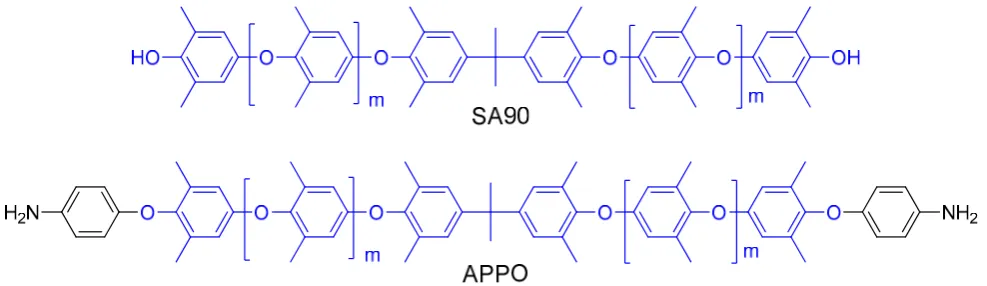
biphenol/monoamine/formaldehyde. Figure 1 shows the structure of SA90, a phenolic hydroxyl-end
capped oligo (2,6-dimethyl phenylene oxide), commercialized by SABIC. The end group of SA90 is
the 2,6-dimethyl phenolic OH, which does not contain free ortho, so it cannot carry outthe Mannich
condensation with primary amine and formaldehyde directly. In addition to the Mannich condensation
of biphenol/monoamine/formaldehyde, difunctional benzoxazines can also be prepared from the
Mannich condensation of diamine/monophenol/formaldehyde. Therefore, the only way to prepare
PPO-containing benzoxazines is transforming the phenolic hydroxyl to amine. In this work, an amine
end-capped oligo (2,6-dimethyl phenylene oxide) (APPO, Figure 1) was prepared from a nucleophilic
substitution of SA 90 and fluoronitrobenzene, and followed by catalytic hydrogenation.
Figure 1. Structures SA90 and APPO. Note that there are no free ortho for SA90
With APPO in hand, a monomer-type benzoxazine from phenol, APPO, and formaldehyde was
prepared by two approaches. The first approach is through a two-pot procedure to obtain the
benzoxazine (P-APPO-2).[38] The second approach is a one-pot Mannich condensation of
phenol/APPO/formaldehyde to obtain the benzoxazine (P-APPO-1). A main-chain-type benzoxazine
(BPA-APPO) was also prepared from the Mannich condensation of bisphenol A/APPO/formaldehyde
using the mixed solvent approach.[39] Experimental data show that thermosets with very low
dissipation factor can be achieved. Detailed synthesis, characterization, and the property are provided
2. Experimental section 2.1. Materials
NORYLTM SA90 (the weight average molecular weight 1700 g/mol, and the number average
molecular weight 1600 g/mol) was purchased from SABIC. Dicyclopentadiene novolac epoxy
(HP7200) with an EEW of 250 g/eq was kindly supplied by Dainippon Ink and Chemicals Corporation.
Potassium carbonate (from Showa), 4-fluoro-1-nitrobenzene (from Alfa), bisphenol A (from Acros),
paraformaldehyde (from TCI), 2-hydroxybenzaldehyde (from Showa), sodium borohydride (from
Alfa), phenol (from Showa), palladium on carbon 10 % (from Acros), and 4-dimethylaminopyrdine
(DMAP, from Alfa) were purchased from various commercial sources and used without further
purification. N-methylpyrrolidone (NMP; HPLC grade from Showa) and N,N-dimethyl acetamide
(DMAc, HPLC grade from Showa) were purified by distillation under reduced pressure over calcium
hydride (from Acros), and stored over molecular sieves. The other solvents (HPLC grade) were
purchased from various commercial sources and used without further purification.
2.2. Characterization.
Thermogravimetric analysis (TGA) was performed with a Perkin-Elmer Pyris1 at a heating rate of 20
oC/min in an atmosphere of nitrogen or air atmosphere. Dynamic mechanical analysis (DMA) was
performed using a Perkin-Elmer Pyris Diamond DMA with a sample size of 5.0 cm x 1.0 cm x 0.2 cm.
The storage modulus E' and tan δ were determined as the sample was subjected to the temperature scan
mode at a programmed heating rate of 5 oC/min at a frequency of 1 Hz. The test was performed using a bending mode with an amplitude of 5 μm. Dielectric properties were performed with Agilent E4991A
at 1GHz at 25 oC. The sample size is 2 x2 cm2 with thickness at around 300 um. Thermal mechanical
analysis (TMA) was performed by a SII TMA/SS6100 at a heating rate of 5 oC/min. The coefficient of thermal expansion (CTE) was determined in the range of 50 oC to 150 oC. NMR measurements were
performed using a Varian Inova 600 NMR in DMSO-d6, and the chemical shift was calibrated by
the standard wavenumber range of 667–4000 cm-1 using a Perkin-Elmer RX1 infrared spectrophotometer. Gel Permeation Chromatography (GPC) was performed by Hitachi L2400 in THF,
using polystyrene as standard.
2.3. Synthesis of nitro end-capped oligo (2,6-dimethyl phenylene oxide) (NPPO).
SA90 10.0 g (6.2 mmole), 4-fluoro-1-nitrobenzene 2.62 g (18.6 mmole), K2CO3 2.57 g (18.6 mmole),
and DMAc 50 mL were introduced into a 250 mL round-bottom glass flask equipped with a nitrogen
inlet, condenser, and a magnetic stirrer. The solution was stirred at 80 oC for 24 h (Scheme 1). After
that, the solution was poured into methanol/water =1/1, yielding green powder. After drying the
powder at 70 oC, the isolated yield was 91 %.
2.4. Synthesis of amine end-capped oligo (2,6-dimethyl phenylene oxide) (APPO).
NPPO 10.0 g ( 6.2 mmole ), Pd/C 0.04 g, and THF 40 mL were introduced into a 250 mL Parr reactor.
The solution was stirred hydrogen atmosphere at 25 oC, 140 psi for 24 h (Scheme 1). After that, the
solution was poured into methanol, yielding gray powder. After drying the powder at 70 oC, the isolated yield was 93 %.
2.5. Two-pot synthesis of monomer-type benzoxazine (P-APPO-2)
2-Hydroxybenzaldehyde 0.22 g (1.68 mmole), APPO 1.0 g (0.56 mole) and DMAc 10 mL were
introduced into a 100-mL round bottom glass flask equipped with a nitrogen inlet and a magnetic
stirrer. The reaction mixture was stirred at room temperature for 12 h. NaBH4 0.066 g (1.68 mmole)
was added and the solution was further stirred at room temperature for 24 h (Scheme 2). After that, the
solution was poured into methanol/water =1/1, yielding intermediate II with gray color. After drying
the powder at 70 oC, the isolated yield was 93 %.
1.0 g (5.6 mmole) of intermediate II, paraformaldehyde 0.052g (1.68 mmol), and toluene 5 mL
were introduced into a 100-mL round bottom glass flask equipped with a condenser and a magnetic
stirrer. The solution was stirred at 60 oC for 12 h. After that, the solution was poured into methanol,
yielding green powder. After drying the powder at 70 oC, the isolated yield was 93 %.
Scheme 2. Two-pot synthesis of monomer-type benzoxazine (P-APPO-2)
2.6. One-pot synthesis of monomer-type benzoxazine (P-APPO-1)
APPO 2.0 g ( 0.56 mmole ), phenol 0.32 g (1.68 mmole), paraforaldehyde 0.224 g (2.24 mmole),
and toluène/ethanol (2/1) 30 mL were introduced into a 250 mL round bottom glass flask equipped
with a condenser and a magnetic stirrer. The mixture was stirred at 80 oC for 24 h (Scheme 3).
After that, the solution was poured into methanol, yielding green powder. After drying the powder
Scheme 3. One-pot synthesis of monomer-type benzoxazine (P-APPO-1)
2.7. Syntheis of main-chain-type benzoxazine (BPA-APPO)
APPO 2.0 g ( 0.56 mmole ), biphenol A 0.26 g (0.56 mmole), paraforaldehyde 0.14 g (2.24 mmole)
, and toluene/ethanol (2/1) 22 mL were introduced into a 250 mL round bottom glass flask
equipped with a condenser and a magnetic stirrer. The mixture was stirred at 80 oC for 24 h
(Scheme 4). After that, the solution was poured into methanol, yielding gray powder. After drying
the powder at 70 oC, the isolated yield was 93 %.
Scheme 4. Synthesis of main-chain-type benzoxazine (BPA-APPO)
2.8. Sample preparation and curing procedure.
2.8.1 The self-curing of P-APPO-2, P-APPO-1, and BPA-APPO
P-APPO-2, P-APPO-1, and BPA-APPO were thermally self-curing. Each benzoxazine was dissolved
in xylene to make a solution with 20 wt% solid content. The solution was cast on a glass by an
automatic film applicator. The resulting thin films were dried at 80 oC for 12 h. Then, cured by the program of 180 oC (2 h), 200 oC (2 h), and 220 oC (2 h) under a nitrogen atmosphere. The thermosets are named C-P-APPO-2, C-P-APPO-1, and C-BPA-APPO, respectively
2.8.2 The co-curing of HP7200 with P-APPO-2, P-APPO-1, and BPA-APPO
ratio of the oxazine moiety to oxirane (epoxy group) was controlled at one (The major curing reaction
is the ring-opened phenolic OHs react with epoxy. The lone-pair electrons of nitrogen in oxazine act
as the catalyst). Each benzoxazine and HP7200 were dissolved in xylene to make a solution with 20
wt% solid content. The solution was cast on a glass with an automatic film applicator. The resulting
thin films were dried at 80 oC for 12 h. Then, cured by the program of 180 oC (2 h), 200 oC (2 h), and
220 oC (2 h) under a nitrogen atmosphere. The thermosets are named E-P-APPO-2, E-P-APPO-1, and E-BPA-APPO, respectively
2.8.3 The co-curing of HP7200 with SA90
For property comparison, SA90 was thermally co-curing with epoxy HP7200. The molar ratio of the
phenolic OH moiety to oxirane (epoxy group) was controlled at one. SA90 and HP7200 were dissolved
in xylene to make a solution with 20 wt% solid content. The solution was cast on a glass by an
automatic film applicator. The resulting thin film was dried at 80 oC for 12 h. Then, cured by the
program of 180 oC (2 h), 200 oC (2 h), and 220 oC (2 h) under a nitrogen atmosphere. The thermoset is named E-SA90.
3.
Results and Discussion
3.1. Synthesis and characterization of APPO
APPO was prepared from the nucleophilic substitution of SA90 and fluoronitrobenzene, forming
NPPO, and followed by catalytic hydrogenation of NPPO(Scheme 1). Figure 1 shows the 1H-NMR spectra of (a) SA90, (b) NPPO, and (c) APPO. The signals of phenolic OH at 7.8-8.0 ppm were
observed in SA90. However, no phenolic OH signals were observed for NPPO, suggesting the
completion of the reaction. The signals of Ar-H ortho to the nitro group were observed at 8.2 ppm for
NPPO, while the signal disappeared in APPO. Furthermore, an amino peak at 4.6 ppm was clearly
observed for APPO, indicating the successful hydrogenation. Figure S1 shows the IRspectra of SA90,
However, no phenolic OH signals were observed for NPPO, suggesting the completion of the reaction.
The absorptions of the nitro group were observed at 1340 and 1518 cm-1, while the signal disappeared in APPO. Furthermore, two amino absorptions at 3455 and 3365 cm-1 were clearly observed, indicating
the successful hydrogenation.
Figure 1. 1H-NMR spectra of (a) SA90, (b) NPPO, and (c) APPO in DMSO-d
3.2. Synthesis and characterization of benzoxazine P-APPO.
The phenol/APPO-based benzoxazine was prepared by two procedures. The first approach is a
two-pot procedure (Scheme 2). The procedure includes the reaction of 2-hydroxybenzaldehyde and APPO,
yielding intermediate I (not isolated) with an o-hydroxy phenylimine linkage. The imine linkage of
intermediate I was reduced by sodium borohydride, yielding intermediate II with a secondary amine
structure. Then, paraformaldehyde was added to induce the ring closure of intermediate II, forming
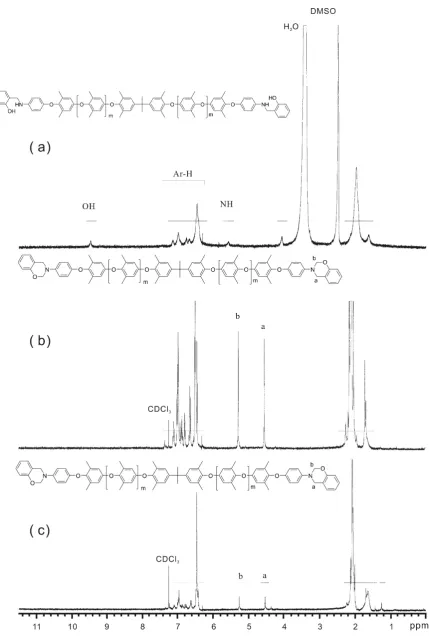
P-APPO-2. Figure 2 shows the 1H-NMR spectra of (a) intermediate II, and (b) P-APPO-2. A phenolic OH signal at 9.5 ppm and two new signals at 5.6 (NH) and 4.1(CH2-NH) confirm the structure of
intermediate II. The characteristic peaks of oxazine at 5.3 ppm and 4.6 ppm confirm the formation of
benzoxazine. No signal corresponding to N-CH2-Ph at around 3.80 ppmresulting from the ring-opened
structure was observed, revealing the purity of synthesized P-APPO-2. The second approach is
one-pot, Mannich condensation of phenol, APPO, and paraformaldehyde (Scheme 3). Using a traditional
solvent such as dioxane leads to gelation. However, P-APPO-1 can be successfully prepared using a
mixed solvent of toluene/ethanol, which is recommended in our previous work.[39]Figure 2(c) shows
the 1H-NMR spectrum of P-APPO-1. The characteristic peaks of oxazine at 5.3 and 4.6 ppm confirm the formation of benzoxazines. However, a small unknown peak was observed at 4.4 ppm, indicating
the purity is not as good as P-APPO-2. Generally, conventional biphenol-based benzoxazines often
need extraction procedures to remove insoluble oligomer and unreacted monomers. However, no
extraction or purification is required to prepare benzoxazines with moderate-to-high purity by this two
3.3. Synthesis and characterization of benzoxazine BPA-APPO
The main-chain-type benzoxazine (BPA-APPO) was prepared by one-pot, Mannich condensation of
bisphenol A, APPO, and formaldehyde (Scheme 4) using toluene/ethanol as a solvent, which is
recommended by our previous work.[39]Figure 3 shows the 1H-NMR spectrum of BPA-APPO. The characteristic peaks of oxazine at 5.2 ppm and 4.5 ppm confirm the formation of benzoxazines. The
number average molecular weight is 12200 g/mol, and the weight average molecular weight is 19800
g/mol. No signal corresponding to N-CH2-Ph at around 3.80 ppmresulting from the ring-opened
structure was observed,revealing the purity of synthesized BPA-APPO.
Figure 3. 1H NMR spectrum of BPA-APPO in CDCl3. 3.4. Solubility
Table S1 lists the solubility data of SA90, P-APPO-1, P-APPO-2, and BPA-APPO. The benzoxazines
show good solubility in various solvents except for DMSO. Especially, the main-chain-type
benzoxazines readily for solution process in the copper clad laminate industry.
3.5. DSC thermograms
Figure 4 shows the DSC thermograms of three PPO-containing benzoxazines and the benzoxazine/
HP7200 blends. The exothermic peak temperature is around 270 oC for benzoxazine. The exothermic enthalpy of APPO-2 is more obvious than that of APPO-1, probably due to the higher purity of
P-APPO-2. The exothermic peak temperature is around 260 oC for benzoxazine/HP7200 blend.
In a single component system, it is well known that ring opening of oxazine leads to benzoxazine
thermoset. However, in the benzoxazine/HP7200 blend system, the reaction routes become more
complicated. According to the literature, there are several possible reaction routes might occur.[40]
(1)The thermally-induced ring-opening polymerization of benzoxazine resin. (2) The
homopolymerization of epoxy resin catalyzed by tertiary amine moiety in benzoxazine. (3)The
co-reaction between epoxy and the phenolic OH resulting from ring-opening of benzoxazine. (4) The ring
opening of benzoxazine catalyzed by the alkoxy anion, which is induced by the reaction between
tertiary amine and epoxy moiety.
100 120 140 160 180 200 220 240 260 280 300 Peak = 264 o
C Delta H = -47.5 J/g Peak = 260 o
C Delta H = -20.4 J/g Peak = 252 o
C Delta H = -60.0 J/g
BPA-APPO Peak = 276 o
C Delta H = -26.4 J/g
P-APPO-1 Peak = 269
o
C Delta H = -10.3 J/g
Peak = 276 o
C Delta H = -37.8 J/g
Mor
m
al
iz
ed Heat F
low
E
n
do Up(W/
g)
Temperature(pC) P-APPO-2
E-BPA-APPO E-P-APPO-1 E-P-APPO-2
3.6. Thermal properties
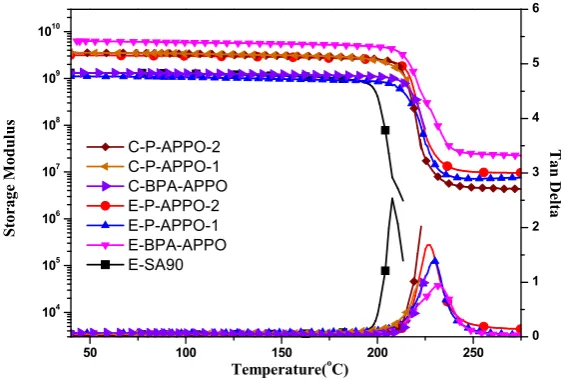
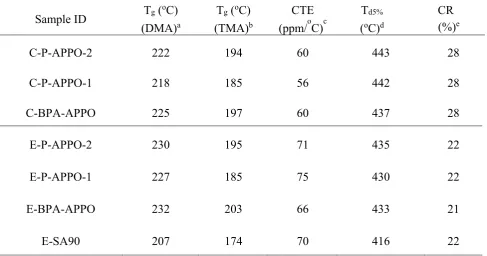
Figure 5 shows DMA thermograms of the prepared thermosets. The Tg data are listed in Table 1.
Thermosets cured from main-chain-type BPA-APPO has the highest Tg (225 oC for C-BPA-APPO).
Tg value of C-P-APPO-2 is 222 oC, which is slightly higher than that (218 oC) of C-P-APPO-1, probably due to the high purity of P-APPO-2. Generally, thermosets of bisphenol A/aniline-based
poly(B-a), and bisphenol F/aniline-based poly(F-a) exhibit Tg at around 150-160 oC.[1,3] The values of 218 and 222 oC are relatively high compared with other benzoxazines, and demonstrate the high-Tg characteristic of PPO-containing benzoxazine thermosets. Table 1 also lists Tg data of the
benzoxazine/epoxy thermosets. BPA-APPO/HP7200 (E-BPA-APPO) shows the highest Tg value of
232 oC while SA90/HP7200 (E-SA90) shows the lowest Tg (207 oC). E-P-APPO-2 and E-P-APPO-1
display higher Tg than E-SA90, demonstrating that our approach is a successful modification in
enhancing thermal properties.
50 100 150 200 250
104 105 106 107 108 109 1010 C-P-APPO-2 C-P-APPO-1 C-BPA-APPO E-P-APPO-2 E-P-APPO-1 E-BPA-APPO E-SA90
Temperature(oC)
Storage Modul us 0 1 2 3 4 5 6 Tan Delta
Figure 5. DMA thermograms of the prepared thermosets
Figure 6 shows TMA thermograms of the prepared thermosets. The data of Tg and coefficient of
thermal expansion (CTE) are listed in Table 1. The Tg values defined by TMA are 20-30 oC lower than those defined by DMA, but the trend is the same. The CTE values of thermosets of PPO-containing
benzoxazine/HP7200 thermosets.
50 75 100 125 150 175 200 225 250
R
e
la
ri
v
e pr
o
b
e po
si
ti
on
(
u
m
)
Temperature (o C)
C-P-APPO-2 C-P-APPO-1 C-BPA-APPO E-P-APPO-2 E-P-APPO-1 E-BPA-APPO E-SA90
Figure 6. TMA thermograms of the prepared thermosets
Table 1 lists the thermal stability data of the prepared thermosets in a nitrogen atmosphere. The 5 wt%
decomposition temperature is higher than 430 oC, and char yield at 800 oC is higher than 21%. Generally, the thermosets of bisphenol F/aniline-based and bisphenol A/aniline-based benzoxazines
Table 1. Thermal properties of the resulting polybenzoxazine
a Measured by DMA at heating rate of 5 oC/min; Tg were determined from a peak temperature of the tan δ curve. b Measured by TMA at heating rate of 5 oC/min; Tg were determined from onset temperature.
c
Coefficient of thermal expansion, recorded at 50 oC to 150 oC
d
Temperature corresponding to 5 % weight loss by thermogravimetry at a heating rate of 20 oC /min in nitrogen e
Residual weight % at 800 oC in nitrogen.
3.7. Dielectric properties
PPO is known for its moderate-to-low dielectric constant and very low dissipation factor. As a result,
low-dissipation copper clad laminated has prepared from SA9000 (a phenyl methacrylate-terminated
PPO oligomer commercialized by SABIC) and OPE-2st (a vinyl benzyl ether-terminated PPO
commercialized by MGC). To the best of our knowledge, no benzoxazine-terminated PPO (or
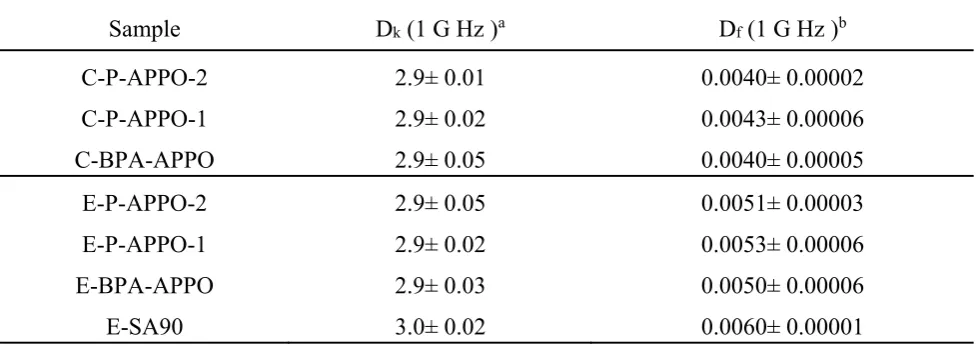
PPO-containing benzoxazine) has been reported. Table 2 lists the dielectric properties of the prepared
thermosets. All the thermosets show the same dielectric constant of 2.9 U, which is a moderate-to-low
value compared with other thermosets (around 3.5 for generally epoxy thermosets [41-45]). In
particular, they all show an extremely low dissipation factor. The dissipation factor is as low as
0.0040-0.0043 U for thermosets of PPO-containing benzoxazines, and 0.0050-0.0053 for
Sample ID Tg (
oC) (DMA)a
Tg (oC) (TMA)b
CTE (ppm/oC)c
Td5% (oC)d
CR (%)e
C-P-APPO-2 222 194 60 443 28
C-P-APPO-1 218 185 56 442 28
C-BPA-APPO 225 197 60 437 28
E-P-APPO-2 230 195 71 435 22
E-P-APPO-1 227 185 75 430 22
E-BPA-APPO 232 203 66 433 21
benzoxazine/HP7200 thermosets. The dissipation factor is as good as that (0.005 U) of thermosets of
commercialized OPE-2st by MGC and SA9000 by SABIC.[46]
Table 2. Dielectric properties of the prepared thermosets.
Sample Dk (1 G Hz )a Df (1 G Hz )b
C-P-APPO-2 2.9± 0.01 0.0040± 0.00002
C-P-APPO-1 2.9± 0.02 0.0043± 0.00006
C-BPA-APPO 2.9± 0.05 0.0040± 0.00005
E-P-APPO-2 2.9± 0.05 0.0051± 0.00003
E-P-APPO-1 2.9± 0.02 0.0053± 0.00006
E-BPA-APPO 2.9± 0.03 0.0050± 0.00006
E-SA90 3.0± 0.02 0.0060± 0.00001
4.
Conclusions
There are no free ortho positions for Mannich condensation in the phenolic hydroxyl-end capped
oligo (2,6-dimethyl phenylene oxide), making it impossible to perform Mannich condensation directly.
To the best of our knowledge, no PPO-containing benzoxazine has been reported before. To prepare
the PPO-containing benzoxazine, we first transformed the phenolic hydroxyl to amine by a two-step
procedure to obtain the amine end-capped oligo (2,6-dimethyl phenylene oxide) (APPO). Based on
APPO, a monomer-type benzoxazine and a main-chain-type benzoxazine (BPA-APPO) were prepared.
The monomer-type benzoxazine was prepared by a two-pot procedure (for P-APPO-2) and a one-pot
procedure (for P-APPO-1). The former has higher purity than the latter, according to NMR and DSC
data. Thermosets cured from BPA-APPO has the highest Tg (225 oC for C-BPA-APPO). The thermoset of P-APPO-2 show slightly higher Tg and lower Df than that of P-APPO-1, indicating the purity of
benzoxazine has an influence on thermal and dielectric properties. BPA-APPO/HP7200
our approach is a successful modification in simultaneously enhancing the thermal and dielectric
properties. The 5 wt% decomposition temperatures of these thermosets are higher than 430 oC, and char yields at 800 oC are higher than 21%. The dissipation factor is as low as 0.0040-0.0043 U for
thermosets of PPO-containing benzoxazines, and 0.0050-0.0053 for benzoxazine/HP7200 thermosets.
The dissipation factor is as good as that (0.005 U) of thermosets of commercialized OPE-2st by MGC
and SA9000 by SABIC. The combination of high Tg characteristic, high Td characteristic,
moderate-to-low Dk, and extremely low dissipation factor makes the PPO-containing benzoxazine attractive for
printed circuit boards for application in high-frequency communication.
Supplementary Materials. Figure S1 and Table S1 are available online at http://www.mdpi.com. Acknowledgment. Financial support of this work from the Ministry of Science and Technology, Taiwan is highly appreciated.
Author Contributions. Ching-Hsuan Lin conceived and designed the experiments; Kuan-Wei Lee performed the experiments; Chien-Han Chen and Tzong-Yuan Juang analyzed the data; Ching-Hsuan
Lin wrote the paper.
References
1. Ning, X.; Ishida, H. Phenolic materials via ring opening polymerization: Synthesis and ‐
characterization of bisphenol a based benzoxazines and their polymers. ‐ Journal of Polymer
Science Part A: Polymer Chemistry 1994, 32, 1121-1129.
2. Ohashi, S.; Cassidy, F.; Huang, S.; Chiou, K.; Ishida, H. Synthesis and ring-opening
polymerization of 2-substituted 1,3-benzoxazine: The first observation of the polymerization of oxazine ring-substituted benzoxazines. Polymer Chemistry 2016, 7, 7177-7184.
3. Liu, J.; Ishida, H. Anomalous isomeric effect on the properties of bisphenol f-based
benzoxazines: Toward the molecular design for higher performance. Macromolecules 2014,
47, 5682-5690.
4. Yagci, Y.; Kiskan, B.; Ghosh, N.N. Recent advancement on polybenzoxazine—a newly developed high performance thermoset. Journal of Polymer Science Part A: Polymer
Chemistry 2009, 47, 5565-5576.
5. Ghosh, N.N.; Kiskan, B.; Yagci, Y. Polybenzoxazines—new high performance thermosetting resins: Synthesis and properties. Progress in Polymer Science 2007, 32, 1344-1391.
6. N. K, S.; Endo, T. Toward elucidating the role of number of oxazine rings and intermediates in the benzoxazine backbone on their thermal characteristics. Macromolecules 2016, 49, 8466-8478.
7. Baranek, A.D.; Kendrick, L.L.; Narayanan, J.; Tyson, G.E.; Wand, S.; Patton, D.L. Flexible aliphatic-bridged bisphenol-based polybenzoxazines. Polymer Chemistry 2012, 3, 2892-2900. 8. Rodriguez Arza, C.; Froimowicz, P.; Ishida, H. Smart chemical design incorporating
umbelliferone as natural renewable resource toward the preparation of thermally stable thermosets materials based on benzoxazine chemistry. RSC Advances 2015, 5, 97855-97861. 9. Ye, Y.S.; Huang, Y.J.; Chang, F.C.; Xue, Z.G.; Xie, X.L. Synthesis and characterization of
thermally cured polytriazole polymers incorporating main or side chain benzoxazine crosslinking moieties. Polymer Chemistry 2014, 5, 2863-2871.
10. Lligadas, G.; Tuzun, A.; Ronda, J.C.; Galia, M.; Cadiz, V. Polybenzoxazines: New players in the bio-based polymer arena. Polymer Chemistry 2014, 5, 6636-6644.
11. Wang, H.; Zhu, R.; Yang, P.; Gu, Y. A study on the chain propagation of benzoxazine.
Polymer Chemistry 2016, 7, 860-866.
12. Kawaguchi, A.W.; Sudo, A.; Endo, T. Functional 1,3-benzoxazine bearing 4-pyridyl group: Synthesis and thermally induced polymerization behavior. Journal of Polymer Science Part
A: Polymer Chemistry 2014, 52, 410-416.
13. Arslan, M.; Kiskan, B.; Yagci, Y. Benzoxazine-based thermosets with autonomous self-healing ability. Macromolecules 2015, 48, 1329-1334.
14. Zhang, S.; Yang, P.; Bai, Y.; Zhou, T.; Zhu, R.; Gu, Y. Polybenzoxazines: Thermal
responsiveness of hydrogen bonds and application as latent curing agents for thermosetting resins. ACS Omega 2017, 2, 1529-1534.
15. Arslan, M.; Kiskan, B.; Yagci, Y. Ring-opening polymerization of 1,3-benzoxazines via borane catalyst. Polymers 2018, 10, 239.
16. Soto, M.; Hiller, M.; Oschkinat, H.; Koschek, K. Multifunctional benzoxazines feature low polymerization temperature and diverse polymer structures. Polymers 2016, 8, 278.
17. Hamerton, I.; McNamara, L.T.; Howlin, B.J.; Smith, P.A.; Cross, P.; Ward, S. Examining the initiation of the polymerization mechanism and network development in aromatic
polybenzoxazines. Macromolecules 2013, 46, 5117-5132.
18. Wan Hassan, W.A.; Liu, J.; Howlin, B.J.; Ishida, H.; Hamerton, I. Examining the influence of bisphenol a on the polymerisation and network properties of an aromatic benzoxazine.
Polymer 2016, 88, 52-62.
benzoxazine–benzimidazole copolymer electrolyte membranes for fuel cells at elevated temperature. Macromolecules 2012, 45, 1438-1446.
20. Ishida, H.; Allen, D.J. Physical and mechanical characterization of near zero shrinkage ‐
polybenzoxazines. Journal of Polymer Science Part B: Polymer Physics 1996, 34, 1019-1030.
21. Wang, C.F.; Su, Y.C.; Kuo, S.W.; Huang, C.F.; Sheen, Y.C.; Chang, F.C. Low surface‐ ‐
free energy materials based on polybenzoxazines. ‐ Angewandte Chemie International Edition 2006, 45, 2248-2251.
22. Su, Y.-C.; Chang, F.-C. Synthesis and characterization of fluorinated polybenzoxazine material with low dielectric constant. Polymer 2003, 44, 7989-7996.
23. Tseng, M.-C.; Liu, Y.-L. Preparation, morphology, and ultra-low dielectric constants of benzoxazine-based polymers/polyhedral oligomeric silsesquioxane (poss) nanocomposites.
Polymer 2010, 51, 5567-5575.
24. Zhang, K.; Zhuang, Q.; Liu, X.; Cai, R.; Yang, G.; Han, Z. Synthesis and copolymerization of benzoxazines with low-dielectric constants and high thermal stability. RSC Advances
2013, 3, 5261-5270.
25. Zhang, K.; Zhuang, Q.; Zhou, Y.; Liu, X.; Yang, G.; Han, Z. Preparation and properties of novel low dielectric constant benzoxazole-based polybenzoxazine. Journal of Polymer
Science Part A: Polymer Chemistry 2012, 50, 5115-5123.
26. Vengatesan, M.R.; Devaraju, S.; Dinakaran, K.; Alagar, M. Sba-15 filled polybenzoxazine nanocomposites for low-k dielectric applications. Journal of Materials Chemistry 2012, 22, 7559-7566.
27. Velez-Herrera, P.; Doyama, K.; Abe, H.; Ishida, H. Synthesis and characterization of highly fluorinated polymer with the benzoxazine moiety in the main chain. Macromolecules 2008,
41, 9704-9714.
28. Lin, C.H.; Chang, S.L.; Lee, H.H.; Chang, H.C.; Hwang, K.Y.; Tu, A.P.; Su, W.C. Fluorinated benzoxazines and the structure-property relationship of resulting
polybenzoxazines. Journal of Polymer Science Part A: Polymer Chemistry 2008, 46, 4970-4983.
29. Hay, A.S. Poly(phenylene oxides)s and poly(arylene ether)s derived from 2,6-diarylphenols.
Progress in Polymer Science 1999, 24, 45-80.
30. Hay, A.S.; Blanchard, H.S.; Endres, G.F.; Eustance, J.W. Polymerization by oxidative coupling. Journal of the American Chemical Society 1959, 81, 6335-6336.
31. Nunoshige, J.; Akahoshi, H.; Shibasaki, Y.; Ueda, M. Efficient oxidative coupling
polymerization for synthesis of thermosetting poly(phenylene ether) copolymer with a low dielectric loss. Journal of Polymer Science Part A: Polymer Chemistry 2008, 46, 5278-5282. 32. Fukuhara, T.; Shibasaki, Y.; Ando, S.; Ueda, M. Synthesis of thermosetting poly(phenylene
ether) containing allyl groups. Polymer 2004, 45, 843-847.
33. White, D.M. Polymerization by oxidative coupling. Ii. Co-redistribution of
poly(2,6-diphenyl-1,4-phenylene ether) with phenols. Journal of Polymer Science Part A-1: Polymer Chemistry 1971, 9, 663-675.
34. White, D.M. Reactions of poly(phenylene oxide)s with quinones. I. The quinone-coupling reaction between low-molecular-weight poly(2,6-dimethyl-1,4-phenylene oxide) and 3,3′,5,5′-tetramethyl-4,4′-diphenoquinone. Journal of Polymer Science: Polymer
Chemistry Edition 1981, 19, 1367-1383.
35. White, D.M. Synthesis of 4-hydroxyarylene ethers by the equilibration of phenols with poly(2,6-dimethyl-1,4-phenylene ether). The Journal of Organic Chemistry 1969, 34, 297-303.
37. Tingerthal, J.M.; Nava, H.; Percec, V. Synthesis and characterization of aba triblock
copolymers containing poly(2,6-dimethyl-1,4-phenylene oxide) as a blocks and tetramethyl bisphenol-a polysulfone as b blocks. Journal of Polymer Science Part A: Polymer Chemistry
1987, 25, 2043-2062.
38. Lin, C.H.; Chang, S.L.; Hsieh, C.W.; Lee, H.H. Aromatic diamine-based benzoxazines and their high performance thermosets. Polymer 2008, 49, 1220-1229.
39. Lin, C.H.; Chang, S.L.; Shen, T.Y.; Shih, Y.S.; Lin, H.T.; Wang, C.F. Flexible
polybenzoxazine thermosets with high glass transition temperatures and low surface free energies. Polymer Chemistry 2012, 3, 935-945.
40. Zhao, P.; Zhou, Q.; Liu, X.; Zhu, R.; Ran, Q.; Gu, Y. Phase separation in benzoxazine/epoxy resin blending systems. Polymer Journal 2012, 45, 637.
41. Tao, Z.; Yang, S.; Ge, Z.; Chen, J.; Fan, L. Synthesis and properties of novel fluorinated epoxy resins based on 1,1-bis(4-glycidylesterphenyl)-1-(3′ -trifluoromethylphenyl)-2,2,2-trifluoroethane. European Polymer Journal 2007, 43, 550-560.
42. Zhao, X.-Y.; Liu, H.-J. Review of polymer materials with low dielectric constant. Polymer International 2010, 59, 597-606.
43. Lin, C.H.; Jiang, Z.R.; Wang, C.S. Low dielectric thermoset. Ii. Synthesis and properties of novel 2,6-dimethyl phenol–dipentene epoxy. Journal of Polymer Science Part A: Polymer
Chemistry 2002, 40, 4084-4097.
44. Lin, C.H.; Hsiao, C.N.; Li, C.H.; Wang, C.S. Low dielectric thermoset. Iv. Synthesis and properties of a dipentene-containing cyanate ester and its copolymerization with bisphenol a dicyanate ester. Journal of Polymer Science Part A: Polymer Chemistry 2004, 42, 3986-3995. 45. Cai, S.X.; Lin, C.H. Flame-retardant epoxy resins with high glass-transition temperatures
from a novel trifunctional curing agent: Dopotriol. Journal of Polymer Science Part A:
Polymer Chemistry 2005, 43, 2862-2873.
46. Ishii, K.; Norisue, Y.; Ohno, D.; Miyamoto, M. Vinyl compound and cured product thereof.