810
Copyright © 2011-15. Vandana Publications. All Rights Reserved.
Volume-5, Issue-3, June-2015
International Journal of Engineering and Management Research
Page Number: 810-815
Design of II Stage Evaporative Cooling System for Residential
Shaik Mohd Amoodi1, Ganoju Sravan Kumar2, Shaik Gulam Abul Hasan3 1,3
Assistant Professor, Mehanical Department, Vidya Jyothi Institute of Technology, C.B. Post. Aziz Nagar, INDIA 2
Assistant professor, Mehanical Department, MGIT, C.B. Post. Aziz Nagar, INDIA
ABSTRACT
The control of indoor climate is important throughout the world, today the air conditioning engineers, architects, contractors; technicians are modifying indoor climates in homes, factories, commercial establishments, hospitals and offices throughout the world. The criticality of air conditioning became evident with the temperature and the humidity conditions became intolerable and industrial production become adversely affected and activities involving computers, electronics, aircraft products, precision manufacturing communication networks and operation in hospitals, in fact many areas of programming would come to a halt, so air conditioning is no longer a luxury but an essential part of modern living.
There are various types of Air conditioning systems depending upon the capacity of cooling required. For applications like big hotels, Super specialty Hospitals, cinema halls etc. where the cooling load is more than 50Tons, Central Air conditioning systems are used. In this system mainly the water is cooled initially then from water the air is cooled which then enters the cooling room. Hence the major part of the system is the piping which carries chilled water. In this paper calculation for the requirement for an Evaporative Cooling Machine sizing and Duct sizing has been performed. At the end of the paper the procedure of designing the 2 stage evaporative cooling system for a residential building can be done.
Keywords--- Cooling, Air Condition System, Cooling
Tower
I.
INTRODUCTION
Air conditioning is the removal of heat from indoor air for can refer to any form of or
an appliance, system, or air temperature and humidity within an area (used for cooling as well as heating depending on the air properties at a given time), typically using refrigeration but sometimes usin cooling in buildings.
Figure 1. Air conditioner
II.
TYPES OF AIR CONDITIONING
SYSTEMS
There are various types of air conditioners like window air conditioner, split air conditioner, packaged air conditioner and central air conditioning system. This series of articles describes all types of air conditioners. Types of Air Conditioning Systems are as shown below:
1 Window Air Conditioning System 2. Split Air Conditioner System 3. 4. Packaged Air Conditioners
III.
DEFINITION OF
EVAPORATIVE COOLING
811
Copyright © 2011-15. Vandana Publications. All Rights Reserved.
gas. You've probably experienced the effects ofevaporative cooling if you've ever changed out of wet clothes because you felt chilled.
3.1 Concept of Evaporative Cooling:
The principle underlying evaporative cooling is the fact that water must have heat applied to it to change from a liquid to a vapor. When evaporation occurs, this heat is taken from the water that remains in the liquid state, resulting in a cooler liquid. Evaporative cooling systems use the same principle as perspiration to provide cooling for machinery and buildings. A cooling tower is a heat-rejection device, which discharges warm air from the cooling tower to the atmosphere through the cooling of water. In the HVAC industry, the term “cooling tower” is used to describe both open- and closed-circuit heat-rejection equipment.
In an HVAC system, heat is generated by the sun shining on the building, the computers, and people. The heat is picked up in the air handlers which are indirectly tied to the refrigerant through several heat exchangers. The heat boils the refrigerant from a liquid to a vapor. Cooling Tower water is circulated through a heat exchanger where refrigerant vapor is condensed and heat is transferred to the water. The purpose of the cooling towers is to cool the warm water returning from the heat exchanger so it can be reused. In the open cooling tower, the warm return water from the heat exchanger is sprayed over the “fill”. The fill provides the surface area to enhance the heat transfer between the water and air, causing a portion of the water to evaporate. That cool water then loops back to the beginning of the process, to absorb more heat from the heat exchanger.
In a closed circuit cooling tower, cold water or a solution of ethylene or propylene glycol is used to provide cooling. Unlike in an open cooling tower, the fluid used to provide cooling is enclosed in a coil and is not exposed directly to the air. Cold water is recirculated over the outside of the coil, which contains the fluid that has been heated by the process. During operation, heat is transferred from the fluid through the coil to the spray water and then to the atmosphere as a portion of the water evaporates. The cool fluid in the coil then loops back to the beginning of the process, to be reused in the process.
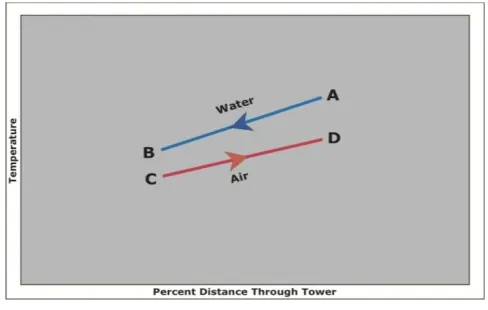
A ton of air-conditioning is the rejection of 12,000 BTUH. A cooling tower ton actually rejects about 15,000 BTUH due to the heat-equivalent of the energy needed to drive the chiller’s compressor. A cooling tower ton is defined as the heat rejection in cooling 3 GPM of water entering at 95°F and leaving the cooling tower at 85°F, with an entering wet bulb temperature of 78°F, which amounts to 15,000 BTUH.The figure below shows the relationship between water and air as they pass through a cooling tower. The curve indicates the drop in water temperature (point A to B) and the rise in the air wet bulb temperature (Point C to D) in their respective passages through the cooling tower.
Fig No. 3 Percent distance Through Tower
From a heat transfer standpoint, a cooling tower’s performance while cooling a given quantity of water is influenced only by the wet bulb temperature of the entering air. This is clearly indicated in the psychrometric analysis of the air path in a cooling tower as indicated below. The true path is approximated by the dotted curved line from Point A to Point C. To simplify the air path for purposes of explanation, it is broken down into Line AB and BC. In the analysis, air enters the tower at an unsaturated condition (Point A). Before reaching the fill, it is saturated adiabatically as it travels to point B. Passing through the fill, it absorbs heat from the falling water, thereby increasing the total heat content of the air. Since the air is continually being washed with falling water, the process follows the saturation line to the final temperature of the air leaving the tower, Point C.
During the adiabatic change, Point A to Point B, there is no cooling of the water. In this stage there is only a conversion of air sensible heat into latent heat as the air dry bulb temperature drops to that of the wet bulb temperature. The effective heat removal takes place between Points B and C where the saturated air is at the wet bulb temperature. The wet bulb temperature of the air is the only air condition influencing the performance of the tower.
An evaporative cooler is basically a large fan that draws warm air through water-moistened pads. As the water in the pads evaporates, the air is chilled and pushed out to the room. The temperature can be controlled by adjusting the airflow of the cooler. Evaporative coolers are rated by the volume of warm/cool air that can be exchanged in one minute (CFM) and by the amount of energy they require to run. EC works best in dry climates; the lower the relative humidity, the easier it is for moisture to evaporate from the pads.
812
Copyright © 2011-15. Vandana Publications. All Rights Reserved.
hazardous to the environment. Installation costs aresignificantly lower, electricity usage is significantly lower and the units themselves are simpler to maintain and operate.
3.2 Evaporative cooler designs:
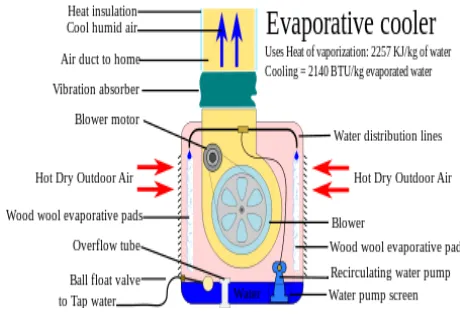
Fig No. 3.2 Evaporative cooler illustration
Most designs take advantage of the fact that water has one of the highest know (latent heat of vaporization) values of any common substance. Because of this, evaporative coolers use only a fraction of the energy of vapor-compression or absorption air conditioning systems. Unfortunately, except in very dry climates, the single-stage (direct) cooler can increase uncomfortable. Indirect and Two-stage evaporative coolers keep the RH lower.
3.2.1 Direct evaporative cooling (open circuit) :
Direct evaporative cooling is used to lower the temperature of air by using latent heat of evaporation, changing liquid water to water vapor. In this process, the energy in the air does not change. Warm dry air is changed to cool moist air. The heat of the outside air is used to evaporate water. The RH increases to 70 to 90% which reduces the cooling effect of human perspiration. The moist air has to be continually released to outside or else the air becomes saturated and evaporation stops.
3.2.2 Indirect evaporative cooling (closed circuit):
Indirect evaporative cooling is similar to direct evaporative cooling but uses some type of The cooled moist air never comes in direct contact with the conditioned air. The moist air stream is released outside or used to cool other external devices such as solar cells which are more efficient if kept cool. One indirect cooler manufacturer uses the so-called Maisotsenko cycle which employs an iterative (multi-step) heat exchanger that can reduce the temperature to below the wet-bulb temperature. While no moisture is added to the incoming air the relative humidity (RH) does rise a little according to the Temperature-RH formula. Conditioned air without added
moisture increases the evaporation of perspiration improving the cooling effect of Indirect compared to Direct.
3.2.3 Two-stage evaporative cooling, or indirect-direct:
In the first stage of a two-stage cooler, warm air is pre-cooled indirectly without adding humidity (by passing inside a heat exchanger that is cooled by evaporation on the outside). In the direct stage, the pre-cooled air passes through a water-soaked pad and picks up humidity as it cools. Since the air supply is pre-cooled in the first stage, less humidity is transferred in the direct stage, to reach the desired cooling temperatures. The result, according to manufacturers, is cooler air with a RH between 50-70%, depending on the climate, compared to a traditional system that produces about 70–80% relative humidity in the conditioned air.
3.2.4 Hybrid:
Direct or Indirect cooling has been combined with vapor-compression or absorption air conditioning to increase the overall efficiency and /or to reduce the temperature below the wet-bulb limit.
3.2.5 Materials:
Traditionally, evaporative cooler pads consist of more modern materials, such as some plastics and Wood absorbs some of the water and has a larger surface area which allows the wood fibers to cool passing air to a lower temperature than some synthetic materials, but natural fibers also can pose a problem with harboring or supporting mildew growth.
Typically, residential and industrial evaporative coolers use direct evaporation, and can be described as an enclosed metal or plastic box with vented sides. Air is moved by a centrifugal
3.2.6 Typical installations:
an electric motor with pulleys known as "sheaves" in water pump is used to wet the evaporative cooling pads. The cooling units can be mounted on the roof or exterior walls or windows (side draft, or horizontal flow) of buildings. To cool, the fan draws ambient air through vents on the unit's sides and through the damp pads. Heat in the air evaporates water from the pads which are constantly re-dampened to continue the cooling process. Then cooled, moist air is delivered into the building via a vent in the roof or wall.
813
Copyright © 2011-15. Vandana Publications. All Rights Reserved.
Large3.2.7 Evaporative (wet) cooling towers:
structural steel for a power plant in Kharkov Cooling towers are structures for cooling water or other heat transfer media to near-ambient wet-bulb temperature. Wet cooling towers operate on the evaporative cooling principle, but are optimized to cool the water rather than the air. Cooling towers can often be found on large buildings or on industrial sites. They transfer heat to the environment from chillers, industrial processes, or the
IV.
DESIGN OF II STAGE
EVAPORATIVE COOLING SYSTEM
4.1.1 Comfort Cooling:
Human comfort depends on a variety of factors ranging from temperature, humidity and air movement to clothing and culture. What is comfortable for one person in one society may be entirely uncomfortable for another. Someone who has long lived without refrigerated air conditioning may find an artificially air-conditioned environment uncomfortable, whereas people who take refrigerated air conditioning for granted in their homes and workplaces may avoid being outside during hot weather all together.”
4.1.2 Residential:
Residential applications of evaporative cooling are common throughout the hot and dry areas in the southwest. Residential EAC's are typically smaller than commercial units but the basic components of a supply fan, water sump, sump pump, water distribution header and both pad and rigid wetted media are very similar. Many residences use direct evaporative coolers, but the addition of indirect coolers are becoming more accepted by users who want lower discharge temperatures and more available cooling hours.
4.1.3 Evaporative Air Cooling:
EAC energy use is like turning on a light bulb. The electric components of an EAC consist of a supply fan motor (1/3 to 50 horsepower, depending on the air flow rate), a small (usually fractional horsepower) sump pump and a low-voltage control thermostat. When an EAC system is energized, there is no variability to the amount of electricity use. The exception to this is when a two speed or variable speed fan motor is used on the supply fan. When trying to understand evaporative cooling, it may help to think of air as a type of sponge. Like a sponge, as air comes into contact with water, it absorbs it. The amount of water absorbed depends largely on how much water is already in the air. After all, how easily you clean up a spill depends on how dry a sponge you are using. The term ‘humidity’ describes the level of water in the air. If the air holds 20% of its capacity, the humidity would be 20%. A humidity of 100% indicates that the air is holding all the moisture it can.
The lower the humidity, the more water the air can hold, and the greater amount of evaporation that can take place. When describing the amount of moisture in the air, the term relative humidity is used because the sponginess of air changes relative to air temperature. The warmer the air, the spongier it becomes and the more water it can hold. As a result, we must describe the level of humidity relative to the type of sponge we are referring. Is it a 50° F sponge or an 80° F sponge? An 80°F sponge will hold more water than a 50°F sponge at 50% humidity.
4.3 Design Calculations:
Evaporative Air Cooling capacity can be sized using different methods. The most common method used by engineers is a building heat balance using manual calculations or a computer program. Summing the heat gains from solar, lights, computers and other office equipment, people and the heat gain from the building envelope will give a heat extraction rate which can be used to size the cooling equipment.
HEAT REMOVED BY EAC = SOLAR HEAT + HEAT FROM EQUIPMENT & PEOPLE
The other side of the heat balance equation depends on which type of evaporative media is used. Rigid media is more effective than aspen media, so the discharge temperature will be cooler. This means that less airflow is required to remove the same amount of heat from the building.
4.3.1 Wet-bulb Depression:
EAC's are sized based on the wet-bulb temperature. Most people are familiar with a fluid filled thermometer with a bulb on the bottom. This thermometer will measure the "dry-bulb" (or sensible) temperature. Now if we were to put a small fabric sock over the bulb on the bottom, and then wet the sock and move air past it, the evaporative effect will cool the sock and the bulb and decrease the temperature reading on the thermometer column. The value that is read from the column would now represent the "wet-bulb" (or latent) temperature.
814
Copyright © 2011-15. Vandana Publications. All Rights Reserved.
Equation 1: Saturation Effectiveness (“Efficiency”)(T1 - T2) SE = 100 X _____________
(T1 - T3) Where:
SE = Saturation Effectiveness (per cent) T1 = Dry—Bulb Temperature of Entering Air T2 = Dry—Bulb Temperature of Leaving Air
T3 = Wet—Bulb Temperature of Entering Air (usually the mean coincident wet bulb-MCWB)
Equation 2: Evaporative Cooler Supply Air Temperature
T2 = T1 - (SE X (T2 – T3))
The Inputs we receive before starting of the project are Location and Application of building.
Calculation of CFM required for the Evaporative Cooling System
Volume x No. of Air Changes/hr CFM = --- 60
As per the drawing we need to calculate the CFM requirement in each room.
Ground Floor Bedroom:
The Dimensions of the Ground floor Bedroom Length =15’
Widht= 14.87’ Height =10’
As per the application being Bedroom we need to take number of air changes as 25
(15X14.87X10) x 25
CFM = --- =2230cfm. 60
Ground Floor Dining:
The Dimensions of the Ground floor Dining Length =15.25’
Widht= 11’ Height =10’
As per the application being function hall we need to take number of air changes as 25
(15.25X11X10) x 25
CFM = --- = 669cfm. 60
Ground Floor Hall:
The Dimensions of the Ground floor Hall Length =16’
Widht= 14.25’ Height =10’
As per the application being Hall we need to take number of air changes as 25
(16X14.25X10) x 25
CFM = --- =950cfm. 60
Ground Floor Drawing Hall:
The Dimensions of the Ground floor Drawing Hall Length =14.25’
Widht= 11.26’ Height =10’
As per the application being drawing hall we need to take number of air changes as 25
(14.25X11.26X10) x 25 CFM = --- = 663cfm. 60
Ground Floor Kitchen:
The Dimensions of the Ground floor Kitchen Length =10.79’
Widht= 9 Height =10’
As per the application being Kitchen we need to take number of air changes as 30
(14.25X11.26X10) x 30 CFM = --- =556cfm. 60
First Floor Bedroom:
The Dimensions of the first floor Drawing Hall Length =14.25’
Widht= 11.26’ Height =10’
As per the application being bedroom we need to take number of air changes as 25
(14.25X11.26X10) x 25 CFM = --- =929cfm. 60
First Floor Bedroom:
The Dimensions of the first floor Drawing Hall Length =14.85’
Widht= 11’ Height =10’
As per the application being bedroom we need to take number of air changes as 25
(14.85X11X10) x 25
CFM = --- =682cfm. 60
First Floor Hall:
The Dimensions of the first floor Drawing Hall Length =14.25’
Widht= 9’ Height =10’
As per the application being hall we need to take number of air changes as 25
(14.25X9X10) x 25
CFM = --- =534cfm. 60
First Floor Home Theater:
The Dimensions of the Home Theater Length =20.25’
Widht= 10.79’ Height =10’
815
Copyright © 2011-15. Vandana Publications. All Rights Reserved.
(14.25X11.26X10) x 25CFM = --- =910cfm. 60
As the area of the Residential buildings 1610 sq.ft and volume comes to 16100 cu.ft and total CFM comes to 6863 nearly 7000cfm. The machine which we select should delivery 7000cfm as the efficiency of II Stage Evaporative cooling is generally 115%.
4.3.2 Basics of Design requirements of the Machine:
Area to condition: 1. The manufacturing area consists of machines with a heat load/motor loadof KW. The no of people working will be
V. CONCLUSIONS
Evaporative cooling can be advantage for residential application. The air inside the home is never recirculated - meaning the freshest, healthiest air possible, without spreading allergens. It is one of the healthiest and safest ways to cool your auditorium, as it uses clean, fresh air to replace the old air in the residence many times an hour. The cool air experiences of occupants will never be dry or warm, meaning that you will never have to deal with irritated or sore eyes, throat or skin. Evaporative cooling is an inexpensive cooling option - being up to 50% cheaper to install and up to seven times cheaper than refrigerated cooling in operation. It is friendly to our environment, as it uses less electricity and has a lower greenhouse gas contribution. In this paper calculation for the requirement for an Evaporative Cooling Machine sizing and Duct sizing has been performed. The calculation has resulted in 7000cfm, the proposed size of the Machine capacity would be 7000cfm.
REFERENCES
[1] Managing energy efficiency in hotel and commercial building. Ten publications. 2000 Edition.65
[2] S.M patil, building services (Electro mechanical and building services)
[3] Bhaduri, A., "Use of PCM materials in HVAC Installations", Air Conditioning and Refrigeration Journal, Mumbai, 2001 July-September.
[4] Jianyi Zhang, Eckhard, A Groll., "Saving Energy in Refrigerated Warehouse using PCM ethylene , Air Conditioning and Refrigeration Journal, China, April-June 2001.
[5] Nimial, C. Gupta., "Air-Cooled Chillers: Myths & Facts", Air
Conditioning and Refrigeration Journal, New Delhi, October-December 2003.
[6] Gupta, P., "Impact of Cooling Tower Blade Modification on EnergyConsumption", A Conditioning and Refrigeration Journal, New Delhi, October-December 2001.
[7] Stulz Gmb,H., "Precision or Comfort Air Conditioning", Air
Conditioning and Refrigeration Journal, Germany, January-March 2002.