Completion Time in a Metagraph with Fuzzy
Duration for Edges
P.Ghasemian Asl
#1, S.S.Hashemin
*2#Department of Industrial Engineering, Ardabil Branch, Islamic Azad University, Ardabil, Iran
*Department of Industrial Engineering, Ardabil Branch, Islamic Azad University, Ardabil, Iran
Abstract— In this paper, it is supposed that a project can be presented as a Metagraph. In real world, activity durations are often indefinite. In the projects, nondeterministic times can be shown as random variables or fuzzy numbers. Here, we have assumed that the activity times are fuzzy numbers with discrete membership functions. In fuzzy Metagraphs, a new algorithm is developed to execute the forward computations. In forward computations, for defining the maximum number among all the fuzzy numbers, one of the ranking methods of fuzzy numbers is used. Finally, by using the forward computations, critical path(critical edges and critical elements) are defined. Also, completion time of Metagraph, is computed as a fuzzy number. Two examples are solved by using the proposed algorithm.
Keywords— Fuzzy Metagraph, Project Completion Time, Critical Path.
I. INTRODUCTION
In the recent years, Metagraphs have been used as a tool to analyze the engineering systems. One of its applications is project planning and control. Management of a model using the Petri network and metagraphs has been illustrated in [1]. The metagraph and its features have been described in [2, 3]. Integration of models has been considered and it has been shown that the model integration has become much easier by applying some of the metagraph’s properties [4].
The application of metagraphs in decision support systems has been shown in [5, 6]. Integrating the constraints in metagraphs has been described in [7].
Metagraphs are used in workflow management [8]. Metagraphs can also be used to model the interactions among workflow tasks and thus provide a comprehensive tool for modelling the various types of information managed by a DSS [9]. Constrained resource allocation in fuzzy metagraphs has been investigated in [10]. Constrained renewable resource allocation in fuzzy metagraph via Min-Slack has been studied in [11].
Completion time of stochastic metagraphs by sampling from edge time and using the conditional Monte-Carlo simulation have been developed in [12]. A new method for allocation of constrained Non-Renewable resource in fuzzy metagraphs has been described in [13].
The application of metagraphs in hierarchical modelling has been expressed in [14]. Metagraphs and some of their applications have been described in [15].
In this paper, the metagraph is considered as a tool for "project planning and control". The deterministic projects have been shown as metagraphs in [16], but in real world, the duration of project’s activities are not deterministic. This uncertainty can be explained by either fuzzy numbers or random variables. Majority of recent researchers have defined the fuzzy characters for the projects, since the fuzzy models are closer to reality and simpler to use [17]. A fuzzy project can be shown as a metagraph with fuzzy characters.
Forward and backward computations and
determination of critical path and critical edges in fuzzy metagraphs have been described in [18] when the activity times are trapezoidal fuzzy numbers.
Ranking the fuzzy numbers is an essential tool in forward computations. Many studies have been conducted to rank the fuzzy numbers. An approximate approach for ranking fuzzy numbers based on left and right dominance is studied in [19]. The process of fuzzy numbers' ranking is considered in [20] in which the new ranking index is proposed not only for measuring the quantities but also incorporate the quantity factor into consideration for the need of general decision-making problems. For comparison of fuzzy subsets with a α-cut dependent index, a method is explained in [21].
In this paper, we intend to obtain the completion time of a project which has been shown with metagraphs. It is assumed that the execution time for each activity is expressed as fuzzy numbers with discrete membership function. To determine the maximum number among the fuzzy numbers, we use the fuzzy number ranking methods. Then critical path, critical activities and elements will be identified.
II. METAGRAPH
In this section, some basic definitions about metagraph cited in [11], are introduced.
A. Metagraph Definition
The finite set of elements of
𝑋 = 𝑥𝑖, 𝑖 = 1,2, … , 𝐼 is called a generating set. A
𝐸 = 𝑒𝑗, 𝑗 = 1,2, … , 𝐽 is a set of edges. In fact, 𝑒𝑗 is an ordered pair as 𝑣𝑗, 𝑤𝑗 that 𝑣𝑗 ⊂ 𝑥 is called the invertex of 𝑒𝑗 and 𝑤𝑗 ⊂ 𝑥 is called the outvertex of
𝑒𝑗.in addition, for each 𝑗 = 1,2, … , 𝐽 there must be
∀𝑗, 𝑉𝑗∩ 𝑊𝑗 = ∅.
To have a clear undrestanding of above mentioned concepts, fig. 1 is described as follows :
Fig. 1 A metagraph
𝐸 = 𝑒1, 𝑒2, 𝑒3
𝑋 = 𝑥1, 𝑥2, … , 𝑥6
𝑒1= 𝑥1 , 𝑥3, 𝑥4
𝑒2= 𝑥2, 𝑥3 , 𝑥5, 𝑥6
𝑒3= 𝑥3, 𝑥4 , 𝑥6
B. Path
An element 𝑥 ∈ 𝑋 is connected to element 𝑥ˊ∈ 𝑋 if a sequence of edges 𝑒𝑘ˊ, 𝑘 = 1, … , 𝐾ˊ exist such that 𝑥 ∈ 𝑉1ˊ , 𝑥ˊ∈ 𝑊𝑘ˊˊ and 𝑊𝑘ˊ∩ 𝑉𝑘+1ˊ ≠ ∅ , ∀ 𝑘 =
1, … , 𝐾ˊ− 1. This sequence of elements is called a simple path from 𝑥 to 𝑥ˊ. 𝐾ˊ is the path length. Sometimes 𝑥 is called Source and 𝑥ˊ is called Target. The set of metagraph paths are shown with 𝑃.
C. Metapath
A metapath is the set of edges that is shown with
𝑀 𝐵, 𝐶 . 𝐵 is the source set and 𝐶 is the target set. 𝐵 is the invertex elements that are not also outvertex elements. 𝐶 is the outvertex elements that are not also invertex elements.
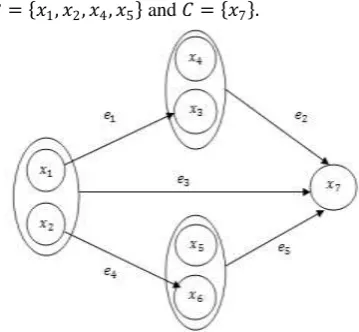
Metagraph in Fig. 2 is a metapath with
𝐵 = 𝑥1, 𝑥2, 𝑥4, 𝑥5 and 𝐶 = 𝑥7 .
III.DEFINITION RELATED TO THE FUZZY SET Reference [22] introduces the operations on fuzzy numbers. Some of them are as follows.
A. Fuzzy Set
If
𝑋 is a set of elements in which each element is shown with 𝑥, then the fuzzy set 𝐴 in 𝑋 will be the set of ordered pairs as follows:
𝐴 = 𝑥, 𝜇𝐴 𝑥 |𝑥𝜖𝑋
𝜇𝐴 𝑥 is the degree of membership or membership function of 𝑋 in 𝐴 .
B. Discrete Fuzzy Set
When the universe of discourse 𝑋 is discrete and finite for a fuzzy set of 𝐴 , it will be shown as the following:
𝐴 = 𝜇𝐴 𝑥𝑖 𝑥𝑖 𝑛
𝑖=1
C. Continuous Fuzzy Set
When the universe 𝑋 is continuous and infinite, the fuzzy set 𝐴 is denoted by:
𝐴 = 𝜇𝐴 𝑥𝑖 𝑥𝑖 D. Bounded Sum
The bounded sum 𝐶 = 𝐴 ⊕ 𝐵 is defined as
𝐶 = 𝑥, 𝜇𝐴 ⊕𝐵 𝑥 | 𝑥 ∈ 𝑋
IV. RANKING FUZZY NUMBERS
It is not always necessary to change the fuzzy numbers to crisp numbers in a fuzzy state of decision making. We can rank the fuzzy sets instead and then make a decision. So the selected method is described in [19].
For a fuzzy number 𝐴, the 𝛼 − 𝐶𝑢𝑡𝑠 (level sets) 𝐴𝛼 = 𝑥 ∈ ℛ 𝜇𝐴 𝑥 ≥ 𝛼 , 𝛼 ∈ 0,1 , are the convex set of ℛ . The lower and upper limits of the
𝐾𝑡ℎ 𝛼 − 𝑐𝑢𝑡 for the fuzzy number of 𝐴 𝑖 are defined as :
𝑙𝑖,𝑘= 𝑖𝑛𝑓 𝑥 𝜇𝐴 𝑥 ≥ 𝛼𝑘
𝑟𝑖,𝑘= 𝑠𝑢𝑝 𝑥 𝜇𝐴 𝑥 ≥ 𝛼𝑘
Respectively, where 𝑙𝑖,𝑘 and 𝑟𝑖,𝑘 are left and right spreads. When two fuzzy numbers 𝐴𝑖 and 𝐴𝑗 are compared, the left (right) dominance 𝐷𝑖,𝑗𝑅 𝐷𝑖,𝑗𝐿 of
𝐷𝑖,𝑗𝐿 =
1
𝑛 + 1 𝑙𝑖,𝑘− 𝑙𝑗 ,𝑘
𝑛
𝑘=0
𝐷𝑖,𝑗𝑅 =
1
1 + 𝑛 𝑟𝑖,𝑘− 𝑟𝑗 ,𝑘
𝑛
𝑘=0
When 𝑛 + 1, 𝛼 − 𝐶𝑢𝑡𝑠 are used to calculate the dominance, Let 𝛼𝑘 denote the 𝐾𝑡ℎ 𝛼 − 𝑙𝑒𝑣𝑒𝑙 , and
𝛼𝑘= 𝑘 𝑛 , 𝑘 ∈ 0,1, … , 𝑛 . Therefore, the distance between each to adjacent 𝛼 − 𝑙𝑒𝑣𝑒𝑙𝑠 is equal: 𝛼𝑘− 𝛼𝑘−1= 1 𝑛 , 𝐾 ≥ 1 .
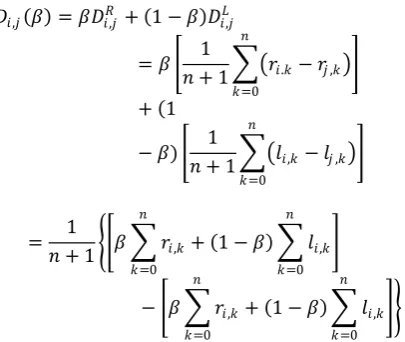
The total dominance of 𝐴𝑖 over 𝐴𝑗 with the index of optimism 𝛽 ∈ [0,1] can be defined as the convex combination of 𝐷𝑖,𝑗𝐿 and 𝐷𝑖,𝑗𝑅 by:
𝐷𝑖,𝑗 𝛽 = 𝛽𝐷𝑖,𝑗𝑅 + 1 − 𝛽 𝐷𝑖,𝑗𝐿
= 𝛽 1
𝑛 + 1 𝑟𝑖.𝑘− 𝑟𝑗 ,𝑘
𝑛
𝑘=0
+ 1 − 𝛽 1
𝑛 + 1 𝑙𝑖,𝑘− 𝑙𝑗 ,𝑘
𝑛
𝑘=0
= 1
𝑛 + 1 𝛽 𝑟𝑖,𝑘
𝑛
𝑘=0
+ 1 − 𝛽 𝑙𝑖,𝑘 𝑛
𝑘=0
− 𝛽 𝑟𝑖,𝑘 𝑛
𝑘=0
+ 1 − 𝛽 𝑙𝑖,𝑘 𝑛
𝑘=0
A decision maker can rank each pair of fuzzy numbers, 𝐴𝑖 and 𝐴𝑗, using 𝐷𝑖,𝑗 𝛽 based on the following rules:
1) If 𝐷𝑖,𝑗 𝛽 > 0 , then 𝐴𝑖 > 𝐴𝑗; 2) If 𝐷𝑖,𝑗 𝛽 = 0 , then 𝐴𝑖 = 𝐴𝑗 ; 3) If 𝐷𝑖,𝑗 𝛽 < 0 , then 𝐴𝑖 < 𝐴𝑗.
This ranking can also be used for the fuzzy numbers with discrete membership function pay attention to the following example:
𝐴 = 4,1 , 5,0.75 , 6,0.5 , 7,0.25 𝐵 = 4,0.5 , 5,1 , 6,0.5
Table 1.The lower and upper limits of 𝑲𝒕𝒉 𝜶 − 𝒄𝒖𝒕 for the fuzzy numbers of 𝑨 and 𝑩
𝛼 0 0.25 0.5 0.75 1
𝐿𝐴,𝐾 4 4 4 4 4
𝑅𝐴,𝐾 7 7 6 5 4
𝐿𝐵,𝐾 4 4 4 5 5
𝑅𝐵,𝐾 6 6 6 5 5
The ranking result:
By substituting the numbers in the final formula, for 𝑛 = 4 , 𝛽 = 0.5, there will be 𝐴 < 𝐵.
For the ease of calculation, a program has been written in MATLAB. To increase the accuracy of fuzzy numbers ranking, we can increase the number of 𝛼 − 𝐶𝑢𝑡𝑠. In order to obtain a more accurate and reliable answer, the written program ranks the set of fuzzy numbers in terms of the number of 𝛼 − 𝐶𝑢𝑡 and number of different 𝛽s.
V. CALCULATION OF CRITICAL PATH IN DETERMINISTIC
METAGRAPH
Suppose that the duration of edges 𝑒𝑗 is deterministic and known. It is shown by 𝑑𝑗. Then, by using the following algorithm [16], completion time of metagraph and its critical path and other specification such as the earliest and latest times of starting and finishing and critical edges can be determined.
A. Phase 1: Forward Computation
For each element 𝑥𝑖 ∈ 𝐵 set 𝑄𝑖 = 0 and mark it.
For other elements, set 𝑄𝑖 = 0 until
𝐸 = 𝑀 𝐵, 𝐶 ≠ ∅ for each edges of 𝑒𝑗 in 𝐸 that (in which) invertex elements are marked, then set :
𝐸𝑆𝑗 = 𝑚𝑎𝑥 𝑄𝑖 , 𝑥𝑖 ∈ 𝑣𝑗
𝐸𝑆𝑗 is the earliest start time of edge 𝑒𝑗.
For each 𝑥𝑘 ∈ 𝑊𝑗 set 𝑄𝑘= 𝑚𝑎𝑥 𝑄𝑘, 𝐸𝑆𝑗 + 𝑑𝑗 and mark it, set 𝐸 ← 𝐸 − 𝑒𝑗 ← 𝐸 = 𝐸 ̸ 𝑒𝑗 then repeat the above steps until 𝐸 = ∅, in this case 𝑇𝑒 is obtained as earliest completion time of the metagraph. Set 𝑇𝑒 = 𝑇𝑙 = 𝑚𝑎𝑥{𝑄𝑖} , ∀ 𝑥𝑖 ∈ 𝑋.
B. Phase 2 : Backward Computation
For each element 𝑥𝑖 ∈ 𝐶 set 𝐿𝑖 = 𝑇𝑙 and mark it. For other elements set 𝐿𝑖 = 𝑇𝑙 until 𝐸0= 𝑀 𝐵, 𝐶 ≠ ∅ for each edge 𝑒𝑗 in 𝐸0, if all the elements in outvertex are marked. Set 𝐿𝐹𝑗 = 𝑀𝑖𝑛 𝐿𝑖 , 𝑥𝑖 ∈ 𝑊𝑗. For each 𝑥𝑘 ∈ 𝑉𝑗 put 𝐿𝑘= 𝑚𝑖𝑛 𝐿𝑘, 𝐿𝐹𝑗 − 𝑑𝑗 and mark it. Set 𝐸0← 𝐸0− 𝑒𝑗 ← 𝐸0= 𝐸0 ̸ 𝑒𝑗 and repeat the above steps. Then, we will have the ordered pair of 𝑄𝑖, 𝐿𝑖 for each element after execution of the algorithm.
VI. THE PROPOSED ALGORITHM FOR FUZZY METAGRAPH
𝑑𝑗 = 𝑥𝑖, 𝜇𝑑 𝑗 𝑥𝑖 𝑥𝑖𝜖𝑋 𝑛
𝑖=0
Here the symbol ∑ means the discrete fuzzy set nit the sum of symbols. Then phase 1 and 2 calculations of the critical paths will be as follows:
A. The Algorithm of Forward Path
Step1: Based on data received from the real worlds, we assume that the completion time of activities are fuzzy numbers with discrete membership function.
Step 2: For each element of 𝑥𝑖 ∈ 𝐵 set 𝑄 𝑖 =
0,0 and mark it.
Step 3: For other elements set 𝑄 i= 0,0 until
𝐸 = 𝑀 𝐵, 𝐶 ≠ ∅.
Step 4: Set 𝐸𝑆𝑗 = 𝑚𝑎𝑥 𝑄 𝑖 , 𝑥𝑖 ∈ 𝑣𝑗 and obtain the earliest start time for edge 𝑒𝑗 using the fuzzy number ranking.
Step 5: For each 𝑥𝑘 ∈ 𝑤𝑗 set
𝑄 𝑘 = 𝑚𝑎𝑥 𝑄 𝑘, 𝐸𝑆𝑗+ 𝑑𝑗 and obtain 𝑄𝑘 using the ranking method and mark it.
Step 6: Put 𝐸 ← 𝐸 − 𝑒𝑗 and then repeat the above steps until 𝐸 = ∅. In this case 𝑇 𝑒 is obtained as the earliest completion time of the metagraph.
In order to calculate the backward path, we have to set 𝑇𝑒 = 𝑇𝑙 , then we should calculate the backward path based on the appropriate fuzzy subtraction and computation of minimum values in order to identify the critical path and critical activities of the project.
An algorithm is proposed to determine the critical path and critical activities considering the forward path.
B. Algorithm to Identify the Critical Path
Step 1: For each element 𝑄𝑖 ∈ 𝐶 set 𝑄𝑖 = 𝑇𝑙. Step 2: If 𝐸𝑆𝑘+ 𝑑𝑘 = 𝑚𝑎𝑥 𝑄𝑛, 𝐸𝑆𝑗 + 𝑑𝑗 , 𝑛 is belong to target and 𝑗 is index of edges that elements 𝑄𝑛 are at their outvertex, then 𝑒𝑘 is on the critical path.
Step 3: If 𝐸𝑆𝑘 = 𝑚𝑎𝑥 𝑄𝑖 = 𝑄𝑘ˊ, 𝑖 is index of elements which are located in outvertex 𝑒𝑘, then the
𝑘ˊ
Step 4: If the element 𝑘ˊ is located in the initial invertex of the metagraph, w have to stop, because
𝐸𝑆𝑘= 𝑚𝑎𝑥 𝑄𝑖 , otherwise
𝐶 = {𝑄𝑖|𝑄𝑖 𝜖 𝑜𝑢𝑡𝑣𝑒𝑟𝑡𝑒𝑥 𝑒𝑘} then go to step 2. VII. EXAMPLE
A. Example 1
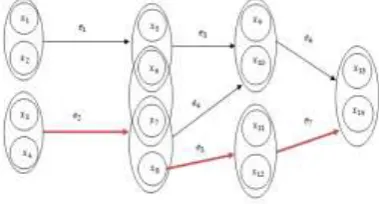
Consider the metagraph of Fig. 3. The duration of each edge is shown in table 2.
Fig. 3 Metagraph of example 1
Table 2. Edge times of example 1
𝑒1 1,0.2 , 2,0.5 , 3,0.6
𝑒2 1,0.5 , 2,0.8 , 3,1
𝑒3 1,0.7 , 2,1 , 3,0.5 , 4,0.4 𝑒4 1,0.3 , 2,1 , 3,0.5 , 4,0.7 𝑒5 1,1 , 2,0.6 , 3,0.4 , 4,0.2
𝑒6 1,0.8 , 2,1 , 3,0.3
𝑒7 1,0.5 , 2,0.7 , 3,0.8 , 4,1
By using the algorithm, the completion time of the project is: 1,1 , 2,1 , 3,1 , 4,1
The critical path is 𝑒2− 𝑒5− 𝑒7 and the critical elements are 𝑥3, 𝑥4, 𝑥7, 𝑥8, 𝑥11, 𝑥12, 𝑥13, 𝑥14.
The ranking of paths is shown in table 3.
Table 3. The paths ranking for example 1
1 𝑒1+ 𝑒3+ 𝑒6 1,1 , 2,1 , 3,1 , 4,0.4
2 𝑒2+ 𝑒4+ 𝑒6 1,1 , 2,1 , 3,1 , 4,0.7
3 𝑒2+ 𝑒5+ 𝑒7 1,1 , 2,1 , 3,1 , 4,1
Path 3 > path 2 > path 1.
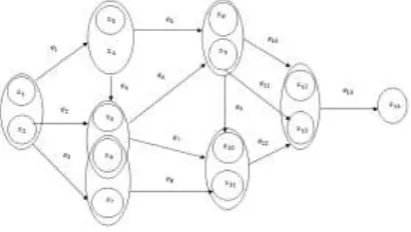
Consider the metagraph of Fig. 4. The duration of each edge is shown in table 4.
Fig. 4. Metagraph of example 2
Table 4. Edges times of example 2
𝑒1 1,0.5 , 2,0.3 , 3,0.8
𝑒2 1,0.2 , 2,0.8 , 3,1
𝑒3 1,0.3 , 2,0.5 , 3,0.7 , 4,1 𝑒4 1,0.2 , 2,0.3 , 3,0.4 𝑒5 1,0.8 , 2,1 , 3,0.5 , 4,0.1 𝑒6 1,0.4 , 2,0.6 , 3,0.8
𝑒7 2,0.5 , 3,0.7 , 4,1
𝑒8 1,0.5 , 2,0.3 , 4,0.7 𝑒9 1,0.3 , 2,0.5 , 3,0.8 , 4,0.1 𝑒10 1,0.2 , 2,0.5 , 3,0.3 , 4,0.2 𝑒11 1,0.8 , 2,0.3 , 3,0.1
𝑒12 1,0.5 , 2,0.8 , 3,1
𝑒13 1,0.7 , 2,0.5 , 3,0.4 , 4,0.3
By using the algorithm, the completion time of the project is: 1,1 , 2,1 , 3,1 , 4,1 .
The critical path is 𝑒3− 𝑒7− 𝑒12− 𝑒13 and the critical elements are 𝑥14, 𝑥13, 𝑥12, 𝑥11, 𝑥10, 𝑥6, 𝑥2, 𝑥1 . The ranking of paths is shown in table 5.
Table 5. The paths ranking for example 2
𝟏 𝒆𝟏+ 𝒆𝟓+ 𝒆𝟏𝟎+ 𝒆𝟏𝟑 𝟏, 𝟏 , 𝟐, 𝟏 , 𝟑, 𝟏 , 𝟒, 𝟎. 𝟔
𝟐 𝒆𝟏+ 𝒆𝟓+ 𝒆𝟗+ 𝒆𝟏𝟐
+ 𝒆𝟏𝟑
𝟏, 𝟏 , 𝟐, 𝟏 , 𝟑, 𝟏 , 𝟒, 𝟎. 𝟓
𝟑 𝒆𝟏+ 𝒆𝟓+ 𝒆𝟏𝟏+ 𝒆𝟏𝟑 𝟏, 𝟏 , 𝟐, 𝟏 , 𝟑, 𝟏 , 𝟒, 𝟎. 𝟒
𝟒 𝒆𝟏+ 𝒆𝟒+ 𝒆𝟔+ 𝒆𝟗
+ 𝒆𝟏𝟐+ 𝒆𝟏𝟑
𝟏, 𝟏 , 𝟐, 𝟏 , 𝟑, 𝟏 , 𝟒, 𝟎. 𝟒
𝟓 𝒆𝟏+ 𝒆𝟒+ 𝒆𝟔+ 𝒆𝟏𝟏
+ 𝒆𝟏𝟑
𝟏, 𝟏 , 𝟐, 𝟏 , 𝟑, 𝟏 , 𝟒, 𝟎. 𝟑
𝟔 𝒆𝟏+ 𝒆𝟒+ 𝒆𝟕+ 𝒆𝟏𝟐
+ 𝒆𝟏𝟑
𝟏, 𝟏 , 𝟐, 𝟏 , 𝟑, 𝟏 , 𝟒, 𝟏
𝟕 𝒆𝟏+ 𝒆𝟒+ 𝒆𝟖+ 𝒆𝟏𝟐
+ 𝒆𝟏𝟑
𝟏, 𝟏 , 𝟐, 𝟏 , 𝟑, 𝟏 , 𝟒, 𝟏
𝟖 𝒆𝟐+ 𝒆𝟔+ 𝒆𝟏𝟎+ 𝒆𝟏𝟑 𝟏, 𝟏 , 𝟐, 𝟏 , 𝟑, 𝟏 , 𝟒, 𝟎. 𝟓
𝟗 𝒆𝟐+ 𝒆𝟔+ 𝒆𝟏𝟏+ 𝒆𝟏𝟑 𝟏, 𝟏 , 𝟐, 𝟏 , 𝟑, 𝟏 , 𝟒, 𝟎. 𝟑
𝟏𝟎 𝒆𝟐+ 𝒆𝟔+ 𝒆𝟗+ 𝒆𝟏𝟐
+ 𝒆𝟏𝟑
𝟏, 𝟏 , 𝟐, 𝟏 , 𝟑, 𝟏 , 𝟒, 𝟎. 𝟒
𝟏𝟏 𝒆𝟐+ 𝒆𝟕+ 𝒆𝟏𝟐+ 𝒆𝟏𝟑 𝟏, 𝟏 , 𝟐, 𝟏 , 𝟑, 𝟏 , 𝟒, 𝟏
𝟏𝟐 𝒆𝟑+ 𝒆𝟕+ 𝒆𝟏𝟐+ 𝒆𝟏𝟑 𝟏, 𝟏 , 𝟐, 𝟏 , 𝟑, 𝟏 , 𝟒, 𝟏
𝟏𝟑 𝒆𝟑+ 𝒆𝟖+ 𝒆𝟏𝟐+ 𝒆𝟏𝟑 𝟏, 𝟏 , 𝟐, 𝟏 , 𝟑, 𝟏 , 𝟒, 𝟏
Ranking of the paths:
Path 13 = Path 12 = Path 11 = Path 7 = Path 6 > Path 1 > Path 8 = Path 2 > Path 3 = Path 4 = Path 10 > Path 9 = Path 5.
VIII. CONCLUTION
different natures. Whenever it is necessary to determine the maximum fuzzy number among several fuzzy numbers in performing the forward calculations, we have used the 𝐶ℎ𝑒𝑛 − 𝐿𝑢 ranking method. For the ease of implementation, a computer
program has been developed using 𝑀𝐴𝑇𝐿𝐴𝐵
software. The development of this computer program helps us to increase the number of applied cuts in fuzzy number ranking and do the ranking with a higher accuracy.
REFERENCES
[1] Basu, A., & Blanning, R. W. (1992, December). Metagraphs and Petri nets in model management. In Proc. Workshop Inform. Tech. Systems (Vol. 64, p. 73).
[2] Basu, A., & Blanning, R. W. (1994, January). Cycles in metagraphs. In HICSS (3) (pp. 310-319).
[3] Basu, A., & Blanning, R. W. (1995). Metagraphs. Omega, 23(1), 13-25.
[4] Basu, A., & Blanning, R. W. (1994). Model integration using metagraphs. Information Systems Research, 5(3), 195-218.
[5] Basu, A., & Blanning, R. W. (1994). Metagraphs: A tool for modeling decision support systems. Management Science, 40(12), 1579-1600.
[6] Basu, A., & Blanning, R. W. (1996, January). A metagraph-based DSS analysis workbench. In System Sciences, 1996., Proceedings of the Twenty-Ninth Hawaii International Conference on, (Vol. 2, pp. 386-395). IEEE.
[7] Basu, A., & Blanning, R. W. (1995, January). Discovering implicit integrity constraints in rule bases using metagraphs. In System Sciences, 1995. Proceedings of the Twenty-Eighth Hawaii International Conference on (Vol. 3, pp. 321-329). IEEE.
[8] Basu, A., & Blanning, R. (1997, January). Metagraph transformations and workflow analysis. In System Sciences, 1997, Proceedings of the Thirtieth Hawaii International Conference on (Vol. 4, pp. 359-366). IEEE.
[9] Basu, A., & Blanning, R. W. (1999). Metagraphs in workflow support systems. Decision Support Systems, 25(3), 199-208.
[10] Hashemin, S.S.(2010). constrained resource allocation in
fuzzy metagraph. 10 th Iranian Conference on Fuzzy Systems,
Shahid Beheshti University, 13-15.
[11] Hashemin, S. S. (2011). Constrained Renewable Resource Allocation in Fuzzy Metagraphs via Min-Slack. International Journal of Applied Operational Research Vol. 1, No. 1, pp. 7-17.
[12] Hashemin, S.S.( May 26-29,2011). Completion Time of Stochastic Metagraphs by Sampling from Edge Time and using the Conditional Monte-Carlo Simulation, 12𝑡ℎ International Symposiumon Econometrics, Operations Research and statistics, Pamukkle Univercity, Denizli, Turkey.
[13] Vahedi, H.,Hashemin, S. S. (2015, May to June). A New Method for Allocation of Constrained Non-Renewable Resource
in Fuzzy Metagraphs. International Journal of Industrial Engineering.2(3), 14-19.
[14] Basu, A., Blanning, R. W. and Shtub, A.,(1997) Metagraphs in Hierarchical Modeling, Management Science, 43(5), 623-639.
[15] Basu, A., and Blanning, R. W., "Metagraph and Their Application", Springer US, Integrated Series in Information Systems, 2007.
[16] Basu, A., and Blanning, R. W., Workflow Analysis Using Attributed Metagraphs, Proceedings of the 34 th Hawaii International Conference on System Science, 2001.
[17] Lootsma, F. A. (1989). Stochastic and fuzzy PERT. European Journal of perational Research, 43(2), 174-183.
[18] Hashemin, S. S., Computing of the Completion Time for
Fuzzy Metagraphs,2nd Joint Congress on Fuzzy and Intelligent
Systems, Iran, Tehran, 2008.
[19] Chen, L. H., & Lu, H. W. (2001). An approximate approach
for ranking fuzzy numbers based on left and right dominance.
Computers & Mathematics with Applications, 41(12), 1589-1602.
[20] Chen, L. H., & Lu, H. W. (2002). The preference order of
fuzzy numbers. Computers & Mathematics with Applications,
44(10), 1455-1465.
[21] Mabuchi, S. (1988). An approach to the comparison of fuzzy subsets with an α-cut dependent index. IEEE Transactions on
Systems, Man, and Cybernetics, 18(2), 264-272.