28
Copyright © 2018. IJEMR. All Rights Reserved.
Volume-8, Issue-3, June 2018
International Journal of Engineering and Management Research
Page Number: 28-36
DOI:
doi.org/10.31033/ijemr.8.3.3
Online Shopping - Its Growth and Status in India
Dr. Renati Jayaprakash Reddy1 and Dr. Rojarani2
1Professor & Head, Department of Management Studies, AIMS Institute of Higher Education, Bangalore, INDIA 2Principal, KC Reddy PG College, Guntur, INDIA
1
Corresponding Author: [email protected]
ABSTRACT
Online shopping is common now a day. Both traditional and online shopping are happening side by side. However, online shopping is getting more and more popularity year after year. In this context, this conceptual and secondary data-based paper aims at understanding growth and status of online shopping in the world and in particular to India. The growth, and participating companies and future of online shopping were studied along with their problems based on the data collected from various secondary sources.
Keywords-- E-commerce, M-Commerce, Internet, Online Shopping
I.
INTRODUCTION
Online shopping
Online shopping is a method of purchasing goods or services from the seller by using a web browser. Online shopping is a form of e-commerce. Online shopping, e-shopping, web shopping, virtual store shopping are the words commonly used for this purpose.
Online shopping has been gaining a lot of popularity as everything available at our door steps, which saves lot of time and energy. It also helps to avoid a lot of inconvenience involved in travelling to a conventional store or visiting busy markets. People can easily shop from their homes or offices; all they need is an Internet connection. Besides, online shops could be reached at any time, as they work 24 hours.
II.
OBJECTIVE
The main objective of the paper is to understand the growth, status and problems of online shopping in the world with special reference to India.
III.
METHODOLOGY
This conceptual research paper is prepared based on the secondary data collected from different web sources to understand the growth and status of online shopping in India.
IV.
HISTORY OF ONLINE SHOPPING
The year 1991 noted a new chapter in the history of the online world where e-commerce became a hot choice among the commercial users. At that time nobody would have even thought of that the buying and selling online or online trading will become a trend in the world and India also share a good proportion of this success.
Michael Aldrich1 invented online shopping in the year 1979. In 1980, Redifon‟s Office revolution launched by him, which enabled the distributors, suppliers, consumers, customers and agents to connect with the corporate system over the Internet and carry on transactions electronically (Michael Aldrich, 2011)2.
V.
MOBILE COMMERCE
(M-COMMERCE)
The latest trend in e-commerce is that it focuses on mobile based shopping. As prices of smart phones are coming down, online shopping increased via mobiles. Because of this, the larger e-commerce firms have started focusing on mobile commerce. Snapdeal used to get half of its traffic from mobiles a year back; similarly, Flipkart is getting 40% of its traffic from mobiles. It is
1Michael Akdrich., (2012). “The History of Online
Shopping –From the 1960s to the 1990s”, March 16th, Editorial Team.
2Michael Aldrich., (2011). “Online Shopping in 1980s”,
29
Copyright © 2018. IJEMR. All Rights Reserved.
speculated that the next wave of digital consumer will come through the mobile devices only.
VI.
PRICE COMPARISON ENGINE
In the race of getting customers, e-commerce sites offer deep discounts and these discounts vary from site to site depending on their capacity to negotiate with the suppliers. To get the best discounts, customers need to search a plethora of sites. For the convenience of customers, sites like mysmartprice.com, pricedekho.com, freekamal.com and junglee.com, came into existence to compare prices from one site to the other. These websites compare the prices over the entire web and provides users with the best available prices. E-commerce sales through websites are increasing year after year and this trend seems to be continued for a longer period.
VII.
ONLINE SHOPPING WORLD
WIDE
The most well-known form of e-commerce is business to consumer (B2C) relation. It is also known as online retail or online shopping. It refers to online purchases from bricks-and-mortar retailers (such as Wal-Mart) to “pure-click” online retailing corporations such as Amazon.com. It is a growing business around the globe and all the countries are involved in this with some variations. As per 2015 information, China stands first having more number of Internet users and online shoppers. Other countries where online shopping is thriving are Germany, India, Brazil and United Kingdom. In 2013, online business reached to 839.8 billion U.S. dollars and the projections show a growth of up to 1.5 trillion U.S. dollars by 2018. Online shopping sales in southern region were 126 billion U.S. dollars in 2013 which was more than double when compared to 2008 sales.
The Asia and Oceania region are also becoming a strong contender, especially due to China‟s economic boom, with an estimated eight-fold increase in sales between 2008 and 2013.
The unprecedented worldwide B2C is however expected to slightly slowdown in the near future. In 2013, global B2C e-commerce sales grew 19 percent compared to the earlier year, but in 2018 forecast expect growth of only 10 percent in Europe. This is the largest market for B2C e-commerce, with a turnover of 107 billion Euros in 2013.
In recent years, mobile shopping has been on the rise, with customers increasingly using their mobile devices for various online shopping activities. According to the survey of statista.com, on “Mobile shopping penetration worldwide as of March 2016”, it was found 46 percent of Internet users in the Asia-Pacific region and 20 percent of those in North America had purchased products via mobile device including tablet computer.
A similar dynamic is playing across Asia. In South Korea, 37% of Internet users made mobile purchases. The rate of mobile adoption was nearly double the rate in the US. Internet users in India, Indonesia, Vietnam, Malaysia, Thailand and Japan were all more likely than those in the US to rely on mobile purchasing.
A report on “Global online consumer behaviour” underscores that the m-commerce plays a significant role in the Asia-Pacific region. The study of over 152,000 Internet users in 31 markets conducted by Global Web Index found that 55% of Internet users in China, made purchases through the mobile phone (Jason Mander, 2015)3. In 2012, China reached the world‟s highest mobile-purchase penetration rate (Sthash. IOaiy, 2012)4.
E-Marketer in 2012 estimated that 270.9 million Internet users in China will make online purchases in year 2016 through mobile devices. It also projects that the number may rise to 423.4 million, and mobile will clearly play a significant role in that transition. (Sthash, IOaiy, 2012)5.
„Mobile phones will become the main tool for purchasing goods in the future‟ (Zitkart, 2015)6.
Opinions however, offered according to region and country, where shoppers Denmark and Belgium rather disagreed, while those in China and India agreed.
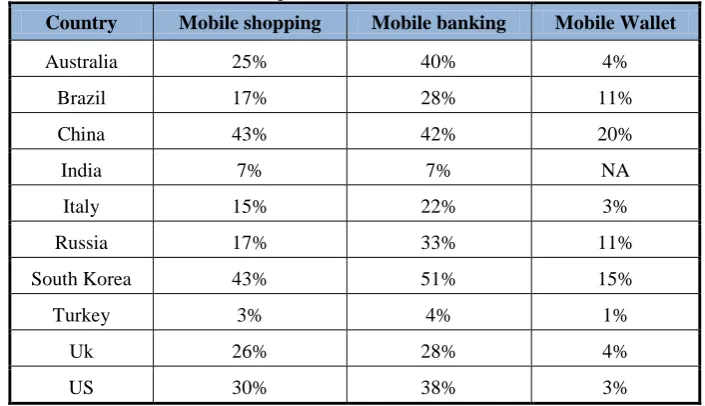
This demonstrates quite clearly that there is increase in usage of mobile phones. With the changes of technology and the development of smart phone features, people are adopting the new technologies and turn to use for their convenience. Undoubtedly mobile users are growing more and more in all the countries. The table below depicts that the mobile users do their activities through their smart phones in select countries7.
3Jason Mander., (2015). “GWI Social Summary”, GlobalWebIndex’s Quarterly report, Latest Trends in Social Networking and eMarketer, March 20, 2015,
“China, South Korea Lead World in Mobile Commerce Adoption”,Retail & Ecommerce.
4Sthash.IOaiy., (2012). “Mobile Commerce Adoption”,
emarketer.com/article/China-South-Korea.
5
Sthash.IOaiy., (2012). “Mobile Commerce Adoption”, emarketer.com/article/China-South-Korea.
6Zitkart., (2015). “Statistics and Facts about Global E-Commerce”, 10th October.
7
30
Copyright © 2018. IJEMR. All Rights Reserved.
Table 1: M-Commerce users done their activities through their Smart phones in select countries
Country Mobile shopping Mobile banking Mobile Wallet
Australia 25% 40% 4%
Brazil 17% 28% 11%
China 43% 42% 20%
India 7% 7% NA
Italy 15% 22% 3%
Russia 17% 33% 11%
South Korea 43% 51% 15%
Turkey 3% 4% 1%
Uk 26% 28% 4%
US 30% 38% 3%
Source: Nielsen, 2007
Due to technological changes mobile users increasing rapidly. They are adopting the technology, following easy methods and accustomed to new life style. Global web index8 reveals the survey report on Internet users of Asia – Pacific countries who have done their purchases through mobiles in 2012. The table below shows the details of mobile users and their smart phones usage in select countries.
Table 2: Asia – Pacific countries Internet users done their purchases through mobiles in 2012
Country Mobile purchases
China 55% South Korea 37% India 26% Indonesia 26% Vietnam 24% Malaysia 23% Thailand 23% Japan 22% Australia 17% Philippines 15% Source: Global web index, 2013
8Global WebIndex., (2013). “State of Global E-Commerce Report 2013”, February 11.
Amazon.com is one of the most popular and well-known examples of an online shopping platform which was founded in 1995. This Seattle-based site started out as an online book store, but soon began expanding its product range towards other retail goods and consumer electronics. During 2013, Amazon is the worldwide leading e-retailer, as well as the leading m-retailer.
Global consultancy surveyed over 1000 consumers and revealed the information, that most shoppers do not cite for lower prices as their primary need for shopping the web (Simon Kucher and partners)9.
A survey by Economic Times (Economic Times, 5th Sep, 2016)10 revealed that 54 percent of Indians won‟t shop online if there are no discounts. A worldwide study revealed by statista.com about shopping behaviour shows that as of 2015, 55 percent had purchased fashion related products and 50 percent purchased the products related to music, books and stationary. In general, most popular product categories shopped online are electronics, fashion and apparel or home appliances. Regional differences are visible, as 90
9Simon-Kucher and Partners., (2013). “Global Consultancy Survey”, Barbara Thau www.forbes.com, 8th August.
10
Economic Times., (2016). “Indians Won’t Shop
Online if there are no Discounts”, A New Survey Report,
31
Copyright © 2018. IJEMR. All Rights Reserved.
percent Chinese internet users buy groceries, but only 26 percent of Americans do shop for this product, while sports and outdoor purchases are more popular in Germany than Japan (statista.com). A YS Research gave a report on „India‟s Favourite Online Shopping Brand‟ in 2015. The report says that customers purchase top categories of products of popular brands. The following table and graph revealed the data i.e. the top category products purchased in online shopping11.
Table 3: Top categories of products for Online Shopping
Product Purchased in %
Baby Care 1.30%
Books 14.90%
Electronics 43.50%
Fashion 30.40%
Groceries 2.30%
Home & Furniture 2.10%
Jewelry 1.20%
Other 4.30%
Source: YS Research, 2015
There are many reasons behind the choice for the online shopping and choosing the products. The below table shows the reasons for online purchases. Customers prefer to buy when discounts and offers are there. Indian customers generally attract towards certain products when there are discounts and offers. The below table and graph also revealed the same information. One of the top reasons for the purchases is „discounts and offers‟ which stood at 59%12.
Table 4: Top reasons behind the choice of products
Reasons Choice of products in %
Known brand 25%
Product range 36.10%
Consistent good
experience 40.50%
Reliable service 56.40%
11
YS Research., (2015). “India’s Favorite Online
Shopping Brand”, yourstory.com. August.
12 YS Research., (2015). “India’s Favorite Online Shopping Brand”, yourstory.com. August.
and delivery
Discounts and
offers 59%
Others 4.80%
Source: YS Research, 2015
VIII.
ROLE OF GOVERNMENTS
The governments‟ role in developing countries is an important one that facilitates for E-Commerce such as providing robust, secure online payment options, ensuring a solid ICT (Information and Communication Technology) infrastructure, providing educational programs and building up awareness using different means such as media and educational institutions. The results of AlGamdi and others study show that the government promotion and support as a crucial factor (AlGamdi et al. 2013)13. According to Molla and Licker (2005)14, the government demonstrates strong commitment in promoting E-Commerce. In Saudi Arabia, Eid (2011)15 in his study found that the Saudi Government‟s support is an important element in the development and growth of local E-Commerce. According to Eid‟s study, some Saudi citizens believe in the government‟s role. Diffusion on E-Commerce by the government and private accreditation is prominent through providing basic facilities, such as a house address for every citizen, using online for correct delivery of products and documents and special services. If there is no reliable postal service, there will be no e-government.
The Indian government has launched an online platform which will act as a one stop shop for most routine government procurements, helping streamline buying while making it faster, more efficient and price competitive. The government‟s central arm –Directorate General of Supplies and Disposals – launched the Government e-Marketplace (GeM). It has developed by the Ministry of electronics and Its National e-governance
13AlGamdi et al. (2013). “A study of Influential Factors in the Adoption and Diffusion of B2C E-Commerce”,
International Journal of Advanced Computer Science and Applications, Volume 4, No. 1.
14Molla and Licker., (2005). “Ecommerce Adoption in Developing Countries: A Model and Instrument”, ACM Digital Library, Journal-Information and Management, Volume 42, Issue 6, 877-899, September.
15
32
Copyright © 2018. IJEMR. All Rights Reserved.
Division (NeGD) (Kritika Suneja, Economic Times, 9thAugust, 2016)16.
IX.
ONLINE SHOPPING IN INDIA
In 2002, India introduced E-commerce as Online Passenger Reservation System, when the Government of India introduced IRCTC (Indian Railway Catering and Tourism Corporation Limited). It allowed online booking of tickets at any time and from anywhere. With the help of this system people can reserve tickets online with easy payments, can check the status of their tickets and look for ticket availability.
In 2003, online ticket booking system was followed by the airlines such as, Air Deccan, Indian Airlines, and Spice Jet etc. Today, the booking system is not just limited to the transportation rather hotel bookings, bus bookings etc. done by using the websites like yatra.com and makemytrip.com etc.
In 2007, e-commerce got large scale acceptance of Indian people, and also influences other business players. They started e-businesses at a stretch and started earning more profits than earlier. Though online shopping has been present since 2000, but it gained popularity only with a deep discount model adopted by Flipkart. In a way it re-launched online shopping in India. Later, other portals like Amazon, Jabong etc., started hunting India for their businesses.
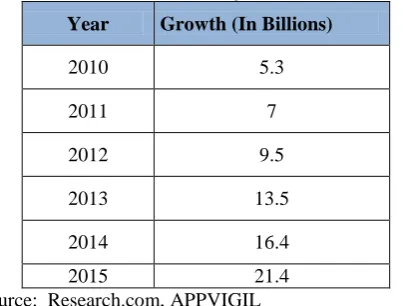
Table 5: India‟s E-Commerce growth in USD Billions
Year Growth (In Billions)
2010 5.3
2011 7
2012 9.5
2013 13.5
2014 16.4 2015 21.4 Source: Research.com, APPVIGIL
The research.com survey revealed that E-Commerce in India is growing very fast and by the year 2020 the growth will reach to 45.17 U.S. billion dollars. By the year 2020 according to an estimate, retail m-commerce sales will reach to 50.54 U.S. billion dollars (statista.com)17. It indicates that online shopping through digital channels will grow fast in the coming years.
16
Kritika Suneja., (2016). “National e-Governance
Division”, Economic Times. 9th Aug.
17statista.com., “India-retail-m commerce-sales”,
https://www.statista.com/statistics/266119/india-retail-mcommerce-sales.
In India roughly, 60-65 percent of the total e-commerce sales are generated by mobile devices and tablets. Shopping online through smart phones is proving to be a game changer, and industry leaders believe that m-commerce contributes up to 70 percent of their e-commerce revenues18.
X.
CURRENT SCENARIO OF
ONLINE SHOPPING IN INDIA
Early stage of online shopping was a simple medium for shopping with fewer options. The users can just place an order and pay cash on delivery. But in the last few years, this field renovated to a high extent and hence fascinated many customers. Today, the online shopping has become a trend in India and the reasons behind this technique lie in the attractive online websites, user-friendly interface, bulky online stores with new fashion, easy payment methods, unrestricted quantity, quality etc. One can choose the items based on size, colour, price, etc. Despite being a developing country, India has shown a commendable increase in the e-commerce industry in the last couple of years, thereby hitting the market with a boom. Though the Indian online market is far behind the US and UK, it has been growing fast.
Further, discounts, coupons, offers, referral systems, 30 days return guarantee, 1-7 days delivery time, etc. have added a new flavour to the online shopping and the E-markets Industry. The online shopping business has grown at a compound annual growth rate (CAGR) of 32 percent between 2009 and 2013 (Reports of http://gadegets.ndtv.com)19.
The most M-commerce sales in India have accounted for 11 percent of total retail sales in 2014 and expected to grow to 25 percent by the end of 2017. In China mobile online retail sales have grown by 450 percent between 2010 and 2011 and expected to continue growing in the future, although at lower rates.
XI.
FUTURE OF ONLINE SHOPPING
IN INDIA
Today online shopping has become a booming industry in India. India stands in fifth place in e-commerce throughout the world. In Asia, it holds the second place. Today, marketers can promote their products and services using the Internet over a wide geographical area. These days‟ companies collaborate with discounts
18
Research.com, APPVIGIL, “ E-Commerce Mobile App Security”.
33
Copyright © 2018. IJEMR. All Rights Reserved.
and daily deals sites to earn profits upon rising trends of online shopping.
Google has estimated that in India there are more than 100 million Internet users and among them half of the users‟ access Internet for their purchases. India‟s plan to rebuild and modernize the Indian Postal infrastructure will no doubt, boost the e-commerce sector. India‟s current dynamics are similar to what existed in China like, growing broadband penetration, acceptance of online marketplaces, and lack of physical retail infrastructure in many places due to high really costs etc.
The women‟s share of E-commerce market will increase from 26 percent in 2013 to 35 percent in 2016. (Reports of http//gadegets.ndtv.com)20.
Table 6: Estimated monthly traffic (in million visitors)
Website
Estimated Monthly Traffic
(In Million Visitors)
Flipkart 62.5 Myntra 59.5 Jabong 42.5 Snapdeal 51.4 Amazon.In 27.6 Ebay 22.6 Junglee 12.2 Hs18 8.8 Shopclues 8.2 Source: Arun Prabhu Desai, 2014
The above table exhibited the estimated monthly traffic i.e. in millions of visitors visited the websites or e-shops for their online shopping or for their curiosity. The e-marketers attract the customers by their creative ideas and methods by implementing on websites, products, features and offers etc.21
A recent survey based on urban areas (Pranati Deva, 2016)22 says that 54 percent of urban Indians won‟t shop online if there are no discounts. An app-based poll conducted by in shorts and Ipsos says that if the price of a product is same in retail market near their homes, the consumers won‟t prefer buying it online. Close to 1.5 lakh respondents took part in the poll, and
20 gadgets.ndtv.com., (2015). “40 Million Online Shoppers in India by 2016”, August 10th.
21
Arun Prabhu Desai., (2014). “Top 10 Indian
E-Commerce Sites Traffic Comparison & More”,
(http://trak.in/tags/business/2014/06/04/top-10-indian-e-commerce-sites-comparison), June 5th.
22
Pranati Deva., (2016). “54% of Urban Indians Won’t
Shop Online If There are No Discounts: Survey”,
economictimes.com,
(economictimes.indiatimescom/industry/services/retail), September 5th.
the survey was done in top metros of India such as New Delhi, Mumbai, Bangalore, Chennai and Kolkata.
Online shopping is changing rural India (Anil Rajvanshi, June 23, 2016)23. Sometimes rural people need special items like books, computer peripherals, electronic goods, or variety of products. These items are not available in rural areas. So online shopping is the best solution for them. The rural area people also discovered the power of such shopping, because to buy few things they need to go away from their places for about 110 km. at least once in a month. People in India are growing year by year in their usage of Internet. The following table and graph show the growth rate of the internet users from the year 2012 to 2015 in rural and urban areas in India24.
Table 7: Internet users in India (in millions)
YEAR URBAN RURAL
2012 99 38
2013 130 60
2014 165 92
2015 216 138 Source: IAMAI: Morgan Stanley Research
XII.
KEY DRIVERS OF INDIAN
E-COMMERCE
For any business there are some key motivating factors or drivers. The key drivers of e-commerce in India are as follows:
Increasing broadband Internet and 3G penetration
Growing living standards
Availability of much wider product range
Busy lifestyles and lack of time for offline shopping
Increased usage of online categorized sites
Evolution of the online market place model with websites like eBay, Flipkart, Snapdeal etc. .
XIII.
MAJOR ONLINE SHOPPING
WEBSITES IN INDIA
Online shopping has grown very fast in India. Only in 2012, online shopping or e-commerce number has crossed 600 from 100. Best of few online shopping
23Anil Rajvanshi., (2016). “How Online Shopping is
Changing Rural India - Moneylife”,
moneylife.in/article, June 23.
34
Copyright © 2018. IJEMR. All Rights Reserved.
websites in India are listed below and these are scored by in voting method.25
35
Copyright © 2018. IJEMR. All Rights Reserved.
Table 8: Top Websites in India for Online Shopping
Website Score Website Image
Flipkart.com 4.78
Amazon.in 4.75
Snapdeal.com 4.90
Jabong.com
5.11
Mynthra.com 5.16
Homeshop18.co
m 5.87
Shopclues.com 5.55
eBay.com 5.02
paytm.com 5.01
Source: indiafreestuff.in, 2017
Flipkart.com
Flipkart online services private limited was found in 2007 by Sachin Bansal and Binny Bansal, who were working for Amazon.com, had an idea to start an e-commerce company in India. They left their job and started their own business. The company registered in Singapore, but their headquarters are in Bangalore, India. Sachin Bansal is the Chairman and Binny Bansal is the CEO of the Flipkart Company.
Indian e-commerce industry was taking its beginner steps, when Flipkart launched. Initially, Flipkart began with selling of books. It soon expanded and started offering variety of goods. Today Flipkart e-commerce has become one of the fastest growing sectors in India. In the first few years of its existence, Flipkart raised funds through venture capital funding. As the company grew in stature, more funding arrived. Flipkart repaid the investors‟ faith with terrific performances year after the year. For the financial year 2008-09, Flipkart has made sales to the tune of 40 million Indian rupees. It increased to 200 million Indian rupees for the following year. According to Morgan Stanley, estimated their value stands at $11 billion as of February 2016.
When Flipkart launched, the company faced two major difficulties. One of the problems was online payment gateways. Many people are not preferred online payments and not easy to set up the gateways. Flipkart tackled the problem by introducing the „Cash on Delivery‟ facility, which was the first to start. Today, every online shopping website in India offers the option in their websites.
The second problem was the entire supply chain system. Delivering the goods on time is one of the most important factors for the success of an e-commerce company. Flipkart solved this issue by launching their own supply chain management system to deliver orders in a timely fashion.
On 6th October 2014, Flipkart launched a promotion called „Big Billion Day‟ with the intention to increase their website by targeting a billion sales in one day. After the failure of its 2014 Big Billion Day, Flipkart recently completed the second edition of Big Billion sales held between 13 and 17 October 2015, which they saw a business turnover of $300 million in gross merchandise volume.
36
Copyright © 2018. IJEMR. All Rights Reserved.
the year 2014 and 2015 a drastic change took place and the sales reached to 5000 million rupees.26
Table 9: Flipkart‟s sales chart from 2009-2015
Year Sales in INR Millions
2009 40
2010 200
2011 750
2012 2000
2013 5000
2014 10000
2015 50000 Source: trak.in, Flipcart Financial Report
Amazon.in
Amazon was founded by Jeff Bezos in 1994. It started out as a bookstore and later included Movies and TV shows, and has gone on to expand into various categories of products including e-readers, electronics, apparel, food, software, etc. It also offers a cloud computing platform and is the largest provider of Infrastructure as a Service (IaaS) in the world. The company launched its e-commerce platform in India in June 2013. Amazon.in has operated in India by Amazon Seller Services Pvt. Ltd. For the third year of operations, in Financial Year 2014-15 it managed to cross INR 1,000 crore in revenue, growing about six times over the previous year.
Amazon also operates „Pay with Amazon‟, a payment processing service and „Amazon Business‟, a members-only B2B website which sells business supplies and other products at wholesale prices and in bulk quantities to businesses. These are operated by Amazon Online Distribution Services Private Limited and Amazon Wholesale (India) Private Limited respectively. Amazon is also into direct selling business model in India through cloud tail.
The company recognizes its revenue from the following avenues:
1. Income from marketing support services from marketing and promotional services offer to its group companies.
2. Income from market place services from operating an internet portal, which facilitates online sale of goods by registered merchants. 3. Sale of traded goods which includes Kindle
book reader and its accessories.
Snapdeal.com
In 2010, Snapdeal Company started as a daily deals platform, by Kunal Bahl and Rohit Bansal, at New
26
Trak.in., “ Flipcart Financial Report”.
Delhi, India. Initially, it was offline business and named as Money Saver. In 2011 it turned to B2C online Business with the inspirations of Alibaba.com. Today Snapdeal valued at a billion dollars. Currently, more than 50,000 sellers sell around 5 million products on Snapdeal. The company began to concentrate on building scale and improving speed. The company‟s phenomenal growth in a short span has been a remarkable journey.
Snapdeal revenues have grown multi fold every year. Every valuation round is a multiple of the last one. Revenue is not the value of products sold at Snapdeal. It is the commission earned by Snapdeal from the sellers who list and sell their products on Snapdeal. The good stuff is that revenues have increased 5 times but loss has increased only 2 times. The loss per rupee of revenue earned has also decreased drastically. The revenue for the financial year 2012-13 was 340 million, which is very small-scale of any use for benchmarking and the loss at even a scale of INR 1,680 million is twice the revenue.27
Table 10: Gross turnover of the Snapdeal for the Years 2012-15 (INR in Million)
YEAR
Gross
turnover Loss
2012-2013 340 -1200
2013-2014 1680 -2650
2014-2015 938 -1319 Source: Snapdeal financial performance trak.in
Flipkart, Amazon and Snapdeal websites
The following table shows the comparison of three websites such as Flipkart, Amazon and Snapdeal of their net revenues and losses for the year 2013-14.28
Table 11: Flipkart, Amazon and Snapdeal revenues & losses for the Year 2013-2014 (INR in Million)
Website
Net
Revenue Loss
Flipkart 179 400 Amazon 168.9 321.3 Snapdeal 154.11 264.6
Source: Arun Prabhu Desai., (2014). Flipkart Vs Amazon Vs Snapdeal: Revenue & Losses Comparison
From the above data it can be said that the three MNCs net revenues and losses were almost same.
27trak.in., “Snapdeal Financial Performance”,
trak.in/tags/business
28
Arun Prabhu Desai., (2014). “Flipkart Vs Amazon Vs
37
Copyright © 2018. IJEMR. All Rights Reserved.
However, comparatively Flipkart loss was higher than Snapdeal and Amazon.
XIV.
PROBLEMS WITH ONLINE
SHOPPING IN INDIA
The following are some of the problems relating to online shopping in India:
Consumers have still not become comfortable with credit or debit card payments for their online purchases. There is still lack of trust on these forms of payments.
Since one cannot see or touch or feel the product before placing an order, sometimes the delivered product is not as per the expected quality, so many people do not shop online. In some products like ready-made garments or footwear, people hesitant to shop online since there might be size issues.
Security is another major issue with online transactions. A lot of customers do not feel confident while sharing their personal details with e-marketers.
XV.
CONCLUSION
From the above study it can be concluded that online shopping is growing fast in all the countries of the world, where India is no exception. Further, in a large country like India the future of online shopping looks bright. Though there are some problems involved in online shopping in India in the initial stage, in future online shopping creates miracles in the business world.
REFERENCES
[1] Abdul Muhmin & Alhassan, G. (2010). Transaction size effects on consumers‟ retail payment mode choice.
International Journal of Retail & Distribution Management, 38 (6), 460 - 478.
[2] Betsy Morris. (2013). More consumers prefer online shopping. the Wall Street Journal, USA. Available at: https://www.wsj.com/articles/SB1000142412788732406 3304578523112193480212
[3] Colliander, J., & Dahlen. (2011). Following the fashionable friend: The power of social media. Journal of Marketing Research, 51 (1), 313-320.
[4] Delafrooz N at el. (2009). Factors affecting students‟ attitude toward online shopping. African Journal of Business Management, 3(5), 200-209.
[5] Hempel, P.S., & Kwong, Y.K. (2001). B2B e-Commerce in emerging economics: I-metal.com‟s non-ferrous metals exchange in china. Journal of Strategic Information Systems, 10(4), 335-355.
[6] Jonathan Coppel. (2000). E-commerce: Impacts and Policy Challenges.
OECD
Economics Department Working Papers, 252, 1-27. Available at:
https://www.oecd-ilibrary.org/docserver/801315684632.pdf?expires=15276 64306&id=id&accname=guest&checksum=5B82596E1 B5428867DC8D1A56E8E2802
[7] Kiseol Yang. (1990). Mobile shopping motivation: An application of multiple discriminant analysis.
International Journal of Retail & Distribution Management, 40(10), 778-789.
[8] Matthew, K.O., & Lee. (2001). A trust model for consumer internet shopping. International journal of electronic commerce, Fall 2001, 6(1), 75-91.
[9] Pani, A.K. & Agrahari, A. (2004). E-market in Emerging Economy – A case study from Indian Steel Industry. Journal of e-Commerce in Organization, 2(4), 116-126.
[10] Reichheld, F. F. & Schefter, P. (2000). E-loyalty – Your Secret Weapon on the Web. Harvard Business Review, 1, 105-113.
[11] Rust R.T., & Zahorik A.J. (1993). Customer satisfaction, customer retention and market share. Journal of Retailing, 69(2), 193-215.
[12] Ruyter K., Wetzels, M., & Kleijnen, M. (2001). Customer adoption of e-service: an experimental study.
International Journal of Service Industry Management, 12(2), 184-208.
[13] Schaupp L. C., & Belanger, F. (2005). A conjoint analysis of online consumer satisfaction. Journal of Electronic commerce Research, 6(2), 95-111.
[14] Slyke, C.V., Comunale, C.L., & Belanger, F. (2002). Gender differences in perceptions of web-based shopping. Communications of the ACM, 45(7), 82-86. [15] Stafford., T.F., Turan, A., & Raisinghani, M. S. (2004). International and cross-cultural influences on online shopping behaviour. Journal of Global information Management, 7(2), 70-87.
[16] Swaminathan, V., Lepkowska, White E., & B.P. Rao. (1999). Browsers or Buyers in Cyberspace? An Investigation of Factors Influencing Electronic Exchange. Journal of Computer-Mediated Communication, 5(2), 1-23.
[17] Pearce, John A./Robbins, Keith D./Robinson, Richard B. (1987). The impact of grand strategy and planning formality on financial performance. Strategic Management Journal, 8(2), 125-134.
[18] Torkzadeh, G., & Dhillon, G. (2002). Measuring factors that influence the success of the internet commerce. Information Systems Research, 13(2), 187-204.
[19] Wolfinbarger, M., & Gilly, M. (2001). Shopping online for freedom, control and fun. California Management Review, 43(2), 34-56.
[20] Xia, Lan. (2010). An examination of consumer browsing behaviours. Qualitative Market Research: An International Journal, 13(2), 154-173.
38
Copyright © 2018. IJEMR. All Rights Reserved.
[22] Yang, B., Lester, & D. (2004). Attitudes toward buying online. Cyberpsychology & Behavior, 7(1), 85-92.