Research Article
High Expression of Vascular Endothelial Growth Factor Receptor-1
(VEGFR-1) is Highly Correlated with Eclampsia
Ekspresi VEGFR-1 yang Tinggi Berkorelasi dengan Eklampsia
Efendi Lukas1, Upik A Miskad2, Miranty Firmansyah1
1Department of Obstetrics and Gynecology
2Department of Pathology
Faculty of Medicine University of Hasanuddin/ Dr. Wahidin Sudirohusodo Hospital
Makassar
INTRODUCTION
Preeclampsia and eclampsia are pregnancy compli-cations that could cause maternal and perinatal death. Global burden of diseases 2000 estimated that the incidence of preeclampsia was around 2.8% of live births in developing countries and 0.4% in developed countries. Incidence of eclamp-sia was around 2.3% of preeclampeclamp-sia in developing countries and 0.8% in developed countries.1
According to Godlin (1982), HELLP syndrome was an initial form of severe preeclampsia while Weinstein (1982) reported HELLP syndrome as a unique variety of preeclampsia.2 HELLP syndrome
incidence was around 2 - 20% of severe pree-clampsia and around 0.2-0.6% of pregnancies.2,3
Etiology and pathogenesis of HELLP syndrome are always associated to preeclampsia, although etiol-ogy and pathogenesis of preeclampsia itself are not fully understood to these days.
Abstract
Objectives: To understand the expression of placental vascular en-dothelial growth factor receptor (VEGFR-1) in severe preeclampsia with complication (eclampsia and HELLP syndrome).
Methods: The study was an observational study with cross sectional design, performed at several hospitals of Department of Obstetrics and Gynecology Medical Faculty of University of Hasanuddin, Makassar. Subjects met to inclusion criteria were taken as samples. Placental tissue samples were taken from cord insertion site and fix-ated with formalin buffer solution. Immunohistochemical examina-tion was performed at Center of Research University of Hasanuddin. Antibody used were primary antibody of Mouse monoclonal anti VEGFR-1 antibody (Santa Cruz) dissolved to 1:100 and link antibody (secondary antibody labeled with biotin) (Dakopatt). Placental tis-sues were examined in Streptavidin biotin peroxides and inter-preted according to the intensity of trophoblast cytoplasmic dye. Results: High VEGFR-1 expression was found in 100% of the pla-centa from patients with eclampsia , 42.9&% in patients with HELLP syndrome and 37.8% in patients with severe preeclampsia. High VEGFR-1 expression was correlated to incidence of eclampsia (p=.000) and not correlated to severe preeclampsia and HELLP syn-drome (p=0.734).
Conclusion: High VEGFR-1 expression was correlated to eclampsia and not correlate to severe preeclampsia and HELLP syndrome. [Indones J Obstet Gynecol 2012; 36-3:116-20]
Keywords: eclampsia, HELLP syndrome, severe preeclampsia, VEGFR-1 expression
Abstrak
Tujuan: Untuk mengetahui ekspresi vascular endothelial growth factor receptor-1 (VEGFR-1) plasenta pada penderita preeklampsia berat, eklampsia dan sindroma HELLP.
Metode: Penelitian ini adalah penelitian observasional dengan desain studi potong lintang yang dilaksanakan pada beberapa rumah sakit pendidikan di Bagian Obstetri dan Ginekologi Fakultas Kedokteran Universitas Hasanuddin, Makassar. Sampel dari subjek yang me-menuhi kriteria inklusi diambil dari plasenta pada tempat daerah in-sersi tali pusat, kemudian difiksasi dengan larutan formalin buffer. Pe-meriksaan imunohistokimia plasenta dilakukan di Pusat Kegiatan Penelitian UNHAS. Antibodi yang digunakan adalah antibodi primer Mouse monoclonal anti VEGFR-1 antibody (Santa Cruz) yang dilarut-kan 1:100 dan link antibody (antibodi sekunder yang dilabel dengan biotin) (Dakopatt). Sediaan plasenta diperiksa dengan Streptavidin biotin peroksidase, kemudian interpretasinya dinilai berdasarkan in-tensitas pewarnaan sitoplasma sel trofoblas.
Hasil: Pada plasenta penderita eklampsia ditemukan 100% ekspresi kuat VEGFR-1 dibandingkan pada sindroma HELLP (42.9%) dan preeklampsia berat (37.8%). Ekspresi kuat VEGFR-1 berhubungan dengan kejadian eklampsia (p=.000) dan tidak berhubungan dengan preeklampsia berat dan sindroma HELLP (p=.734).
Kesimpulan: Ekspresi kuat VEGFR-1 pada plasenta berhubungan dengan eklampsia dan tidak berhubungan dengan kejadian pre-eklampsia berat dan sindroma HELLP.
[Maj Obstet Ginekol Indones 2012; 36-3:116-20]
Kata kunci: eklampsia, ekspresi VEGFR-1, preeklampsia berat, sin-droma HELLP.
Preeclampsia is considered as an antiangiogenic condition.4 Recent studies showed that ischemic
trophoblast synthesized antiangiogenic factors.5
Hypoxia stimulated some protein expression in-cluding endothelin, vascular endothelial growth factor (VEGF) and vascular endothelial growth fac-tor recepfac-tor-1 (VEGFR-1). VEGF is a potent mito-genic and angiomito-genic factor for endothelial cells. VEGF and placental growth factor (PlGF) bound to abundant VEGFR-1 may take place in pathogenesis of maternal symptoms in preeclampsia.6
Specifi-cally, Maynard et al (2003) proposed a hypothesis stated that in pregnant women with preeclampsia, there was an increase of sVEGFR-1 produced by placenta in the circulation, which then bound the free VEGF and PlGF. As a consequence, normal vas-cularization in the kidney, lungs, and other vital or-gans fell to/became dysfunction. Also, injection of sVEGFR-1 into animal induced hypertension, pro-teinuria and glomerular endotheliosis, symptoms classic to preeclampsia.7 Hence, VEGFR-1 may be
the missing link between implantation disorder and preeclampsia maternal symptoms.8 This study
would like to show the VEGFR-1 expression in the placenta.
The remaining question is whether VEGFR-1 plays an important role in pathogenesis of HELLP syndrome and eclampsia. To these days, there is no study compares the expression of placental VEGFR-1 between severe preeclampsia and eclam-psia or HELLP syndrome.
The aim of the study was to understand the ex-pression of placental vascular endothelial growth factor receptor (VEGFR-1) in severe preeclampsia with complication (eclampsia and HELLP syn-drome).
METHODS
This study was performed from November 2010 to January 2011 at several hospitals of Department of Obstetrics and Gynecology Faculty of Medicine University of Hasanuddin, Makassar.
Subjects were pregnant women with severe preeclampsia who met the inclusion criteria and taken by sonsecutive sampling.
Placental tissue samples were taken from cord insertion site and fixated with formalin buffer so-lution. Immunohistochemical examination was performed at Center of Research University of Hasanuddin. Antibody used were primary antibody
of Mouse monoclonal anti VEGFR-1 antibody (Santa Cruz) dissolved to 1:100 and link antibody (secondary antibody labeled with biotin) (Dak-opatt). Placental tissues were examined in Strepta-vidin biotin peroxides and interpreted according to intensity of trophoblast cytoplasmic dye.
Score 0 (negative) means that no dyed cell was found. Score +1 (low) means that <10% dyed tro-phoblast with weak/moderate intensity was found. Score +2 (low) means that 10-50% dyed tro-phoblast with weak/moderate intensity, or >50% with weak intensity was found. And score +3 (high) means that >50% dyed trophoblast with moder-ate/strong intensity was found.
The data analysis was performed using Kruskal Wallis test, Mann Whitney test and Chi-square test to compare between two unpaired variable groups.
RESULTS
The total of samples obtained were 61 samples, devided into 37 samples of severe preeclampsia, 14 samples of HELLP syndrome, and 10 samples of eclampsia.
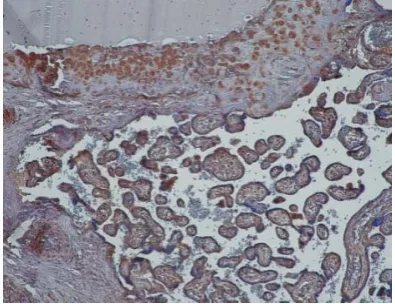
Figure 1a. Immunohistochemical dyeing of placental VEGFR-1 expression (score 0).
There was no significant difference in the sub-ject characteristics of maternal age, parity, systolic blood pressure, diastolic blood pressure, and pro-teinuria.
Table 1. Characteristic distribution of samples
Variable
Group*
p Severe
Pre-eclampsia Eclampsia syndromeHELLP
Age 28.3±7.3 24.2±6.4 28.6±6.7 0.215 Parity 1.8±0.9 1.3±0.5 1.7±0.9 0.309 Systolic BP 168.9±20.5 176±23.2 171.4±12.3 0.475 Diastolic BP 108.1±13.1 116±11.7 112.1± 8.9 0.113 Proteinuria 3.0±0.7 3.4±0.5 3.2±0.4 0.197
* Mean
Using Kruskal Wallis test, we found significant difference (p<0.05) of VEGFR-1 expression be-tween severe preeclampsia, HELLP syndrome and eclampsia group. Percentage of score +3 in eclamp-sia group (100%) was higher than others.
Since there was significant difference found among the three groups, we performed further analysis test between two groups by Mann Whit-ney test. Significant difference were found between severe preeclampsia and eclampsia groups (p=0.007) and between eclampsia and HELLP syn-drome groups (p=0.014). There was no significant difference between severe preeclampsia and HELLP syndrome groups (p=0.745).
Table 2. Expression of placental VEGFR-1 in severe pre-eclampsia, eclampsia and HELLP syndrome
VEGFR-1 expression
Severe
preeclampsia Eclampsia syndromeHELLP Total
n % n % n % n %
Score 3 8.1 0 0 0 0 3 4.9
Score +1 12 32.4 0 0 5 35.7 17 27.9
Score +2 8 21.6 0 0 3 21.4 11 18
Score +3 14 37.8 10 100 6 42.9 30 49.2
Total 37 100 10 100 14 100 61 100
Chi Square Test, p=0.032
Group severe preeclampsia and eclampsia, p=0.007 Group severe preeclampsia and HELLP syndrome, p=0.745 Group eclampsia and HELLP syndrome, p=0.014
We looked for correlation between high VEGFR-1 expression (score +3) and complication (com-bined groups of eclampsia and HELLP syndrome). The percentage of sample with score +3 was higher in severe preeclampsia with complication (66.7%) than without complication (37.8%). There was sig-nificant difference (p=0.028) in the strength of VEGFR-1 expression between the group with com-plication of severe preeclampsia (3.3 times risk) and the group with no complication.
Table 3. Strength of VEGFR-1 Expression Based on Complication of Severe Preeclampsia
VEGFR-1 expression
Severe
preeclampsia HELLP syndromeEclampsia+ Total
n % n % n %
High expression 14 37.8 16 66.7 30 49.2
Low expression 23 62.2 8 33.3 31 50.8
Total 37 100 24 100 61 100
Chi-Square test, p=0.028, OR 3.286 (95% CI 1.118-9.654)
We also looked for correlation between high VEFGR-1 expression (score +3) and eclampsia. The percentage of samples with score +3 was higher in patients with eclampsia (100%) than in combined Figure 1d. Immunohistochemical dyeing of placental
VEGFR-1 expression (score +3).
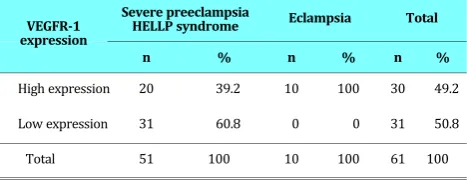
groups of HELLP syndrome and severe preeclamp-sia (39.2%). There was significant correlation (p=0.000) in the strength of VEGFR-1 correlation between eclampsia and combined groups of HELLP syndrome and severe preeclampsia. We could not estimate the risk since there was no low expression in eclampsia. However, it is a very significant ex-pression because all eclampsia samples showed high expression of VEGFR-1.
Table 4. Strength of VEGFR-1 Expression on Eclampsia Compared to HELLP Syndrome and Severe Preeclampsia
VEGFR-1 expression
Severe preeclampsia
HELLP syndrome Eclampsia Total
n % n % n %
High expression 20 39.2 10 100 30 49.2
Low expression 31 60.8 0 0 31 50.8
Total 51 100 10 100 61 100
Chi-Square test, p=0.000, OR 0.667 (95% CI 0.518-0.859)
DISCUSSION
We found that the expression of VEGFR-1 in the placenta of severe preeclampsia, eclampsia and HELLP syndrome, varied from score 0 (4.9%), score +1 (27.9%), score +2 (18%) to score +3 (49.2%). It was in accordance with previous stud-ies, which stated that in preeclamptic condition, ex-pression of VEGFR-1 in syncitiotrophoblast was very high and the soluble level in maternal serum was also increased.8,9 Helske et al found expression
of VEGFR-1 in 50% syncitiotrophoblast of severe preeclampsia. The only 50% expression was ex-plained by individual variation among the patients based on gestational age and severity of pree-clampsia.8 In this study, we found that VEGFR-1
ex-pression in 95.1% of total samples or 91.9% of se-vere preeclampsia samples. This difference might be caused by homogenity in our sample charac-teristics and inclusion criteria of term pregnancy.
We found significant difference in VEGFR-1 ex-pression among severe preeclampsia, eclampsia and HELLP syndrome. The higher the VEGFR-1 ex-pression in the placenta, the more severe the com-plication of preeclampsia. This was seen as 100% of the samples with eclampsia had VEGFR-1 ex-pression score +3, while only 37.8% of samples with severe eclampsia had VEGFR-1 expression score +3. The more severe the hypoxia, the higher the VEGFR-1 synthesis that will worsen the severe
preeclampsia.10 In eclampsia, there are cerebral
edema and neurological complications that do not relate to the grade of hypertension (found also in normotension) and are reversible. It showed that edema might relate to the diminished autoregula-tion of cerebral blood flow, caused by endothelial dysfunction, and not because of the autoregulatory breakdown of cerebral blood flow. Findings in the head CT scan and MRI of eclampsia were similar with that of posterior reversible encephalopathy syndrome (PRES), with vasogenic cerebral edema and infarct. Findings with these characteristics were correlated with acute encephalopathy hyper-tension in conjunction with renal disease and im-munosuppressive condition, for examples like in treatment of antiangiogenic agent for cancer ther-apy. This correlation supported the involvement of antiangiogenic factors in pathophysiology of eclampsia.11,12 Blood pressure characteristics, both
systole and diastole, in severe preeclampsia and eclampsia were homogen and thus supported the statement above.
VEGFR-1 expression was not significantly differ-ent between severe preeclampsia and HELLP syn-drome. We performed further analysis to HELLP syndrome group. First test was performed to cor-relate the high VEGFR-1 expression to severe pree-clampsia group (37.8%) versus combined groups of HELLP syndrome and eclampsia (66.7%). Sec-ond test was performed to correlate the high VEGFR-1 expression to combined groups of severe preeclampsia and HELLP syndrome (39.2%) ver-sus eclampsia group (100%). The results showed that HELLP syndrome might not be a complication with similar pathogenesis with eclampsia. This can be interpreted as whether HELLP syndrome is a variant of severe preeclampsia or HELLP syndrome has causative factors other than VEGFR-1.13,14
liver enzyme as seen in HELLP syndrome.3,15 sEng
is also elevated in maternal serum several months before the onset of preeclampsia, thus sEng can be used as a predictor for patients who may undergo a severe variant of preeclampsia.15
From this study, it was concluded that the high expression of placental VEGFR-1 was correlated with eclampsia and there was no difference in pla-cental VEGFR-1 expression between severe pree-clampsia and HELLP syndrome.
REFERENCES
1. Dolea C, AbouZahr C. Global burden of hypertensive disor-ders of pregnancy in the year 2000. Geneva: Evidence and Information for Policy (EIP), World Health Organization; 2003.
2. Roeshadi RH. Sindroma HELLP. In: Hariadi R, editor. Ilmu Kedokteran Fetomaternal. Surabaya: Himpunan Kedok-teran Fetomaternal POGI; 2004. 500-5.
3. Hawfield A, Freedman BI. Pre-eclampsia: the pivotal role of the placenta in its pathophysiology and markers for early detection. Ther Adv Cardiovasc Dis. 2009; 3(1):65-73. 4. Bujold E, Romero R, Chaiworapongsa T, Kim YM, Kim GJ,
Kim MR, et al. Evidence supporting that the excess of the sVEGFR-1 concentration in maternal plasma in preeclamp-sia has a uterine origin. J Matern Fetal Neonatal Med. 2005; 18(1):9-16.
5. Berkane N, Lefevre G, Hertig A. Angiogenic factors in pre-eclampsia: so complex, so simple? Nephrol Dial Transplant. 2007; 22:2753-6.
6. Lam C, Lim KH, Karumanchi SA. Circulating Angiogenic Fac-tors in the Pathogenesis and Prediction of Preeclampsia. Hypertension. 2005; 46:1077-85.
7. Maynard SE, Min JY, Merchan J, Lim KH, Li J, Mondal S, et al. Excess placental soluble fms-like tyrosine kinase (sFlt 1) may contribute to endothelial dysfunction, hypertension, and proteinuria in preeclampsia. J Clin Invest. 2003; 111:649-58.
8. Helske S, Vuorela P, Carpen O, Hornig C, Weich H, Halmes-maki E. Expression of vascular endothelial growth factor receptors 1, 2 and 3 in placentas from normal and compli-cated pregnancies. Mol Hum Reprod. 2001; 7(2):205-10. 9. Gu Y, Lewis DF, Wang Y. Placental Productions and
Expres-sions of Soluble Endoglin, Soluble fms-Like Tyrosine Kinase Receptor-1, and Placental Growth Factor in Normal and Preeclamptic Pregnancies. J Clin Endocrinol Metab. 2008; 93:260-66.
10. Ahmad S, Ahmed A. Elevated Placental Soluble Vascular En-dothelial Growth Factor Receptor-1 Inhibits Angiogenesis in Preeclampsia. Circ Res. 2004; 95:884-91.
11. Cipolla MJ. Cerebrovascular function in pregnancy and eclampsia. Hypertension. 2007; 50:14-24.
12. Wang A, Rana S, Karumanchi SA. Preeclampsia: the role of angiogenic factors in its pathogenesis. Physiology. 2009; 24:147-58.
13. Sibai BM. Diagnosis, Controversies, and Management of the Syndrome of Hemolysis, Elevated Liver Enzymes, and Low Platelet Count. ACOG. 2004; 103(5):981-91.
14. Järvenpää J. Placental angiogenesis and angiogenesis re-lated risk factors in severe pre-eclampsia [Academic Dis-sertation]. Oulu: University of Oulu; 2008.