250
Volume-4, Issue-4, August-2014,
ISSN No.: 2250-0758
International Journal of Engineering and Management Research
Available at:
www.ijemr.net
Page Number: 250-263
Wear and Friction in Journal Bearing: A Review
Sanjay Kumar1, S.S. Sen2
1M. Tech Student, Green Hills Engineering College, Kumarhatti, Solan, INDIA 2
Professor, Green Hills Engineering College, Kumarhatti, Solan, INDIA
ABSTRACT
The importance of friction and wear control cannot be overemphasized for economic reasons and long-term reliability. The savings can be substantial, and these savings can be obtained without the deployment of investment. These advances provide the impetus for research aimed at developing a fundamental understanding of the nature and consequences of the interactions between materials on the atomic scale, and they guide the rational design of material for technological applications.This paper presents the reviews of different works in the area of wear and friction in journal bearings and tries to find out latest developments and trends available in industries and other fields in order to minimize the total equipment cost, minimize damages and maximize the safety of machines, structures and materials.
Keywords-- Wear, Friction, Literature Review, Summary
of Literature Review and Conclusion
I.
INTRODUCTION
Despite their presence in our everyday life, friction, wear and tribology are not phenomena that most peoples are considering on daily basis. Nevertheless, they are responsible for many problems and large cost in modern civilization and engineers and designers are always must take these factors into account when constructing technical equipment.Variables in friction and wear testing are load, velocity, contact area, surface finish, sliding distance, environment, material of counter face, type of lubricant, hardness of counter face and temperature. Usually wear is undesirable, because it makes necessary frequent inspection and replacements of parts and also it will lead to deterioration of accuracy of machine parts. It can induce vibrations, fatigue and consequently failure of the parts. For the particular practical application the kind of wear loading can be different, and therefore the structure of the composite material used for these applications can also be different in order to fulfill the particular requirements [1].
As soon as two bodies are in mutual mechanical contact and they are forced to slide against each other there
will frictional force between them, directed exactly opposite to sliding direction [2]. Even though certain amount of friction often is necessary there are many applications where friction coefficient should be as low as possible. Friction is an important factor in many engineering disciplines. Rail adhesion refers to the grip wheels of a train have on the rails. Road slipperiness is an important design and safety factor for automobiles Split friction is a particularly dangerous condition arising due to varying friction on either side of a car.Road texture affects the interaction of tires and the driving surface. A tribometer is an instrument that measures friction on a surface. A profilograph is a device used to measure pavement surface roughness. A number of material-processing strategies have been used to improve the wear performance of polymers. This has prompted many researchers to cast the polymers with fiber/fillers. Considerable efforts are being made to extend the range of applications. Various researchers have studied the tribological behavior of FRPCs. Studies have been conducted with various shapes, sizes, types and compositions of fibers in a number of matrices. In general these materials exhibit lower wear and friction when compared to pure polymers. An understanding of the friction and wear mechanisms of FRPC’s would promote the development of a new class of materials. Use of inorganic fillers dispersed in polymeric composites is increasing.
1.2 Tribology
251
realized only after a fundamental understanding of thefrictional process is obtained for all conditions of temperature, sliding velocity, lubrication, surface finish and material properties.
Many polymers and polymer based composites are widely used for sliding couples against metals, polymers and other materials. However, where the contact is there, there is the problem of friction and wear. The friction between polymers can be attributed to two main mechanisms, deformation and adhesion. In this case, the deformation mechanism involves complete dissipation of energy in the contact area while the adhesion component is responsible for the friction of polymer and is a result of breaking of weak bonding forces between polymer chains in the bulk of the material. In fact, tribologists often classify thermoplastic polymeric materials into three distinct groups according to their friction and wear behavior. These are: the normal polymers such as low-density polyethylene (LDPE), (PMMA); and the smooth molecular profile polymers such as Polytetrafluoroethylene (PTFE) and ultra-high molecular weight polyethylene (UHMWPE). Among them, the better frictional performance of the smooth molecular profile polymers can be explained by the easiness with which the long chain molecules shear across each other.
1.3 Industrial Significance of Tribology
Tribology is crucial to modern machinery which uses sliding and rolling surfaces. Examples of productive friction are brakes, clutches, driving wheels on trains and automobiles, bolts, and nuts. Examples of productive wear are writing with a pencil, machining, polishing, and shaving. Examples of unproductive friction and wear are internal combustion and aircraft engines, gears, cams, bearings, and seals. According to some estimates, losses resulting from ignorance of tribology amount in the United States to about 6% of its gross national product (or about $200 billion dollars per year in 1966), and approximately one-third of the world's energy resources in present use appear as friction in one form or another. Thus, the importance of friction reduction and wear control cannot be overemphasized for economic reasons and long-term reliability. According to Jost [1] (1966, 1976), the United Kingdom could save approximately 500 million pounds per annum, and the United States could save in excess of 16 billion dollars per annum by better tribological practices. The savings are both substantial and significant, and these savings can be obtained without the deployment of large capital investment.
II.
FRICTION AND WEAR
2.1 Friction
Friction is the resistance to relative tangential motion between the two solid bodies or surfaces in contact with each other. Friction always acts in direction opposite to that of motion.
The friction exists:
1) When an attempt is made to initiate the motion: & 2) During the motion.
2.1.2 Laws of Friction
The classic laws of friction are as follows: Friction force is proportional to loadCoefficient of friction is independent of apparent contact area.
Static coefficient is greater than the kinetic coefficient and Coefficient of friction independent of sliding speed. The first law, commonly referred as Coulomb’s law is correct except at high pressure. It generally takes form
F = W. Where,
F is the friction force,
is the coefficient of friction, W is the normal load.
The second law is appears to be valid only for materials possessing a definite yield point (metals), and it does not apply to elastic and visco elastic materials.
The third law is not obeyed by any visco elastic material.
The fourth law is not valid for any material, however visco elastic properties are dominant then this law is obeyed to some extent.
2.1.3 Types of Friction
Based On Status Of Relative Motion:
Static Friction: The friction between contacting surfaces at the start of relative motion is known as static friction Kinetic Friction: The friction between contacting surfaces during relative motion is known as dynamic friction Based On Type Of Relative Motion:
Sliding Friction: The friction between contacting surfaces having relative sliding motion is known as sliding friction. Rolling Friction: The friction between contacting surfaces having relative rolling motion is known as rolling friction. Based On Lubrication between Contacting Surfaces: Dry Friction: If no lubrication is provided between contacting surfaces, the friction is dry friction.
Boundary Friction: The friction between the contacting surfaces which are separated by one or more molecular layers of lubricants is known as boundary friction.
Fluid (Viscous) Friction: The friction between the contacting surfaces which are separated by fluid film is known as fluid (viscous) friction.
2.1.4 Causes of Friction
252
causes the real area of contact to grow. At the area ofplastic deformation, the contact pressure is so high that the contacting surfaces get cold-welded. This cold-welding between contacting surfaces is known as adhesion.
Deformation:In addition to adhesion, the friction is also due to deformation of contacting surfaces. When two surfaces are in sliding contact, the asperities on harder surface & entrapped wear particles penetrate & plough in to softer surface. This ploughing not only increases friction but also creates wear particles
Combined Effect: The friction between two surfaces is due to combined effect of adhesion & deformation. The total frictional force equal to additional frictional force due to adhesion & deformation.
2.2 Wear
2.2.1 Introduction
Wear is progressive loss or removal of material from one or both the surfaces in contact as the result of relative motion between them.Wear is the single most influencing factor which shortens the effective life of machine or its components.
2.2.2 Types of Wear
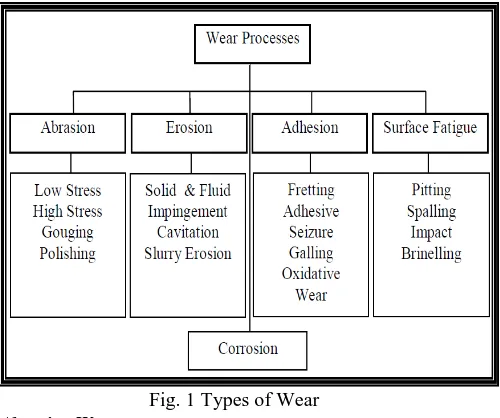
Fig. 1 Types of Wear Abrasive Wear
Abrasive wear occurs when material is removed from one surface by another harder Material, leaving hard particles of debris between the two surfaces. It can also be called scratching, gouging or scoring depending on the severity of wear. Abrasive wear occurs under two conditions:
1. Two body abrasion: In this condition, one surface is harder than the other rubbing surface as shown in figure (a). Examples in mechanical operations are grinding, cutting, and machining.
2. Three body abrasion: In this case a third body, generally a small particle of grit or abrasive, lodges between the two softer rubbing surfaces, abrades one or both of these surfaces, as shown in figure (b).
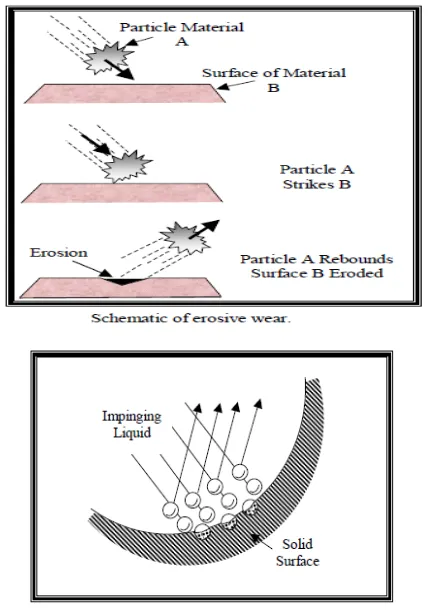
Fig 2 Abrasive Wear Erosive Wear
253
Fig 3 Abrasive Wear due to solid erosionFig 4 AbrasiveWear due to liquid erosion
Adhesive Wear
Adhesive wear is often called galling or scuffing, where interfacial adhesive junctions lock together as two surfaces slide across each other under pressure, according to Bhushan and Gupta (1991) [4]. As normal pressure is applied, local pressure at the asperities become extremely high. Often the yield stress is exceeded, and the asperities deform plastically until the real area of contact has increased sufficiently to support the applied load, as shown in figure. In the absence of lubricants, asperities cold-weld together or else junctions shear and form new junctions. This wear mechanism not only destroys the sliding surfaces, but the generation of wear particles which cause cavitation and can lead to the failure of the component. An adequate supply of lubricant resolves the adhesive wear problem occurring between two sliding surfaces.
Fig 5 Adhesive Wear Surface Fatigue
When mechanical machinery move in periodical motion, stresses to the metal surfaces occur, often leading to the fatigue of a material. All repeating stresses in a rolling or sliding contact can give rise to fatigue failure. These effects are mainly based on the action of stresses in or below the surfaces, without the need of direct physical contact of the surfaces under consideration. When two surfaces slide across each other, the maximum shear stress lies some distance below the surface, causing microcracks, which lead to failure of the component. These cracks initiate from the point where the shear stress is maximum, and propagate to the surface as shown in figure. Materials are rarely perfect, hence the exact position of ultimate failure is influenced by inclusions, porosity, microcracks and other factors. Fatigue failure requires a given number of stress cycles and often predominates after a component has been in service for a long period of time.
Fig 6 Surface Fatigue
Corrosive Wear
254
products then occurs as a result of crack formation, and/orabrasion, in the contact interactions of the materials. This process results in increased reactivity of the asperities due to increased temperature and changes in the asperity mechanical properties.
III.
OBJECTIVES
To find out the behavior of the material from wear & friction point of view and the effect of various sliding speeds and loads.
To study the phenomenon of failure of transfer film by making use of SEM or optical microscope.
To suggest the best suitable material for the journal bearing applications from the tested materials.
IV.
LITERATURE SURVEY
A test method to determine the friction and wear coefficients of bearing material-steel couples under conditions of boundary lubrication is described [5]. Test results obtained with three different test rigs in three laboratories show the validity of the proposed test method. The results are believed to contribute to the characterization of materials for specific technical applications and the test method is thus proposed for standardization procedures of the International Organization for Standardization.
Shyam Bahadur[6] observed that transfer films are formed in sliding between polymer and polymer as well as polymer and metal. In the former case, material transfer occurs from a polymer of low cohesive energy density to one of higher cohesive energy density. Inorganic particulate materials used as the fillers in polymers may either increase or decrease its wear resistance. Wear depends upon the cohesion of transfer film, adhesion of transfer film to the counter face, and the protection of rubbing polymer surface from metal asperities by transfer film.
Voong et al.[7] were examined the wear properties of Al–Si alloys used in the crankshaft bearings of internal combustion engines under two fully formulated lubricants, which have the same viscosity grade. It was found that in a completely ferrous‐based system fully formulated lubricants are effective in reducing wear and friction.
Yuji Yamamoto &, Masaaki Hashimoto [8]proved that, under boundary or mixed lubricating conditions, with 18 vol. % carbon fiber-reinforced PEEK and PPS, the fiber orientation affected the wear resistance. The fibers aligned perpendicular to sliding direction exhibited higher wear resistance than those parallel to sliding direction Yuji Yamamoto& Masaaki Hashimoto were studied the friction and wear characteristics of fiber-reinforced PEEK and PPS in water using a face-contact sliding tester. The fibers used were glass and carbon fibers.
Under boundary lubricating conditions, PEEK reinforced with glass fiber was little improved in friction and wear characteristics, since both PEEK and glass fiber had poor resistance to wear in water.
Das and Biswas[9]were examined the tribology properties of Al–Si alloys under the lubricants with additives. They analyzed the data in terms of the formation of a mechanically mixed layer at the interface and the corrosive action of additive addition.
Ertugrul Durak [10]was studying the effects of addition of rapeseed oil to the base oil on the friction coefficient in the journal bearing under static loading at different temperatures. The rapeseed oil is added to a mineral‐based lubricant acts as an additive that decreases the friction coefficient at high journal speeds, and even at medium loads.
Klaus Friedrich, Zhong Zhang, & Alois K. Schlarb [11]have observed during the wear test that , if the particle sizes of the filler material used in PTFE are diminishing down to Nano-scale, significant improvements of the wear resistance of polymers were achieved at very low Nano-filler content (1–3 vol.%). A combinative effect of nanoparticles with short carbon fibers exhibited a clear improvement of the wear resistance of both thermosetting and thermoplastic composites. A topographic smoothening and a possible rolling effect due to the nanoparticles are running-in supposed to be the reason for this progress in the friction and wear performance.
Gwidon W. Stachowiak et al[12] describes the fundamental wear mechanisms operating in non-metallic materials together with some prognoses concerning the future developments of these materials. Two classes of materials with entirely different characteristics—polymers and ceramics—are discussed. Polymers can provide low friction and low wear coefficients but their use is limited to lower temperatures and consequently low speeds and loads. Ceramics are resistant to high temperatures and often have a good wear resistance but their applications are limited by poor friction coefficients, especially in unlubricated applications. Ceramics and polymers are surprisingly vulnerable to accelerated wear in the presence of corrosive reagents and care should be taken in the selection of materials that are appropriate for particular operating conditions.
255
the wear behavior of PTFE and its composites than thesliding velocity.
Hernandez Battez et al. [14]were discussed the extreme‐pressure behavior of Nano particle suspensions in a polyalphaolefin. The Nano particles of CuO, ZnO and ZrO2 were dispersed at 0.5, 1.0 and 2.0 wt. % in PAO 6 using an ultrasonic probe during 2 min in four ball wear tester. The wear scar diameter (WSD) was measured using an optical microscope and scanning electron microscopy and energy dispersive spectrometry. From the analysis of the worn surface all concentrations of Nano particles improved the extreme properties of PAO 6 and CuO Nano particles exhibited the best extreme property behavior.
Wu et al. [15] were examined the tribological properties of two lubricating oils with CuO, TiO2, and Diamond nanoparticles used as additives. The results shown that the nanoparticles especially CuO, added to standard oils exhibit good friction‐reduction and anti‐wear properties. The addition of CuO nanoparticles in the engine oil and the base oil decreased the friction coefficient and reduced the worn scar depth compared to the one without CuO nanoparticles.
The friction and wear properties of polyamide 66 (PA66), polyphenylene sulfide (PPS) and polytetrafluoroethylene (PTFE) sliding against themselves under dry sliding and oil-lubricated conditions were studied by using a pin-on-disc tribometer[16]. The effect of applied load and sliding speed on tribological behaviors of the polymer–polymer sliding combinations under dry sliding and oil-lubricated conditions were also investigated. The worn surfaces were examined by using Scanning Electron Microscope (SEM). Experimental results showed that friction properties of the three sliding combinations could be greatly improved by oil lubrication, the antiwear properties of PTFE and PPS were improved by oil lubrication, while that of PA66 were decreased by oil lubrication.
Bekir Sadik Unlu and Enver Atik [17]were investigated friction coefficient of bronze radial bearings by a new approach. The result shows that high friction coefficient and high wear have been observed in dry test conditions and the lubricated conditions have low friction coefficient and low wear have been observed.
E. Feyzullahoglu et al.[18] discussed the tribological behavior of tin based alloys and brass in oil lubricated conditions. It is shown that the performance of brass under oil lubrication is better than tin based alloys due to its hardness. The wear in brass is lower than the tin‐based alloys under similar tribological loading conditions.
Yu et al.[19] were studied friction and wear properties of copper Nano particles. The morphologies, typical element distribution and chemical states of the worn surfaces were characterized by SEM, EDS and XPS, respectively. The results indicate that the higher the oil temperature applied, the better the tribological properties of Cu Nano particles.
Yu et al.[20] were investigated copper Nano particles dispersed in SN 650 oil to improve the lubricating properties of the oil. The result shown that the friction‐reducing and anti‐wear properties of SN 650 oil have been improved by adding Cu Nano particles.
It is well known that in journal bearings, friction occurs in all lubrication regimes. However, shaft misalignment in rotating systems is one of the most common causes of wear. In this work, the bearing is assumed to operate in the hydrodynamic region, at high eccentricities, wear depths, and angular misalignment [21]. As a result, the minimum film thickness is 5–10 times the surface finish, i.e., near the lower limit of the hydrodynamic lubrication when taking into account that in the latest technology CNC machines the bearing surface finish could be less than 1–2 μm.An analytical model is developed in order to find the relationship among the friction force, the misalignment angles, and wear depth.
Erol Feyzullahoglu et al[22]were examined, the tribological behaviors of different polymer journal bearings during the working period with steel shaft at dry friction conditions. Journal bearings are produced by different engineering plastics .Bearing and shaft are studied at dry friction conditions in journal bearing experiment apparatus. The friction force is obtained on contact surface. The friction and wear behaviors of bearings are affected by speed, load, and temperature and working time. The wear and friction behaviors of Devateks and Ertalyte are superior to Ertacetal and Ertalon 6PLA according to test results.
According to J.D. Bressana et al [23] the disc wear was more severe as the difference in hardness between pin and disc increased. It can be observed that the decrease in the pin hardness yields to lower pin wear resistance distance the trend of the pin wear rate curves with the sliding distance is approximately constant and linear. However, in the final stage, some pins presented the tendency to decrease the wear rate. This is due the decrease in the real contact pressure with the increase of the pin contact area and/or increase in the hardness of the disc track.
According to G. Zhanga, et al. [24] the sliding velocity plays significant roles on the tribological characteristics by influencing the interface temperature and strain rate of the PEEK surface layer involved in the friction process. The applied load influences the tribological performance by varying the strain range in the surface layer.
256
wear for the same nanoparticle content (2%). An increaseof nanoparticle concentration in base oil increases deposition on wear surfaces.
In this study, the tribological behavior of Cr2O3/Ni8.5Cr7Al5Mo2Si2B2FeTiO2 coatings for bearing materials was investigated in dry and acid conditions[26]. Flame spray technique was used in order to deposit coating materials onto AISI 304L steel substrate. The wear experiments were performed under dry and acid environments using a pin-on-plate configuration against AISI 303 counter material for different loads. It was found that in acid environment, the amount of wear loss is less than that of in dry condition and applied load level is more effective in dry condition. In SEM study, the effect of plastic deformation of adherent and compacted debris particles on friction of the coatings was investigated.
Crankshaft main bearings are subjected to various stresses. A new material supposed to be adapted these operating conditions was designed composing of Pb–Sn– Cu–ZrO2 and manufactured by HVOF spraying technique. Wear behavior of the bearing was tested with the simulation of real operating conditions. An original bearing was used for comparison. After a trial of 500 h, the weight losses were measured. SEM micrographs of both original and new bearings were examined. The effect of micro hardness was discussed[27]. The new composition was seen as promising as a bearing material for automotive engines.
Y. Choi et al.[28] were investigated the friction coefficient for raw oil and Nano‐oil mixed with copper Nano particles by using a disc‐on‐disc tribotester. The result shown that the average friction coefficient of raw oil and Nano oil under a load of 3000 N is decreased by 44 % and 39 % respectively.
Boncheol Ku et al [29] were examined the comparative tribological behavior of journal bearings made from polytetrafluoroethylene composites and aluminum alloys. The tribological properties of journal bearings were evaluated as a function of the applied normal load by measuring the temperature of lubricating oil and coefficient of friction. The results showed that the Al alloy journal bearings reduce the friction coefficient by 28 % compared to the PTFE composite bearings and the PTFE composite journal bearings exhibited strong adhesion at the loads ranging from 6300 to 8000 N. Based on this experiment the Al alloy is a more promising material in journal bearings than PTFE composites.
Jiang and Xie[30]were investigated the tribological behavior of plasma‐spray TiO2 coating pairing with conventional metallic bearing materials and triphenyl thiophosphate and tricresyl phosphate. The results shown that the copper– lead alloy paired with TiO2 coating lubricated with the base oil exhibited the optimum tribological performance.
Ramesh Kumar et al.[27] studied the mechanical and tribological properties of plain bearing alloys used in internal combustion engines. The wear and sliding friction
of aluminum‐tin alloy against high carbon high chromium steel were experimented at different loads in lubricated conditions with a sliding speed of 1 m/s. They found that the friction and wear value of aluminum alloy bearings is less than that of pure aluminum bearing.
The effects of process and material parameters on the coefficient of friction in the flat-die test were examined[32]. Low carbon steel, a hot-dip galvanized steel and Extra Gal™, another hot-dip galvanized steel were used in the tests. As the die surface roughness increased, the coefficient of friction increased most of the time. Under some conditions an optimum roughness was evident. The bare steel produced the highest coefficient of friction in the majority of the tests. The speed and load effects, found in other applications, have been confirmed, in general: the coefficient decreased for increases in load and speed in most cases.
A novel method for measuring the interfacial coefficient of friction between two solids which avoids sliding is described, and sample results are given[33]. The technique makes use of the fact that a carefully controlled sequence of partial slip states between contacting bodies may be used to produce relative motion whose extent is a strong function of the coefficient of friction. It is argued that this approach induces much less surface damage in the components, and therefore yields a value for the coefficient of friction which is much more representative of their unmodified condition.
Erol Feyzullahoglu et al [34] were investigated aluminum‐based alloys produced by metal mould casting and analyzed tribological properties of these alloys under lubrication. The experiments were carried out at pressures of 0.231–1.036 N/mm2 and sliding speeds at 0.6– 2.4 m/s. The results showed that the friction and wear behavior of the alloys have changed according to the sliding conditions. Al8.5Si3.5Cu alloy has a lower friction coefficient value than other alloys.
This work reports on the structural and wear properties of a range of engineering coatings including TiN, TiAlN, CrAlN, MoS2/Ti and a number of different DLC coatings, deposited on tool steel substrates[35]. The tribological properties of the coatings were characterized by sliding wear tests in different environments of humid air and in dry nitrogen. Microstructural assessment was performed using scanning electron microscopy and atomic force microscopy (AFM). DLC coatings produced the lowest friction coefficient in dry nitrogen and in humid air, demonstrating their versatility. The coefficient of friction can be attributed to the oxidation of MoS2 at the wear track to form MoOx that is known to cause an increase in the friction coefficient.
257
contact and sliding conditions are severe. Due to this fact,this research was conducted to characterize the materials in relation to the wear process. The sliding wear test was performed using a reciprocating wear test machine. All tests were conducted in dry conditions with a room temperature between 20 °C and 23 °C and 45% to 50% relative humidity. It was possible to know the wear life of these coatings and possible causes of life variations. The load was an important factor in the variation of the wear life results, although other factors such as surface roughness and coating thickness were also significant.
Al 6063 based in situ composites were manufactured from Al–10%Ti and Al–3%B master alloys by liquid metallurgy route. Tribological properties of both Al 6063 matrix alloy and the developed in situ composites have been evaluated. Dry sliding friction and wear tests were carried out using a pin on disc type machine with steel counter disc hardened to HRC60. A load range of 10– 50 N with the sliding velocity varying from 0.209 m/s to 1.256 m/s were adopted. Results have revealed that the developed in situ composites have lowered coefficient of friction and wear rates when compared with Al 6063 matrix alloy under all the test conditions studied. However, wear rates of both matrix alloy and in situ composites increased with increase in both load and sliding velocity[37].
A procedure is developed for the study of wear of aluminum alloys AlSi7 obtained by casting, reinforced by TiC micro particles, before and after heat treatment. Tribological study is realized under conditions of friction on counter body with fixed abrasive. Experimental results were obtained for mass wear, wear rate, wear intensity and wear-resistance of the alloys with different wt. % of micro particles [38].
S. Srivastava et al [39]studied a modified impeller mixing coupled with chill casting technique was used for the preparation of Al-Fe composite. The electrolytic grade iron powder of 300mesh size was dispersed in the melt of commercially pure aluminum. The ductility showed the adverse effect with increase of the iron content in the matrix. The results from microstructure showed the presence of second phase particles at the grain boundaries of aluminum-rich phase as well as within the grain itself which was confirmed by EPMA line as well as XRD analysis.
The wear parameters studied are sliding speed, applied load, time and percentage of Ferro-manganese additions. The experimental data were taken in a controlled way. Scanning electron microscope was used to examine the morphology of the samples [40]. The results from linear regression equation and analysis of variances shows that manganese additions, load and speed variable are more pronounced on the wear behavior of the NF Grey (8) C.I.
Manu Varghese et al.[41] found that the coconut oil enhanced by addition of copper oxide nanoparticles reduced the friction very effectively. All the review of the
literature done left the scope for the authors to study the impact of chemically modified rapeseed oil as lubricant for the journal bearing. The present study is intended to bridge this gap in the investigation on the behavior of chemically modified rapeseed oil with Nano copper oxide as anti‐wear additives in engine lubricant compound with synthetic lubricant on the tribological characteristics of journal bearing material.
The service life and the reliability of contact mechanical seal are directly affected by the wear of seal pairs (rotor vs. stator), especially under the cryogenic environment in liquid rocket engine turbo pumps. Because of the lower friction and wear rate, amorphous carbon (a-C) coatings are the promising protective coatings of the seal pairs for contact mechanical seal[42]. The tribological performances of the specimen were tested under three sealed fluid conditions (air, water and liquid nitrogen). The results show that the coatings could endure the cryogenic temperature while the friction coefficients decrease with the increased contact load.
M.A. Chowdhury et al.[43] were examined the coefficient of friction for different material pairs and found that the frictional coefficient differs with rubbing duration, normal load and sliding velocity.
This chapter examines three different problems involving friction and wear[44]. The first case study involves most of the factors that affect friction and wear: it is that of a round shaft or journal rotating in a cylindrical bearing. This type of journal bearing is common in all types of rotating or reciprocating machinery: the crankshaft bearings of an automobile are good examples. Furthermore, it includes several advantages of possessing a relatively soft bearing material. The second case study is quite different: it involves the frictional properties of ice in the design of skis and sledge runners. The third case study is an introduction to some of the frictional properties of polymers—that is, the selection of rubbers for anti-skid tires.
M.A. Chowdhury et al.[45] found that the frictional coefficient increases with a duration of rubbing and decreases with increase in normal load.
Alves et al.[46] were studied the development of vegetable based lubricants and the tribological behavior of nanoparticle additives in an oil base. The results showed that the addition of nanoparticles to conventional lubricant, the tribological properties can be improved, the friction and wear can be reduced due to formation of tribo film on the worn surface. The lubricants developed from modified vegetable oil can replace mineral oil, improving the tribological and environmental characteristics.
258
the concept of compatibility, as described by Rabinowicz,to define a new formulation for copper based triboalloys, in the form of the Cu–Mg–Sn system. These examples, together with the general principles derived from modern literature, indicate that there is no theoretical or practical reason why journal bearing alloys should be limited to the existing classes.
Arumugam et al[48]were examined the formulating environmental‐friendly lubricant with good oxidative stability and improved cold flow behavior. Rapeseed oil was chemically modified via, peroxidation, hydroxylation followed by esterification process. The results shown that the friction and wear characteristics of diesel engine liner–piston ring combination using diesel‐contaminated chemically modified rapeseed oil bio‐lubricant and diesel‐ contaminated commercial synthetic lubricant (SAE20W40) in a high frequency reciprocating tribometer test rig.
Arumugam et al.[49] studied comparative of the tribological properties of chemically modified rapeseed oil with and without Nano‐ and micro scale titanium dioxide (TiO2) particles and investigated the influence of TiO2 particles to reduce the friction and wear in chemically modified rapeseed oil. The results showed that the TiO2 nanoparticles exhibited good friction reduction and anti‐wear properties compared with the micro scale TiO2 and without TiO2 additives to chemically modified rapeseed oil.
In the present work friction and wear of polyimides reinforced by carbon, glass and aramid fibers were studied and comparatively evaluated under dry sliding against sandpaper and steel rig as well as under three-body abrasive conditions[50]. The worn surfaces of the composites were examined by scanning electron microscopy to reveal mechanisms of materials damage. It was proven that reinforcements affect tribological properties of the polyimide composites to a great extent. The best performance under tests conditions was shown by inorganic fibers reinforced composites due to the effective sharing of the load between surfaces in contact.
Friction and wear behavior of Al–Sn–Si alloy with MoS2 layer under lubricated condition was investigated by a reciprocating friction tester[51]. It became clear that the Al–Sn–Si alloy with MoS2 layer showed about 70% lower friction and about 1/10 lower wear depth compared to the Al–Sn–Si alloy. The worn surfaces of the Al–Sn–Si alloy with MoS2 layer were observed and analyzed by a SEM, a TEM and an EDX. It indicated that the sliding surface of the counter face had larger area of Mo than the area of Al which was transferred from the Al–Sn–Si alloy with MoS2layer by sliding, resulting in low friction and high wear resistance.
Within this work, the lubrication of journal bearings is investigated in detail starting from an extensive thermo-elastohydrodynamic (TEHD) simulation, which yields important insights into the thermodynamical behavior of journal bearings[52]. From these results a powerful isothermal elastohydrodynamic (EHD) simulation model using a simple approach to calculate equivalent temperature is derived. The capabilities of the presented simulation methods are compared to extensive experimental measurements performed on a journal bearings test-rig, which show excellent agreement.
Xiaowen Qi et al [53]studied to improve the sliding friction and wear properties of the fabric self-lubricating liner for journal bearings, conventional and reinforced liners were prepared to investigate the influence of weft density on the friction and wear properties of the liner under heavy load conditions using the self-lubricating liner performance assessment tester. The tribological results showed that the weft density significantly affects the tribological properties of the fabric self-lubricating liner under heavy load conditions.
Friction surfacing was performed to produce multi-layer coatings of AISI 1024, AISI 1045 and AISI H13 over mild steel substrates where a continuous joining was achieved between adjacent layers and between the clad and the substrate[54]. Microscopic and hardness characterization revealed the presence of bainitic and martensitic microstructures which influenced the hardness of the coatings. The study aimed to determine which material combination was more wear-resistant. The analysis suggested that AISI 1024 presents the least wear, both in terms of friction coefficient and wear rate.
Pin-on-disc is widely used to evaluate tribological properties of thin films. However, the results are often present without standard uncertainties; moreover, in many cases the standard uncertainty is replaced by standard deviation, which is a strong underestimation of real uncertainty. In this study we have followed ISO and NIST guidelines to investigate the possible sources of uncertainties related to friction and wear rate measurement and to apply them on two selected coating systems – TiN and DLC. We show that influence of operator is a significant contribution to the uncertainty of the wear rate, particularly in the case of very low wear of DLC coatings [55].
V.
SUMMARY OF LITERATURE
SURVEY
The summery researches done by experts in the area of wear and friction in journal bearings have been presented in Table1 which Carries the Author name, year
and investigated problem types.
259
5 K.H. Habig, E. Broszeit et al (1981) Friction and wear tests on metallic bearing materials foroil-lubricated bearings.
6 Shyam Bahadur et al (2000) The development of transfer layers and their role in polymer tribology
7 M. Voong, A. Neville et al (2003) The compatibility of crankcase lubricant‐material combinations in internal combustion engines.
8 Yuji Yamamoto et al (2004) Friction and wear of water lubricated PEEK and PPS sliding contacts
9 S. Das, S.K. Biswas (2004) Boundary lubricated tribology of an Aluminium–silicon alloy sliding against steel.
10 Ertugrul Durak et al (2004) A study on friction behaviour of rapeseed oil as an environmentally friendly additive in lubricating oil.
11 Klaus Friedrich et al (2005) Effects of various fillers on the sliding wear of polymer composites.
12 Gwidon W. Stachowiak et al (2006) Wear of Non-Metallic Materials
13 H. Unal et al (2006) An approach to friction and wear properties of polytetraflouroethylene composite.
14 A. Hernandez Battez et al (2007) Wear prevention behaviour of nanoparticle suspension under extreme pressure conditions.
15 Y.Y. Wu et al (2007) Experimental analysis of tribological properties of lubricating oils with nanoparticle additives
16 Tong-Sheng Li et al (2007) Tribological behaviours of several polymer–polymer sliding combinations under dry friction and oil-lubricated conditions 17 Enver Atik et al (2007) Determination of friction coefficient in journal bearings.
18 E. Feyzullahoglu et al (2008) Tribological behaviour of tin‐based materials and brass in oil lubricated conditions.
19 Yu H, Xu Y et al (2008) Tribological properties and lubricating mechanisms of Cu nanoparticles in lubricant.
20 H.L. Yu et al (2008) Characterization and Nano‐ mechanical properties of tribofilms using Cu nanoparticles as additives.
21 Padelis G. Nikolakopoulos et al (2008) A study of friction in worn misaligned journal bearings under severe hydrodynamic lubrication.
22 Erol Feyzullahoglu et al (2008) The tribological behaviour of different engineering plastics under dry friction conditions.
23 J.D. Bressana et al (2008) Influence of hardness on the wear resistance of 17-4 PH stainless steel evaluated by the pin-on-disc testing.
24 G. Zhanga et al (2008) Effects of sliding velocity and applied load on the tribological mechanism of amorphous poly-ether–ether–ketone (PEEK).
25 Hernandez Battez et al (2008) CuO, ZrO2 and ZnO nanoparticles as antiwear additive in oil lubricants.
26 Hakan Cetinel et al (2008) Tribological behaviour of Cr2O3 coatings as bearing materials.
27 Mustafa Nursoy et al (2008) Wear behaviour of a crankshaft journal bearing manufactured by powder spraying.
28 Y. Choi et al (2009) Tribological behaviour of copper nanoparticles as additives in oil.
29 Boncheol Ku et al (2010)
Comparison of tribological characteristics between aluminium alloys and polytetrafluoroethylene composites journal bearings under mineral oil lubrication.
30 S.Y. Jiang et al (2010) Tribological behaviour of plasma‐spray TiO2 coating against metallic bearing materials under oil lubrication.
31 T. Ramesh Kumar et al (2010) Investigation on the Mechanical and Tribological Properties of Aluminium‐ Tin Based Plain Bearing Material
260
33 S. Reina et al (2010) Determining the coefficient of friction between solids withoutsliding.
34 Erol Feyzullahoglu et al (2010) The wear of Aluminium‐based journal bearing materials under lubrication.
35 A.J. Gant et al (2011) The wear and friction behaviour of engineering coatings in ambient air and dry nitrogen.
36 E.E. Vera et al (2011) A study of the wear performance of TiN, CrN and WC/C coatings on different steel substrates.
37 C.S. Ramesh et al (2011) Friction and wear behaviour of cast Al 6063 based in situ metal matrix composites.
38 M. Kandeva et al (2011) Wear‐resistance of Aluminium Matrix Micro composite Materials.
39 S. Srivastava et al (2011) Study of Wear and Friction of Al‐Fe Metal Matrix Composite Produced by Liquid Metallurgical Method.
40 J.O. Agunsoye et al (2012) Effect of Manganese Additions and Wear Parameter on the Tribological Behaviour of NF Grey (8) Cast Iron.
41 Manu Varghese Thottackkad et al (2012)
Experimental Evaluation on the Tribological Properties of Coconut Oil by the Addition of CuO Nanoparticles.
42 Jianlei Wang et al (2012)
Experimental study on friction and wear behaviour of amorphous carbon coatings for mechanical seals in cryogenic environment.
43 M.A. Chowdhury et al (2012) Friction Coefficient of Different Material Pairs under Different Normal Loads and Sliding Velocities.
44 Michael F. Ashby et al (2012) Case Studies in Friction and Wear.
45 M.A. Chowdhury et al (2012) Experimental Investigation on Friction and Wear Properties of Different Steel Materials.
46 S.M. Alves et al (2013) Tribological behaviour of vegetable oil‐based lubricants with nanoparticles of oxides in boundary lubrication conditions. 47 A.E. Bravo et al (2013) Towards new formulations for journal bearing alloys.
48 S. Arumugam et al (2013)
Synthesis and characterization of rapeseed oil bio‐lubricant ‐ its effect on wear and frictional behavior of piston ring ‐ cylinder liner combination.
49 S. Arumugam et al (2013) Preliminary Study of Nano‐ and micro scale TiO2 additives on tribological behavior of chemically modified rapeseed Oil 50 Gai Zhao et al (2013) Friction and wear of fiber reinforced polyimide composites.
51 T. Miyajima et al (2013)
Friction and wear properties of lead-free aluminum alloy bearing material with molybdenum disulphide layer by a reciprocating test.
52 H. Allmaier et al (2013) Simulating Friction Power Losses in Automotive Journal Bearings.
53 Xiaowen Qi et al (2014)
Effects of weft density on the friction and wear Properties of self-lubricating fabric Liners for journal Bearings under heavy load conditions.
54 D.Pereira et al (2014) Wear behavior of Steel Coatings Produced by Friction Surfacing.
55 R. Novak et al (2014) Tribological analysis of thin films by pin-on-disc: Evaluation of friction and wear measurement uncertainty.
VI.
DISCUSSION
Wear depends upon the cohesion of transfer film, adhesion of transfer film to the counter face, and the protection of
rubbing polymer surface from metal asperities by transfer film.
261
Under boundary lubricating conditions, PEEK reinforced with glass fiber was little improved in friction and wear characteristics, since both PEEK and glass fiber had poor resistance to wear in water.
Ceramics are resistant to high temperatures and often have a good wear resistance but their applications are limited by poor friction coefficients, especially in unlubricated applications.
Friction and wear experiments were run under ambient conditions in a pin-on-disc arrangement. High friction coefficient and high wear have been observed in dry test conditions and the lubricated conditions have low friction coefficient and low wear have been observed.
Average friction coefficient of raw oil and Nano oil under a load of 3000 N is decreased by 44 % and 39 % respectively.
The friction and wear behaviors of bearings are affected by speed, load, and temperature and working time.
In acid environment, the amount of wear loss is less than that of in dry condition and applied load level is more effective in dry condition. The friction and wear value of aluminum alloy bearings is less than that of pure aluminum bearing.
The load was an important factor in the variation of the wear life results, although other factors such as surface roughness and coating thickness were also significant.
The friction and wear behavior of the alloys have changedaccording to the sliding conditions.
The frictional coefficient increases with a duration of rubbing and decreases with increase in normal load.
The addition of nanoparticles to conventional lubricant, thetribological properties can be improved, the friction and wear can be reduced due to formation of tribo film on the worn surface.
The TiO2 nanoparticles exhibited good friction reduction and anti‐wear properties compared with the micro scale TiO2 and without TiO2 additives to chemically modified rapeseed oil.
The capabilities of the presented simulation methods are compared to extensive experimental measurements performed on a journal bearings test-rig, which show excellent agreement.
Friction surfacing was performed to produce multi-layer coatings of AISI 1024, AISI 1045 and AISI H13 over mild steel substrates where a continuous joining was achieved between adjacent layers and between the clad and the substrate.VII. CONCLUSION
Based on the literature review, it is concluded that wear and friction is very important criteria for the selection of material of journal bearings and coatings of bearing.
Selection of material is done by selecting the parameters like rate of wear, coefficient of friction, duration of use and conditions in which journal bearing is used. Wear and friction can be observed in dry and lubricated conditions which is affected by speed, load, and temperature and working time.
REFERENCES
[1]H.P. Jost, Tribology - origin and future, Wear, 136, 1989.
[2]I.M. Hutchings, Tribology - friction and wear of engineering materials, Edward Arnold, 1992.
[3]Bharat Bhushan; Introduction to Tribology; John Wiley, 2001.
[4]Bharat Bhushan, Balkishan K. Gupta; Technology & Engineering;McGraw-Hill, 1991.
[5]K.H. Habig, E. Broszeit, A.W.J. de Gee; Friction and wear tests on metallic bearing materials for oil-lubricated bearings; Wear, Volume 69, Issue 1, 1 June 1981, Pages 43-54
[6]Shyam Bahadur, The development of transfer layers and their role in polymer tribology, Wear 245 (2000) 92– 99.
[7]M. Voong, A. Neville, R. Castle: The compatibility of crankcase lubricant‐material combinations in internal combustion engines, Tribology Letters, Vol. 15, No. 4, pp. 431–441, 2003.
[8]Yuji Yamamoto, Masaaki Hashimoto, Friction and wear of water lubricated PEEK and PPS sliding contacts. Composites with carbon or glass fiber, Wear 257 (2004) 181–189.
[9]S. Das, S.K. Biswas: Boundary lubricated tribology of an aluminum–silicon alloy sliding against steel. Tribology Letters, Vol. 17, No. 3, pp. 623– 628, 2004.
[10] Ertugrul Durak; A study on friction behavior of rapeseed oil as an environmentally friendly additive in lubricating oil, Industrial Lubrication and Tribology, Vol. 56, No. 1, pp. 23–37, 2004.
[11]Klaus Friedrich, Zhong Zhang, Alois K. Schlarb, Effects of various fillers on the sliding wear of polymer composites, Composites Science and Technology 65 (2005) 2329–2343.
[12]Gwidon W. Stachowiak, Andrew W. Batchelor; Wear of Non-Metallic Materials; Engineering Tribology (Third Edition), 2006, Pages 651-704
[13] H. Unal, U.sen, A Mimaroglu, 2006, ―An approach to friction and wear properties of polytetraflouroethylene composite‖, Materials and Design 27 (2006) 694–699. [14] A. Hernandez Battez, R. Gonzalez, D. Felgueroso, J.E. Fernandez, M.R. Rocio Fernandez, M.A. Garcia, et al: Wear prevention behavior of nanoparticle suspension under extreme pressure conditions, Wear, Vol. 263, No. 12, pp. 1568– 1574, 2007
262
nanoparticle additives, Wear, Vol. 262, No. 7, pp. 819–825, 2007.
[16]Bin-Bin Jia, Tong-Sheng Li, Xu-Jun Liu, Pei-Hong Cong; Tribological behaviors of several polymer–polymer sliding combinations under dry friction and oil-lubricated conditions; Wear 262 (2007) 1353–1359
[17]Bekir Sadık Unlu, Enver Atik: Determination of friction coefficient in journal bearings, Materials and Design, Vol. 28, No. 3, pp. 973‐977, 2007.
[18] E. Feyzullahoglu, A. Zeren, M. Zeren: Tribological behavior of tin‐based materials and brass in oil lubricated conditions, Materials and Design, Vol. 29, No. 3, pp. 714– 720, 2008.
[19]Yu H, Xu Y, Shi P, Xu B, Wang X, Liu Q: Tribological properties and lubricating mechanisms of Cu nanoparticles in lubricant, Transactions of Nonferrous Metals Society of China, Vol. 18, No. 3, pp. 636–641, 2008.
[20] H.L. Yu, Y. Xu, P.J. Shi, B.S. Xu, X.L. Wang, Q. Liu, H.M. Wang: Characterization and nano‐ mechanical properties of tribofilms using Cu nanoparticles as additives, Surface and Coatings Technology, Vol. 203, No. 1, pp. 28–34, 2008.
[21] Padelis G. Nikolakopoulos, Chris A. Papadopoulos; A study of friction in worn misaligned journal bearings under severe hydrodynamic lubrication; Tribology International, Volume 41, Issue 6, June 2008, Pages 461-472
[22] Erol Feyzullahoglu, Zehra Saffak, The tribological behavior of different engineering plastics under dry friction conditions, Materials and Design 29 (2008) 205– 211.
[23]J.D. Bressana,, D.P. Darosa, A. Sokolowskib, R.A. Mesquitac, C.A. Barbosad, Influence of hardness on the wear resistance of 17-4 PH stainless steel evaluated by the pin-on-disc testing, Journal of materials processing technology 2 0 5 (2008) 353–359.
[24]G. Zhanga, C. Zhanga, P. Nardinb, W.-Y. Lia, H. Liaoa, C. Coddet , Effects of sliding velocity and applied load on the tribological mechanism of amorphous poly-ether–ether–ketone (PEEK), Tribology International 41 (2008) 79–86.
[25]Hernandez Battez , R. Gonzalez , J.L. Viesca , J.E. Fernandez , J.M. Diaz Fernandez , A. Machadoc, R. Choud, J. Riba , CuO, ZrO2 and ZnO nanoparticles as antiwear additive in oil lubricants, Wear 265 (2008) 422– 428.
[26]Hakan Cetinel, Erdal Celik, Murat I. Kusoglu; Tribological behavior of Cr2O3 coatings as bearing materials; Journal of Materials Processing Technology, Volume 196, Issues 1–3, 21 January 2008, Pages 259-265 [27]Mustafa Nursoy, Cengiz Öner, İbrahim Can; Wear behavior of a crankshaft journal bearing manufactured by powder spraying; Materials & Design, Volume 29, Issue 10, December 2008, Pages 2047-2051
[28]Y. Choi , C. Lee , Y. Hwang , M. Park, J. Lee ,C. Choi, M. Jung: Tribological behavior of copper
nanoparticles as additives in oil, Current Applied Physics, Vol. 9,No. 2, pp. 124–127, 2009.
[29]Boncheol Ku, Youngdo Park, Chiun Sung, Youngchul Han, Junghoon Park, Yujin Hwang, Jungeun Lee, Jaekeun Lee, Hyeongseok Kim, Sungyoung Ahn and Soo Hyung Kim: Comparison of tribological characteristics between aluminum alloys and polytetrafluoroethylene composites journal bearings under mineral oil lubrication, Journal of Mechanical Science and Technology, Vol. 24, No. 8, pp. 1631‐1635, 2010.
[30] S.Y. Jiang and H J Xie: Tribological behavior of plasma‐spray TiO2 coating against metallic bearing materials under oil lubrication, Journal of Engineering Tribology, Vol. 225, No.3, pp. 128‐ 138, 2010.
[31]T. Ramesh Kumar, I. Rajendran, A.D. Latha: Investigation on the Mechanical and Tribological Properties of Aluminium‐ Tin Based Plain Bearing Material, Tribology in industry, Vol. 32, No. 2, pp. 4‐10, 2010.
[32]Erik D. Szakaly, John G. Lenard; The effect of process and material parameters on the coefficient of friction in the flat-die test; Journal of Materials Processing Technology, Volume 210, Issues 6–7, 1 April 2010, Pages 868-876 [33]S. Reina, R.J.H. Paynter, D.A. Hills, D. Dini; Determining the coefficient of friction between solids without sliding; Wear, Volume 269, Issues 5–6, 19 July 2010, Pages 339-343
[34]Erol Feyzullahoglu, Nehir Sakiroglu: The wear of aluminum‐based journal bearing materials under lubrication, Materials and Design, Vol. 31, No. 5, pp. 2532‐2539, 2010.
[35]A.J. Gant, M.G. Gee, L.P. Orkney; The wear and friction behavior of engineering coatings in ambient air and dry nitrogen; Wear, Volume 271, Issues 9–10, 29 July 2011, Pages 2164-2175
[36]E.E. Vera, M. Vite, R. Lewis, E.A. Gallardo, J.R. Laguna-Camacho; A study of the wear performance of TiN, CrN and WC/C coatings on different steel substrates; Wear, Volume 271, Issues 9–10, 29 July 2011, Pages 2116-2124
[37]C.S. Ramesh, Abrar Ahamed; Friction and wear behavior of cast Al 6063 based in situ metal matrix composites; Wear, Volume 271, Issues 9–10, 29 July 2011, Pages 1928-1939
[38] M. Kandeva, L. Vasileva, R. Rangelov, S. Simeonova: Wear‐resistance of Aluminum Matrix Micro composite Materials, Tribology in Industry, Vol. 33, No. 2, pp. 57‐62, 2011.
[39] S. Srivastava, S. Mohan: Study of Wear and Friction of Al‐Fe Metal Matrix Composite Produced by Liquid Metallurgical Method, Tribology in Industry, Vol. 33, No. 3, pp. 128‐ 137, 2011.
263
[41] Manu Varghese Thottackkad, RajendrakumarKrishnan Perikinalil and Prabhakaran Nair Kumarapillai: Experimental Evaluation on the Tribological Properties of Coconut Oil by the Addition of CuO Nanoparticles, International Journal Of Precision Engineering And Manufacturing, Vol. 13, No. 1, pp. 111‐116, 2012. [42]Jianlei Wang, Qian Jia, Xiaoyang Yuan, Shaopeng Wang; Experimental study on friction and wear behavior of amorphous carbon coatings for mechanical seals in cryogenic environment; Applied Surface Science, Volume 258, Issue 24, 1 October 2012, Pages 9531-9535
[43] M.A. Chowdhury, D.M. Nuruzzaman, A.H. Mia, M.L. Rahaman: Friction Coefficient of Different Material Pairs under Different Normal Loads and Sliding Velocities, Tribology in Industry, Vol. 34, No. 1, pp. 18‐23, 2012.
[44]Michael F. Ashby, David R.H. Jones; Case Studies in Friction and Wear; Engineering Materials 1 (Fourth Edition), 2012, Pages 431-442.
[45]M.A. Chowdhury and D.M. Nuruzzaman: Experimental Investigation on Friction and Wear Properties of Different Steel Materials, Tribology in Industry, Vol. 35, No. 1, pp. 42‐50, 2013.
[46] S.M. Alves, B.S. Barros, M.F. Trajano, K.S.B. Ribeiro, and E. Moura: Tribological behavior of vegetable oil‐based lubricants with nanoparticles of oxides in boundary lubrication conditions, Tribology International, Vol. 65, No. 1, pp. 28– 36, 2013.
[47]A.E. Bravo, H.A. Durán, V.H. Jacobo, A. Ortiz, R. Schouwenaars; Towards new formulations for journal bearing alloys; Wear, Volume 302, Issues 1–2, April–May 2013, Pages 1528-1535
[48] S. Arumugam, G. Sriram: Synthesis and characterization of rapeseed oil bio‐lubricant ‐ its effect on wear and frictional behavior of piston ring ‐ cylinder liner
combination, Journal of Engineering Tribology, Vol. 227, No. 1, pp. 3‐15, 2013.
[49] S. Arumugam, G. Sriram: Preliminary Study of Nano‐ and micro scale TiO2 additives on tribological behavior of chemically modified rapeseed Oil, Tribology Transactions, Vol. 56, No. 5, pp. 797‐805, 2013.
[50]Gai Zhao, Irina Hussainova, Maksim Antonov, Qihua Wang, Tingmei Wang; Friction and wear of fiber reinforced polyimide composites; Wear, Volume 301, Issues 1–2, April–May 2013, Pages 122-129
[51]T. Miyajima, Y. Tanaka, Y. Iwai, Y. Kagohara, S. Haneda, S. Takayanagi, H. Katsuki; Friction and wear properties of lead-free aluminum alloy bearing material with molybdenum disulfide layer by a reciprocating test; Tribology International, Volume 59, March 2013, Pages 17-22
[52]H. Allmaier, D.E. Sander, F.M. Reich Simulating Friction Power Losses in Automotive Journal Bearings; Procedia Engineering; Volume 68, 2013, Pages 49–55;
INTERNATIONAL TRIBOLOGY CONFERENCE
MALAYSIA 2013.
[53]Xiaowen Qi, Jian Ma, Zhining Jia, Yulin Yang, Haibi Gao; Effects of weft density on the friction and wear Properties of self-lubricating fabric Liners for journal Bearings under heavy load conditions; Wear, In Press, Accepted Manuscript, Available online 8 July 2014 [54]D.Pereira, J. Gandra, J. Pamies-Teixeira, R.M. Miranda, P. Vilaça; Wear behavior of Steel Coatings Produced by Friction Surfacing; Journal of Materials Processing Technology, In Press, Accepted Manuscript, Available online 1 July 2014
[55]R. Novak, T. Polcar; Tribological analysis of thin films by pin-on-disc: Evaluation of friction and wear measurement uncertainty; Tribology International, Volume 74, June 2014, Pages 154-163