Symbols C CD C, E F. H IC, Kg K. K. L M. M. P Ri R.
T h
PA
1
Definition Units
Drag coefficient Local drag coefficient Specific heat of air Water vapor flux
Surface area density function Sensible heat flux
Water vapor transfer coefficient Heat transfer coefficient Momentum transfer coefficient Combined transfer coefficient
Latent heat of vaporization Molecular weight of air Molecular weight of water Atmospheric pressure Richardson number Net radiation Sensible heat storage Temperature Water vapor pressure Crop height
Mean windspeed at height a Height above ground Density of air Shearing stress
cal
g-
deg-' g cm' sec"cm' cm' cal earl sec'
cm' see cm' sec-1 cm' sec" cm' sec' cal
ri
g mole" g mole" mbcaI cm' sec" cal cm" sec" deg C mb cm cm sec4 cm g cm dynes an' Purchased by filo U. S. Depar!moot of Agricalus.
For Official UN
Reprinted from the AGRONOMY JOURNAL
Vol. 59:427432, 1967.
Comparison of Momentum and Energy Balance Methods of
Computing Vertical Transfer Within a Crop'
J. L. Wright and K. W. Browne
ABSTRACT
Measurements of windspeed, air temperature, wet-bulb depression, and net radiation were made at several levels within and above the crop. Soil heat flux and incident radiation were also measured. Transfer coefficient distri-butions were computed separately from the windspeed data by a momentum balance approach, and from the other data by the energy balance method. The agreement between the two methods was better near the top of the crop than near the soil. Drag coefficients computed from the energy balance results were not independent of height within the crop as was assumed in the momentum balance analysis. The low Reynolds numbers for the lower por-tion of the crop could account for the deviation. The energy balance approach required more measurements but was easier to apply in calculating the distribution of the transfer coefficient for the computation of the vertical flux of such entities as heat, water vapor, and carbon dioxide within the crop.
Additional index words: exchange coefficient, wind pro-file, temperature propro-file, humidity propro-file, drag coefficient.
THE exchange of the molecular and energy componentswithin the aerial environment of the plant community is associated with the physical and physiological processes existing therein. An ability to accurately measure this rate of exchange makes possible a determination of the rates of the processes. Of particular interest are the rates of photosynthesis and transpiration.
The momentum and energy balance methods were used in this study to determine the vertical transfer existing within a growing crop under natural field conditions. The necessary measurements for both methods were made simultaneously so that a direct comparison of results could be made. The transfer coefficient, a parameter similar to a molecular diffusion coefficient which characterizes the turbu-lent transfer by relating the intensity of transfer to the existing gradient, was separately calculated by both the energy balance and momentum balance methods. Brown and Covey (2) have reported on the energy balance portion of this study in detail, and Uchijima and Wright (11) have discussed some aspects of the momentum balance approach.
Recently, the energy balance approach has found increas-ing use in the study of the transfer rates of the heat budget constituents at the earth/air interface and particularly the
Contribution from Northeast and Northwest Branches, Soil and Water Conservation Research Division, Agricultural Research Service, USDA, in cooperation with the New York State Agr. Exp. Sta. at Cornell University (Department of Agronomy Paper Series No. 733). The work was supported in part by the Atmos-pheric Sciences Research Division, U. S. Army Electronics Research and Development Activity, Fort Huachuca, Ariz, Presented by the senior author at the 1965 Annual Meeting of the ASA, Oct. 31– Nov. 5, 1965, at Columbus, Ohio. Received March 8, 1967.
'Research Soil Scientist (Physics) Snake River Conservation Re-search Center, Kimberly, Idaho (formerly located at Ithaca, N. Y.), and Research Assistant, University of Nebraska (formerly Research Assistant, Cornell University, Ithaca, N. Y.)
rate of evapotranspiration (1, 4, 6, 7, 8, 9). The momen-tum balance approach has been used in only a few cases to study the vertical transfer near the surface (10). In most cases, the two methods have not been employed simultaneously nor under conditions permitting a direct comparison and evaluation.
THEORETICAL
A brief statement of the more basic aspects of the two approaches is presented for clarity. More detailed discus-sions are given by Brown and Covey (2) and Uchijima and Wright (11).
Turbulent transfer, the swirling and mixing motion of parcels of air, serves as a type of mass transfer process and accounts for most of the molecular and energy exchange within the crop. During the daytime, the incoming energy from the sun both warms the crop and provides energy for the evaporation of water and the photosynthetic fixation of CO2 . The temperature and water vapor concentration in-creases within the crop and there is a net upward flux of heat and water vapor to the air above. The crop thus acts as a source of heat and water vapor. At the same time, photosynthesis creates a sink for CO2 so that there is a net downward flux from the air above. The magnitude of the thus established gradients is a function of the intensity of the source or sink and the existing rate of transfer. The same turbulent transfer processes accomplish both transfers simultaneously, although the gradients may be in opposite directions. Transfer coefficients computed by some method can, therefore, be applied to the determination of the rates of transfer of other entities not explicitly involved in the determination of the transfer coefficient. Accordingly, the turbulent transfer coefficients can be applied in the deter-mination of the rate of photosynthetic fixation of carbon dioxide if the respective concentration gradients are meas-ured (14).
428 AGRONOMY JOURNAL, VOL. 59, SEPTEMBER–OCTOBER 1967
Energy Balance
The simplified energy balance equation can be written as
R. = H LE S [ 1 ]
This neglects the relatively small photosynthetic energy component. The flux equations for heat and water vapor are
H
= —pa KH (ddTz
LE = p L K ( de)
E dz
Inasmuch as turbulent transfer is a type of mass transfer, the transfer coefficient for the separate entities is not as much a function of the molecular properties as is the case with molecular diffusion coefficients. Assuming the equality of the K's, substitution of equations [2] and [3] for the sensible and latent heat terms in the energy balance equa-tion [i] leads to an expression for the combined transfer coefficient:
R. — S
n,, [Cp ( crndTz + 14"p/Mt L Gde )]
The term K, can thus be obtained from the energy bal-ance method by measuring at some height, either within or above the crop, the air temperature gradient, humidity gradient, net radiation, and the soil-heat and plant-heat storage terms. Once this combined transfer coefficient is calculated it may be used to calculate the latent heat flux and sensible heat flux by equations [2] and [3].
Momentum Balance
The surface drag of the soil or crop gives rise to a vertical flux of momentum downward from the moving air mass above, with an associated decrease in horizontal velocity. The concept of the coefficient of drag for flow past solid bodies, as defined in fluid mechanics, can be extended to the plant community. The drag coefficient can then be used to relate the divergence of momentum flux to the frictional surface area of the plant and the wind velocity.
rti = pa
h
o C Fz u25 dz [5]
lJ
If the drag coefficient is assumed to be independent of height, this equation can be rewritten as
C= (
-VA
R[f
Fa u2z dz [6]which gives a method of determining the drag coefficient. The distribution of the shearing stress with height within the crop is then given by
h
T. = "Th — pa C F. u2z dz [ 7]
For flow past smooth, uniform objects, the surface area of the object is used in the determination of the drag coefficient. In the case of a plant, however, the effective surface area is less well defined. For purposes of this study, the leaf area of the plants was used as a reasonable first approximation of the effective frictional surface.
Accord-ingly, the distribution of leaf area with height was used to calculate the Fz function. Removal of C from under the integral sign in equation [6] assumes C to be independent of height. To be valid, C must be independent of wind-speed and the nature of the frictional surface (in this case the corn plant) must be uniform with height. Results obtained in fluid mechanics investigations have shown that C is relatively independent of windspeed for windspeeds of sufficient intensity to insure fully developed turbulence. The nature of the leaves and stems of the corn crop are fairly uniform with height except for the tassel and ears. Another expression for the shearing stress (where shearing stress and momentum flux are used interchange-ably) equates the flux of momentum to the velocity gradient by a momentum transfer coefficient.
T = pa Km (du/dz)
The distribution of the transfer coefficient with within the crop can then be written as
( Kth ) =. [ Thip„ C
z 112s d2 du/dz
[9] The momentum balance approach thus requires the de-termination of the mean windspeed profile above and within the crop and the measurement of the effective sur-face area of the plant.
EXPERIMENTAL PROCEDURE
The measurements for this comparative study were made in a 5-ha field of corn in Ellis Hollow near Ithaca, N. Y, on Septem-ber 12, 1962. The day was clear with moderate northwesterly winds.
Basic Assumptions
Though both the energy balance and momentum balance methods are derived from basic physical principles, there are some assump-tions and weaknesses in the application of these methods which should be stated. To be valid, the measurements for both methods must be made within the boundary layer of the surface-air-layer.
As applied in this study, the methods require that there is no horizontal divergence of the respective quantities, i.e., that con-ditions are sufficiently uniform in a horizontal sweep around the measurement site to assure that the measurements truly reflect the vertical flux of momentum, mass, and energy at the site. To some extent, steady state conditions are necessary during the measure-ment periods, becauses in many cases mean values of the various parameters are used to simplify the measurement and analysis pro-cedures. Both methods have been developed for free air flow. As applied here within the crop, there is the basic assumption that the bulk air patterns within the crop are subject to the same treat-ment as the free air above and that the differences in the distribu-tion of the sources and sinks for the various entities are either taken into account in the analysis procedures or that they do not materially affect the results.
Some specific assumptions in the application of the energy balance are that the smaller components can be neglected and that there is no radiative flux divergence. As mentioned, certain conditions of similarity are assumed such as the equality of the transfer coefficients. The momentum balance approach is specifically sub-ject to the assumptions concerning the drag coefficient. The com-parison of the two methods assumes that the processes involved in the transfer of mass and energy are similar to those for the transfer of momentum. In all cases, the accurate recording of the intensities of the various highly transient processes demands the utmost care in instrumentation and technique.
Windspeed measurements were obtained for six heights above the crop with conventional cup anemometers and at one level above and three levels within the crop with Hastings heated thermocouple anemometers. The Hastings signals were continuously recorded on strip chart recorders. The chart records were hand-digitized and mean values of windspeed were calculated by computer analysis. [2]
[3]
[4]
9/12/62 CORN CROP h 250 cm
275 250
200
170 150 (cm)
100
50
20
0
12.9 i2.1 i4.3 165 175 73.4 19.1 20.0 205 20.6 14.1
. . CORN CROP h = 250 cm
°n r g g 0
tpt .1S `;:t1 "2 I '2 2
- 1122 ,1, 12215\ \‘11,itit
'.A
9/12/62WRIGHT & BROWN: MOMENTUM AND ENERGY BALANCE METHODS 429
Radiation measurements were made within the crop with the type of net radiometers described by Fritschen (5). These were mounted on a traversing mechanism to give spatial sampling across the corn rows. A special air sampling tower with aspirated wet and dry thermocouples was used to obtain dry-bulb and wet-bulb depression measurements within and above the crop. Stem tempera-tures were obtained with copper-constantan thermojunctions inserted into the stalk. Disc-shaped soil heat flow transducers wired in series were used to measure soil heat storage. Self-balancing millivolt recording potentiometers were used to record all signals.
Measurements of the plants included height, fresh and dry weight, and leaf area index.
The windspeed and energy balance measurements were taken continuously during 10-min periods near the beginning of each hour during the day. Ten-min mean values were calculated from these data and used to construct the respective profiles which were used in turn for gradient determination. [For a more detailed discussion of procedures, refer to Brown and Covey (2) and Lkhijima and Wright ( 1 ) .]
DATA ANALYSIS AND RESULTS
The height of the crop was 250 an. The summer had been drier than normal and the corn crop was shorter and not nearly as lush as in previous years.
The 10-min mean windspeed profiles for several of the runs, together with a diagrammatic representation of the leaf area with height, are shown in Fig. 1.
Transfer coefficients were computed by momentum bal-ance analysis by equation [9]. The shearing stress 7,, at the top of the crop was computed from the windspeed data above the crop by logarithmic profile analysis in the usual manner (13). The drag coefficient was calculated by equa-tion [6].
The temperature and humidity profile data are shown in Fig. 2 and 3, The values of the combined transfer coefficient K5, as calculated by energy balance analysis by
equation [4], are given in Table 1.
100 200 300 400 u (cm/sec)
Fig 1. Five representative windspeed profiles for
10-min periods, with the beginning time of the period as indicated, for a corn crop 250 cm in
het. Windspeeds above the crop were obtained with cup anemometers and within the crop with
Hastings anemometers. A diagrammatic represen-tation of the distribution of the leaf area of the crop is shown in the lower right corner of the
figure.
The respective transfer coefficient profiles were
normal-ized by calculating the ratio K/K,, where Kb is the value
at the top of the crop. This was done to smooth out short period discrepancies and to permit comparison of the re-sults. A comparison of the normalized transfer coefficient
Table 1. The combined exchange coefficient, K., calculated by
energy balance analysis, and the momentum transfer coeffi-cient, K., calculated by momentum balance analysis for vari-ous times and heights within a corn crop.
Transfer coefficient. erg enc-' et varioun limes (EST)
ma 0825 0935 1108 1500 1305 1402 1503 1602 EC,. by energy balance
250 760 4300 6400 4720 3290 4390 3310 1550 200 860 2820 3900 3140 2280 2390 2300 1510 130 450 1150 1810 970 1250 930 900 1020
100 640 920 1620 980 970 990 520 590
30 360 540 320 525 490 330 240 140
K. by momentum balance
260 1935 3433 2708 3530 2398 2442 1927 1412 200 974 1925 1363 1274 /207 1229 970 711
150 669 866 964 900 853 889 686 502
100 364 458 609 476 451 459 302 208
50 98 123 137 128 122 124 98 72
275 250
200
170
E
(cm) 150
100
50
20
0
,.1mn–, Vapor Pressure (mb) 1-1 mb -t Fig. 2. Daytime temperature profiles within the crop for IO-min
periods, with the beginning time of the period as indicated.
The temperature (C) for the uppermost point is indicated for each profile.
1°--i Air Temperature (C*) l 1°•
Fig. 3. Daytime water-vapor pressure profiles within the crop
with the beginning time of the period as indicated. The
water-vapor pressure (mb) for the uppermost point is indicated for
0 6000
5000
4000
3000
2000 1000
9/12/62 CORN h. 250 cm o- Energy balance
• — Momentum balance 0 /
0 8' /
7
0
100 U h
200 cm/sec)
300 Fig. 5. Value of the exchange coefficient at the top of the
crop (z = h) as determined by energy balance and
momentum balance analysis and plotted as a function of the windspeed at the top of the crop.
SEPTEMBER-OCTOBER
430 AGRONOMY JOURNAL, VOL. 59, 1967
1.0
.5 distributions obtained by momentum balance and energy
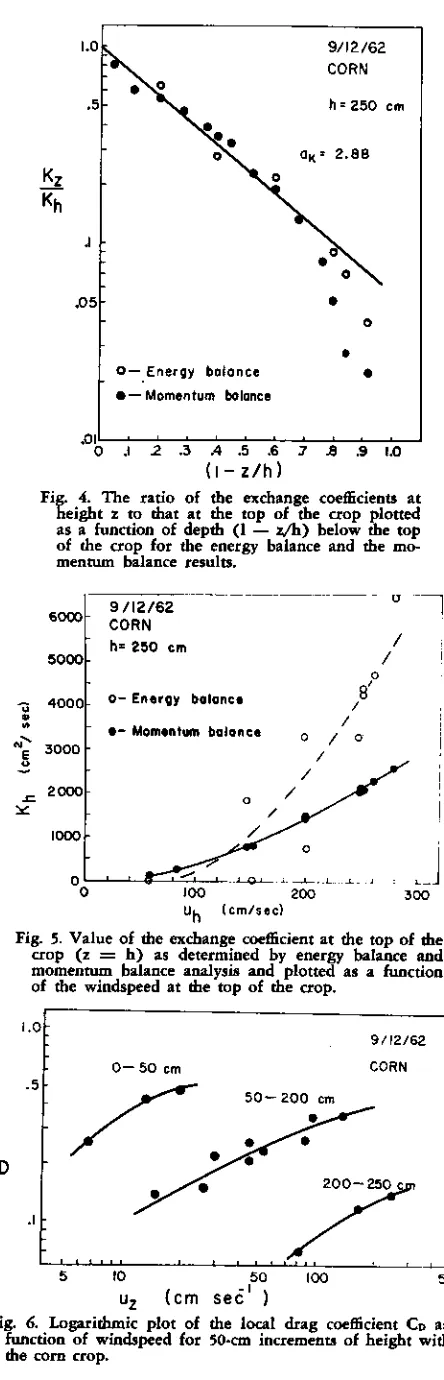
balance methods for the period 0900-1600 hours is shown in Fig. 4. Each point is the average of the respective normalized values for the 10-min profiles. In the upper 9/10 of the crop, the distribution shown in this figure fits the equation
K= Kb exp [ a (1 -z/h)] [10]
where "a" has a value of 2.88. The normalized distributions are nearly the same in the upper portion of the crop.
The absolute values of the transfer coefficient at the top of the crop as calculated by the two methods are shown as a function of windspeed at the top of the crop in Fig. 5. At the higher windspeeds, the K values calculated by the energy balance were nearly twice as large as those calcu-lated by the momentum balance.
A back calculation of the drag coefficient from equation [9], using the K values obtained from the energy balance analysis and the windspeeds actually measured, was made to check the accuracy of the assumption that C was constant with height. Values of CD were calculated for zones or increments of height of 50 cm for three representative windspeed profiles covering the range of windspeeds meas-ured on that day. The resulting Co values are plotted in Fig. 6 as a function of windspeed at the respective heights. The values grouped themselves into three distinct patterns, indicated by the best-fit lines drawn through them. The three groups correspond to the zone near the soil surface (0 to 50 cm), the zone containing the main portion of the corn crop rather uniform in nature (50 to 200 cm), and the zone containing the tasseled portion of the crop (200 to 250 cm). The group of points indicated as 50 to 200 cm contains the values for three separate 50-cm height zones and thus the nine points about the line. The close agreement of these nine points to the best-fit line indicated that the back-calculated drag coefficient C0 was essentially constant with height within the entire 50- to 200-cm zone for a given windspeed. The distinctly higher values for the 0- to 50-cm zone are reasonable because of the proximity of the soil surface. Also, the distinctly lower values for the 200- to 250-cm zone would be expected in this tasseled portion of the crop.
DISCUSSION
The agreement between the normalized distributions of K as determined by the two methods and yet the difference in the absolute values at higher windspeeds require some discussion. The agreement in the shape of the distributions and the agreement of the absolute values within a factor of two even at the higher windspeeds is encouraging, con-sidering the several required assumptions. It indicates that with refinement in technique and theory the two separate approaches may yield results in close agreement.
The energy balance method should be more precise under low windspeed conditions when the temperature and humidity gradients are greatest, whereas the momentum balance analysis should be more exact at the higher wind-speeds when forced convection predominates, turbulence is fully developed and the windspeed gradients are greatest. The energy balance K values, when used to calculate values of the shearing stress according to equation [8], yielded extremely high values at the higher windspeeds (9.75 dynes cm-2 for a uh of 300 cm sec- 1 ),
It is true that the momentum balance approach yielded a momentum transfer coefficient, whereas the energy balance
KZ Kh
.1
.05
0- Energy balance
_
• - Momentum balance
.01
0 .1 2 .3 A .5 .6 T .e .9 10 (I- Z/h)
Fig. 4. The ratio of the exchange coefficients at height z to that at the top of the crop plotted as a function of depth (1 — 1/10 below the top of the crop for the energy balance and the mo-mentum balance results.
CD
5 10
uz (cm Fig. 6. Logarithmic plot of
function of windspeed for
the corn crop.
50 100 500
sec l )
the local drag coefficient Co as a
WRIGHT at BROWN: MOMENTUM AND ENERGY BALANCE METHODS 431.
Table 2. Values of the Richardson number, Ri, computed for various times and heights within a corn crop.
Height, Richardson number at various times (EST)
em 0826 0935 1108 1200 1306 1402 1503 1908
226 -.006 -.002 -.002 -.004 -. 003 -. 003 008
175 125
-.012 4, 008
-, 009 -.039
-.010 -.029
-.029 055
-. 037 -.022
0.20
-.019 -.010 +, 029 75 +.068 +, 097 +, 058 4. 099 +. 106 +, 154 4.183 +.371
25 +,110 +.077 4.50 -F. 107 +.175 +.091 +.199 +.370
• Ri m1(erH8T/8zitiouie with actual tentperatare taken to be equal to the potential temperature became of the nearnese to the Surfloe,
yielded a combination of the sensible and latent heat ex-change coefficients. Though it is not expected that these coefficients are exactly equal, it is generally held that they are more nearly equal than would account for the differ-ences observed in this study for the existing conditions of stability. Webb (12) has reviewed the relatipnship of the exchange coefficients as dependent upon Richardson num-bers as a measure of stability conditions. According to his discussion, the Ri numbers obtained in this study as pre-sented in Table 2 would predict equality of the exchange coefficients, The results of Crawford (3) also imply that transfer coefficients for heat and vapor transfer should be equal under these conditions.
We realized at the outset that the assumption of the con-stancy of the drag coefficient with height and with wind-speed in the momentum balance analysis was not exactly valid. However, in the absence of more exact knowledge about the functional relationship of the drag coefficient C, this simplifying assumption permitted the solution of equa-tion [5]. Utilizing this assumpequa-tion for the entire crop in determining C by equation [6] should have resulted in an average value of C which, when used to determine values of Km, would produce results nearly the same as if the exact functional relationship of C had been used.
The results presented in Fig. 6 showing the drag coeffi-cient C D as a function of both windspeed and height within the crop are in actuality the type of results that would be
expected. As previously mentioned, these values of CD
were calculated by assuming the final results of the energy balance analysis to be correct and then calculating back to a drag coefficient.
As mentioned earlier, for flow past smooth, uniform ob-jects, the drag coefficient is relatively independent of wind-speed for fully developed turbulence. However, this holds only for solid objects when there is no deformation or change in shape with increasing windspeed. However, in the case of vegetation which is highly flexible, we know that there is a deformation and also a flapping of leaves and a
swaying of the entire plant associated with increasing wind-speed, The streamlining of the plant parts might be ex-pected to decrease the drag coefficient, but the relationship of surface and form drag would also change so that the overall result could well be an increase in the total drag coefficient. The flapping and swaying of the plant would certainly be expected to increase the total drag coefficient. The higher values of Cr, near the soil surface are reason-able inasmuch as in the calculation of Cr, it was assumed that all of the frictional resistance was due to the plant when, in fact, the ground surface itself would certainly present some frictional resistance. Also, a Reynolds num-ber effect would be expected in this zone of relatively low wind velocities and decreased turbulence.
In the upper tasseled portion of the crop, the lower values of Cr, could well be due to the shape and roughness characteristics of the tassels which might result in less frictional resistance per unit of exposed area than would be
the case for wide stalks and broad leaves, On the other hand, it may merely reflect that the area value used in the calculations was not the true representative surface area
presented by the tassels. The determination of such an area could well be the subject of much intensive investigation itself in the case of objects such as corn tassels.
The airflow conditions existing within the crop are not exactly similar to those existing in the usual wind tunnel determinations of drag coefficients for various bodies. In
these determinations, the bulk airflow is nearly uniform around a single object on which the drag is being meas-ured. Within the corn crop, on the other hand, there A definite velocity gradient in the bulk airflow. It is also possible that an interaction between leaves exists so that where there are several levels of drag surfaces the drag coefficient may increase with depth into the crop. The same leaf would therefore have different drag coefficients at different positions within the crop. Channeling of the air-flow can occur within the crop, especially if the wind direc-tion is parallel to the row orientadirec-tion. In this investigation,
however, the wind direction was essentially cross-row so this effect would have been minimal.
Proceeding to a discussion of other aspects of the anal-ysis of data, it should be mentioned that the determina-tion of the respective gradients in the case of both methods is a very crucial step. Slight differences in this phase of the analysis can have rather pronounced effects upon the final results. The slope determination is particularly complicated right at the top of the crop where conditions change rapidly with height.
The underestimation or overestimation of the total shear-ing stress at the top of the crop as determined by logarith-mic profile analysis is also a possible source of difference. A direct determination of the total drag would greatly im-prove the reliability of this portion of the analysis. A more precise measurement of the effective frictional surface area of the plant is needed in the momentum balance analysis, though this would improve the accuracy of the shape of the K profile within the crop rather than change appreciably the absolute value of K.
The disagreement in the lower portion of the crop could well be due to differences in the respective K's for heat, vapor, and momentum transfer, inasmuch as the Reynolds numbers are low in this zone and free convection can be significant at certain times of the day.
CONCLUSIONS
The shape of the normalized profiles of the transfer coefficient as determined by both the momentum balance and energy balance approaches was in good agreement. The normalized values as determined by the energy balance were
slightly larger near the soil surface. The values of the separately determined transfer coefficients agreed at the lower windspeeds, but at the higher windspeeds the energy balance yielded K values twice as large as the momentum balance values.
An absolute check on total drag or heat and vapor flux was not available. However, based on results reported in the literature, it seemed that the assumption of equivalency of the separate transfer coefficients was justified for the
432 AGRONOMY JOURNAL, VOL, 59, SEPTEMBER-OCTOBER 1967
windspeeds as evidenced by the extremely large shearing stress values predicted from these K values.
A comparison of these methods at a location where an absolute check is available, such as a lysimeter with capa-bilities of sensing weight changes and surface drag, is highly desirable. Though the results preclude quantitative determinations of beat and vapor flux and the extension to the calculation of carbon dioxide flux at this point, they do indicate that semi-quantitative assessments of these fluxes can be attempted with either method.
In the absence of high-speed recording means and sensi-tive anemometers, the energy balance approach is easier to apply.
LITERATURE CITED
1. BEGG, 3. E., J. F. BIERHUIZEN, E. R. LEMON, R. 0. SLATYER, and W. R. STERN. 1964. Diurnal energy and water exchanges in bulrush millet in an area of high solar radiation. Agr. Meteorol, 1:294-312.
2. BROWN, K. W., and W. COVEY. 1966. The energy-budget
evaluation of the micrometeorological transfer processes within
a corn field. Agr. Meteorol, 3:73-96.
3. CRAWFORD, T. V. 1965. Moisture transfer in free and forced convection. Quart. J. Roy. Meteorol. Soc. 91:18-27.
4, DENMEAD, 0. T. 1964. Evaporation sources and apparent
dif-fusivities in a forest canopy. J. Appl. Meteorol. 3:383-389.
5. FRITSCHEN, LEO 3. 1963. Construction and evaluation of a
miniature net radiometer. J. Appl. Meteorol. 2:165-172. 6. , and C. H. M. VAN BAVEL. 1962. Energy
bal-ance components of evaporating surfaces in arid lands. J. Geophy. Res. 67:5179-5185.
7. LETrAU, H. H. 1957. Computation of heat budget constituents
of the earth/air interface. p. 305-327. In H. H. Lettau and B. Davidson [ed.], Exploring the atmosphere's first mile, Perga-mon, N. Y., Vol. 1.
8. TANNER, C. B. 1960. Energy balance approach to evapotran-spiration from crops. Soil Sci. Soc. Am. Proc. 24:1-9. 9. ticIn jimA, Z. 1961. On characteristics of heat balance of water
layer under paddy plant cover. Bul. Nat. Inst. Agr. Sci. (Japan) Series A. No. 8:243-265.
10. . 1962. Studies on the microclimate within the plant communities. (1) On the turbulent transfer coefficient within plant layer. (In Japanese with English summary) J.
Agr. Meteorol. (Tokyo) 18:1-9.
11. , and J. L. WRIGHT. 1964. An experimental study of air flow in a corn plant-air layer. (In English with summary in Japanese) The Bul. of the Nat. Inst. of Agr. Sci.
(Japan) Series A. No. 11:19-66.
12. WEBB, E. K. 1965. Aerial microclimate, p. 27-53. In Agricul-tural meteorology, Meteorological Monographs, Vol. 6, No 28, Am. Meteorol. Soc., 45 Beacon Street, Boston, Massachusetts. 13. Wruoirr, 3. L., and E. R. LEMON. 1966. Photosynthesis under
field conditions. VIII. Analysis of windspeed fluctuation data to evaluate turbulent exchange within a corn crop. Agron. J. 58:255-261.