Volume 2, Issue 8, August 2013
Page 352
ABSTRACT
Computer users now faces new levels of risks, which needs more insurance because of the increasing use of networks, as well as the centralization of data in specific places, as well as increased reliance on information in the completion of a lot of work. Wrong use of computer systems could lead to many risks, and that the main purpose of this study is to investigate the existence of risks facing the computerized information system, as well as ways of prevention or at least reducing it.
Despite the importance of the subject of the information security, however, the organizations are not interested in developing specific policies to secure information; there are degrees of diversity in the extent of the importance of confidentiality of data contents and methods of information dissemination.
A survey was distributed to collect data from managers of information security in a sample of some financial institutions, which include five groups, banks, insurance companies, securities brokerage firms, Funds co and credit companies, and Money Transfer companies
The application of the study was on some of those selected organizations to identify the policies and procedures and methods used to secure information. As well as identifying the means of monitoring information security, and how to apply the standards to evaluate the effectiveness of information security.
Keywords: Information security, information privacy, information assets, information security policy
1.
Introduction
Policies and reactions toward securing information
With common increase to retrieve digital stored information, the traditional ways for securing information is specific to the sufficiency of the needs of the insurance and application of information systems. For many reasons, the protection of information leakage or unauthorized disclosure is necessary in the present time.
However, (Michael G. Solomon, Oct 7, 2009 ) there is a degree of resistance to secure information or spending on its expenditure
Assessing the value of this security is difficult since securing (Michael E. whitman, Jan 1, 2011) the Internet has become accompanying loss of values and substantially from the market value of the company during brief periods, accompanied by loss of huge amount of shareholders and relevant to destroy confidence in the management of the Organization. In practice in the companies that employ information security systems policy in such a strategic way, the broad range of implementing such policy must be directed to control any danger if it occurs.
Organizational aspects to secure information takes many (Nancy R. Kingsbury, may 1, 2011) trends, which is based on the different ways to evaluate the risks that are being developed to include risk factors and also the relevant quantitative measures used in risk management
The reaction (Umar, 2003) to procedures for securing information vary according to the different impact of information and how it could be compared with the information technology industry revenues as follows:
1.Emphasize the need for internal control to protect sensitive financial information stored in information technology systems in the Organization.
2.An emphasis on confidentiality and integrity of information to secure it against perceived risks, information integrity, unauthorized use of it or unwanted disclosure of the protected information.
3.A single factor could be considered not enough in trading transactions, which includes private information for clients or movements of funds.
2.
the research theoretical background
2.1 A general overview of information security and privacy
Controlling of information security (Herold, managing an information security and privacy Awareness and Training Program, Aug 24, 2010.) is the handling of the principles of the Organization conduct and ensuring that the system is in
Implementation of policies and reactions to
information security in financial organizations
Dr. Maha Mahmoud Talaat Mustafa
Volume 2, Issue 8, August 2013
Page 353
control in the levels of Executive Directors to provide strategic direction and confirmation of the completion of the objectives and overcome expected risks that must be managed and to optimize the use of resources.Therefore, the policy (Trcek, Jan 26, 2006) of securing that information must be a driving force in running Organization activities as a whole.
2.2 Policies, procedures and methods used to secure information
A general framework to secure information must developed as well as to be supplied in accordance with the best applications.
The use of certain security policy (Vacca, 2012) help in the prevention of interference and non-compliance
It also help users to interact effectively toward matters relating to security policy, as well as security policy process basic goal is the protection of information systems in the organization and allowing acceptable application of these policies, as well as emphasis on risk measures.
Organizations face different types of threats, and that the policies of securing information must be dedicated in accordance with the needs of the Organization to deal with:
Business activities.
The information environment.
Sources of information.
2.3 Auditing and Review procedures for securing information
The audit process enables the opportunity to retrieve the Risk Management (bidgoli, Mar 10, 2006) Program, as well as confirmation that the program has been done in a manner to be accurate, as well as to make sure that it has reduced or at least select what are the risks that can be exposed to the organization.
In addition, that review and audit (Jackson, Jun 2, 2010 )will be conducted based on the following:
Compatibility: Is the level of security control suitable for the Specific dangers.
2 - Implementation in a proper manner: Is the security monitoring in the right place? Moreover, the leader must make sure it works well.
Identifying the purpose of securing information: in other words, does the monitoring take place to secure the information effectively, as well as the potential risks is determined in order to prevent or at least reduce it.
2.4 Generally accepted standards to ensure information security 1- integrity
When information is valid, it means (Andress, Jul 16, 2011 ) that the information has a value, the primary purpose of securing information is to make sure that they have not been modified or erased or change in it with any way, whether they are stored in a storage media or be transferred across networks.
2-Privacy
Making sure that (Anupam Chander, 2008 ) the information is not disclosed to non-authorized, whether from inside or outside the Organization
3-Availability
Information systems assets must be made available to the authorized information systems persons when they need it. 4-Confidentiality
Emphasis (McCallister, 2010) on the participation of information only between authorized persons to do so
A breakthrough of secret data can occur if the data in a manner that does not include adequate protection of data confidentiality and information on the organization.
Disclosure of information can be done through hearing, printing, copying, electronic mail or penetrating documents, and that it is necessary to determine the degree of confidentiality of the information, as well as prevention measures.
5-authentications
Verification (Bill Ballad, Oct 22, 2010 ) is the process of confirmation of the identity of the user, so it is determined by the possibility of entering the system and the access to allowed services to him, and all forms of verification are to ensure that the user knows or has something private.
6- IT resources control
The information sources control, means, monitoring all the computers, display, and storage capacity, as well as the use of computer hardware, and the transfer of data between the client and server, networks and communications sources, In addition, procedures, equipment, facilities and software, as well as the data covered by the information system or any site that contains information for the Organization.
7-Responses to crisis or disasters
Volume 2, Issue 8, August 2013
Page 354
Where the expected scenarios for crises, as well as the resources required are well identified to overcome them and to determine the crises and reactions toward it, also deciding the required communication work, as well as how to end the crisis.2.5 Information security policy
I. Information System Assessment in the organization is done periodically.
II. Setting (Calder, Jul 1, 2009) the potential risks and how to avoid it before they occur. III. There must be a clear strategy to mitigate the danger after its occurrence
IV. Putting the necessary measures to reduce the effects of the danger.
V. The assessment is done every quarter of an hour at least to identify the things needed to secure private information using sources of information and thus reduce or at least reduce the danger.
VI. Identify the requirements needed to secure information on the basis of the outcome of the survey
VII.Clarifying which type of the information is considered confidential for the Organization and work to make a full insurance for it.
2.6 The definition of information security
Information security is the protection of information systems and information from unauthorized access, disclosure, usage, registration or making of imbalance, change, reading , inspection, registration or destruction of information.
3 The research Importance
With the increasing volume of information usage and high rates of identity theft, it is important to be cautious in the use of computers, especially if the computer is connected to a networks
Whether it is internal or external data transmission within the Organization or through the Internet, resulting in the need for information system for following-up the process of securing information within organizations, including supporting of the Organization objectives.
Therefore, the importance of research is run through the need for clear policy to secure information in the financial Organizations, which vary from one organization to another depending on the nature of the Organization work, as well as identifying ways to protect information assets from expected threats, which depends on:
The nature of the Organization activities.
The method of work through information systems.
Basic information technology environment.
The time required to develop a policy to secure information.
The criteria to be followed when designing a policy to secure information.
How to maintain information technology sources through a policy of information security.
3.1 The research problem
Exposure to attack toward information or information assets are exposed to the many institutions, in particular, financial institutions, because they are targeted.
This attack may be from within or from outside the organization, resulting in the need for a policy to secure information in such Organizations, which can be accessed from an information system to assess the success of the implementation policy of securing information and ensuring their safety.
With the increasing wireless connection and use of cloud computing, the exposure to information and the need to secure it is increasing, which requires the need for flexibility in the process of assessing the extent to which the possibility of following-up the process of securing information.
3.2 The research objectives
1.Identifying the steps and procedures necessary for the implementation of policies to secure information.
2.The design of information system to follow up the process of securing information in the financial Organizations. 3.Studying how to develop flowchart of information system to follow up threats and risks that faced by the Organization,
which may affect the Organization as a whole.
4.Measuring the effectiveness of information security policy
5.developing an information system for evaluating information security policy
3.3 The Research field
The Research field includes several key issues: 1-Identify Risks expected to information security. 2- Identify a way to assess expected risks.
Volume 2, Issue 8, August 2013
Page 355
3.4 Research SocietyResearch society, therefore Returns to, financial institutions that have been divided into a layers sample so as to include all financial institutions in Egypt, as follows:
Table no. shows the research sample
The institution name Financial institution category
No.
Cairo Bank Investment bank
1
Almohandes insurance` Insurance companies
2
Naeem Mena Growth Fund Funds co and credit companies
3
EFG Hermes Stock brokerage companies
4
Western union Money Transfer companies
5
3.5 The Research limitation
The research was applied in financial institutions in Egypt, so the questionnaire and interviews were suitable for data collection.
Data collection methods include: 1-Interview & questionnaire. 2-Field observations.
3-Document archives revised
Questionnaire design
The research Questionnaire was designed to capture the relevant data to current study, and its questions were revised on five – point likert scale
Data analysis
The Questionnaire was gathered from the respondents that participated in the Questionnaire, and the data were recorded and analyzed to test the research hypnosis
Research hypotheses
First hypothesis
H1: there is no differences between the expected information security policies in all financial institutions categories.
second hypothesis
H2: there is no differences between the total operating expenses on securing information in all financial institutions categories.
3.6 Research methodology 3.6.1 Sampling
The most suitable sampling techniques for the current research is Stratified sampling
In Stratified sampling - the population is divided into subpopulations (strata) and random samples are taken of each stratum
A stratified sample is a mini-reproduction of the population. Before sampling, the population is divided into characteristics of importance for the research.
Stratified samples are as good as or better than random samples, but they require a fairly detailed advance knowledge of the population characteristics, and therefore are more difficult to construct.
Proportional stratified sampling was used in this research where proportional stratified sampling is an equal probability sampling method that means that the subsamples are equal
Frequency Distributions Of Measures of IT Employee Perceptions Concerning First hypothesis questions
Table (1) Frequency Distributions Of Measures of IT Employee Perceptions Concerning the expected information security policies in the financial institution
serial
the expected information security
policySD D UD A SA mean median
1 The information security policy protects all the confidential information the institution
13 10 10 20 22 3.37 4.00
Volume 2, Issue 8, August 2013
Page 356
working conditions safer3 The information security policy enables exchanging data from remote locations safely
19 6 16 8 26 3.21 3.00
4 The information security policy solve many operational security problems.
12 5 14 18 26 3.55 4.00
5 The information security policy rules are clear and easy to be understood from all employees in the institutions.
15 15 10 15 20 3.13 4.00
6 The information security policy enables the cooperation among several department in different locations safely
16 9 6 23 21 3.32 4.00
7 The information security policy has an acceptable rules and guidelines for working activities from all involved parties.
23 10 6 9 17 2.96 3.00
8 According to Networks security policy the user would feel secure in exchanging information across networks at the institution by the private use of e-mail, passwords and social networking.
6 6 15 13 35 3.87 4.00
9
IT workers are aware with the
implemented
information security policy.20 12 7 11 25 3.12 4.00
10 According to data security policy the user would feel secure in data backup and restore, data handling and classification, data encryption and workstation locking.
18 12 5 6 34 3.35 4.00
11 There is no missing issue with regard to the institution information security system
7 15 13 11 29 3.53 4.00
12 The current approaches towards The information security system are well implemented
10 13 20 3 29 3.37 3.00
13 There is a plan for securing The information security system from the expected threats that may happen in the future.
11 9 13 13 29 3..53 4.00
14 The information security system can achieve its expected results successfully.
15 7 5 20 28 3.52 4.00
Values represent percentages
SD = Strongly Disagree; D = Disagree; UD = Undecided; A = Agree; SA = Strongly Agree
Frequency Distributions of Measures of IT Employee Perceptions Concerning second hypothesis questions
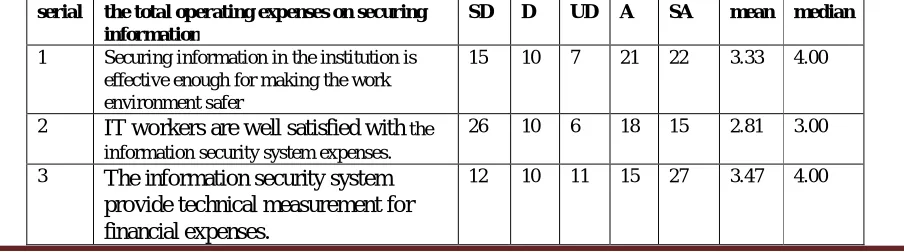
Table (2) Frequency Distributions of Measures of IT Employee Perceptions Concerning the total operating expenses on securing information in the financial institution
serial the total operating expenses on securing information
SD D UD A SA mean median
1 Securing information in the institution is effective enough for making the work environment safer
15 10 7 21 22 3.33 4.00
2
IT workers are well satisfied with
the information security system expenses.26 10 6 18 15 2.81 3.00
3
The information security system
provide technical measurement for
financial expenses.
Volume 2, Issue 8, August 2013
Page 357
4 The IT leadership make sure that theavailable infrastructure in the institution meets the needed standards for securing information.
12 11 8 9 35 3.59 4.00
5 IT workers develop regular tests to advance the productive use of information security system.
14 4 13 11 33 3.60 4.00
6 Information security responsibilities include the development of guidelines for the cost-effective security system.
10 10 10 12 33 3.64 4.00
7 The information security infrastructure ensures the confidentiality of critical information the institution
10 4 18 13 30 3.65 4.00
8 The information security infrastructure ensures the integrity of critical information the institution
15 14 7 12 27 3.29 4.00
9 The information security infrastructure ensures the availability of critical information the institution
13 4 7 21 30 3.68 4.00
10 The information security infrastructure provide , operating, and control of an effective mix of management, planning the information security system
23 14 5 11 22 2.93 3.00
11 The information security system total expenses is faire.
11 11 10 23 20 3.40 4.00
12 The information security system worth spending the current total expenses for it.
12 15 13 7 28 3.32 3.00
Values represent percentages
SD = Strongly Disagree; D = Disagree; UD = Undecided; A = Agree; SA = Strongly Agree
3.6.2 Statistical method
Participants were divided into categories based on the financial institution category
Responses of participants in each of these categories were compared using one-way ANOVA. This study showed that, among participants overall, investment banks was highly stigmatized. (ANOVA) showed that the differences between the five research categories
3.6.3 Hypotheses Testing
To test the research hypothesis, one-way analysis of variance ANOVA model was used, where the summation for each answers of a sample questions was taken of the existing institution in the sample.
The data were analyzed using the statistical program SPSS/PC and the degree of significance was 5%
Finally, the test of the result was significant, meaning that the alternative hypothesis for both hypotheses was accepted and null hypothesis was refused.
First hypothesis
There is no differences between the expected information security policies in all financial institutions categories. Null hypothesis
There is no differences between the expected information security policies in all financial institutions categories. The alternative hypothesis
There is a difference between the expected information security policies in all financial institutions categories. The ANOVA analyses of variance table for the first hypothesis the first is as follows:
Analysis of variance ANOVA table for the testing of the first hypothesis Source of
variation
Sum of Squares
df Mean square F Sig.
Between Groups
5321.503 4 1330.376 13.387 0.00
Within Groups 6956.684 70 99.381
Volume 2, Issue 8, August 2013
Page 358
The second hypothesisThere is no differences between the total operating expenses on securing information in all financial institutions categories.
Null hypothesis
There is no differences between the total operating expenses on securing information in all financial institutions categories..
The alternative hypothesis
There is a difference between the total operating expenses on securing information in all financial institutions categories.
The ANOVA analysis of variance table for the second hypothesis was as follows: Analysis of variance ANOVA table for testing of the second hypothesis
Source of variation
Sum of Squares df Mean Square F Sig.
Between Groups
4081.299 4 1020.325 10.760 0.00
Within Groups 6637.822 70 94.826
Total 10719.120 74
Volume 2, Issue 8, August 2013
Page 359
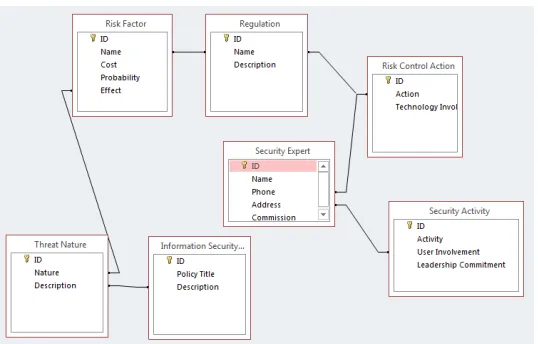
The information security policy evaluation system Inputs Risk factor ( ID, Name, Cost, Probability, Effect )
Threat Nature ( ID, Nature, Description )
Information Security Policy ( ID, Policy Title, Description )
Regulation ( ID, Name, Description )
Risk Control Action ( ID, Action, Technology Involvement )
Security Expert ( ID, Name, Phone, Address, Commission )
Security Activity ( ID, Activity, User Involvement, Leadership Commitment )
Figure No. (1) proposed system relationships
Figure No. (2) proposed system interface
Volume 2, Issue 8, August 2013
Page 360
Results
and
recommendations
recommendations results
serial
The definition of each employee responsibilities and roles must be identified before starting any work activities.
The roles and responsibilities of each employee in relation to information security has to be defined before starting the daily activities. 1
Starting training courses and seminars to the employees on information security.
Employees aren’t aware with the importance of information security policy
2
Insuring that messages among employees were effectively communicated.
The effective communications among employees plays an important role in preventing
information risks or threats. 3
An information security policy must be designed to protect the organizational information assets.
It is important to have an information security policy.
4
There is a need to evaluate the
information security policy periodically to insure that it is suitable for the organization.
The changing IT environment made the information security policy implementation complex.
5
The must recognize and react to any attack may suddenly happen Any attack would happen suddenly
6
IT workers must understand incidents and how they relate to the IS security policy
The incidents approach is not clear 7
There must be a plan for the immediate response to the security incidents. There is no plan for responding to information
incidents 8
The information system evaluation system must identify common types of system attacks.
The common types of system attacks is not identified
9
Acknowledgement
The researcher is grateful to all information technology professionals who gave her some of their time to answer the research questions and to improve the proposed information system. In addition, special thanks to all her colleagues who encouraged her and IT workers in the financial institutions for providing her with the data needed for completing the current research.
References
[1] Andress, J. (Jul 16, 2011 ). The Basics of Information Security: Understanding the Fundamentals of InfoSec in Theory and Practice -. Elsevier, .
[2] Anupam Chander, L. G. (2008 ). Securing Privacy in the Internet Age -. Stanford University Press, .
[3] bidgoli, h. (Mar 10, 2006). -Handbook of information security, will help, vulnerabilities, prevention, detection, and management. John wiley & Sons.
[4] Bill Ballad, T. B. (Oct 22, 2010 ). Access Control, Authentication, and Public Key Infrastructure . Jones & Bartlett Publishers.
[5] Calder, A. ( Jul 1, 2009). Information Security Based on ISO 27001/ISO 27002: A Management Guide. Van Haren Publishing, .
[6] Herold, R. (Aug 24, 2010.). managing an information security and privacy Awareness and Training Program. second edition, CRC press.
[7] Herold, R. (Aug 24, 2010.). managing an information security and privacy Awareness and Training Program. second edition, CRC press.
[8] Jackson, C. (Jun 2, 2010 ). Network Security Auditing. Cisco Press, .
[9] jennex, M. E. (2011). gave response and management and emerging information systems: Critical Applications. (San Diego State University, USA).
[10]McCallister, E. (2010). Guide to Protecting the Confidentiality of Personally Identifiable Information. DIANE Publishing.
[11]Michael E. whitman, H. J. (Jan 1, 2011). principles of Information Security. cengage learning, .
Volume 2, Issue 8, August 2013
Page 361
[13]Nancy R. Kingsbury, N. R. (may 1, 2011). -Information Security: IRS needs to enhance internal control overfinancial reporting and taxpayer data. Diane publishing, .
[14]Trcek, D. (Jan 26, 2006). Managing Information Systems Security and Privacy. Springer, . [15]Umar, A. ( 2003). Information Security and Auditing in the Digital Age . nge solutions, inc,. [16]Vacca, J. R. ( 2012). Computer and Information Security Handbook. Newnes, Nov 5,.