An Exploratory Study to Examine Big Data
Application on Services and SCM
Satya Shah Off Campus/Institute of
Management University of Bolton Bolton, United Kingdom
Anastasia Theodosoulaki Department of Business and
Management New York College
Athens, Greece [email protected]
Abstract— This research study aims to examine the importance of Big Data applications with a specific focus towards services and supply chain management, then just the standard dimension focus on marketing. Although big data is generally accepted as still being in its infancy, it has many applications. For instance, in Logistics, Healthcare, Banking & Finance and it has changed the way of traditional operation in these fields. The paper aims to use literature studies as a knowledge platform in investigating the use of Big Data and Big Data Analytics within services and supply chain environments. The value of this research study is to examine the concept of Big Data within the dimension of supply chain and service management. This study is at its preliminary stages of the research project, and the researcher aims to further investigate the use of big data adoption within service/supply chain manufacturing industry. The findings and early analysis of this research study can be referred by researchers when addressing the use of Big Data adoption within Supply Chain environments.
Keywords— big data (BD), supply chain management (SCM), big data analytics (SCA), data analytics, and service management
I. INTRODUCTION
Big Data is defined as vast and complex quantities of data being created due to the latest technological advancements and is constantly rising in numbers so that it becomes difficult to be stored, processed, and analysed from current database systems, storage methods and data processing applications, let alone make use of the value contained in that information [1, 2, 3, 4]. Big data is so voluminous that it overwhelms the technologies of the day and challenges experts to create new storage tools and techniques [3]. Big Data is not a new concept. In fact, it is existed since 1997 where it was first being acknowledged [2, 5]. From this time onwards, it has drawn great attention to academia, researchers, and specialists as big data has been described as the next “big thing” [6]. To put it in numbers, in 2012 the worldwide amount of data being produced surpassed 2.8 Zettabytes (1 ZB = 10007bytes= 1 trillion gigabytes) and in 2016 the amount of world’s data was depicted as equivalent to a two-lane highway connecting Tokyo to San Francisco. Researchers predict that by 2020 the total amount of data being produced will be multiplied by 50 times. From all this vast amount of data, just the small amount of 0.5% can efficiently leveraged and used; when at least 33% of this information could be useful if it was appropriately addressed and analysed
[1]. The study aims to investigate relevant literature on the concepts of big data and its applicability towards service and supply chain management areas in industry. The study is a preliminary attempt for the research project to develop a thorough understanding of the topic to further enable the researchers develop a more robust methodology within the research, through use of multiple case study-based analysis on qualitative aspect and examining the benefits of these emerging technologies within wider supply chain concepts.
II. LITERATURE REVIEW
The section aims to provide the strong foundation knowledge of some of the existing theories and platforms towards the key elements of the research, including the wider understanding of the big data concepts and big data analytics, the application and technological dimensions and finally that of its applicability and adoption within the supply chain networks. Based on this literature studies, the researchers aim to review and identify core research gaps within this field allowing the future development of preliminary framework and the adoption of case study approach within the research. The study on the interdependencies and that of interrelationships between these research components enables the researchers to design and develop an effective and robust framework towards the research, which will be fully analysed and adopted within the industry in future.
A. Overview of Big Data
data makes its way through the store via RFID and GPS [10]. Big Data is often defined by the 3 V’s of Volume, Velocity and Variety which makes its approach to be holistically managed quite challenging. These were later to be expanded into the 5 V’s, with Veracity and Value being added [8, 6].
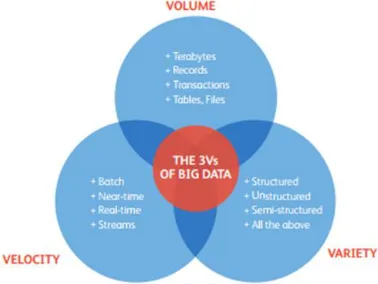
Many of the earlier studies within the areas of Big Data have focussed and used the 3V model as a framework towards the adoption and implementation of big data. The model identifies three main features as volume, velocity and variety towards defining big data. Firstly, volume refers towards the generation or collection of different amounts of data by an organisation or an individual. Many of the manufacturing companies and that of retail organisations gather huge amounts of data from customers, suppliers, providers, and operations to improve their performance measures. This also allows them to customise actions and offerings towards suitable produces and services to the end consumer. Secondly, velocity is more associated to the speed with which the data arrives and how that data is processed and delivered. The velocity of any data generation is raised through time. Researchers also consider velocity as more subjective than volume for many of the applications [11, 12]. Finally, variety is referred to as different types and forms of data. Data could be produced, stored and retrieved in different formats. As more organisations and that of its associated activities are now digitised, new sources of information are derived and hence, different techniques and methods are required for these types of data. Figure 1 represents a simple illustration of the 3Vs model of big data.
Fig.1. The 3Vs of Big Data. Volume, Velocity and Variety.
These are considered as the key dimensions of big data through previous research studies. In addition to the three Vs, many other researchers have been extending this over time. For example, IBM added veracity as a fourth dimension [12] that referred to the trustworthiness of the data. As the number of resources is growing, factors such as unreliability and inaccuracy is evident in some sources of data as well. Variability and complexity were introduced by SAS as further two additional dimensions. While variability refers to the variation within the flow of data, complexity refers towards the fact that all big data are generated through innumerable sources [13]. Finally, many previous studies and more recent studies the definition and that of dimension of big data has also been advancing.
B. Supply Chain Analytics (SCA)
Companies are faced with the risen necessity to create the appropriate methods in order to acquire the value enclosed in the magnitude of data “pouring down” on them and use it as a highly effective, advantageous, and competitive tool. Driven from this necessity, a new concept linked to big data was created, the Big Data Analytics (BDA) or also known as Big Data Business Analytics (BDBA) [14].
TABLE I
BDA TECHNOLOGIES AND RELEVANT SERVICES TO SCM Cat. Definition Tools and Techniques Applications in
SCM D esc ri p ti v e A n a ly ti cs Uses standardized, traditional methods of analysis and it targets areas like problem and opportunity identification in already existing processing mechanism [2, 14] ✓ OLAP
✓ Visualization tools drawing information from RFID, GPS, Barcode transactions [2, 14]
Processing Data through:
✓ Clustering
✓ Cloud sourcing technology
✓ Hadoop
✓ Map-reduce
✓ Apache ✓ MDMS [4]
Company’ s: ▪ Historical records ▪ Production ▪ Sales ▪ Finance ▪ Inventory ▪ Customer transactions-behavior [2] P re d ic ti v e A n a ly ti cs
Uses algorithms and mathematical programming in order to identify patterns hidden in the data and make predictions of what might happen in the future according with the findings [2, 14]. Is considered to be an asset in regards to risk factors involved and fraud detection [8].
✓ Algorithms
✓ Data mining
✓ Machine learning
✓ Simulation and Programming
✓ Meta-heuristic method [2, 14]
▪ Prediction of customer behavior
▪ Transaction patterns
▪ Prediction of sale activities
▪ Prediction of supply and demand from operations and inventory history [2]
▪ Detection of risk and fraud
▪ Support in maintenance & productivity [8] P re sc ri p ti v e A n a ly ti cs
Uses the other two categories of analytics in order
to draw
conclusions that can lead to alternative decisions making. Prescriptive analytics is rather complicated to execute, but once implemented daily, decision making,
production and inventory will be optimized to the fullest [8, 2, 14].
According to [14], Big Data is defined as the capacity to holistically analyze the data filtered in all the 5 V’s dimensions. On the other side, Big Data Analytics is acknowledged by the capacity to process, analyze, add value, measure performance, create competitive advantages from this data and help decision makers to act accordingly and not merely on intuition [8, 14, 5, 6]. As research describes, BDA has to do with the identification of patterns and hidden linkages deriving from vast amount of data that will help companies gain insight of the value concealed in it and manage to reap the economic benefits from it [2]. The methods used to obtain such assets from the data include data mining, visualization and simulation techniques, statistics, econometrics and many more [14]. The use of analytics and the techniques of visualization to appropriately handle supply and demand, is not a new thing for supply chain management as business analytics is highly connected to SCM performance [2].
Therefore, with the exponential growth of big data and the strong correlation of supply chain with advanced analytics, the term supply chain analytics (SCA) was established (Wang et al., 2016a). While the SCA is widely accepted of still being in its infancy, academia and professionals break it down into 3 main categories: descriptive, predictive and prescriptive analytics, that provide a variety of services in SCM as shown in Table I.
C. Application of Big Data Analytics (BDA) in Supply Chain Management
Strategic sourcing is the company’s longstanding
cooperation with suppliers. This cooperation affects decision-making that engages with company’s expenses, delivery methods and product value. It is a two-way interaction that establishes strategies to both enhance supplier’s performance and company’s economic performance while minimizing expenditure for both parties [14]. The application of SCA in strategic sourcing can be performed through the analysis of supplier’s economic performance, company’s expenditure and investment patterns, market trends and demand prediction. An additional advantage in strategic sourcing with SCA could definitely be the ability to evaluate available suppliers and come to an agreement with the best. For instance, suppliers that do not meet demand due to not providing services and products on time or being regularly late on delivery, would have high numbers of stock available in inventory [14]. Big Data Analytics is in a position to provide insight in Return on Investment (ROI) and perform thorough investigations on possible future partners-suppliers [2]. It also provides the opportunity for benchmarking company’s best implementation techniques and evaluates performance in order for new goals to be established. SCA can forecast possible factors that could lead to supply delay and recognize possible risks and uncertainties. For example, this can be achieved by forecasting possible extreme weather conditions that could slow down the delivery process [14].
Network design falls under the decision-making spectrum
and how supply chain could physically be shaped in regards to infrastructure (warehouses, manufacturing facilities, stocking, and shipping nodes among facilities and retailers). SCA is capable of performing network design both when demand is
certain and when demand varies or involves uncertainties. The first can be performed through a mixed-integer linear programming and the latter by creating a more complex network design deriving from advanced optimization techniques [14].
Product Design and Development is a highly competitive
part in supply chain management. Companies have to provide products that are both reliable and of high standards [2, 14]. So here lies the challenge of minimizing company’s expenditure while providing products of high quality that meet customer’s expectations and demands. An important fact that also needs to be considered in this is innovation; bringing something new and competitive into the market. SCA role in this lies in the analysis and evaluation of customer behavior and purchasing history that could help designers better comprehend customer’s demands [2]. In addition big data analytics is in a position to predict the outcome of many plausible scenarios, to analyze the possible impact of the product design, as well as, which design is the one best meeting customers’ demands regarding quality; while also keeping the cost for the company to the minimum. Demand planning has to do with prediction, sales and operation activities. Connecting predictions of demand with sales and operation adds important value that will become an asset for marketing, production and inventory [14]. Demand planning analyzes among others customer behavior, traffic and weather. Through customer behavior, big data analytics can anticipate demand, range of desirable price and many more, while through forecasting weather and traffic, delivery disruption and maintenance issues can be detected and avoided [2]. Big data analytics in procurement engage mostly in the field of risk and supplier’s performance management. So the category of analytics that plays a leading part in procurements is predictive analytics [2]. Predictive analytics are making use of both internal and external data here like data collected and analyzed from a variety of sources like the social media and the news connected with suppliers and the supply market. This real-time monitoring of data provides full insight and flexibility , while also giving the opportunity to adjust to the new market trends and act accordingly [14].
(Tiwari et al., 2017). As the sources linked to logistics and distribution networks (GPR-tracking devices, RFID tags, mobile devices, etc.) increase, so does the data deriving from them [8]. Because of the uncertainty aspect involved in this sector predictive analytics tools play a vital role so as to enable flexibility into the sector. SCA is highly used in order to identify the best route, vehicle capacity, delivery and collection times, vehicles maintenance, staff resting times and many more [14].
With all the above mentioned applications of big data analytics in supply chain management, it is more than evident that, the advantages of installation of such analytic techniques are tremendous. Big data provides enterprises the opportunity to find insight in new and emerging types of data. In other words, it gives full insight not only of the enterprises own business but also of their customers and partners, e.g. suppliers. By leveraging bid data analytics in SCM some of the benefits to be gained include, improving company’s performance and customer service, accurate prediction of demand, demand increase and expenditure decrease, responsiveness to current and new market trends, improvement of product design and overall optimization of company’s decision-making techniques [2, 14, 15]. Last but not least, leveraging big data analytics could be a powerful tool for SC stakeholders, as crucial information can be shared among them and therefore increase insight of how to place the company in an advantageous position as well as warn them of potential risks and fraud [6]. However, leveraging big data is not an easy task. In the contrary, it is highly expensive and requires some time before the profits of the investment become evident. As mentioned before, in order for big data to be stored and analyzed, appropriate storage databases, as well as analytic tools and techniques are required [14]. Some other issues that can lead to hesitation of implementing big data analytics are inadequate resources, lack of knowledge (untrained, inexperienced staff, incapability data interpretation), security and privacy matters (e.g. hacking, credit cards theft, illegal access to systems, etc.), lack of policies and governance, velocity [8, 15]. As far as the latter is concerned, traditional networks are incapable of providing adequate big data transmission signals and as a result the experience of waiting in front of a web page before it loads is quite common. So, new high-frequency networks are highly demanded [5].
III. RESEARCH GAPS
The study has aimed to identify some core research gaps towards the adoption and implementation of the big data technologies within entire supply chain environment. It has been evident through research studies and that of examples from the industry that many companies are finding difficulties towards balancing the opportunities vs. that of the threats of adopting big data functionality within their respective environments and considering it as a key strategy within the technological developments. It has been shown many times that companies should consider that they require new and advanced technology resources at the starting phase of the implementation. Research has highlighted that there is a negative misconception that acquisition and implementation of the most advanced and expensive technology within the environment will provide higher functionality and benefits,
either on short term or long-term performance measures. Hence, our study aims to address some key founding research gaps that will prove to be beneficial for companies considering the adoption of big data functionalities within their environments, or likewise future researchers to develop these as the foundation of their respective studies within this context. ▪ Investment and Resources – Big Data requires investment and resourcing, not just in terms of the technology, but human and other technical resources; ▪ Strategic Direction and Objectives – companies should
also aim to align the implementation and change as the core aspect of their objectives and direction for future; ▪ Short Term vs. Long Term – firms should clearly assign
and develop both short-term advantages and long term goals that will benefit the company through the implementation;
▪ Data Driven and/or Knowledge Driven – the difference in priorities and that of the functionalities of the systems allows the companies to benefit equally through the classification of the data and that of the knowledge; ▪ Global Interaction and Change Management – the
implementation should be considered and observed as a continuous change process, both internal and external facing environments of the organisation.
IV. CONCLUSION AND FUTURE RESEARCH
literature studies and that of the implications on the advantages of big data utilization within supply chain, the researchers will enable more robust and practical strategies towards the implementation and adoption of big data technologies.
REFERENCES
[1] Jain, A.D.S., Mehta, I., Mitra, J. and Agrawal, S., 2017. Application of big data in supply chain management. Materials Today: Proceedings, 4(2), pp.1106-1115.
[2] Tiwari, S., Wee, H.M. and Daryanto, Y., 2018. Big data analytics in supply chain management between 2010 and 2016: Insights to industries. Computers & Industrial Engineering, 115, pp.319-330. [3] Witkowski, K., 2017. Internet of things, big data, industry 4.0–
Innovative solutions in logistics and supply chains management. Procedia Engineering, 182, pp.763-769.
[4] Addo-Tenkorang, R. and Helo, P.T., 2016. Big data applications in operations/supply-chain management: A literature review. Computers & Industrial Engineering, 101, pp.528-543.
[5] Zhong, R.Y., Newman, S.T., Huang, G.Q. and Lan, S., 2016. Big Data for supply chain management in the service and manufacturing sectors: Challenges, opportunities, and future perspectives. Computers & Industrial Engineering, 101, pp.572-591.
[6] Wamba, S.F., Akter, S., Edwards, A., Chopin, G. and Gnanzou, D., 2015. How ‘big data’can make big impact: Findings from a systematic review and a longitudinal case study. International Journal of Production Economics, 165, pp.234-246.
[7] Brinch, M., Stentoft, J. and Jensen, J.K., 2017, January. Big data and its applications in Supply Chain Management: findings from a Delphi Study. In Proceedings of the 50th Hawaii International Conference on System Sciences.
[8] Arunachalam, D., Kumar, N. and Kawalek, J.P., 2018. Understanding big data analytics capabilities in supply chain management: Unravelling the issues, challenges and implications for practice. Transportation Research Part E: Logistics and Transportation Review, 114, pp.416-436.
[9] Bradlow, E.T., Gangwar, M., Kopalle, P. and Voleti, S., 2017. The role of big data and predictive analytics in retailing. Journal of Retailing, 93(1), pp.79-95.
[10] Venkatesan, R. and Kumar, V., 2004. A customer lifetime value framework for customer selection and resource allocation strategy. Journal of marketing, 68(4), pp.106-125.
[11] McAfee, A., Brynjolfsson, E., Davenport, T.H., Patil, D.J. and Barton, D., 2012. Big data: the management revolution. Harvard business review, 90(10), pp.60-68.
[12] Lee, I., 2017. Big data: Dimensions, evolution, impacts, and challenges. Business Horizons, 60(3), pp.293-303.
[13] Gandomi, A. and Haider, M., 2015. Beyond the hype: Big data concepts, methods, and analytics. International Journal of Information Management, 35(2), pp.137-144.
[14] Wang, G., Gunasekaran, A., Ngai, E.W. and Papadopoulos, T., 2016. Big data analytics in logistics and supply chain management: Certain investigations for research and applications. International Journal of Production Economics, 176, pp.98-110.