Full Terms & Conditions of access and use can be found at
http://www.tandfonline.com/action/journalInformation?journalCode=cthe20
Download by: [86.12.115.137] Date: 02 January 2018, At: 00:11
ISSN: 1356-2517 (Print) 1470-1294 (Online) Journal homepage: http://www.tandfonline.com/loi/cthe20
Doing, being, becoming: a historical appraisal of
the modalities of project-based learning
Roy Hanney
To cite this article: Roy Hanney (2018): Doing, being, becoming: a historical appraisal
of the modalities of project-based learning, Teaching in Higher Education, DOI: 10.1080/13562517.2017.1421628
To link to this article: https://doi.org/10.1080/13562517.2017.1421628
Published online: 01 Jan 2018.
Submit your article to this journal
View related articles
Doing, being, becoming: a historical appraisal of the
modalities of project-based learning
Roy Hanney
School of Media Arts & Technology, Southampton Solent University, Southampton, UK
ABSTRACT
Any pedagogy of media practice sits at the intersection between training for employment and education for critical thinking. As such, the use of projects is a primary means of structuring learning experiences as a means of mirroring professional practice. Yet, our understanding of the nature of projects and of project-based learning is arguably under-theorised and largely taken for granted. This paper attempts to address this issue through a synthesis of the literature from organisational studies and experiential learning. The article aims to shift the debate around project-based learning away from an instrumentalist agenda, to one that considers the social context and lived experience of projects and re-conceptualises projects as ontological modalities of doing, being and becoming. In this way, the article aims to provide a means for thinking about the use of project-based learning within the media practice curriculum that draws on metaphors of discovery, rather than of construction.
ARTICLE HISTORY
Received 25 March 2017 Accepted 12 December 2017
KEYWORDS
Project; project-based; learning; ontology; doing; being; becoming
A rationale for the study of project-based learning
Organising, planning, strategizing; these kinds of activities are not new, they have been a part of the human cycle of life since we began arranging ourselves into complex societies. Indeed, some have argued that even before the advent of complex social systems humans have organised themselves in ways which would nowadays be considered asprojects. It is a word that is in common use. It has professional, business and common-sense contexts for its adoption into common speech. How often do we hear this word in conversation? People ask each other ‘what is your latest project’? A project can be something you do as a hobby, it can be something you do as a professional. It can refer to activities under-taken in the creative industries just as much as in finance, engineering and science, to name but a few. In contemporary society the idea of a project has become so increasingly co-opted as a form of organisation to the extent that some have started to refer to the
pro-jectification of society(Lundin and Söderholm1998; Maylor et al.2006; Packendorff and
Lindgren2014).
In higher education, especially in creative and practice-based subjects, it is common to adopt an approach to learning and teaching calledproject-based learning. Students work
© 2017 Informa UK Limited, trading as Taylor & Francis Group
CONTACT Roy Hanney [email protected] School of Media Arts & Technology, Southampton Solent Uni-versity, East Park Terrace, Southampton SO14 0YN, UK
on projects and we even consider projects as units of assessment. We value the fact that projects have a professional context. We attempt to mirror this for the benefit of the stu-dents, who are expected to adopt ways of working and interacting that reflect thereal
world of work. A world it seems, that is filled with projects. We see the use of projects
in education across a wide range of subject areas, where project-based learningis often selected from a range of pedagogic options in order to deliver particular kinds of learning experience, knowledge or skills. Project working in media practice is, however, not selected through choice. It comes with the territory. Indeed, project working is the very essence of practice in the professional realm, where you cannot separate out theproject workingfrom the practice of media.
Though, as has been argued elsewhere (Hanney2016), carrying out media practice pro-jects in the professional field is very different to undertaking them in an educational setting. It has been suggested that the recontextualisation of practice from the professional to the educational transforms that practice (Bernstein2000; Garraway2005). Such that, while in the professional setting we may do projects, in the educational setting we do
project-based learningand, it is argued, these are two very different manifestations of prac-tice. In order to understand the difference between these two categories of practice it is necessary to understand the nature of a project as phenomena. We need to unpick all we know about projects and ask some very basic questions about the assumptions we make about them (Linehan and Kavanagh2006, 51). Only then might it be possible to the-orise a sufficient, or optimal, methodology for the use of projects in an educational setting. With this in mind this article draws on the work of Giddens (1990,1991) in order to undertake a genealogical investigation into the historical, social and cultural roots of the concept of a project. The aim here is not to verify theoriginsof the concept but to engage in a process of de-reification that offers a critical view of the complexity around the idea of a project. The article argues for a conception of a project as more than a collection of tools, techniques and procedures but as a practice born of a particular set of historical, social and cultural factors. In this way, the article aims to position the differing manifestations of
project-based learningas ontological modes ofdoing, being and becoming.
The article begins by first defining the difficulty of theorising the object of study, before going on to explore the concept of ontological modalities, offering along the way some ter-minological definitions. This is followed by a brief analysis for each of the proposed onto-logical modes along with a description of the social and cultural manifestations that are typical of each. The final section of the paper draws conclusions from this analysis and reflects on the ways in which the proposed project modalities of doing, being and becom-ing might impact on educators’thinking about projects. In doing so, it hopes to provide a foundation for understandingproject-based learningas more than an instrumental frame-work for organising activity, but as a pedagogy of/for practice.
The difficulty of theorising the object of study
As a starting point this article positionsproject-based learningas a subset of experiential learning, following a claim often attributed to Aristotle (2001) that‘the things we have to learn before doing them, we learn by doing them’. More recent literature (see Moon2004) suggests that experiential learning occurs through a process of reflection on the actions and interactions that come about through experience, leading towards a refinement of
judgements of choice and future action. For Moon and others, experiential learning is analytical, immersive and requires learners to be participant both cognitively and affec-tively. It develops not only skills and knowledge but attitudes, values and behaviours (Hoover and Whitehead1975, 25). Champions ofproject-based learningmight well recog-nise these characteristics as ones that align with their own values as educators. Yet it is unclear quite howproject-based learningachieves these aims beyond the construction of a framework for busy-working or in other words, work that keeps us busy but serves little value. In fact, a review of the literature on the subject reveals that currently
project-based learning is under-theorised and (see Helle, Tynjälä, and Olkinuora 2006)
largely confined to‘how-to manuals’ which largely present project-based learningas an administrative framework rather than as an approach that fosters a personal transform-ation in the learner.
Gauthier and Ika (2012) argue that if educators want to truly understand the nature of projects and the ways in which learners do projects, there is an implicit need to identify and theorise an object of study. They go onto to suggest that for the purposes of analytical investigation there is a need to make some pre-suppositions, or in their words‘ontological commitments’(Gauthier and Ika2012, 7), about the nature of this object of study. There is a need to make a commitment to a concept of a project as an ontological experience so that it is possible to move forward and begin to ask‘what it is we do when we do this thing called a project’(Hodgson and Cicmil2006a, 32). To answer such a question, it is necess-ary to be able to draw on a working definition of the object of study. Nevertheless, a review of the literature from the field oforganisational studieswould suggest there is no unified approach to the study of projects and the related concept of doing projects (Engwall2003; Gauthier and Ika2012; Hodgson and Cicmil2006a). The general view of projects is an instrumentalist one that has developed from a practitioner-evolved normative theory based around universal standards and exemplars of management practice. In other words, the focus is on the understanding of a project as an administrative framework rather than of a project as a practice.
In their exhaustive meta-analysis of published research on the topic, Helle, Tynjälä, and Olkinuora (2006) set out to ask fundamental questions about the nature ofproject-based learning, the pedagogical or psychological motives supporting it, and to evaluate the evi-dence of its impact on learning (Helle, Tynjälä, and Olkinuora2006, 288). The results of their analysis suggest that psychological and socio-constructivist elaborations on these questions are largely missing from the available literature which is focused loosely around course descriptions (Helle, Tynjälä, and Olkinuora2006, 288). Again, they find the literature is typified by a practitioner-evolved normative theory in which project methods are adopted from an imagined professional practice, or from common sense understandings of the nature of a project. It appears then, that custom and practice forms the basis of a folkloric body of knowledge that attaches itself to a notion of pro-fessional authenticity for legitimisation.
This would seemingly leave educators open to critique since arguably, if they are unable to theorise the practice of projects, they may well undervalue the benefit of this pedagogic approach and may mis-recognise the learning that occurs though participation in projects. Thus, there is still a need to ask questions about thewhatof projects before thehowof project working can be explored.
Framing the ontological modalities of project-based learning
Given the difficulty with theorisingproject-based learning, it is argued here that there is a need to return to core principles in order to understand the nature of the object of study. In order to pursue such an enquiry, it is first necessary to establish a set of ontological commitments. It can be said that there needs to be an agreement to address the subject domain from a particular point of view; a commitment to the use of a common terminol-ogy and a set of core concepts with which to think about project working as an experiential practice. Since, beyond this there are no pre-requisites, it is possible to start at the begin-ning and build from there and ask fundamental questions about the principles and con-cepts that underpin the notion of a project. The argument presented here takes the point of view that while project management might be a model, project working is a practice. Though its forms and manifestations may be shaped by models of management, as a prac-tice it is a lived experience that emerges from a complex of social relations. As such it has an ontological quality and it is this aspect which should be the focus of any pedagogical enquiry into the nature of project working.
It is the particularities of the ontological qualities of project working that is explored here through an evaluation of the historical and sociological contexts that give rise to observable formations, or ontological modes of project working. The different ontological states that are identified through this investigation refer to the qualities of experience and the relations between entities and things within that experience. The investigation ques-tions what can be said about the object of study, asks what assumpques-tions can be made about it and considers the way in which experience is determined by the particular social relations within which practice occurs. The derivation of three specific ontological modes for project working follows a progression from traditions to models to practices. The different modes are formulated as:doing(tradition, static, unchanging),being (chan-ging but the self is acted upon),becoming(self-transformation). The modes are arrived at through a genealogical methodology inspired in part by the writing of Giddens (1990,
1991), who along with others (Dewey1960; Garel2013; Saugstad2013) offers a critical account of the changing manifestations of the social following a commonly accepted per-iodisation which is given as: pre-modernity, modernity, post-modernity, and high-mod-ernity. It is argued that it is only through the analysis of the forms of organisation and management that arise in these periods that the contemporary meaning of a project can be understood.
It is the ‘abruptness and extent’ (Giddens 1990, 100) of the discontinuities between these periods that are of particular interest here. In particular, Giddens identifies disconti-nuities as a means of contrasting modern forms of social institution and organisation with what he refers to as‘traditional forms’. Modern forms, he argues, are unique in that they are not seen prior to their emergence in the twentieth century. Beyond this, he is not par-ticularly interested in the forms of early discontinuities other than to contrast them with modern forms of social institution. He merely asserts that modernity is post-traditional: and the traditional is pre-modern and goes on to claim that what really separates the modern and pre-modern is the rate of change and the scope of change (Giddens1990, 6–7) that comes about during the modern period. For Giddens, modernity emerges from the seventeenth century onwards as a model of social organisation and cultural iden-tity. Its emergence is a response to new forms of technological and social reality such as the
nation state, industrialisation, and the commodification of products. In particular, he focuses on the disembeddedness of social relations as they are lifted out of local contexts and restructured infinitely across other global contexts, as though they are universals. Out of this milieu emerge new standards and institutional models of organisational control such as project management.
According to Garel (2013), the emergence of managerial thinking at the start of the twentieth century is linked to the rise of mass production and forms of managerial process that ‘produce sufficiently general and recurring discourses that move beyond the context and the case that gave rise to them in the first place’(Garel2013, 664). An example of this kind of managerial discourse might be the concept of Fordism as a model for industrial production that can be reproduced and disseminated across different locations through the use of standardised blueprints. Garel (2013) adopts Navarre’s (1993) periodisation of ayear zerofor the advent of a modern concept of aproject. He postulates that it is only in the early twentieth century that organisational principles, which we now commonly associate withprojects,begin to attain autonomy. He argues for the latter half of the twentieth century as year one,i.e. when a standardised model begins to coalesce and we start to see the emergence of what we now call project management as a subject dis-cipline. The period of time that precedes year zero, Garel refers to as year minus one
(2013, 665) and this is for him typified by the undertaking of organised activities that might look like projects but where no management model corresponding to that of project management existed. Garel (2013) argues that what is distinct between the two periods is a differentiation betweenpractices of managementandmodels of management. Thus, it would seem possible to align the emergence of the concept of a project as a par-ticular practice with Gidden’s (1990, 1991) periodisation of pre-modernity, modernity, post-modernity, and high-modernity.
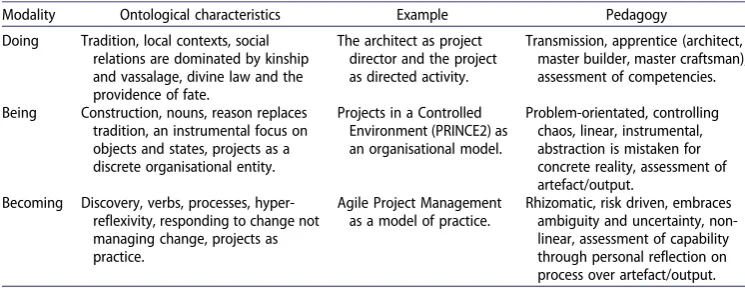
Through such a marriage of ideas it is possible to pair the ontological characteristics of each period to those of the correspondingly manifest forms of projects. In this way, it is possible to arrive at three ontologically unique manifestations of the idea of a project which are presented in Table 1 as the modalities of doing, being and becoming. It is this differentiation between ontological manifestations of a project that is of interest for educators seeking an optimum or sufficient methodology for the use of project-based learning.
Table 1.Ontological manifestations of a project.
Modality Ontological characteristics Example Pedagogy
Doing Tradition, local contexts, social relations are dominated by kinship and vassalage, divine law and the providence of fate.
The architect as project director and the project as directed activity.
Transmission, apprentice (architect, master builder, master craftsman), assessment of competencies.
Being Construction, nouns, reason replaces tradition, an instrumental focus on objects and states, projects as a discrete organisational entity.
Projects in a Controlled Environment (PRINCE2) as an organisational model.
Problem-orientated, controlling chaos, linear, instrumental, abstraction is mistaken for concrete reality, assessment of artefact/output.
Becoming Discovery, verbs, processes, hyper-reflexivity, responding to change not managing change, projects as practice.
Agile Project Management as a model of practice.
Rhizomatic, risk driven, embraces ambiguity and uncertainty, non-linear, assessment of capability through personal reflection on process over artefact/output.
What follows is a summary of the derivation of the three modalities presented inTable 1which aims to further investigate their particular social and historical discontinuities and the ways in which these can be used as a means of rethinkingproject-based learning.
Doing: pre-modernity as a doing ontology
In the pre-modern period we are told, the bulk of the people were embedded in a local context or a situatedness of place (Giddens 1991, 16). The daily needs of these people are rooted in local contexts of production and distribution, their social relations domi-nated by kinship and social obligations through vassalage. Their forms of exchange are largely structured through this local context and their value systems are rooted in a belief of divine law, fate and providence. Modes of production are sequential. So, for example, the production of books required that one copy be made at a time and then passed from hand to hand on order for others to experience it. Monumental architecture constructed during the pre-modern period is often built to the glory of gods both living (deified rulers) and dead. These monuments obscure the everyday activities of the large mass of people and serve to narrativise the rule of the elite. During the pre-modern period, knowledge of practice is transmitted through a master-apprentice system that required study under an expert for many years before the range of tools and techniques required of a master builder could be skilfully employed. Thus, the transmission of knowl-edge at this time can be classified as serial and contextualised by a locality of time and place.
It is in the field of architectural construction that the role ofproject actor(Garel2013, 666) is most clearly differentiated as a specialised practice, as architects take on the role of designer and contractor replacing the role of master-builder which had traditionally been part entrepreneur, part builder and part architect. As techniques of construction become more specialised, especially on grand scales of work such as that undertaken in the con-struction of gothic cathedrals, there is increasingly a division of labour and the role of architect crystallises into one which not only interprets the needs and desires of the patron, but also undertakes to design the building, oversee construction and manage the finances. During the eighteenth century this separation out of roles continues as engin-eers also begin to adopt specialised codes and organise into institutions. Mirroring this crystallisation of the role of architect asproject actor, Knoll (1997) tells us that in education during the eighteenth century, theproject methodbegins to emerge in the architectural and engineering schools of Europe initially in the form of competitions held in Italian schools of architecture, in which students were required to produce hypothetical designs that would be judged by panels of experts. Garel (2013, 666) informs us that by the end of nine-teenth century, there existed schools in engineering which were adopting a state-approved approach to teaching construction and engineering based around a rationalised and scien-tific methodology. Even so, Garel (2013) argues that these changes, while they certainly constituted a set of practices, had not formed into an institutionalised model that would be recognised as one specifically pertaining to the generalisablemanagement of pro-jectsor ofproject-based learning.
By the end of the 1800s theproject methodhad begun to be incorporated into the new technical and industrial colleges founded in the USA following a set of principles detailed in a training manual published by Woodward (1887). The manual required students to
complete a final independent project as a requirement for graduation. Its author thought of the project as a‘synthetic’activity which built on practical instruction delivered earlier during the course. His conceptualisation of this process as one of moving frominstruction
to construction became widely adopted across schools and colleges in the USA (Knoll
1997). Critiqued for its focus on work and technical skills by educationalists such as John Dewey, Knoll (1997) tells us that later iterations of this method began to recognise that creativity and problem solving were equally important. In addition, the breaking down of the process ofinstructionproceeding toconstruction was challenged, such that any instructive component became integrated into the project activity. Though it is poss-ible to see the genesis of project-based learning in these early iterations of the project
method, it is argued here that there are significant differences. For example, though
there may be some experiential component to the learning activity it would typically be teacher-led and there is a requirement that the activity be completed in accordance with detailed guidelines set in advance. Such an approach might best be characterised
astask-based learning(de Graaff and Kolmos2007, 5) and may be more commonly
associ-ated with approaches to the teaching of vocational subjects.
Doing ontology and project-based learning
It is clear then that by the end of pre-modernity the concept of theprojectin its modern sense is not fully formed. Though, by the end of this period, there had already emerged some standards and codes of practice that form the basis for the future development of the concept. Thus, for the purposes of the argument presented here, a doing ontology is understood as one that specifies the condition of a subject in relation to what they do
andwhat can be doneto them. The subject derives its self-identity and sense of place in
the world through the doing of work which, for the subject ‘provides the mechanism for social inter-action, and societal development and growth, forming the foundation stone of community, local and national identity’ (Wilcock 1999, 4). In an educational context, a doing ontology can be understood as one in which the position of the subject is defined in relation to the source of knowledge and transmission is the primary form of communication. A pedagogy that exhibits a doing ontology would be one that con-structs an activity around a prescribed set of learning outcomes and frames the activity in a highly structured manner. The focus of the learning activity is on the acquisition of skills and pre-specified knowledge, whereas the experiential aspects of learning through construction or discovery are not so highly valued. This kind of pedagogy would be typi-cally focused on the transmission of a tradition or subject discipline competencies and could be characterised as task-based rather than project-based learning (de Graaff and Kolmos2007, 5).
Being: modernity as a being ontology
Modernity sees history as a progressive appropriation of rational foundations of knowl-edge which Giddens has described as the application of ‘unfettered reason’ (Giddens
1990, 48). Such a view relies on the conceptual framework provided by provident
reason, the idea that greater knowledge means a safer and more rewarding existence
(Giddens1991, 28). That, as new understanding emerges this is used to build upon this
foundation, an idea that has its roots in the Enlightenment (Giddens 1990, 47). The modern is, for Giddens, characterised by the domination of abstract systems that structure discourses of practice across time and space. Just as those very practices are lifted from local contexts and globalised through a separation of time and place. The increasing dom-inance of expert systems which‘bracket time and space by deploying modes of technical knowledge which have validity independent of the practitioners or clients who make use of them’ (Giddens1991, 18) leads to new specialisations and the emergent of new subject disciplines such as that of project management.
A further characteristic of modernity for Giddens is the idea ofreflexivity, a process of
‘chronic revision in the light of new information’(Giddens1991, 20) which he tells us per-vades the modern world. Giddens argues that reason replaces tradition with uncertainty since all knowledge in the modern age is subjected to reflexive examination. By this, he means that knowledge can change at any time should some new knowledge come along to undermine it. To ‘know’ in the modern world is to be uncertain, whereas being certain is the old, or pre-modern, way of knowing (Giddens1990, 39). For Giddens, reflex-ivity is defined by‘the chronic entry of knowledge into circumstances of action it analyses or describes creating a set of uncertainties to add to the circular and fallible character of post-traditional claims to knowledge’(Giddens1991, 28). Thus, we find ourselves living in a world of continuous change that is beyond our control and spend our time in consider-ation of counterfactual possibilities i.e. the considerconsider-ation of alternate possibilities that may have arisen in different circumstances if different decisions had been taken. The‘ consider-ation of counterfactual possibilities is intrinsic to reflexivity in the context of risk assess-ment and evaluation’(Giddens1991, 29). In fact, the use of counterfactual evaluation as a tool for managing risk becomes one of the driving mechanisms for these new models for project management.
The timeline for the development of contemporary forms of project management could be said to have begun with the development of the Gantt Chart by Henry Gantt (1861– 1919) in 1917. The Gantt Chart is a scheduling tool that was famously used on the Hoover Dam project that began in 1931. When combined with the Critical Path Method (CPM) which was developed in 1957 by the Dupoint Corporation, the Gantt Chart becomes a powerful tool for analysing the process of organising, sequencing and scheduling project activities and is recognisably the basis for all project management soft-ware applications, such as MS Project among others. In 1958 the United States Depart-ment of Defence’s US Navy Special Projects Office undertook the development of the Polaris ballistic missile and introduced the Program Evaluation Review Technique (PERT), a variation on CPM used as a means of analysing tasks in relation to time and resources required to complete them. Then, in 1962, the United States Department of Defence introduced the Work Breakdown Structure (WBS), a hierarchical structure for determining the tasks and deliverables that need to be undertaken in order to implement a project. Taken together, this set of abstract systems forms the basis for a conceptual fra-mework that, coupled with the concept ofrisk management, form the basis of all contem-porary project management methodologies. Importantly though, it is worth noting here that risk is most commonly formulated negatively, as something that has jeopardy and needs to be controlled.
The subsequent emergence of the role of project manager led to the foundation of the Project Management Institute (PMI) in 1969 which set out to promote the profession
through standardisation and accreditation. Founded originally by volunteers, the organis-ation went on to be one of the most important and globally influential project manage-ment associations. In 1987 the PMI published what is now recognised as a world standard theProject Management Body of Knowledge(PMBOK). While in the UK,
PRo-jects IN Controlled Environments (PRINCE2) serves a similar purpose – establishing a
common set of standards and processes in accordance with the so called ‘iron triangle’ of project management: time, cost and quality. Developed from pre-existing methods, the original version of PRINCE as published in 1989, was aimed primarily at projects in information systems, whereas PRINCE2 is aimed to be more generically applicable to a wider range of project contexts. Often associated with large-scale construction pro-jects, PRINCE2 is intended to be scalable and can be applied to projects of differing sizes and complexity. What we have here then, are organisational models that emerged in response to the uncertainty and ambiguity of the modern world –models that seek
to control chaosthrough the deployment of abstract systems in the form of standards
that systemise organisational practice. These are combined with the development of expert systems through forms of professional accreditation.
Being ontology and project-based learning
We learn from Knoll (1997) that in the educational field theproject methodis first formally defined by Kilpatrick (1918) who was heavily influenced by the progressive educational reformers of the time, specifically Dewy and theories of experiential learning. He placed the student at the heart of the project method and insisted that projects be interdisciplin-ary, unplanned and proceed according to the motivation and direction of those participat-ing – in his own words ‘a wholehearted purposeful activity in a social environment’ (Kilpatrick 1918, 2). Knoll (1997) explains that it was Dewy’s criticism of Kilpatrick that returned the role of the teacher to the heart of the classroom as a central tenant of
theproject method,claiming that by themselves students were incapable of planning
pro-jects from which learning would occur. Theproject methodfor Dewey (1960) was to be teacher-directed and required students to go through a process of‘encountering a diffi-culty, via drafting a plan, to solving the problem’(Knoll (1997)–a common formulation
forproject-based learningthat would be recognisable today. Consequently, we can see, as
Knoll (1997) usefully concludes, that what emerged in the early part of the twentieth century were two conflicting models for project-based learning. The first, inspired by the progressive ideas of Kilpatrick, is a broad definition that is open, student centred and could be framed asproximal. The second, championed by Dewy, adopted a scientific and empirical formulation of what might constitute a project. While it is still essentially experiential there is a focus on results or outputs, standards and regulatory structures pre-dominate, adopting a scientific approach which could be framed asdistal.
Chia (1995, 581) suggests that whileproximalanddistalare complementary terms they reflect differing ways of thinking.Distalthinking characteristically conceives of a project in terms of its epiphenomena i.e. chaotic social states that need to be managed, thus privile-ging the orchestration of relationships between individuals and organisations. Proximal
thinking, however, is concerned with movement, emergence, transformation, the transient and ephemeral. It is the latter, which for Chia, forms the‘primary stuff of reality […] the emergent relational interactions and patternings that are recursively intimated in the
fluxing and transforming of our life-worlds’ (Chia 1995, 582). Consequently, we might think of PRINCE2 as typifying abeing ontologythat recognises the inner-life of project space (for a more detailed exposition on the conceptualisation of ‘project space’ see Hanney and Savin-Baden 2013) but subjects this to scientific scrutiny and classification in order to construct it as an object. It is essentially static and, though it employs reflection, it is in the form of description in service of counterfactual reflexivity. In this context we can perhaps think of Dewy’sproject methodas abeing ontology, one that embodies instru-mental principles for structuring experience that work from the exterior to the interior. It adopts abstract systems in order to establish norms and its primary concern is with con-trolling chaos. It employs systems of control in order to peer into the interior of project space and introject previously specified learning and values.
Post-modernity: the mirror of modernity
According to Giddens (1990, 45) post-modernity is less of a periodisation with its own defining characteristics and more of a style of aesthetic reflection upon modernity. He suggests the discontinuity between institutional modernity and this new social for-mation is characterised by an unravelling of grand narratives, along with an acceptance that the foundation of knowledge is unreliable, that history is devoid of teleology, and that progress is an implausible idea (Giddens1990, 46). Post-modernity is for Giddens, nothing more than modernity coming to understand itself (1990, 48) and what emerges with the more extreme reflexivity of post-modernity is a widespread scepticism of the idea of providential reason (Giddens 1991, 27). Project methodologies such as PRINCE2, which can be thought of as embodying principles that replicate the dis-courses of modernity, are replaced by new accounts in which the idea of a project is deconstructed as just another grand narrative that serves to legitimate modes of hege-monical domination.
In response, theCritical Projects Movement(Hodgson and Cicmil2006b) reconceptua-lises a project as a metaphor for something that is discovered, rather than something which is constructed. The theorists of this school have been influential in reorienting the study of projects towards a conception of a project as‘an aggregate of individuals tem-porarily enacting a common cause’(Gauthier and Ika2012, 14). This stands opposed to the techno-rationalist definition offered by the PMBOK (Project Management Institute
2013) which sees a project as ‘a temporary endeavour undertaken to create a unique product or service’, or PRINCE2 which takes the position that a project is‘a temporary organization that is created for the purpose of delivering one or more business products according to an agreed Business Case’ (Government UK 2009). The latter definitions are both results orientated and take an exterior ordistalposition that sees a project as a phenomenon with objective and concrete characteristics, rather than taking a proximal
position that sees the phenomena as the result of complex, changing, social process (Chia1995, 581). A project that has abeing ontology is a tool, an instrument or means, which serves the organisation in achieving its objectives (Gauthier and Ika2012, 13). In the case ofproject-based learningthese objectives might be manifest as learning outcomes but, importantly, the emphasis is on the outcomes serving the exterior need, be that in terms of the organisation’s teleology, or other stimuli (such as government policy, the need to get a job, to fit in, feed aspirations etc…).
Linguistically, there is an important distinction to be made here between thenounand
verbform of the word‘project’. The notion ofenactinga project folds in the static, noun: project, into an enacted, verb form which implies a doing-ness in its etymological route. We can think of the modernist conception of a project as abeing ontology which gives primacy to‘objects, things, states, events, and nouns and casts projects as discrete and con-crete entities’ (Linehan and Kavanagh 2006, 54). Project space is conceptualised as an object, something that is acted upon from the exterior through mechanisms of control. Whereas abecomingontology‘emphasises processes, verbs, activity, and the construction of entities, and the role of language, meaning, and interpretation’(Linehan and Kavanagh
2006, 54). A project is conceptualised as a practice that emerges from the interior of project space–that is enacted on the external world. Thus, the differentiation between a being
ontology and a becoming ontology heralds a shift from conceptualising a project as a
machine to a project as a practice (Gauthier and Ika 2012, 15), a shift betweenmodels
of organisation and models of practice. There is an important distinction being made
here, between a dominant Parmenidean, diachronic, being ontology that is regulatory and seeks to control the world; and a Heraclitean, synchronicbecomingontology which recognises the uncertain nature of the world and embraces change (Gauthier and Ika
2012, 13). Thus, in a similar manner to the break between the modern and pre-modern; post-modernity signals an ontological break between modernity and high-modernity.
Becoming: high-modernity as a becoming ontology and the providence of extreme reflexivity
While post-modernity might be viewed from some positions as almost a passing reaction to modernity–a fashion or fad even–it does enable us to critically reconsider the charac-teristics of what Giddens (1990,1991) refers to as‘high-modernity’and provides us with the means for a reanalysis of the‘doing of projects’. TheCritical Projects Movementhas taken significant steps towards this aim, having already established a body of work that positions a project as a social space, with both interior and exterior characteristics. For
theCritical Projects Movement, projects are conceived of as complex and reflexive
inter-actions between people, in which intuition and experience are valued over and above stan-dardised bodies of knowledge. The project is perceived as a network of actors that lends itself to transformations, as the actors engage in reflection and transform themselves (Alderman and Ivory 2011; Sydow 2006).Those involved in the doing of projects are seen as reflexive agents of change, who are embedded in a social context in constant trans-formation (Gauthier and Ika2012, 12)–one in which knowledge is shared, held collec-tively and accessed through social interactions. We might now think of a project as: a space in which a vision or goal is enacted through a complex set of social interactions between actors who share goals.
This tendency towards extreme-reflexivity is perhaps nowhere better exemplified than through the emergence of a recent addition to the cannon of project management meth-odologies. Agile Project Management (APM) emerged in response to a need within the software development sector for a flexible process-led approach, that allows for rapid delivery of high-quality software, in chaotic and often experimental contexts in which the final goal may not be fully specified at the outset (Cohn2006; DeCarlo2004; Fischman
2008; Highsmith2004). An APM process suits small teams, thrives in chaos and offers a reflexive response to change in the face of uncertainty. The APM philosophy resonates deeply with the ideas of a project as a social space in which it is enacted as a collective, goal-orientated activity. APM models a project as a practice in which we see the fostering of interactions within the team over processes and tools, a focus on delivery rather than on documentation, the utilisation of a project vision and collaborative relationships as organ-ising principles, and prioritorgan-ising a response to change over following a plan (Fitchner
2011).
The principles of APM require an engagement with the process of delivering a project that celebrates learning through continued and regular critical reflection on the nature of the project. With methodologies such as PRINCE2 this is typically undertaken at the end of the project, whereas with APM it becomes an organising principle and the key factor for measuring progress. Teams are self-organising, coalescing around shared goals. Solutions to problem encounters are managed by the team who also select the most appropriate tools to use on the basis‘of maximising the work not done’(Fitchner2011). Essentially non-linear (synchronic), APM exists in antithesis to the more non-linear, sequential principles of a modernist project management methodology as typified by PRINCE2 (diachronic). In a sense, APM as a project management methodology typifies high-modernity in that it draws upon an extreme reflexivity and actively engages with the notion of risk to the point where this becomes a fundamental organising principle. Importantly, APM dis-tinguishes between opportunity risk and jeopardy risk (Hanney2012) and embraces the positive possibilities present in ambiguity and uncertainty. APM is seemingly abecoming
ontology manifest as a project method; it offers a means of structuring a project as a peda-gogy of becomingthat returns to Kilpatrick’s notion ofproject-based learningas‘a whole-hearted purposeful activity in a social environment’(Kilpatrick1918, 2). Consequently, it would seem as though the underpinning philosophy behind APM might offer inspiration to educators seeking to theorise an approach toproject-based learningwhich is rooted in a
becomingontology.
Implications for a project-based pedagogy
Applying a genealogical method is useful because it allows us to see that the concept of a
projectis not innate, natural or concrete–that it is an idea that has emerged in response to modern social, historical and economic conditions. It also allows us to see the concept of a
project as multifaceted in that it can be ontologically constructed as a doing, being or
becomingontology. It is argued here that in the context of education it is the transforma-tive conditions of abecomingontology that is the pedagogic ideal–enabling a rethinking ofproject-based learningas an experiential pedagogy that places reflection on actions and interactions at the heart of an optimum or sufficient methodology and positioning the use of project-based approaches as a tool for learning rather than just for administration. A
becomingontology constructs a project as a network of actors engaged in relationships
(Alderman and Ivory2011; Sydow 2006) within a collective space that has interior and exterior aspects, within which a collaborative vision is enacted. Those involved in this enacting of projects are seen as reflexive agents of change who are embedded in a social context and in constant transformation (Gauthier and Ika 2012, 12) i.e. in permanent crisis!.
Critical reflection is the key tool utilised by APM for managing a project, around which its organising principles are constructed and out of which a methodology emerges. As such, the Agile Method constitutes a pedagogy in its own right and offers a model which not only mirrors the world of professional practice but may also offer an optimum or sufficient methodology for theorisingproject-based learningas a model for practice. The Agile philosophy resonates deeply with the conceptualisation of a project as abecoming ontology. Thus, it may be possible to take Dall’Alba’s (2009, 38–42) criteria for structuring abecoming ontologyand merge them with the more organisationally orien-tated concepts underpinning APM. Such that: continuity with change, possibilities with constraints, openness with resistance, individuals with others, might provide the basis for a manifesto forAgile Learning. At its simplest, a turn toward Agile Methods requires only the adoption of simple risk tools which are, by their very nature, reflexive and eva-luative as a pedagogic strategy.
However, we need to think carefully about what the consequences of adopting abecoming ontologymight be for those participating in projects. We shouldn’t forget that project com-munities are constructed (Linehan and Kavanagh2006, 60) and the concept of a project is a constructed idea. We should remember that there is still a danger of the reification of our new ‘cleverer and better representations’ (Linehan and Kavanagh 2006, 60). Adopting a
becoming ontologyforproject-based learningis a risky business; it is not straight-forward and requires a certain amount of testing and trialling of ideas. For example, educators will need to become familiar with the tools and techniques available; there is a process of translation and recontextualisation required along with the need for the flattening out of specialist jargon and terminology (Hanney2012). The focus on risk requires students to engage with what might be an important, but difficult, threshold concept. Furthermore, there needs to be a recognition that risk is not always negative, that opportunity is risky as well. But, importantly, if we are to value risk taking among learners there needs to be a means for valuing and assessing failure as a positive aspect of learning. Meanwhile, edu-cators will also need to embrace uncertainty and risk, let go of the cherished notion of indus-try methods and look elsewhere for the authenticity of practice.
Disclosure statement
No potential conflict of interest was reported by the authors.
Funding
This work was supported by Solent Learning & Teaching Institute.
ORCID
Roy Hanney http://orcid.org/0000-0001-7374-0032
References
Alderman, Neil, and Chris Ivory. 2011. “Translation and Convergence in Projects: An Organizational Perspective on Project Success.” Project Management Journal 42 (5): 17–30.
doi:10.1002/pmj.20261.
Aristotle.2001.Nicomachean Ethics[Electronic Resource]. Blacksburg, VA: Virginia Tech. Bernstein, Basil.2000.Pedagogy, Symbolic Control and Identity: Theory, Research, Critique. Rev. ed.
Oxford: Rowman & Littlefield.
Chia, Robert.1995.“From Modern to Postmodern Organizational Analysis.”Organization Studies 16 (4): 579–604.doi:10.1177/017084069501600406.
Cohn, Mike.2006.Agile Estimating and Planning. Upper Saddle River, NJ: Prentice Hall. Non-fiction.
Dall’Alba, Gloria. 2009. “Learning Professional Ways of Being: Ambiguities of Becoming.” Educational Philosophy & Theory41 (1): 34–45.doi:10.1111/j.1469-5812.2008.00475.x. DeCarlo, Doug. 2004. eXtreme Project Management: Using Leadership, Principles, and Tools to
Deliver Value in the Face of Volatility. 1st ed. San Francisco: Jossey-Bass.
de Graaff, Erik, and Anette Kolmos.2007.“History of Problem-based and Project-based Learning.” In Management of Change: Implementation of Problem-based and Project-based Learning in Engineering, edited by Erik de Graaff and Anette Kolmos, 1–8. Rotterdam: Sense Publishers. Dewey, John.1960.On Experience, Nature and Freedom. Indianapolis: The Library of Liberal Arts. Engwall, Mats.2003.“No Project is an Island: Linking Projects to History and Context.”Research
Policy32: 789–808.doi:10.1016/S0048-7333(02)00088-4.
Fischman, Lee.2008.“Improving Outcomes on Experimental Projects.”InThe PM Podcast, edited by Cornelius Fitchner.
Fitchner, Cornelius.2011.“The Agile Manifesto for Project Managers.”InThe PM Podcast, edited by Cornelius Fitchner.
Garel, Gilles.2013.“A History of Project Management Models: From Pre-models to the Standard Models.”International Journal of Project Management31 (5): 663–669.doi:10.1016/j.ijproman. 2012.12.011.
Garraway, James. 2005. “Recontextualising Work into Academic Practices.” Southern African Journal of Education25 (4): 217–222.
Gauthier, Jacques-Bernard, and Lavagnon A. Ika. 2012. “Foundations of Project Management Research: An Explicit and Six-facet Ontological Framework.”Project Management Journal43 (5): 5–23.doi:10.1002/pmj.21288.
Giddens, Anthony.1990.The Consequences of Modernity. Cambridge: Polity Press. Non-fiction. Giddens, Anthony. 1991. Modernity and Self-identity: Self and Society in the Late Modern Age.
Cambridge: Polity. Non-fiction.
Government UK.2009.Projects in a Controlled Environment 2. Online: Axelos.
Hanney, Roy.2012. “Are We Any Good At It: Using Risk as a Tool for Reflection and Critical Enquiry: Report of Research in Progress.”Art, Design & Communication in Higher Education 10 (1): 103–109.doi:10.1386/adch.10.1.103_1.
Hanney, Roy.2016.“Taking a Stance: Resistance, Faking and Muddling Through.”Journal of Media Practice17 (1): 4–20.doi:10.1080/14682753.2016.1159437.
Hanney, Roy, and Maggi Savin-Baden. 2013. “The Problem of Projects: Understanding the Theoretical Underpinnings of Project-led PBL.” London Review of Education 11 (1): 7–19.
doi:10.1080/14748460.2012.761816.
Helle, Laura, Päivi Tynjälä, and Erkki Olkinuora.2006.“Project-based Learning in Post-secondary Education–Theory, Practice and Rubber Sling Shots.”Higher Education51 (2): 287–314.doi:10. 1007/s10734-004-6386-5.
Highsmith, James A. 2004. Agile Project Management: Creating Innovative Products. Boston: Addison-Wesley.
Hodgson, Damian E., and Svetlana Cicmil. 2006a. “Are Projects Real? The PMBOK and the Legitimisation of Project Management Knowledge.” In Making Project Critical, edited by Damian E. Hodgson and Svetlana Cicmil, 29–50. Basingstoke: Pallgrave Macmillan.
Hodgson, Damian E., and Svetlana Cicmil.2006b.“Making Projects Critical: An Introduction.”In Making Projects Critical, edited by Damian E. Hodgson and Svetlana Cicmil, 1–28. Baisingstoke: Palgrave Macmillan.
Hoover, Duane, and Carlton Whitehead.1975.“An Experiential-cognitive Methodology in the First Course in Management: Some Preliminary Results.” Simulation Games and Experiential
Learning in Action: The Proceedings of the Second National ABSEL Conference, Bloomington, Indiana.
Kilpatrick, William Heard.1918.“The Project Method.”Teachers College Record19: 319–335. Knoll, Michael. 1997. “The Project Method: Its Vocational Education Origin and International
Development.”Journal of Industrial Teacher Education34 (3): 59–80.
Linehan, Carol, and Donncha Kavanagh. 2006. “From Project Ontologies to Communities of Virtue.”In Making Projects Critical, edited by Damian E. Hodgson and Svetlana Cicmil, 51– 67. Basingstoke: Pallgrave Macmillan.
Lundin, Rolf A., and Anders Söderholm.1998.“Conceptualizing a Project Society—Discussion of an Eco-institutional Approach to a Theory on Temporary Organizations.”InProjects as Arenas for Renewal and Learning Processes, edited by Rolf A. Lundin, and Midler Christophe, 13–24. Dordrecht: Kluwer Academic Publishers.
Maylor, Harvey, Tim Brady, Terry Cooke-Davies, and Damian Hodgson. 2006. “From Projectification to Programmification.”International Journal of Project Management24: 663– 674.doi:10.1016/j.ijproman.2006.09.014.
Moon, Jennifer A.2004.A Handbook of Reflective and Experiential Learning: Theory and Practice. London: RoutledgeFalmer. Non-fiction.
Navarre, C.1993.“Pilotage stratégique de la firme etmanagement de projet: de Ford et Taylor à Agile et IMS.”InPilotage de projet et entreprises; diversité et convergences, edited by V. Giard and C. Midler, 181–215. Rome: Economica.
Packendorff, Johann, and Monica Lindgren.2014.“Projectification and Its Consequences: Narrow and Broad Conceptualisations.”Southern African Journal of Economic and Management Sciences 17 (1): 7–21.
Project Management Institute. 2013. Project Management Body of Knowledge. Online: Project Management Institute.
Saugstad, Tone. 2013. “The Importance of Being Experienced: An Aristotelian Perspective on Experience and Experience-Based Learning.” Studies in Philosophy and Education32 (1): 7– 23.doi:10.1007/s11217-012-9329-0.
Sydow, Jörg. 2006. “Managing Projects in Network Contexts: A Structuration Perspective.”In Making Projects Critical, edited by Damian E. Hodgson and Svetlana Cicmil, 252–264. Basingstoke: Pallgrave Macmillan.
Wilcock, Ann Allart.1999.“Reflections on Doing, Being and Becoming.”Australian Occupational Therapy Journal46 (1): 1–11.doi:10.1046/j.1440-1630.1999.00174.x.
Woodward, Calvin Milton.1887.The Manual Training School, Comprising a Full Statement of its Aims, Methods, and Results. Boston: Heath.