The Thirty-Third AAAI Conference on Artificial Intelligence (AAAI-19)
Towards Optimal Fine Grained Retrieval via
Decorrelated Centralized Loss with Normalize-Scale Layer
Xiawu Zheng,
1Rongrong Ji,
1,2∗Xiaoshuai Sun,
1Baochang Zhang,
3Yongjian Wu,
4Feiyue Huang
41Fujian Key Laboratory of Sensing and Computing for Smart City, Department of Cognitive Science,
School of Information Science and Engineering, Xiamen University,2Peng Cheng Laboratory, China 3Beihang University,4Tencent Youtu Lab, Tencent Technology (Shanghai) Co., Ltd
Abstract
Recent advances on fine-grained image retrieval prefer learn-ing convolutional neural network (CNN) with specific fully-connect layer designed loss function for discriminative fea-ture representation. Essentially, such loss should establish a robust metric to efficiently distinguish high-dimensional fea-tures within and outside fine-grained categories. To this end, the existing loss functions are defected in two aspects: (a) The feature relationship is encoded inside the training batch. Such a local scope leads to low accuracy. (b) The error is established by the mean square, which needs pairwise dis-tance computation in training set and results in low efficiency. In this paper, we propose a novel metric learning scheme, termed Normalize-Scale Layer and Decorrelated Global Cen-tralized Ranking Loss, which achieves extremely efficient and discriminative learning,i.e., 5×speedup over triplet loss and 12% recall boost onCARS196. Our method originates from the classic softmax loss, which has a global structure but does not directly optimize the distance metric as well as the inter/intra class distance. We tackle this issue through a hypersphere layer and a global centralized ranking loss with a pairwise decorrelated learning. In particular, we first propose a Normalize-Scale Layer to eliminate the gap between metric distance (for measuring distance in retrieval) and dot prod-uct (for dimension redprod-uction in classification). Second, the relationship between features is encoded under a global cen-tralized ranking loss, which targets at optimizing metric dis-tance globally and accelerating learning procedure. Finally, the centers are further decorrelated by Gram-Schmidt pro-cess, leading to extreme efficiency (with 20 epochs in train-ing procedure) and discriminability in feature learntrain-ing. We have conducted quantitative evaluations on two fine-grained retrieval benchmark. The superior performance demonstrates the merits of the proposed approach over the state-of-the-arts.
Introduction
Fine-grained image retrieval (FGIR) is to search image through subordinate in the same visual category,e.g., birds (Wah et al. 2011), cars (Krause et al. 2013) and products (Oh Song et al. 2016), which has attracted increasing re-search focus recently. In such a setting, instances are sim-ilar to each other within a general class and are difficult
∗
corresponding author
Copyright c2019, Association for the Advancement of Artificial Intelligence (www.aaai.org). All rights reserved.
to distinguish among fine-grained categories, due to vari-ous pose, illumination and occlusion. Therefore, FGIR is more challenging comparing with content based image re-trieval (CBIR). In order to distinguish the subtle differences among fine-grained categories, a discriminative feature rep-resentation is demanded. To this end, a recent trend is to adopt convolutional neural network (CNN) with a distance metric learning (Huang, Loy, and Tang 2016; Oh Song et al. 2016; Bell and Bala 2015; Ustinova and Lempitsky 2016; Wang et al. 2014) to extract the discriminative and genera-tive features, which aim to distinguish high-dimensional fea-tures within/outside fine-grained categories.
Despite the recent progress, fine-grained image retrieval remains as an open problem. The key challenge lies in de-signing a good loss to efficiently learn a robust metric, which measures similarity of features extracted from deep neural networks (Krizhevsky, Sutskever, and Hinton 2012; Szegedy et al. 2015; Simonyan and Zisserman 2014; He et al. 2016). However, the existing loss functions in FGIR are still far from satisfactory, which are defected in terms of lo-cal structureandslow training. The former refers to encod-ing the example relationship locally, i.e., pairwise, triplet, which results in low accuracy. The latter refers to establish-ing the loss with mean square error (MSE), which causes low efficiency, since the MSE will theoretically get stuck in local optimum (Golik, Doetsch, and Ney 2013). More specifically, most existing loss functions in FGIR are de-fined in terms of pairs (Hadsell, Chopra, and LeCun 2006) or triplets (Wang et al. 2014) inside the training mini-batch. This contradicts from the optimal loss that should max-imize intra-class compactness and inter-class separability. And since the existing loss in FGIR did not consider the em-bedding space globally, the resulting weak features will de-generate the retrieval performance. Besides, the computation complexity for pairwise and triplet loss can go up toO(N2),
whereN denotes the total number of training samples.
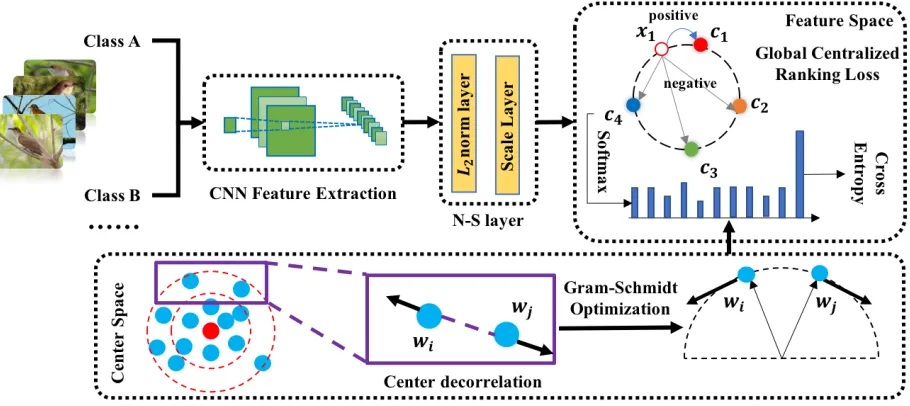
opera-Figure 1: An illustration of the proposed framework. The Norm-Scale (N-S) layer projects the features of images on a hy-persphere by using L2 normalization and scale layer. The proposed Decorrelated Global-aware Centralized Ranking Loss (DGCRL) consists of two parts, a global aware ranking loss in the feature space and a Gram-Schmidt independent optimization in the center space. The framework can directly optimize the intra-class compactness and inter-class separability and establish an effective representaiton for fine-grained retrieval.
tion is theoretically not a distance metric, which is unable to enforce feature discriminability. To further explain, features in the same class could lie on different hypersphere therefore apart from each other, while being closer in hard examples of different classes.
The Slow Training Challenge.The main reason for the unsatisfactory training speed lies in the disparity between training/testing and the usage of MSE. In particular, since the dataset contains images with different qualities, the cor-responding features tend to lie on different spheres (Ranjan, Castillo, and Chellappa 2017). It is therefore makes it diffi-cult to minimize the inter-class distance in training and ro-bustly measure similarity between features withoutL2 nor-malization in testing, which further leads to a gap between training and testing,i.e.the feature is optimizedwithoutL2 normalization in training while the similarity is measured
after normalizationin testing. More importantly, according to the (Golik, Doetsch, and Ney 2013), MSE will quickly stuck in local minima, which further degenerate the training efficiency.
In this paper, we present a novel metric learning scheme that conquers the above difficulties in a unified framework. As illustrated in Fig.1, the framework contains two crucial components,i.e.Normalize-Scale LayerandDecorrelated Global-aware Centralized Ranking Loss, the former of which eliminates the gap between training and testing as well as inner-product and the Euclidean distance, while the latter encourages learning embedding function to directly optimize inter-class compactness and intra-class separabil-ity. In particular, the Decorrelated Global-aware Central-ized Ranking Loss (DGCRL) is composed by two parts, a global-aware ranking loss in feature space and a
Gram-Schmidt independent operation on center space, which tack-les the challenge of feature discriminability and generaliza-tion respectively. The proposed normalize-scale(N-S) layer employs normalization and scaling operation in image fea-tures, which connects inner-product and Euclidean distance metric to well accelerate DGCRL through softmax loss. It is worth to note that, most methods need to train their networks with cropped images, hard example mining, or extra infor-mation. In contrast, no extra information, models or datasets are used in our network.
We have conducted extensive experiments on two widely-used FGIR benchmarkCUB-200-2011andCARS196, with comparisons to a set of state-of-the-art methods. Quanti-tatively, it outperforms CRL-WSL (Zheng et al. 2018) by 12.0% inCAR196, and runs 5×faster in training over triplet loss.
Related Work
neural network. However, as discussed above, these methods encode the local relationship between features, which de-generate the feature discriminability and learning efficiency, while leaving the problem of variations between training and testing unsolved.
Deep Metric Learning. The goal of deep metric learn-ing is to learn an optimal metric to minimize the distance between similar images. Similarities can be encoded as pair-wise loss (Bell and Bala 2015) or triplet loss (Wang et al. 2014). The work in Oh Song et al. (2016) proposed a high-order similarity constraint by lifting the pairwise distance within a mini-batch in the form of a dense matrix. Beyond Euclidean metric, (Huang, Loy, and Tang 2016) introduced a Position-Dependent Deep Metric (PDDM) unit, which is capable of learning a similarity metric that is adaptive to local structure in the feature space. However, the perfor-mance of these methods is still unsatisfactory. The tremen-dous search space, the limitation of local-aware structure, as well as the time-consuming mean square optimization lead to inefficient training and less discriminative feature repre-sentation. In contrast, the proposed DGCRL updates param-eters using the global centers, which makes the optimization more sustainable and more efficient i.e., 12.0% over CRL-WSL(Zheng et al. 2018) inCARS196, 5×speed up in train-ing over triplet loss.
The Proposed Method
As shown in Fig.1, the proposed model innovates in two as-pects, i.e., Normalize-Scale (N-S) Layer and Decorrelated Global-aware Centralize Ranking Loss (DGCRL). The N-S Layer projects the features onto a hypersphere by anL2 nor-malization and a scale layer. Such an N-S layer is a precon-dition of the rest components, i.e., the proposed DGCRL can be transformed iff. the features and centres are normalized. On the other hand, the proposed DGCRL is composed of two parts which directly optimizes the intra-class compactness (by Gram-Schmidt decorrelated operation in center space) and inter-class separability (by Global Centralized Ranking Loss (GCRL) in feature space) in a global way. This dif-fers from previous methods which tend to focus on the local structure of the embedding space using pair-wise/triplet loss, and hence improves the feature discriminability and learning efficiency. Moreover, by combining the proposed N-S layer with DGCRL, the proposed model can be trained by using cross-entropy loss, as the Euclidean distance can be trans-formed into inner-product.
Problem Definition and Overall Pipeline
LetI = {I1, ...., In} ∈ I be a labeled collection of
fine-grained images, where I is the original input space of all possible images. Depending on the application, in training set each image has its corresponding labely ∈ {1, ..., K}
ofK classes/clusters. Functionf(·;θ) : I → Rdmaps an
imageIto a vectorxi=f(Ii, θ)in ad-dimensional
embed-ding spaceX.θis the CNN parameters to be learned. We first summarize the general pipeline for fine-grained image retrieval (Wei et al. 2017; Xie et al. 2015; Zhang et al. 2016; Zheng et al. 2018). Given a training set with fine-grained images and corresponding labels, CNN is trained
without feature normalization. At the testing stage, feature descriptorxi is extracted from imageIi andnormalizedto
a unit length. Then, the returning list is sorted according to similarity computed by using the Euclidean distance. Note that normalization is unavoidable in online stage. Since the features lie on different spheres, retrieving images with nor-malization can largely promote the performance (Ranjan, Castillo, and Chellappa 2017).
There are two issues in this pipeline. First, the training and testing phases for fine-grained image retrieval are de-coupled. There is no guarantee that the training step directly optimizes the ranking function in the Euclidean space,i.e
some retrieval tasks follow an inner-product + softmax loss pipeline, which differ from the loss design in training. Sec-ond, existing deep metric learning is unable to extract dis-criminative features on different hyperspheres. Some previ-ous works (Wang et al. 2017; Ranjan, Castillo, and Chel-lappa 2017) proposed feature normalization methods to solve these issues. Nevertheless, as illustrated in Fig.3, nor-malizing features with unit length can lead to a “degenera-tion” problem,i.e.the loss cannot converge due to the tiny space on unit sphere. Moreover, inner-product with feature normalization is not a Euclidean distance, which means the gap between training and testing steps still exists. We solve the above issues by proposing a novel Normalize-Scale (N-S) Layer, which eliminates the gap between inner-product and the Euclidean distance by normalization and expand representation space by scale operation .
Normalize-Scale Layer
The N-S layer forces the features to be distributed on a hy-persphere. For an input vectorx, the layer can be defined as follows:
ˆ x= x
kxk2
∗α= αx
pP
ix2i
. (1)
Herexcan be either a feature vector or a center. The layer can be easily implemented by publicly available deep learn-ing frameworks such as MXNet (Chen et al. 2015) or Caffe (Jia et al. 2014). The N-S layer disposes the feature with normalization and a scale layer, as illustrated in Fig.1. It is worth to note that the center should not be projected on hy-perspheres, since the centers will gradually close to the fea-tures hypersphere through back propagation and the “degen-eration” problem exists only in the original feature space. Furthermore, the distance calculation can be transformed into inner-product form (which will be described in the next section). Therefore, employing project operation in feature space makes numerical calculations easier.
Decorrelated Global Centralized Ranking Loss
directly minimizing the Euclidean distance leads to a very slow convergence. As a result, it is reasonable to back-propagate through a global learnable center. Therefore, com-bining with N-S layer, the proposed GCRL scheme directly optimizes the following loss:
L= max
N
X
i=1
(m+kxi−wyik − 1 K−1
K
X
c6=j
kxi−wjk)
s.t. kxik2=α.
(2)
For a given feature xi, the loss function consists of three
parts, the margin m, the distance between corresponding centrewyiand the distance between negative pairs. The
gra-dients are defined as:
∂L ∂xi
= xi−wyi kxi−wck
− 1
K−1 K
X
c6=j
xi−wj kxi−wjk
, (3)
∂L ∂wyi
= wyi−xi kwyi−xik
, ∂L ∂wj
= 1
K−1
xi−wj kxi−wjk
. (4)
As shown in Eq.3, GCRL forces the featurexito approach
the center of the target class, while leaving away from ters of irrelevant classes. At the same time, in Eq.4, the cen-ter is updated by the information generated fromxi, which
gradually approaches the global center, leading to a more compact and separable feature representation in the testing phase. However, due to the mean square loss, the proposed loss function also suffers from the training efficiency prob-lem. Considering that FGIR often handles large-scale train-ing sets, a modification to accelerate GCRL is indispensable.
Accelerating GCRL. The work in (Golik, Doetsch, and Ney 2013) argued that the cross entropy criterion allows to find better local optimum and convergence faster than mean square loss. Together with softmax, it has become the most commonly adopted loss function in various tasks, including retrieval (Wen et al. 2016). However, in these methods, the loss function is only used as an auxiliary function, which is insufficient in fine-grained image retrieval. Combining with N-S layer, we reformulate the global-aware centralized loss to an equivalent softmax loss, which retains the global struc-ture, distance metric and large margin in GCRL, while en-gaging the merit of softmax loss.
Softmax loss has been recognized as an essential com-ponent in the classification. For an input featurexi with its
corresponding center/label/clusteryi, it can be formulated
as:
Lsof tmax=−log
efyi
P
jefj
!
, (5)
wherefj is thej-th element of the class vectorf. In most
CNN structure,f is usually the output of a fully-connected layer W. So fj can be written as fj = WjTxi in which
Wj is thej-th column ofW. We define the probability for
theyi-th class aspyi = efyi
P
jefj
for simplicity. And in back
propagation, the gradient w.r.t. fj can be obtained by the
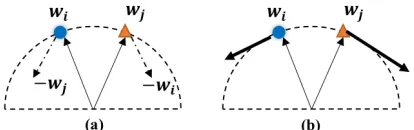
Figure 2: An illustration of two different optimization meth-ods. (a) Directly minimizing wiwj is ineffective (the
gra-dient will be damped by N-S Layer) and unstable (hard to minimize when wiwj is close to zero). (b) A more stable
and effective gradient conducted by Gram-Schmidt process.
chain-rule. Ifj=yi, we have:
∂Lsof tmax
fj
=− 1 pyi
∂pyi fj
=− 1 pyi
efjP ie
i−efj ·efj
(P
iei)
2
=−(1−pj),
(6)
and whenj6=yi, the gradient becomes
∂Lsof tmax
fj
=− 1 pyi
∂pyi fj
=− 1 pyi
0·P
ie
i−efj·efyi
(P
iei)
2
=pj.
(7)
As shown in Eq.6 and Eq.7, in the training step, if we con-sider the inner-product as a similarity metric, softmax loss enhances the similarity value when the featurexibelongs to
classyi, and depresses the similarity with other classes
si-multaneously1. It is worth to note that, the value ofL2norm
with features and centres are invariable2 in training, which means the Euclidean distance is inversely proportional to the inner product,i.e.
kxi−wjk=kxik+kwjk −2xiwj =C−2xiwj. (8)
Therefore, we reformulate the proposed GCRL to softmax except for the margin parameterm. For the softmax form, it can be easily implemented by most deep learning frame-works. For the margin parameterm, it is still unable to opti-mize the intra-class compactness and inter-class separability.
Center Decorrelation. The work in (Liu et al. 2016; 2017) introduced an angular margin to make the objective function more rigorous, and used the intermediate value
cos(mθ)to replace the originalcosθduring training. How-ever,mis supposed to be positive to makecos(mθ) deriv-able, which largely compress the representation space. Be-sides, the function is hard to implement due to the angular
1
The gradient represent the negative direction of the optimiza-tion
2
margin involved. To address these issues, we design a new Center Decorrelation operation to enlarge the distance be-tween different centers. We first give a simple description to our intuition. Considering Eq.7 and Eq.6, the gradient w.r.t.
xican be obtained by the chain rule:
∂fj
∂xi
= ∂wjxi ∂xi
=wj, (9)
which indicates that in training, the features are moving ac-cording to the centerwj, eventually point to the same
direc-tion withwj. Therefore, the margin can also be obtained by
decorrelating centers with the following objective function:
Li=−log
ewyixi ewyixi+P
j6=yie wjxi
s.t. kxik2=α, WTW =I.
(10)
The constraintWTW =Irequires the centers to be orthog-onal to each other, which is an implicit version of the re-quirement that the centers should be pairwise decorrelated. Since the normalize value of center wis not important in our formulation, to further simply the computation, we use the Lagrange Multiplier with constraintWTW =Iand the
final DGCRL can be obtained as:
Li=−log
ewyixi ewyixi+P
j6=yie wjxi −
λ |Ω|
X
i6=j |wiwTj|
s.t. kxik2=α,
(11)
whereΩdenotes different pairwise sets of centers. With the absolute operation, Eq.11 requires the centers to be perpen-dicular, which promotes the feature discriminability (large center distance) and generalization (wide feature representa-tion space) simultaneously. However, there are optimizarepresenta-tion issues in Eq.11. As illustrated in Fig.2, directly minimizing
|wiwj|is ineffective (the gradient will be damped by the
fea-ture normalization) and unstable (hard to minimize when the
wiwjis close to zero).
Gram-Schmidt Optimization In this paper, we employ the Gram-Schmidt process to solve the above problems. Let
{ui|i = 1,2, ..., n} be a set ofm-vectors and we wish to
obtain an equivalent orthonormal set{vi|i = 1,2, ..., n}of
m-vectors. The Gram-Schmidt process (Schmidt 1908) can be constructed by following successive operation:
vk0 =uk− k−1 X
j=1
hvj, ukivj, vk=
vk0
kvk0k;k= 2, ..., n, (12)
wherev1 = u1
ku1k. The Gram-schmidt is used for two
rea-sons. One is that the process can orthogonalise the origi-nal gradient to be vertical with corresponding centre, which makes the optimization more effective, as illustrated in Fig.2b. The other one is that the operation is stable when two centers are perpendicular, due to thehvj, ukioperation
(the second term becomes zero). Moreover, when dealing with two vectors, Eq.12 can be easily implemented as:
∂L wi
= ∂L wi
+ 1
|Ω|λ(wi− hwi, wji)wj, (13)
Algorithm 1:Decorrelated Global Centralized Ranking Loss
Input:Training data:Dt; CNN model:F. Output:Trained CNN model:F.
1 fort=1,...,Tepoch do
2 Forward image to feature layer; 3 Pass the feature through N-S layer;
4 Calculate the loss by softmax and cross-entropy; 5 Get the gradient of softmax loss;
6 Gram-Schmidt optimize by Eq.13; 7 Update CNN modelFbytthepoch data ; 8 end
where the computation of ∂Lw
i is the same as the original
softmax. Obviously, in Eq.13, the update is co-determined by the inter-class compactness ∂Lw
i and intra-class
separa-tion(wi− hwi, wji)wj. This means that the discriminability
and generalization will be explicitly enhanced. The overall framework is summarized in Alg. 1.
Experiments
Experimental Settings
Datasets. CUB-200-2011(Wah et al. 2011) contains 200 bird classes with 11,788 images. We use the first 100 classes in training and the rest in testing. The split in CARS196
(Krause et al. 2013) is also similar toCUB200-2011, which contains 196 car classes with 16,185 images, i.e. with the first 98 classes (8,045 images) for training and the remain-ing classes (8,131 images) for testremain-ing. The trainremain-ing/testremain-ing split also follows the standard setting in (Huang, Loy, and Tang 2016; Bell and Bala 2015; Oh Song et al. 2016).
Evaluation Protocols. We evaluate the retrieval perfor-mance [email protected]@Kis the average recall scores over all query images in the test set, which strictly follows the setting in (Oh Song et al. 2016). Specifically, for each query, we return the topKsimilar images. In the top K re-turning images, the score will be1if there exists at least one positive image, and0otherwise.
Implementation Details. We apply the widely-used Res50 (He et al. 2016) in our experiments. The net-work is pre-trained on ImageNet ILSVRC-2012 (Deng et al. 2009)3. We set the same hyperparameters in all experi-ments without specific tuning, with a margin parameterm
of 4, a scale parametersαof128, a mini-batch size of60, and an initial learning rate starts from0.0001and is divided by 10 in every 100 epochs. The feature is extracted from the last convolutional layer of Resnet-50 with max and average pooling, which is followed through SCDA (Wei et al. 2017).
Baselines We compare the proposed method with the fol-lowing state-of-the-art methods: (1) Contrastive, Triplet,
PDDM+Quadruplet and liftedStruct (Bell and Bala 2015; Zhang et al. 2016; Oh Song et al. 2016; Huang, Loy, and
3
Method CARS196 CUB-200-2011
K = 1 2 4 8 16 32 1 2 4 8 16 32
Contrastive 21.7 32.3 46.1 58.9 72.2 83.4 26.4 37.7 49.8 62.3 76.4 85.3 Triplet 39.1 50.4 63.3 74.5 84.1 89.8 36.1 48.6 59.3 70.0 80.2 88.4 LiftedStruct 49.0 60.3 72.1 81.5 89.2 92.8 47.2 58.9 70.2 80.2 89.3 93.2 Facility Location 58.1 70.6 80.3 87.8 - - 48.2 61.4 71.8 81.9 -
-N-pairs 53.9 66.76 77.75 86.35 - - 45.37 58.41 69.51 79.49 - -Binomial Deviance - - - 52.8 64.4 74.7 83.9 90.4 94.3
Histogram Loss - - - 50.3 61.9 72.6 82.4 88.8 93.7 PDDM+Quadruplet 57.4 68.6 80.1 89.4 92.3 94.9 58.3 69.2 79.0 88.4 93.1 95.7 SCDA 58.5 69.8 79.1 86.2 91.8 95.9 62.2 74.2 83.2 90.1 94.3 97.3
CRL-WSL 63.9 73.7 82.1 89.2 93.7 96.8 65.9 76.5 85.3 90.3 94.4 97.0 Our Method 75.9 83.9 89.7 94.0 96.6 98.0 67.9 79.1 86.2 91.8 94.8 97.1
Table 1:Recall@K onCARS196andCUB-200-2011with baseline methods.Recall@K is the average recall scores over all query images in the testing set. Specifically, for each query image, top K nearest images will be returned. The recall score will be 1 if there is at least one positive image in the returning K images, and 0 otherwise.
Figure 3: Recall@K in testing (left) and classification accu-racy in training (right) with different αonCUB200-2011.
Tang 2016). These methods aim at training CNN using lo-cal aware metric learning with different numbers of exam-ples (pairwise, triplet and quadruplet). (2)Facility Location
(Song et al. 2017) introduces a new metric learning method which is able to learn a global structure by facility location. (3) Histogram LossandBinomial Deviance (Ustinova and Lempitsky 2016) proposed to evaluate the cost of overlap between distributions of positive pairs’ distances and nega-tive pairs’, which is robust to outliers. (4)SCDA(Wei et al. 2017) employs the network saliency to generate a discrimi-native and representative feature. (5)CRL-WSL(Zheng et al. 2018) combines a centralized ranking loss with weakly su-pervised localization method to obtain features under pixel level object localization, which only uses image-level labels.
Fine-grained Image Retrieval
As shown in Tab.1, our model consistently outperforms the state-of-the-arts in terms ofRecall@K, which achieves
67.9 Recall@1 on CUB200-2011 and 75.9 Recall@1 on
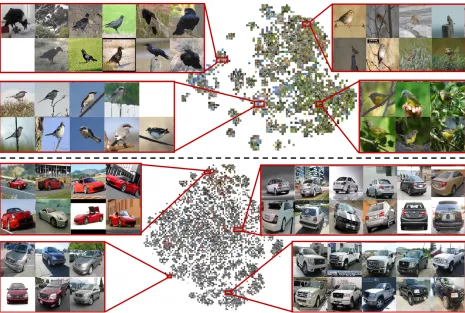
CARS196. It is worth to note that only our method is op-timized to capture the global structure, which confirms the point we argued before. Fig.4 visualizes the t-SNE (Van Der Maaten 2014) plots on the embedding vectors of our method on CUB200-2011 andCARS196, respectively. We can see that our method performs very well on grouping
Marginλ recall@K
K=1 2 4 8 16 32
λ= 0 66.7 76.7 85.0 90.4 93.8 96.4
0.1 67.9 79.1 86.2 91.8 94.8 97.1 0.2 67.0 77.1 84.9 90.5 93.9 96.4
0.4 65.9 76.3 84.5 90.2 93.8 96.5
Table 2: Recall@K with differentλonCUB-200-2011. The
λis the weight of Gram-Schmidt optimization in DGCRL.
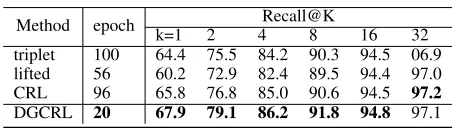
Method epoch Recall@K
k=1 2 4 8 16 32
triplet 100 64.4 75.5 84.2 90.3 94.5 06.9 lifted 56 60.2 72.9 82.4 89.5 94.4 97.0 CRL 96 65.8 76.8 85.0 90.6 94.5 97.2
DGCRL 20 67.9 79.1 86.2 91.8 94.8 97.1
Table 3: Recall@K and corresponding training epoch with different loss function onCUB-200-2011.
similar objects despite the variations in view point, pose and configuration.
Ablation Study: Scale
α
and Factor
λ
We further explore the retrieval performance in different hy-perparameter settings ofαandm, as well as how they affect the FGIR performance in CUB200-2011. Fig.3 shows the performance variations in different settings of parameterα. The performance is poor whenαis small and is stable when
αis higher than 16. As mentioned before, we observe the “degeneration” problem in Fig.3, i.e., the inter-class com-pactness and intra-class separation can be easily obtained in training set rather than disjoint testing set. In fact,α de-cides the size of the feature representation space. Therefore, the overfit can be alleviated with a higherα. On the other hand, the performance is consistent when αis lager than
Figure 4: Visulization of the proposed method with t-SNE onCUB200-2011(up) and CARS196(down). Best viewed when zoomed in. Based on our approach, images with similar objects are more likely to be grouped together despite the variations in view point, pose and configuration.
a large λthe results would decrease, due to the too strict Gram-Schmidt condition.
On Different Loss Functions
To evaluate the effectiveness of the proposed global central-ized ranking loss, we further replace our GCRL with dif-ferent loss functions and quantify the retrieval degeneration by Recall@K on CUB200-2011. As shown in Tab.3, our method is the best among different loss functions under the same setting of the rest components. Please note that, com-paring with the same methods in Tab.1, the performance is higher in Tab .3, which demonstrates the effectiveness of the proposed N-S layer. Besides, in Tab.3, we further re-port the training epochs with respect to different loss func-tions. The MSE loss functions (CRL, triplet, liftedstruct) are time consuming. Instead, loss function with cross-entropy is extremely effective in training, particular the our proposed DGCRL (only 20 epochs in the training phase).
Conclusion
In this paper, we solve two crucial issues in FGIR, termed
local structure and slow training, the former of which is caused by using the relationship only in a mini batch, while the latter refers to the usage of the mean square error. To
address the local structure issue, we propose a global cen-tralized ranking loss to learning the feature in aglobalway, which can be further enhanced by a Gram-Schmidt decorre-late optimization. To address the slow training issue, we pro-pose a normalize-scale layer to eliminate the gap between inner-product and the Euclidean distance, hence, the loss function can be further accelerated by using softmax loss. We achieve the best retrieval performance on the widely-used CUB200-2011 and CARS196 benchmarks. Quantita-tively, it gains 12.0% overCRL-WSL(Zheng et al. 2018) in
CARS196, as well as 5×faster in training over triplet loss.
Acknowledgements
References
Bell, S., and Bala, K. 2015. Learning visual similarity for product design with convolutional neural networks. ACM Transactions on Graphics (TOG)34(4):98.
Chen, T.; Li, M.; Li, Y.; Lin, M.; Wang, N.; Wang, M.; Xiao, T.; Xu, B.; Zhang, C.; and Zhang, Z. 2015. Mxnet: A flexi-ble and efficient machine learning library for heterogeneous distributed systems. arXiv preprint arXiv:1512.01274. Deng, J.; Dong, W.; Socher, R.; Li, L.-J.; Li, K.; and Fei-Fei, L. 2009. Imagenet: A large-scale hierarchical im-age database. InComputer Vision and Pattern Recognition, 2009. CVPR 2009. IEEE Conference on, 248–255. Ieee. Golik, P.; Doetsch, P.; and Ney, H. 2013. Cross-entropy vs. squared error training: a theoretical and experimental com-parison. InInterspeech, volume 13, 1756–1760.
Hadsell, R.; Chopra, S.; and LeCun, Y. 2006. Dimension-ality reduction by learning an invariant mapping. In null, 1735–1742. IEEE.
He, K.; Zhang, X.; Ren, S.; and Sun, J. 2016. Deep resid-ual learning for image recognition. InProceedings of the IEEE conference on computer vision and pattern recogni-tion, 770–778.
Huang, C.; Loy, C. C.; and Tang, X. 2016. Local similarity-aware deep feature embedding. InAdvances in Neural In-formation Processing Systems, 1262–1270.
Jia, Y.; Shelhamer, E.; Donahue, J.; Karayev, S.; Long, J.; Girshick, R.; Guadarrama, S.; and Darrell, T. 2014. Caffe: Convolutional architecture for fast feature embedding. In
Proceedings of the 22nd ACM international conference on Multimedia, 675–678. ACM.
Krause, J.; Stark, M.; Deng, J.; and Fei-Fei, L. 2013. 3d ob-ject representations for fine-grained categorization. In Pro-ceedings of the IEEE International Conference on Computer Vision Workshops, 554–561.
Krizhevsky, A.; Sutskever, I.; and Hinton, G. E. 2012. Imagenet classification with deep convolutional neural net-works. InAdvances in neural information processing sys-tems, 1097–1105.
Liu, W.; Wen, Y.; Yu, Z.; and Yang, M. 2016. Large-margin softmax loss for convolutional neural networks. InICML, 507–516.
Liu, W.; Wen, Y.; Yu, Z.; Li, M.; Raj, B.; and Song, L. 2017. Sphereface: Deep hypersphere embedding for face recogni-tion. InThe IEEE Conference on Computer Vision and Pat-tern Recognition (CVPR), volume 1, 1.
Long, J.; Shelhamer, E.; and Darrell, T. 2015. Fully con-volutional networks for semantic segmentation. In Proceed-ings of the IEEE conference on computer vision and pattern recognition, 3431–3440.
Oh Song, H.; Xiang, Y.; Jegelka, S.; and Savarese, S. 2016. Deep metric learning via lifted structured feature embed-ding. InProceedings of the IEEE Conference on Computer Vision and Pattern Recognition, 4004–4012.
Ranjan, R.; Castillo, C. D.; and Chellappa, R. 2017. L2-constrained softmax loss for discriminative face verification.
arXiv preprint arXiv:1703.09507.
Ren, S.; He, K.; Girshick, R.; and Sun, J. 2015. Faster r-cnn: Towards real-time object detection with region proposal net-works. InAdvances in neural information processing sys-tems, 91–99.
Schmidt, E. 1908. ¨Uber die aufl¨osung linearer gleichungen mit unendlich vielen unbekannten. Rendiconti del Circolo Matematico di Palermo (1884-1940)25(1):53–77.
Simonyan, K., and Zisserman, A. 2014. Very deep convo-lutional networks for large-scale image recognition. arXiv preprint arXiv:1409.1556.
Song, H. O.; Jegelka, S.; Rathod, V.; and Murphy, K. 2017. Deep metric learning via facility location. InComputer Vi-sion and Pattern Recognition (CVPR), volume 8.
Szegedy, C.; Liu, W.; Jia, Y.; Sermanet, P.; Reed, S.; Anguelov, D.; Erhan, D.; Vanhoucke, V.; and Rabinovich, A. 2015. Going deeper with convolutions. In Proceed-ings of the IEEE conference on computer vision and pattern recognition, 1–9.
Ustinova, E., and Lempitsky, V. 2016. Learning deep em-beddings with histogram loss. InAdvances in Neural Infor-mation Processing Systems, 4170–4178.
Van Der Maaten, L. 2014. Accelerating t-sne using tree-based algorithms. The Journal of Machine Learning Re-search15(1):3221–3245.
Wah, C.; Branson, S.; Welinder, P.; Perona, P.; and Belongie, S. 2011. The caltech-ucsd birds-200-2011 dataset.
Wang, J.; Song, Y.; Leung, T.; Rosenberg, C.; Wang, J.; Philbin, J.; Chen, B.; and Wu, Y. 2014. Learning fine-grained image similarity with deep ranking. In Proceed-ings of the IEEE Conference on Computer Vision and Pat-tern Recognition, 1386–1393.
Wang, F.; Xiang, X.; Cheng, J.; and Yuille, A. L. 2017. Normface: l 2 hypersphere embedding for face verification. InProceedings of the 2017 ACM on Multimedia Conference, 1041–1049. ACM.
Wei, X.-S.; Luo, J.-H.; Wu, J.; and Zhou, Z.-H. 2017. Se-lective convolutional descriptor aggregation for fine-grained image retrieval. IEEE Transactions on Image Processing
26(6):2868–2881.
Wen, Y.; Zhang, K.; Li, Z.; and Qiao, Y. 2016. A dis-criminative feature learning approach for deep face recog-nition. InEuropean Conference on Computer Vision, 499– 515. Springer.
Xie, L.; Wang, J.; Zhang, B.; and Tian, Q. 2015. Fine-grained image search. IEEE Transactions on Multimedia
17(5):636–647.
Zhang, X.; Zhou, F.; Lin, Y.; and Zhang, S. 2016. Embed-ding label structures for fine-grained feature representation. InProceedings of the IEEE Conference on Computer Vision and Pattern Recognition, 1114–1123.