OXYGEN AND ITS CONTROL OVER STRUCTURAL
AND ELECTRONIC PROPERTIES OF PB BASED 1212
SUPERCONDUCTORS
Brian James Mitchell
A Thesis Submitted for the Degree of PhD
at the
University of St Andrews
1998
Full metadata for this item is available in
St Andrews Research Repository
at:
http://research-repository.st-andrews.ac.uk/
Please use this identifier to cite or link to this item:
http://hdl.handle.net/10023/15031
o o
School of Chemistry
North Haugh
St Andrews. KYI6 9ST
Oxygen and its control over structural
and electronic properties of Pb based
1212 superconductors
Brian James Mitchell
A thesis presented for the degree of Doctor of
Philosophy
All rights reserved INFORMATION TO ALL USERS
The qua lity of this reproduction is d e p e n d e n t upon the qua lity of the copy subm itted. In the unlikely e v e n t that the author did not send a c o m p le te m anuscript and there are missing pages, these will be noted. Also, if m aterial had to be rem oved,
a n o te will in d ica te the deletion.
uest
ProQuest 10166815
Published by ProQuest LLO (2017). C o pyright of the Dissertation is held by the Author.
All rights reserved.
This work is protected against unauthorized copying under Title 17, United States C o d e M icroform Edition © ProQuest LLO.
ProQuest LLO.
789 East Eisenhower Parkway P.Q. Box 1346
I, Brian J. Mitchell, hereby certify that this thesis, which is approximately 33300 words in length, has been written by me, that it is the record of work carried out by me and that it has not been submitted in any previous application for a higher degree.
Date signature of candidate
I was admitted as a research student in October 1994 and as a candidate for the degree of Doctor of Philosophy in October 1995; for higher study for which this is a record was carried out in the University of St Andrews between 1994 and 1997.
Date signature of candidate /
I hereby certify that the candidate has fulfilled the conditions of the Resolution and Regulations appropriate for the degree of Doctor of Philosophy in the University of St., Andrews and that the candidate is qualified to submit this thesis in application for that degree.
Date 2 ^ // signature of supervisor
In submitting this thesis to the University of St. Andrews I understand that I am giving permission for it to be made available for use in accordance with the regulations of the University Library for the time being in force, subject to any copyright vested in the work not being affected thereby. I also understand that the title and abstract will be published, and that a copy of the work maybe made and supplied to any bona fide library or research worker.
ACKNOWLEDGEMENTS
On the academic side of things I would like to thank the following for their assistance with experiments and useful discussions:
ELL Grenoble France. Clemens Ritter and Alan Hewat.
ESRF Grenoble France. Andy Fitch, Eric Dooryhee, Gavin Vaughan. ISIS Didcot. Kevin Knight.
SRS Daresbury Warrington - Andy Dent and Mark Roberts
Edinburgh University. Andrew Harrison, Gavin Whittaker and Aidrew Wills
St Andrews University. Bob Cywinski, Adrian Hillier, David Tunstall, Svetlana Titova and Stephanie Lagrave.
Great thanks though to my supervisor John Irvine for his encouragement and help with this research in what has been at times extremely challenging occasionally tedious, and of course the University of St Andrews for providing my funding.
ABSTRACT
The phase stability, electronic properties and crystal structure of the Pb based 1212 cuprate superconductor (Pb[i+x]/2Cu[i-x]/2)Sr2(Yi-xCax)Cu2 0 7 ± 8 were studied using a
number of techniques.
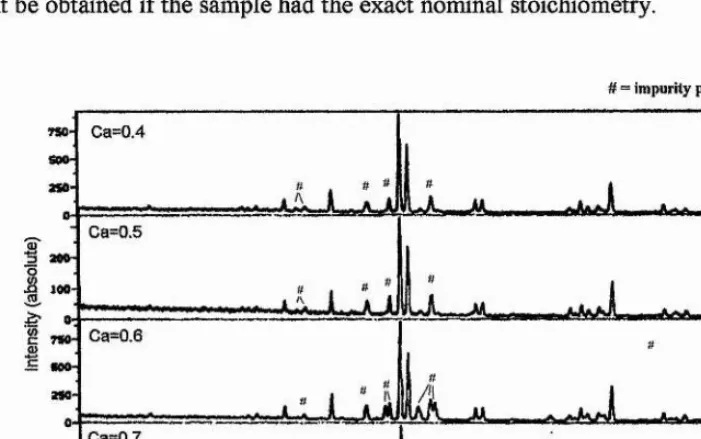
Since synthetic difficulties limited study of these materials, sol-gel techniques incorporating mixed metal nitrate precursors were applied. Novel synthesis techniques improved reaction rate but did not entirely overcome synthesis difficulties. The effects of Ca content; reaction temperature, and oxygen content in controlling product phase formation and phase stability under synthesis conditions were investigated.
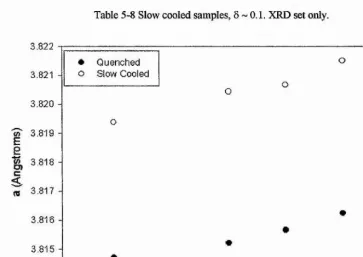
X-ray and neutron diffraction were used to probe structural disorder within samples as Ca levels increased and sample oxygen content was varied. The subsequent Rietveld refinements revealed that the levels of cation site disorder increase in line with increasing Ca levels.
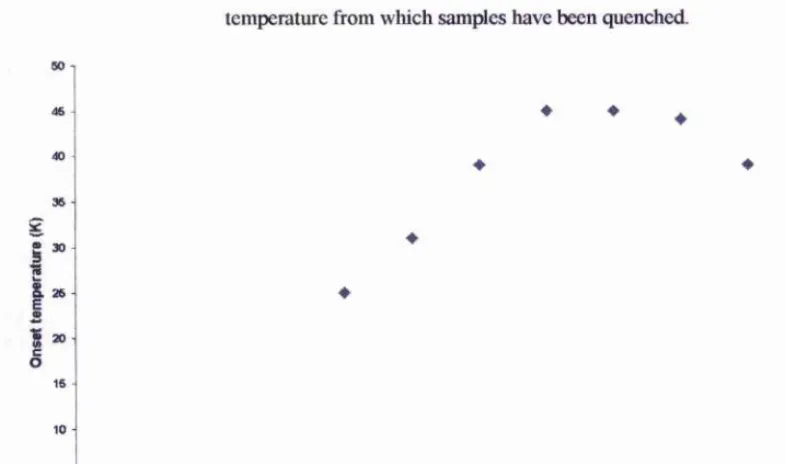
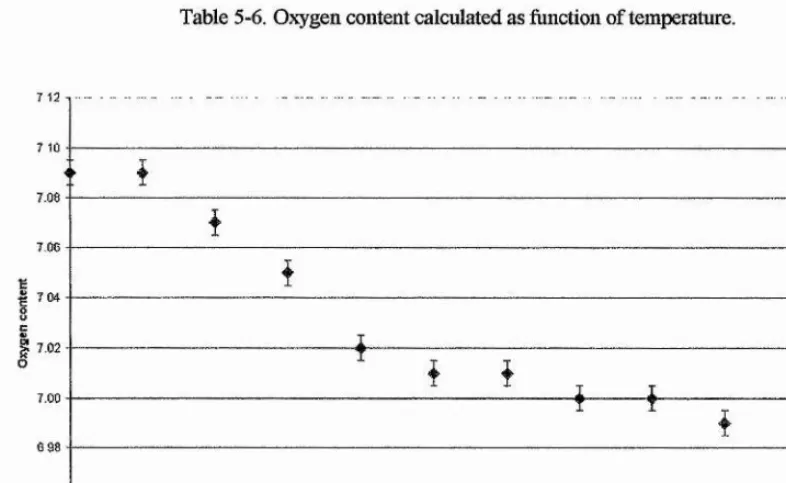
Under oxidising conditions, annealing temperature and thus oxygen content of the sample plays a critical role in controlling superconducting properties. Optimal Tc and superconducting volume are only achieved over the oxygen content range 6.99-7.00. Low p02 annealing conditions were used to control sample oxygen content; however, these were not significantly better than standard techniques. Low p02 environments facilitate the removal of oxygen from samples and allowed the study of phase stability. It was possible to show that decomposition of the 1212 phase leads to formation of new superconducting phases that might well account for contentious literature claims.
EXAFS and NMR measurements show that on a local scale, the structure of the 1212 phase rocksalt layer is quite different to the average structure generated from diffraction measurements. The Pb atoms tend to form a Pb0 4+x molecular type cluster,
Pages
Ch a p t e r 1. In t r o d u c t io n 1-24
Ch a p t e r 2. Pb; 1212 Cu pr a t e s Re se a r c h 25-44
Ch a p t e r 3. Ex pe r im e n t a l 45-75
C h a p te r 4. S y n th e s is a n d P h a s e S t a b i l i t y 76-102
CHAPTER 5. St r u c t u r e a n d Diso r d e r 103-16I
Ch a p t e r 6. De c o m po sit io n o f 1212 st r u c t u r e 161-215
Page
1.1. Overview 2
1.2. Properties of superconducting materials 3
1.21. Historical review
1.22. Behaviour of superconductors in a magnetic field
1.3. High Tc superconductivity 11
1.31. Properties ofHTS materials
1.32. Control of superconducting properties
1.4. Structural properties of cuprate superconductors 15
1.5. Commercial Applications of High Tc materials 19 1.51. Small scale commercial applications
1.52. Power applications
Although the 1986 discovery of superconductivity in the La-Ba-Cu-O (cuprate) system by Bednorz and Müller^^\ who subsequently received the Nobel prize, caused great interest and initiated one of the greatest surges of research activity of the Century, superconductivity had first been discovered in 1911 by Kamerlingh Onnes^^\ Over the next 75 years thousands of materials were studied. Properties improved, industrial uses developed e.g. high field magnets, and of course the theory from Bardeen Cooper and Schrieffer^^^ that describes the phenomenon of superconductivity was developed. The limitation, until 1986, was the superconducting transition temperature of the materials. Indeed the maximum onset temperature (Tc) achieved was 22.3K in a NbsGe sample by Testardi et al^'^l This meant that liquid He was required as the cooling medium. Liquid He is approximately 20 times more expensive than liquid N2. Of course there had been
claims by a number of scientists that superconductivity could be induced at temperatures far above 23K e.g. Ogg et al^^’^^ in metallic solutions of sodium in ammonia, or the prediction of high transition temperatures in organic material by Little^^l These claims, however, have either been disproved or not yet confirmed.
The discovery of High Temperature Superconductivity (HTS) in LBCO, an oxide material by Bednorz and Müller, initially raised interest because the Tc was >3OK, well above the previous record which had only been achieved after decades of research. Although treated initially with scepticism, laboratories began working on these systems and the real breakthrough came at the end of 1986 when Wu^*^ et al discovered a Tc >90K in a sample containing Y-Ba-Cu-O. The liquid Nitrogen barrier had been broken and the number of groups working in the field mushroomed. Onset temperatures climbed steadily above the lOOK mark with the discovery of multi-elemental Bi2Sr2CaCu20sand Tl2Ba2Ca2Cu3 0 io. The maximum onset temperature to date was
achieved in 1993 at -135K by Schilling et al^^^ (-165K under pressure) in HgBa2Ca2Cu3 0s samples. Since then the Hg based system has produced the highest
onset temperatures, though they are still around the 135K mark.
on the discovery of new novel superconducting materials and improvement of existing material properties with the view to developing industrial applications. However, most applications so far have only been small scale and more of novel value e.g. ultra sensitive magnetic detectors (SQUIDS), and the low temperature BCS type superconductors still are the most amenable to development for industrial applications. HTS materials can compete on cost, but fabrication and reliability problems are still a major drawback.
The cuprate based superconductors interested theoreticians fi-om very early on since superconductivity occurs at temperatures far exceeding the limit imposed by BCS theory. These materials show marked differences in a number of properties e.g. coherence length, penetration depth and large spatial anisotropy from the conventional BCS low temperature superconductors. Even at the present time, there are a number of theories being put forward to describe the cuprate systems, yet no one theory is showing dominance. Interest has also been sparked in a number of new low Tc superconductors such as Y(Nii.xC0x)2B2C, which appear not to be simply classified as
BCS materials. Superconductivity may well have been studied for a long period of time, but it still leaves many unanswered questions and great scope for research.
1.2. Properties of Superconductors.
1.21. Historical review
showed that superconductivity could be destroyed by applying a critical current to the sample. It was not until 1933 that Meissner and Ochsenfeld^“ ’ showed that a superconducting material when cooled below its Tc with no external magnetic field present and then subjected to an external magnetic field, totally expels the magnetic flux from its core This leads to a situation where there is no magnetic flux within its interior, figure 1.1 (al and a2). If the sample temperature is above Tc in the presence of an external field flux penetrates the sample, figure l(bl). When this superconducting material is cooled below Tc in the presence of a magnetic field, then the magnetic flux is also expelled from its interior, figure 1.1 (b2).
i
Figure 1.1. Top left to right, (al) Cooling below Tc with zero applied field. (a2) Expulsion of flux from within sample as external field is applied. Bottom left to right, (bl) Above Tc magnetic flux enters
sample. (b2) Expulsion of flux from sample below Tc with magnetic field applied.
Critically, the work by Meissner and Ochsenfeld showed that the superconducting state not only possessed the property R=0, but should be treated as a thermodynamic phase since the magnetic flux was expelled from its interior independent of experimental conditions.
penetration depth).
For many years the evidence suggested that the lattice played no part in the superconducting mechanism; however, the development of nuclear physics allowed preparation of large amounts of the isotopes of a particular element. The work of Maxwell^^^^ and Reynolds et al^^"^^ in 1950 showed that the Tc of a material was found to depend on the isotopic mass, M, such that:
Teocl/VM (1.1)
The frequency, v, of vibration of a diatomic molecule is known to be given by:
V = — -\/k / pi ( 1 2 )
In
where [i is the reduced mass of the molecule, and k the force constant of the bond. The force constant depends on the bonding of the atoms in the material and ought not to be altered by variation of the isotopic mass, so v oc Although the situation for a lattice is more complex it remains that the frequency of vibration of the lattice is altered by isotopic substitution.
Frohlich^^^^ and Bardeen^^^^ in 1950 independently suggested that there was an interaction of the electrons via the lattice in superconducting materials. The vibrational modes of a lattice are quantized, as are the modes of an isolated molecule, the quanta of the lattice vibrations being called phonons.
charge density. As these oscillate, a second electron passing this moving region of positive charge density is attracted to it. The net effect is that the two electrons have interacted with one another, using the lattice vibration as an intermediary. Furthermore, the interaction between the electrons is attractive because each of the two separate steps involved has an attractive Coulomb interaction.
High frequency techniques to determine X gave an effective depth considerably larger than calculated from the London equations, and this was resolved by Pippard^^^^ who introduced a coherence length (^) for the wavefimctions of the superconducting carriers, such that a perturbation at one point influences every carrier within a distance
of that point.
Around the same time Ginzberg and Landau^^^^ (GL) proposed phenomenological equations, which were an alternative to London theory. One important parameter is;
k = ÀL/ S 0.3)
The GL parameter is a dimensionless ratio, which proves important in differentiating between types of superconductor.
In 1957 Bardeen Cooper and Schrieffer published their theory of superconductivity (BCS theory) which predicts that under certain conditions, the attraction between two conduction electrons due to a succession of phonon interactions can slightly exceed the repulsion that they exert directly on one another due to the Coulomb interaction of their like charges. The two electrons are thus weakly bound together forming a so-called Cooper pair.
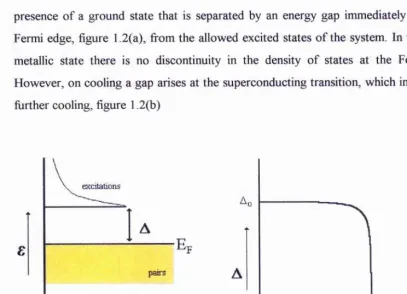
metallic state there is no discontinuity in the density of states at the Fermi edge. However, on cooling a gap arises at the superconducting transition, which increases on further cooling, figure 1.2(b)
excitations
s
pairs
k
A
Figure 1.2. From left. 1.2(a). Schematic density of states near the Fermi edge of a superconductor. 1.2(b) Variation of the superconducting energy gap with temperature.
In the superconducting state, carriers immediately below the Fermi edge are paired, those above the superconducting gap are electron-like or hole like excitations, figure 1.2(b). The lowest energy for a Cooper pair is achieved by binding together an electron with wave vector +k and an electron with -k, and with their spins anti parallel, so that the net spin is zero. The net linear momentum of such a pair is zero. Particles with odd half-integral spins e.g. electrons are subject to Fermi statistics and as a result can only occupy a state defined by all the quantum numbers once. Here, we are dealing with a situation where a state is occupied by very many particles and these are composed of electrons. The reason, simply put, is that Cooper pairs obey Bose-Einstein statistics.
1.22. Behaviour of superconductors in a magnetic field^^^’^®’^^*
[image:15.616.84.492.63.357.2]studying this in more detail we can expand on a number of important parameters, which categorise superconductors.
Neglecting demagnetisation effects, if a superconductor is placed in a magnetic field up to a critical value He, figure 1.3, it generates a screening current and associated magnetic field that completely counters the external applied magnetic field. The magnetic flux, B, is thus zero inside a superconductor and the material is a perfect diamagnet.
H ■¥ He
M
Figure 1.3. Magnetisation curve for a superconductor up to He.
However, if the magnetic field were to drop discontinuously to zero at the surface of the superconductor then the surface current would have to rise to an infinite value, which is impractical. Thus, the magnetic field must penetrate somewhat into the surface of the material. F. and H. London developed equations which relate the penetration depth to pair density;
(1.5)
into the sample and a return to the normal state. This transition is reversible and lowering the field below He leads to a return of superconductivity. Superconductors, that display this type of behaviour are described as Type 1 or soft superconductors. They usually are single elements e.g. Pb, and are not suited for industrial applications. In type 1 superconductors, X is small compared to ^ (the range within which electrons can interact to form Cooper pairs), thus k « 1.
If, however, X is large compared to then different sort behaviour in a magnetic field occurs, figure 1.4. This type of superconductor is known as a Type II or hard superconductor.
H
H cl He Hc2
M
Figure 1.4. Magnetisation curve for a Type II superconductor.
Up to the point Hci the superconductor is a perfect diamagnet, just as for type I materials. However, above Hci magnetic flux penetrates the sample and the magnetisation of the sample decreases until all superconductivity has been abolished at the point Hc2. Known as the mixed or ‘vortex’ state, the region between Hci and Hc2 is
B e
Figure 1.5. Representation of the mixed phase. Magnetic field and supercurrent shown for one tube.
It consists of tiny vortices, typically in a hexagonal lattice, of supercurrent in the form of Cooper pairs, circulating around regions of magnetic flux. The current density and the number of Cooper pairs decreases towards the centre of each vortex, where the material is in the normal state. The ideal pattern is disrupted by lattice imperfections and grain boundaries.
1.3. H igh Tc superconductivity^^^^^^^^^l
The discovery of HTS superconductivity in doped lanthanum cuprate certainly created a large number of problems for experimentalists and theorists alike. Before 1987 it was believed that superconductivity was the select domain of low-temperature physics.
These cuprates contain layers of copper oxide sandwiched between insulating oxide layers that donate the charged carriers into the conducting planes. Even in their normal metallic state these materials are unusual. Usually their resistances are almost linear functions of temperature up to 600K; they are exceptionally anisotropic conductors; and a small reduction in the density of carriers in the copper oxide layers converts them to magnetically ordered insulators. Even after ten years, there is no consensus on the mechanism of cuprate superconductivity. Indeed, there is heated debate on whether or not electron pairs with s-wave or d-wave symmetry are favoured. It is beyond the scope of this review to discuss proposed theories; however, it is clear that this is a particularly ‘grey area’ where experimental results are not convincing and indeed are open to very loose interpretation. On the other hand, the cuprate systems have generated challenging problems to condensed matter scientists that may well lead to a reappraisal of the way we approach the behaviour of systems on the microscopic and macroscopic level.
1.31. Properties of HTS materials.
In the superconducting state, the electrons are paired. Several different experiments showed that in the superconducting state, the fundamental charge is 2e. _____ ____ Photoemmision spectroscopy, electron tunneling and other experiments indicate an energy gap in the superconducting state. The energy gap is probably anisotropic and lies
in the range S.SkeTc-S kpTc, larger than the isotropic BCS value of 3.54kBTç. ____
Several experiments suggest pairing into a singlet-spin state and a s-wave orbital angular momentum state, as predicted by BCS.______________
HTS materials display many familiar superconducting properties,
tunneling and vortex structure found in any type II superconductor such as Josephson
Table 1-1. Properties of HTS superconductors shared with conventional BCS superconductors.
Extremely high value of Tc.
Linear dc resistivity in the normal state.
Unusual behaviour of the nuclear relaxation rate below Tc. Close proximity of antiferromagnetic phases.
Extremely small coherence lengths. Large penetration depths.
Large spatial anisotropy.
Zero isotope effect, not reduced as seen in some BCS superconductors.
Table 1-2. Properties of HTS superconductors not seen for conventional superconductors.
1.32. Control of superconducting properties.
The properties of high temperature superconductors tend to be highly dependent on carrier concentration, which may be controlled by chemical doping. There are two principal methods of doping high temperature superconductors, oxygen non stoichiometry and aliovalent substitution. Note these two methods can operate in tandem. Good examples of these mechanisms are in YBa2Cu3 0 7-x and La2Cu0 4
respectively.
In YBa2Cus0 7-x (YBCO) carrier concentration is predominantly controlled by oxygen
atmospheric oxygen into the lattice with removal of electrons from the electron energy bands creating holes (1.6 and 1.7);
2Cu^* + '/2O2 (1.6)
(1.7)
It is usual to consider doping in terms of nominal Cu valence; however, no assumption that hole carriers reside on Cu is implied. In YBCO the critical temperature is found to decrease smoothly as the oxygen content is decreased for stoichiometries prepared at high temperatures and quenched. In samples prepared at lower temperatures or slow cooled, plateaux behaviour is observed, figure 1.6. This behaviour which is commonly encountered is associated with oxygen ordering on the basal YBCO plane, and shows clearly how important it is to control oxygen stoichiometry in some samples.
too
LU ccI
LU
Q. 3
Slow cool
' Rapid cool
7.0
6.8
6.6
6.4
6.2
OXYGEN CONTENT (7 - X)
Figure 1.6. Relationship between To and oxygen stoichiometry in YBasCugO^ x.
( Taken from niomspson^^ )
In La2Cu0 4 oxygen non-stoichiometry is generally less important than aliovalent
electron hole. In this system the oxygen stoichiometry remains, more or less, constant, thus the number of holes is proportional to the extent of substitution. Figure 1.7 shows the effect of doping La2Cu0 4 with Sr. On increasing hole concentration, La2Cu0 4
transforms from an antiferromagnetic insulator to a metal at high temperatures. At lower temperatures the transition is from an antiferromagnetic insulator to a spin glass to a superconductor to a metal.
ZOOK
Metal
38K Afl
0
0.15
X
Figure 1.7. Phase diagram of La2.^xSrxCu0 4 (AFI = Aiitiferromagiietic insulator, SG = spin glass and SC = superconductor). ( From Tlicaiispson“ )
Aliovalent substitution with a cation of lower charge does not always lead to increased carrier concentration since sometimes charge neutrality is maintained by loss of oxygen. In Nd2Cu0 4, n-type doping is achieved by replacement of Nd^^ with an ion
1.4 Structural properties of cuprate superconductors
The ideal perovskite structure upon which the cuprates are based has the general formula ABX3. The perovskite structure has a cubic cell in which the A cations (larger
and in blue in figure 1.8) lie at the centre of each cube. The structure therefore comprises a three dimensional network in which the A cations have AX12 dodecahedral
co-ordination and the B cations (not shown but in the centre of the octahedra) have a
3 X5 octahedral co-ordination.
Figure 1.8. Ideal perovskite structure ABX3.
A variety of perovskites or perovskite related structures are produced when the atoms at the A, B and X sites are changed. A or B sites can be filled with two or more different cations e.g. Ca2CaU06 (A2BB’06) or CaCu^Mn^On (AA\B4 0i2) The
octahedral centres can be filled not only by two different elements but also by differently charged ions of the same element, e.g. Ba2Bi^ Bi^ Oe Partial substitution at the A/B
physical properties of perovskite type metal oxides e.g. YBa2Cu3 0 7-x. Ideal perovskite
structures are isotropic in their electrical properties. However, many are somewhat distorted with tilted octahedra, which lower the symmetry, potentially altering the electrical and other physical properties. Thus, the electrical properties vary from insulating (SrTiOs) to semiconducting (BaBiOs).
In cuprate systems the phenomenon is only seen in structures which can be described as oxygen deficient perovskites or perovskite intergrowths. The key structural feature in all these systems is the presence of a CUO2 plane or a series of CUO2 planes. The co
ordination environment of Cu in these planes can be octahedral, square pyramidal or square. YBa2Cu20?_x, often described as an oxygen deficient perovskite. The structure of YBa2Cu2 0 7-x can simply be simply derived from that of a triple perovskite unit, 3ABX3, by removing all of the oxygens from the yttrium plane and all of the 0(5)
0I« i
---F
— ^ CW2)Ô O Il)
3 ASX) ® B
# A
O X
# X'
C
i
01S» TBSjCujO,
F
o Cw# Bo
e Y O 0
Figure 1.9. Relationships between the YBuaCusOT and triple perovskite (ABX3) unit cells. ( From Tliomspson^^ )
The vast majority of HTS cuprates may be regarded as intergrowth phases between perovskite and rocksalt/fluorite blocks. The most important of these are the Ruddlesden-Popper phases of formula (AOjmEABOsL which are rocksalt perovskite intergrowths. La2Cu0 4 , (Nd,Ce)2Cu0 4 and (Nd,Ce,Sr)2Cu0 4 are good examples shown
#
Figure 1.10. La2Cu0 4 structure. ( From Park'*’* )
( N d f e k C u O X T )
(Nd,Ce,Sr)
2Cy
0 4( r )
It ...srrisrr
' i î ' -
ILM
j
E
--art^iscr- n
^ # g» DJOCk
Figure 1.1 l(a,b). (Nd,Ce)2Cu0 4 and (NdCe,Sr)2Cu0 4. ( From Park‘d’* )
The most important of the Ruddlesden-Popper phases are those based on single or double TIO, PbO, BiO and HgO rocksalt layers. These belong to two ideal structural families: 12[n-l][n] e.g. TlBa2CaCu2 0?o is 1212 where n = 2 and 22[n-l][n] e.g.
Bi2Sr2CaCu20s is 2212 where n = 2. These series contain the highest Tc’s discovered to date including Bi2Sr2Ca2Cu3 0 io (Tc=110K); Tl2Ba2Ca2Cu3 0io (Tc=128K); and
Of course these compositions are represented with ideal stoichiometries, but in reality this is never the case in such systems. There is cation intersite substitution and oxygen non-stoichiometry and additional structural deviations arise from supercell modulations, particularly in Bi based systems where the Bi has a lone pair.
1.5 Commercial Applications of High Tc materials^^^ ^^^^^^l
When high-temperature superconductivity reached temperatures above that of liquid nitrogen more than ten years ago, many very enthusiastic people talked of magnetically levitated trains, computers and motors all soon to be operating above 77K. However, when reality set in the field settled into a large active one, but with only the simplest of products being proposed for the following few years.
Now after many years of hard work, outstanding progress is being reported in thin film technology and electronics using HTS superconductors. Some products are already on the market and others imminent. The first HTS products to be sold in quantity were sensors for magnetometers. Now work is going well on sensors for NMR spectrometry, cellular-phone base stations and military systems.
1.51. Small scale commercial applications.
YBCO is the workhorse material used in the fabrication of thin films. Using a bicrystal technique it is possible to control the production of grain boundaries, which of course act as weak links and reduce the supercurrent. Other materials successfully used for thin films are Tl-Ba-Ca-Cu-0 and Tl-Pb-Sr-Ca-Cu-0. SQUIDs are ideal for making sensitive magnetic field measurements, and the HTS versions are showing promise for geophysics, magnetocardiology and non-destructive testing. Certainly research in this area has advanced particularly in overcoming “noise” which was a major problem. In terms of military applications SQUIDS were only really used for submarine detection; however, now they are being used in many areas including seeking of unexploded ordnance or mines. HTS SQUIDs can also be used for non-destructive testing e.g. to detect and quantify hidden cracks and corrosion in ageing commercial or military aircraft, or to test nuclear reactor vessels.
Because every large geographic region has two cellular phone providers, with interleaving frequency allocations, a filter must ensure that signals fi*om one provider do not leak into the other's band. HTS filters have been shown to be less noisy than copper, even when copper is run at 77K. The main materials being used are YBCO and Tl-Ba-Ca-Cu-0 (TBCCO) thin films. It is not just the superconductors that are complex; the existing cryogenic commercial cryogenic refrigeration systems were too unreliable and expensive. These new HTS filter units are currently 10 times smaller than existing units and this certainly is advantageous. In the future the hope is to design HTS filters for transmitting as well as receiving. With the growth of cellular communications, this market has great potential.
small MRI device to examine elbows, knees and fingers, the noise is limited by the sensor itself.
Many people have asked, “when will HTS materials be used for high-speed communications or computers?” A key requirement for these technologies is the ability to fabricate multilayer thin films to interconnect individual devices. It is more difficult, but such devices have been made using YBCO. Before the discovery of HTS superconductors some firms had R&D efforts to build a Josephson junction computer. Projects were cancelled because silicon technology was advancing at such a rapid rate. There is some research using HTS devices, but it would seem that considerable R&D is necessary to make reproducible, reliable Josephson devices especially as the number of junctions is increased beyond the pair needed say for a SQUID.
1.52. Power applications.
Japan is putting much more money into bulk applications than the US and its annual budget for bulk material on power related projects is estimated to be about $100 million. In addition Japan is using HTS materials in its R&D on magnetically levitated trains and flywheels.
Presently HTS materials research is concentrating on optimising materials for applications through processing. Currently, bulk applications primarily use Bi-Sr-Ca- Cu-0 (BSCCO) as 2223 and 2212. The other leading HTS material is YBCO. Two major factors influence the amount of current density, Jc, which can be transported. The most important is that if the material is polycrystalline it tends to subdivide into regions of strong superconductivity separated by weak superconducting interfaces, known as weak links. The principal way of avoiding weak links is to align the grains so that grain boundaries are at low angle with respect to the Cu-0 planes. One can improve the Jc characteristics of individual grain boundaries or align the “texture” of the grains to improve the links in the current path. The Jc for both BSCCO and YBCO is strongly correlated with the distribution of grain boundary misorientations. The second major factor influencing the current density is the need to develop strong flux pinning so that vortices can resist the Lorentz force that dissipates energy and causes current losses.
YBCO has better intrinsic flux pinning than BSCCO, but it has poor intergranular current flow because of weak links. Despite its inadequate flux pinning, BSCCO has been preferred for making wire because the grains align and form good grain boundaries for conduction when they are drawn, rolled into a tape shape and then fired. Tl-Ba-Ca- Cu-0 TBCCO in 2223 and 1223 varieties have also shown promise for wire applications. Its properties fall between that of YBCO and BSCCO. It has links that are stronger than YBCO but its flux pinning is poorer.
For almost all of the important electric power applications, a Jc of at least 10"^ A.cm"^ is needed. The most popular materials used in wire making are the BSCCO’s and it is good grain alignment that is crucial. It is now possible using BSCCO materials to manufacture cables and coils with lengths of 100-1000 metres with a Jc above
10^ A.cm‘^ at 77K. Much of the work involves B12223, although B12212 is easier to fabricate and has a better Jc in high magnetic fields and low temperature (<20K) it cannot be used at 77K. At 4K though 2212 is superior because it is less prone to weak links. For operation at liquid nitrogen temperature, YBCO is preferable because it retains Jc under strong magnetic fields either as an epitaxial film or a single crystal. YBCO retains high critical currents in strong fields because there is stronger coupling between its Cu-0 planes than in BSCCO. YBCO lacks the micaceous layer of BSCCO, which has prevented attempts to use the powder-in-tube processing to make wire.
1.6. Bibliography and references for chapter I.
^ J.G. Bednorz and K.A. Müller, Z Phys. B, 1986, 64, 189.
^H.K. Onnes, Comm. Leiden^ 1911,120b.
^ J. Bardeen, L.N. Cooper and J R. Schrieffer, Phys. Rev., 108, 1175.
L.R. Testardi, J.H. Wemick and W.A. Royer, SohdState Commun., 1974, 15, 1. ^ R. A Ogg, Phys. Rev., 1946, 69, 243.
® R A Ogg, Phys. Rev., 1946, 70, 93. ^ W.A. Little, Phys. Rev., 1964,134A, 403.
^ M.K. Wu, J R. Ashburn, C.J. Torng, P.H. Hor, R.L. Meng, L. Gao, Z.J. Huang, Y.Q. Wang and C.W. Chu, Phys. Rev. Lett., 1987, 58, 908.
^ A. Schilling, M. Cantoni, J.D. Guo, H R. Ott, Nature, 1993, 363, 56. F.B. Silsbee, J. Wash. Acad. Soi., 1916, 6, 597.
W. Meissner and R Ochsenfeld, Naturwissensch, 1933, 21, 787. F. London and H. London, Z Phys., 1935, 96, 359.
E. Maxwell, Phys. Rev., 1950, 78,477.
C.A. Reynolds, B. Serin, W.H. Wright and L.B. Nesbitt, Phys. Rev., 1950, 78, 487. H. Frohlich, Phys. Rev., 1950, 79, 845.
J. Bardeen, Phys. Rev., 1950, 80, 567.
A.B. Pippard, Proa. R. Soc. London, 1953, 216, 547.
V.L. Ginzburg and L.D. Landau, Zh. Eksperim. I. Teor. Fiz., 1950, 20, 1064. W. Buckel, Super-conductivity'.fundamentals and applications, Weinheim, VCH, 1991.
B.I. Bleaney and B. Bleaney, Electiicity and magnetism, London, Oxford University Press, 1976.
L. Smart and E. Moore, Solid state chemistry:an introduction, London, Chapman & Hall, 1992.
P. Coleman, Physics World, 1995, 8, 29.
^ G Burns, High-temperature superconductivity. New York, Academic Press, 1992. B. Batlogg, Phys. Today, 1991, 44, 44.
^ D P. Tunstalî and W. Barford (éd.), High temperature superconductivity. Bristol, Institute of Physics, 1992.
T. A. Vanderah (ed.). Chemistry o f high temperature superconductors. New Jersey, Noyes Publications, 1991.
A.R. West, Solid state chemistry and its applications, Chichester, John Wiley and Sons, 1984.
C.Park and R.L. Snyder, J. Am. Cer. Soc., 1995, 78, 3171.
P.P. Edwards and C.N.R. Rao, Chemistry in Britain, 1994, 30, 722. G.B. Lubkin, Physics Today, 1995, 48, 20.
G.B. Lubkin, Physics Today, 1996, 59, 48.
Chapter
2
.
Pb:
1212
CUPRATES RESEARCH
Page
2.1. Literature review 26
2.11. The PbCu: 1212 system 1989-1994 2.12. The PbM: 1212 system 1989-1994 2.13. Conclusions
2.2. Research aims 41
2.1. Literature review
This literature review covers the most important research papers published concerning (Pb,M)Sr2(Y,Ca)Cu20y Pb:1212 cuprates. Section 2.11 focuses solely on the development of the PbCu: 1212 system from its discovery in 1989 up to the starting point of this study. The aims are to highlight the key results that describe the phase, and also show the problems in controlling phase stability and oxygen stoichiometry during synthesis and annealing. Section 2.12 covers the same time span, but describes other Pb:1212 based systems e.g. PbTl;1212 or PbSr:1212. In some cases these phases show better phase stability and superconducting properties than PbCu: 1212, however, there are also results that contradict one another in addition to problems controlling phase stability and oxygen stoichiometry during synthesis and annealing.
2.11. The PbCu: 1212 system 1989-1994
Subramanian and co-workers initially reported^^^ the presence of an impurity among a Pb2Sr2(Y,Ca)iCu3 0 8+y sample composition, which could be approximated at
(Y,Ca)Sr2(Cu,Pb)3 0 ?-y. Further analyses showed the material to be non
superconducting and having the formula (Pbo.7Cuo.3)Sr2(Yo.85Cao.i5)Cu206.8, corresponding to a tetragonal cell (a « 3.8A and ç « 11.8Â) with the P 4/mmm space group. Lee et al^^^ around the same time independently reported that another non superconducting compositional variant of this material
(Pbo.7Cuo.3)Sr2(Yo.7 3Cao.2 7)Cu2 0 7 had lattice constants which were nearly identical to
# %
Y/Ca
#
Cu(l)Pb/Cu
0(3)
Figure 2.1. The 1212 structure represented in ideal form.
The interesting features emerging from the crystal structure analysis were that the Cu(2) was displaced from the (0,0,0) site and the 0(3) atom also displaced from its ideal (^,16,0) site, seen also in TlSr2Cu0 5^^l Thus, the idealised Pb-0(3) bond length
of 2.7Â was shortened by these displacements. Lee also noted that there was a reversible oxygen loss when heating to and cooling from 800°C, this weight being small and corresponding to about 0.1 of an oxygen atom.
portion of the sample annealed at 400°C showed no sign of superconductivity.
Koriyama et al^^^ failed to induce superconductivity in (Pbo.5Cuo.5)Sr2(Yi-xCax)Cu20y samples (x = 0, 0.25) when cooling from 1000°C at 50°C.h'\ although the replacement of some Sr for Ba produced superconductivity in the aforementioned samples.
Maeda et aF^ produced a series of samples in a flowing O2 environment with
3.85 p
3.84.
CO
c
3.83-5
w
co 3.826
o
1
s
3
.8
1
-s
03.80-# quenched =S
0.0
0.
1
0
.2
0.3
0.4
Ca Content x
3.97
% 3.96
O as-sintered
# quenched
O *#
Ç 3.95
c 3.94
1
.
5 ^ .
O 3.9:^ o
oi 9
C9
3.92
0.0
0.
1
0
.2
0.3
Ca Content x
0.4
The a lattice parameter barely changes upon increasing Ca content in either quenched or "as sintered" samples. The ç lattice parameter increases since Ca^^ is larger than and there is no difference between the quenched and "as sintered" samples.
Tang et al^^^ then achieved superconducting onset temperature of 67K in (Pbo.5Cuo.5)Sr2(Yo.5Cao.5)Cu2 0 y, where the oxygen content had been adjusted by high
TGA in 02 at5*C/mm
100.0
0.34%
0.52%
I
99.098.0
100.0
0.79% 99.0
0.52%
98.0
100.0
0.28%
0.45%
stage II
— 5 --- ^ k » ■
99.0
98.0
900
100 300 500 700
Temperat
urc("C)
The results show that the non-superconducting samples contained excess oxygen at some "unknown" site in the structure that killed superconductivity, thus it was necessary to remove this oxygen and quench to prevent its return. Worth noting is that the removal of too much oxygen, stage in, affected superconductivity. The oxidation state of the Pb in the (Pb,Cu)0 layers was determined to be 4+ from Electron Spectroscopy (ESCA) measurements The authors noted impurities when the Ca content, x > 0.5 suggesting that Ca was reaching its limit of solubility.
On the subject of oxygen pressure, Maignan and co-workers^^^ annealed samples of nominal composition (Pbo.7Cuo.3)Sr2(Yo.5Cao.5)Cu20y at 400°C for 10 hours under different oxygen pressures, figure 2.4. When annealed at this temperature at atmospheric pressure, no superconductivity existed, however, under oxygen pressures from 10-80 bar superconductivity is induced and the best signals are achieved at 30 and 50 bar before dropping off again at higher pressures.
10 15
T em p eratu re (K)
20 25 30 35 40 49 50
- 0.05
-0.1
10b 20b
-0.2 c — 30b
50 b — d
60b 70b
80b
“0.3
Figure 2.4. Superconductivity in (PbojCuo^lSrzCYo sCuoslCuzOy.as a fiinction of annealing pressure.alSraCYosCaoslCuaO^
600
Y
I
0.01700
; 900
I
0.00200 150
100
0 50
Temperature (K)
Figure 2.5. Temperature dependence of annealing stage in x = 0.5 sample. ( From Adachi^*®^ )
The above arises because the excess oxygen which destroys superconductivity is being removed to give the best results at 800°C. However, too much oxygen is being removed at 900°C which in turn affects the Tc but not as drastically as seen below 800°C. The authors tried synthesising samples of composition
(Pbo.75Cuo.25)Sr2(Yi.xCax)Cu20y, x = 0.4-0.7 and found that the samples for x > 0.5 were not single phase. Using the same annealing conditions described above, the sample with x = 0.5 gave the highest Tc but samples with x > 0.5 gave no superconductivity. The problem, however, may have been that the annealing temperature needed altering.
Atom Site X y z g-occiipancy
M(Pb/Cu(l) 41 0.0605 0 0 1/4
Sr 2h Î/2 0.20842(13) 1
M’(Y/Ca) Id Î/2 14 14 1
Cu(2) 2g 0 0 0.36119(13) 1
0(1) 4i 0 14 0.37462(12) 1
0(2) 2g 0 0 0.1637(2) 1
0(3) 4n 0.3315(13) 14 0 1/4
0(4) 2f 0 14 0 0.015(5)'
* B factor was fixed, probably incorrect fractional occupancy. Result, m ost likely 0 really.
Table 2-1. Superconducting sample (S).
Atom Site X y z g-occupancy
M(Pb/Cu(l) 41 0.068(2) 0 0 1/4
Sr 2h 14 14 0.2081(2) 1
M’(Y/Ca) Id 14 14 14 1
Cu(2) 2g 0 0 0.3613(2) 1
0(1) 4i 0 14 0.3750(2) 1
0(2) 8s 0.047(5) 0 0.1636(4) 1/4
0(3) 8p 0.312(2)) 0.537(7) 1 / 8
0(4) 2f 0 14 0 0.048(5)'
* B factor fixed
# % #
Y/Ca
#
Pb/Cu splits la to 41 NS and S samples
0(2) splits 2g to 8s NS
0(1) Cu(l)
0 (2)
Pb/Cu
0 (3 ) splits Ic to 4n S sample splits to 8p NS
Figure 2.6. Displacements in 1212 superconducting (S) and non-superconducting samples (NS).
Liu et reported a compositional induced superconductor to semiconductor transition in the system (Pbo.7 5Cuo.2 5)Sr2(YxCai.x)Cu2 0 y with the Tc decreasing as x
increases before the superconducting behaviour ceased. The multiphase nature of the samples, however, makes this difficult to realistically confirm.
Kosuge et al^^^^ investigated resistivity. Hall and Seebeck effect on the composition (Pb[i+x]/2Cu[i-x]/2)Sr2(Yi-xCax)Cu20y similar to that investigated by Maeda over the range x = 0-0.35. The authors found that as x increased, the measurements showed that the number of hole carriers increased. They believed this PbCu: 1212 phase to be a self doping system. The presence of extra oxygen at the (0,14,0) site introduced a random potential which localised hole carriers in the samples.
Maeda et al^^"^^ increased the range over which phase pure samples in the system (Pb[n-x]/2Cu[i-x]/2)Sr2(Yi-xCax)Cu2 0 7 + 5 existed by substituting some of the Sr by Ca. In
(Pb[i+x]/2Cu[i-x]/2)(Sr2-yCay)(Yi.xCax)Cu2 0 7 + 8 when y = 0.1, then multiphase samples
existed when x > 0.4. More interestingly they showed that these samples exhibited superconductivity when slow cooled in addition to being quenched. The authors also noted that the samples in which the Sr sites were partially substituted by Ca were unstable in air at 800°C but not flowing O2
Kosuge et al^^^^ carried out high pressure transport studies in
(Pb[i+xi/2Cu[i-x]/2)Sr2(Yi.xCax)Cu2 0 7+ô. They found, unsurprisingly, that increasing
pressure in superconducting samples caused the resistance to decrease and Tc to increase, as well as finding that the pressure coefficient àlnljdp increased with ambient pressure Tc that was in good agreement with other studies. In the fully oxidised samples, they could not induce superconductivity even up to a limit of 8 GPa
Returning to the question of annealing conditions, Zhang et al^^^^ achieved an onset temperature of 77K for a sample of composition (Pbo.7Cuo.3)Sr2(Yo.6Cao.4)Cu20y by annealing in argon for 29 hours 800°C before quenching. Maeda^^^ could only reach an onset temperature of 52K using a different annealing and quenching treatment. This shows that the post annealing treatment is essential to remove excess oxygen.
Naqvi and Boyd*^^^^ showed that annealing in a nitrogen flow for 2 hours at 820°C before quenching gave excellent results. With nominal composition
(Pbo.75Cuo.25)Sr2(Yi.xCax)Cu20y, x = 0.4-0.7, superconductivity could be induced in these impure samples. Indeed in the x = 0.7 sample the highest Tc was 82K, unlike the samples produced by Adachi^^®^ mentioned previously.
Ono and Horiuchi^^^^ attempted 2 GPa synthesis of the PbCu: 1212 cuprates, and although no exceptional onset temperatures were achieved, they did manage to produce these samples in orthorhombic form by varying the KC1 0 3/sample ratio.
2.12. The PbM: 1212 system 1989-1994
Rouillon et reported an onset of superconductivity in samples of nominal
composition Pbo.5Sr2.5Yo.5Cao.5Cu2 0 7 -6 at lOOK. This was at about the same time as
Subramanian an co-workers^^^ discovery of the PbCu: 1212 phase and bulk superconductivity in the Tl-Pb-Sr-Cu-0 system^^^'^^l In Rouillon's system superconductivity was achieved in untreated samples. Untreated is used in the sense that the prepared sample was not post-treated to induce superconductivity, although the authors noted that Tc could be enhanced by annealing in an oxygen atmosphere. The resistance ratio versus temperature plot suggested, however, that two superconducting phases were present.
Rouillon et al^^^^ also reported superconductivity in (Pbo.5Cao.5)Sr2(Yi.xCax)Cu2 0 7.§
compositions could be synthesised, only the x = 0.5-0.6 samples showed superconductivity and no post annealing treatments were used.
Liu et al^^^^ reported that the Tc in the (Pbo.5Tlo.5)Sr2(YxCai-x)Cu2 0 7-ô system could
reach 108K and pointed out some interesting features:
1. Monophasic samples were produced for the entire composition range (1 > x > 0).
2. Increasing yttrium level (Y^^) causes room temperature resistivity to rise.
3. Cu^^ concentration decreases with increasing Y concentration figure 2.7. Adding Y^^ lowers the concentration of holes in the Cu0 2 layers.
4. The Ç lattice parameter decreases with increasing Y concentration, figure 2.7. This may be explained simply by the fact that the Y^^ ion is smaller in eight-fold co ordination than Ca^^.
5. The a lattice parameter increases with decreasing Ca^^ concentration, figure 2.7. In this case^^^^ we are seeing a decrease in the number of holes in the Cu02 layers. This causes the population of the antibonding Cu 3dx2.y2 orbitals to increase, thereby weakening the Cu-0 bonds.
6. For X = 0 the material is a 78K superconductor with a metallic normal state. On increasing x the Tc then increases to 108K at x = 0.2, and then decreases to 44K at x = 0.5. For X > 0.6 the material exhibits semiconducting behaviour, and is an antiferromagnetic insulator for x = 1. The effect seen for x = 0-0.2 is consistent with the parent (Pbo.5Tlo.5)Sr2CaCu2 0 7 - 8 being "overcompensated" and reduction of excess
Cu^^ increases the Tc. the decrease from 0.2 onwards is explained by further removal of holes.
12,îî 11,85 3.82 (À) 3.81 3.80
0 0.2 0,4 0.6 0.8 1.0
î
I
S, s 4 3 2 1 0 S 0 o üI
s
0.2 0.4 0.8 0.8 1.0
X
Figure 2.7. Variation of lattice parameters as a function of x in (Pbo.5Tlo.5)Sr2(YxCai.x)Cu2 0 7. Variation of Cu^ concentration as a function of x in (R >o.5T lo.5)S r2(Y x C a i.x )C u207. ( From )
Substituting the rocksalt layer Cu with Cd was first shown by Liu et to give quite reasonable onset temperatures, 70 K in (Pbo.5Cdo.5)Sr2(Yo.5Cao.5)Cu2 0 7-8.
However, Beales et al^^^^ really demonstrated the potential of PbCd:1212 by achieving a 92K onset temperature in partially melted samples of nominal composition
(P b o .5 C d o .5 )S r 2 (Y o .7 C a o .3 )C u 2 0 7 -g .
In addition to Tl, Sr, Ca and Cu atoms in the rocksalt layer, the great flexibility of these layers was demonstrated by Maignan et al'^^^l The authors in addition to those above synthesised samples containing Mg, Sc, Zn, Fe and Ni and were able to induce superconductivity in the first three. For Fe and Ni inducing superconductivity by any means was impossible, most likely due to the fact that iron and nickel can adopt a pyramidal co-ordination and will also tend to substitute for copper in the CuOs pyramids.
samples up to x = 0.8 they could not produce single-phase samples over the entire compositional range. Nor could they synthesise any of the 1212 phase for the (Pbo.5Mo.5)Sr2CaiCu20y end members. The authors also found that post annealing treatment at 800°C coupled to quenching were necessary to induce superconductivity in some samples.
2.13. Conclusions
From the very simple viewpoint of superconductivity onset temperature, then PbTl:1212 and PbCd;1212 are much more promising. Neglecting toxicity for a moment, then it is only the PbTl:1212 system that has proved itself. The clear advantage of (Pbo.5Tlo.5)Sr2(YxCai-x)Cu2 0 7-ô is the ease of synthesis of monophasic
samples for the entire composition range (1 > x > 0) under non-extreme conditions. It has allowed a comprehensive study of the electronic and structural properties of the material to be completed. Toxicity and volatility of Tl based oxides has realistically limited their potential for industrial uses and Cd is an extremely toxic element also. Of course the question arises as to the suitability of Pb in any material, it certainly is not the least toxic element in the periodic table. But it is certainly less volatile than Tl or say Hg and definitely less toxic than Tl, Hg or Cd and is not noted in research for its unsuitability due to toxicity.
For the rest of the Pb based 1212 systems, then none have been synthesised as a single 1212 product phase when the doping of 100% Ca^^ in place of Y^^ is attempted. If the level of interest is gauged, then the PbCu: 1212, PbSr:1212 and PbCa:1212
systems certainly are the most important.
2.2. Research aims
From the literature it was clear that the PbCu: 1212 system had not fulfilled the potential, which had originally been expected, and a number of areas were identified as warranting further attention. The aim of this research was to study the PbCu: 1212 system develop its potential. In addition to the routine electronic and structural measurements, it was clear that some areas in particular were key to the research as outlined in the following sections.
2.21. Synthesis
In the cases above the synthesis route is the standard solid state method and has not been successful, so the approach must tend towards novel synthesis methods. Sol-gel methods certainly have been applied successfully in a wide range of areas^^^^ and the aim was to attempt synthesis of the PbCu: 1212 using this technique.
Previous research never really touched upon the formation route of the 1212 phase from precursors to product. Impurity formation and determination had been covered, but not necessarily correctly and there had been no attention paid to the role of oxygen during synthesis. The aim here was to study all areas of the synthesis procedure and understand the system and attempt to produce ideal synthesis conditions, which could eliminate impurity formation.
2.22. Post annealing.
2.23. Structural determination.
2.3. Bibliography and references for chapter 2
^ M.A. Subramanian, J. Gopalakrishnan, C.C. Torardi, P.L. Gai, E.D. Boyes, T.R. Askew, R.B. Flippen, W.E. Farneth and A.W. Sleight, Physica C, 1989,157,124. ^ J.Y. Lee, J.S. Swinnea and H. Steinfmk, J. Mat Res., 1989,4, 763.
^ P. Haidar, S. Sridhar, A. Roig-Janicki, W. Kennedy, D.H. Wu, C. Zahopoulos and B. Giessen,/, of Superconductivity, 1988, 1, 211.
S.A. Sunshine, T. Siegrist, L.F. Schneemeyer, D.W. murphy, R.J. Cava, B. Batlogg, R.B. van Dover, R M. Fleming, S.H. Glarum, S. Nakahara, R. Farrow, J.J. Krajewski, S.M. Zahurak, J.V. Waszczak, J.H. Marshall, P. Marsh, L.W. Rupp and W.F. Peck,
Phys. Rev. B, 1988, 38, 893.
^ A. Ono and Y. Uchida, Jpn. J. Appl. Phys., 1990, 29, L586.
^ S. Koriyama, K. Sakuyama, F. Izumi, H. Yamauchi and S. Tanaka, Physica C, 1990, 166, 413.
T. Maeda, K. Sakuyama, F. Izumi, H. Yamauchi, H. Asano and S. Tanaka, Physica
C, 1991,175, 393.
^ X X Tang, D.E. Sinha and A.P.B. Sinha, Phys. Rev. B, 1991, 43, 7936. ^ A. Maignan, T. Rouillon, D. Groult, J. Provost, M. Hervieu, C. Michel and B. Raveau, Physica C, 1991,177, 461.
S. Adachi, H. Adachi, K. Setsune and K. Wasa, Jpn. J. Appl. Phys., 1991, 30, L690.
“ T. Maeda, K. Sakuyama, S. Koriyama, H. Yamauchi and S. Tanaka, Phys. Rev. B,
1991, 43, 7866.
R.S. Liu, S.F. Hu, I. Gameson and P.P. Edwards, J. Solid State Chem., 1991,93, 276.
M. Kosuge, T. Maeda, K. Sakuyama, H. Yamauchi, N. Koshizuka and S. Tanaka,
Physica C, 1991,182, 157.
T. Maeda, K. Sakuyama, K. Isawa, H. Yamauchi and S. Tanaka, Physica C, 1991, 185-189, 687.
M. Kosuge, T. Maeda, K Sakuyama, T. Miyatake, N. Koshizuka and H. Yamauchi,
Phys. Rev. B, 1992, 45, 10713.
S.F. Hu, DA. Jefferson, R.S. Liu and P.P. Edwards, J. Solid State Chem., 1992,96, 455.
H. Zhang, GS. Chen, S.Q. Feng, X. Zhu and Q.R. Feng, Solid State Comm., 1992,
S.H.H. Naqvi and I.W. Boyd, Physica C, 1993, 213,161. A. One and S. Horiuchi, Jpn. J. Appl Fhys., 1994, 33, 1839.
T. Rouillon, J. Provost, M. Hervieu, D. Groult, C. Michel and B. Raveau, Physica C,
1989,159, 201.
T. Rouillon, J, Provost, M. Hervieu, D. Groult, C. Michel and B. Raveau, J. Solid State Chem., 1990, 84, 375.
M.A. Subramanian, C.C. Torardi, J. Gopalakrishnan, P.L. Gai, J.C. Calabrese, T.R. Askew, R.B. Flippen and AW. Sleight, Science, 1988, 242, 249.
J.B. Parise, P.L. Gai, M.A. Subramanian, J. Gopalakrishnan and A.W. Sleight,
Physica C, 1989,159, 245.
T. Rouillon, A. Maignan, M. Hervieu, C. Michel, D. Groult and B. Raveau, Physica C, 1990,171, 7.
R.S. Liu, P.P. Edwards, Y.T. Huang, S.F. Wu and P.T. Wu, J. Solid State Chem.,
1990, 86, 334.
A.R Armstrong and W.I.F. David, Chemistry in Britain, 1994,30, 727.
R.S. Liu, D. Groult, A. Maignan, S.F. Hu, D A. Jefferson, B. Raveau, C. Michel, M. Hervieu and B. Raveau, Physica C, 1992,195, 35.
T.P. Beales, C. Dineen, W.G. Freeman, S.R. Hall, M R. Harrison, D M. Jacobson and S.J. Zammattio, Supercond. ScL TechnoL, 1992, 5,47.
A. Maignan, D. Groult, R.S. Liu, T. Rouillon, P. Daniel, C Michel, M. Hervieu and B. Raveau, J. Solid State Chem., 1993,102, 31.
Chapter 3. EXPERIMENTAL
3.1. Chemicals
3.2. Sample preparation
3.21. Sol-gel 3.22. Solid-state
3.3. Heat treatments
3.31. High p02 3.32. Low pOz
3.4. Diffraction studies
3.41. X-ray diffraction 3.42. Neutron diffraction 3.43. Electron diffraction 3.44. Resonant diffraction 3.45. Powder pattern analysis 3.46. R factors
Page 46
46
49
52
3.5. Thermal analysis (TGA/DTA)
3.6. Magnetic measurements
3.61. SQUID magnetometer
3.62. Vibrating Sample Magnetometer (VSM)
3.7. Electron microscopy
3.8. Extended X-ray Absorption Fine Structure (EXAFS)
62
63
65
67
3.9. Bibliography and references for chapter 3 70
3.1. Chemicals
The chemicals used for all synthetic work are shown in table 3-1,
Formula Name and Grade Supplier
CuO Copper(n) oxide, 99+% Aldrich
SrCOs Strontium carbonate, 99+% Fisher
Y2O3 Yttrium oxide, 99+% Aldrich
PbO Lead(II) oxide, 99+% Aldrich
CaCOs Calcium carbonate, 99+% Fisher
Y(N03)3.5H20 Yttrium nitrate pentahydrate, 99+% Aldrich
SrCNOs) Strontium nitrate, 99+% Aldrich
Pb(NOs) Lead nitrate, 99+% Aldrich
Cu(N03).3H20 Copper nitrate trihydrate (Analar), 99+% BDH
Ca(N03).4H20 Calcium nitrate tetrahydrate, 99+% Aldrich
Poly(acrylic acid) 25 wt.% soln. in H2O, 240 000 mwt. Aldrich
Ethane Diol Ethane Diol, 99% Aldrich
Table 3-1. Listing of chemicals used in sample syntliesis.
3.2. Sample Preparation
Samples were synthesised by two routes, either sol-gel or by the conventional solid- state routes. These routes are described below.
3.11. Sol-gel synthesis
A gef^^ consists of a continuous solid network surrounding and supporting a continuous liquid phase. The network can result from the destabilisation of a particulate sol by reduction of a repulsive double layer or removal of a steric barrier, or it can be built by crosslinking of polymer clusters. In either case, the free energy of the gel is similar to that of the sol, because relatively few bonds have to be formed to produce a spanning cluster.
Sol-gel enables materials to be mixed on a molecular level and then brought out of solution either as a colloidal gel or polymerised macromolecular network, advantageous over the solid-state route. The gel can be evaporated off leaving a solid with a fine porosity. The sol-gel method in principal also allows the material to be sintered and densified at much lower temperatures than would be expected for more conventional methods, since the fine porosity creates a large amount of free energy in the gel whilst pyrolising to drive the reaction along. The great advantage of sol-gel is that many of the problems of coprecipitation are avoided.
A number of sol-gel materials may be used when synthesising superconductors e.g. citrate, oxalate and alkoxide, but many still suffer from strict pH control, carbonate formation and cost. From a previous study*^^\ Polyacrylic acid seemed to avoid many of these problems while still being reasonably inexpensive and safe to handle and control its conditions. These reasons seemed to make this material suitable for syntheses required in this work.
Polyacrylic acid has a long chain structure made up from repeat units of the acrylic acid unit. In solution these long chains tangle to give a viscous liquid which has a pH ranging from 2-3. The metals are introduced in the form of their nitrates, which are usually readily soluble. This means that all of the metals can enter into solution and mix freely on the atomic scale to give an even distribution of each ionic species. Another advantage of the nitrate is that it can be totally removed as NO% at reasonably low temperatures.
When the metal ion (M^^) enters the reaction mixture it should co-ordinate with H2O
co-ordinates with more of the acid groups, and thus begins to cause cross-linking of the acid strands which leads to production of a gel. More polar cations can immediately cause this cross-linking to produce a gel.
Ethane diol is another cross-linking agent, which is added to affect cross-linking by condensation reaction; however, the pH would seem to affect whether or not the condensation and thus cross-linking will occur.
For the (Pb,Cu)Sr2(Y,Ca)Cu20y materials, appropriate amounts of the metal nitrates were accurately weighed out (±0.1 mg), to provide ~5g of the product, which was then dissolved in boiling distilled H2O This solution was slowly added while stirring to a
solution containing 30 ml distilled H2O, 2-5 ml of 10% NHgOH^^^, 10 ml ethane diol
and 10 g polyacrylic acid. The clear blue solution was then transferred to an oven at 80- 120°C to remove the water and produce a dried gel. The carbon matrix of the gel was removed by slowly heating the gel to 400°C in either an air or flowing O2 for 1 hour
before increasing the temperature to 750°C and then 850°C to ensure total removal of the carbon matrix.
The resulting black powder was then ground in acetone for 10-30 minutes and the acetone allowed to evaporate at room temperature before pressing into pellets in a
13 mm diameter stainless steel die at a pressure of 2 tonnes. The pellets were placed on Au foil to prevent reaction with the alumina boat, before being fired in air (muffle furnace) or flowing O2 (tube furnace) for 24-48 hours at 850-950°C. Regrinding and
refiring stages were repeated, until the reaction could be deemed complete from X-ray powder diffraction analysis. At this point the powder was ready to undergo various heat treatments, section 3.3.
Samples of nominal composition (Pb[i+x]/2Cu[i-x]/2)Sr2(Y[i-xiCa[x])Cu2 0 7 ± 5 were
synthesised over the range x=0-l. In addition, samples of nominal composition
(Pbo.5Cuo.5)Sr2(Yp-x]Ca[x])Cu2 0y and (Pbo.7Cuo.3)Sr2(Y[i-x]Ca[x])Cu2 0y were synthesised
over the range x=0-l.
3.22. Solid-state synthesis
The starting materials of SrCOs, CaCOs and Y2O3 were dried at 440°C for 6 hours
before use, while CuO was dried at 750°C for 6 hours and the PbO dried at 275°C.
Appropriate quantities of the precursors were accurately weighed out (±0.1 mg) and then ground in acetone for 10-30 minutes. The acetone was allowed to evaporate at room temperature, before pressing the powder into pellets in a 13 mm diameter stainless steel die at a pressure of 2 tonnes. These pellets were placed on Au foil to prevent reaction with the alumina boat before being fired in air (muffle furnace) or flowing 0 2 (tube furnace) for 24-48 hours at 850-950°C. Regrinding and refiring stages
were repeated until the reaction could be deemed complete from X-ray powder diffraction analysis. At this point the powder was ready to undergo various heat treatments, section 3.3. Samples of nominal composition
(Pb[i+x]/2Cu[i.x]/2)Sr2(Yi.xCax)Cu2 0 7 ± 5 were produced over the range x=0-l. Also
produced were samples of composition (Pbo.5Cuo.5)Sr2(Yi_xCax)Cu2 0y and
(Pbo.7Cuo.3)Sr2(Yi.xCax)Cu2 0 y over the range x=0-l.
In addition the solid-state route was used to make products of nominal composition Pb3Sr4Y2Cu5 0x, Pb3Sr4YiCaiCu5 0x, PbiSr2YiCu3 0x. These powders were weighed
accurately (±0.1 mg) and ground in acetone for 10-30 minutes, before being fired at 880°C in air to undergo decarbonation. These materials were then subject to various heat treatments, section 3.3.
3.3. Heat Treatments