Journal of Applied Linguistics and Language Research Volume 3, Issue 4, 2016, pp. 253-265
Available online at www.jallr.com ISSN: 2376-760X
* Correspondence: Kobra Koranian, Email: [email protected] © 2016 Journal of Applied Linguistics and Language Research
The Effect of Input-based Instruction on the Speaking Ability
of Iranian EFL Learners
Amir Reza Nemat Tabrizi
Assistant Professor, Department of English language, Payame Noor University, Iran
Kobra Koranian *
Department of English language, Payame Noor University, Iran
Abstract
This study is an attempt to test the effect of input-based instruction on the speaking ability of Iranian EFL learners. To do so, fifty female EFL learners were selected from a whole population of eighty based on an IELTS interview and were randomly assigned into an experimental group and a control group. The participants in the experimental group received input-based instruction while the participants in the control group received. The mean scores of groups on the postest were compared through an independent samples t-test which led to the rejection of the null hypothesis. The results showed that the students who received input -based instruction outperformed the other students in the control group. This led to the conclusion that input-based instruction influences total speaking ability of EFL learners. Course designers and language teachers can benefit from the results of study.
Keywords: input-based instruction, speaking skill, EFL learners
INTRODUCTION
The goal of language is for communication and the most effective way to communicate is through speech. The aim of speaking in a language context is to promote communicative efficiency. Teachers want students to actually be able to use language. The ability to speak English opens up wider opportunities to achieve success in life. So the scholars and researchers began to recognize the role of the useful ways of instruction in English learning environment.
Monitor model challenged the notion of practice in second language acquisition because he held that only one kind of practice is needed in order for L2 acquisition to take place. The famous Input hypothesis, proposed by Krashen (1985), indicates that language is acquired only through receiving comprehensible input. Also, producing language output is a result of SLA, not the cause of it. He considered only a minimal role for output practice, seeing output as largely unproblematic, provided the relevant competence had been acquired. Put simply, the only thing L2 learners need to build their inter-language is comprehensible input created by syntactic and lexical simplification. In other words, he made the strong claim that all the language teachers have to do is intentionally simplifying the data in terms of syntax and lexicon so that L2 learners can make use of it.
Krashen’s comprehensible input hypothesis, nevertheless, has been a controversial proposal for second language teaching (Larsen-Freeman, 2003; Swain, 2005; Gass, 2003). It not only says that language learners do not need to drill and practice, but also that they do not have to speak at all, except to get other people to provide input by speaking to them. According to this view, it is enough to hear and understand the target language.
Other applied linguists have leveled criticisms against it. Swain (2005), for example, is of the opinion that it is comprehensible output rather than comprehensible input which is necessary for L2 acquisition. On the other hand, Long (1985) combined the comprehensible input and output hypotheses and introduced the interaction hypothesis according to which neither comprehensible input nor comprehensible output can bring about the necessary changes in the L2 learners’ inter-language. L2 learners, Long argues, have to simultaneously engage in language comprehension and production so that they can access the data necessary for their inter-language development.
One important aspect of input/or output controversy in second language acquisition is whether the effect of input and output instruction is skill- specific or not. That is to say, the question is whether comprehension-based instruction and production-based instruction affect the receptive and productive skills of L2 learners? In line with the same strand of research, the notion of input processing became the focus of several second language acquisition studies (VanPatten, 1996; DeKeyser and Sokalski, 1996; Lightbown and Spada, 2002 among others). Input processing refers to how input is presented to l2 learners in the classroom and its effects on the processes learners employ to interact with the input (Leow, 2007).
As the debate over the input- based instruction continues, it seems inevitable that more research is needed to clearly understand the role which input plays in the second language acquisition. It is in line with this need that the present study is conducted. It is an attempt to investigate the potential effect of input-based instruction on speaking skill. In doing so, the current research intends to investigate the issue in a foreign language context where, unlike second language context, l2 learners have limited access to language data.
Based on the stated problems the following research question will be investigated: RQ: Does input-based instruction have any effect on improving the speaking skill of Iranian EFL learners?
To provide the required answer to the above mentioned research question, the researcher proposes the following null hypothesis:
H0: Input-based instruction has no effect on improving speaking skill of Iranian EFL learners.
REVIEW OF THE LITERATURE
Krashen’s comprehensible Input hypothesis was an attempt to offer a better account of how classroom input contribute to L2 acquisition. Krashen repeatedly emphasizes that acquisition is the result of comprehensible input not production. In other words, only comprehensible input is necessary for L2 acquisition; output plays little or no role in this respect (Ellis, 1991).
What implication can be inferred from the hypotheses put forward by Krashen’s theory? Hadley (2003, p.51) derives the following implications: Students should never be required to produce speech in the second language unless they are ready to do so. Speaking fluency cannot be taught, but “emerges” naturally in time with enough comprehensible input.”
Krashen’s Input hypothesis, however, is not without its criticism and a number of assertions in Krashen’s theory of second language acquisition have been challenged in recent years. Later on what Krashen did not believe to be important in classroom language learning become the cornerstone of Swain’s (1985) Output hypothesis. Based on her observation of immersion program in Canada, Swain claimed that comprehensible input alone could not help learners achieve high level of grammatical and sociolinguistic competence. Put more simply, the output hypothesis claims that the act of producing language (speaking or writing) constitutes, under certain circumstances, part of the process of second language learning (Swain,2005).
opportunities for learners to engage in verbal production (i.e. output) in French immersion classrooms.
The notion of input processing has been the focus of several strands of second language acquisition studies (VanPatten, 1996; DeKeyser and Sokalski, 1996; Lighbown and Spada, 2002). Input processing refers to how input is presented to l2 learners in the classroom and its effects on the processes learners employ to interact with the input (Leow, 2007).
In proposing the theory of input processing, VanPatten’s (1996) claimed that practice in production does not make a significant contribution to L2 acquisition and that comprehension practice is enough to bring about significant development, not only in comprehension but also in production (Muranio, 2007).
Input processing theory is based on the limited processing capacity of human being according to which learners cannot attend to content and the form of a message simultaneously (Larsen-Freeman, 2003). In input processing, VanPatten argues, learners are guided to pay special attention to a feature in the L2 input which possibly causes a problem in processing; consequently, they increase the chances of the feature in becoming intake (i.e., become a part of learners’ inter-language). That is to say, learners are helped to be selective, paying attention to those parts of the input which make the message understandable.
In 1996, DeKeyser and Sokalski conducted an experimental study to examine whether what was claimed by VanPatten could be proved or not with regard to the acquisition of conditional sentences. The result of their study was in sharp contrast to that of VanPatten. They reported that “the effect of input and output practice was basically skill-specific; input practice was significantly better for comprehension skills and output practice significantly better for production skills (p.640).”
Ross (1992) (cited in Nunan, 1999), carrying out a detailed longitudinal study of several dimensions to language teaching and its effect on student output in Japan, reported that appropriate listening materials which are calibrated to the interests and abilities of the students are needed for systematic growth in listening skills.
In reviewing the studies done based on comprehensible input hypothesis, Spada (2006) concludes: “classroom research has confirmed that students can make a great deal of progress through exposure to comprehensible input, however, that students may reach a point from which they fail to make further progress on some features of the second language unless they also have access to guided instruction” (p.38). Still in another study R.Ellis (2002) in an experimental study examined the differential effects of pre-modified input, inter-actionally pre-modified input, and pre-modified output on the comprehension of directions in a listen-and-do task and the acquisition of new words embedded in the directions. The modified output group achieved higher comprehension and vocabulary acquisition scores than either of the input groups. There was no difference between the pre-modified and inter-actionally modified input groups. Ellis explained the advantage of the modified output group in terms of the qualitatively superior dialogic interaction that occurred in this condition rather than in terms of actual language production.
Morgan and Wood (2006) decided to know if meaningful input- and output-based practices affect second language acquisition differently or not. In their study, they chose 45 first -semester Spanish students and exposed them to processing instruction, meaningful output-based instruction, or control groups. Experimental groups received the same input in instruction but received meaningful practice that was input or output based. Both experimental groups showed considerable improvement on immediate and delayed interpretation and production tasks. In other words, both experimental groups outperformed the control group. These results revealed that both input-based and output-based instruction can lead to linguistic development.
METHOD
Participants
This study was conducted with thirty female intermediate English language learners (aged 18-22) studying at Farshid Institute of Kermanshah, Iran. The participants happened to have already passed 8 courses in general English which lent credence to their being at intermediate level. They were all Iranian nationals sharing the same language background. None of the participants had opportunity to use English for communicative purposes outside the classroom context.
remaining participants were randomly assigned to two groups (25 participants in each group). Deviations from normality were identified in this study using Kolmogorov-Smirnov test. The mean rank of experimental group was 15.30, whereas that of control group was 15.70. Since the data in participants’ IELTS scores was not normal, the results of Mann-Whitney test, the non-parametric equivalent to the independent samples t-test, with z=o.130 and p=.896, indicated no statistically significant difference among IELTS speaking test scores of the two classes. Thus, the test confirmed that the two groups were at the same level of speaking proficiency.
Table1. The Distribution of the Participants’ Number and the Instruction They Received
Class Number Gender Instruction
A 25 Female Input-based
B 25 Female usual program
Independent variable is input-based instruction and the dependent variable is the development of the EFL leaners’ speaking skill.
Research Design
The present study employed experimental research to examine the effect of input-based instruction on development of the EFL learners’ speaking skill. For both groups, language teaching was used with the same instructor, same demonstration and same visual aids. For the experimental group, the researcher conducted VanPatten’s model of input processing instruction (VanPatten, 1996). There are two main stages in this type of instruction:
1. Explicit information stage providing learners with information regarding the target structure
2. Structured input activities aimed at pushing learners away from inefficient and incorrect processing strategies.
Instruments
IELTS speaking
Teaching materials
Book 2 of English interchange book was used as course book for learning English in their regular classes and active skills for reading (2).
Procedure
Group A
The first experimental class, (group A) was based on only input design. They only received input (both written and audio) from the teaching materials mentioned earlier for 25 sessions, each lasting an hour. The class met three sessions a week for three months. The instruction had the following stages:
Stage 1: In each session the instructor began with explicit explanation of one unit of the interchange intro level. He then presented the vocabularies of the unit.
Stage 2: the teacher had the students listen to two listening passages with true-false and multiple -choice comprehension questions to which the students responded. The comprehension test format was intentional to help ensure that the students would not have production.
Stage 3: The instructor replayed the listening passage two or three times more, loudly repeating the passage in meaningful chunks to students. During this stage, the teacher provided the students with any necessary information regarding the passage.
Stage four: to ensure that the students have indeed understood the listening passages, transcriptions of the listening materials was given to the students. They listened and read the transcriptions simultaneously.
Stage five: the students were presented a reading passage from the reading book (Active skills for reading). The instructor explained the meaning of the new words to students and they silently read the passage in pairs. Next they were required to answer some true- false or multiple choice comprehension questions about the passage. The test format, once again, helped ensure that the students would not have any production. Once they were finished with the reading passage, the instructor read and explained it to the students, proving them with necessary information.
Group B
The second experimental class – group B- was based on only output (both written and oral). Like group A, they were instructed for 25 sessions each lasting an hour. The class met three sessions a week for three months. The instruction had the following stages: Stage one: the instructor began each session with explicit instruction of the grammar and vocabulary of one unit of the Intro book of the interchange series.
Stage three: the structures were engaged in mechanical drills of the structures and lexical items of the dialogues.
Stage four: the students were asked to close their books and practice the same dialogue without changing it (oral reconstruction of the dialogue).
Stage five: they were required to make a similar dialogue based on their own experiences.
Stage six: the students were engaged in the written reconstruction of the dialogue. Stage seven: through tasks, the students were required to use what they had learned during the session to produce some grammatically correct sentences or simple paragraphs related to their lives.
For both groups, the instructor conducted the course with the same steps and the same amount of time. For the experimental group, the instructor used the explicit explanation to deliver the target form. For the listening passage; the instructor replayed the listening passage two or three times more, loudly repeating the passage in meaningful chunks to students. During this stage, the teacher provided the students with any necessary information regarding the passage. To ensure that the students have indeed understood the listening passages, transcriptions of the listening materials was given to the students. They listened and read the transcriptions simultaneously. To present a reading passage, the instructor explained the meaning of the new words to students and they silently read the passage in pairs. Next they were required to answer some true- false or multiple choice comprehension questions about the passage. Once they were finished with the reading passage, the instructor read and explained it to the students, providing them with necessary information. Also the instructor informed learners of the particular strategies that might negatively affect the acquisition of the target form. Data Analysis
For both control and experimental group, raw scores of all tests for each participant were calculated. To perform the relevant statistical analyses, first, descriptive statistics was applied in order to examine the distribution and normality of test scores obtained on the speaking test. Second, a t-test was run to see whether there was any difference in the effect of the instructions applied on speaking ability of the participants.
RESULTS
To analyze the data and to see whether the independent variable had, in fact, any effect on the participants' speaking ability, first the descriptive data of the both groups in the posttest were calculated. This is shown in table 2 below:
Table 2. Results of Descriptive statistics of speaking performance on the post-test
Group No. Mean Std. deviation Std. error mean
Input-based 15 70.092 9.92 2.562
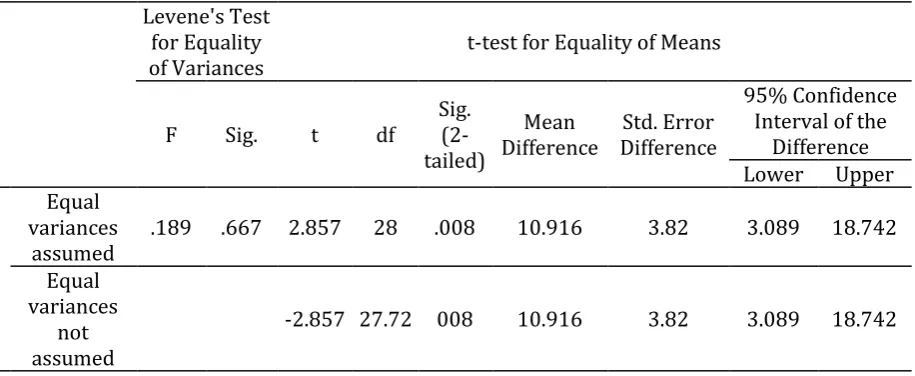
Then a t-test was applied to see whether the input-based instruction had any effect on the participants' speaking ability, first the descriptive data of the both groups in the posttest were calculated. This is shown in table 3 below:
Table 3. The t-test data for posttest
Levene's Test for Equality of Variances
t-test for Equality of Means
F Sig. t df
Sig. (2-tailed)
Mean Difference
Std. Error Difference
95% Confidence Interval of the
Difference Lower Upper Equal
variances assumed
.189 .667 2.857 28 .008 10.916 3.82 3.089 18.742
Equal variances
not assumed
-2.857 27.72 008 10.916 3.82 3.089 18.742
Table 3 illustrates the results of posttest for the experimental and control groups. As shown in this table, the difference between the experimental and the control groups (28) =2.857, p=.008, was considered to be statistically significant. That is, the participants in experimental group outperformed the ones in control group in terms of speaking performance. Therefore, the previously-developed null hypothesis of the study “Input-based instruction has no effect on improving speaking skill of Iranian high school student " was rejected.
The results indicated that there was not a significant difference between the mean scores of the participants in the control group and the experimental group (28)=-.057, p=.95. In simple words, the experimental group and the control group were equal in terms of speaking performance.
To definitely answer question:" Does input-based instruction have any effective on improving the speaking skill of Iranian EFL learners?" an independent samples t-test was run again for posttest phase to compare the group means for the experiment and control groups.
DISCUSSION AND CONCLUSION
instruction has no effect on developing students’ speaking skill, this finding rejected our hypothesis. The results can be both empirically and theoretically discussed.
The positive effect of input-based instruction observed in this study can be attributed to the role of comprehensible language input providing learners with linguistic data that they are able to understand. In the field of SLA, there is a mimic metaphor about language input proposed by Lee and VanPattn (2003,p. 26) “input is to language acquisition what gas is to a car”. There is language input that is better than other input, just like there is high octane gas that is better than low-octane gas. The “better input” here is both comprehensible and meaning bearing. The more comprehensible and meaning –bearing the input is, the more likely it will be turned into intake that learners are able to internalize into their cognitive systems.
Empirically, this supports the findings of a number research studies which claimed that comprehension practice is effective to bring about development, not only in comprehension but also in production (VanPatten, 1996; Lightbown and Spada, 2002). The present study investigated the effect of input-based instruction on the speaking ability of the Iranian high school students. To do so, thirty high school students were randomly divided into two groups each receiving a different kind of instruction. Results of the study revealed that input-based activities lead to better gains in EFL learners’ performance on speaking test than the regular program instruction. It clearly showed a superiority of input-based instruction over the regular program in improving students’ speaking ability.
REFERENCES
DeKeyser, R. M. (2007), ‘practice in a second language: perspectives from Applied
Linguistics and Cognitive Psychology’. Cambridge: Cambridge university press. DeKeyser, R., Salaberry, R., Robinson, P., & Harrington, M. (2002). What gets processed
in processing instruction? A commentary on Bill VanPatten’s ‘processing instruction: Language Learning, 52,4, 805-23.
DeKeyser, R., & Sokalski, K. (1996). The differential role of comprehension and production practice. language learning, 46,4, 613-42
Ellis, N. (2002). Frequency effects in language processing: a review with implications for theories of implicit language acquisition. Studies in secondlanguage acquisition, 24: 143-88.
Ellis, R. (1991). Instructed second language acquisition. Oxford: Blackwell.
Ellis, R. (1993). Second language acquisition and the structural syllabus. TESOL Quarterly 27: 91-113. Oxford: Oxford University Press.
Ellis, R. (1994). The study of second language acquisition. Oxford: Oxford University Press.
Ellis, R. (2008). The study of second language acquisition (3rd ed.). Oxford: Oxford University Press.
Erlam, S. (2003). Evaluating the relative effectiveness of structured-input and output-based instruction in foreign language learning. SSLA, 25, 559–582
Gass, S. (2003). Input and interaction in C. Doughty and M. Long (eds.): the handbook of
secondlanguage acquisition. Malden, Mass.: Blackwell.
Gass, S., &Varonis, E. (1994). Input, interaction and second language production. Studies
in second language acquisition research, 16, 283-302.
Gass, S. and Varonis, E. (1994). Input, interaction and second language acquisition production. Studies in second language acquisition research, 16, 283-302.
Hadley, A. (2003). Teaching Language in Context. (3rd ed.). Henile & Henile publication. Genesee, F. (2001). Evaluation in R. Carter, & D. Nunan (eds.). The Cambridge guide to
teaching English to speakers of other languages,(pp. 144-150). Cambridge : Cambridge University Press.
Izumi, S. (2002). Output, input enhancement, and the noticing hypothesis. Studies in
second Language acquisition, 24, 541-77.
Jakeman & McDowell,C. (2008).New Insights into IELTS.Cambridge. Cambridge University Press.
Kara Morgan-Short and Harriet Wood Bowden(2006). Processing instruction and
meaningful output-based instruction: effects on second language development
Cambridge University Press.
Johnson, K. (1996). Language teaching and skill learning. Oxford: Blackwell.
Kowal, M., & Swain, M. (1994). Using collaborative language production tasks to promote students’ language awareness. Language Awareness, 3, 73-93.
Krashen, S. (1982). Principles and practice in second language acquisition. Oxford: Pergamon Press.
Larsen-Freeman, D. (2003). Teaching Language: from Grammar to Grammring. Boston, MA: Heinle.
Leow, R. (2007). Input in the classroom: An attentional perspective on receptive practice. In M. DeKeyser practice in a second language: perspectives from Applied
Linguistics and Cognitive Psychology’. Cambridge: Cambridge university press.
21-50.
Lightbown, P. (1985). Great expectations: Second language acquisition research and classroom teaching. Applied Linguistics 6/2: 173-89.
Lightbown, P. (2000). Anniversary article: classroom SLA research and language teaching. Applied Linguistics 21: 431-62.
Long, M. (1985). Input and second language acquisition theory. In S. Gass & C. Madden,
Input in second language acquisition, 377-393.
Johnson & Johnson (1999). Encyclopedic Dictionary of Applied Linguistics. Blackwell Publishers Ltd.
Long, M. H., (1985). Input and second language acquisition theory. In S. Gass & C. Madden input in second language acquisition, (pp.377-393).
Mackey, A. (1999). Input interaction and second language development: an empirical study of question formation in ESL. Studies in second language acquisition,
21(4):557-87.
Mackey, A., Oliver, R., & Leeman, J. (2003). Interactional input and the incorporation of feedback: an exploration of NS-NNS and NNS-NNNS adult and child dyads.
Language learning, 53, 35-66.
McLaughlin, B. (1987). Theories of second language learning. London: Edward Arnold. Muranoi, H. (2007). Output practice in the L2 classroom In M. DeKeyser practice in a
second language: perspectives from applied linguistics and cognitive psychology
(pp.51-85). Cambridge: Cambridge University Press. Practice in a Second Language Cambridge: Cambridge University Press, 50-85
Nunan, D. (1999). Second language teaching and learning. Heinle and Heinel Publishers. Oxford, R.L., Park-Oh, Y., Ito, S. & Sumrall, M. (1993). Japanese by satellite: Effects of
motivation, language learning styles and strategies, gender, course level and previous learning experiences on Japanese language achievement. Foreign
Language Annals, 26, 359-371.
Pienemann, M. (2003). Language processing capacity in C.J Doughty and M.H. Long (eds.): The Handbook of Second Language Acquisition. Oxford. Blackwell. pp. 679-714.
Ross, S. (1992). Program-defining evaluation in a decade of eclecticism in Aldderson, C.& Beretta, A. (1992), evaluating second language education Cambridge; CUP. Salaberry, R. (1997). The role of input and output practice in second language
acquisition. The Canadian modern language review 53: 422-51.
Sharwood, Smith, M. (1993). Input enhancement in instructed SLA: theoretical bases.
Studies in second Language Acquisition, 15/2: 165-79.
Spada, N. and P. Lightbown. (2002) L1 and L2 in the education of Inuit children in northern Quebec: Abilities and perceptions. Language and Education, 16/3: 212-40. Spada, N. and P. Lightbown. (2006). How languages are learned. (3rd ed.). Oxford: Oxford
University Press.
Sun,Young. (2001). Two types of input modification and EFL reading comprehension: simplification versus elaboration. TESOL quarterly 35.1. 45-63.
Swain, M. (1995). Three functions of output in second language learning in G.Cook and B.Seidlhofer (eds.). Principles and practice in the study of language: studies in honor
of H.G. Widdowson. Oxford: oxford University Press.
Swain, M. (1998). Focus on form through conscious reflection in C. Doughty and J. Williams (eds.): Focus-on-form in classroom second language acquisition. Cambridge: Cambridge University Press.
Swain, M. (2005). The output hypothesis: theory and research in E. Hinkle (eds.),
Handbook of research in second language teaching and learning. Lawrence Erlbaum
Swain, M. and S. Lapkin. (1998). Interaction and second language learning: two adolescent French immersion students working together. Modern Language
Journal, 82/3: 338-56.
Taki, S. (2008). International and Local Curricula: the question of ideology. Language
Teaching Research, 12, 127-142.
VanPatten, B. (1996). Input processing and grammar instruction: theory and research. Norwood, NJ: Ablex