49
Students’ Alternative Conceptions and
Patterns of Understanding Concerning
Electric Circuits
Gil Nicetas Bareng Villarino
Corresponding author: Gil Villarino ([email protected] ) Leyte Normal University, Tacloban City, Leyte, Philippines
Keywords: alternative conceptions, electric circuits, grain-size knowledge, patterns of understanding
International Journal of Innovation in Science and Mathematics Education, 26(4), 49–70, 2018.
Abstract
The aim of this study was to investigate freshmen college students’ alternative conceptions on electric circuits. For this purpose, data gathered through audio-tape recorded classroom discussion, interviews and a 25-item open-ended alternative conceptions test were used to assess students’ conceptions concerning electric circuits. Students’ conceptions were investigated using choice-explanation-consistency analysis of their grain-size knowledge before and after instruction. The results of the pretest via grain-size knowledge analysis indicated that students’ have different patterns of preconception and that individual students have different explanations to a particular situation. The choice-explanation-consistency analysis of the pretest revealed patterns of preconception such as correct choice with accurate explanations, correct choice with a partly correct explanation, inconsistent choice/explanation and reiteration of question/choice. Similar patterns were seen considering the end points, that is pre-test and post-test results. The patterns of conceptual change that were exhibited by the students through the lens of choice-explanation-consistency analysis are unchanged alternative conceptions, regression of alternative conceptions, attenuated alternative conceptions, reinforced alternative conceptions, and reconstructed alternative conceptions. The results suggest that a substantial revision of teaching strategies is needed in relation to electric circuits. However, from the Observer Daily Diary (ODD) the teachers were using heterogeneous lecturing styles. That is, teacher’s instructional actions in the classroom are not only comprised of teaching methods, but also strategic pedagogical moves, interactions with students, cognitive engagements, laboratory activities and the use of instructional technology. This maybe because the teacher participant was a grantee in the 1990 Philippine-Australia Science and Mathematics Program (PASMEP) physics teacher.
Introduction
One challenge of teaching is to bring college learners to a high degree of understanding of what is being taught. However, understanding is difficult to assess. As White (1998) stated:
There is general acceptance, without debate, that students should not only learn things but should also understand them. Understanding is one of our widely used words, both in normal language and in education. But although the word is widely used, and understanding is so valued, it is a term that is not well defined. Indeed it is not easy to define… (p.49).
50
It is not only the amount of knowledge that matters, though naturally greater knowledge tends to engender greater understanding. The nature of the knowledge and the pattern of associations between its elements are important too (p. 51).
Understanding is not merely the accumulation of facts or knowledge. The relationship between the elements of knowledge must also be considered. Concurrent to this is Berliner’s (1987) idea that understanding “requires the integration of new information with one’s existing knowledge”.
Teachers can help college students to understand by making explicit the relationship of the new instructional knowledge to other knowledge already possessed by the students. In view of these propositions, this study presents outcomes of an investigation that attempted to find out how integration of prior and new learning might have occurred during the process of learning. This integration process could be a way of qualitatively assessing students’ understanding of concepts.
Literature review
Many teachers believed that most of the misconceptions originated from students’ experiences of daily life. The commonality of the misconceptions across different cultures and populations suggest that external effects such as textbooks, instructional practices and the excessive reliance on everyday language should be considered as potential sources of misunderstandings. Shipstone et al.’s (1988) study is important research, which concludes that students from England, France, Netherlands, Sweden and West Germany have misconceptions about electric current. In a survey done with university level students in France and Sweden (Rainson, Tranströmer, & Viennot, 1994) concluded that for most of the students, electrostatics and electric circuits are two unconnected subjects. A lot of students think that current is the cause of the field, reversing the cause and the effect. Moreau and Ryan (1985) argued that although many introductory textbooks contain excellent treatments of electrostatics and electric circuits, an important connection between these two topics is often overlooked or at least not emphasised, namely that the electric potential in circuits is exactly the same as the electrostatic potential and to expect students themselves to make the connection back to electrostatics is perhaps too much. In a study in Turkey, Çepni and Keleş (2006) sought to identify high school students' misconceptions on ‘Electric Current’ with the help of concept maps. For this purpose, research was conducted with 244 10th grade students (119 female and 125 male) from eight different schools in Ankara during the 2003-2004 spring semester. At the end of study, they found that students had misconceptions of concepts including current, resistance, potential difference, electricity, generator/emf source and electric energy. In another study in Turkey, Yildirim, Yalcin, Sensoy and Akcay (2008) conducted research in order to identify sixth, seventh and eighth grade students’ misconceptions in electric current. It was observed that students have some difficulties in analyzing and understanding new situations when an additional resistance is put into an existing circuit. It was also found that the students had misconceptions associated with changes made in circuits and that misconceptions similar to those observed in 6th grade students are also prevalent among 7th and 8th grade students.
51
The research question for this study is: What kind of alternative conceptions have the First Year Bachelor of Elementary Education (BEED) college students about electric current? Many studies which have been carried out to discover students’ misconceptions and learning difficul ties in electric current topics have shown that students have problems in understanding electric current. (Ateú & Polat, 2005). These studies revealed that almost all college students cannot distinguish among related concepts such as current, energy, voltage, etc. Assuming a battery as a constant current source is an example of the confusion between electric current and voltage. Another example is the consumption of current by electrical devices within a circuit which contributes to the confusion between electric current and energy (Bauman & Adams, 1990). These two misconceptions are the most shared and resistant misconceptions among students according to the related literature (Bauman & Adams, 1990; MacDermott & Shaffer, 1992; Shipstone et al., 1988). The study by Sobel (2009) reports that students from England, France, Netherlands, Sweden and West Germany have misconceptions about electric current. In a survey done with university-level students in France and Sweden (Rainson, Transtromer & Viennot, 1994) concluded that for most of the students, electrostatics and electric circuits are two unrelated subjects. In a study in the Philippines, Mendoza, (2008) sought to identify high school students' misconceptions on ‘Electric Current’ with the help of concept maps. For this purpose, research had been carried out with the contribution of two hundred forty-four 10th-grade students (119 female and 125 male) from eight different schools in Ankara during the 2003-2004 spring semester. This study found that these students had have misconceptions concerning the concepts of current, resistance, potential difference, electricity, generator/elecromotive force (emf) source and electrical energy.
In another study in the Philippines, Mendoza, (2008) investigated sixth, seventh and eighth-grade students’ misconceptions in electric current. For this purpose, they developed a conceptual test, which comprised 28 multiple-choice items. They administered this test to 1162 students in 12 middle schools across Metropolitan Manila. The analysis showed that the students had some misconceptions about electric current and its use. It observed that students have some difficulties in analyzing and understanding new situations when an additional resistance was introduced into existing circuit. It also found that the students had misconceptions associated with such changes made in circuits by adding resistive component and that misconceptions similar to those observed in 6th-grade students are also prevalent among 7th and 8th-grade students.
And according to results of the study that have suggested instead of traditional teaching methods in science education, teaching methods should be used which can address pre-existing misconceptions and minimize the formation of misconceptions.
Methodology
Research questions
The main purpose of this study was to investigate the construction of meaning in electric circuits of BEED first year college students at a Philippine University in a naturalistic constructivist-based classroom setting. Specifically, it attempted to answer the following questions:
52
2. What are the patterns of integration of alternative conceptions and new knowledge for some electric circuit concepts observed in the students’ constructed meaning during the learning process?
3. What are the patterns of conceptual change in these concepts?
Research design
The research approach used was qualitative. This involved the naturalistic classroom setting as a direct source of data, the descriptive form of the data collected (such as interview transcripts, and observation notes), the concern with process learning instead of outcomes, the interpretation of students’ constructs verbalized during instruction, and the inductive method of data analyses (Salvador, 1990) were some aspects of the study that characterized it essentially as qualitative.
A teaching model based on the constructivist view of learning was used. The teaching sequences contain a new range of teaching strategies which enable students to reflect, construct meanings and undergo conceptual change.
The Sample
The data for this study were gathered from November to February of the 2015-2016 school year. The sample comprised thirty (30) First Year BEED College students (called case students in this study) from three different class sections in the University of Tacloban City, Leyte. Ten students from each class section were taken based on their midterm examination in physics and score in a mental ability test.
The student participants were taught by a physics teachers who was trained in the Philippine-Australia Science and Mathematics Program (PASMEP). All of them were familiar with the teaching sequences, the laboratory equipment and the data gathering procedures used in the study. Furthermore, laboratory equipment was available in this university.
Instruction and content
The study dealt with the concepts in electric circuits listed in Table 1. It investigated students’ construction of meaning so that difficult topics were argued to be more appropriate to use, such as electric circuit. Bowman & Aubrecht (2007), reported in their investigation of multiple sets of data from an electric circuits is an area in physics feared not only by students but also by teachers because they find it difficult to understand.
Table 1: Selected concepts in electric circuits
C1. Electric current in open/closed circuits C2. Models of electric current
C3. Electric current in series of circuits C4. Electric current in parallel circuits C5. Voltage across resistors in circuits C6. Total voltage in parallel circuits
53
The instruments
The instruments used in collecting data are as follows:
Pre-test/Post-test
The pre-test/post-test is a 25-item multiple-choice test with four distractors and an open response for the student to provide a reason for choosing the distractor. It was designed in such a way that students’ ability to construct their own ideas about concepts or their ability to link or make use of their knowledge with other concepts can be tested. Student’ notions or beliefs explored by previous researchers were the bases for developing the test. Some of the test items were adapted from existing instruments.
The items in the test were subjected to a reliability test. This is to determine errors due to content sampling, differences in test wiseness of the student, ability to follow instructions, which affect teacher-made tests. The coefficient alpha of the test was 0.73, generally considered as an appropriate coefficient for teacher made tests.
Data collection procedure
Measuring alternative conceptions and post knowledge
Alternative conceptions and post knowledge of the participants were measured by the pre-test and post-test. The pre-test was administered a day before the first lesson and the post-test at the end of the last lesson. The test was administered by the researcher. This is to prevent the teacher being biased during the teaching process in terms of the concepts that will be focussed on. The test was administered for about an hour.
Measuring new knowledge
Students’ acquisition of the new knowledge was assumed to have been taking place from the day constructivist-based instruction started. The following methods were used to determine student’s new knowledge.
1. Classroom observation. The main purpose of observation was to develop a picture and have a description of what is happening in the classroom with full concentration on the case students. The researcher-observer was introduced at the beginning of the lesson but not introduced formally in every lesson to ensure a naturalistic setting of the class. The researcher- observer carried along an Observer Daily Diary (ODD) for each class where daily observations were written.
The researcher-observer recorded whatever conceptions the case students would bring out inside the classroom during instruction. Students were provided with color name tags and a particular color was given to case students for easy identification. The observer recorded the case students’ questions, conceptions, and answers to teachers’/peers’ questions; peers’/teachers’ questions and case students’ reactions to these questions; and on-the-spot interviews.
2. On-the-spot interview. As often as possible, the researcher-observer mingled with the students especially when activities were being performed. On-the-spot interviews about - what the students were doing; how they were doing; and why they were doing - the activities were carried out. Most of the conversations were tape-recorded although some were recalled and recorded after the class by the researcher-observer. During on-the-spot interviews, other students besides the case students were allowed to participate to avoid the class from noticing there were case students being given special attention.
54
laboratory reports. The laboratory reports included some student responses to the question in the activities.
Data analysis procedure
Choice-explanation-consistency analysis
Patterns of prior knowledge were determined using choice-explanation-consistency analysis.
According to Wooten, Cool, Prather and Tanner (2014), the students' performance on multiple-choice questions was comparable to their ability to provide evidence when asked to respond to an open-ended question. In this method, a student’s combined responses in the multiple choice part and in the open-ended part of the pre-test and post-test were analysed according to ‘correctness’ and consistency of choice and explanation.
The student’s response in the multiple choice part and in the open-ended part of the post-test together with those of the pre-test were analysed and used to determine patterns of conceptual change.
Concept-chain analysis.
For the interrogation of prior and new knowledge, a method was devised in this study to investigate patterns. Each case student has a series of conceptions which were related and relevant in the understanding of the selected concept. This series of conception is named a concept chain.
The conceptions in the concept chain were those written and verbalized by students from the following measures in this order.
1. Pre-test response
2. Recitation recorded during observation Pre-activity discussion
On-the-spot interviews Post-activity discussion Regular class discussion
Laboratory reports Teacher-made-test 3. Post-test response
Examples of concept chains of the same student in a particular concept are shown in Appendix B.
The concept chain of each individual case student was analysed and synthesized to determine the understanding of that particular student of the concept investigated. In effect, a representation of an individual students’ mental model of a particular concept is constructed. The mental model construct for the first sample concept chain in Appendix B is:
There is current inside a dry cell in a closed circuit because the bulb light, electron flow, and voltage causes current.
Categories of description of the integration are then generated from the mental model construct using a phenomenographic approach.
55
how students understand the content they are learning and can be used to evaluate students’ variation in all forms of experience within a learning and teaching context (Trigwell, K., 2006). Conceptions presented in categories of description are the main outcomes of a phenomenographic research.
These categories of description, or conceptions of the phenomenon under investigation are seen as one of the main outcomes of phenomenographic research (Marton & Booth 1997). The categories of description identified in this study represent variation in participants’ conceptions of using learning technology within their face-to-face pedagogical practices. In the end, there were eight different categories of description of integration since there were eight selected concepts. From these categories of description, patterns of integration of alternative conceptions and new knowledge were generated. Appendix B illustrates an example of how phenomenography was used in the analysis of the mental model constructions.
Results and discussion
Data on students’ patterns of alternative conceptions, integration of alternative conceptions and new knowledge and patterns of conceptual change about electric circuit were gathered with the use of the survey instrument consisting of a 25–item open-ended alternative conceptions test. The patterns of alternative conceptions gathered were limited to the situations included in the survey and to the students’ written responses. After a thorough collection, tabulation, and analysis of students’ responses, the following results were obtained.
Research Question 1: Patterns of prior knowledge
The responses of the students in the pretest were organized and analyzed to determine the patterns of alternative conceptions using choice-explanation-consistency analysis.
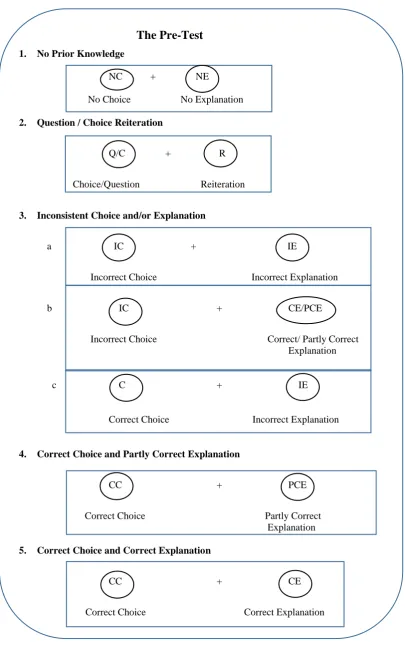
Results of choice-explanation consistency analysis. An examination of the consistency of choice with explanation revealed the patterns shown in Figure 1.
Results showed that individual students have different alternative conceptions of the same concept as revealed in their patterns of alternative conceptions. This implies that teachers must elicit students’ alternative conceptions before teaching a particular concept. In this sense, they will be able to address students’ alternative conceptions during instruction.
56
The Pre-Test
1. No Prior Knowledge
NC + NE
No Choice No Explanation
2. Question / Choice Reiteration
Q/C + R
Choice/Question Reiteration
3. Inconsistent Choice and/or Explanation
a IC + IE
Incorrect Choice Incorrect Explanation
b IC + CE/PCE
Incorrect Choice Correct/ Partly Correct Explanation
c C + IE
Correct Choice Incorrect Explanation
4. Correct Choice and Partly Correct Explanation
CC + PCE
Correct Choice Partly Correct Explanation
5. Correct Choice and Correct Explanation
CC + CE
Correct Choice Correct Explanation
57
The percentage of students exhibiting each alternative conception pattern in each concept is found in Table 2. It can also be seen in Table 2 that the majority of the students had incorrect choice and incorrect explanation in all concepts. However, the greatest percentages (85% and 65%) of students with correct choice and partly correct explanation are found at concepts C1 and C2 respectively.
Table 2: Percentage distribution of prior knowledge pattern per concept (N=30)
Pattern C1 C2 C3 C4 C5 C6
No prior knowledge 0 0 5 0 5 15
Question/choice reiteration 5 0 15 5 15 0
Incorrect choice and incorrect explanation 5 35 20 60 35 45 Incorrect choice and correct/partly correct
explanation
0 0 0 10 5 0
Correct choice and inconsistent/incorrect explanation
10 0 15 5 15 5
Correct choice and partly correct explanation 85 65 20 10 5 0 Correct choice and correct explanation 0 0 15 10 20 35
Research Question 2: Patterns of integration of prior and new knowledge
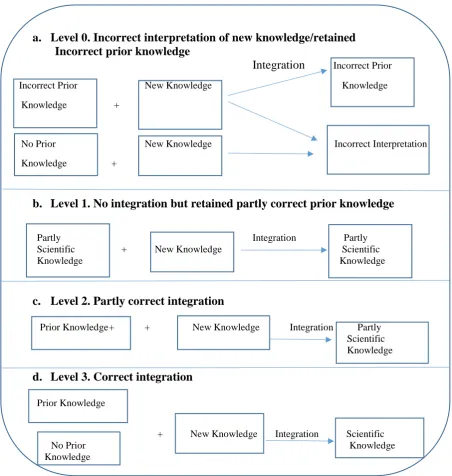
In the analysis of the levels of understanding across concepts there were four patterns generated in which students integrate prior and new knowledge. This is shown by the similarities in the levels of understanding indicated by the numbers before each category of description. These levels are illustrated in Figure 2 and are described as follows:
Level 0 = Incorrect interpretation of new knowledge/retained incorrect prior knowledge
This level indicates that the new knowledge after instruction was incorrectly understood by a student and therefore resulted in incorrect integration with the old conception. There were cases when students failed to integrate due to incorrect interpretation of the new knowledge. This means that the incorrectly interpreted new knowledge could not fit into the students’ old alternative conceptions, thus the students retained the old knowledge which they could understand. Meyer and Land (2006) in their study say students will always retain their old knowledge and have described troublesome knowledge as that which is not thoroughly understood by students; as a result, the knowledge diminishes and "[does] not serve them beyond the compass of the course and its superficial credentials" (p. 37). Also, in cases when students did not have prior knowledge but incorrectly interpreted the new, were classified under this level of integration (See Figure 2, a).
Level 1 = No integration but retained partly correct knowledge
58
Level 2 = Partly correct integration
Prior knowledge was partly reconstructed with the introduction of new conceptions. However, part of the old alternative conceptions that was widely different from the new one persistent during integration. Hence, it did not lead to a unified and scientific version of the concept. Figure 2, c illustrates this pattern.
Level 3 = Correct integration
In this pattern, the students were able to correctly interpret new knowledge so that unified and scientific integration occurred. This means that, although the old alternative conceptions is widely different from the acceptable one or there is no existing idea at all, correct integration may still occur if the interpretation of the newly acquired knowledge is right (Figure 2, d). This means further that there may be aspects of instruction that have allowed students to reconstruct their prior knowledge to a better framework.
a. Level 0. Incorrect interpretation of new knowledge/retained Incorrect prior knowledge
Integration Incorrect Prior Incorrect Prior New Knowledge Knowledge
Knowledge +
No Prior New Knowledge Incorrect Interpretation
Knowledge +
b. Level 1. No integration but retained partly correct prior knowledge
Partly Integration Partly
Scientific + New Knowledge Scientific
Knowledge Knowledge
c. Level 2. Partly correct integration
Prior Knowledge + + New Knowledge Integration Partly Scientific Knowledge
d. Level 3. Correct integration
Prior Knowledge
+ New Knowledge Integration Scientific
No Prior Knowledge
Knowledge
59
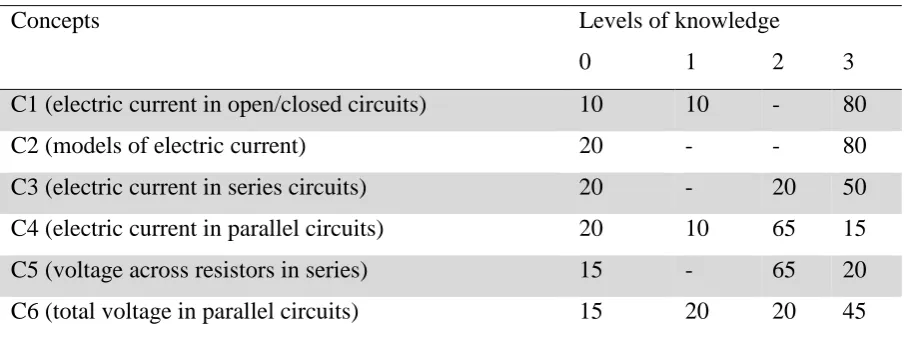
These patterns are consistent with the assumptions on prior knowledge (Gilbert, Osborne & Fensham, 1982). Levels 1 and 2 support the assumption that the learned amalgam of students’ prior knowledge and the teacher’s (if assumed to be the new knowledge acquired and interpreted by the students during integration) can co-exist after instruction. It is further stated that ‘successful’ learners use the teacher’s version when required in test and examinations. The old alternative conceptions that are best understood by some students are usually persistent despite instruction. Levels 0 and 1 support this general finding on prior knowledge. Table 3 summarises the percentage distribution of the students in each pattern for each concepts. It is seen from the table that not all the patterns were exhibited by students in all the concepts. Obviously, the percentage distribution is also different for different concepts. However, the highest level of understanding (Level 3) is seen to have occurred among students in all concepts at varying percentages. Most of the students have shown scientific understanding in all concepts. All the patterns were experienced by students in concept C4 (electric current in parallel circuits) and in concept C6 (total voltage in parallel circuits). However, the greatest and lowest percentages are at Level 2 and Level 1 respectively.
Table 3: Percentage distribution of students per integration pattern per concept (N = 30)
Concepts Levels of knowledge
0 1 2 3
C1 (electric current in open/closed circuits) 10 10 - 80
C2 (models of electric current) 20 - - 80
C3 (electric current in series circuits) 20 - 20 50
C4 (electric current in parallel circuits) 20 10 65 15
C5 (voltage across resistors in series) 15 - 65 20
C6 (total voltage in parallel circuits) 15 20 20 45
Codes: 0–Incorrect interpretation of new knowledge/retained incorrect prior knowledge; 1–No integration but retained partly correct prior knowledge; 2–Partly correct integration; 3–Correct integration
The patterns of integration shown in Figure 2 imply that different students have different patterns of integration in a particular concept. This means that students’ integration of prior and new learning is not a dichotomy of right or wrong, but a series of levels. Hence, assessment of students’ understanding of concepts should not be treated as right or wrong, but should consider the level of understanding achieved. In this study there are three levels of understanding, first was the incorrect understanding of new knowledge and retained incorrect alternative conceptions, second level was no integration but retained partly correct knowledge, and the last level was the partly correct understanding.
60
Research question 3: Patterns of conceptual change
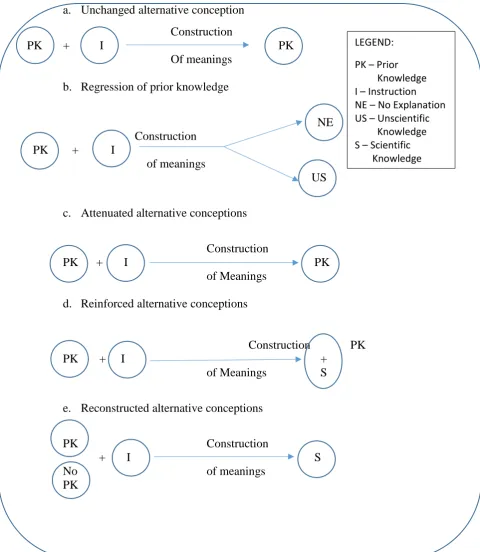
Similar patterns were seen considering the end points, that is, pre-test and post-test results. In the conceptual-change approach, integration of prior learning with new knowledge can be determined by analysing the change in the quality of the responses and identifying the integrating conceptions assuming integration did occur. Some researchers who used this approach emphasised the mapping of alternative conceptions as evidence of conceptual change (for example, Fetherstonehaugh & Treagust, 1992). The patterns of conceptual change that were exhibited by the students as a result of choice-explanation-consistency analysis are shown in Figure 3 and are described below.
Unchanged alternative conceptions
Some students retained their alternative conceptions (whether correct or incorrect) even after instruction (see Figure 3, a). There were also instances when the students restated their alternative conceptions without actually changing the meaning. An example showing this pattern is:
Question 4 Electric current in series circuits Pre-test “They use identical dry cells” ( Hanry) Post-test “They have identical voltage source” (Hanry)
Regression of alternative conceptions
This pattern, as illustrated in Figure 3 at b, is of two types:
(a) There were students who exhibited the pattern of having explanations before instruction but provided no explanations after instruction. This could mean that there are students who have prior knowledge about a concept but cannot accommodate the new knowledge so they tend to disregard their alternative conceptions. Students who exhibited this pattern had unstable or incorrect prior knowledge. The following is an example showing this pattern: Question 4 Electric current in series circuits
Pre-test “Maybe so because Bulb 1 which is actually smaller consumed less energy from the dry cell that Bulb 2 which is bigger.” (Myrna) Post-test “I don’t know.” (Myrna)
(b) Some correct prior explanations were changed to alternative conceptions after instruction. This implies that students can become confused after instruction. The confusion may be due to the assumption (Gilbert, Osborne, & Fensham, 1982) that prior beliefs can co-exist with the new knowledge after instruction and may result in alternative conceptions of the one. An example illustrating this pattern is as follows:
Question 8 Electric current in parallel circuits
Pre-test “Same brightness because both are connected to identical cells.” (Mark)
61
Attenuated alternative conceptions
As shown in Figure 3 as c, this pattern indicates that part of the correct understanding of the concepts was deleted and changed into partly incorrect understanding. This pattern was not exhibited by many. It was only seen to occur in C1 (electric current in open/closed circuits) and C5 (total voltage in parallel circuits). Examples are:
Question 1 Electric current in open/closed circuits
Pre-test “…the bulb lights. If there is no current, the electricity won’t reach the bulb and won’t let it light.” Hanz)
Post-test “…the bulb lights.” (Hanz)
Question 2 Electric current in open/closed circuits
Pre-test “There is no flow electrons inside the dry cell because the wire is unattached.” (Malou)
Post-test “There’s no flow of electrons.” (Malou)
Reinforced alternative conceptions
This pattern was exhibited by students who changed partly scientific prior explanations to more scientific ones by adding a new explanation (Figure 3, d). In this sense, students do not find any conflict between their partly correct prior knowledge and the knowledge acquired from instruction. This pattern was seen to have frequently appeared in concepts C1 (electric current in open/closed circuits). An example illustrating this pattern is as follows:
Question 1 Electric current in open/closed circuits
Pre-test When there is current inside the dry cell, the bulb will light.” (Kit)
Post-test “There is current inside the dry cell because the bulb will light and, if the bulb lights, there is current. And if there is voltage there is current.” (Kit)
Reconstructed alternative conceptions
62 a. Unchanged alternative conception
Construction
PK + I PK
Of meanings b. Regression of prior knowledge
NE
Construction
PK + I
of meanings
US c. Attenuated alternative conceptions
Construction
PK + I PK
of Meanings d. Reinforced alternative conceptions
Construction PK
PK + I +
of Meanings S
e. Reconstructed alternative conceptions
PK Construction
+ I S
No of meanings
PK
Figure 3: Patterns of conceptual change
In this form of change, students are able to accommodate new knowledge, thus transforming their alternative conceptions into scientific concepts or principles. In this sense, students are dissatisfied with their prior knowledge and find the new knowledge fruitful, plausible and intelligible to accommodate (Posner, et al., 1982). Also, Buckley and Boulter (2000) thought
LEGEND:
63
that learners use their already held alternative conceptions and integrate the new understanding of the concepts to change their alternative conceptions into scientific concepts.
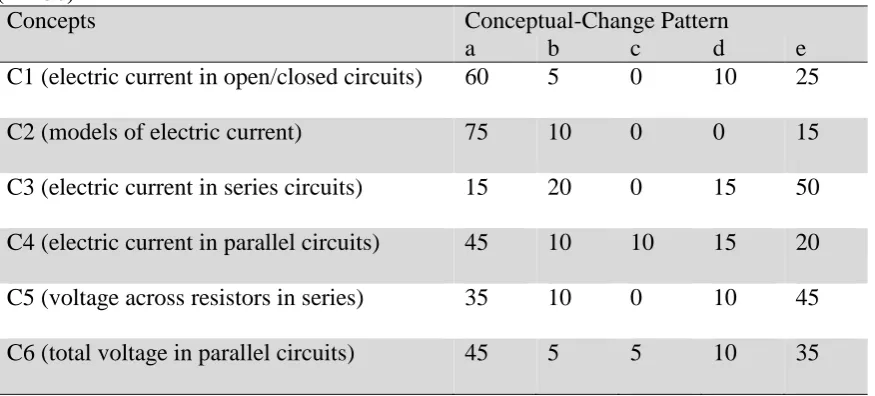
The percentage of students who exhibited these patterns in each concept is shown in Table 4. It can be gleaned from the table that students experienced the patterns of change in the different concepts although at varying frequencies.
Table 4: Percentage distribution of students per conceptual-change pattern per concept (n = 30)
Concepts Conceptual-Change Pattern
a b c d e
C1 (electric current in open/closed circuits) 60 5 0 10 25
C2 (models of electric current) 75 10 0 0 15
C3 (electric current in series circuits) 15 20 0 15 50 C4 (electric current in parallel circuits) 45 10 10 15 20 C5 (voltage across resistors in series) 35 10 0 10 45 C6 (total voltage in parallel circuits) 45 5 5 10 35
Codes: a–unchanged prior knowledge; b–regression of prior knowledge; c–attenuated prior knowledge; d–reinforced prior knowledge; e –reconstructed prior knowledge
The highest percentage of students who experienced regression of prior knowledge (Pattern b) after instruction is found in C3 (electric current in series circuits). One possible reason for this is at lessons in this topic were not fully articulated because they were taken towards the end of the school year. Hence, it is possible that most of the explanations given were either guesses or inferences from proceeding lessons.
However, excluding unchanged prior knowledge (Pattern a), the highest percentage of students experiencing the highest form of conceptual change occurred in 50% of the concepts, C3 (Electric current in series circuit), C5 (total voltage in series circuits). The relatively low percentage distribution of students experiencing high conceptual change in the other concepts may be explained by the high percentage of students having correct unchanged alternative conceptions. Thornton, (1999), in his study “Using the Results of research in Science Education to Improve Science Learning” reported that the students’ ability to achieve conceptual learning improves in a physics course that employs activity-based, computer-supported, interactive learning environments methods.
Table 4 also shows that the highest percentage distribution in majority of the concepts is found in the first pattern (Pattern a) where prior knowledge remained unchanged even after instruction.
64
The above result implies that the degree of conceptual change is high when prior knowledge is correct or there is no prior knowledge at all. Furthermore, it can be deduced from the tables that the degree of conceptual change is high when the level of integration is also high.
It can also be seen in Table 5 that the majority (55% and 60%) of the students had retained correct prior knowledge in electric current (C1 and C2). However, the low percentages (10%) of students with retained correct knowledge are found in the electric current in series and parallel circuits (C3 and C4) respectively.
Table 5: Percentages of students retained correct and incorrect prior knowledge
Concepts
Retained Knowledge
Correct/partly correct Incorrect C1 (electric current in open/closed circuits) 55 5
C2 (models of electric current) 60 15
C3 (electric current in series circuits) 10 5
C4 (electric current in parallel circuits) 10 35
C5 (voltage across resistors in series) 25 10
C6 (total voltage in parallel circuits) 30 15
Conclusions
The conclusion derived from the outcomes of the study are that the students have different explanations to a particular situation, the students have different patterns of prior knowledge, and students have patterns of integration in a particular concept. This can be interpreted to mean that students’ integration of prior and new learning is not a dichotomy of right or wrong but a series of levels. Hence, assessment of students’ understanding of concepts should not be simply treated as right or wrong but should consider the level of understanding achieved. An individual student’s level of integration in a particular concept may not be the same as the student’s level of understanding in another concept. In effect, assessment of a student’s understanding in a particular concept should also vary in delivering effective and authentic assessment processes beginning with designing high quality assessment tasks and instruments. The patterns show that students’ alternative conceptions and the degree to which conceptual change occurs are important aspects in assessing the end points of instruction. If addressing the alternative conceptions of the students is to be used by teachers in assessing students’ understanding, it is the quality of the change in scientific conceptions that should matter. It is not enough to say that a student’s construction of meaning of a certain concept is right or wrong. The students should also know why they are wrong and how their old beliefs are different from the scientific conceptions. This way, they may be able to reconstruct their alternative conceptions to a better framework. In effect, student’s alternative conceptions need not be addressed directly; rather, what is needed is a focus on key concepts coupled with clear explanations and extensive applications. This type of instruction helps students build a new conceptual framework that is independent of previously held alternative conceptions.
65
about a concepts before teaching can help a teacher in preparing lesson plans or teaching strategies that will address alternative conceptions. It is only through understanding students’ alternative conceptions about a concept that a teacher can effect changes in the teaching and learning process for a higher degree of conceptual change. Teachers have to be sensitive to the students’ alternative conceptions, which may be informed by research and examples of students’ common alternative conceptions. Teachers can benefit from relevant research in helping them make an informed decision regarding teaching strategies.
It is also indicated that the degree of conceptual change is directly related to the level of integration. It may be inferred that the outcomes of learning depend on the process by which knowledge is being constructed.
Based on the outcomes of the study, the following are recommended:
1. Since students have a range of different prior knowledge on a particular concept, teachers should address students’ alternative conceptions when teaching. One way of doing this is to elicit or probe students’ prior views before teaching a lesson.
2. Teachers should address students’ learning difficulties. Students should be allowed to reconstruct their alternative conceptions and make them aware about their learning by employing a variety of metacognitive teaching and learning strategies such as concept mapping, inquiry- based approaches, predict-observe-explain, interpretive discussion and group dynamic. These strategies are highly recommended for big classes (40 students per class) for they allow more student participation in the class discussion. Also, students can practice metacognition which promotes awareness and control of one’s own learning. Furthermore, students should be given the chance to make decisions on what they want learning strategies and to practice reflective evaluation of their own performance.
3. Since the study revealed different patterns of students’ integration of alternative conceptions and new knowledge and conceptual change, a qualitative assessment such as individual interview or classroom observation can be employed in order to account for the differences in the way the students construct meanings of concepts. Performance must be based not only on a dichotomy of right or wrong answers to a multiple choice test, but also on a hierarchy of the different levels or degree of ‘correctness’ of the answers.
The methods used in deriving patterns of prior knowledge, conceptual change and integration of prior and new knowledge in this study are recommended for qualitatively assessing students’ performance. It could also be that teachers design their tests such that assessment could be done qualitatively.
References
Alteu, R., & Polat, B. (2005). An investigation of the effectiveness of conceptual change text-
oriented instruction on students’ understandings of brightness concepts. Journal of Science Education, 8(1), 46–52.
Berlin, D.C. (1987). But do you understand? In V.R. Koehler, Educators’ handbook: A research perspective, (pp. 84-111).New York: Longman.
Bauman, R. P., & Adams, S. (1990). Misunderstanding of electric current. The Physics Teacher, 28(5), 334.
66
physics by inquiry's electric circuits module. AIP Conference Proceedings 951, 61; Retrieved from https://doi.org/10.1063/1.2820947.
Buckley, B. C., & Boulter, C. J. (2000). Investigating the role of representations and expressed models in building mental models. In J. K. Gilbert & C. J. Boulter (Eds.), Developing models in science education (pp. 119–135). Netherlands: Kluwer Academic Publishers.
Çepni, S., Keleş, E., (2006), Turkish students' conceptions about the simple electric circuits. International Journal of Science and Mathematics Education, 30, 92–101.
Fetherstonhaugh, T., & Treagust, D. F. (1992). Students’ understanding of light and its properties: Teaching to engender conceptual change. Science Education, 76, 653–672.
Gilbert, J.K., Osborne, R.J., & Fensham, P.J. (1982). Children’s science and its consequences for teaching,
Science Education, 65(3): 291–299.
Marton, F., & Booth, S. (1997). Learning and awareness: The educational psychology series. Mahwah, N.J.: L. Erlbaum Associates.
McDermott, L.C., & Shaffer, P.S. (1992). Research as a guide for curriculum development: An example from introductory electricity. Part I: Investigation of student understanding, American Journal of Physics,60, 994–1003.
Mendoza, Aurora. (2008). High school students’ construction of meanings in electromagnetism. Unpublished PH. D. Dissertation. University of the Philippines, Diliman, Quezon City.
Moreau, W. R., & Ryan, S. J. (1985). Charge density in circuits. American Journal of Physics, 53(6), 552–554. Mayer, J. H. F., & Land, R. (2006). Threshold concepts and troublesome knowledge: An
introduction. In J. H. F. Meyer & R. Land (Eds.), Overcoming barriers to student understanding: Threshold concepts and troublesome knowledge (pp. 3–18). London: Routledge.
Posner, G.J., Strike, K. A., Hewson, P. W., & Gertzog, W. A (1982). Accommodation of scientific conception: Toward a theory of conceptual change, Science Education, 66, 211–227.
Trigwell, K. (2006). Phenomenography: An approach to research into geography education. Journal of Geography in Higher Education,30(2), 367–372.
Rainson, S., Tranströmer, G., & Viennot, L. (1994). Students' understanding of superposition of electric fields.
American Journal of Physics, 62(6), 1026–1032.
Salvador, G.R., (1990). General qualitative research. In Educational research: Problem conceptualization and research designs (pp. 45-51). Manila: ALJUN Printing Press,.
Shipstone, D. M., Rhöneck, Cvon., Karrqvist, C., Dupin, J., Johsua, S. & Licht, P. (1988). A
study of student’ understanding of electricity in five European countries. International Journal of Science Education, 10(3), 303–316.
Sobel, M. (2009). Physics for the non-scientist: A middle way. The Physics Teacher, 47(1), 346–349.
Thornton, R.K. (1999). Using the results of research in science education to improve science learning.
Proceedings in International Conference on Science Education, Nicosia, Cyprus, 4–7.
White, Richard T. (1988). Learning Science. Oxford: Basil Blackwell.
Wooten, M. M., Cool, A. M.,Prather, E. E., & Tanner, K. D. (2014). Comparison of performance on multiple-choice questions and open-ended questions in an introductory astronomy laboratory. Phys. Rev. ST Phys. Educ. Res.10, 020103.
67
APPENDIX A
Properly Assembled Circuit
Purpose: In this activity, you will assess your existing knowledge of circuit connections and connecting circuit components based on diagrams.
Materials:
2 2.2-V light bulbs 1 cell holder
2 light bulbs holders 2 switches
1 1.5 V dry cell 6 connecting wires with clips
Procedure:
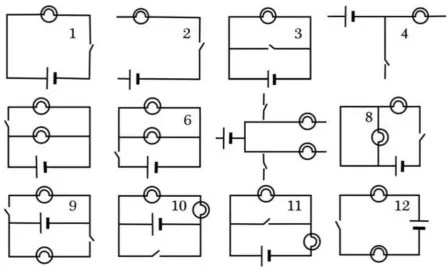
1 . Select and discuss circuit diagrams (Fig. 10.1c) which group believes are properly assembled. List down their corresponding numbers on a sheet of paper. Explain why the circuit(s) does/do not work.
68
Guide to symbols used in the circuit diagram:
Symbol Name/Description Actual Drawing
connecting wire
light bulb
switch
dry cell
2. Write your reason(s) for choosing or not choosing the circuits. Complete the table below.
Predictions Observations
Circuit Chosen
Reasons/Basis for Choosing
Proper Circuit (Yes/No)
Reasons of
Disagreement
Circuit Not Chosen
Reasons/Basis for not Choosing
3. Set up first the circuits which your group believes to be properly assembled. Close each circuit and observe what happens. Assemble also those circuits you did not choose. Close each circuit and observe what happens.
69
APPENDIX B
Phenomenography: An Exemplary Concept-chain Analysis
Sample Concept Chains on Concept 1
Hanry
1. There is current inside the dry cell because the bulb lights. 2. Open circuit when flow continuously.
3. Closed circuit when bulbs won’t light. Dry cell supplies electrons.
Current is proportional to voltage.
4. There is current inside the dry cell because the bulb lights and voltage causes current.
5. Closed circuit when electrons flow.
Mark
1. There is current inside the dry cell because the battery is new and full of current. 2. Open circuit when bulb does not light.
Closed circuit when bulb lights. Current is the flow of electrons. 3. Dry cell supplies energy.
4. There is no current inside the dry cell because only energy is present inside dry cell. 5. Battery is the source of energy.
Myrna
1. There is current inside the dry cell because the bulb glows and the battery is a source of power.
2. Current is the flow of electron.
3. Electric circuit is any arrangement of materials that permits electrons to flow. Dry cell is power source.
No energy, no electron motion.
There is P.D. when wire is connected at both terminals of battery.
4. There is current inside the dry cell because current passes through the source, then the load will glow as current passes it.
5. Energy from dry cell to bulb makes it glow.
Kit
1. There is current inside the dry cell because is a closed circuit. 2. Copper is a good conductor because it has free electrons.
Dry cell supplies energy. 3. Current is flow of electrons.
70
Mental Model Constructs (Derived from concept chains)
Hanry
There is current inside the dry cell in a closed circuit because the bulb lights, electrons flow and voltage causes current.
Mark
Current is the flow of electrons and dry cell is source of energy so there is no current inside the dry cell because only energy is present inside it.
Myrna
There is current inside the dry cell when the arrangement of the materials in a circuit permits electrons to flow, making the bulb glow.
Kit
There is current inside the dry cell when the circuit is closed, there is electron flow and the bulb lights.
Phenomenographic Approach (Derived from mental model constructs)
Component of Description
A. There is no current inside the dry cell because only energy is present inside the dry cell.
B. There is current inside the dry cell when the bulb lights and electron flow.
C. There is current inside the dry cell when the bulb lights, the circuit is closed and electron flow.
D. There is current inside the dry cell when the bulb lights, the circuit is closed, electron flow, and there is voltage that causes current.
These categories of description have distinct characteristics that differentiate them from one another although they are related to each other. They are categorized with increasing levels of understanding.
Category A – created a misconception
Category B – (does not include closed circuit and voltage) Category C – (does not include voltage)