Journal of Applied Linguistics and Language Research Volume 3, Issue 6, 2016, pp. 199-212
Available online at www.jallr.com ISSN: 2376-760X
* Correspondence: Farzad Mashhadi, Email: [email protected] © 2016 Journal of Applied Linguistics and Language Research
Error Is Not Terror: Error Correction in Second Language
Writing
Farzad Mashhadi *
Islamic Azad University, Isfahan (Khorasegan) Branch, Isfahan, Iran Reza Biria
Islamic Azad University, Isfahan (Khorasegan) Branch, Isfahan, Iran
Abstract
From the host of factors contributing to the accuracy of second language (L2) writing, the role of error correction and teacher’s feedback have formed the cynosure of a wealth of studies. Truscott's (1996) controversial idea about the role of error correction in writing has further compounded the mystery of error correction in L2 writing. To unravel the aforementioned dilemma, this study investigated the effect of learners' error correction exercises versus teacher’s feedback on improving the writing accuracy of Iranian EFL learners. A predominantly quantitative approach coupled with an experimental design were employed. Thirty EFL learners were selected through double sampling and after taking a pre-test were randomly assigned to two experimental groups (error correction exercise versus teacher’s feedback) and a control group. After the treatment, a post-test was given to all participants. The analysis of the results revealed that provision of teacher's explicit, written error feedback, coupled with oral instruction decreased the number of errors. The findings may have insightful implications for EFL teachers in general and those involved in L2 writing contexts in particular.
Keywords: error correction exercises, teacher's feedback, writing accuracy, L2 writing
INTRODUCTION
Recognizing this complexity has prompted the idea that teaching L2 writing might profit from many related interdisciplinary fields including applied linguistics and composition studies (Silva & Matsuda, 2002). Due to the complex nature of writing and the diversity of factors playing a pivotal role in the writing process, researchers have attempted to delve into this complex, yet essential skill from different perspectives focusing on the way learners process feedback (Sachs & Polio, 2007; cited in Polio & Williams, 2009), synthetic representation of writing (Cleland & Pickering, 2006; cited in Polio & Williams, 2009) as well as “what students bring to the writing task in terms of cultural identification and experience”(Polio & Williams, 2009, p. 486).
The efficacy of teacher’s feedback in L2 writing has sparked a great deal of controversy. Errors correction has been an important topic in first and second language acquisition. Swain (1985) claims that error treatment helps students learn better, whether the treatment is explicit or implicit. However, the findings of a plethora of studies have either supported or rejected the use of error correction in L2 writing (e.g., Bitchener, 2008; Chandler; 2003; Ferris, 2004; Lee, 2004; Truscott, 1996).
Error correction has become a bone of contention since Truscott published his seminal work on the effect of grammar correction on L2 writing in 1999. Underlying his argument was that since students keep making the same error even after being corrected, error correction is futile and serves no pedagogically useful purpose (Arege, 2010). According to him, error correction should be abandoned altogether because it is ineffective in improving students’ writing quality. He even took an extreme view by claiming that error correction harms the students’ writing (Al Saeed, 2010). In a similar vein, Hendrikson (1978, p.216) states that “one thing is certain, providing all the correct forms in students’ imperfect sentences is a time consuming ordeal that can be frustrating to the teacher, especially when they see identical errors recurring again and again in compositions written over a period of time by the same student”.
Concerns with teaching writing can be traced back to hundreds of years. “However long ago writing really started, it has remained for most of its history a minority occupation” (Harmer, 2004, p.3). Therefore, it is not surprising to know that the ability to write an effective piece of writing must be consciously taught and learned.
LITERATURE REVIEW
Traditionally, writing teachers and students have regarded error correction as playing a driving force in improving L2 writing accuracy (Ferris & Roberts, 2001; Lee, 2004); however, several writers have questioned the ultimate effectiveness of error correction (Truscott, 1996; Chandler, 2003). Results of some scholarly studies (Kepner, 1991; Truscott & Hsu, 2008) have shown that error correction was not only ineffective, but also potentially deleterious to second language writing development. Truscott (1996) in his seminal work targeting the issue argued that error correction in L2 classes should be abolished. In an extensive review of past studies, he stated that error correction is pedagogically ineffective and unhelpful. In a similar vein, Kepner's (1991) study showed that students who were provided with error correction in their journal entries did not manifest a significantly improved performance in comparison to those who did not receive any written corrective feedback. This means that no matter how many times an erroneous structure is corrected; students are unable to transfer the correct structure to their L2 writing regularly. In Kepner's study, students were provided with two types of written feedback: message-related comments and surface-error corrections. It became clear that employing consistent L2 teacher's written error corrections was ineffective in L2 writing. In contrast, the consistent use of message related comments was facilitative in enhancing both overall quality and surface-level accuracy. Ferris (1999) argued against Truscott's claim addressing the likely utility of grammar correction. She carefully examined the Truscott's argument and identified two major pitfalls: (1) there are manifold approaches to error correction which are less or more effective; (2) his conclusions made based on the results attained by other writers were flawed and untenable.
Bitchener (2008) carried out a two-month study on the efficacy of written error correction to 75 low intermediate ESL students in New Zealand. The aim of the study was to determine the impact of corrective feedback on ESL students' writing and whether it improves the accuracy of students in L2 essay writing over a two-month period. The students were assigned to four groups: three of which received written corrective feedback, and the other one, a control group, received no corrective feedback. The results clearly showed that accuracy of students who received corrective feedback improved over time and they outperformed the students in the control group. Furthermore, the students' level of performance was retained when a further examination was administered two months later.
Another equally important issue in teaching L2 writing is the role of teacher feedback. One of the "most highly valued and desired classroom activities" in any language class is providing error feedback by the teacher (Kim & Mathes, 2001, p. 56). Selinker (1992) noted that errors are an indispensible part of any language learning process and must be corrected in a way that helps students to produce target language structures more accurately. In another study carried by Chun et.al (1982), researchers found that teacher's feedback rarely happens in classroom context. Furthermore, in majority of cases teacher's feedback was provided erratically and went unnoticed by students. Sheppard (1992) conducted a study for period of ten weeks amongst 26 immigrant students. He utilized two different types of feedback in a narrative writing class. The students were divided into two groups: group A was provided with coded error feedback in which the type of error and its location were pointed out to the learners. Group B was provided with feedback on the content of their writing. This group received requests for clarification in the form of written feedback in the margin of their papers. When the revised papers of two groups were examined there was no significant difference. The accuracy of both groups was improved drastically, but no noticeable difference was observed. This study was based on the central theme in Truscott's (1996) argument in which he claimed that if error correction was effective, then the content group should have not shown any significant improvement.
Liu (2008) also examined the effect of error feedback in second language writing. This study was quasi-experimental. The study attempted to examine 12 university students who were required to self-edit their writings across two feedback conditions: (1) direct correction with the correct form provided by the teacher; (2) indirect correction, indicating that an error exists but without providing any correction. The learners were randomly assigned to the two groups: group A and group B. Data were gathered from the two drafts of the first essay and the first draft of the second essay. Students' errors were identified and classified into three groups: morphological, semantic and syntactic errors. Error ratios (the number of errors divided by the number of words written) were calculated and compared between drafts and between groups. The results indicated that both types of feedback were beneficial and helped students self-edit their drafts. Although direct feedback minimized students' errors in the immediate draft, it "did not improve students' accuracy in a different paper". Alternatively, indirect feedback had a considerable impact on reducing morphological errors compared to the semantic errors. Overall, the results indicate that providing corrective feedback on students' writing is not a sufficient way to improve students' accuracy in writing.
Rassaei and Moinzadeh (2010) examined the immediate and delayed effects of three types of corrective feedback, namely recasts, metalinguistic feedback, and clarification requests, on the acquisition of English wh-question forms by Iranian EFL learners. To this end, 134 Iranian EFL learners from four intact classes participated in the study. Learners in 3 intact classes which were designated as feedback groups received feedback during a meaning-focused task, while learners in the control group received no feedback. The results of data analysis revealed the effectiveness of metalinguistic feedback and recasts in both immediate and delayed post-tests. Further inspection of the results revealed that while metalinguistic feedback was more effective than recasts in the immediate post-test, recasts had a more stable and enduring effect, compared with metalinguistic feedback, on learners' performance in the delayed post-test.
From the review of the studies related to error correction, certain conclusions can be drawn. First, there is a good deal of controversy and mixed findings regarding the role of error correction and teacher’s feedback in L2 writing. Second, very few studies have examined feedback addressing cross error categories. More studies are needed here to illuminate the effect of teacher's feedback on different error categories. Finally, error correction exercises have received less attention and very few articles have examined the effect of error correction feedback on improving students' accuracy in L2 writing. Considering the-state-of-the art articles and the confusions existing in this realm, it is highly vital to attempt to address issue using different angles.
The research questions of the study are:
Q1: Is there any significant difference between learners' error correction exercises and teacher's error feedback in improving writing accuracy of Iranian intermediate EFL learners?
Q3: Do learners' error correction exercises have any impact on improvement of accuracy of the Iranian intermediate EFL learners?
In order to find satisfactory response for the research questions, the following null hypotheses were proposed:
H01: There is no significant difference between learners' error correction exercises and teacher's error feedback in improving writing accuracy of Iranian intermediate EFL learners.
H02: Teacher's error feedback does not have any effect on improvement of the writing accuracy of Iranian intermediate EFL learners.
H03: Learners' error correction exercises don’t have any effect on improvement of the writing accuracy of the Iranian intermediate EFL learners.
METHOD
Participants
The population in this study consisted of all English language learners in the city of Hamadan. From the accessible population, a sample of 45 male and female English language learners taking their general English course at Kish Institute and Home of Language in Hamadan, Iran was chosen. All these language institutes are private, and as a result, the participants were chosen based on a convenient sapling method. All the participants in the study were locals of Hamadan and their native language was Persian. The participants were selected on the basis of institutes' evaluation. However, since the homogeneity of the students might be under the question and to control proficiency as an extraneous variable, a Nelson Test (400A) was also administered by the researchers to estimate their homogeneity.
The scores obtained by 45 students on the test were distributed on a Standard Distribution Curve, and only those who were placed 1 score of deviation above and below the mean score were selected. Through this, 30 participants were chosen.
Instruments
The following 3 elicitation instruments were used for the purpose of conducting this research: a) Nelson test (series 400A) as a proficiency test (PT), b) writing pre-test, c) writing post-test.
Nelson test is a test of measuring reading ability among high school and college students. It has two subtests namely, vocabulary and reading comprehension with both multiple choice questions and yields four scores. In this case, Nelson series 400A, was administered before the pre-test in order to determine the homogeneity of the control and experimental groups in terms of English language proficiency.
were given to students and they were supposed to write a paragraph of 150 words from one of the topics. The same test was administered to both experimental and control groups. After the treatment, the post-test was administered to determine the effect of treatment on experimental groups. Like the pretest, this was a one-hour, in-class paragraph. Again, students were supposed to write a paragraph of 150 words from given topics.
Enough care was exercised to choose appropriate writing materials. Given the fact that majority of writing text books are not comprehensive and do not reflect on all aspects of writing in a suitable manner, a summary of key points were provided from four books and were taught to students. The summary was provided from following books:
Paragraph Development, by Arnaudet and Barrett (1990), Writing Academic English, by
Houshima and Hough (2007), The Practical Writer with Readings, by Bailey and Powell (1989), Academic Writing from Paragraph to Essay, by Zemach and Rumisek (2011). Eerror correction exercises were chosen from the editing section of TOEFL tests.
Procedures
Nelson general proficiency test (Nelson, series 400A) was administered to all participants before the treatment in order to compare students’ level of proficiency and make sure that there was no significant difference between the participants. By administrating the Nelson test, the scores obtained by 45 students were distributed on a Standard Distribution Curve, and for the sake of understanding the outliers (Best & Kahn, 2006) only those which were placed 1 score above and below the mean were selected. Subsequently, participants were randomly assigned to two experimental groups (teacher’s feedback versus error correction exercise), and a control group. Before the treatment, a writing pre-test was given to all participants to capture the initial differences.
Each class involved 10 students, from which only students of Home of Language were female. Before the treatment, a pre-test was given to all the students, involving three topics from which students were obliged to select one and write a paragraph of at least 150 words. After the pre-test, the classes were held for 1 hour three times a week over 12 weeks. The basic principles of paragraph writing were adequately dealt with in all three classes. The instructions took students from paragraph structuring to essay writing through a process approach. The participants were instructed the steps of writing process, the structures of a paragraph, various paragraph types common in written assignments (e.g., enumeration, cause and effect, comparison and contrast), punctuation, and etc.
feedback to the students. The participants had to rewrite their writings and hand them to the teacher again to check their corrections. Second drafts were collected and were given to the students the next session. Further oral feedbacks were given sometimes to the students to bolster their understandings. The teacher gave both content and error feedback on the paper. To encourage the students, the teacher always gave a brief, positive comment on the content of writing.
Students in other experimental group were given error correction exercises and they were supposed to answer the exercises on their own. If any, they could take peer consultation from other students, share their problems with other partners and ask for guidance from others. These exercises were used to enhance students' editing ability and hence it was hypothesized that they could have improved students' accuracy. The students of the control group neither received any special treatment, nor any error feedback for their writing assignments. Content feedbacks were only given to the participants in the control group. At the end of the treatment, a post test was given to all participants. The post-test entailed three topics from which students had to write a paragraph of at least 150 words.
To control for subjectivity and minimize teacher effect, two experienced EFL raters were used in this study to ensure that they identified the same set of errors and employed the same criteria. The raters were given taxonomy of targeted grammatical errors to spot and calculate the number of the errors each student made in his or her paragraph. Before administrating the pretest, each rater was given a list of definitions of grammatical errors, adopted from Ferris (2003). They were instructed on how to use this list in their ratings. Furthermore, an error analysis form was given to the raters to fill in the errors that they found in each student's paragraph. The data of the two raters were compared to verify whether they identified the same errors or not.
RESULTS
Homogeneity process through Nelson test
To ensure the homogeneity of the participants, Nelson Proficiency Test was administered to 42 participants. Those students whose Nelson score fell within one standard deviation (SD = 8.34) above and below the mean (M = 31.62) were selected as homogeneous participants for this study. Therefore 30 students whose score were between 22 and 41 were selected. The descriptive statistics of the participants’ scores on this test are set forth in Table 1.
Table 1. Descriptive Statistics for Nelson Proficiency Test
N Range Min. Max. Mean Median Mode SD
45 32 15 47 31.62 34.00 37 8.834
Table 2. One-Sample Kolmogorov-Smirnov Test of Normality for Nelson
N 42
Normal Parameters Mean 31.62
Std. Deviation 8.834
Most Extreme Differences
Absolute .181
Positive .100
Negative -.181
Kolmogorov-Smirnov Z 1.174
Sig. (2-tailed) .127
As it is shown in Table 2, Sig. (p value) of normality test for N was .12. This value of significance is more than the selected significance i.e. .05. Therefore, the assumption of normal distribution is not violated.
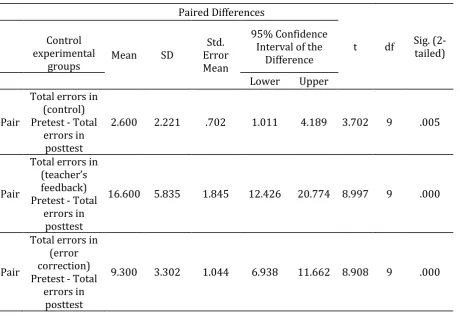
Table 3. Paired Samples Test
Paired Differences
t df Sig.
(2-tailed) Control
experimental
groups Mean SD
Std. Error Mean
95% Confidence Interval of the
Difference
Lower Upper
Pair
Total errors in (control) Pretest - Total
errors in posttest
2.600 2.221 .702 1.011 4.189 3.702 9 .005
Pair
Total errors in (teacher’s feedback) Pretest - Total
errors in posttest
16.600 5.835 1.845 12.426 20.774 8.997 9 .000
Pair
Total errors in (error correction) Pretest - Total
errors in posttest
9.300 3.302 1.044 6.938 11.662 8.908 9 .000
The paired t-test results for the control group (Table 3) showed that the difference between the two essays was statistically significant with t = 3.70, which is more than t -critical of 2.20, and p = .005, which is less than .05. This meant that students in the control group improved in terms of grammatical accuracy.
The paired t-test results for the error correction group showed that the difference between the two essays was statistically significant with t = 8.908, which is more than t -critical of 2.20, and p = .000, which is less than .05. This meant that students in the error correction group improved in terms of grammatical accuracy.
Table 4. One Way ANOVA
posttest Groups Sum of Squares df Mean Square F Sig.
Total errors
Between Groups 726.200 2 363.100 13.493 .000
Within Groups 726.600 27 26.911
Total 1452.800 29
To determine whether there is a significant difference between the means of three groups, One-Way ANOVA was conducted. The One Way ANOVA found significant difference in total number of errors among the three groups with F-ratio =13.493 which is more than F-critical of 3.35, and p = .000, which is less than .05 (p <α). However, ANOVA results showed no significant difference in articles/determiners, fragments, and run-ons among three groups with F-ratio less than F-critical of 3.35, and p-value more than .05 (p>α). However, it showed significant difference in other seven types of errors with F-ratio more than F-critical of 3.35, and p-value less than .05(p<α). The ANOVA did not reveal how the three groups differed. For this reason, the post-hoc Scheffe test was conducted.
Table 5. The Post-Hoc Scheffe Test
Dependent Variable (I) Group (J) Group Mean Difference (I-J) Std. Error Sig.
Total errors Control
Experimental 1 11.900* 2.320 .000
Experimental 2 4.300 2.320 .199
Experimental 1 Experimental 2 -7.600* 2.320 .011
have any significant effect on improvement of the writing’s accuracy of the Iranian EFL learners.
Besides, Post-hoc Scheffe Test revealed significant difference between the teacher feedback group and the error correction group with p = .01, which is less than .05 (p<α), as a result, the first null hypothesis which predicted that there is no significant difference between learners’ error correction exercise and teacher's error feedback in improving the writing’s accuracy of the Iranian intermediate EFL learners was rejected. Thus, it can be claimed that teacher error feedback was more effective than error correction exercises in improving the writing’s accuracy of Iranian intermediate EFL learners. Thus, it can be claimed that teachers’ feedbacks were more effective than error correction exercises in improving the writing’s accuracy of Iranian intermediate EFL learners.
DISCUSSION AND CONCLUSION
As was mentioned before, the issue of error correction has been a controversial and a much disputed subject within the field of L2 writing. In line with a line of research advocating teacher's feedback in L2 writing (e.g., Al Saeed, 2010; Ashwell, 2000; Chandler, 2003; Ferris et.al., 2000; Fathman & Whally, 1990), the findings revealed that teacher's feedback played an important role in improving students' accuracy in writing. A possible explanation might be that the provision of full, explicit, written coded feedback coupled with teacher oral instruction in situation where written feedbacks are either ambiguous or insufficient helped students to improve their writing accuracy. However, some equivocal results were which a note of caution is due here.
Firstly, the analysis of paired t-test for the control group revealed that the difference between the two essays was statistically significant. This means that students in the control group improved in terms of grammatical accuracy. It could be argued that the relative improvement in students' accuracy mainly occurred in fragment and run on sentences, and these categories of error were comprehensively addressed in classes. This slight improvement in writing’s accuracy happened in all three groups. However, Paired Sample Test for the control group revealed that students’ writing showed no significant improvement.
types of teacher’s feedbacks (e.g., discussing errors, clarifying the rules, and illustrating with additional examples) would assist students to notice the differences between these categories of errors. That is, the result further supports the idea of noticing in second language learning. Noticing is a widely accepted concept in SLA research and plays a pivotal role in uptake and long-term acquisition (Schmidt, 1990, 1994). This finding is in line with what Al Saeed (2010), Ferris (1999), Hong (2004) observed.
Thirdly, as shown in Table 5, the difference between the two essays was statistically significant for the error correction group. This means that students in the error correction group improved in terms of grammatical accuracy. Paired Sample t-test for error correction group revealed that students’ errors in subject-verb agreement, pronouns, and run-ons dropped significantly. It is difficult to explain this result, but this discrepancy could be attributed to the observation that doing a couple of error-correction exercises would help students to implicitly identify some basic grammatical rules and subsequently subsume them in their interlanguage system. This is mostly the case with pronoun and agreement errors. However, these finding must be interpreted with caution because verb tense, verb form, articles/determiners, noun endings, word choice and miscellaneous showed no significant difference. This inconsistency may be attributed to mechanical nature of error correction exercises. By mechanical, it is argued that the task itself is not potentially meaningful and is related to cognitive structure only in an arbitrary and verbatim fashion. Here the students failed to subsume the underlying rules or if they had acquired, they would have failed to transfer the acquired knowledge to actual writing context.
In conclusion, practicing a couple of mechanical, multiple-choice exercises which are devoid of teacher's constructive feedback will not consolidate the grammatical rules in learners’ interlanguage and hence learners would fail to correctly transfer this knowledge to actual writing task.
There are still many unanswered questions about the efficacy of different types of corrective feedbacks such as direct vs. indirect, coded vs. un-coded, delayed vs. undelayed. Moreover, as suggested in the literature (Ferris, 2004, Hyland & Hyland, 2006), it might be the case that uncoded, indirect corrective feedbacks are not beneficial for lower proficiency language learners, since they lack the required linguistic competence to self-correct their errors. It would be interesting to test this hypothesis in future research.
REFERENCES
Arege, J. B. (2010). Exploring some effects of different types of error correction feedback
on ESL student writing (M.A thesis). University of South Africa, Botswana.
Ashwell, T. (2000). Patterns of teacher response to student writing multiple-draft composition classroom: is content feedback followed by feedback the best method? Journal of Second Language Writing,9, 227-58.
Al Saeed, N. S. (2010). The effect of error correction types on grammatical accuracy in
student essay revision (M.A. Thesis). University of Cairo.
Bailey, E., & Powell, P. (1988). The practical writer with readings. New York: Holt, Rinehart and Winston, INC.
Best, J., & Kahn, J. V. (2006). Research in education. London: Longman Pearson Education Inc.
Bitchener, J. (2008). Evidence in support of written corrective feedback. Journal of
Second Language Writing, 7, 102-118.
Brown, D. (2001). Teaching by principles: An interactive approach to language pedagogy. USA: Longman Pearson Education Company.
Chandler, J. (2003). The efficacy of various kinds of error feedback for improvement in the accuracy and fluency of L2 student writing. Journal of Second Language
Writing,12, 267–296.
Chun, A., Day, R. R., Chenoweth, A., & Luppescu, S. (1982). Errors, interaction, and correction: A study of native-nonnative conversation. TESOL Quarterly, 16, 537-547.
Fathman, A., K. & Whalley, E. (1990). Teacher response to student writing: Focus on form versus content. In B. Kroll (Ed.), Second language writing: Research insights
for the classroom (pp. 178-190). New York: Cambridge University Press.
Ferris, D. (2004). The “Grammar Correction” debate in L2 writing: Where are, and where do we go from here? (and what do we do in the mean time…?). Journal of
Second Language Writing, 13, 49-62.
Ferris, D. R. (2003). Response to student writing: Implications for second language
students. Mahwah, NJ: Lawrence Erlbaum.
Ferris, D. R., & Roberts, B. (2001). Error feedback in L2 writing classes: How explicit does it need to be? Journal of Second Language Writing, 10, 161–184.
Ferris, D. R. (1999). The case for grammar correction in L2 writing classes: A response to Truscott (1996). Journal of Second Language Writing, 8(1), 1–11.
Harmer, J. (2004). How to teach writing. Malaysia: Longman Pearson Education Limited. Hendrickson, J. M. (1980). The treatment of error in written work. The Modern
Language Journal, 64 (2), 216-221.
Hong, Y. (2004). The effect of teachers’ error feedback on international students’
self-correction ability (M.A. thesis). Brigham Young University, Provo, Utah.
Hyland, F., & Hyland, K. (2001). Providing effective support: investigating feedback to distance language learners. Open Learning, 16(3), 233-247.
Hyland, K. (2002). Second Language Writing. Cambridge: Cambridge university press. Kepner, C. G. (1991). An experiment in the relationship of types of written feedback to
Kim. H., Mathes, G. (2001). Explicit and Implicit corrective Feedback. The Korea TESOL
Journal, 4(1), 57-72.
Lee, I. (2004). Error correction in L2 secondary writing classrooms: Some implication for teaching. System, 25(4), 465-477.
Liu, Y. (2008). The effects of error feedback in second language writing. Arizona
Working Papers in SLA and Teaching, 15, 65-79.
Oshima, A., & Hogue, A. (2007). Introduction to academic writing. London: Longman Pearson.
Polio, C., & Williams, J. (2009). Teaching and Testing Writing. In M.H. Long C.J. Doughty,
The handbook of language teaching (pp. 486-517). Malden, MA: Blackwell
Publishing LTD.
Rassaei, E., & Moinzadeh, A. (2012). Effects of recasts and metalinguistic corrective feedback on the acquisition of implicit and explicit L2 knowledge. The Journal of
Language Teachingand Learning, 2 (1), 144-156.
Richards, J.C., & Renandya, W.A, (2002). Methodology in language teaching. Cambridge: Cambridge University Press.
Selinker, L. (1992). Rediscovering interlanguage. London: Longman.
Silva, T., & Matsuda, P. K. (2002). Writing: In An introduction to applied linguistics. Norbert Schmidt (ed.), pp. 251-266. London: Arnold.
Schmidt, R. (1990). The role of consciousness in second language learning. Applied
Linguistics, 11, 129–158.
Sheppard, K. (1992). Two feedback types: Do they make a difference? RELC Journal,
23,103-110.
Truscott, J. (1996). The case against grammar correction in L2 writing classes. Language
Learning, 46(2), 327–369.
Truscott, J. (1999). The case for ‘‘the case for grammar correction in L2 writing classes’’: A response to Ferris. Journal of Second Language Writing, 8, 111–122.
Truscott, J. (2004). Evidence and Conjecture on the Effects of Correction: A Response to Chandler. Journal of Second Language Writing, 13, 337-343.
Truscott, J. & Hsu, Y. (2008). Error correction, revision and learning. Journal of Second
Language Writing, 17, 292-365.
Zemach, E., & Rumisek, L. (2011). Academic writing from paragraph to essay. USA: Macmillian.