What works for pupils
with literacy difficulties?
The effectiveness of intervention schemes
Third edition
Greg Brooks
University of Sheffield
The views expressed in this report are the author’s and do not necessarily reflect those of the Department for Children, Schools and Families.
© Greg Brooks and National Foundation for Educational Research 2007. Published by the Department for Children, Schools and Families. Applications for reproduction should be made to Prof. Greg Brooks, School of Education, University of Sheffield, Education Building, 388 Glossop Road, Sheffield S10 2JA, and/or to Company Secretary, National Foundation for Educational Research, The Mere, Upton Park, Slough SL1 2DQ.
December 2007
ST IVES L
What works for pupils with literacy difficulties 00688-2007BKT-EN Primary and SecondaryNational Strategies © Greg Brooks and NFER 2007
2
Contents
List of tables
6
List of figures
7
Acknowledgements
8
Chapter one
Focus and intention of this report 13
1.1 The focus 13
1.2 The need 15
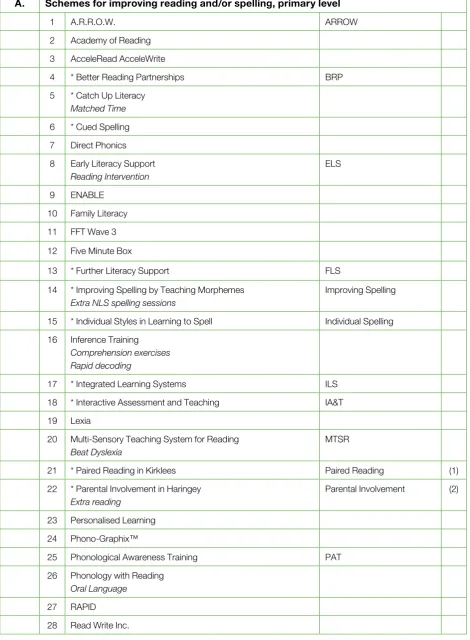
1.3 The schemes covered 15
1.4 Forms of data 18
1.5 New features in 2007 19
1.6 Changes in this edition 20
Chapter two
Signposts 22
2.1 Finding your way 22
2.2 Scale of the evaluations 22
2.3 The impact of ordinary classroom teaching 22
2.4 What works at secondary level? 25
2.5 Focusing on writing and spelling 26
2.6 Focusing on phonological skills for reading 26
2.7 Focusing on comprehension skills 27
2.8 Focusing on self-esteem 27
2.9 Focusing on ICT 28
2.10 Large-scale programmes 28
2.11 Partnership approaches for reading 29
2.12 How can those with the greatest difficulties be helped? 29
2.13 Duration and impact 30
2.14 Immediate benefits: satisfactory versus good 30
2.15 Lasting benefits 30
Chapter three
The schemes and their evaluations 33
A. Reading and spelling schemes – primary level 36
3.1 A.R.R.O.W. 36
3.2 Academy of Reading® 37
3.3 AcceleRead AcceleWrite 38
3.4 Better Reading Partnerships 40
3.5 Catch Up Literacy 43
3.6 Cued Spelling 45
3.7 Direct Phonics 46
3.8 Early Literacy Support 47
3.9 ENABLE 48
3.10 Family Literacy 49
3.11 FFT Wave 3 51
3.12 Five Minute Box 52
3.13 Further Literacy Support 53
3.14 Improving Spelling by Teaching Morphemes 54
3.15 Individual Styles in Learning to Spell 55
3.16 Inference Training 56
3.17 Integrated Learning Systems: the National Council for
Educational Technology study 57
3.18 Interactive Assessment and Teaching 59
3.19 Lexia 60
3.20 Multi-sensory Teaching System for Reading 61
3.21 Paired Reading in Kirklees 62
3.22 Parental Involvement in Reading in Haringey 63
3.23 Personalised Learning 64
Note on Blitz! 64
3.24 Phono-Graphix™ 65
3.25 Phonological Awareness Training 66
3.26 Phonology with Reading 67
3.27 RAPID 68
3.28 Read Write Inc. 69
3.29 Reading Intervention 71
3.30 Reading Recovery 74
3.31 Reciprocal Teaching 77
What works for pupils with literacy difficulties 00688-2007BKT-EN Primary and SecondaryNational Strategies © Greg Brooks and NFER 2007
4
3.33 SIDNEY 79
3.34 Somerset Self-esteem and Reading Project 80
3.35 Sound Discovery® 83
3.36 Sounds~Write 84
3.37 SPELLIT 85
3.38 The Early Reading Research 86
3.39 THRASS 87
3.40 Time for Reading 88
3.41 Toe by Toe® 89
B. Reading and spelling schemes – secondary level 90
3.42 Academy of Reading® 90
3.43 Better Reading Partnerships 91
3.44 Catch Up Literacy 92
3.45 Corrective Reading 93
3.46 ENABLE-PLUS (KS3) 94
3.47 Integrated Learning Systems: the National Council for
Educational Technology study 95
3.48 Literacy Acceleration 96
3.49 Philosophy for Children 98
3.50 Read Write Inc. Fresh Start 99
3.51 Sound Training for Reading© 100
3.52 The Accelerated Reader 101
3.53 The Secondary Reading Research 102
3.54 THRASS 103
3.55 Toe by Toe® 104
C. Schemes for improving writing 105
3.56 Family Literacy 105
3.57 Further Literacy Support 106
3.58 Paired Writing 107
3.59 Reading Recovery 108
Chapter four
Comments on the evaluations 109
4.1 Schemes not included 109
4.2 The quality of the research 110
References
112
Appendix: Details of the evaluations 122
A.1 Introduction to the evaluation data 123
A.2 Data on evaluated schemes 133
Primary 133
1 A.R.R.O.W. 133
2 Academy of Reading® 134
3 AcceleRead AcceleWrite 135
4 Better Reading Partnerships 140
5 Catch Up Literacy 147
6 Cued Spelling 153
7 Direct Phonics 155
8 Early Literacy Support 156
9 ENABLE 158
10 Family Literacy 160
11 FFT Wave 3 163
12 Five Minute Box 164
13 Further Literacy Support 165
14 Improving Spelling by Teaching Morphemes 168
15 Individual Styles in Learning to Spell 171
16 Inference Training 172
17 Integrated Learning Systems, National Council for
Educational Technology study 175
18 Interactive Assessment and Teaching 177
19 Lexia 179
20 Multi-sensory Teaching System for Reading 181
21 Paired Reading in Kirklees 184
22 Parental Involvement in Reading in Haringey 186
23 Personalised Learning 188
24 Phono-Graphix™ 190
25 Phonological Awareness Training 193
26 Phonology with Reading 194
27 RAPID 196
28 Read Write Inc. 197
29 Reading Intervention 200
30 Reading Recovery 205
What works for pupils with literacy difficulties 00688-2007BKT-EN Primary and SecondaryNational Strategies © Greg Brooks and NFER 2007
6
32 RITA 217
33 SIDNEY 219
34 Somerset Self-esteem and Reading Project 220
35 Sound Discovery® 226
36 Sounds~Write 228
37 SPELLIT 229
38 The Early Reading Research 230
39 THRASS 232
40 Time for Reading 234
41 Toe by Toe® 236
Secondary
42 Academy of Reading® 237
43 Better Reading Partnerships in Derbyshire 238
44 Catch Up Literacy 239
45 Corrective Reading 240
46 ENABLE PLUS (KS3) 241
47 Integrated Learning Systems, National Council for
Educational Technology study 243
48 Literacy Acceleration 245
49 Philosophy for Children 250
50 Read Write Inc. Fresh Start 251
51 Sound Training for Reading 254
52 The Accelerated Reader 255
53 The Secondary Reading Research 256
54 THRASS 257
55 Toe by Toe® 258
Writing
56 Family Literacy 260
57 Further Literacy Support 261
58 Paired Writing 263
59 Reading Recovery 266
A.3 Comparisons between schemes 269
A.4 Follow-up studies 294
List of tables
Table 1 Percentage of children in England achieving below level 2 in reading in Key Stage 1 National Curriculum tests, or below level 3 in English at
Table 2 Full and abbreviated names, and outline structure, of the 48 schemes 16 Table 3 Numbers of children involved in the 48 studies, in decreasing order
of number in experimental group 23
Table 4 General characteristics of the primary schemes 34
Table 5 General characteristics of the secondary schemes 35
Table A.1 Organisation of entries in log of studies 123
Table A.2 List of randomised controlled trials 124
Table A.3 List of matched-groups quasi-experiments 125
Table A.4 List of unmatched-groups pre-test/post-test studies 126
Table A.5 Schemes with alternative intervention groups, by method of
allocation and whether also had no-intervention group 129
Table A.6 List of reading studies for primary level in decreasing order of
ratio gain for whichever of accuracy and comprehension is the higher 270 Table A.7 List of reading studies for primary level in decreasing order of
effect size for whichever of accuracy and comprehension is the higher 279 Table A.8 List of spelling studies for primary level in decreasing order of
ratio gain 282
Table A.9 List of spelling studies for primary level in decreasing order of effect size 284 Table A.10 List of writing studies for primary level in decreasing order of effect size 285 Table A.11 List of reading studies for secondary level in decreasing order of ratio
gain for whichever of accuracy and comprehension is the higher 286 Table A.12 List of reading studies for secondary level in decreasing order of effect size
for whichever of accuracy and comprehension is the higher 288 Table A.13 List of spelling studies for secondary level in decreasing order of ratio gain 289 Table A.14 List of spelling studies for secondary level in decreasing order of effect size 290 Table A.15 Statistical comparisons between experimental and alternative intervention
(AI) groups at primary level 291
List of figures
What works for pupils with literacy difficulties 00688-2007BKT-EN Primary and SecondaryNational Strategies © Greg Brooks and NFER 2007
8
Acknowledgements
The original version of this report was Brooks, G., Flanagan, N., Henkhuzens, Z. and Hutchison, D. (1998). What Works for Slow Readers? The Effectiveness of Early Intervention Schemes. Slough: NFER.
www.nfer.ac.uk/publications/other-publications/downloadable-archive-reports/what-works-for-slow-readers-the-effectiveness-of-early-intervention-schemes.cfm
The first revision was Brooks, G. (2002). What Works for Children with Literacy Difficulties? The Effectiveness of Intervention Schemes. London: DfES Research Report no. RR380. ISBN 1 84185 830 7
www.dfes.gov.uk/research/data/uploadfiles/RR380.pdf – because of the change of title then, this further revision is called the ‘second edition’.
The 2002 edition formed the basis of Enters, I. and Brooks, G. (2005). Boosting Reading in Primary Schools. London: Basic Skills Agency. ISBN 1 85990 328 2. Four schemes which had produced suitable evaluation data since 2002 were added; others were dropped.
For this edition, one scheme has been dropped (Knowsley Reading Project), and a number added – see sections 1.5–6.
As in the previous edition, all the new material in this edition is the work of Prof. Greg Brooks, formerly at NFER, at the University of Sheffield since 1 January 2001. He wishes to record his deep gratitude to all the following:
His former colleagues, the other members of the project team at NFER for the original report: Zenta Henkhuzens, Research Officer
Nicola Flanagan, third-year undergraduate student of University of Surrey, on work experience at NFER in academic year 1997–98
Dr Dougal Hutchison, Principal Research Officer and Chief Statistician Effie de Souza, Project Secretary
and especially to
all the individuals and organisations who provided us in 1995–98, and Greg in 2002 and 2006–07, with information: without their help none of this project would have been possible on any of the three occasions. They are acknowledged here and on the next three pages.
Acknowledgements of information provided for the 1998 edition and retained for the 2002 and 2007 editions
Local Authorities
Bradford Buckinghamshire Jersey Kirklees
Institutions of Initial Teacher Training
Institute of Education, University of London Oxford Brookes University
Individuals
Suzi Clipson-Boyles }
Diana Bentley } Catch Up Literacy
Dee Reid }
Martin Miles AcceleRead AcceleWrite
Acknowledgements of information provided for the 2002 edition and retained for the 2007 edition
Local Education Authorities
Bolton Cumbria Haringey
Bradford Derbyshire Norfolk
Bridgend Devon Redcar and Cleveland
Bristol Durham Worcestershire
Cornwall Hampshire
Individuals
Where individuals’ affiliations are not shown in the left-hand column, their affiliations are with the LA mentioned in the right-hand column.
Alan Davies, Director of THRASS THRASS
Sue Derrington Phono-Graphix™ in Bristol
Dr Angela Fawcett, University of Sheffield Interactive Assessment and Teaching, Reader’s Intelligent Teaching Assistant, three reviews on DfES website
Ann Foster Better Reading Partnerships in Durham Pam Fudge Reading Recovery in Bristol
Dr Peter Hatcher, University of York Reading Intervention
Mike Johnson, Manchester Metropolitan University Multi-sensory Teaching System for Reading
Julie Lawes, Project Director, The Catch Up Project Catch Up Literacy in Cornwall and Norfolk, and the National experimental study
Prof. Ann Lewis, University of Birmingham Use of ILS with children with literacy difficulties Kerry Longhorn Family Literacy in Hampshire
Anthea Main Better Reading Partnerships in Worcestershire Dr Martin Miles, University of Exeter AcceleRead AcceleWrite in Devon
John Rack, Dyslexia Institute, York SPELLIT
Heather Swain Reading Intervention in Cumbria
Andrew Taylor Better Reading Partnerships in Redcar and Cleveland
What works for pupils with literacy difficulties 00688-2007BKT-EN Primary and SecondaryNational Strategies © Greg Brooks and NFER 2007
10
Acknowledgements of information provided for the 2007 edition
These acknowledgements include many for information which, sadly, could not be used.
Where individuals’ affiliations are not shown in the left-hand column, their affiliations are with the LA mentioned in the right-hand column.
Mary Adams, Bath and North East Somerset Sound Discovery
Rosemary Austin, Cornwall Read Write Inc. Fresh Start Jean Barney, North East Lincolnshire Building Blocks
Dr (now Prof.) Roger Beard, University of Leeds (now at Institute of Education, University of London)
Further Literacy Support
Phil Bowen and Jane Yeomans ENABLE
John Bowring The Bowring Code
Donna Boutilier, Sunderland THRASS Dr Sue Burroughs-Lange, Institute of Education,
University of London
Reading Recovery – Every Child a Reader in London
Jill Canning, Fischer Family Trust FFT Wave 3 Susan Case, David Philpot and John Walker,
Northamptonshire
Sounds~Write
John Catron, York Reciprocal Teaching
Vivienne Clifford, Harrow AcceleRead AcceleWrite (original) Mitch Cronick and Sarah Turner, Oxford University
Press
Read Write Inc. and Read Write Inc. Fresh Start
Sarah Couzens AcceleRead AcceleWrite in Wiltshire Alan Davies, Director of THRASS THRASS
Sue Derrington AcceleRead AcceleWrite and Cued Spelling in Bristol
Ian Enters, for having written, and Carol Taylor of the (former) Basic Skills Agency, for permission to reproduce the paragraphs in italics in section 2.16
Anthony Feiler LEAP
Barry Graham and Jen Scott, Pyramid Trust Pyramid Gill Hague, Torbay Toe by Toe
Karen Hanson, Derbyshire BRP in Nottinghamshire Ben Hayes, Kent Large and small units Cath Haynes, Harcourt, and Marian Morris, NFER RAPID
Dr Jane Hurry, Institute of Education, University of London
Extra information on Improving Spelling by
Teaching Morphemes and on Reading Recovery in London and Surrey (latter also Prof. Morag Stuart, IoE)
Dr Dougal Hutchison, NFER Statistical information Sandra Hutton, Scotland The Word Factory Caroline Jennings Corrective Reading Joy Johnson, Rotherham Reading Rescue
Dr Colin Lane A.R.R.O.W.
Denise Lanes, Leicester Read Write Inc. Fresh Start
Julie Lawes, Project Director, Catch Up Literacy Catch Up Literacy in Barnsley, Hampshire, Norfolk and Powys
Viv Leather, Stockport Every Child a Reader and SERI (Stockport Early Reading Intervention)
Prof. Ann Lewis, University of Birmingham Use of ILS with children with literacy difficulties Joanna Lockley and Tony Whatmuff, Leicester Inference Training
Rosy McVittie via Graham and Jane Kendall Five Minute Box, and MTSR in Southampton Dr Martin Miles, University of Exeter AcceleRead AcceleWrite in Devon
Vaughn Mudie, Isle of Wight The Great 8
Maggie Noon, Newham Newham Learning Support Roger Norgate, Hampshire SIDNEY
Roger Norgate, Hampshire, via Alan Davies, Director of THRASS
THRASS
Heather Osmond, York LINK (Literacy Intervention Kit) and Talking Partners Jo Padbury, Bedfordshire, via Dr Marlynne Grant,
South Gloucestershire
Sound Discovery
Katy Parkinson, Middlesbrough Sound Training for Reading Isabell Pasternicki, Leicester Big Writing
Linda Perry, Carole Price and Denise Kingston, East Sussex
Blitz!, Personalised Learning
Dr Mark Pilling, University of Sheffield Some statistical analyses Dr John Rack, Dyslexia Institute, York SPELLIT
Dr Rea Reason, University of Manchester Direct Phonics
Christa Rippon, Haringey Read Write Inc., Reciprocal Teaching and Tracks Literacy
Dr Ian Schagen, NFER Statistical information Andrea Smart and Ian Enters, Yorkshire Reading Matters for Life Neil Smith and Joanna Lunt, Camden Sound Waves
What works for pupils with literacy difficulties 00688-2007BKT-EN Primary and SecondaryNational Strategies © Greg Brooks and NFER 2007
12
Dr Jonathan Solity, consultant (formerly University of Warwick)
The Early Reading Research, The Secondary Reading Research
Arthur and Judith Staples Lexia
Christopher Staunton, Stoke on Trent Daily Diary for Reading and Spelling (also known as Reading Focus)
Heather Swain, Cumbria Reading Intervention
Keith Taylor Toe by Toe
West Dunbartonshire County Council Toe by Toe Steve Williams, Derbyshire, and Steve Trickey and
Prof. Keith Topping, University of Dundee
Philosophy for Children
Jacqui Worsley, Norfolk Catch Up Literacy, Lexia and Sound Discovery And finally and above all to the two members of the Steering Group: Diana Hatchett (the National Strategies at Capita) and Jean Gross (KPMG/Every Child a Reader), who provided me with lots of leads and copious information.
Chapter one
Focus and intention of this report
1.1 The focus
Most children learn to read and write satisfactorily first time through high-quality classroom teaching and/ or home support, but what of those who don’t? How are they to be helped? This research report reviews intervention schemes that have been devised to help struggling readers and writers, and is intended to inform schools’ choices among such schemes.
More exactly, this research report is addressing the following questions:
What intervention schemes are there which have been used in the UK in an attempt to boost the reading,
■
spelling or overall writing attainment of lower-achieving pupils in at least one of Years 1–11, and which have been quantitatively evaluated here?
What are those schemes like, and how effective are they?
■
The restriction to schemes used and evaluated in the UK is partly intended to avoid a deluge of information on schemes used elsewhere in the world, but mainly to circumvent the objection, ‘How do we know that it will work here?’
The intention of this report is to provide clear and analytic information on such schemes available in order to inform practice and choices of approach. Those choices should be guided not only by the evidence assembled and analysed here, but also by careful matching of the needs of an individual school, class or child to the specifics of particular schemes.
What works for pupils with literacy difficulties 00688-2007BKT-EN Primary and SecondaryNational Strategies © Greg Brooks and NFER 2007
14
The Three Waves
Effective inclusive provision has been summarised in the National Strategies’ Waves model which describes a strategic approach to teaching and additional intervention designed to minimise
underachievement for all learners. The Waves model can be extended to incorporate additional challenge for all learners, including gifted and talented learners, and can be used as a strategic approach to
developing the broader idea of personalisation.
Wave 1 – Quality first teaching
High-quality inclusive teaching is supported by effective whole-school policies and frameworks, clearly targeted at all learners’ needs and prior learning. This teaching needs to be based in planning and schemes of work that are designed to move all learners from where they are to where they need to be. Where there are large numbers of learners who share the same learning needs, the best solution is to adjust the planning to cater for them. It means setting a new trajectory for the learning programme to take learners to where they need to be in terms of age-related expectations. Effective Wave 1 teaching anticipates the needs of learners based on good use of yearly transition data and information.
When applied to early reading, this means the provision of a rich language curriculum that fosters all four interdependent strands of language – speaking, listening, reading and writing – while providing access for all children to high-quality phonic work as part of quality-first teaching.
Wave 2 – Wave 1 plus additional, time-limited, tailored intervention support programmes
Wave 2 provision is designed to increase rates of progress and secure learning for groups of learners that puts them back on course to meet or exceed national expectations. This usually takes the form of a tight, structured programme of small-group support that has an evidence base of impact on progress. This support is carefully targeted according to analysis of need and is delivered by teachers or teaching assistants who have the skills to help learners achieve their learning objectives. The progress of learners is closely tracked for impact. This support can occur outside (but in addition to) whole-class lessons, or be built into mainstream lessons as part of guided work. Critically, intervention support needs to help children and young people apply their learning in mainstream lessons, and to ensure that motivation and progress in learning are sustained. The outcome of Wave 2 intervention is for learners to be back on track to meet or exceed national expectations at the end of the key stage.
Wave 3 – Wave 1 plus increasingly individualised programmes, based on independent evidence of what works
1.2 The need
What proportion of children experience literacy difficulties? An estimate (for England only, since the DCSF remit is only for England) can be based on the results of National Curriculum assessments. Table 1 gives the percentages of children not yet achieving level 2 in reading at the end of Key Stage 1 (age 7), or not yet achieving level 3 in English at Key Stage 2 (age 11), in 1998–2006.
Table 1: Percentage of children in England achieving below level 2 in reading in Key Stage 1 National Curriculum tests, or below level 3 in English at Key Stage 2, 1998-2006*
Year Key Stage 1 Percentage Key Stage 2 Percentage
1998 19% 7%
1999 17% 7%
2000 16% 6%
2001 16% 7%
2002 15% 7%
2003 16% 7%
2004 15% 7%
2005 15% 6%
2006 16% 6%
* excluding absent pupils
This shows that significant numbers of children experience literacy difficulties and are likely to have difficulty in coping with the steadily increasing demands of the curriculum in Key Stage 3 (and beyond).
So what can be done for these children? I have identified a total of 48 schemes which fit my requirement of having quantitative evaluation data from the UK covering at least one year group and designed to boost reading and/or spelling and/or writing. Between them, these schemes have been the subject of at least the 121 studies which are analysed in the Appendix. The numbering system, however, runs up to 59 – this is because the 11 schemes which have both primary- and secondary-level data or data on both reading and/ or spelling and writing get two entries each.
1.3 The schemes covered
What works for pupils with literacy difficulties 00688-2007BKT-EN Primary and SecondaryNational Strategies © Greg Brooks and NFER 2007
[image:16.595.57.528.73.714.2]16
Table 2: Full and abbreviated names, and outline structure, of the 48 schemes
A. Schemes for improving reading and/or spelling, primary level
1 A.R.R.O.W. ARROW
2 Academy of Reading
3 AcceleRead AcceleWrite
4 * Better Reading Partnerships BRP
5 * Catch Up Literacy
Matched Time
6 * Cued Spelling
7 Direct Phonics
8 Early Literacy Support
Reading Intervention
ELS
9 ENABLE
10 Family Literacy
11 FFT Wave 3
12 Five Minute Box
13 * Further Literacy Support FLS
14 * Improving Spelling by Teaching Morphemes
Extra NLS spelling sessions
Improving Spelling
15 * Individual Styles in Learning to Spell Individual Spelling
16 Inference Training
Comprehension exercises Rapid decoding
17 * Integrated Learning Systems ILS
18 * Interactive Assessment and Teaching IA&T
19 Lexia
20 Multi-Sensory Teaching System for Reading
Beat Dyslexia
MTSR
21 * Paired Reading in Kirklees Paired Reading (1)
22 * Parental Involvement in Haringey
Extra reading
Parental Involvement (2)
23 Personalised Learning
24 Phono-Graphix™
25 Phonological Awareness Training PAT
26 Phonology with Reading
Oral Language
27 RAPID
29 * Reading Intervention
(originally Cumbria Reading with Phonology Project – where this is meant it is called ‘original’)
Reading-only Phonology-only
30 * Reading Recovery
Phonological Training
(3)
31 Reciprocal Teaching
32 * Reader’s Intelligent Teaching Assistant
IA&T
RITA
33 SIDNEY
34 * Somerset Self-esteem and Reading Project
Self-esteem counselling only Remedial phonics only Remedial reading only Drama plus DISTAR DISTAR only
Somerset (4)
35 Sound Discovery
36 Sounds~Write
Progression in Phonics
37 * SPELLIT
Home Support programme
38 The Early Reading Research TERR
39 THRASS
40 * Time for Reading
41 Toe by Toe
B. Schemes for improving reading and/or spelling, secondary level
42 Academy of Reading
43 Better Reading Partnerships BRP
44 Catch Up Literacy
45 Corrective Reading
46 ENABLE PLUS (KS3)
47 * Integrated Learning Systems ILS
48 * Literacy Acceleration
49 * Philosophy for Children
50 Read Write Inc. Fresh Start
51 Sound Training for Reading
52 The Accelerated Reader
53 * The Secondary Reading Research TSRR
54 THRASS
What works for pupils with literacy difficulties 00688-2007BKT-EN Primary and SecondaryNational Strategies © Greg Brooks and NFER 2007
18
C. Schemes for improving writing
56 Family Literacy
57 * Further Literacy Support FLS
58 * Paired Writing
59 * Reading Recovery
Phonological Training
(3)
Key to Table 2: * = scheme with no-intervention control/comparison group in at least one study – see Appendix and section 2.3
Approaches mentioned in italics under each main scheme are alternative interventions investigated within the same evaluation.
Notes to Table 2:
Topping and Lindsay (1992) reviewed dozens of Paired Reading schemes from all over the English-1.
speaking world. For this report, the Kirklees scheme, which was not only based in England but also by far the biggest of those reviewed by Topping and Lindsay, has been taken as representative of all the findings, and is referred to simply as ‘Paired Reading’.
Similarly, since there have been many Parental Involvement schemes, the original and best-known, 2.
Haringey, has been taken as the exemplar for this report.
Where Reading Recovery itself is meant, the title ‘Reading Recovery’ is used; but where it is necessary 3.
to refer to the comparison or alternative intervention conditions, the abbreviation RR is used instead; sometimes this abbreviation is also used to save space.
Somerset was a series of four studies; where necessary these are distinguished by a number in brackets, 4.
e.g. Somerset (1).
1.4 Forms of data
In order to judge whether an initiative has really made a difference, it is not enough just to ask the
participants – they will almost always say it has. This feel-good factor is valid on its own terms, but doesn’t always correlate with measured progress, and certainly doesn’t convince policy-makers and funders. So quantitative data on the learners’ progress are essential, measured by appropriate tests of (in this case) reading, spelling or writing.
But not just any test data will do: if the test provides only raw scores, the average gain may look impressive, but what does it mean? How good is it, compared with gains in other projects and/or with national norms? We need some way of comparing the impacts of different initiatives. The two forms of impact measure used in this report are ratio gains and effect sizes. These are explained in more detail in the early part of the Appendix; briefly,
a ratio gain is a group’s average gain in reading or spelling age in months divided by the time between pre-
■
and post-test in months. A ratio gain can only be calculated where the test provides reading or spelling ages;
an effect size is the experimental group’s gain minus the comparison group’s gain divided by (usually) the
■
Both forms of impact measure make it possible to put different initiatives on the same scale, despite their having used different tests, and therefore to compare their effectiveness. Unfortunately, ratio gains and effect sizes can’t be translated into each other, so in Tables A6–14 in the Appendix you will find some that list ratio gains and others that list effect sizes. A very few evaluations provide the information to calculate both forms of impact measure, but so few that the two scales cannot be correlated.
There are, of course, other forms of data out there, and a word of explanation is needed on why they have not been used. Basically, it’s because they don’t allow different initiatives’ impacts to be put on a common scale and compared. This is not to deny the usefulness of these forms of data for their own purposes. For example, all Reading Recovery schemes calculate and report ‘the percentage of children successfully discontinued’, and this enables Reading Recovery providers to see how closely they are matching up to the high targets they are set. But this measure cannot be used to provide external comparisons. This is also mainly true of another measure frequently reported now, namely, how far children have progressed up the Reading Recovery book levels. However, the Reading Recovery National Network has recently amassed enough data from the same children on both book levels and the British Ability Scales Word Reading Test that they can now offer translations of book levels into reading ages; this information has been used in just two cases, FFT Wave 3 and the 1997–98 cohort of Reading Recovery itself.
Similarly, some initiatives now report in terms of children’s greater achievement at (say) Key Stage 1 than their teachers had predicted, and this is meaningful to providers within the system that operates in England. I have reported such data in six cases: FLS, Key Stage 2 reading and writing; RR, 1997–98 cohort, Key Stage 1 and Key Stage 2 reading; RR, ECaR in Britain and Ireland, Year 2 children in England, Key Stage 1 reading and writing. In the case of Further Literacy Support I have also reported Teacher Assessment data for comparison with test scores.
1.5 New features in 2007
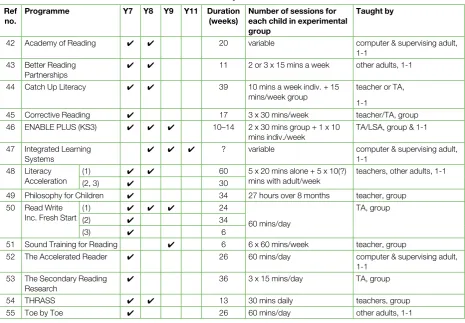
The main innovation is the extension of coverage to secondary level, up to age 16. There are far fewer schemes for this age range than for primary level. However, I have found 14, and these are:
Academy of Reading Better Reading Partners Catch Up Literacy Corrective Reading ENABLE-PLUS (KS3) ILS
Literacy Acceleration
Philosophy for Children Read Write Inc. Fresh Start Sound Training for Reading The Accelerated Reader
The Secondary Reading Research THRASS
Toe by Toe
These are all in section B of chapter three. All 14 have data for Key Stage 3, but only ILS has data for Year 11, and there are no data at all for Year 10.
What works for pupils with literacy difficulties 00688-2007BKT-EN Primary and SecondaryNational Strategies © Greg Brooks and NFER 2007
20
are also given at relevant points in each main entry in chapter three and at the top of Tables A6–14 in the Appendix. This is intended to show more precisely what works for different groups and enable readers to assess which interventions provide the best match to the needs they have identified.
1.6 Changes in this edition
Between the publication of What Works for Slow Readers? (Brooks et al.,1998) and that of the previous edition of this report in 2002, the field had moved on considerably. A great deal of the information from the original 1998 report was retained, but some was not, and section 1.5 of the 2002 edition listed the schemes which were no longer included. Similarly, in this edition a great deal of the information from the previous edition, and even some from the original 1998 report, has been retained, though again some has been dropped, and a great deal more has been added. The only scheme which featured in the 2002 edition that has been dropped completely is Knowsley Reading Project, but some data on small studies or small comparison groups have also been dropped from Better Reading Partnerships, Cued Spelling, Paired Writing, Reciprocal Teaching and Sound Discovery.
Schemes solely or primarily focused on reading which have been added in this edition are the following (those marked with an asterisk also have spelling data – see below):
* A.R.R.O.W.
Academy of Reading Corrective Reading Direct Phonics
* Early Literacy Support * ENABLE
FFT Wave 3 Five Minute Box
Further Literacy Support * Lexia
* Literacy Acceleration Personalised Learning
Philosophy for Children Phonology with Reading RAPID
* Read Write Inc. SIDNEY
* Sound Discovery
Sound Training for Reading * Sounds~Write
The Accelerated Reader * The Early Reading Research * The Secondary Reading Research Toe By Toe
Detailed comparison of entries for reading in this and the 2002 edition will reveal that many impact
measures which were previously attributed to accuracy are now attributed instead to comprehension – this is because it has become clear to me that many of the relevant tests (e.g. Salford, Suffolk), being sentence tests, are in fact tests of comprehension rather than accuracy.
Both previous editions had a separate section for ICT-based schemes. These are now merged into the reading and spelling sections.
Schemes for spelling
writing more generally, and information was given on 12 schemes which provided data on spelling and two for writing. The ten new schemes which have spelling as well as reading data are indicated by an asterisk just above, and there is one new scheme concerned solely with spelling, Improving Spelling by Teaching Morphemes. The 12 schemes with spelling data retained from 2002 are:
AcceleRead AcceleWrite Catch Up Literacy Cued Spelling
Individual Styles in Learning to Spell Interactive Assessment and Teaching Multi-sensory Teaching System for Reading
Phono-Graphix™
Reader’s Intelligent Teaching Assistant Reading Intervention
Reading Recovery THRASS
Time for Reading
All the schemes which focus on reading and/or spelling are in parts A and B of chapter three; those focused on primary level are in part A, and those focused on secondary level are in part B.
Schemes for writing
In 2002 the requirement to cover the general process of writing was difficult to fulfil, because much less quantitative research had been done on writing than on other aspects of literacy, and there was very little that stood up to analytic scrutiny. In 2002, the new section on schemes for improving writing consisted of just three small studies on the Paired Writing technique, plus some insights from Family Literacy. However, since then a very large and well-conducted study has been carried out evaluating Further Literacy Support, and there are very useful data from two Reading Recovery studies, the 1997–98 cohort and RR across Britain and Ireland; even so, more quantitative studies of how to improve writing are needed.
What works for pupils with literacy difficulties 00688-2007BKT-EN Primary and SecondaryNational Strategies © Greg Brooks and NFER 2007
22
Chapter two
Signposts
2.1 Finding your way
Literacy research is a jungle, and quantitative evaluations of interventions are among its densest thickets. This chapter is intended to help you find the schemes which may be most relevant to your situation. All the schemes mentioned are described in chapter three – but remember that these are only the schemes analysed for this report.
Before going on to the remainder of the chapter it would be advisable to read the caveat in the next section on the scale of the various evaluations.
When reading this chapter it is particularly important to remember that it mentions all schemes, whether effective or not; however, as a rough guide, schemes which the data suggest are less effective are shown in [square brackets].
2.2 Scale of the evaluations
When considering the interventions and what is said about them here, it would be well to bear in mind that the evaluations differed vastly in scale. To emphasise this, Table 3 shows the numbers of children involved. Where more than one project is covered by a heading, the various studies’ numbers are summed.
The reason for the huge numbers for ILS is explained in its entry in the Appendix. Some schemes have been evaluated on a large scale, while the numbers against some well-known names in the list are comparatively small. But there is no simple correlation between size and quality here – some small studies (in terms of number of children in the experimental group) were meticulously designed and reported, while the reporting of some with much larger numbers was considerably less complete.
2.3 The impact of ordinary classroom teaching
As shown in Table 3, 22 of the 48 schemes provided evidence of well-defined control/comparison groups who received no extra intervention, in other words, ordinary classroom teaching. Several of the studies providing information on the impact of ordinary teaching were among the largest; indeed, the number of comparison-group children in the Year 11 part of the Durham study in ILS Phase III was claimed to be 37,000. With these children included, the total number of children in control/comparison groups is about 45,000; without them, about 8,000.
Table 3: Numbers of children involved in the 48 studies, in decreasing order of number in experimental group
Ref(s) Name of study Numbers of children Experimental groups
Comparison groups
Alternative Intervention(s)
Total
30, 59 Reading Recovery 5438 339 92 5869
17, 47 Integrated Learning Systems 3772* 39 861* 43 633*
4, 43 Better Reading Partnerships 2978? 142? 3120?
21 Paired Reading in Kirklees 2372 446 2818
5, 44 Catch Up Literacy 2090 60 60 2210
13, 57 Further Literacy Support 1054 2720 3774
10, 56 Family Literacy 515 515
29 Reading Intervention 459 31 61 551
28, 50 Read Write Inc. 446 446
27 RAPID 418 368 786
14 Improving Spelling 363 365 27 755
39, 54 THRASS 320 320
3 AcceleRead AcceleWrite 300 300
35 Sound Discovery 278 278
24 Phono-Graphix™ 242 242
38 TERR 211 36 247
2, 42 Academy of Reading 186 186
20 MTSR 173 17 190
9, 46 ENABLE 165 165
34 Somerset 143 90 224 457
41, 55 Toe by Toe 112 112
18 IA&T 97 89 186
23 Personalised Learning 92 92
45 Corrective Reading 92 92
1 ARROW 91 91
31 Reciprocal Teaching 88 88
16 Inference Training 83 26 109
19 Lexia 79 79
32 RITA 74 103 177
6 Cued Spelling 72 72
26 Phonology with Reading 71 75 146
51 Sound Training for Reading 70 21 91
What works for pupils with literacy difficulties 00688-2007BKT-EN Primary and SecondaryNational Strategies © Greg Brooks and NFER 2007
24
40 Time for Reading 68 72 140
11 FFT Wave 3 67 67
33 SIDNEY 66 66
48 Literacy Acceleration 63 40 103
53 TSRR 62 62 124
22 Parental Involvement 51 152 45 248
37 SPELLIT 51 58 41 150
52 The Accelerated Reader 47 47
12 Five Minute Box 40 40
58 Paired Writing 39 39 78
15 Individual Spelling 26 22 48
25 PAT 24 24 48
7 Direct Phonics 24 24
36 Sounds~Write 24 27 51
49 Philosophy for Children 15 17 32
Key: ? = number not stated clearly or at all in a contributing report
* = numbers for Integrated Learning Systems are for numeracy as well as literacy; literacy numbers were not given separately Note: Where no number is shown, there was no comparison or alternative intervention group.
As the Appendix shows, most control/comparison groups made normal progress. This finding is, however, circular: children receiving ordinary teaching mostly made the progress to be expected of children receiving ordinary teaching. What is more interesting is that some comparison groups made better than expected progress. In some cases, the explanation is both known and obvious: the control/comparison group was also receiving extra attention – see in particular RAPID. However, there are some control/comparison groups which made better than expected progress despite, apparently, receiving no extra intervention – see especially Paired Reading. What secret might this scheme have had? It seems that in Kirklees (the LEA where the Paired Reading study was conducted) the experimental intervention affected a significant proportion of schools.
So it may be that Paired Reading affected a high proportion of the schools in the area in which it took place, and the experimental schools were observed by others. This may have influenced non-participating schools to raise their game, and provide ordinary teaching of a higher effectiveness than usual. Density of implementation seems not to have been a feature of schemes where the comparison groups made normal progress, and it might be reasonable to conclude that this is more like the normal situation, and therefore that ordinary teaching provides extra impact only in exceptional circumstances.
On the other hand, if the density effect is real, it would support an argument for implementing initiatives at a fairly high density and/or with great publicity.
2.4 What works at secondary level?
There is much less evidence for secondary level than for primary; in particular, there is none at all for writing. That said, there is evidence of useful to remarkable effectiveness for reading for the following schemes: Academy of Reading, BRP, Corrective Reading, ENABLE PLUS (KS3), Literacy Acceleration, Read Write Inc. Fresh Start, THRASS and Toe by Toe; less convincing or mixed evidence for Catch Up Literacy, Philosophy for Children, The Accelerated Reader, Sound Training for Reading, and The Secondary Reading Research; and pretty convincing evidence of ineffectiveness for [ILS].
There are only four schemes with evidence for spelling at secondary level. Two have moderately convincing evidence of effectiveness: Literacy Acceleration and THRASS, while [Read Write Inc. Fresh Start] and [The Secondary Reading Research] seem relatively ineffective here.
While its effectiveness is not huge, [Philosophy for Children] nevertheless represents a wholly different angle from all the other schemes analysed; whatever benefit it might have for reading was an unexpected bonus effect.
What works for pupils with literacy difficulties 00688-2007BKT-EN Primary and SecondaryNational Strategies © Greg Brooks and NFER 2007
26
2.5 Focusing on writing and spelling
There was only a handful of studies on the compositional aspect of writing at primary level: Family Literacy, Further Literacy Support, Paired Writing (two small studies) and two Reading Recovery studies (ECaR in London and RR across Britain and Ireland). However, the sample sizes in FLS and RR across Britain and Ireland, both added in this edition, were so large that they hugely increase the weight of evidence. Despite this, the approaches are too disparate to justify broad conclusions. Suffice to say that Paired Writing has definite potential and the others seem to have been effective.
Among schemes which provided data on spelling at primary level, there are just three, Cued Spelling, Improving Spelling and Individual Spelling, which were concerned exclusively with spelling. Cued Spelling and Individual Spelling and at least seven others, ARROW, ENABLE One-to-One, Lexia, Phono-Graphix™, Sound Discovery, Sounds~Write and [THRASS – less effective for spelling than for reading], paid explicit attention to phoneme-grapheme relationships. However, it is less obvious for spelling than for reading that embedding within a broad framework is crucial, since Phono-Graphix™, [THRASS] and Cued Spelling did this, but other schemes did not.
Two other schemes were highly effective for spelling: IA&T and RITA. What these seem to have in common with the other effective schemes for spelling is that they are highly structured.
Improving Spelling through Teaching Morphemes is the wild card here: its approach was almost entirely different from all the other schemes which focused on spelling, and it deserves to be developed.
For greatest impact with children who struggle with spelling, highly structured schemes work best.
2.6 Focusing on phonological skills for reading
Phonological skills, including spelling, were the focus of the largest number of studies. Among those analysed here, the following mainly phonological schemes focused on reading:
Fourteen main schemes: ARROW, AcceleRead AcceleWrite, Direct Phonics, Lexia, Phono-Graphix™,
■
[PAT], Phonology with Reading, Read Write Inc. (including Fresh Start), SIDNEY, Sound Discovery, Sounds~Write, Sound Training for Reading, THRASS and Toe by Toe;
Six alternative interventions: [Phonology-only in Cumbria], [PiPs in the ELS study], Rapid decoding in
■
Inference Training, [Phonological Training in the Reading Recovery in London and Surrey study], Phonics-only in Somerset (1) and DISTAR-Phonics-only in Somerset (4).
Those shown in square brackets were relatively ineffective, while the rest were at least reasonably effective. Three generalisations seem warranted:
the sheer number of phonologically-based schemes has increased substantially since 2002, when I
■
logged just four. Most of the new schemes are quite recent, and presumably reflect the influence of the Rose Review and the wider renewed interest in phonics;
the evidence on schemes which focused on phonological skills appears to show that they are mostly
■
effective;
moreover, a further generalisation can be drawn from the six schemes mentioned above which were
■
alternative interventions within larger evaluations. In all of these except Somerset (1), the phonological scheme was substantially less effective than the main experimental approach; and the main approach was broader and incorporated work on phonological skills.
teaching within a broad and rich language curriculum enables both normally-developing children and those at risk of failure to make better progress in reading accuracy (word identification) than unsystematic or no phonics teaching.
For greatest impact with struggling readers, therefore, work on phonological skills should be embedded within a broad approach.
2.7 Focusing on comprehension skills
Both previous versions of this report stated that ‘Most aspects of reading improvement are under-researched in the UK, but this is the most under-researched of all’. Partly because of my reclassification of some tests as tests of comprehension rather than accuracy, but mainly because of the proliferation of studies, it can now be said that there is a satisfactory and growing body of evidence on how to boost primary-level children’s comprehension. In the United States there was already a powerful meta-analysis of rigorously conducted randomised controlled trials (Rosenshine and Meister, 1994) which had found a satisfactory effect size in favour of working on comprehension, based on a range of instructional approaches. A similar conclusion was reached by the US National Reading Panel’s sub-group (Ehri et al., 2001) on the basis of both randomised and other controlled trials involving phonics, but Torgerson et al.’s (2006) more rigorous systematic review found insufficient evidence to decide whether phonics benefits comprehension. However, the wider literature analysed here does suggest that a range of approaches have potential in this regard.
The two studies which addressed this issue most directly were Inference Training and Reciprocal Teaching. The original Inference Training study included only thirteen ‘less skilled comprehenders’ and thirteen ‘skilled comprehenders’, but had a detailed and tightly organised experimental design. The Inference Training which was designed specifically for the experiment was effective for less skilled comprehenders, and more so than for skilled comprehenders. However, extra comprehension exercises were equally effective. The more recent study in Leicester backs up the usefulness of this approach for boosting comprehension.
Reciprocal Teaching was larger – eighty-eight children, but with no comparison group. However, its result was very clear – a useful impact on reading accuracy and a substantial one on comprehension.
There are now many other schemes which had substantial impacts on comprehension – see Tables A6–7 in the Appendix.
From the evidence now available it can definitely be deduced that children’s comprehension skills can be boosted by suitable teaching.
2.8 Focusing on self-esteem
A series of four studies on this topic was carried out from 1970 to 1984 in Somerset – see pages 43–46. The results can be summarised as follows.
Self-esteem counselling by a professional educational psychologist was effective in raising reading attainment. But since this was too expensive an approach for general use, the researcher then trained non-professionals to deliver self-esteem counselling. When used alone, this was not effective, but when combined with a specific reading intervention it was very effective. And in the final study drama teaching designed to boost self-esteem plus a specific reading intervention was also very effective – and could be seen as even more cost-efficient.
Very little further work has been done in this tradition – for the very little that was found, see the entry for Somerset, section 3.34.
What works for pupils with literacy difficulties 00688-2007BKT-EN Primary and SecondaryNational Strategies © Greg Brooks and NFER 2007
28
2.9 Focusing on ICT
In the 2002 edition there were only three schemes which used ICT as their main resource (AcceleRead AcceleWrite, [ILS], RITA). To these must now be added Academy of Reading, ARROW, Lexia and The Accelerated Reader. The results from the new studies reinforce those stated in previous editions.
RITA did produce significant progress, but no more than the non-computer-based intervention to which it was compared, IA&T – hardly the result that advocates of the technology expect.
The main result of [ILS] was that its impact on reading was non-significant. The children in the experiments did make some progress, but no more than would be expected from normal schooling. And in one primary school where an Integrated Learning System had been targeted at children with SEN, the children in the project made significantly less progress than the comparison group (see NCET, 1996, pp. 19 and viii, school U). Even more generally, Ann Lewis’s (1999) review of using ILS with children with low attainments in reading concluded that its effectiveness had not been demonstrated.
However, there were contrary findings. Four studies of AcceleRead AcceleWrite showed significant gains. What is striking about the approach is how precisely targeted it is. Children read and reread a sentence from a card until they can type it into the (talking) computer from memory with high accuracy. Thus, the approach stresses the accuracy of both reading and spelling. ARROW and Lexia produced good gains, and are also very targeted schemes. (The Accelerated Reader is a secondary scheme, and quite different – see section 3.52.)
And within the generally non-significant results from [ILS], there was one school (see NCET, 1996, pp. 19, 29 and ii, school A) where project pupils made three times as much progress in six months as the comparison group. It is worth quoting at length the researchers’ description of how this was achieved (op. cit., p. 29):
The teachers ... found that pupils had completed Initial Reading without having mastered the
comprehension strands. In some cases pupils had avoided comprehension completely but were still able to finish the module. Teachers decided to re-enrol pupils on Initial Reading, switching on only the comprehension strands and increasing their support of pupils. Pupils then moved on... better prepared to cope with the comprehension level demanded of them.
Thus, where the technology was used with precision and backed up by teachers, gains were made. In other circumstances, pupils were left to find their own routes and targets. This left them at risk of what Hurry (1996, p. 26) has called ‘the butterfly approach or the smorgasbord approach’, either flitting unproductively from one item to another, or trying to digest too much all at once.
Given the financial investment that all ICT approaches require, technology used to boost literacy attainment deserves to be targeted as precisely as possible.
2.10 Large-scale programmes
Seven of the primary schemes covered here merit this description: ELS, Family Literacy, FLS, Phono-Graphix™, Reading Intervention, Reading Recovery, and The Early Reading Research. All were effective, but all are relatively expensive, since they require considerable training for teachers, and either a good deal of individual tuition for children or recruitment of parents also onto the courses. But since US evidence suggests that every dollar spent on early intervention saves $7 on social remediation later (Schweinhart et al., 1993), and British evidence (KPMG Foundation, 2006) that every pound spent saves between £15–£18, such schemes may well be good value.
delivery, averaged out over a five-year period the cost of support for Reading Recovery children was only 10% more than the cost of learning support which schools normally provide, as calculated for the
comparison schools in the London and Surrey evaluation. Brooks et al. (1996) calculated the cost of each participant learning hour in the Basic Skills Agency’s Family Literacy Demonstration Programmes as £3.47 (1996 prices), and judged this to be good value.
Large-scale schemes, though expensive, can give good value for money.
2.11 Partnership approaches for reading
Where resources do not permit such large-scale schemes, partnership approaches may be effective. I have given the general label ‘partnership’ to schemes in which children who are poorer readers are tutored one-to-one, or in small groups, by better readers of the same age, or by older children, or by adult volunteers, or (in some cases) by their teachers.
The best-known partnership approach is Paired Reading, and the effectiveness of this approach has been fully demonstrated. Its siblings, Cued Spelling and Paired Writing, are much less researched to date but seem promising, and operate on the same principle. Anyone interested in following up these schemes is recommended to contact the Paired Learning Centre at the University of Dundee: www.dundee.ac.uk/ psychology/TRWresources
Catch Up Literacy is perhaps the most precisely designed of the partnership schemes. Originally it was targeted specifically at children who achieve level 1 in reading at the end of Key Stage 1 – see chapter 1 of this report for the evidence that about a sixth or a fifth of children achieve below level 2 – and very practically designed to be delivered by Year 3 teachers in a few minutes per child per week. Though it is increasingly being adapted for and used with other age-groups there is a lot of evidence for its effectiveness.
Other schemes of this general type whose evaluations have demonstrated their effectiveness are Better Reading Partnerships, and Parental Involvement.
All effective partnership schemes rely on providing poorer readers with substantially increased time for reading, supported by a sympathetic, more skilled reader who has received structured training for the purpose, and who receives ongoing support. In order to ensure that the increased time on task is effective, focused training for the tutors is essential, so that they know what to do when a reader falters or makes an error. As Bentley and Reid (1995, p. 21) put it: ‘Hearing children read is not teaching them to read’.
A tendency that is apparent in many of the schemes added in this edition is that several are or can be delivered by trained teaching or learning support assistants: ELS, ENABLE, FFT Wave 3, Five Minute Box, FLS, Personalised Learning, RAPID, Read Write Inc., SIDNEY, The Secondary Reading Research, recent versions of Catch Up Literacy, and several recent studies in the York series – see under Reading Intervention, section 3.29. This may well be a cost-effective way of delivering schemes, since the personnel are, in principle, already in place and being paid.
Where resources are limited, and partners are available and can be given appropriate training and ongoing support, reading partnership approaches deserve close consideration.
2.12 How can those with the greatest difficulties be helped?
Most of the schemes analysed here worked well for many children with what might be called ‘moderate’ literacy difficulties. However, there are several indications in the reading data that a number of schemes worked less well for children with more severe difficulties:
The local adviser in Worcestershire stated that Better Reading Partnerships were not working there for
What works for pupils with literacy difficulties 00688-2007BKT-EN Primary and SecondaryNational Strategies © Greg Brooks and NFER 2007
30
children who were non-readers when the intervention began;
In the special school in [ILS, School U], intervention produced a negative result, since the children in the
■
comparison group outperformed those in the experimental group;
More generally, Ann Lewis’s (1999) review of the literature on using ILS with children with low attainments
■
in reading (see the end of section 3.17) showed that no benefits from the technology could yet be proved; In the follow-up Reading Intervention study of children with moderate learning difficulties or dyslexia, these
■
groups were not benefited relative to comparison groups receiving no intervention;
In the further Reading Intervention study of children given extra phonics over and above RI most of those
■
in the bottom third on pre-test scores did benefit, but even so some did not, and a further intervention provided solely for them did not seem to help.
On the other hand, Phono-Graphix™ in Surrey did work well for children with severe difficulties; and in Reading Recovery in London and Surrey, unlike the rest of the experimental group, children who were non-readers at the start maintained their gains right through to the three-year follow-up. No obvious reason for this discrepancy is apparent, but the ongoing research programme at York may reveal one.
Therefore, success with some children with the most severe problems is elusive, and this reinforces the need for skilled, intensive, one-to-one intervention for these children.
2.13 Duration and impact
Do shorter interventions produce bigger gains, or do gains continue to mount up during longer
interventions? There is a dual problem of publication bias here: non-significant results are much less likely to be published, except in the case of longer-term interventions, which are likely to be more expensively funded and therefore to be under more pressure to publish, whatever the results. That said, in the 2002 edition it seemed clear that there were very few moderate-to-weak impact measures (ratio gain less than 2.0, effect size less than 0.50) for interventions running for a term or less (4–13 weeks), and more for longer-term interventions. This distinction is no longer so clear-cut, as many of the new longer interventions have at least a reasonably significant impact.
Interventions longer than one term may produce greater benefits but the further gains need to be carefully monitored.
2.14 Immediate benefits: satisfactory versus good
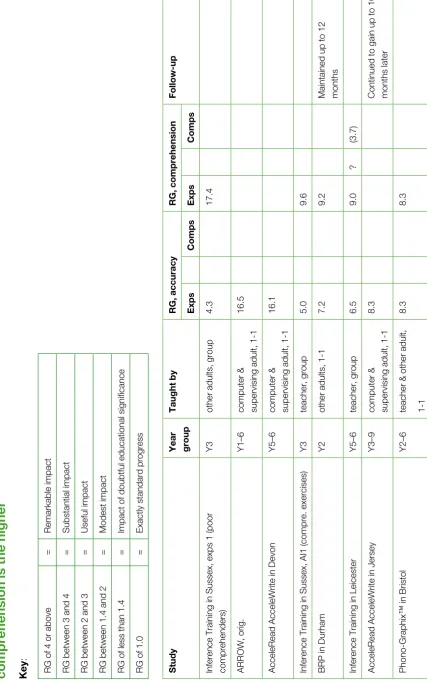
Both the 1998 report and the 2002 edition used the rule of thumb that ratio gains of 1.4 or more and effect sizes of 0.25 or more represent gains that are definitely more than standard progress, and therefore educationally significant. In this edition further distinctions have been drawn among interventions with an RG of more than 2.0 or an effect size of more than 0.50. This is because many schemes now produce impacts of this order or more – see Tables A6–14 in the Appendix.
Good impact – sufficient to at least double the standard rate of progress – can therefore be achieved, and it is reasonable to expect it.
2.15 Lasting benefits
summarised at the end of the Appendix, and may be condensed by saying that: in eight cases the children at least maintained the improvements, and
■
in nine cases the children made a further relative gain, but
■
in four cases the gains partly or wholly washed out.
■
No generalisations seemed reasonable about when gains might wash out or not, but the general picture is positive.
2.16 Conclusions
Ordinary teaching (‘no intervention’) does not enable children with literacy difficulties to catch up.
■
Implication: Although good classroom teaching is the bedrock of effective practice, most research suggests that children falling behind their peers need more help than the classroom normally provides. This help requires coordinated effort and training.
Schemes for secondary-age children are few, but several work well for reading.
■
Implication: Provided they receive continuing support, children who make these gains should be better able to cope with the secondary curriculum.
Schemes for children who struggle with spelling work best when highly structured.
■
Implication: Children with spelling problems need schemes tailored to their preferred ways of learning and delivered systematically ‘little and often’. Such schemes work particularly well for enabling children to grasp relatively regular patterns of spelling.
Work on phonological skills for reading should be embedded within a broad approach.
■
Implication: Phonic teaching should normally be accompanied by graphic representation and reading for meaning so that irregular as well as regular patterns can be grasped. Children with severe
difficulties in phonological skills or using English as an additional language may need more ‘stand alone’ phonics teaching to support their speaking and listening.
Children’s comprehension skills can be improved if directly targeted.
■
Implication: Engaging the child in exploring meaning embeds the relevance of reading for life, expands vocabulary and broadens the range of texts. Children falling behind their peers need both carefully structured reading material and rich, exciting texts.
Working on children’s self-esteem and reading in parallel has definite potential.
■
Implication: Building strong and trusting relationships between teacher and child is an essential prerequisite for accelerating learning. Schools need to provide a coherent network, using multi-agency support.
ICT approaches work best when they are precisely targeted.
■
Implication: The mediation of a skilled adult is essential to ensure technologically-driven schemes meet children’s needs. Time needs to be allocated effectively so that the diagnostic tools of programmes can be used for each child appropriately.
Large-scale schemes, though expensive, can give good value for money.
■
What works for pupils with literacy difficulties 00688-2007BKT-EN Primary and SecondaryNational Strategies © Greg Brooks and NFER 2007
32
Where reading partners are available and can be given appropriate training and support, partnership
■
approaches can be very effective.
Implication: Reading partners need skilled training and support to maximise impact. A school needs to manage partners so that feedback to classroom teachers is effectively and regularly given. Teaching and learning support assistants are well equipped to undertake this role.
Success with some children with the most severe problems is elusive, and this reinforces the need for
■
skilled, intensive, one-to-one intervention for these children.
Implication: The greater the problem, the more skilled the teacher needs to be. Children with special educational needs normally benefit from a highly-trained teacher working through an intensive and wide-ranging scheme using powerful ongoing diagnosis based on close observation.
Interventions longer than one term may produce proportionally further benefits but the gains need to be
■
carefully monitored.
Implication: If a scheme is not providing the required acceleration for a child, it is counter-productive to provide more of the same. Schools need to analyse the needs of individual children carefully and then match needs with the most appropriate intervention.
Good impact – sufficient to at least double the standard rate of progress – can be achieved, and it is
■
reasonable to expect it.
Implication: If the scheme matches the child’s needs, teachers and children should expect to achieve rapid improvement. High expectations are realistic expectations in most cases.
Most of the schemes which incorporated follow-up studies showed that the children maintained their
■
gains or even made further gains.
Chapter three
The schemes and their evaluations
This chapter describes the 48 schemes, in three sections: schemes targeting reading and/or spelling at primary level;
■
schemes targeting reading and/or spelling at secondary level;
■
the few studies of any intensity which have investigated how to improve writing all at primary level (there
■
were none at secondary level).
In both previous editions schemes which involve the use of ICT had their own section. Because of the increasing use of computer-based resources within otherwise paper-based schemes, schemes using ICT are now integrated into the reading and spelling sections.